
Why Hanging Plants Are the Smartest Greenery Choice for UK Homes
Hanging plants are the most spacae-efficient way to introduce greenery into any UK home. Unlike floor-standing plants, they occupy vertical space — the one dimension most British homes have in abundance. A well-placed hanging plant can make a room feel up to 30% larger, according to interior design research, while adding a living, breathing focal point at eye level.The numbers tell the story: the average UK household now spends over £306 per year on houseplants, and trailing, cascading varieties are the fastest-growing category in 2026.
From studio flats in Manchester to Victorian terraces in Bristol, hanging plants have become the go-to solution for gardeners who want impact without sacrificing floor space.
What this guide covers:
- The 15 best indoor hanging plants for UK homes — with lux ratings, watering schedules, trail lengths, and pet-safety flags
- Outdoor hanging basket plants for UK gardens, including a month-by-month planting calendar
- A room-by-room placement guide (including north-facing rooms, bathrooms, and rented flats)
- A complete care masterclass: watering, feeding, pruning, humidity, and winter protection
- How to hang plants without drilling — essential for the 40%+ of under-35s in the UK who rent
- A buyer’s guide to pots, hangers, liners, and compost
- The 2026 UK hanging plant trends identified by the RHS and leading plant retailers
Whether you are a total beginner, a renter who cannot drill walls, or an experienced gardener looking to fill a south-facing conservatory, this guide has your answer.
What Makes the Best Hanging Plants for UK Conditions?
A great hanging plant for UK homes combines shade-tolerance, trailing growth habit, forgiving watering needs, and the ability to cope with Britain’s low winter light and central-heating dryness. This section explains exactly what to look for — and why the UK context matters.
The 6 Criteria Used to Select These Plants
Every plant in this guide was assessed against six UK-specific criteria:
1. Adaptability to UK light levels. UK homes average just 200–800 lux indoors — far below the tropical origins of most popular trailing plants. The selected plants must cope with this reduced light, especially between November and February when daylight can fall to as few as 7.5 hours per day.
- 2. Trailing or cascading growth habit. Hanging plants are typically viewed from below or at eye level. Plants must produce foliage that looks attractive when hanging down — not just spreading outward as a floor plant would.
- 3. Forgiving watering needs. Hanging pots dry out 30–40% faster than floor pots because air circulates around all sides of the container. Selected plants must tolerate some inconsistency between waterings without collapse.
- 4. Manageable weight. Heavy plants stress ceiling hooks, brackets, and plasterboard. Lightweight root balls are preferred, particularly for rental properties where drilling is restricted.
- 5. UK temperature tolerance. UK homes range from approximately 15°C in unheated winter rooms to 24°C in south-facing summer rooms. Plants must handle this 9°C seasonal spread without specialist intervention.
- 6. Pet and child safety. Over 13 million UK households own pets. Toxicity is a critical filter for many buyers, which is why every plant in this guide carries a clear pet-safety flag.
Indoor vs. Outdoor Hanging Plants: Key Differences
| Factor | Indoor Hanging Plants |
| Light source | Indirect natural light, typically 200–800 lux in UK homes |
| Watering frequency | Every 7–14 days depending on species |
| Temperature range | 15–24°C (year-round stability) |
| Humidity | 30–40% in winter due to central heating (challenge for tropical species) |
| Season | Evergreen display year-round |
| Primary challenge | Low UK winter light; maintaining humidity without central heating |
| Factor | Outdoor Hanging Basket Plants |
| Light source | Full sun to partial shade; UV exposure |
| Watering frequency | Daily in July (2–3 litres per day for full-sun baskets) |
| Temperature range | –5°C (winter) to 30°C+ (summer heatwaves) |
| Humidity | Variable; UK rainfall generally adequate unless under an overhang |
| Season | Seasonal display — summer (May–October) or winter (November–April) |
| Primary challenge | Wind, frost, and rapid moisture loss in summer heat |
A Note on UK Light: Why It Changes Everything
UK light levels are the single most important factor when choosing hanging plants. A south-facing window in December may deliver less light than a north-facing window in June. Here is what that means in practice:
- 200–400 lux: Deep shade. Only the most tolerant plants survive (Pothos, Spider Plant, English Ivy, Heartleaf Philodendron).
- 400–800 lux: Low-medium light. Most indoor hanging plants thrive. Tradescantia, Scindapsus, and Prayer Plant all do well here.
- 800–1,500 lux: Bright indirect light. Hoya, Lipstick Plant, String of Hearts, and Monstera adansonii prefer this range.
- 1,500+ lux: Bright or direct light. Reserved for succulents: String of Pearls and Burro’s Tail require this level to survive.
If you are unsure of your room’s lux level, a free smartphone light-meter app (search ‘lux meter’ on iOS or Android) will give you an accurate reading in seconds.
The 15 Best Indoor Hanging Plants for UK Homes (2026)
Each plant below is assessed on light needs (in lux), watering schedule, maximum trail length, difficulty rating, and pet safety. A quick-reference comparison table follows all 15 entries.
- Pothos / Devil’s Ivy (Epipremnum aureum) Editor’s Pick
| Light | 200–1,500 lux (tolerates deep shade) |
| Water | Every 7–10 days (summer); every 14 days (winter) |
| Trail length | Up to 2–3 metres indoors |
| Difficulty | Beginner |
| Pet safe | Toxic to cats and dogs (calcium oxalate crystals) |
Pothos is the UK’s most recommended hanging houseplant because it is virtually indestructible in low winter light. Native to the Solomon Islands, it has adapted effortlessly to the dim conditions of British homes. Key varieties include Golden Pothos (chartreuse-splashed leaves), Marble Queen (requires 500+ lux for variegation), Neon Pothos (vivid lime-yellow), and Global Green (dark and mid-green marbling).
The plant droops noticeably when thirsty and bounces back within hours of watering — a built-in reminder system no other plant matches. Pothos can also grow in plain water, making it ideal for glass vases on shelves.
Pro tip: Rotate the pot 90° every two weeks to prevent one-sided growth toward the light source.
- Spider Plant (Chlorophytum comosum)
| Light | 300–1,000 lux |
| Water | Every 7–10 days |
| Trail length | 60–90 cm (plus hanging plantlets extending further) |
| Difficulty | Beginner |
| Pet safe | Non-toxic to cats, dogs, and children |
The Spider Plant has been a fixture of British homes for generations, and for good reason: it tolerates neglect, thrives in north-facing kitchens, and produces cascading ‘spiderettes’ — baby plantlets on long runners that hang freely below the mother plant. These spiderettes can be potted up for free propagation, making the Spider Plant one of the most economical plants you can own. The curly variety (Chlorophytum comosum ‘Bonnie’) creates a tighter, more dramatic hanging display than the standard flat-leaved form.
Ideal for households with cats and children, as it carries no toxicity risk.
Pro tip: Spiderettes root readily in water. Place them in a small glass of water on a sunny windowsill for two weeks before potting up into compost.
- String of Hearts (Ceropegia woodii)
| Light | 800–1,500 lux (east or west-facing windowsill ideal) |
| Water | Every 10–14 days (summer); every 3–4 weeks (winter) |
| Trail length | 1–2 metres |
| Difficulty | Beginner–Intermediate |
| Pet safe | Non-toxic to cats and dogs |
String of Hearts is one of the most photogenic hanging plants available in the UK. Its delicate heart-shaped leaves on thread-thin stems trail gracefully from any hanging pot, making it a favourite for Instagram-style shelfies and minimalist interiors. The plant stores water in small tubers along the stem, giving it excellent drought tolerance — ideal for busy households. For best results, use a compost mix of 50% standard multipurpose and 50% perlite (or a ready-made cactus mix) to prevent root rot.
A pink-tinged variety (‘Silver Glory’) and a variegated form are also widely available in UK garden centres.
Pro tip: To propagate, simply pin a section of stem against moist compost with a hairpin or bent paper clip. Roots form within 2–3 weeks.
- Tradescantia (Tradescantia zebrina / fluminensis) 2026 Trend
| Light | 400–1,500 lux |
| Water | Every 5–7 days (summer) |
| Trail length | 60–90 cm (grows 2–3 cm per week in summer) |
| Difficulty | Beginner |
| Pet safe | Mildly irritating to cats and dogs |
Tradescantia is experiencing a renaissance in 2026, increasingly trialled in sheltered outdoor spots across southern England — a trend noted by the RHS. Indoors, it remains one of the fastest-growing and most forgiving hanging plants available. The silver-purple zebrina variety is the most popular, though its vibrant colouring fades in low light — it needs at least 400 lux to maintain intensity. Pinch growing tips regularly to keep the plant bushy near the crown; without this, it can become leggy.
Tradescantia propagates effortlessly: snip a 10 cm section, strip the lower leaves, and place in water for 10–14 days before potting up.
Pro tip: If your Tradescantia starts looking sparse at the base, cut it back by one-third and it will regenerate within weeks.
- String of Pearls (Senecio rowleyanus)
| Light | 1,000–2,000 lux (bright, indirect — south or west-facing) |
| Water | Every 14 days (summer); every 4–6 weeks (winter) |
| Trail length | Up to 90 cm |
| Difficulty | Intermediate–Advanced |
| Pet safe | Toxic to cats and dogs |
String of Pearls is the statement plant of the hanging plant world: rows of perfectly round, pea-like bead leaves cascade from the pot in a display unlike anything else in the plant kingdom. However, it is also the plant most frequently killed by UK gardeners. The number-one mistake is overwatering. String of Pearls is a succulent, not a tropical plant — its round leaves store water, and root rot in UK homes is almost always caused by too much moisture, not too little.
Treat it more like a cactus than a fern: water sparingly, use a very free-draining compost (50% grit or perlite), and position on a south or west-facing windowsill away from radiators.
Pro tip: If your String of Pearls develops shrivelled, wrinkled beads, that indicates underwatering. Mushy or yellow beads indicate overwatering — the far more common UK problem.
- Boston Fern (Nephrolepis exaltata)
| Light | 200–800 lux (tolerates shade) |
| Water | Keep consistently moist; mist every 2–3 days |
| Trail length | 60–90 cm fronds arching outward |
| Difficulty | Intermediate |
| Pet safe | Non-toxic |
The Boston Fern produces the most dramatic hanging silhouette of any indoor plant: full, lush, arching fronds that evoke a Victorian greenhouse. It is the ideal UK bathroom hanging plant because post-shower humidity mimics its tropical native environment. The challenge in British homes is central heating, which drops winter indoor humidity to 30–40%; Boston Ferns prefer 50–70%.
Solutions include grouping it with other humidity-lovers, placing a pebble tray filled with water beneath the pot, or using a small room humidifier nearby. Despite its demands, the Boston Fern rewards attentive care with extraordinary visual impact.
Pro tip: Ferns hate dry, hot air. Move the plant away from radiators and south-facing windows in summer — it prefers cool, consistent humidity over warmth.
- Heartleaf Philodendron (Philodendron scandens / ‘Micans’)
| Light | 300–1,200 lux |
| Water | When top 2–3 cm of compost is dry |
| Trail length | 1.5–2 metres |
| Difficulty | Beginner |
| Pet safe | Toxic to cats and dogs |
The Heartleaf Philodendron is often described as the more elegant sibling of Pothos: it shares the same forgiving, low-light tolerance but produces softer, more genuinely heart-shaped leaves. The ‘Micans’ variety, with its velvety bronze-green leaves that shimmer in raking light, has become particularly sought-after in UK plant shops in 2025–26. Care is almost identical to Pothos: water when the top few centimetres of compost dry out, feed monthly in the growing season, and keep away from direct sun. The Heartleaf Philodendron can also be trained upward on a moss pole or allowed to trail freely, giving it unusual versatility.
Pro tip: The ‘Micans’ variety develops more vivid bronze colouring in brighter light. An east-facing windowsill gives it the best colour without risk of leaf scorch.
- Lipstick Plant (Aeschynanthus radicans) Flowering
| Light | 800–1,500 lux (bright indirect — east or west-facing) |
| Water | Every 7–10 days |
| Trail length | 45–60 cm |
| Difficulty | Intermediate |
| Pet safe | Non-toxic |
The Lipstick Plant is one of the very few hanging houseplants that provides real colour rather than just foliage. It produces vivid red tubular flowers that emerge from dark calyxes — hence the ‘lipstick’ name — typically in spring and summer. To encourage flowering, it needs good light (an east or west-facing UK window is ideal) and a slightly cool, dry rest period in winter when watering should be reduced.
It is an excellent choice for households with pets or children who need non-toxic options but still want a visually striking plant. The trailing stems can grow up to 60 cm, creating a full, dramatic hanging display when in flower.
Pro tip: Reduce watering and move to a slightly cooler spot (15–18°C) in November–January to encourage the spring flower display.
- Satin Pothos / Scindapsus (Scindapsus pictus ‘Exotica’)
| Light | 300–1,200 lux |
| Water | When top 2 cm of compost is dry |
| Trail length | 1–2 metres |
| Difficulty | Beginner |
| Pet safe | Toxic to cats and dogs |
Scindapsus is what designers reach for when they want the reliability of Pothos but with a more distinctive, contemporary look. Its large, heart-shaped leaves are covered in silver-grey markings on a deep green background, with a satiny, almost metallic sheen that photographs exceptionally well. Despite its luxurious appearance, it is just as forgiving as standard Pothos — tolerant of low light, irregular watering, and temperature fluctuations.
It looks particularly striking against dark-coloured feature walls or in rooms with Scandi or mid-century modern interiors. Unlike Pothos, it grows a little more slowly, which means less frequent trimming and repotting.
Pro tip: Scindapsus develops the most vivid silver patterning in bright indirect light (800–1,200 lux). In lower light, the silver fades to a more uniform green.
- English Ivy (Hedera helix)
| Light | 200–1,000 lux |
| Water | Every 7–10 days; allow to dry slightly between waterings |
| Trail length | Unlimited — a vigorous grower |
| Difficulty | Beginner |
| Pet safe | Toxic to cats, dogs, and humans if ingested |
English Ivy is a British garden classic that adapts brilliantly to indoor hanging life. Unlike most houseplants, it actually prefers cool UK room temperatures — it thrives below 20°C and struggles in warm, centrally heated rooms. This makes it perfect for draughty hallways, cool spare bedrooms, and north-facing living rooms. Variegated varieties such as ‘Gold Child’ and ‘Glacier’ create more visual interest but need slightly more light than all-green forms.
One important indoor caveat: Ivy is prone to spider mite infestations in dry indoor air. Ensure good air circulation around the plant and inspect the undersides of leaves regularly during winter.
Pro tip: Mist the leaves every 2–3 days in winter to deter spider mites, which thrive in dry, centrally heated rooms.
- Prayer Plant (Maranta leuconeura)
| Light | 500–1,000 lux (no direct sun — scorches easily) |
| Water | When compost surface is just dry; high humidity required |
| Trail length | 30–45 cm (more spreading than trailing) |
| Difficulty | Intermediate–Advanced |
| Pet safe | Non-toxic to cats and dogs |
The Prayer Plant is one of nature’s most theatrical houseplants: its leaves fold upright at night like praying hands and open flat again in daylight. The Herringbone variety (var. erythroneura) has vivid red veins on deep green leaves with purple undersides — visually spectacular and unlike anything else available in UK plant shops. It is, however, the most particular plant on this list: it dislikes tap water (brown tips result from fluoride and chlorine — use rainwater or filtered water) and needs consistently high humidity. Experienced growers who can meet its needs are rewarded with extraordinary foliage.
Pro tip: Leave tap water in an open container overnight before using it to water your Prayer Plant — this allows chlorine to dissipate and takes the edge off temperature shock.
- Staghorn Fern (Platycerium bifurcatum) Statement Plant
| Light | 800–1,500 lux (bright, indirect) |
| Water | Soak every 1–2 weeks; mist regularly |
| Trail length | Fronds can reach 60–90 cm |
| Difficulty | Advanced |
| Pet safe | Non-toxic |
The Staghorn Fern is the showstopper of the hanging plant world — a genuinely architectural specimen unlike any conventional potted plant. It is typically mounted on a piece of wood or bark rather than hung in a standard pot, creating a living wall art installation. The antler-shaped fronds (hence ‘staghorn’) can reach 60–90 cm and create an extraordinary focal point in hallways, stairwells, or large living rooms.
Watering requires the whole mount to be soaked in a bucket of water for 10–20 minutes every 1–2 weeks. This is a plant for confident, experienced plant parents who want something genuinely impressive as a feature piece.
Pro tip: The flat, brown, papery fronds at the base are normal — they are called shield fronds and protect the roots. Never remove them.
- Burro’s Tail / Donkey’s Tail (Sedum morganianum)
| Light | 1,500–3,000 lux (full sun to bright indirect — south-facing) |
| Water | Every 14–21 days (summer); monthly in winter |
| Trail length | Up to 90 cm |
| Difficulty | Beginner–Intermediate |
| Pet safe | Mildly toxic to cats and dogs |
Burro’s Tail is the definitive succulent hanging plant: plump, overlapping blue-green leaves packed tightly along cascading stems create a dense, almost sculptural display. It needs the sunniest spot in the house — a south-facing UK windowsill in summer is ideal. Like String of Pearls, it must be treated as a succulent rather than a tropical: very infrequent watering, free-draining gritty compost, and maximum available sunlight.
Handle with extreme care: the leaves detach at the lightest touch. However, any dislodged leaves can be placed on the surface of dry compost and will root readily within a few weeks.
Pro tip: Hang Burro’s Tail slightly back from the window glass in summer to avoid leaf scorch — the glass intensifies heat, which can damage the outermost leaves.
- Hoya / Wax Plant (Hoya carnosa)
| Light | 800–2,000 lux |
| Water | Every 10–14 days (allow to dry well between waterings) |
| Trail length | 1–2+ metres (slow but dramatic over time) |
| Difficulty | Beginner–Intermediate |
| Pet safe | Non-toxic to cats and dogs |
Hoya is a long-term investment plant: slow-growing, extremely long-lived, and capable of producing waxy, star-shaped flower clusters with a sweet honeyed scent in summer. A Hoya purchased today could still be thriving in 20 years. It is one of the most rewarding hanging plants for patient gardeners. The ‘Compacta’ or rope Hoya (H. carnosa ‘Compacta’) has tightly curled, twisted leaves that trail in uniquely fascinating spirals — a favourite in Scandi-style UK interiors. One important rule: do not repot unnecessarily.
Hoyas actually bloom better when slightly pot-bound, a rare example of a houseplant that rewards neglect.
Pro tip: Do not remove the bare flower stalks (spurs) after flowering — new flowers emerge from the same spur the following year.
- Monstera adansonii (Monstera adansonii (Swiss Cheese Vine)) 2026 Trend
| Light | 500–1,500 lux |
| Water | When top 3–4 cm dries; every 7–10 days in summer |
| Trail length | 1.5–3+ metres |
| Difficulty | Beginner |
| Pet safe | Toxic to cats and dogs |
Monstera adansonii delivers all the fenestrated leaf drama of its famous cousin, Monstera deliciosa, in a compact, trailing form. The distinctive holes (technically called fenestrations) develop as the plant matures, creating leaves that look like they have been punched through by a hole-punch in deliberate, artistic patterns. It is a fast grower in good conditions — dramatic results are achievable within a single UK growing season.An increasingly popular 2026 technique is to train the vines across a wall using discreet adhesive hooks, creating a living wall effect without any drilling. A genuinely versatile and rewarding plant for UK homes.
Pro tip: Fenestrations develop more readily in bright light (800–1,500 lux). In low light, the leaves remain smaller and less perforated — still attractive, but less dramatic.
Quick Reference Comparison Table: All 15 Plants at a Glance
| Plant | Light | Pet Safe | Difficulty | Max Trail |
| Pothos / Devil’s Ivy | Low–High (200–1,500 lux) | Toxic | Beginner | 2–3 m |
| Spider Plant | Low–Med (300–1,000 lux) | Safe | Beginner | 90 cm |
| String of Hearts | Med–High (800–1,500 lux) | Safe | Beginner–Int. | 1–2 m |
| Tradescantia | Low–High (400–1,500 lux) | Mild irritant | Beginner | 90 cm |
| String of Pearls | High (1,000–2,000 lux) | Toxic | Int.–Advanced | 90 cm |
| Boston Fern | Low–Med (200–800 lux) | Safe | Intermediate | 90 cm |
| Heartleaf Philodendron | Low–Med (300–1,200 lux) | Toxic | Beginner | 2 m |
| Lipstick Plant | Med–High (800–1,500 lux) | Safe | Intermediate | 60 cm |
| Scindapsus / Satin Pothos | Low–Med (300–1,200 lux) | Toxic | Beginner | 2 m |
| English Ivy | Low–Med (200–1,000 lux) | Toxic | Beginner | Unlimited |
| Prayer Plant | Med (500–1,000 lux) | Safe | Int.–Advanced | 45 cm |
| Staghorn Fern | Med–High (800–1,500 lux) | Safe | Advanced | 90 cm |
| Burro’s Tail | High (1,500–3,000 lux) | Mildly toxic | Beginner–Int. | 90 cm |
| Hoya / Wax Plant | Med–High (800–2,000 lux) | Safe | Beginner–Int. | 2 m+ |
| Monstera adansonii | Med–High (500–1,500 lux) | Toxic | Beginner | 3 m+ |
Best Outdoor Hanging Basket Plants for UK Gardens (2026)
Outdoor hanging baskets are a completely different discipline from indoor hanging plants. Basket plants face UV radiation, wind, heavy rain, and frost — requiring hardier, more resilient choices and a distinct seasonal approach.
Summer Hanging Basket Plants (May–October)
- Trailing Petunias. The UK’s best-selling basket plant. Deadhead weekly for continuous flowering. A full-sun basket in July can lose 2–3 litres of water per day — daily watering is non-negotiable. Available in dozens of colours and bicolours; Wave and Surfinia series are the most reliable varieties.
- Fuchsia. The classic British basket plant, shade-tolerant and available in trailing and upright forms. Deadhead spent blooms regularly. Hardy fuchsias can be overwintered in a frost-free garage; tender varieties must be brought inside or discarded.
- Lobelia. Low-growing and carpet-forming; perfect for basket edges. Available in blue, white, and pink. Combine with pelargonium and bacopa for a classic UK cottage-garden basket.
- Pelargonium (commonly called Geranium). Drought-tolerant once established and ideal for south-facing UK walls. Deadhead regularly. Can be overwintered in a frost-free spot and used again the following year.
- Bacopa. Delicate white or pink star-shaped flowers produced almost continuously. An excellent filler plant between larger specimens. Self-cleaning — no deadheading required.
- Dichondra ‘Silver Falls’. Unusual silver-leaved trailer with a waterfall-like habit. RHS Award of Garden Merit. Heat and drought tolerant — ideal for south-facing hot spots.
- Creeping Jenny (Lysimachia nummularia ‘Aurea’). Chartreuse-yellow foliage that trails beautifully. One of the best plants for shaded basket positions where flowering plants struggle.
Winter Hanging Basket Plants (November–March)
- Winter Pansies and Violas. The UK standard for winter baskets. Frost-hardy and cheerful. Plant September–October for a display lasting through to spring.
- Cyclamen. Elegant, frost-tolerant flowers in pink, red, and white. Choose outdoor varieties — indoor cyclamen will not survive UK winter conditions.
- Ivy (Hedera helix). The structural backbone of any winter basket. Evergreen, frost-hardy, and available in dozens of leaf shapes and variegations.
- Gaultheria. Bright berries in red or white provide winter interest and feed garden birds. Good for wildlife-friendly gardens.
- Ornamental Cabbage and Kale. Dramatic structural specimens with highly decorative foliage. Survives hard frosts and provides year-round architectural interest.
UK Hanging Basket Planting Calendar: Month-by-Month
| Month | Action |
| January–February | Plan; order seeds, plug plants, and hardware online |
| March | Start seeds indoors under grow lights if growing from seed |
| April | Buy plug plants; keep indoors or in a greenhouse until after last frost |
| Mid-May | Plant up summer baskets — last frost risk passes across most of the UK |
| June–September | Peak display; water daily (twice daily in heatwaves); feed weekly |
| October | Remove summer baskets after first hard frost; plant winter baskets |
| November–March | Maintain winter baskets; water twice weekly; no feeding needed |
Room-by-Room Hanging Plant Placement Guide
Different rooms in UK homes present very different conditions for hanging plants. This section matches the right plants to the right rooms — capturing the specific challenges of UK bathrooms, north-facing rooms, and rental flats.
Best Hanging Plants for Bathrooms (UK)
Definition: UK bathrooms are typically small, humid (post-shower steam), and have frosted or small windows providing 200–600 lux. This combination makes them ideal for shade-tolerant, humidity-loving plants.
- Best choices: Boston Fern, Pothos, Heartleaf Philodendron, Tradescantia
- Why they work: Post-shower steam mimics tropical humidity; shade tolerance suits typical UK bathroom window sizes
- Avoid: String of Pearls, Burro’s Tail, Lipstick Plant — all need high light and drier conditions
Best Hanging Plants for Kitchens (UK)
Definition: UK kitchens tend to have better natural light than other rooms, plus temperature fluctuations from cooking. This suits hardy, adaptable species.
- Best choices: Spider Plant, Pothos, English Ivy, Tradescantia
- Bonus option: Trailing herbs — cascade thyme, trailing rosemary, and tumbling oregano all make excellent edible hanging plants near sunny kitchen windows
- Practical tip: Avoid hanging plants directly above the hob where heat and steam from cooking concentrate
Best Hanging Plants for Bedrooms (UK)
Definition: Bedrooms are typically the darkest room in a UK home during the day. Calming, low-maintenance plants that require minimal daily attention are ideal.
- Best choices: String of Hearts, Hoya, Pothos, Scindapsus
- Biophilic design note: Research from the University of Exeter and others links indoor plants within eyeline to reduced anxiety and improved sleep quality — a benefit that is amplified when plants hang at eye level rather than on the floor
Best Hanging Plants for Living Rooms (UK)
Definition: Living rooms are typically the best-lit room in a UK home and the primary display space — ideal for statement or slower-growing decorative plants.
- Best choices: Monstera adansonii, String of Hearts, Lipstick Plant, Hoya
- Styling tip: Group three hangers at varying heights (e.g., 140 cm, 160 cm, and 180 cm from the floor) to create a ‘living wall’ cluster effect that transforms any wall into a focal point
Best Hanging Plants for North-Facing Rooms (UK)
Definition: North-facing UK rooms may receive under 200 lux in winter — the most challenging light condition for any houseplant.
- Best choices: Pothos (tolerates as low as 200 lux), Spider Plant, English Ivy, Heartleaf Philodendron
- Strictly avoid: String of Pearls, Burro’s Tail, Lipstick Plant, Tradescantia — all require significantly higher light levels
- Winter tip: Move pots as close to the window as possible in November–February; even a 30 cm difference can increase available lux by 15–20%
Best Hanging Plants for Rented Flats and Apartments (UK)
Definition: An estimated 40% of UK adults under 35 rent their home and cannot drill walls or ceilings. This section covers no-drill plant hanging solutions.
- No-drill hardware: Adhesive ceiling hooks (Command strips rated 2–4 kg), over-door hooks, tension rod systems across window frames, and furniture-mounted clamp brackets
- Best plants for renters: Lightweight Pothos in a small ceramic pot plus a macramé hanger should total under 2 kg — well within the rating of most adhesive hooks
- Rule of thumb: Always weigh the total hanging load — pot + compost + plant + water — before choosing hardware. A waterlogged basket weighs significantly more than a dry one
Hanging Plant Care Masterclass
This section covers every aspect of hanging plant care in the UK context: watering, feeding, pruning, humidity management, winter protection, and troubleshooting.
How to Water Hanging Plants (Without Making a Mess)
Hanging pots dry out 30–40% faster than floor pots because air circulates around all sides of the container. This is the most important difference to understand when moving from floor plants to hanging plants.
- The finger test: push your finger 3 cm into the compost. If it is dry at that depth, water the plant.
- Water in the morning so roots can absorb moisture before the cooler nighttime temperature drop.
- Direct the water into the compost, not over the leaves — root-level hydration prevents fungal issues.
- For difficult-to-reach baskets, use a long-spouted watering can or lower the basket, water thoroughly, and rehang.
- Water retention crystals added to compost at planting time reduce watering frequency by 25–30%.
- Full-sun outdoor baskets in July may need 2–3 litres of water per day — check daily during heatwaves.
How to Fertilise Hanging Plants
- Indoor plants: Feed monthly from April to September with a balanced liquid fertiliser at half the recommended strength. Stop all feeding from October to February.
- Outdoor summer baskets: Feed weekly with a high-potash fertiliser (tomato feed at half strength works perfectly and is economical).
- Slow-release granules: Incorporate at planting time to provide background nutrition for 3–6 months. Reduces the risk of nutrient starvation if you miss a liquid feed.
- Seaweed feed: An excellent organic supplement. Use monthly in combination with a balanced feed for improved root development and stress resistance.
- Winter rule: Stop all feeding from October to February. Winter feeding encourages soft, weak growth that is vulnerable to cold and disease.
How to Prune and Deadhead Hanging Plants
- Trim long, trailing vines by one-third to encourage bushy growth near the crown rather than a few long, bare stems.
- Deadhead outdoor basket flowers weekly — this prevents seed formation and redirects the plant’s energy into producing new blooms.
- Trailing petunias and fuchsias benefit most from regular deadheading; bacopa is self-cleaning and requires no deadheading.
- Cut back leggy indoor plants by up to one-third — they bounce back quickly, especially in the growing season (April–September).
Rotation: The Step Most UK Gardeners Skip
Trailing plants grow toward their light source. Without rotation, one side of the plant becomes lush while the side facing away from the window thins out over time.
- Rotate hanging pots 90° every two weeks. This takes approximately 10 seconds and makes a dramatic difference to even coverage.
- In UK winter (November–February), move pots closer to windows to compensate for shorter days and lower light intensity.
Humidity and UK Central Heating
| Factor | Details |
| UK indoor winter humidity | 30–40% (central heating effect) |
| Humidity-loving plants prefer | 50–70% relative humidity |
| Most affected plants | Boston Fern, Prayer Plant, Tradescantia |
| Solution 1: Grouping | Group humidity-loving plants together — they create a localised microclimate |
| Solution 2: Misting | Mist leaves every 2–3 days using a fine spray bottle |
| Solution 3: Pebble tray | Place pebbles in a tray of water beneath the pot; evaporation raises local humidity |
| Solution 4: Humidifier | A small room humidifier near plants is the most effective solution |
| Critical warning | Never position hanging plants directly above a radiator — dry heat damages foliage |
How to Protect Hanging Baskets Over Winter (UK)
- Bring tender outdoor basket plants indoors before the first frost — typically October across most of the UK.
- Hardy winter baskets (pansies, ivy, cyclamen) can remain outdoors but move to a sheltered spot during hard frosts.
- Check that brackets and hooks are rated for the weight of a waterlogged winter basket — significantly heavier after UK autumn rainfall.
- Do not use water-retaining gel in winter baskets — it causes waterlogging in the wet UK winter climate.
Common Problems and How to Fix Them
| Problem | Likely Cause | Fix |
| Yellow leaves | Overwatering or poor drainage | Allow compost to dry; check drainage holes are clear |
| Brown leaf tips | Low humidity or tap water minerals | Mist every 2–3 days; switch to rainwater or filtered water |
| Leggy, sparse growth | Insufficient light | Move closer to a window or rotate pot 90° every two weeks |
| Wilting despite watering | Compacted, dry compost shrinking from pot sides | Soak thoroughly twice in quick succession to rehydrate |
| Not flowering (outdoor) | Underfeeding or underwatering | Water daily; increase high-potash feed to weekly |
| Pale or faded variegation | Too little light | Move to a brighter spot — variegated leaves need more light |
How to Hang Plants in the UK — Drilling and No-Drill Options
There are multiple methods to hang plants in UK homes, from permanent drilled fixtures to renter-friendly no-trace adhesive solutions. This section covers every option.
How to Hang Plants Without Drilling (UK Renters’ Guide)
- Adhesive ceiling hooks: Command strips rated 2–4 kg are the most popular renter solution. Apply to clean, painted plasterboard following the manufacturer’s instructions. Weight limit: strictly observe the rating — pot, compost, plant, and water combined must stay within it.
- Over-door plant hangers: Hook over the top of a door frame with no installation required. Suitable for lightweight plants up to 1.5 kg.
- Tension rod systems: A tension rod fitted across a window frame can support a lightweight macramé hanger. No marks, no fixings.
- Furniture-mounted brackets: Clamp brackets attach to shelving units, bed frames, or wardrobes. Suitable for heavier pots when fitted correctly.
- Free-standing hanging stands: Floor-standing metal frames with height-adjustable hanging bars. No installation required; easily moved.
How to Drill for Hanging Plants in UK Ceilings
- Locate ceiling joists before drilling using a stud finder (available from any UK DIY store for under £15).
- UK plasterboard is typically 12.5 mm thick; ceiling joists are set at 400–600 mm centres.
- Use a minimum hook rating of 5 kg for a typical indoor hanging basket. For outdoor baskets, use 10 kg+ rated anchors when wet.
- Use swivel hooks to prevent the hanger twisting in wind or when rotating the pot.
- Recommended anchor brands for UK plasterboard: Hilti, Fischer, and Rawlplug all produce ceiling-rated toggle anchors.
The Shelf-Cascade Method (No Hardware Required)
Place a pot on a high shelf and allow vines to trail down naturally — this achieves the aesthetic of a hanging plant without any hooks, hooks or drilling. Best plants for this method: Pothos, Tradescantia, Scindapsus, and String of Hearts.
Pots, Hangers & Hardware Buyer’s Guide (UK 2026)
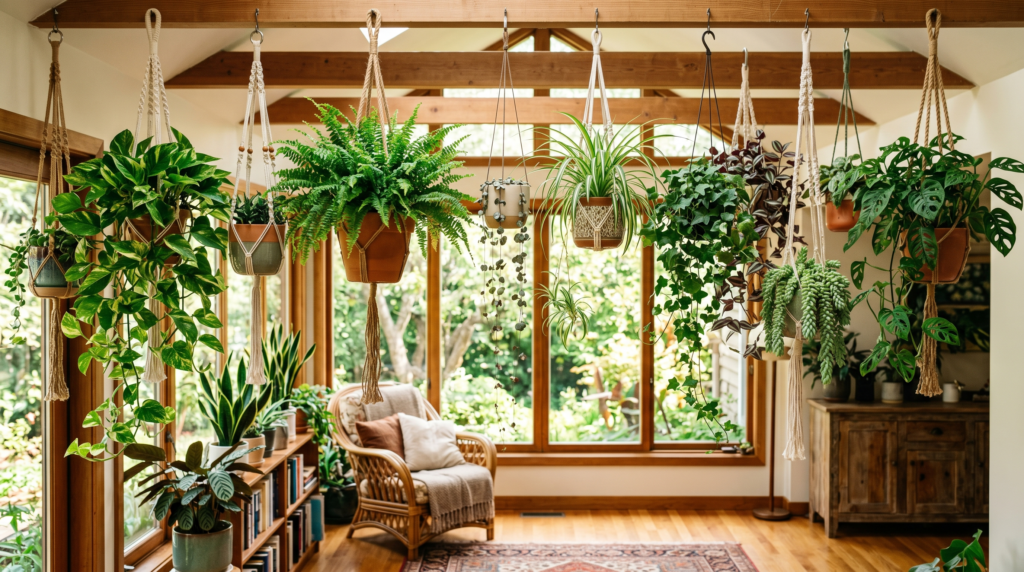
Types of Hanging Planters
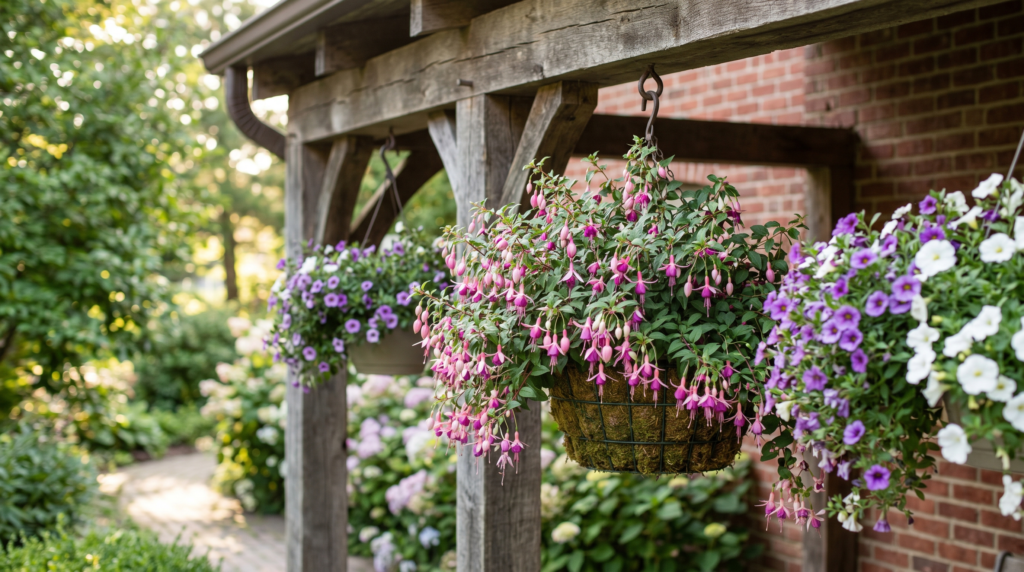
- Wire hanging baskets. The traditional outdoor style. Can be planted through the sides as well as the top for a full-ball planting effect. Must be lined before use (see liner comparison below).
- Plastic hanging pots. Lighter and more durable than terracotta. Self-watering options with a built-in water reservoir are available and reduce watering frequency by up to 50%.
- Macramé plant hangers. Natural cotton or jute rope in knotted designs — the dominant interior trend of 2023–26, suiting boho, Scandi, and mid-century interiors. Must be paired with a pot that has drainage holes.
- Ceramic hanging pots. Heavy but beautiful. Ensure ceiling hook and bracket are rated for the combined weight, particularly when watered.
- Self-watering hanging planters. The built-in reservoir reduces watering frequency by 40–50%. Particularly valuable for holiday periods.
What Size Hanging Basket for UK Gardens?
| Basket Size | Notes |
| 30 cm basket | Suitable for small balconies; limited plant choice; dries out quickly in summer — water twice daily in July |
| 35 cm basket | The sweet spot. Enough compost volume to sustain plants through summer with daily watering. Recommended for most UK gardens. |
| 40 cm+ basket | Maximum visual impact. Best for south-facing walls with unrestricted sun. Requires daily watering and weekly feeding in July–August. |
Liner Comparison: Which Is Best for UK Hanging Baskets?
| Liner Type | Water Retention | Appearance | Eco-Friendly? | Reusable? |
| Sphagnum Moss | Excellent | Natural, rustic | Yes | Yes |
| Coir (coconut fibre) | Good | Natural, neat | Yes | One season |
| Hessian | Moderate | Natural, flexible | Yes (biodegradable) | One season |
| Supamoss (synthetic) | Good | Uniform green | Synthetic | Yes (durable) |
| Plastic liner | Poor (needs holes) | Plain | No | Yes |
Best Compost for Hanging Baskets (UK)
- Base: Peat-free multipurpose compost — the RHS recommended baseline following the UK’s trajectory toward a full peat ban.
- Drainage: Add 20% perlite to improve drainage, reduce weight, and prevent waterlogging.
- Long-term plantings: Incorporate John Innes No. 2 (loam-based) for structure and to prevent compost shrinkage over time.
- Beginner option: Pre-mixed hanging basket compost already contains slow-release fertiliser and water-retaining crystals — ideal for first-time basket gardeners.
Pet-Safe and Child-Safe Hanging Plants for UK Homes
What is a pet-safe hanging plant? A pet-safe hanging plant is one confirmed non-toxic to cats and dogs by the ASPCA (American Society for the Prevention of Cruelty to Animals), the UK Veterinary Poisons Information Service, or equivalent authority. Toxicity matters because over 13 million UK households own pets, and trailing vines are particularly accessible to curious cats.
Hanging Plants Confirmed Safe for Cats and Dogs
- Spider Plant (Chlorophytum comosum)
- String of Hearts (Ceropegia woodii)
- Boston Fern (Nephrolepis exaltata)
- Prayer Plant (Maranta leuconeura)
- Lipstick Plant (Aeschynanthus radicans)
- Hoya / Wax Plant (Hoya carnosa)
- Staghorn Fern (Platycerium bifurcatum)
Hanging Plants to Avoid if You Have Pets
- Pothos (Epipremnum aureum). Contains calcium oxalate crystals. Causes oral irritation, drooling, and vomiting in cats and dogs.
- Heartleaf Philodendron. Same toxin mechanism as Pothos. Toxic to cats and dogs; keep strictly out of reach.
- English Ivy (Hedera helix). Toxic to cats, dogs, and humans if ingested. The berries are the most toxic part.
- String of Pearls (Senecio rowleyanus). Can cause drooling, vomiting, and lethargy in pets. Toxic to cats and dogs.
- Monstera adansonii. Contains calcium oxalate; toxic to pets. The same family as Pothos.
Safety Tips for Pet-Owning Plant Parents
- Hang toxic plants genuinely out of reach — cats will attempt to reach any plant if sufficiently motivated. 2 metres off the floor is a sensible minimum.
- Consider a glass-enclosed terrarium for high-risk toxic plants if you have persistent climbers.
UK Emergency Contact: Veterinary Poisons Information Service
If your pet has ingested a toxic plant, contact your vet immediately. The Veterinary Poisons Information Service (VPIS) is available to UK vets at: 0207 379 9775
Hanging Plant Trends UK 2026
The hanging plant category in the UK is evolving rapidly. These are the key trends identified by the RHS, major UK plant retailers, and interior design publications for 2026.
Tradescantia Goes Outdoor
Previously considered strictly a houseplant, Tradescantia is being trialled in sheltered outdoor spots across southern England. The RHS has noted this as a 2026 development, with warm, sheltered UK gardens successfully overwintering established plants. This mirrors the broader trend of UK gardeners pushing tropical species into outdoor settings as milder winters become more common.
Indoor–Outdoor Plant Migration
Moving tropical houseplants outside for the British summer (May–September) is gaining popularity as a technique to accelerate growth and improve plant health. Pothos, Philodendron, and Monstera all benefit from outdoor air circulation, higher light intensity, and natural humidity during warmer months. Bring plants back indoors before night temperatures drop below 15°C.
Edible Hanging Baskets
Tumbling tomatoes, hanging strawberries, trailing nasturtiums, and cascade peppers are all gaining popularity as the ‘grow-your-own’ movement intersects with vertical gardening. The RHS specifically highlighted edible hanging baskets at Chelsea 2025 as a key horticultural trend for 2026. Herb hangers — trailing rosemary, lemon thyme, and cascading oregano — combine beauty with genuine kitchen utility.
Biophilic Design and Hanging Plants at Eye Level
Biophilic design — the practice of incorporating natural elements into built environments — is moving from commercial spaces into UK homes. Hanging plants at eye level are increasingly recommended over floor-level plants because they are within constant eyeline and provide greater psychological impact. The 2026 interior design trend is three-tier hanging plant clusters creating vertical ‘living wall’ features in living rooms and hallways.
Sustainable and Eco-Friendly Baskets
- Peat-free compost is now mainstream in UK garden centres, driven by the UK’s peat ban trajectory.
- Biodegradable liners — hessian, coir — are replacing plastic in many UK basket plantings.
- Self-watering baskets with reservoirs are reducing water waste, particularly relevant in regions subject to hosepipe bans.
- Propagating from cuttings rather than buying new plants is growing as a sustainable and cost-effective approach
Smart Watering Systems for Hanging Baskets
Solar-powered drip irrigation systems designed specifically for hanging baskets (such as the Irrigatia range) are growing in popularity among UK gardeners. App-controlled watering systems can track soil moisture and deliver precise amounts of water on a schedule — particularly useful during the UK’s unpredictable summer heatwaves and for the 8.5 million UK allotment holders managing multiple baskets
Q: What are the best hanging plants for low light in the UK?
A: The best hanging plants for dark or north-facing UK rooms are Pothos (tolerates as low as 200 lux), Spider Plant (300–1,000 lux), Heartleaf Philodendron (300–1,200 lux), and English Ivy (200–1,000 lux). All four are beginner-friendly and cope with the reduced light typical of British winter conditions. Avoid String of Pearls and Burro’s Tail, both of which require 1,500+ lux to survive.
Q: When should I plant hanging baskets in the UK?
A: Plant summer hanging baskets from mid-May, after the last frost risk has passed across the UK. In sheltered spots in southern England, you may be safe from late April. Plant winter baskets in September–October using frost-hardy plants such as pansies, ivy, cyclamen, and violas. Summer baskets should be removed or replaced after the first hard frost, typically in October.
Q: How often should I water indoor hanging plants in the UK?
A: Most indoor hanging plants need watering every 7–14 days, depending on species and season. Use the finger test: push your finger 3 cm into the compost — water when dry at that depth. Hanging pots dry out 30–40% faster than floor pots. Outdoor summer baskets in full sun may need 2–3 litres of water per day in July. In winter, most indoor plants need watering every 14 days or less.
Q: Are hanging plants safe for cats and dogs?
A: Not all hanging plants are safe for pets. Safe options include Spider Plant, String of Hearts, Boston Fern, Hoya, Lipstick Plant, Prayer Plant, and Staghorn Fern. Toxic to cats and dogs: Pothos, Heartleaf Philodendron, English Ivy, String of Pearls, and Monstera adansonii. Always verify with the ASPCA toxicity database or your vet before introducing a new plant to a home with pets.
Q: How do I hang plants without drilling in the UK?
A: Use adhesive ceiling hooks rated for 2–4 kg (Command strips are widely available in UK DIY stores), over-door hooks, tension rods fitted across window frames, or furniture-mounted clamp brackets. Ensure the total weight of pot, compost, plant, and water stays within the hook’s load rating. The shelf-cascade method — placing a pot on a high shelf and allowing vines to trail down — requires no hardware at all.
Q: What are the best hanging plants for UK bathrooms?
A: The best hanging plants for UK bathrooms are Boston Fern, Pothos, Heartleaf Philodendron, and Tradescantia. All four thrive in the post-shower humidity typical of UK bathrooms and tolerate the lower light levels of frosted or small bathroom windows. Avoid succulents and high-light species in bathroom positions.
Q: How do I stop my hanging basket drying out so quickly?
A: Add water-retaining crystals to the compost at planting time — this reduces watering frequency by 25–30%. Choose a 35 cm or larger basket, as greater compost volume retains moisture more effectively. Water thoroughly twice in quick succession each session to ensure the compost is fully saturated. Consider a self-watering hanging planter with a built-in reservoir, which can halve the watering frequency for outdoor summer baskets.
Q: Can I grow hanging plants outdoors year-round in the UK?
A: Only hardy varieties can remain outdoors year-round in the UK. English Ivy, pansies, cyclamen, and violas overwinter successfully in most UK regions. Tender summer plants — fuchsia, petunias, lobelia, pelargonium — must be brought indoors before the first hard frost, typically October across most of the UK, or discarded and replaced the following spring.
Q: What is the easiest hanging plant for beginners in the UK?
A: Pothos (Devil’s Ivy) is the easiest hanging plant for UK beginners. It tolerates the UK’s low winter light (as little as 200 lux), forgives irregular watering, copes with temperature fluctuations, and grows vigorously in almost any indoor position. Spider Plant is the best beginner choice for households with pets or children, as it is non-toxic and equally forgiving.
Conclusion: Ready to Transform Your Space with Hanging Plants?
Hanging plants are the most space-efficient, visually impactful, and versatile way to add greenery to any UK home or garden — regardless of space, light level, or gardening experience. From the virtually indestructible Pothos in a north-facing flat to a full summer hanging basket blazing with petunias and fuchsia on a south-facing wall, there is a hanging plant for every situation, every budget, and every level of expertise.
Our top three beginner picks for 2026:
- 1. Pothos / Devil’s Ivy — the most forgiving indoor hanging plant available. Thrives in low UK light, recovers quickly from neglect, and trails dramatically up to 3 metres.
- 2. Spider Plant — the best choice for pet and child-safe households. Classic, cheerful, and completely non-toxic.
- 3. String of Hearts — the best-looking easy plant. Non-toxic, drought-tolerant, and produces one of the most distinctive trailing displays of any houseplant.
Save this guide, share it with a fellow plant lover, and explore the full range of ready-to-hang plants available from specialist UK plant retailer

Leave a Reply