
This guide goes deeper than any other UK resource. You’ll find UK-specific advice on hard water and fluoride damage (a very real problem in London and the South East), how to manage your dragon tree through the low-light UK winter, and exactly what to do when things go wrong.
Why UK Gardeners Love It
- Tolerates low winter light — including north-facing UK rooms
- Stays slender — ideal for UK flats and Victorian terraces
- Very slow-growing, so stays manageable for years
- Forgiving of missed waterings
- Extremely long-lived — decades with good care
- RHS Award of Garden Merit — proven UK performance
Honest Drawbacks
- Mildly toxic to cats and dogs
- UK tap water causes chronic leaf tip browning
- Dislikes cold draughts — a real issue in old UK homes
- Will not air-purify your room in any meaningful way
- Very slow growth can feel unrewarding at first
Quick Plant Profile
What Is Dracaena Marginata?
Origins & Botanical Background
Dracaena marginata is native to Madagascar, Mauritius and the surrounding Indian Ocean islands, where it grows in dry, rocky terrain. It belongs to the Asparagaceae family — the same family as common asparagus, though it looks nothing like it.
The genus name Dracaena derives from the ancient Greek drakaina, meaning “female dragon.” The common name “Dragon Tree” comes from its famous relative Dracaena draco, whose red resin is called “dragon’s blood.” Important: D. marginata does NOT produce this red resin — this is a very common misconception.
Its species name marginata means “margined” in Latin — a direct reference to the striking red/crimson margins that edge each leaf.
What Does It Look Like?
- Slender, woody stems with tufts of narrow, arching leaves at the tips
- Leaves are deep green with distinctive red/crimson margins — up to 40cm long
- As the plant matures, lower leaves naturally drop, revealing an elegant bare trunk with a palm-like silhouette
- In its native habitat it can grow over 3m tall; in UK homes, typically 150–200cm
- Rarely flowers indoors in the UK; in the wild produces tiny white/magenta flowers
Why Is It So Popular in the UK?
The dragon tree occupies a rare position: it is both genuinely easy to care for and genuinely attractive. Its slim silhouette suits UK Victorian terraced houses and modern flats alike. It tolerates the low light of British winters and the dry heat of central heating — conditions that kill many tropical houseplants.
Dracaena Marginata Varieties Available in the UK
| Variety | Leaf Description | RHS Award | UK Availability | Best For |
|---|---|---|---|---|
| D. marginata (standard) | Dark green, red-edged margins | Yes | Widely available | Beginners; all budgets |
| ‘Tricolor’ | Green, cream & crimson-edged — three distinct bands | Yes | Widely available | Beginners wanting more colour |
| ‘Colorama’ | Intense pink-red margins, yellow streak — very vivid | Yes | Good availability | Bold colour statements |
| ‘Magenta’ | Deep magenta-pink leaf margins — richer than standard | No | Moderate | Moody, dramatic interiors |
| ‘Tarzan’ | Thick, stiff, wide leaves — more structural and dramatic | No | Harder to find; pricier | Design-led spaces; collectors |
| ‘Bicolor’ | Two-tone green and red — subtler than ‘Colorama’ | No | Specialist nurseries | Muted, natural aesthetics |
Which Variety Should You Choose?
Beginners: Start with the standard D. marginata or ‘Tricolor’ — both hold RHS Awards and are widely available in budget-friendly sizes. Bold look: ‘Colorama’ makes a vivid statement. Dramatic architecture: ‘Tarzan’ has the most structural presence. Find rarer varieties at Patch Plants, Hortology, or UK Etsy plant sellers.
Dracaena Marginata Care Guide: UK Conditions
Light Requirements
Ideal: Bright, indirect light. A west or east-facing windowsill is perfect for most UK homes.
| Window Direction | Suitability | UK-Specific Note |
|---|---|---|
| East-facing | Excellent | Gentle morning light — ideal year-round |
| West-facing | Excellent | Warm afternoon light — excellent for colour |
| South-facing | Good with caution | Add a sheer blind or net curtain in summer to prevent scorch |
| North-facing | Tolerated | Very common in UK terraced houses. Plant copes but red colour fades and growth slows. Position as close to the window as possible. |
UK Winter Light Warning
November to February brings very low light levels across the UK. Move your dragon tree as close to the window as possible. If you have a particularly dark room, supplement with a dedicated grow light during these months. Signs that light is insufficient: loss of red colouring in leaves, leggy or sparse new growth.
Watering — The Most Common Mistake
Overwatering is the #1 Killer
Yellowing leaves are the first warning sign of overwatering. UK plant owners most commonly overwater in autumn and winter, when the plant is semi-dormant and barely drinking.
| Season | Watering Frequency | What to Check |
|---|---|---|
| Spring (Mar–May) | Every 10–14 days | Top 3–5cm dry before watering |
| Summer (Jun–Aug) | Every 7–14 days | More frequent in warm rooms; less in cooler ones |
| Autumn (Sep–Nov) | Every 2–3 weeks | Begin reducing as growth slows |
| Winter (Dec–Feb) | Every 3–4 weeks | Soil should be almost fully dry before watering |
Water Quality — The Critical UK-Specific Section
UK Hard Water Areas
London, South East England, East Anglia, East Midlands, Yorkshire. If you’re in these areas, tap water is the most likely cause of persistent brown tips. Switch water source first before changing anything else.
UK Soft Water Areas
Scotland, Wales, Northern Ireland, much of Northern England. Hard water is less of a concern here, though fluoride levels can still cause issues over time.
Solutions ranked by effectiveness:
- Collected rainwater — best option, free, and completely fluoride-free
- Filtered tap water — a basic jug filter reduces chlorine and some fluoride
- Tap water left to stand overnight — allows chlorine to dissipate; fluoride remains
- Distilled or reverse-osmosis water — most thorough; worth it for sensitive cultivars
Practical Tip for UK Owners
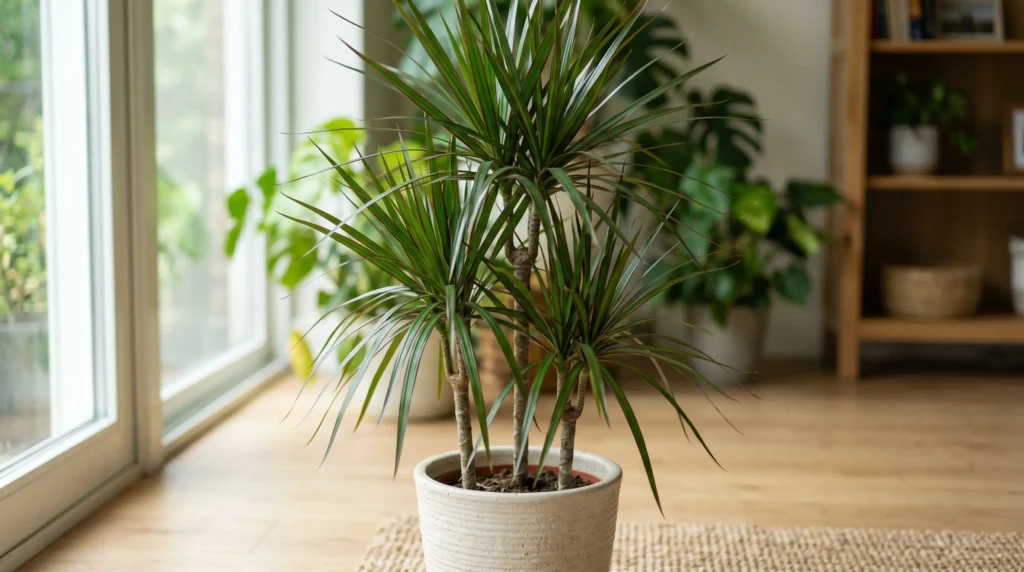
Switching to collected rainwater for 4–8 weeks can visibly reduce new tip browning. Already-damaged leaf tips will not recover — but new growth will come through clean. A simple water butt in the garden makes rainwater collection effortless.
Soil & Compost
- Needs well-draining, slightly acidic compost
- UK peat-free recommendation: Use a peat-free, loam-based compost (e.g. John Innes No. 2) mixed with perlite or horticultural grit — roughly 70% compost, 30% grit/perlite
- Avoid standard multipurpose compost alone — it retains too much moisture and compacts easily
- Add a layer of horticultural grit to the bottom of the pot to further improve drainage
Temperature & Humidity
- Optimal temperature: 18–30°C
- Minimum: Never allow below 15°C — a real risk in UK conservatories and draughty Victorian homes in winter
- Avoid: Cold draughts (open windows, letterboxes, old window frames), radiators, air conditioning units
UK Central Heating Problem
Central heating dramatically reduces indoor humidity in winter. Combat this by grouping plants together, placing the pot on a tray of damp gravel, light weekly misting (only in warm months), or using a small room humidifier. Dry air combined with fluoride-rich tap water is the most common cause of brown tips in UK homes.
Feeding
- Feed only from March to August — the active growing season
- Use a balanced liquid fertiliser (10-10-10 or 20-20-20) at half the recommended strength
- Frequency: every 4–6 weeks during the growing season
- Stop feeding entirely from September to February — feeding during dormancy causes salt build-up and root damage
- Signs of over-fertilising: white crust forming on soil surface, sudden leaf drop
Repotting
- Repot when roots visibly emerge from drainage holes — typically every 2–3 years
- Move to a pot only 2–3cm larger — “overpotting” leads to waterlogged compost
- Best time to repot: Spring (March–April), as new growth begins
- Use terracotta or ceramic pots with drainage holes; avoid decorative pots without drainage
- After repotting, water sparingly for 4 weeks while roots settle
How to Propagate Dracaena Marginata
Stem Cuttings in Water (Easiest — Recommended for Beginners)
Best UK timing: April to June, when longer daylight hours improve rooting success.
- Cut a healthy stem section roughly 8–15cm long, just above a node (a slight swelling on the stem). Use clean, sharp secateurs wiped with rubbing alcohol.
- Remove the lower third of leaves from the cutting, leaving a bare section of stem.
- Place the cutting in a jar of room-temperature water on a bright windowsill. Avoid direct sunlight.
- Change the water every 5–7 days to prevent stagnation and bacterial growth.
- Wait 4–8 weeks. Roots should appear, typically growing from the cut end and from nodes.
- Once roots are 3–5cm long, pot the cutting into moist, free-draining compost. Keep lightly moist for the first few weeks.
No Rooting Hormone Needed
Dragon trees root readily in water without any rooting hormone. Success rates are high when cuttings are taken in spring or early summer. Avoid propagating in winter — low UK light levels significantly reduce success rates.
Beheading (For Overgrown or Leggy Plants)
This method is ideal when your dragon tree has grown too tall for your space and lost its lower leaves.
- Cut the entire top section off, leaving 20–30cm of the main stem in the pot
- Plant the removed top directly into moist potting compost; place on a heat mat or in a propagator at 18–21°C
- The original bare stem will re-sprout from dormant nodes within 4–8 weeks — often producing 2–3 new shoots
- Keep remaining sections from the “beheaded” stem as additional cuttings
Air Layering (Advanced)
Air layering produces a large, established new plant directly on the parent stem before it’s removed.
- Wound the stem at your chosen point by removing a ring of bark or making two cuts
- Wrap the wounded area in damp sphagnum moss
- Cover the moss tightly in clear plastic film to retain moisture
- Roots will develop inside the moss over several weeks — visible through the plastic
- Once roots are well-developed, cut the stem just below the rooted section and pot up as a new plant
Pruning & Shaping Your Dragon Tree
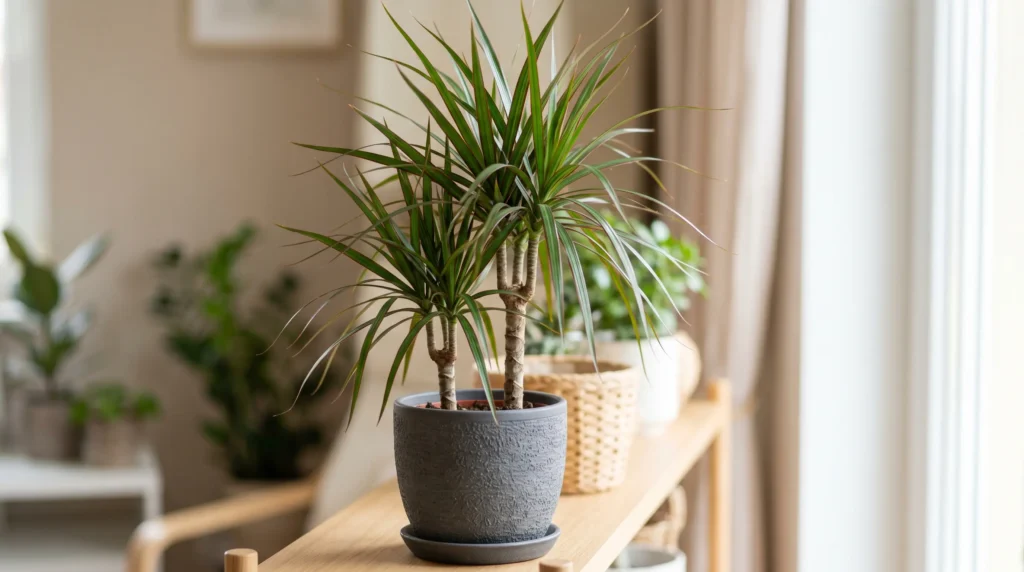
Best time to prune: Early spring (February–March), just before new growth begins. Pruning at this time maximises the energy available for re-sprouting.
How to Prune Step-by-Step
- Sterilise your secateurs or sharp scissors with rubbing alcohol to prevent infection.
- Cut the main stem at the desired height. You can cut at any point — the plant will re-sprout regardless.
- New branches (typically 1–3) will emerge from just below the cut point within 4–8 weeks.
- Remove individual yellowing or brown leaves by pulling them downward firmly — they should detach cleanly from the stem.
- Save any healthy stem cuttings for propagation (see Section 4).
After Pruning
Reduce watering slightly and hold off fertilising for 6 weeks while the plant recovers from pruning. A small amount of clear sap at the cut point is completely normal. Do not apply wound sealant — it is unnecessary for this species.
Common Problems, Pests & Troubleshooting
| Symptom | Most Likely Cause(s) | UK-Specific Context | Fix |
|---|---|---|---|
| Brown crispy leaf tips | Fluoride/chlorine in tap water; low humidity | Very common in London & SE England hard water zones | Switch to rainwater or filtered water; raise humidity |
| Yellowing lower leaves | Overwatering | Especially common in dark UK winters when growth has stopped | Reduce watering frequency; check drainage is not blocked |
| Yellowing all over | Root rot from prolonged overwatering | — | Remove from pot, trim any rotten roots, repot in fresh compost |
| Brown patches on leaves | Direct sunlight scorch | South-facing UK windows in summer — very common | Move away from direct sun; add a sheer blind |
| Pale, bleached leaves | Too much bright direct sun | — | Filter light or relocate to indirect light |
| Loss of red colouring | Insufficient light | North-facing UK rooms — very common in winter | Move closer to window; consider a grow light November–February |
| Leggy, sparse growth | Too little light | — | Move to a brighter indirect light position |
| Sudden leaf drop | Cold draught or temperature shock | UK winters, draughty old houses, near open windows | Move away from windows and exterior doors; check minimum 15°C |
| White crust on soil surface | Salt build-up from hard tap water or over-fertilising | UK hard water areas; most visible in clay pots | Flush soil with filtered water; reduce or stop fertiliser |
| Drooping leaves | Underwatering OR root rot | — | Check soil moisture: dry = water; wet = check roots for rot |
| Mushy stem at base | Advanced root rot | — | Emergency repot; remove all soggy compost; may need propagation rescue |
Common Pests
| Pest | Signs | UK Context | Treatment |
|---|---|---|---|
| Spider Mites | Tiny dots on leaves, fine webbing on undersides | Thrive in the dry air created by UK central heating | Increase humidity; wipe leaves with damp cloth; neem oil spray |
| Mealybugs | White fluffy deposits in leaf axils and joints | Common year-round indoors | Wipe with rubbing alcohol on cotton bud; neem oil spray |
| Scale Insects | Brown, waxy bumps on stems | — | Scrape off manually; treat with horticultural soap |
| Fungus Gnats | Tiny flies around the soil surface | Common in UK winter when soil stays damp longer | Allow soil to dry more between waterings; yellow sticky traps |
| Thrips | Silvery streaks or stippling on leaves | — | Yellow sticky traps; neem oil spray |
Best Pest Prevention
Wipe leaves monthly with a damp cloth — this removes dust, improves photosynthesis, and lets you spot early pest problems before they escalate. Inspect any new plants before placing them near your dragon tree.
Air Purification: The Honest UK Guide
NASA’s 1989 Clean Air Study found Dracaena marginata was effective at removing benzene and trichloroethylene from air in sealed, controlled environments. This finding was widely reported and became a major selling point for the plant.
However, a 2014 review published in the journal HortScience found that the air exchange rate in normal buildings means you would need approximately 10–1,000 plants per square metre to match what standard ventilation already achieves naturally.
Practical conclusion for UK buyers: Do not purchase a dragon tree primarily for air purification — the effect in a normal UK home with standard ventilation is negligible. It does, however, contribute to wellbeing in other measurable ways: it improves local humidity slightly through transpiration, provides the documented psychological benefits of biophilic design (living with plants), and is simply beautiful to look at.
The Real Reasons to Buy One
Buy a Dracaena marginata because it is genuinely easy to care for, genuinely beautiful, and genuinely long-lived — not because it will clean your air. Honest expectation-setting is why experienced UK plant owners keep coming back to this species decade after decade.
Is Dracaena Marginata Safe? Toxicity Guide for UK Pet & Family Owners
| Affected Animal/Person | Risk Level | Symptoms if Ingested | Action |
|---|---|---|---|
| Cats | Moderate | Vomiting, excessive drooling, dilated pupils, loss of appetite | Contact vet immediately |
| Dogs | Mild–Moderate | Vomiting, drooling, weakness | Contact vet if symptoms appear |
| Young children | Mild | Stomach upset, nausea | Seek medical advice if ingested |
UK Emergency Contact
If your pet eats any part of a dragon tree, contact your vet immediately or call the Animal Poison Line (UK): 01202 509000. This is a 24-hour service staffed by veterinary toxicologists.
Safe Placement Tips for UK Pet Owners
- Hang from ceiling hooks out of reach of cats (who can jump onto most surfaces)
- Place on a tall, stable plant stand that dogs cannot reach
- Choose a heavy, wide-base pot that cannot be knocked over
Pet-Safe Alternatives
If you share your home with cats or dogs and want a large, statement houseplant, consider: Spider plant (Chlorophytum comosum), Boston fern (Nephrolepis exaltata), Areca palm (Dypsis lutescens), or Calathea species — all non-toxic and available at UK garden centres.
UK Seasonal Care Calendar
Styling Dracaena Marginata in UK Homes
| Room | Suitability | Notes |
|---|---|---|
| Living room | Excellent | Statement floor plant beside a west or east-facing window. Pairs with mid-century modern, Scandi, or boho interiors. |
| Hallway | Excellent | One of the few plants suited to UK hallway widths. Its vertical form won’t block movement. |
| Home office | Excellent | Low maintenance; improves biophilic feel of WFH spaces without demanding attention. |
| Bathroom | Good | Benefits from humidity. Ensure there’s adequate indirect light — bathrooms are often dark in UK terraces. |
| Bedroom | Good | Fine in bedrooms — plants do not meaningfully deplete bedroom oxygen overnight. A common myth. |
| North-facing rooms | Tolerated | Place as close to the window as possible. Red leaf colour will fade, but the plant will survive. |
Pot Styling for UK Homes
- Terracotta: Excellent drainage, suits boho or earthy aesthetics — very popular in UK cottage-style interiors
- White ceramic: Clean and minimal — suits modern UK flats and Scandi-inspired rooms
- Rattan basket over nursery pot: A popular current UK trend — warm, textural, easy to swap out
- Avoid black pots in south-facing rooms — they absorb heat and can damage roots in summer
Grouping Tip
Dragon trees look stunning grouped with other tropical plants (Monstera, Calathea, Bird of Paradise). Beyond aesthetics, grouping plants together creates a shared humidity microclimate that benefits all the plants — particularly important in the dry air of UK centrally-heated rooms.
Where to Buy Dracaena Marginata in the UK
Online Specialists
Patch Plants, Hortology, Happy Houseplants, The Little Botanical, Bloom & Wild. Best selection; plants shipped with care packaging.
High Street & Garden Centres
B&Q, Dobbies, Homebase, and local independents. Good for inspecting plants before purchase.
Budget Options
IKEA (widely stocked year-round), Aldi and Lidl (seasonal houseplant events — watch for announcements).
Rare Varieties
Etsy (search UK sellers only), specialist online nurseries. Best source for ‘Tarzan’, ‘Bicolor’, and uncommon cultivars.
What to Look for When Buying
- Healthy, unmarked leaves with no signs of browning or yellowing
- Firm, upright stems — avoid floppy or mushy-feeling stems
- Check under leaves for pests (white fluff, tiny dots, brown bumps) before bringing the plant home
- Transport tip (cold weather): Wrap the plant in newspaper or place in a large carrier bag when transporting in autumn or winter — even brief cold exposure below 12°C can shock the plant
Frequently Asked Questions
Structured answers to the most common dragon tree questions from UK plant owners.
ConclusionThe Dragon Tree in a UK Home: A Genuinely Long-Term Companion
Dracaena marginata is one of the few houseplants that genuinely earns the word “easy.” It tolerates the low light of a British November, survives a missed watering (or three), and grows slowly enough to stay manageable in a UK flat for years without demanding a repot. Its RHS Award of Garden Merit is not an accident — it is a plant proven to perform in UK conditions.
The two things that trip up most UK owners are both preventable: overwatering in winter, and using fluoride-rich tap water year-round. Switch to collected rainwater and adjust your watering schedule with the seasons, and you will largely sidestep the problems that send other owners back to Google.
If you have cats or dogs, keep it out of reach or choose a pet-safe alternative. If you’re in London or the South East, get a water butt. Beyond those two points, this is a plant that largely looks after itself — which is exactly why it has been a fixture in UK homes for over 60 years.
🇬🇧 Your UK Dragon Tree Checklist
Bright, indirect light — east or west window preferred
Water every 1–2 weeks in summer; every 3–4 weeks in winter
Use rainwater or filtered water in hard water areas
Feed March–August only, at half strength
Keep above 15°C — away from draughts and radiators
Keep out of reach of cats, dogs, and young children

Leave a Reply