
What Is Satin Pothos?
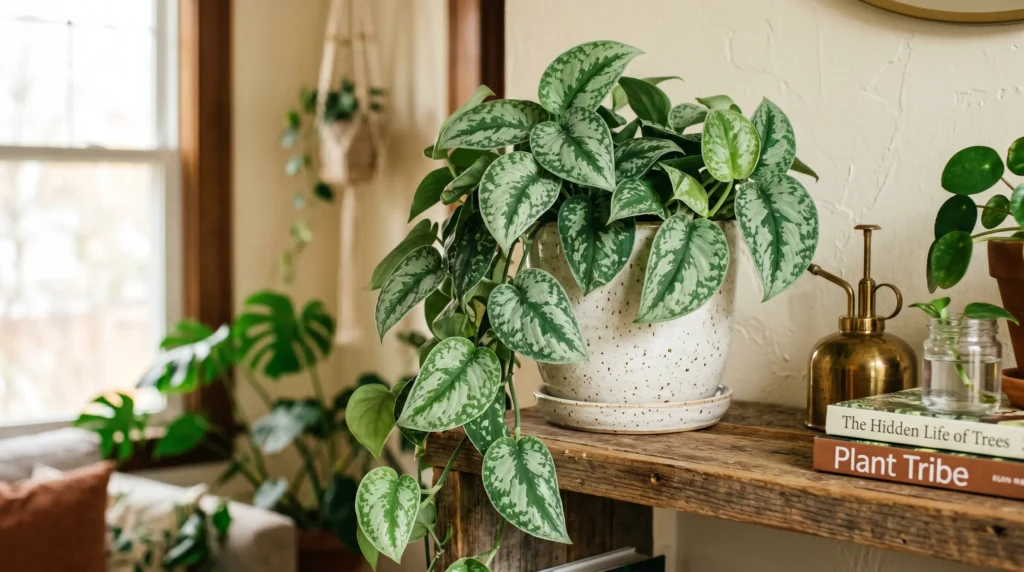
Satin Pothos (Scindapsus pictus) is a trailing houseplant native to Southeast Asia, known for its velvety, heart-shaped dark green leaves splashed with silvery-grey markings.
Despite its common name, Satin Pothos is not a true Pothos. It belongs to the genus Scindapsus, not Epipremnum. It is one of the best houseplants for UK homes because it:
- Tolerates low light levels typical of UK winters (October–February)
- Thrives at standard UK living room temperatures (18–24°C)
- Requires only moderate watering — more drought-tolerant than true Pothos
- Is widely available at UK garden centres, supermarkets, and online retailers
Pronunciation: Scindapsus pictus = “Sin-Dap-Sis Pik-TUS”
What does “pictus” mean? The Latin word pictus means “painted” — a reference to the silver variegation that appears hand-painted across the leaves.
At-a-Glance Care Card
| Care Factor | Requirement | UK Note |
| Light | Bright, indirect | Tolerates low light; variegation fades in dim conditions |
| Watering | When top 2.5cm of soil is dry | Reduce significantly in winter |
| Humidity | 40–60% | UK central heating drops humidity to ~30%; use a humidifier |
| Temperature | 18–24°C | Keep away from cold draughts and windowsills in winter |
| Soil | Well-draining, aerated mix | Add perlite to standard UK potting compost |
| Fertiliser | Every 2–4 weeks (March–September only) | Do not feed October–February |
| Toxicity | Toxic to cats, dogs, and humans | Keep out of reach of pets and children |
| Difficulty | Easy — beginner-friendly | One of the most forgiving houseplants for UK homes |
| RHS Award | Yes (Argyraeus cultivar) | RHS Award of Garden Merit holder |
Table of Contents
- What Is Satin Pothos? Plant Identity & Basics
- Botanical Profile & Natural Habitat
- All Satin Pothos Varieties — UK Collector’s Guide
- Satin Pothos Care Guide — UK Climate Adapted
- 4a. Light Requirements
- 4b. Watering — UK Seasonal Approach
- 4c. Humidity — The UK Central Heating Problem
- 4d. Temperature
- 4e. Soil & Potting Mix
- 4f. Fertilising
- 4g. Repotting
- Training, Styling & Display in UK Homes
- How to Propagate Satin Pothos — Step-by-Step UK Guide
- Pests & Diseases — UK-Specific Problems
- Common Problems Diagnostic Guide
- Is Satin Pothos Toxic? Pets & Children (UK)
- Where to Buy Satin Pothos in the UK
- Satin Pothos vs Similar Plants — UK Comparison
- UK Seasonal Care Calendar
- Frequently Asked Questions
What Is Satin Pothos? Plant Identity & Basics
Satin Pothos is the common name for Scindapsus pictus, a tropical vining plant in the family Araceae. It is native to Southeast Asian rainforests and is widely grown as a houseplant in UK homes for its silver-variegated foliage and low-maintenance care requirements.
Why “Satin Pothos” Is a Misnomer
Satin Pothos is not a true Pothos. True Pothos plants belong to the genus Epipremnum (such as Epipremnum aureum, the Golden Pothos). Satin Pothos belongs to the separate genus Scindapsus — the two are cousins within the Araceae family, not the same plant. This naming confusion is widespread in UK garden centres and supermarkets.
Other common names for Satin Pothos in the UK:
- Silver Pothos
- Silver Vine
- Silk Pothos
- Silver Philodendron (also incorrect — it is not a Philodendron)
- Silver Cloud
Why Satin Pothos Is Ideal for UK Homes
- Low-light tolerance: Survives the dim conditions of UK winters (October–February)
- Temperature compatibility: Thrives at 18–22°C — standard UK living room temperature
- Slower growth: Requires less frequent pruning than true Pothos
- Visual appeal: Unique satin-textured, silver-marked leaves — more striking than Golden Pothos
- Wide availability: Sold at IKEA, B&Q, Tesco, Dobbies, and specialist online retailers
Botanical Profile & Natural Habitat
Scindapsus pictus is an evergreen climbing vine (liana) native to the tropical rainforests of Southeast Asia. Understanding its natural habitat directly explains the care conditions it needs indoors.
“Scindapsus pictus is an evergreen climbing vine native to the tropical rainforests of Southeast Asia, classified within the family Araceae.”
Native Range
Satin Pothos is native to: Bangladesh, Thailand, Philippines, Malaysia (Peninsular and Borneo), Sumatra and Java (Indonesia), India, Taiwan, and Sulawesi. It has also naturalised in parts of Northern Australia.
In the wild, it grows in tropical rainforest understorey — climbing tree trunks toward filtered light beneath the forest canopy.
Wild Growth vs. UK Indoor Growth
| Factor | In the Wild | In a UK Home |
| Growth habit | Climbs trees using sticky aerial roots | Trails downward or climbs a moss pole |
| Humidity | 60–80% | 30–40% in heated homes |
| Light | Bright, dappled, filtered | Near a window with indirect light |
| Rooting surface | Bark and moss | Standard potting compost in a pot |
| Mature length | Up to 3 metres | Typically 60–120cm |
| Leaf size | Very large, lobed (mature form) | Small, heart-shaped, 5–10cm (juvenile form) |
Plant Family Context
Satin Pothos belongs to the Araceae family — the same family as:
- Monstera (Monstera deliciosa)
- Philodendrons
- Peace Lily (Spathiphyllum)
- ZZ Plant (Zamioculcas zamiifolia)
Its closest relatives in cultivation are Epipremnum aureum (Golden Pothos) and Scindapsus treubii (Moonlight Pothos).
What Are Aerial Roots?
Aerial roots are small, sticky roots that grow along the stems of Satin Pothos. In nature, they grip tree trunks and absorb atmospheric moisture. Indoors, they allow the plant to attach to a moss pole and absorb ambient humidity.
Do not remove aerial roots. They support climbing and growth. Avoid misting leaves directly, as aerial roots at the stem can absorb this water and cause overwatering at the stem level.
Does Satin Pothos Flower Indoors?
No. Satin Pothos almost never flowers indoors in the UK. It requires specific seasonal triggers and high light levels to produce its small Araceae-type flower spike (spadix). These conditions cannot be replicated in a UK home. This does not affect plant health — the foliage is the ornamental feature.
All Satin Pothos Varieties — UK Collector’s Guide
Scindapsus pictus has multiple cultivars, each distinguished by the amount, placement, and intensity of silver variegation on the leaves. The most commonly sold variety in the UK is ‘Argyraeus’.
Common UK Varieties
Scindapsus pictus ‘Argyraeus’
The most widely available Satin Pothos in the UK.
- Appearance: Small pine-green leaves (5–8cm) with scattered silver spots and a thin silver leaf-edge outline
- RHS Award: Holds the RHS Award of Garden Merit — the only Scindapsus pictus cultivar with this distinction
- UK availability: Very common — IKEA, B&Q, Tesco, Patch Plants, most garden centres
- UK price: £5–£20
- Best for: Beginners, hanging baskets, shelves
Scindapsus pictus ‘Exotica’
The best Satin Pothos variety for a statement climbing display.
- Appearance: Large leaves (up to plate-sized when climbing), predominantly silver with teal-green blotches; leaves fold slightly at the edges
- Key difference from Argyraeus: Leaves can be double the size; silver coverage is far more extensive
- UK availability: ★★★☆☆ Moderate — Hortology, Patch Plants, specialist plant shops
- UK price: £10–£25
- Best for: Statement climbing plant on a moss pole
Scindapsus pictus ‘Silvery Ann’
The most heavily variegated commonly available Satin Pothos.
- Appearance: Same leaf shape as Argyraeus, but 50%+ of each leaf is white or silver; the outer edge is fully silver/white
- UK availability: ★★★☆☆ Moderate — specialist online retailers, Etsy UK
- UK price: £10–£20
- Best for: Collectors wanting maximum visual impact
Scindapsus pictus ‘Silver Splash’ (Shimmering Falls™)
- Appearance: Large leaves with dappled, subtle silver variegation — the silver “fades” into the green rather than contrasting sharply
- Key difference from Exotica: Softer, less defined variegation; more muted silver tones
- UK availability: ★★★☆☆ Moderate — specialist retailers
- UK price: £12–£22
Rare UK Varieties (Collector Tier)
| Variety | Appearance | UK Availability | UK Price |
| Silver Hero | Almost fully silver leaves; matte, sparkly grey-silver tone; large leaves | Rare — Etsy UK, plant swap groups | £20–£50+ |
| Silver Lady | Medium-large leaves; camouflage-like even distribution of silver and dark green | Very rare | £25–£60 |
| Jade Satin | No silver markings; fully jade-green leaves; slight sheen; thicker than true Pothos | Very rare | £30–£80+ |
Collector note on Jade Satin: Extremely slow-growing, no variegation, but highly sought after for its unique jade-green foliage and thick leaf texture. Occasional Etsy UK listings; plant swap events.
Variety Comparison Table
| Variety | Leaf Size | Silver Coverage | UK Availability | Price (UK) |
| Argyraeus | Small (5–8cm) | Low (silver spots) | Very common | £5–£20 |
| Exotica | Large (10–20cm+) | High (predominantly silver) | Moderate | £10–£25 |
| Silvery Ann | Small–Medium | Very high (50%+ silver) | Moderate | £10–£20 |
| Silver Splash | Large | Medium (dappled) | Moderate | £12–£22 |
| Silver Hero | Large | Extreme (almost fully silver) | Rare | £20–£50 |
| Silver Lady | Medium–Large | Medium (camouflage) | Very rare | £25–£60 |
| Jade Satin | Medium–Large | None (fully green) | Very rare | £30–£80+ |
Satin Pothos Care Guide — UK Climate Adapted
Key principle for UK growers: Satin Pothos care in the UK is primarily about managing two seasonal challenges: low light in autumn and winter (October–February) and dry air from central heating (October–April). Address these two factors and the plant will thrive.
Light Requirements
Satin Pothos requires bright, indirect light to maintain healthy growth and vivid silver variegation. It tolerates medium and lower light, but variegation will fade and growth will slow significantly in dim conditions.
Best Light Conditions by Window Direction (UK)
| Window Direction | Suitability | Notes |
| East-facing | Excellent | Morning sun, afternoon shade — ideal year-round |
| West-facing | Very good | Afternoon sun — use a sheer curtain in summer |
| South-facing | Good with care | Intense summer sun can scorch; use sheer curtain or distance from glass |
| North-facing | Tolerable | Plant will survive but variegation will fade; growth very slow in winter |
Why Variegation Fades — The Science
The silver markings on Satin Pothos leaves form inside specialised cells called iridoplasts, which only develop when new leaves grow in bright light. In dim conditions, new leaves emerge plain green.
Important: Once variegation fades on existing leaves, it never returns. However, new leaves will display full silver markings once the plant receives more light.
UK Winter Light — What to Do
The problem: UK daylight drops to 7–8 hours per day in December and January, often heavily overcast — insufficient to maintain silver variegation.
Solutions:
- Move the plant 30–50cm closer to the window from October to February
- Place on a windowsill (but keep leaves from touching cold glass)
- Add a supplemental full-spectrum LED grow light — position 30–45cm above the plant, on for 12–14 hours per day
- UK options: Sansi, Barrina, and Mosthink LED grow lights (Amazon UK, £15–£40)
Watering — UK Seasonal Approach
Satin Pothos should be watered when the top 2.5cm (1 inch) of soil is dry. It is more drought-tolerant than true Pothos due to its thicker, waxier leaves. When in doubt, wait longer before watering.
UK Seasonal Watering Schedule
| Season | Watering Frequency | Soil Dryness Before Watering |
| Spring (Mar–May) | Every 7–10 days | Top 2.5cm dry |
| Summer (Jun–Aug) | Every 6–8 days | Top 2.5cm dry |
| Autumn (Sep–Nov) | Every 10–14 days | Top 2.5cm dry |
| Winter (Dec–Feb) | Every 14–21 days | Top 4–5cm dry |
Key Watering Rules
- Always check the soil before watering — never water on a fixed schedule without checking
- Use room-temperature water — cold tap water in winter can shock the roots
- UK tap water note: UK tap water is often hard (especially London, the Midlands, and the South East). Use collected rainwater, leave tap water to stand overnight to off-gas chlorine, or use filtered water for long-term plant health
- Water deeply: Pour slowly until water flows from the drainage holes, then empty the saucer after 15 minutes
- Never leave standing in water — this is the single most common cause of root rot in UK homes during winter
Overwatering vs. Underwatering — How to Tell
| Symptom | Overwatering | Underwatering |
| Leaf colour | Yellow leaves | Pale, dull green |
| Leaf texture | Mushy, limp | Curled, crispy edges |
| Stem condition | Mushy, dark at soil level | Firm but plant looks wilted |
| Soil condition | Soggy, heavy, possibly smelling | Bone dry, pulling away from pot sides |
| Action needed | Repot; reduce watering | Water thoroughly; check humidity |
Humidity — The UK Central Heating Problem
Satin Pothos requires 40–60% relative humidity to thrive. UK homes with central heating typically drop to 30–40% humidity during the heating season (October–April) — below the plant’s preferred range.”Grouping plants together raises local humidity — pairing your Satin Pothos with other humidity-lovers like a Calathea plant creates a natural moisture microclimate.”
Why this is a UK-specific problem: UK gas-fired central heating systems rapidly dry indoor air. Humidity can drop to 25–30% in heavily heated UK rooms in winter. This is the primary cause of brown leaf tips on Satin Pothos in the UK.
How to Increase Humidity — UK Solutions Ranked by Effectiveness
- Electric humidifier — most effective; compact models from Argos, Amazon UK, Lakeland; cost £15–£40; place near (not on) the plant
- Bathroom or kitchen placement — naturally higher ambient humidity; ideal if light permits
- Grouping plants together — plants release moisture through transpiration, raising local humidity
- Pebble tray with water — place pot on a tray of pebbles half-submerged in water; evaporation raises local humidity slightly
- Misting — least effective; raises humidity for only minutes; not recommended as it wets aerial roots (causing overwatering risk) and leaves (promoting fungal issues)
UK Tip: If your radiator sits beneath the window where the plant lives, place the humidifier between the radiator and the plant. The heat disperses moisture upward toward the leaves.
How to Monitor Humidity
Use a digital hygrometer — available for £8–£15 from Amazon UK, Wilko, or B&Q. Place it near the plant. Target reading: 40–60%.
Temperature
Satin Pothos prefers temperatures between 18–24°C and should never be exposed to temperatures below 15°C, even briefly.
| Range | Guidance |
| 18–24°C | Ideal — typical UK living room; no special action needed |
| 15–18°C | Tolerable but growth will slow |
| Below 15°C | Leaf damage occurs — move immediately |
| Above 30°C | Growth slows; stress increases |
UK Temperature Danger Zones
| Location | Risk | What to Do |
| Windowsill in winter | Glass conducts cold; can drop to 5–10°C at night | Move plant back from glass at night; do not let leaves touch glass |
| Hallway near front door | Cold air rushes in when door opens | Move to an inner room in autumn |
| Conservatory | Can drop near-freezing in winter | Move indoors by October; return in May |
| Near a radiator | Hot dry air damages leaves | Keep at least 60cm from direct radiator heat |
| Near an open window in winter | Cold draught causes immediate leaf damage | Close windows when plant is nearby |
Soil & Potting Mix
Satin Pothos needs a well-draining, aerated potting mix that retains some moisture without becoming waterlogged. Dense, heavy compost holds too much water — especially dangerous in UK winter when the plant is in semi-dormancy.
Recommended UK Soil Mix (DIY)
| Component | Proportion | Purpose | UK Source |
| Peat-free multipurpose compost | 60% | Base nutrition and moisture retention | Westland, Miracle-Gro, B&Q own brand |
| Perlite | 30% | Drainage and aeration | B&Q, Dobbies, Amazon UK |
| Bark chips or coco coir | 10% | Structure; mimics natural epiphytic habitat | Garden centres; Amazon UK |
Ready-Made UK Alternatives
- Westland Cacti & Succulent Mix mixed 50/50 with standard compost — good drainage
- Miracle-Gro Indoor Potting Mix with extra perlite added — widely available
Pot Selection
- Always use pots with drainage holes
- Use a cachepot (decorative outer pot) if preferred, keeping the plant in an inner nursery pot with holes
- When repotting, go only 2–5cm larger — a pot too large holds excess moisture and significantly increases root rot risk in UK winters
Fertilising
Satin Pothos should be fertilised only during the active growing season (March–September in the UK). It does not require feeding during winter dormancy.
UK Fertilising Schedule
| Period | Frequency | Product Type |
| March–April (early spring) | Once per month | Balanced liquid fertiliser, diluted to half-strength |
| May–August (peak growing) | Every 2–3 weeks | Balanced liquid fertiliser, diluted to half-strength |
| September (late season) | Once | Final feed of the year |
| October–February | None | Plant is in semi-dormancy; feeding causes salt build-up and root burn |
UK-Available Fertilisers
- Baby Bio Houseplant Food — Tesco, Wilko, B&Q; balanced NPK; easy to use
- Miracle-Gro All Purpose Liquid Feed — dilute more than instructions recommend
- Westland Houseplant Feed — UK garden centre staple
- Ideal NPK ratio: 20-10-10 (nitrogen-heavy) in spring to support lush leaf production
Important: Always water the plant before applying fertiliser. Applying fertiliser to dry soil burns the roots.
Repotting
Satin Pothos needs repotting every 1–2 years, or when roots begin emerging from the drainage holes. The best time to repot in the UK is spring (March–April), when the plant is entering active growth.
Signs Your Satin Pothos Needs Repotting
- Roots growing out of the drainage holes
- Roots visibly circling the inside base of the pot
- Soil drying out very quickly after watering (roots have replaced most of the compost)
- Stunted growth despite adequate light and feeding
How to Repot — Step by Step
- Choose a new pot 2–5cm larger than the current one (with drainage holes)
- Water the plant the day before to reduce root stress
- Gently remove the plant from its pot — squeeze plastic pots to loosen
- Shake off old soil from around the roots
- Inspect roots: trim any black, mushy, or dead roots with clean scissors
- Place a layer of fresh potting mix at the base of the new pot
- Position plant centrally and fill around the roots with fresh mix
- Water lightly and place in indirect light for 1–2 weeks while it adjusts
Training, Styling & Display in UK Homes
Satin Pothos can be grown as a trailing plant (vines hanging downward) or a climbing plant (supported on a moss pole or trellis). Each method produces a different aesthetic and encourages different leaf sizes.
Trailing vs. Climbing — Pros and Cons
| Style | Best For | Leaf Size | Pros | Cons |
| Trailing (hanging/shelf) | Smaller spaces, bathrooms, bookshelves | Smaller, juvenile leaves | Low maintenance; suits many spaces | Leaves stay small |
| Climbing (moss pole) | Statement pieces, living rooms | Larger leaves — especially Exotica | Spectacular leaf size; dramatic display | Needs ongoing training; takes up vertical space |
Best UK Rooms for Satin Pothos
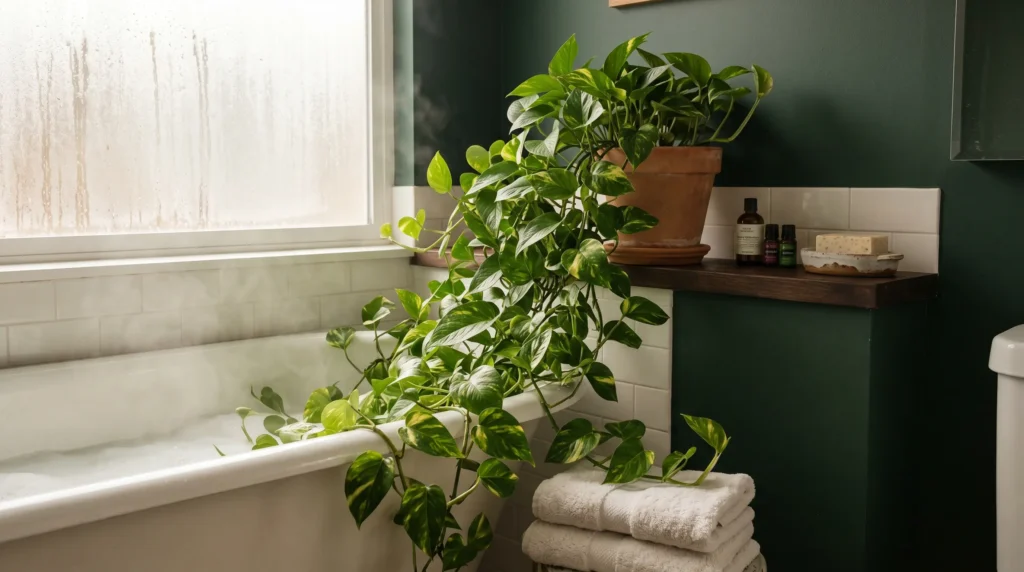
- Bathroom: High natural humidity; ideal with a frosted window providing indirect light
- Kitchen: Often warmer and more humid; east-facing kitchens are perfect
- Living room: Most flexible; works on shelves, coffee tables, or in hanging planters
- Home office: Thrives under artificial light; good for desk or shelf placement
UK Interior Styling Pairings
| Style | Pot | Companion Plants |
| Scandi-minimalist | White ceramic | Snake Plant, Peace Lily |
| Maximalist jungle | Terracotta | Monstera, Calathea, Tradescantia |
| Cottagecore | Wicker basket | Ferns, trailing ivy |
| Modern industrial | Dark metal or concrete | ZZ Plant |
Moss Poles in the UK
Moss poles encourage larger leaves and a more dramatic climbing aesthetic.
Where to buy in the UK: Dobbies Garden Centres · RHS Online Shop · Amazon UK (search: “coir pole UK” or “moss pole UK”)
Cost: £5–£20 depending on size
How to train: Use soft garden ties or strips of jute twine to gently secure stems to the pole. Aerial roots will eventually grip the pole independently.
How to Propagate Satin Pothos — Step-by-Step UK Guide
Propagation is the process of creating new plants from cuttings of the parent plant. Satin Pothos is easy to propagate via stem cuttings.
How Do You Propagate Satin Pothos?
Take a stem cutting 10–15cm long with at least one node (a small brownish bump where a leaf meets the stem). Remove lower leaves, leave 1–2 at the top, and place in water or moist potting mix. Roots develop in 3–6 weeks. Propagate in spring or summer for fastest results in the UK.
When to Propagate in the UK
- Best time: March–August (active growing season)
- Avoid: October–February — low light and cool temperatures dramatically slow root development and increase failure rates
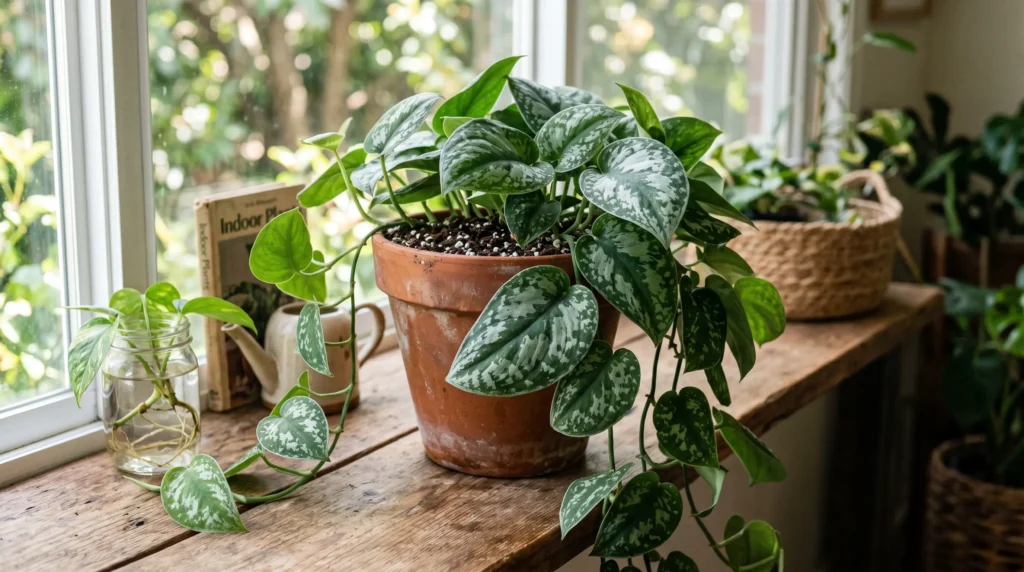
Water Propagation (Recommended for Beginners)
Step-by-step instructions:
- Identify a healthy stem with at least one visible node
- Cut the stem 10–15cm below the node using clean, sharp scissors or pruning shears
- Remove all leaves except 1–2 at the top
- Allow the cut end to air-dry for 30–60 minutes
- Place the cutting in a jar of room-temperature water — node submerged, leaves above water
- Position in bright, indirect light (a bright bathroom windowsill is ideal)
- Change the water every 3–5 days to prevent bacterial growth
- Roots appear in 3–6 weeks (longer in winter)
- Transfer to potting mix when roots are 2–4cm long
- Keep the newly potted cutting in high humidity for 1–2 weeks to ease the transition
Soil Propagation
- Take a 10cm stem cutting with one node, cut just above the node on the parent plant
- Allow the cut end to callous for 1 hour
- Insert the node end into a small pot of moist perlite-heavy mix (70% perlite, 30% compost)
- Cover with a clear plastic bag or propagation dome to retain humidity — essential in dry UK homes
- Place in a warm spot (18–22°C); an airing cupboard with a small grow light works well
- Do not water again until the top of the mix feels dry
- Roots develop in 4–6 weeks; tug gently to test for resistance (rooted = resistance)
- Transfer to standard potting mix once rooted
Single Node Cutting (For Rare Varieties)
Use this method to maximise yield from expensive varieties such as Silver Hero or Jade Satin.
- One leaf + one node = one viable cutting = one new plant
- Follow the water propagation method above
- Expect slower rooting times for rare varieties (4–10 weeks)
Common Propagation Mistakes
| Mistake | Why It’s a Problem | Fix |
| Propagating in winter | Low light and cold = very slow or failed rooting | Wait until March |
| Cutting without a node | Cannot root — nodes contain the cells needed for root production | Always include at least one node |
| Stagnant water | Promotes bacterial rot on the stem | Change water every 3–5 days |
| Transferring to soil too early | Roots under 2cm have insufficient structure for soil | Wait until roots are 2–4cm |
| Using too large a pot for the cutting | Excess soil holds water; rot risk is high | Use a small 5–7cm pot |
Pests & Diseases — UK-Specific Problems
Satin Pothos is naturally resistant to many common houseplant pests but is susceptible to spider mites (especially in winter) and fungus gnats (especially when overwatered). UK central heating conditions in winter create the primary risk environment for both.
Spider Mites
When: Most prevalent October–March, when central heating drops humidity below 30%.
Signs:
- Fine webbing between leaves and stems
- Pale, stippled dots on leaf surfaces
- Leaves look dull and dusty
Treatment:
- Isolate the plant immediately
- Wipe all leaf surfaces (top and underside) with a damp cloth
- Apply insecticidal soap or neem oil solution — spray every 5–7 days for 3 weeks
- Increase ambient humidity to 50%+ to deter reinfestation
UK products: Bug Clear Ultra (Wilko, B&Q) · Provanto Ultimate Bug Killer (Tesco, garden centres)
Fungus Gnats
When: Autumn and winter, when overwatering is most common in UK homes.
Signs: Small black flies hovering around soil; larvae in top layer of compost.
Treatment:
- Allow soil to dry out more thoroughly between waterings
- Apply yellow sticky traps at soil level (catches adults)
- Apply a layer of horticultural grit or sand to the top of the soil (deters egg-laying)
- Use Bacillus thuringiensis israelensis (Bti) biological control for severe infestations
UK products: Westland Resolva Houseplant Bug Killer · Nemasys biological control
Mealybugs
Signs: White, fluffy cotton-like clusters in leaf axils (where leaves meet the stem).
Treatment: Isolate plant; dab each cluster with a cotton bud soaked in 70% isopropyl alcohol; apply neem oil solution weekly for 3 weeks.
Root Rot
Cause: Overwatering — the most common cause of plant death in UK homes, especially in winter.
Signs: Yellowing leaves; mushy, dark stems at soil level; foul smell from pot; plant collapses.
Treatment:
- Remove plant from pot
- Trim all black or mushy roots with clean scissors
- Allow roots to air-dry for 1–2 hours
- Repot in fresh, dry potting mix
- Do not water for 5–7 days post-repot
- Dramatically reduce future watering frequency
Quarantine Rule
Always isolate new plants for at least 2 weeks before placing them near your existing collection. Spider mites and mealybugs almost always arrive on new plants. Two weeks of isolation allows time to identify and treat any infestation before it spreads.
Common Problems Diagnostic Guide
How to use this guide: Satin Pothos communicates stress through its leaves. Match the symptom you observe to the most likely cause, then apply the fix.
| Problem | Most Likely Cause (UK Context) | Secondary Cause | Fix |
| Yellow leaves | Overwatering (especially UK winter) | Nutrient deficiency | Check soil; reduce watering; ensure drainage |
| Brown crispy leaf tips | Low humidity from central heating | Underwatering | Use humidifier; move away from radiator |
| Brown spots with yellow halos | Bacterial leaf spot | — | Remove affected leaves; water at soil level only |
| Fading silver variegation | Insufficient light (UK low-light months) | — | Move closer to window; add grow light in winter |
| Leggy stems with long gaps | Too little light | — | Brighter spot; prune leggy stems to encourage branching |
| Curling leaves | Underwatering | Low humidity | Water thoroughly; check humidity with hygrometer |
| Small new leaves | Insufficient light; needs climbing support | — | Add moss pole; improve light levels |
| Drooping, limp plant | Severe underwatering | Root rot | Check soil — if dry, water; if soggy, check roots |
| Mushy stems at soil level | Root rot (overwatering) | — | Unpot; trim black roots; repot in fresh dry mix |
| No new growth | Normal winter dormancy | Insufficient light or nutrients | Patience in winter; feed and increase light in spring |
| Leaves dropping | Cold draught or temperature shock | Overwatering | Move away from cold draughts; check soil moisture |
| Pale, washed-out leaves | Too much direct sun | — | Move further from window or use sheer curtain |
Is Satin Pothos Toxic? Pets & Children (UK)
Satin Pothos (Scindapsus pictus) is toxic to cats, dogs, horses, and humans. It contains insoluble calcium oxalate crystals that cause irritation to the mouth, throat, and digestive system if ingested.
Is Satin Pothos Toxic to Cats and Dogs?
Yes. Satin Pothos contains insoluble calcium oxalate crystals. If a cat or dog chews or ingests the plant, it causes immediate pain and burning in the mouth, excessive drooling, swelling, and difficulty swallowing. Symptoms are usually self-limiting (rarely fatal), but veterinary advice should be sought immediately.
Toxicity at a Glance
| Species | Risk Level | Symptoms |
| Cats | Toxic | Oral pain, drooling, pawing at mouth, vomiting, swelling |
| Dogs | Toxic | Same as cats; GI upset |
| Horses | Toxic | Oral irritation; unlikely to be exposed indoors |
| Humans (adults) | Mildly toxic | Skin irritation from sap; wear gloves when repotting |
| Children | Mildly toxic | Keep out of reach; ingestion causes oral pain and vomiting |
What to Do if a Pet Ingests Satin Pothos (UK)
- Do not induce vomiting
- Rinse the pet’s mouth with water if possible
- Contact your vet immediately, or call the Animal Poison Line (UK): 01202 509000 (charges apply)
- Take a photo of the plant to show the vet for identification
Safe Placement in UK Homes with Pets
- High shelves — but assess your cat’s climbing abilities honestly
- Hanging planters mounted from ceiling hooks
- Rooms the pet cannot access
UK Pet-Safe Alternatives to Satin Pothos
If you have curious cats or dogs, consider these non-toxic alternatives:
- Spider Plant (Chlorophytum comosum)
- Boston Fern (Nephrolepis exaltata)
- Calathea (all species)
- Peperomia (all species)
- Prayer Plant (Maranta leuconeura)
Where to Buy Satin Pothos in the UK
Satin Pothos (Argyraeus cultivar) is widely available across UK garden centres, supermarkets, and online retailers year-round. Rarer varieties require specialist online retailers or plant swap communities.
UK Retailers — Common Varieties
| Retailer | Varieties Available | Price Range | Notes |
| IKEA | Argyraeus | £5–£8 | Very affordable; healthy stock; limited sizes |
| B&Q / Dobbies | Argyraeus | £6–£15 | Seasonal variation; best in spring–summer |
| Waitrose / M&S / Tesco | Argyraeus | £5–£10 | Small plants; occasional stock |
| Patch Plants | Argyraeus, Exotica | £12–£30 | Quality plants; well-packaged for delivery; plant guarantee |
| Beards & Daisies | Argyraeus | £10–£25 | Multiple sizes; good customer care |
| Hortology | Argyraeus, Exotica | £10–£22 | Good online shop; detailed care info |
| The Little Botanical | Argyraeus | £12–£28 | Gift-ready packaging |
| Happy Houseplants | Argyraeus | £8–£20 | UK-based; detailed care guides included |

For Rare Varieties (Silver Hero, Jade Satin, Silver Lady)
- Etsy UK — search “Scindapsus pictus Silver Hero UK” or “Jade Satin UK”; buy from UK-based sellers only to avoid APHA plant import regulations
- UK Houseplant Facebook Groups — “UK Houseplant Swaps & Sales”; “UK Tropical Plant Swap” — community selling, often fair prices
- RHS Plant Fairs and Shows — specialist nurseries occasionally stock rare Scindapsus varieties
- Local independent plant shops — smaller shops in cities often stock unusual varieties; always worth asking
What to Check Before Buying — Checklist
- Leaves are firm, not limp or yellowing
- Silver variegation is visible and clear (not faded)
- No webbing on undersides of leaves (spider mites)
- No white fluffy deposits in leaf joints (mealybugs)
- No small black flies around the soil (fungus gnats)
- Soil is moist but not waterlogged
- Roots are not severely circling or escaping the pot
UK Price Guide (2025)
| Size / Type | Expected Price |
| Small (9cm pot, Argyraeus) | £5–£10 |
| Medium (12cm pot) | £10–£18 |
| Large (hanging basket) | £18–£30 |
| Exotica (medium) | £12–£25 |
| Rare varieties (Silver Hero, Silver Lady) | £20–£60+ |
| Jade Satin | £30–£80+ |
Satin Pothos vs Similar Plants — UK Comparison
Satin Pothos vs Golden Pothos
| Feature | Satin Pothos (Scindapsus pictus) | Golden Pothos (Epipremnum aureum) |
| Botanical genus | Scindapsus | Epipremnum |
| Leaf texture | Velvety, matte, thick | Glossy, thinner |
| Growth speed | Slower | Faster |
| Variegation | Silver-grey on dark green | Yellow-cream on bright green |
| Leaf size (indoor) | 5–15cm | 10–20cm |
| Light needs | Bright indirect preferred | More tolerant of low light |
| Humidity needs | Higher (40–60%) | Lower (standard household) |
| UK availability | Common | Very common |
| Difficulty | Easy | Very easy |
Verdict: Golden Pothos is easier and grows faster; Satin Pothos is more visually striking and better suited to those who want a slower-growing, more characterful plant.
Satin Pothos vs Heartleaf Philodendron
| Feature | Satin Pothos | Heartleaf Philodendron |
| Leaf texture | Velvety, matte | Glossy, thinner, softer |
| Appearance | Silver variegation | Plain deep green (standard) |
| Growth speed | Slower | Faster |
| Care difficulty | Easy | Easy |
| Light needs | Bright indirect | Tolerates lower light |
Satin Pothos vs Scindapsus treubii ‘Moonlight’
| Feature | Scindapsus pictus (Satin Pothos) | Scindapsus treubii ‘Moonlight’ |
| Leaf colour | Dark green with silver spots | Pale, milky green with full silver sheen |
| Leaf texture | Matte, velvety | Slightly glossy-matte |
| Care needs | Very similar | Very similar |
| UK availability | Common | Less common |
| Price (UK) | £5–£25 | £10–£35 |
UK Seasonal Care Calendar
Use this calendar to adapt your care routine to UK seasons. The biggest seasonal shifts are watering reduction in autumn/winter and humidity management when the heating comes on in October.
| Season | Watering | Feeding | Light | Humidity | Key Tasks |
| Spring (Mar–May) | Every 7–10 days | Start feeding — every 2–4 weeks | Move back slightly from window as days lengthen | Reduce humidifier as outdoor humidity rises | Repot if root-bound; begin propagating; prune leggy growth |
| Summer (Jun–Aug) | Every 6–8 days | Feed every 2 weeks | Sheer curtain on south windows | Monitor; pebble tray often sufficient | Propagate new plants; train climbers; enjoy rapid growth |
| Autumn (Sep–Nov) | Reduce to every 10–14 days | Final feed in September; none from October | Move closer to window as daylight reduces | Restart humidifier when heating comes on (October) | Check for pests; set up grow light if needed |
| Winter (Dec–Feb) | Every 14–21 days | None | Supplemental grow light if possible; keep near window | Humidifier running in heated rooms | Minimal intervention; check soil before every watering; resist the urge to feed or repot |
Frequently Asked Questions
What is Satin Pothos?
Satin Pothos is the common name for Scindapsus pictus, a trailing or climbing houseplant native to Southeast Asia. It has velvety, heart-shaped dark green leaves with silvery-grey markings and belongs to the Araceae family. Despite its name, it is not a true Pothos — it belongs to the genus Scindapsus, not Epipremnum.
Is Satin Pothos the same as Silver Pothos?
Yes and no. “Silver Pothos” is another common name for Scindapsus pictus, so they often refer to the same plant. However, “Silver Pothos” is also sometimes used specifically to describe the ‘Silvery Ann’ cultivar. Both names describe the same species (Scindapsus pictus) — neither is a true Pothos botanically.
How fast does Satin Pothos grow in the UK?
Satin Pothos grows slowly compared to true Pothos. In the UK, active growth occurs from March to September. During peak summer in good conditions, expect 2–4 new leaves per month. In winter (October–February), growth almost completely stops due to low light and shorter days. Over a full year, a well-cared-for plant might add 20–40cm of new growth.
Can Satin Pothos live in a north-facing room in the UK?
Yes, but with limitations. Satin Pothos will survive in a north-facing room, but growth will be very slow and silver variegation will fade significantly — new leaves will emerge plain green. To maintain variegation in a north-facing room, use a full-spectrum LED grow light for 12–14 hours per day, positioned 30–45cm above the plant.
Why is my Satin Pothos losing its silver markings?
Fading silver variegation is caused by insufficient light. The silver iridoplast cells only form in new leaves when the plant grows in bright conditions. Existing faded leaves will never recover their markings, but new leaves will show full silver variegation once you move the plant to a brighter spot. In UK winters, moving the plant closer to a window or adding a grow light solves this problem.
Can I put my Satin Pothos in the bathroom?
Yes — a bathroom is an excellent location for Satin Pothos in a UK home, provided there is a window. The naturally higher humidity reduces the impact of winter central heating, and the warmer temperatures suit its tropical origins. A frosted north-facing bathroom window is adequate; south or east-facing is ideal.
Is Satin Pothos toxic to cats and dogs in the UK?
Yes. Satin Pothos contains insoluble calcium oxalate crystals, which are toxic to cats, dogs, and other pets. Ingestion causes oral pain, drooling, swelling, and vomiting. If your pet ingests the plant, contact your vet immediately or call the UK Animal Poison Line: 01202 509000.
How do I make my Satin Pothos fuller and bushier?
Four proven methods to create a bushier Satin Pothos:
- Pinch out the growing tip of each vine regularly — this signals the plant to branch from lower nodes
- Cut back long, leggy vines to just above a node
- Ensure adequate light — leggy, sparse growth is the most common sign of insufficient light
- Pot multiple cuttings together in one pot to create a fuller-looking plant from the start
What is the difference between Satin Pothos Argyraeus and Exotica?
‘Argyraeus‘ has smaller leaves (5–8cm) with scattered silver spots on a dark green background — compact and widely available. ‘Exotica‘ has much larger leaves (up to 20cm+ when climbing) with predominantly silver coloration and teal-green blotches — dramatic and ideal as a statement plant on a moss pole.
Does Satin Pothos need a moss pole?
No — a moss pole is optional, not required. Without support, Satin Pothos trails downward as a hanging or shelf plant with small juvenile leaves. With a moss pole, aerial roots grip the surface and the plant climbs upward, producing significantly larger leaves (especially the Exotica variety). A moss pole is recommended if you want maximum leaf size.
How often should I water Satin Pothos in winter in the UK?
In UK winter (December–February), water your Satin Pothos only when the top 4–5cm of soil is dry — typically every 14–21 days. The combination of low light, cool temperatures, and reduced growth means the plant uses very little water. Overwatering in winter is the most common cause of root rot and plant death. Always check the soil with your finger before watering.
Can Satin Pothos grow outside in the UK?
No — not permanently. Satin Pothos is a tropical plant that cannot tolerate temperatures below 15°C and is not frost-hardy. It cannot survive UK winters outdoors. It can be placed outside in a sheltered spot during warm summer months (June–August) when temperatures are consistently above 15°C overnight, but must be brought indoors in September before temperatures drop.
Article last reviewed: May 2025 | Botanical accuracy checked against RHS Plant Database | UK retail information current as of 2025
Related Articles:
- How to Propagate Satin Pothos: The Full UK Step-by-Step Guide
- All Scindapsus Varieties: A UK Collector’s Identification Guide
- Best Houseplants for UK North-Facing Rooms
- Pet-Safe Houseplants for UK Homes: 30 Non-Toxic Alternatives
- Satin Pothos Buying Guide: Best UK Retailers Compared (2025)

Leave a Reply