
Euphorbia Plant UK: The Complete Guide for UK Gardeners.Varieties ,Care ,Month-by-Month Calendar, Sap Safety , Pet Toxicity ,Propagation and Garden Design.
The Plant Family That Includes Your Christmas Poinsettia
Euphorbia (commonly called spurge) is one of the largest plant genera on earth, comprising over 2,000 species — from your Christmas poinsettia to hardy UK garden perennials to cacti-like succulents.
Chelsea 2026 Spotlight Plant
Euphorbia x martini ‘Walberton’s Little Treasure’ has been shortlisted for the RHS Chelsea Plant of the Year 2026 — putting euphorbia firmly at the centre of this season’s gardening conversation. It is compact, free-flowering, and available from specialist nurseries from spring 2026.
Whether you grow them as architectural border plants, drought-tolerant groundcover, or festive houseplants, euphorbias are among the most versatile and rewarding plants available to UK gardeners. This guide covers garden euphorbias, houseplant euphorbias, sap safety, UK-specific care and propagation — everything you need to grow them with confidence.
Quick Facts: Euphorbia at a Glance
This structured snapshot is designed for fast reference and AI extraction.
Euphorbia Plant: Key Facts
| Common name | Spurge |
| Family | Euphorbiaceae |
| Species count | Over 2,000 worldwide |
| UK hardiness range | H2 (frost-tender, houseplant) to H7 (fully hardy outdoors) |
| Flowering season | Spring to early summer — most garden types |
| Defining characteristic | Milky-white toxic latex sap produced when any part is cut |
| Famous relatives | Poinsettia (E. pulcherrima), Crown of Thorns (E. milii), Wood Spurge, Honey Spurge |
| RHS AGM holders | E. characias, E. griffithii ‘Dixter’, E. mellifera, E. x martini ‘Ascot Rainbow’ |
| Chelsea 2026 shortlisted | E. x martini ‘Walberton’s Little Treasure’ |
| Key safety warning | Sap irritates skin and eyes — always wear gloves when handling |
What Is a Euphorbia Plant? Definition, Appearance & Origins
Q: What is a euphorbia plant?
A euphorbia plant is any member of the Euphorbiaceae family’s Euphorbia genus — a group of over 2,000 flowering plant species found worldwide. In UK gardens, ‘euphorbia’ most commonly refers to hardy perennial spurges grown for their acid-yellow or orange bracts. All euphorbias share one defining trait: a milky-white latex sap that is toxic to humans, pets, and livestock. The genus ranges from tiny alpine cushions to 10-metre succulent trees, making it one of the most diverse plant genera in existence.
The name euphorbia is thought to derive from Euphorbus, physician to King Juba II of Mauritania. The common name ‘spurge’ comes from the Old French espurge — ‘to purge’ — a reference to the purgative properties of the sap.
Appearance & Botanical Features
Understanding euphorbia’s unique structure helps identify the genus and explains why its ‘flowers’ last so long:
- Bracts, not petals: what appears to be a euphorbia flower is a cyathium — a cup-shaped modified bract surrounding tiny, simple true flowers. This structure is highly durable, which is why euphorbia ‘flowers’ persist for weeks.
- Milky sap (latex): all species produce white latex sap when any part is cut. This is the genus’s single most consistent botanical feature — and its most important safety consideration.
- Habit diversity: from ground-hugging creepers (E. myrsinites at 10–15cm) to 2m architectural shrubs (E. mellifera) to 10m+ succulent trees (E. ingens).
- Foliage range: blue-grey (E. characias) to purple-bronze (E. amygdaloides ‘Purpurea’) to variegated cream and green (E. x martini ‘Ascot Rainbow’).
Where Do Euphorbias Come From?
- Mediterranean basin: E. characias wulfenii, E. rigida, E. myrsinites — sun-lovers perfectly suited to UK gravel gardens.
- Himalayan foothills: E. griffithii — explains its tolerance of UK damp and shade.
- Turkey / Black Sea coast: E. amygdaloides var. robbiae — a dry-shade specialist.
- Sub-Saharan Africa: E. trigona, E. obesa, E. tirucalli — grown as UK houseplants.
- Mexico / Central America: Euphorbia pulcherrima — the poinsettia.
Euphorbia vs Cactus: Comparison Box
Euphorbia vs Cactus — Key Differences (Structured Answer)
| Feature | Euphorbia | Cactus
|
|---|---|---|
| Milky sap | Present in all species | Clear or watery sap |
| Spines | Some species only; not universal | Almost universal |
| Flowers | Cyathia (modified bracts) | True petals |
| Native origin | Worldwide | Americas only |
| Plant family | Euphorbiaceae | Cactaceae |
| UK hardiness | Wide range H2–H7 | Usually frost-tender |
| Latex allergy risk | Yes — sap is latex-based | No |
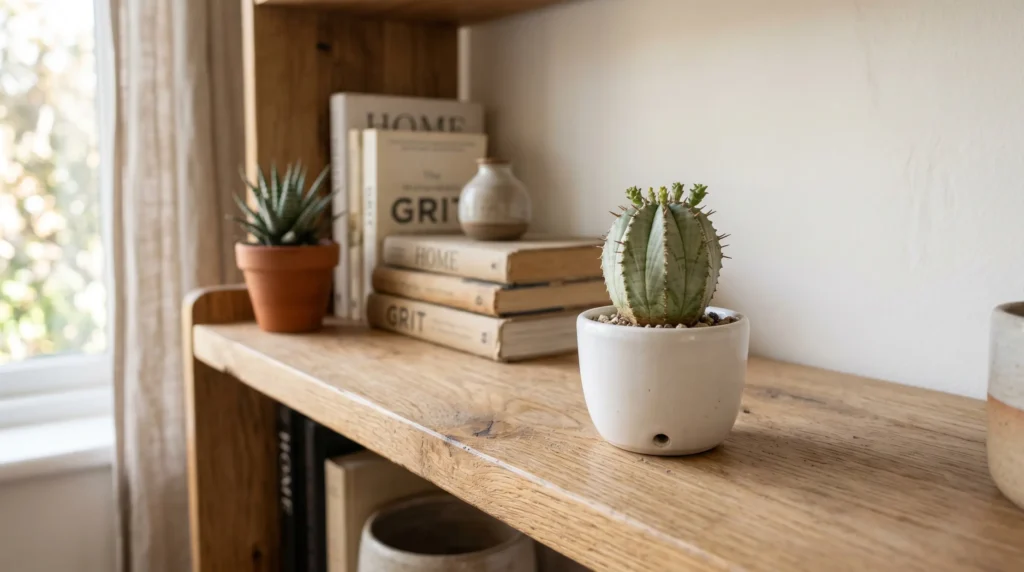
Two Types of Euphorbia in the UK: Garden, Houseplant & Succulent
Q: What type of euphorbia should I grow in the UK?
It depends on where you want to grow it. Hardy garden euphorbias (E. characias, E. griffithii) are grown outdoors year-round in UK borders. Succulent houseplant euphorbias (E. trigona, E. milii) are grown indoors or in frost-free conservatories. Tender varieties can be used as summer container plants then overwintered inside. Knowing which type you have is the first step to growing it successfully.
Type 1: Hardy Garden Euphorbias
- RHS hardiness H4–H7 — fully to near-fully hardy in UK
- Perennial — return each year, evergreen or herbaceous
- Borders, gravel gardens, woodland edges
- Sun types: E. characias, E. rigida
- Shade types: E. amygdaloides var. robbiae
Type 2: Houseplant & Succulent Euphorbias
- Frost-tender — must remain indoors year-round (or summer patio only)
- Need bright light, very low winter watering
- Popular: E. trigona, E. milii, E. tirucalli, E. obesa
- Move outdoors June–August; bring inside before October
The Poinsettia — The Euphorbia You Already Own
Euphorbia pulcherrima — sold in millions as a Christmas gift plant — is a fully fledged euphorbia. Most UK owners discard it in January, unaware it can be kept and re-bloomed each December.
How to re-bloom your poinsettia: Reduce watering after flowering. In spring, cut stems back by half and repot. From early October, give 14 hours of complete darkness per day for 8 consecutive weeks. This short-day protocol mimics Mexican winter conditions and triggers red bract formation for a December display.
Best Euphorbia Varieties for UK Gardens: Complete Comparison Table
The RHS recognises dozens of euphorbia cultivars with its Award of Garden Merit (AGM) — a reliable indicator of UK garden performance. The twelve varieties below have been selected for UK suitability, hardiness, and garden impact.
12 Best Euphorbia Varieties for UK Gardens (2026) — Structured Answer Table
| Variety | Type | Height | AGM | Hardiness | Sun/Shade | Best For
|
|---|---|---|---|---|---|---|
| E. characias wulfenii | Shrubby evergreen | 1.2m | AGM | H4 | Full sun | Mediterranean/gravel gardens |
| E. x martini ‘Ascot Rainbow’ | Semi-evergreen | 60cm | AGM | H4 | Sun/part shade | Borders, containers |
| E. griffithii ‘Fireglow’ | Herbaceous perennial | 75cm | AGM | H7 | Part shade | Moist borders, woodland |
| E. mellifera (Honey Spurge) | Shrubby, semi-tender | 1.5–2m | AGM | H3–H4 | Sun (sheltered) | Large gardens, coastal |
| E. amygdaloides var. robbiae | Evergreen groundcover | 45cm | AGM | H5 | Full shade | Dry shade, woodland |
| E. palustris (Marsh Spurge) | Herbaceous perennial | 1m | AGM | H7 | Sun/damp | Wet borders, pond edges |
| E. polychroma (Cushion Spurge) | Herbaceous perennial | 40cm | AGM | H7 | Full sun | Front of border, rockery |
| E. myrsinites | Trailing evergreen | 15cm | AGM | H5 | Full sun | Rockery, wall tops, gravel |
| E. rigida | Upright, glaucous | 60cm | AGM | H4 | Full sun, dry | Gravel, Mediterranean style |
| E. x martini ‘Walberton’s Little Treasure’ | Compact semi-evergreen | 40cm | Chelsea 2026 ★ | H4 | Sun/part shade | Containers, small gardens |
| E. schillingii | Herbaceous perennial | 90cm | AGM | H7 | Sun | Average borders |
| E. cornigera | Herbaceous perennial | 90cm | AGM | H7 | Sun | Borders, naturalising |
Which Euphorbia for Your Garden? Decision Guide
Euphorbia Selector: Match Variety to Garden Conditions
| Your Garden Situation | Best Euphorbia to Grow
|
|---|---|
| Full sun, dry or sandy soil | E. characias wulfenii, E. rigida, E. myrsinites |
| Damp or clay soil, full sun | E. palustris, E. schillingii |
| Dry shade under trees or hedges | E. amygdaloides var. robbiae |
| Dappled shade, moist soil | E. griffithii ‘Fireglow’, E. amygdaloides |
| Small garden or containers | E. polychroma, E. x martini ‘Ascot Rainbow’, ‘Walberton’s Little Treasure’ |
| Large architectural feature | E. mellifera, E. characias wulfenii |
| Wildlife / pollinator garden | E. mellifera, E. palustris, E. griffithii |
How to Grow Euphorbia in the UK: A Complete Planting Guide
Growing Conditions at a Glance
Euphorbia Growing Conditions (UK) — Structured Answer
| Factor | Requirement | UK Context
|
|---|---|---|
| Sunlight | Full sun to partial shade | Most garden types: south or west-facing. Shade types: north-facing or under deciduous trees. |
| Soil | Well-drained, fertile | Improve heavy clay with grit. Sandy soils: add well-rotted manure. Avoid waterlogged ground. |
| Watering | Moderate (low once established) | Water well for first two seasons. Most garden types drought-tolerant after establishment. |
| Hardiness | H2–H7 depending on variety | Most UK garden types H4–H7. Tender types (H2–H3) need frost-free overwintering. |
| Feeding | Low requirement | Mulch with well-rotted compost in spring. Avoid high-nitrogen feeds — causes floppy growth. |
| Soil pH | 6.0–7.5 (slightly acid to neutral) | Most UK garden soils are suitable. Avoid highly alkaline chalk soils for sensitive varieties. |
When to Plant Euphorbia in the UK
UK Euphorbia Planting Times
| Planting Type | Best Time in UK
|
|---|---|
| Pot-grown garden euphorbia | Spring (March–May) — moist, warming soil aids establishment |
| Bare-root / mail-order plants | Spring or early autumn (September) |
| From seed (sown indoors) | February–March under cover; plant out after last frost in May |
| Container plants (any size) | Spring or early autumn; avoid midsummer heat and midwinter frost |
| Division of existing clumps | Early spring (March), just as new growth appears |
Step-by-Step Planting Guide (HowTo Schema)
How to Plant Euphorbia in a UK Garden
Tools & materials: Thick waterproof gloves · Eye protection · Trowel or spade · Horticultural grit · Peat-free compost · Bark mulch · Watering can
- Protect yourself — put on gloves and eye protection before handling any euphorbia.
- Choose your site — check sun/shade requirements and soil drainage for your specific variety.
- Prepare the soil — for clay soils, dig in horticultural grit (1 part grit to 3 parts soil). For sandy soils, add well-rotted compost.
- Dig the hole — 1.5× the width of the rootball and the same depth as the pot.
- Position the plant — at the same depth as it was growing in the pot. Do not plant too deeply.
- Backfill — with a 50/50 mix of excavated soil and peat-free compost.
- Firm in gently — do not compact the soil around the roots.
- Water thoroughly — to settle the roots and eliminate air pockets.
- Mulch — apply 5cm of bark or leaf mould around (not touching) the base.
- Ongoing watering — water during dry spells for the first two growing seasons.
Growing Euphorbia in Containers
- Use a well-draining compost: mix 2 parts peat-free multi-purpose with 1 part perlite or horticultural grit.
- Always choose a pot with drainage holes — euphorbia roots rot in waterlogged containers.
- Re-pot every 2–3 years into a container 2–3cm larger, using fresh compost.
- Water spring–autumn when the top 2cm of compost feels dry. Reduce dramatically in winter.
- Move tender types indoors before the first frost — typically October for most UK regions.
Euphorbia Care UK: Month-by-Month Calendar
This is the only comprehensive euphorbia care calendar published for UK gardeners. Use it for hardy garden euphorbias and adjust tasks by 2–4 weeks north or south of a midlands baseline.
UK Euphorbia Care Calendar — Jan to Dec (Unique Structured Answer)
| Month | Key Tasks | Notes
|
|---|---|---|
| January | Check hardy types for wind rock. Firm back in if lifted by frost. Houseplant types: reduce watering to once a month. | No feeding. Do not prune. |
| February | Begin weekly checks for new shoots. Order plants and seeds. Watch for slug damage on emerging shoots. | First new basal growth may appear on biennial types. |
| March | Plant out new container-grown euphorbias. Divide herbaceous clump-forming types. Take basal cuttings of shrubby types. | Ideal propagation month. Wear gloves for all handling. |
| April | Apply 5cm mulch of compost or bark (not touching stems). Begin regular watering for newly planted specimens after dry spells. | Do not feed with high-nitrogen fertiliser. |
| May | Enjoy peak flowering (E. characias, E. polychroma). Remove faded flower bracts on evergreen types. | Chelsea 2026: ideal month to buy new cultivars from specialist nurseries. |
| June | Deadhead herbaceous perennials after flowering. Cut biennial-stemmed types back to ground level. | Wear gloves — sap most active on warm days. Pruning risk is highest in summer. |
| July | Continue deadheading. Water containers regularly. Monitor for aphids and powdery mildew. | Holiday-proof containers: move to shade and water thoroughly before leaving. |
| August | Late prune E. mellifera — cut flowered shoots to base. Take softwood cuttings before stems harden. | Last chance for cuttings with enough season to root before winter. |
| September | Plant autumn-bought container plants. Pot tender types to bring inside before frost. Collect seeds from annual types. | Division possible in southern England now. Northern UK: wait until spring. |
| October | Move tender houseplant types indoors before first frost. Cut back dead herbaceous stems if desired. | Stop feeding. Reduce watering for all types. |
| November | Hardy types: no action needed. Houseplant types: place in brightest room. Water sparingly once per month. | Do not prune in cold weather — sap movement slows and cuts spread disease. |
| December | Ensure indoor euphorbias have bright light. Check hardy garden types are not sitting in waterlogged soil. | Minimal care month. Plan spring orders. Admire your poinsettia. |
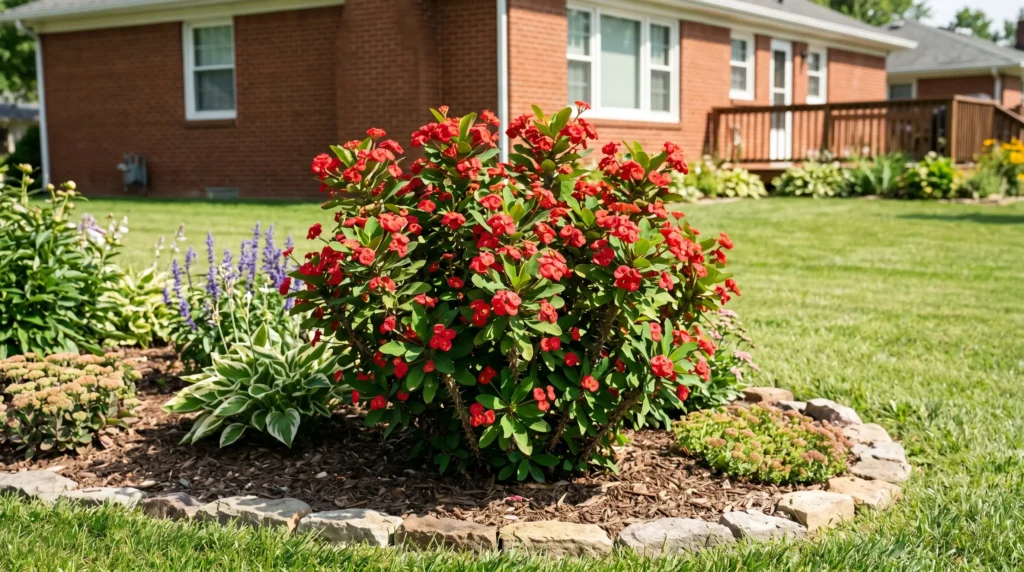
How and When to Prune Euphorbia: A Type-by-Type Guide
Safety First — Before Any Pruning
- The sap released when cutting euphorbia is phototoxic — sunlight exposure after skin contact causes burning and blistering (phytophotodermatitis).
- Always wear: thick waterproof gloves, long sleeves, and ideally safety glasses.
- Wash all tools immediately after use with soapy water.
- Avoid pruning on bright sunny days where possible.
- Keep children and pets away from all cut stems and sap-wet tools.
The Three Pruning Groups
Euphorbia Pruning Groups — Which Type Is Yours?
| Group | Examples | When to Prune | How to Prune
|
|---|---|---|---|
| Group 1: Evergreen (deadhead only) | E. amygdaloides, E. mellifera, E. ‘Blackbird’, E. ‘Redwing’ | After flowering (late spring/early summer) | Cut back flowered stems to the first ring of leaves below browning bracts. Never cut into old wood. |
| Group 2: Biennial-stemmed | E. characias, E. x martini, E. myrsinites | Late summer or autumn after flowering | Cut previous season’s flowered stems to ground level. Leave new shoots — they will flower next year. |
| Group 3: Herbaceous perennials | E. griffithii, E. cyparissias, E. palustris, E. polychroma | After flowering, or before first frost | Deadhead spent flowers. Cut entire plant back to ground level in autumn. Returns each spring. |
Step-by-Step: Pruning Group 2 Euphorbias (HowTo Schema)
How to Prune E. characias and E. x martini (Most Common UK Garden Types)
- Put on waterproof gloves, long sleeves, and eye protection before making any cuts.
- Identify new shoots — bright green with no flower heads. Do NOT cut these — they are next year’s flowers.
- Identify flowered stems — brown or grey with spent bracts. These are what you remove.
- Cut each flowered stem to ground level using clean, sharp secateurs.
- Remove all cuttings immediately — do not leave sap-wet stems near children or pets.
- Clean all tools with soapy water and rinse before storing.
- Wash hands thoroughly with soap and water, even if you wore gloves.
Euphorbia Sap: Danger, First Aid & Safety — What Every UK Gardener Must Know
Q: Is euphorbia sap dangerous?
Yes. All euphorbia species produce a milky-white latex sap that is a strong irritant and mild toxin. The sap contains diterpenoid compounds and ingenol esters. It is phototoxic — meaning exposure to sunlight after skin contact dramatically increases the risk of blistering and burns. Eye contact can cause temporary vision loss and, in rare severe cases, permanent damage. Always wear gloves and eye protection when handling any euphorbia.
Euphorbia Sap on Skin: What to Do
- Do not touch your face or eyes after any skin contact with sap.
- Wash the area immediately with soap and water.
- If sap has dried on skin, use milk (not water alone) to dissolve the latex before washing — congealed sap is not fully water-soluble.
- Stay out of sunlight for at least 48 hours — phototoxicity means sun exposure activates the irritant reaction and causes blistering even after washing.
- If blistering, severe redness, or burning develops, contact NHS 111 or attend A&E.
Euphorbia Sap in the Eye: Urgent Action Required
EMERGENCY: Euphorbia Sap in the Eye
- Immediate action: Irrigate the eye continuously with clean, cool running water for at least 15–20 minutes. Do not rub the eye.
- After irrigation: Call NHS 111 immediately or attend A&E. Do not wait — symptoms can progress.
- What to tell them: “I have had euphorbia / spurge plant sap in my eye.” Medical staff may not recognise this without prompting.
- Clinical context: Euphorbia sap causes keratoconjunctivitis — inflammation of the cornea and conjunctiva. In severe cases: corneal ulceration, anterior uveitis, and vision loss for up to two weeks (source: Bristol Eye Hospital case report, Eye journal).
- Recovery: With prompt treatment, most cases resolve within 1–2 weeks. Delay significantly increases the risk of permanent damage.
Euphorbia Ingestion: Swallowing or Mouth Contact
- If sap contacts the mouth: rinse thoroughly with water and spit. Do not induce vomiting.
- Symptoms: burning/stinging in lips, mouth, throat; excess salivation; vomiting; diarrhoea in significant exposure.
- Contact the UK National Poisons Information Service via NHS 111 or attend A&E if significant ingestion has occurred.
- Children are more susceptible to skin dermatitis from sap contact than adults.
Latex Allergy Warning
Euphorbia sap is a latex-based substance. People with documented latex allergies may experience a more severe reaction — including potential anaphylaxis in extreme cases. If you have a known latex allergy, treat euphorbia handling with particular caution.
How to Propagate Euphorbia: Seeds, Cuttings & Division
Euphorbia Propagation Methods — Comparison
| Method | Best For | Best Time (UK) | Difficulty | Notes
|
|---|---|---|---|---|
| Softwood cuttings | Shrubby types: E. characias, E. mellifera, E. myrsinites | March–April | Easy | Most reliable. 2–4 weeks to root. Always wear gloves. |
| Division | Clump-forming types: E. griffithii, E. palustris, E. polychroma | March | Easy | Fastest method. Guarantees true-to-type plants. |
| Seed | Species types (not named cultivars) | February–March (under cover) | Moderate | Named cultivars will not come true. Germination: 2 weeks–6 months. |
Expert note: Euphorbias have male and female plants and, once pollinated, produce seeds that explode outward (ballistic seed dispersal). Those propagating under cover often use fine nets to catch seeds — Darren Evans, Plant Manager, Horticulture Magazine.
Step-by-Step: Softwood Cuttings (HowTo Schema)
How to Take Euphorbia Softwood Cuttings
- Prepare — put on gloves and eye protection. Fill small pots with 50/50 peat-free compost and perlite.
- Select shoots — choose short, young basal shoots (5–8cm) from the base of the plant in early spring.
- Cut cleanly — just below a leaf node using sharp, clean secateurs.
- Stop sap flow — immediately dip the cut end into cool water. Pat dry with a paper towel.
- Callus — allow the cut end to dry for 30 minutes before potting.
- Pot up — insert cuttings, water lightly. Place in a propagator or cover with a clear plastic bag.
- Root — keep at 15–18°C in bright indirect light. Roots appear in 2–4 weeks.
- Harden off — gradually increase ventilation over 1–2 weeks before planting out.
Step-by-Step: Dividing Clump-Forming Euphorbias
- Water the plant thoroughly the day before dividing to reduce root stress.
- Dig around the root ball with a fork, keeping as much root intact as possible.
- Lift the clump and separate into sections using two forks back-to-back — each must have stems and roots.
- Replant divisions immediately at the same soil depth as the original.
- Water thoroughly and mulch around (not touching) the crown.
Euphorbia as a UK Houseplant: Succulent Types & Indoor Care
Most Popular UK Houseplant Euphorbias
| Variety | Common Name | Height | Light | Watering | Key Feature
|
|---|---|---|---|---|---|
| E. trigona | African Milk Tree | Up to 2m | Bright indirect/direct | Every 2–3 weeks | Architectural, fast-growing |
| E. milii | Crown of Thorns | 30–60cm | Bright direct sun | When top 2cm dry | Long-flowering, colourful bracts |
| E. tirucalli | Pencil Cactus / Firestick | Up to 3m | Full sun | Monthly in winter | Orange-red tips in bright sun |
| E. obesa | Baseball Plant | 10–15cm | Bright indirect | Monthly in winter | Unusual spherical form |
| E. pulcherrima | Poinsettia | 30–60cm | Bright indirect | When compost feels light | Classic Christmas gift plant |
UK Houseplant Euphorbia Care
Euphorbia Houseplant Care Guide (UK)
| Care Factor | Guidance
|
|---|---|
| Light | Bright indirect or direct sun. South- or west-facing windowsill ideal. Rotate pot quarterly. |
| Watering (summer) | ‘Drench between droughts’ — water thoroughly, then let compost dry completely before watering again. |
| Watering (winter) | Reduce to once per month or less. Cold + wet = root rot. |
| Temperature | Minimum 10–12°C. Never below 5°C. Keep away from cold draughts and direct radiator heat. |
| Feeding | Half-strength cactus fertiliser once a month, April–September only. No feeding in winter. |
| Repotting | Every 3–4 years in spring, using cactus/succulent compost with added horticultural grit. |
| Common pests | Mealybugs, spider mites, scale insects — inspect leaf axils and stem joints regularly. |
Euphorbia Troubleshooting: 10 Common Problems & Solutions
This is the most complete euphorbia troubleshooting table available for UK gardeners. Each row is a self-contained Q&A structured answer.
Euphorbia Problem-Solver
| Problem | Likely Cause | Solution
|
|---|---|---|
| Yellowing leaves | Overwatering (root rot) or underwatering | Check roots. If mushy: repot in fresh dry compost. If bone dry: water more consistently. |
| Floppy, leggy growth | Soil too nitrogen-rich or insufficient light | Move to sunnier spot. Avoid high-nitrogen feeds. Cut back leggy stems to encourage bushy growth. |
| No flowers | Too much shade, poor drainage, or young plant | Move to more sun. Improve drainage. Plants may take 2–3 years to flower from young. |
| Brown, soft stem base | Root rot from overwatering or waterlogged soil | Remove rotted tissue. Repot in fresh well-draining compost. Reduce watering significantly. |
| Powdery white coating | Powdery mildew — common in dry, still conditions | Improve air circulation. Remove affected leaves. Apply organic fungicide if severe. |
| Sticky residue / sooty mould | Aphid or scale insect infestation | Wipe with damp cloth. Apply insecticidal soap or neem oil. Encourage ladybirds in the garden. |
| Fine white web on stems | Spider mites — common on houseplants in dry air | Increase humidity. Shower the plant. Apply insecticidal soap. Improve air circulation. |
| Leaf drop (houseplant types) | Cold draughts, temperature change, or overwatering | Move away from cold windows. Check and correct watering. Stable temperatures are critical. |
| Plant dying after transplanting | Transplant shock, root disturbance | Water well. Mulch. Do not feed for 6 weeks. Shade from direct sun initially. |
| Invasive spreading in borders | Vigorous running types (E. cyparissias, E. amygdaloides var. robbiae) | Dig out excess growth each spring. Install root barriers for persistent spreaders. |
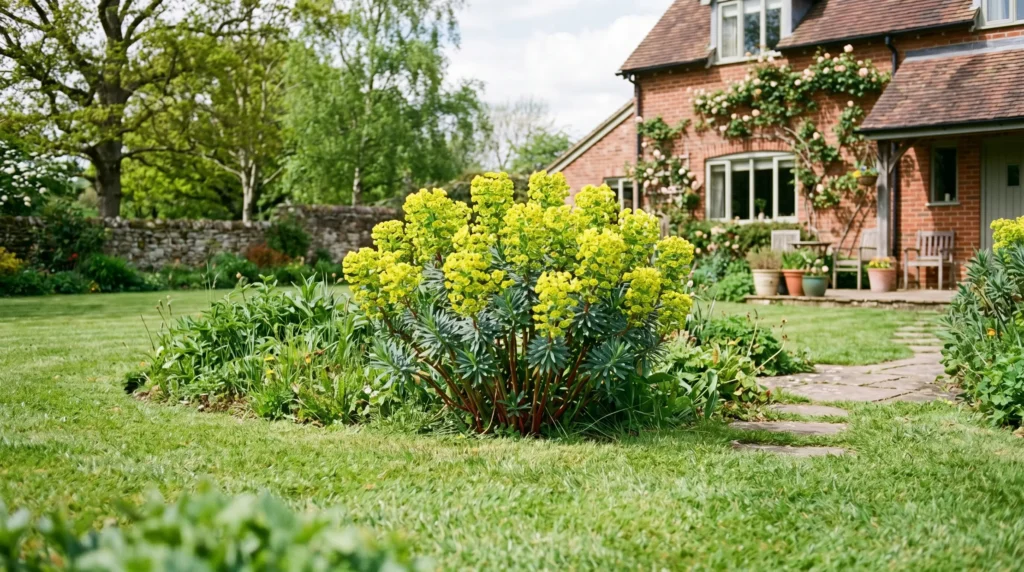
Is Euphorbia Toxic? Safety for Pets, Children & Livestock
Q: Is euphorbia poisonous?
Yes. All parts of euphorbia plants are toxic to humans, dogs, cats, horses, rabbits, and most livestock. The milky latex sap contains diterpenoid compounds and is classified as an irritant and mild poison by the RHS. The sap is most dangerous when it contacts the eyes or is ingested in quantity. Skin contact causes dermatitis and blistering (especially in sunlight). Ingestion causes mouth and throat irritation, vomiting, and gastrointestinal upset.
Toxicity by Animal: UK Guide
Euphorbia Toxicity — Per-Animal UK Guide (Unique Structured Answer)
| Animal | Toxic? | Likely Exposure | Symptoms | Action
|
|---|---|---|---|---|
| Dogs | Yes | Chewing stems or leaves | Mouth irritation, drooling, vomiting, skin blistering | Rinse mouth. Call Animal Poison Line: 01202 509000 |
| Cats | Yes | Brushing against sap / grooming sap from fur | Mouth burning, vomiting, skin and eye irritation | Wash sap from fur. Contact your vet. Eye exposure: flush with water. |
| Rabbits | Yes | Grazing near garden plants | Gastrointestinal upset, mouth ulceration | Move away from plant. Contact vet if symptoms present. |
| Horses/Livestock | Highly toxic | Grazing euphorbia in paddock | Severe GI damage, mouth and eye burns — potentially fatal in quantity | Keep euphorbia out of all grazing areas. Emergency vet immediately. |
| Children | Yes | Touching plants; rubbing eyes after contact | Skin irritation, eye pain, blistering after sun exposure | Rinse skin or eye with water. NHS 111 or A&E for any eye exposure. |
UK Emergency Contacts
Animal Poison Line: 01202 509000 (24hr) NHS 111 — Human skin or eye exposure A&E — All eye sap exposures National Poisons Info Service — via NHS 111
How to Make Your Garden Safer
- Do not plant euphorbia where young children play unsupervised.
- Use low fencing or physical barriers around large euphorbias in family gardens.
- Keep pets away during and immediately after pruning — freshly cut sap is most concentrated.
- Label euphorbia plants clearly so visitors and house-sitters are aware of the hazard.
- In small family gardens, choose compact, non-spreading varieties (E. polychroma) over vigorous running types.
Euphorbia for Wildlife: Pollinators, Bees & Ecological Value
Euphorbias are valuable contributors to UK wildlife gardens — their nectar-rich cyathia attract bees, hoverflies, butterflies, and beetles in April–June, bridging a critical gap when many other plants are not yet flowering.
Best Euphorbias for UK Wildlife Gardens
| Euphorbia | Wildlife Benefit
|
|---|---|
| E. mellifera | Rich nectar source for bees, hoverflies, and butterflies. Honey-scented. One of the earliest-season food sources for bumblebee queens. |
| E. palustris | Supports wetland invertebrates. Flowers in early summer alongside pond plants. |
| E. griffithii | Orange bracts attract hoverflies. Good autumn colour for late-season insects. |
| E. characias wulfenii | Large, accessible flowerheads attract bumblebees. Long flowering period March–June. |
| E. amygdaloides var. robbiae | Ground cover in dry shade supports beetles and soil invertebrates. |
The RHS includes several euphorbia species in its Perfect for Pollinators plant list, including E. mellifera and E. characias.
Euphorbia Garden Design Ideas: 4 UK Garden Styles
Euphorbias are extraordinarily versatile in design. Their acid-yellow or lime-green bracts act as a foil for almost any colour palette. Here are four proven UK garden style combinations:
Euphorbia Planting Combinations by Garden Style
| Garden Style | Best Euphorbia | Companion Plants | Design Effect
|
|---|---|---|---|
| Mediterranean gravel garden | E. characias wulfenii, E. rigida, E. myrsinites | Cistus, lavender, Stipa tenuissima, Salvia | Silver-blue drought-tolerant palette with strong structure |
| Cottage garden border | E. x martini ‘Ascot Rainbow’, E. polychroma | Allium, Salvia nemorosa, hardy Geranium | Lime-green foil for purples and blues — naturalistic, relaxed |
| Woodland shade garden | E. amygdaloides var. robbiae, E. griffithii | Ferns, Epimedium, Helleborus | Textured groundcover under trees — works where almost nothing else will |
| Contemporary structural garden | E. characias wulfenii, E. mellifera | Ornamental grasses, Agapanthus, architectural shrubs | Bold architectural statement — works with modern hard landscaping |
Where to Buy Euphorbia in the UK: Nurseries, Garden Centres & Prices
UK Euphorbia Price Guide (2026)
| Plant Size / Format | Typical UK Price | Where to Buy
|
|---|---|---|
| 9cm pot (starter) | £4.99–£8.99 | Garden centres, RHS Plant Centres, local nurseries |
| 1 litre pot | £8.99–£14.99 | J Parkers, Waitrose Garden, RHS Plant Shop, local nurseries |
| 2 litre pot | £12.99–£22.99 | Specialist nurseries, Burncoose, Beth Chatto’s Plants |
| 3+ litre pot (specimen) | £18.99–£45.00 | RHS Partners, Hardy’s Nursery, specialist growers |
| Mail-order bare root | £6.99–£16.99 | Hayloft, Sarah Raven, Crocus.co.uk |
- RHS Plant Centres: All five RHS gardens stock AGM-awarded varieties with expert advice on-site.
- Specialist nurseries: Burncoose (Cornwall), Beth Chatto’s Plants (Essex), Hardy’s Cottage Garden Plants (Hampshire) — best variety selection and rarer cultivars.
- Online mail order: Hayloft Plants, Crocus.co.uk, Thompson & Morgan for reliable delivery.
- General garden centres: Dobbies and Blue Diamond reliably stock mainstream varieties such as E. x martini ‘Ascot Rainbow’ and E. polychroma.
Frequently Asked Questions About Euphorbia Plants (UK)
Q1: What is a euphorbia plant?
A euphorbia plant is any member of the Euphorbia genus within the Euphorbiaceae family — a group of over 2,000 species found worldwide. In UK gardens, the term most often refers to hardy perennial spurges grown for their architectural form and long-lasting acid-yellow or orange bracts. All euphorbias share one defining trait: a milky-white latex sap produced whenever any part of the plant is cut or broken.
Q2: Is euphorbia toxic to dogs and cats?
Yes,the milky white sap contains irritant diterpenoid compounds that cause mouth burning, drooling, vomiting, and potential skin blistering on contact. If your pet has chewed or brushed against a euphorbia, rinse the affected area with water and contact your vet or the UK Animal Poison Line (01202 509000, available 24 hours). Eye exposure in pets requires immediate veterinary attention. Keep all euphorbias out of reach of pets and do not allow grazing animals near garden plantings.
Q3: When should I cut back euphorbia in the UK?
The correct time depends on the type. Biennial-stemmed types (E. characias, E. x martini) should have their flowered stems cut to ground level in late summer or autumn, leaving new green shoots untouched — they will flower next year. Herbaceous types (E. griffithii, E. polychroma) can be cut to the ground in autumn after flowering. Evergreen types (E. amygdaloides, E. mellifera) need only light deadheading after flowering — never cut hard into old wood. Always wear gloves: the sap is a serious skin and eye irritant.
Q4: Is euphorbia sap dangerous?
Yes. it causes burning and blistering on skin exposed to sunlight after contact, and can cause temporary vision loss or permanent eye damage if it enters the eye. Always wear thick waterproof gloves and eye protection when handling euphorbia. If sap contacts skin, wash immediately with soap and water and avoid sunlight for 48 hours. If sap enters the eye, irrigate with cool running water for 15–20 minutes and attend A&E or call NHS 111 immediately.
Q5: What is the difference between euphorbia and a cactus?
The easiest way to tell them apart is to check for milky white sap — euphorbias produce it when cut, cacti do not. Euphorbia spines are modified leaves or stems; cactus spines grow from specialised structures called areoles, unique to the Cactaceae family. Euphorbia flowers are modified bracts (cyathia), whereas cacti produce true petals. Most cacti originate from the Americas; euphorbias are found worldwide.
Q6: How do I grow euphorbia in a UK garden?
Most hardy garden euphorbias are straightforward to grow. Plant in spring or early autumn in well-drained soil — add horticultural grit for heavy clay. Sun-loving types (E. characias, E. rigida) need a south- or west-facing position; shade-tolerant types (E. amygdaloides var. robbiae) thrive under trees. Water regularly for the first two seasons; established plants are largely drought-tolerant. Always wear gloves when handling.
Q7: Does euphorbia spread in the UK?
Some species spread freely; others are well-behaved clump-formers. E. cyparissias and E. amygdaloides var. robbiae spread vigorously by underground runners — remove excess growth each spring or install root barriers. E. griffithii also spreads underground. By contrast, E. characias, E. polychroma, and E. x martini varieties are compact and non-invasive.
Q8: Why is my euphorbia turning yellow?
Yellowing euphorbia leaves most commonly indicate overwatering (the most frequent cause) or underwatering. Check the roots: if they are brown and mushy, the plant has root rot — repot in fresh, dry, well-draining compost and reduce watering. If the compost is bone-dry, increase watering frequency. Yellowing can also occur in too much shade, in waterlogged soil, or as a natural process of older leaves dropping at the base. Garden types rarely need extra feeding.
Q9: Is euphorbia good for bees and pollinators?
Yes — several euphorbia species are excellent pollinator plants. E. mellifera (Honey Spurge) is particularly valuable: its honey-scented flowers attract bumblebees, hoverflies, and butterflies in early spring when few other plants bloom. E. characias wulfenii and E. palustris also support a wide range of pollinators across their long flowering season. The RHS includes several euphorbia species in its Perfect for Pollinators plant list.
Q10: How do I keep a poinsettia alive after Christmas?
To keep a poinsettia (Euphorbia pulcherrima) alive past Christmas: reduce watering in January; keep at a stable 13–20°C away from cold draughts. In spring, cut stems back by half and repot in fresh compost. From early October, give 14 hours of complete darkness each day for 8 consecutive weeks (cover with a black bag each evening).
There are many online resources available where you can find further details and insights about this topic if needed. harmony in garden

Leave a Reply