
The cheese plant (Monstera deliciosa) is a tropical houseplant that thrives in most British homes and rewards minimal care with dramatic, deeply split foliage. It disappeared from UK living rooms for a decade or two — overshadowed by orchids and succulents — but it never really left. Now it is back with a vengeance: one of the best-selling houseplants in British garden centres, a fixture on every interior design mood board, and a staple in homes from Glasgow to Cornwall.
What this guide covers:
- What a cheese plant is — botanical identity, UK naming, and brief history
- A full UK care overview at a glance (care summary table)
- Light requirements — window positions, seasonal changes, grow lights
- Watering — the golden rules, UK seasonal schedule, and how to avoid overdoing it
- Temperature and humidity — the British central heating problem, solved
- Soil, potting, and feeding
- Repotting and aerial roots
- Moss poles — why they matter and how to set one up
- How to propagate — three methods explained step by step
- Complete troubleshooting table for every common problem
- Pests — identification and UK-specific treatments
- All major varieties compared (including rare ones)
- Toxicity — what to do if pets or children eat it
- Where to buy in the UK — high street and online
- Styling ideas for British homes
- Full FAQ section
What Is a Cheese Plant — and Why Does Everyone in the UK Have One?
The cheese plant is Monstera deliciosa, a tropical climbing plant in the arum family (Araceae), native to the subtropical forests of Mexico and Central America down to Panama. Indoors, it is one of the most widely grown houseplants in the United Kingdom.
Botanical Identity
| Detail | Information |
|---|---|
| Scientific name | Monstera deliciosa |
| Family | Araceae (the arum family) |
| Common UK names | Cheese plant, Swiss cheese plant |
| Native range | Mexico south to Panama (subtropical/tropical forest) |
| Name origins | Monstera = monstrous (its eventual size); deliciosa = delicious (its edible fruit) |
What Is a “Cheese Plant”? The Name Explained
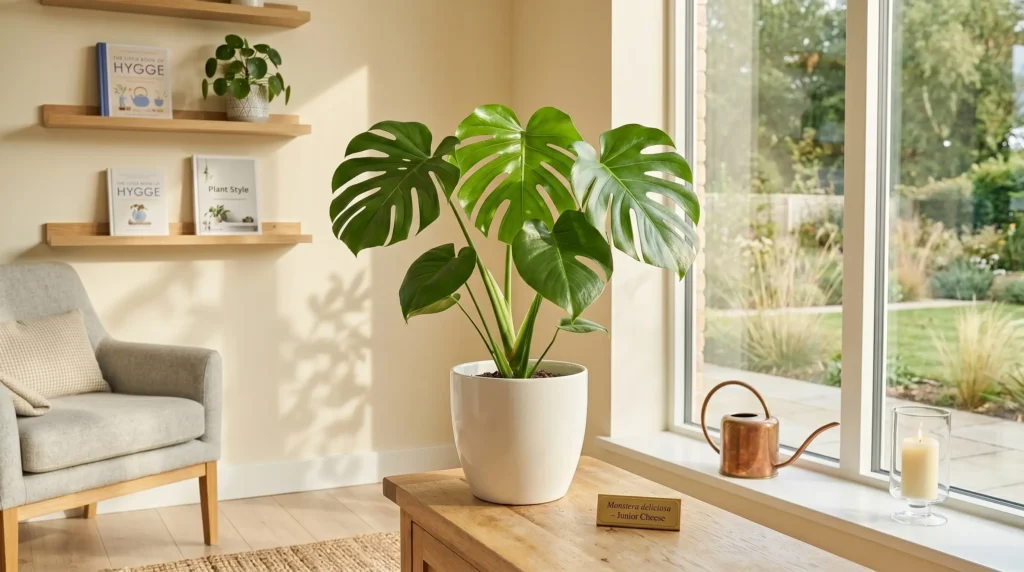
A cheese plant gets its name from the distinctive holes in its mature leaves — a pattern that resembles the holes in Swiss Emmental cheese. These holes are called
fenestrations. The prevailing scientific theory is that fenestrations evolved to allow light to filter through large lower leaves to smaller leaves beneath them in the dense jungle canopy.
In the UK, the plant is almost universally called a “cheese plant.Some UK retailers use both names interchangeably. Note that Monstera adansonii is sometimes called the “Swiss cheese vine” — it is a different but related plant with smaller, rounder holes. When in doubt, look for Monstera deliciosa on the label.
A Plant with a British History
Monstera deliciosa reached European cultivation in the mid-19th century. Its UK peak came in the 1970s and early 1980s, when it became a symbol of modern British interiors — the kind of plant that appeared in every soft-furnishings catalogue and sitcom living room. It fell from fashion for a while, overshadowed by minimalist trends, but returned emphatically from around 2016, driven by a global surge of interest in tropical houseplants via Instagram and interior design content.
Cheese Plant Care at a Glance
The cheese plant is an easy-care houseplant suited to most UK homes. The table below summarises everything you need.
| Care Factor | Requirement |
|---|---|
| Light | Bright indirect light; tolerates medium light |
| Watering | When the top 5 cm of compost feels dry (approx. every 7–10 days in summer) |
| Temperature | 18–27°C; never below 13°C |
| Humidity | 50–70% preferred; UK central heating drops this to 30–40% in winter |
| Soil | Well-draining aroid mix or peat-free compost with perlite and orchid bark |
| Fertiliser | Monthly liquid feed, April to September only |
| Repotting | Every 2–3 years in spring |
| Support | Moss pole or coir pole recommended as the plant matures |
| Toxicity | Toxic to cats, dogs, and children if eaten — keep out of reach |
| RHS Hardiness | H1B — can survive down to approximately 10°C but will stop growing |
UK-specific note: Most UK homes maintain temperatures well above the 13°C danger line, but unheated conservatories, draughty hallways, and rooms with single glazing can drop dangerously close in winter. Check these spots in January before placing your plant there.
How Much Light Does a Cheese Plant Need in a UK Home?
A cheese plant needs bright indirect light — and “bright indirect” in a UK home means positioning the plant within one to two metres of a south- or west-facing window, away from direct sun.
In the wild, Monstera deliciosa grows under a tropical forest canopy, receiving dappled, filtered light — rarely direct sun. This natural preference maps well onto most British homes, where rooms tend to receive moderate rather than intense light.
Best Window Positions in a UK Home
| Window Direction | Suitability | Notes |
|---|---|---|
| South-facing | Excellent (best option) | Use a sheer curtain to filter direct midday sun |
| West-facing | Excellent | Warm afternoon light; good growth |
| East-facing | Good | Soft morning light; gentle and consistent |
| North-facing | Marginal | Plant survives but may produce little to no fenestration; consider a grow light in winter |
The UK Seasonal Light Problem
This is the single biggest difference between UK care and US or tropical-country care guides: UK day length drops from around 16 hours in June to around 8 hours in December. The winter sun angle is also much lower — even a south-facing window in December provides a fraction of the light intensity it offers in June.
Practical UK seasonal light rule:
- Move the plant 30–40 cm closer to the window in October
- Move it back to its usual position in April
- This simple seasonal adjustment can make a significant difference to winter growth
Direct Sunlight Warning
Direct sun through glass will scorch cheese plant leaves, leaving brown crispy patches that will never recover. The fix for south-facing windows is simple: a sheer or net curtain placed between the window and the plant filters the light sufficiently without blocking it.
Signs Your Cheese Plant Needs More Light
- New leaves emerge without holes or splits (no fenestrations)
- Leaves are smaller than usual or than previous leaves
- The plant leans strongly toward the window
- Growth is very slow even during the summer growing season
Grow Lights for UK Winters
For north-facing rooms or very low-light positions, full-spectrum LED grow lights are a practical UK solution. Look for 6500K (“daylight” spectrum) bulbs. Position 20–30 cm above the plant, on a timer set to 12–14 hours per day. UK-available brands include Sansi, Barrina, and Soltech, widely available on Amazon UK.
How to Water a Cheese Plant — and How to Stop Killing It
The most common cause of cheese plant death in UK homes is overwatering. The golden rule is simple: never water on a fixed schedule — water only when the top 5 cm of compost feels dry.
How to Check Soil Moisture Correctly
Three methods, in order of reliability:
- Finger test: Push your finger 5 cm into the soil. If it feels damp or cool, wait another few days.
- Chopstick test: Insert a wooden chopstick to the same depth. If compost clings to it when you pull it out, the soil is still moist.
- Lift the pot: A well-watered pot feels noticeably heavy; a dry pot feels light. With practice, this is the quickest method.
Moisture meters (widely available in UK garden centres, typically £5–£15) are also reliable and particularly good for beginners.
How to Water Properly
- Water thoroughly until water runs freely from the drainage holes
- Allow the pot to drain completely — never let it sit in standing water in a saucer
- Empty the saucer after 30 minutes
- Bottom watering method (optional but effective): Place the pot in a bucket or sink of water for 20–30 minutes and allow it to soak up from below. This method reduces fungal issues and ensures thorough, even watering throughout the root zone.
UK Seasonal Watering Schedule
| Season | Typical Frequency | Notes |
|---|---|---|
| Spring (March–May) | Every 7–10 days | Plant waking up; begin increasing water gradually |
| Summer (June–August) | Every 5–7 days | Active growth; compost dries faster |
| Autumn (September–October) | Every 10–14 days | Reduce as growth slows |
| Winter (November–February) | Every 2–3 weeks | Always check 5 cm deep before watering — surface can feel dry while roots still have moisture |
UK winter watering note: Central heating dries out the surface of compost faster than the root zone dries. Always check 5 cm deep rather than judging moisture by the surface appearance.
Water Quality — a UK-Specific Consideration
UK tap water is generally safe for houseplants. However, hard water areas — including London, the South East, and the Midlands — can cause white mineral deposits on leaves. The fix: wipe leaves monthly with a damp cloth, and consider using rainwater, filtered water, or tap water left in an open container overnight.
Overwatering Symptoms
- Yellow leaves (by far the most common sign)
- Soggy, dark soil that never seems to dry out
- Mushy or blackened stem at the base
- Foul smell from the soil — root rot has begun
Underwatering Symptoms
- Drooping leaves when the compost is bone dry
- Leaves curling inward
- Brown, dry, papery leaf tips (a different texture from humidity-related browning)
Temperature and Humidity — The UK Challenge No One Talks About
The cheese plant prefers temperatures between 18–27°C and humidity between 50–70% — but British central heating, typically running from October to April, can push indoor humidity down to 30–40%. This gap is the single most under-discussed aspect of UK cheese plant care, and the primary cause of the brown crispy tips and edges that affect so many plants in British homes every winter.
Ideal Temperature Range
- Optimal: 18–27°C — the range found in most UK living rooms
- Minimum: 13°C — growth stops below this; prolonged cold causes leaf damage
- Brief cold draughts (from an exterior door, for example) can cause dark spots on leaves even without sustained low temperatures
Where NOT to Position Your Cheese Plant in a UK Home
- Next to a radiator — intense dry heat browns and crisps leaf edges
- In a draughty hallway or near frequently opened exterior doors
- On a windowsill with single glazing — can approach freezing on cold January or February nights
- In an unheated conservatory from October to April — too cold and too dark
- In a cold garage or utility room — unsuitable year-round
The Central Heating Humidity Problem — and Five Proven Solutions
When UK central heating is running, indoor relative humidity often drops from a comfortable 50–60% to as low as 30–40%. At this level, cheese plants develop brown, crispy tips and edges. This is not a watering problem — watering more will make it worse. The solution is to raise local humidity.
Five ways to raise humidity around your cheese plant:
- Pebble tray method: Fill a wide, shallow tray with pebbles. Add water to just below the top of the pebbles. Place the pot on top. As water evaporates, it raises the local humidity around the plant. Refill every few days. Cost: near zero.
- Plant grouping: Cluster your monstera with other tropical houseplants (pothos, peace lily, calathea). Combined transpiration from a group creates a naturally humid microclimate.
Good companions: pothos, peace lily, and calathea — which shares the same central heating humidity problem as your cheese plant.
- Humidifier: The most effective and consistent solution. A small ultrasonic humidifier placed near the plant maintains steady humidity levels. Aim for 50–60%. UK models: Levoit, Crane, TaoTronics (£20–£50 on Amazon UK).
- Bathroom placement: UK bathrooms are naturally more humid due to showers and baths. If your bathroom has a window with reasonable light and stays above 15°C year-round, it is close to an ideal environment for a cheese plant.
- Misting: Mist in the morning so leaves dry fully before evening — damp leaves overnight can encourage fungal spots. Use water at room temperature, never cold from the tap. Misting alone is not sufficient in very dry conditions; combine it with another method above.

The Best Soil and Pot for a UK Cheese Plant
A cheese plant needs well-draining compost with a chunky, open texture that holds some moisture without becoming waterlogged. It is an aroid — its roots need air as much as water.
What Monstera Needs from Its Compost
- Well-draining but not totally dry — retains moderate moisture
- Chunky texture with air pockets — roots are semi-aerial and need to breathe
- Slightly acidic to neutral pH — ideally 5.5–7.0
UK-Available Soil Mixes (Peat-Free Options)
Ready-made: Westland Aroid Potting Mix (Dobbies, online); Miracle-Gro Houseplant Compost (B&Q, Homebase, supermarkets).
DIY mix (recommended for best results):
- 60% peat-free houseplant compost
- 20% perlite (improves drainage; prevents compaction)
- 20% orchid bark (adds chunky air pockets)
All ingredients are available at B&Q, Dobbies, Homebase, and Amazon UK.
Choosing the Right Pot
Always use a pot with drainage holes. Non-draining pots cause root rot.
| Pot Type | Pros | Cons | Best For |
|---|---|---|---|
| Terracotta | Breathable; dries out faster; heavy and stable | Heavier to move; can break | Beginners; tends to prevent overwatering |
| Plastic nursery pot | Light; retains moisture; cheap | Less attractive; can lead to overwatering | Experienced waterers |
| Ceramic with drainage | Attractive; moderate water retention | Heavier; more expensive | Any level |
Pot sizing rule: Choose a new pot only 2–4 cm wider than the current one. Oversized pots hold too much water around the roots and significantly increase the risk of root rot.
Top-Dressing as an Alternative to Repotting
For large monsteras over 1 metre tall, repotting becomes physically difficult. Top-dressing is an effective annual alternative: remove the top 5–7 cm of compost and replace it with fresh mix. This refreshes nutrients and improves drainage without disturbing the root system.
Feeding Your Cheese Plant — A UK Seasonal Schedule
Feed your cheese plant monthly with a balanced liquid fertiliser from April through September. Do not feed in winter.
- Dose: Dilute to half the recommended strength — overfeeding causes more problems than underfeeding
- Products: Baby Bio Houseplant Food (supermarkets); Miracle-Gro Liquid All Purpose Plant Food (B&Q); Westland Houseplant Feed (garden centres); specialist monstera feeds from Patch Plants and Beards & Daisies
Signs of over-fertilising: White crusty deposits on the soil surface; sudden brown leaf tips. Fix by flushing the pot thoroughly with water several times.
Signs of under-fertilising: Pale, washed-out leaf colour despite good light; very slow summer growth; new leaves consistently smaller than older ones.
How and When to Repot a Cheese Plant
Repot your cheese plant when roots are visibly growing from the drainage holes, when it dries out within 2–3 days of watering, or when growth has stalled despite good care. The best time to repot in the UK is March or April, at the start of the spring growth surge.
Signs Your Cheese Plant Needs Repotting
- Roots visibly growing out of the drainage holes
- Soil dries out completely within 2–3 days of thorough watering
- Growth has slowed noticeably despite good light and regular feeding
- Water runs straight through without being absorbed (fully compacted soil)
When to Repot in the UK
- Best time: March–April (start of the growing season)
- Avoid: Winter repotting — the plant is resting and repotting stress can trigger leaf drop
- Young plants under 3 years may need repotting annually; mature plants every 2–3 years
Step-by-Step Repotting Guide
- Water the plant 24 hours before repotting — moist roots are more resilient
- Choose a new pot only 2–4 cm wider than the current one; have fresh aroid compost ready
- Add a layer of fresh compost to the base of the new pot
- Gently remove the plant — tap the sides of the old pot to loosen; never pull by the stem
- Inspect roots: trim any that are black, mushy, or rotten using clean scissors
- Place the plant in the new pot, fill around the sides with fresh compost, and firm gently
- Water thoroughly and return to its usual position
- Do not fertilise for 4–6 weeks after repotting — fresh compost contains sufficient nutrients
Aerial Roots and Moss Poles — What to Do and Why It Matters
Aerial roots are the brown or white rope-like roots that emerge from the stem of a cheese plant. They are a sign of a healthy, maturing plant — not a problem.
In the wild, Monstera deliciosa uses aerial roots to cling to tree trunks and climb toward the forest canopy. Supporting this behaviour indoors encourages the plant to produce its largest, most fenestrated leaves.
What Are Aerial Roots?
Aerial roots grow from the stem above soil level. They are designed to anchor the plant to surfaces and to absorb moisture from the air and from whatever surface they contact. Seeing them is a good sign.
Your Options When Aerial Roots Appear
- Tuck into the soil: The roots will absorb water and nutrients — a simple, effective option
- Leave them alone: Perfectly fine; adds to the tropical aesthetic
- Trim them back: Won’t harm the plant, though they will regrow
- Guide to a moss pole: The best long-term option for leaf size and fenestration quality
How to Set Up a Moss Pole in a UK Home
Moss poles and coir poles are widely stocked at B&Q, Dobbies, and on Amazon UK (£5–£20).
- Push the pole deep into the pot close to the main stem
- Use soft plant ties, jute twine, or small cable clips to guide stems and aerial roots toward the pole
- Keep the pole damp — mist it regularly so aerial roots can attach and draw moisture from it
- As the plant grows, add taller extensions (extendable poles are available in the UK)
Why a moss pole matters: Supporting the stem upright encourages larger, more deeply fenestrated leaves. Without support, the plant sprawls and produces smaller leaves. In UK homes with limited floor space, training the plant upward is far more practical than allowing it to spread. Expect noticeably larger leaves within 2–3 growth cycles after adding a well-maintained pole.
How to Propagate a Cheese Plant — Three Methods That Work in the UK
The best time to propagate a cheese plant in the UK is late spring to early summer — May and June — when growth is at its most active. Propagating in autumn or winter is possible but significantly slower. A heat mat (£10–£20 on Amazon UK) underneath the propagation container will speed things up in cooler months.
What You Need to Find: The Node
A node is the small bump or joint on the stem where a leaf attaches. Every cutting must include at least one node — without one, a cutting cannot produce roots or new growth. Aerial roots at the node will substantially speed up rooting.
Water Propagation (Beginner-Friendly)
- Identify a healthy stem with at least one node and one healthy leaf
- Cut 2–3 cm below the node using clean, sharp secateurs wiped with alcohol
- Remove any leaves or aerial roots that would sit underwater
- Place the cutting in a clear jar with enough water to cover the node
- Position in bright indirect light on a warm windowsill
- Change the water every 3–4 days to keep it fresh
- Roots appear within 2–4 weeks; pot up when roots reach 5–8 cm
- Transfer to a small pot with moist aroid compost; keep warm and humid for the first few weeks
Soil Propagation (Slightly Faster to Establish)
- Take the cutting as above — node, leaf, and aerial root if available
- Allow the cut end to callous for 1–2 hours
- Dip the cut end in rooting hormone powder (Westland Rooting Powder, available at B&Q)
- Plant 5–8 cm deep in a small pot of moist perlite or sphagnum moss
- Enclose loosely in a clear plastic bag or propagation dome to maintain humidity
- Keep at 20–22°C in bright indirect light
- Tug gently after 3–4 weeks — resistance means roots have formed
Air Layering (Best for Large, Mature Plants)
Best used when the plant is too large to cut without losing a significant amount of growth.
- Find a healthy stem section with a node or aerial root on your existing plant
- Make a small upward angled cut (2–3 cm) into the stem — do not cut all the way through
- Dust the cut with rooting hormone powder
- Wrap a large handful of damp sphagnum moss around the wound
- Wrap tightly with clear cling film, sealing top and bottom with tape
- Roots will grow into the moss over 4–8 weeks — visible through the cling film
- Once roots reach 3–5 cm, cut the stem below the rooted section and pot up normally
Cheese Plant Problems Solved — The Complete UK Troubleshooting Guide
Most cheese plant problems in UK homes are caused by one of four things: overwatering, insufficient light, low humidity from central heating, or cold exposure. The table below covers every common symptom.
| Problem | Most Likely Cause | Fix |
|---|---|---|
| Yellow leaves | Overwatering | Let soil dry; check for root rot |
| Brown crispy tips and edges | Low humidity (central heating) | Pebble tray, humidifier, move away from radiator |
| Brown patches on leaf face | Sunburn | Move away from direct sun; use sheer curtain |
| No holes or splits in leaves | Insufficient light | Move closer to window; add grow light in winter |
| Drooping leaves (moist soil) | Root rot or pot-bound | Check roots; repot if necessary |
| Drooping leaves (dry soil) | Underwatering | Water thoroughly |
| Small new leaves | Too dark, root-bound, or under-fed | More light; repot; begin monthly feeding |
| Dark spots on leaves | Cold damage or cold water splash | Move away from cold draughts; use room-temperature water |
| White deposits on leaves | Hard water (common in SE England) | Wipe with damp cloth; switch to rainwater or filtered water |
| Plant leaning badly | No support | Add moss pole; guide stem upward |
| Leggy growth, large gaps between leaves | Insufficient light | Move to a brighter spot |
Problem 1 — Yellow Leaves
Yellow leaves almost always mean overwatering — but context matters. A single lower yellow leaf is normal ageing; the plant sheds older leaves as it grows. Multiple leaves yellowing at once, particularly when the soil is wet, signals overwatering. If the compost smells and the base of the stem feels soft or mushy, root rot has set in. Treatment: remove from pot, cut away all black or mushy roots with clean scissors, allow roots to dry for one hour, repot in fresh dry compost, and withhold water for 7–10 days.
Problem 2 — No Fenestrations
Fenestrations develop only when the plant has sufficient light and has reached a certain maturity — typically plants need at least one to two years and several mature leaves before they begin fenestrating. Young plants under one year old will not split their leaves regardless of light. If a mature plant produces uncut leaves, move it to a significantly brighter position immediately. This problem is most common in UK homes between January and March when light levels are at their annual lowest.
Problem 3 — Brown Tips and Crispy Edges (the UK Winter Special)
Brown crispy tips and edges in UK homes during winter are almost always a humidity problem, not a watering problem. British central heating creates very dry air from November through March. Do not water more — it makes things worse. Raise humidity using the methods in the temperature and humidity section. Keep the plant at least 60 cm from any active radiator.
Problem 4 — Root Rot
Root rot is caused by overwatering combined with poor drainage and is far more common than most UK growers realise. Signs: yellowing leaves, soft or mushy stem base, foul-smelling compost. Early treatment is effective: remove all rotten roots, allow to dry, repot in fresh well-draining compost, and reduce watering significantly. Prevention is far easier than cure — always use a pot with drainage holes and never allow the pot to sit in standing water.
Cheese Plant Pests — What to Look For and How to Treat Them in the UK
The most common cheese plant pests in UK homes are spider mites, scale insects, mealybugs, and thrips. Spider mites are particularly prevalent in winter when central heating creates warm, dry conditions they thrive in.
Specialist monstera feeds from Patch Plants and Beards & Daisies — read our full Patch Plants review if you want to know whether they’re worth ordering.
Spider mites: Tiny red or orange specks on leaf undersides, often with fine webbing visible. Raise humidity immediately; wipe all leaf surfaces with a damp cloth; spray with diluted neem oil or houseplant pest spray. UK products: Westland Resolva Houseplant Bug Killer, SB Plant Invigorator.
Scale insects: Hard, brown oval bumps fixed to stems and leaf undersides. Scrape off individually with a cotton bud dipped in rubbing alcohol, then spray with neem oil weekly for 3–4 weeks.
Mealybugs: White fluffy deposits in leaf joints and at the base of leaves. Remove visible colonies with an alcohol-soaked cotton bud; spray the entire plant with neem oil or insecticidal soap. Repeat weekly.
Thrips: Tiny dark insects causing silvery streaks or stippling across leaves. Use yellow sticky traps plus neem oil spray; remove heavily infested leaves immediately.
Prevention Tips for UK Homes
- Inspect any new plant before bringing it home — pests travel on recently purchased plants
- Wipe leaves monthly with a damp cloth — removes dust and catches infestations early
- Avoid overcrowded plant arrangements in winter — poor air circulation encourages pests
- Quarantine any new plant for two weeks before placing it near your existing collection
Types of Cheese Plant — From the Classic to the Rare
There are several distinct varieties of cheese plant available in the UK, ranging from the widely stocked classic Monstera deliciosa to rare variegated forms that can cost several hundred pounds.
Monstera deliciosa (The Classic Cheese Plant)
The original and most widely available. Large, glossy, deeply split and holed leaves on a robust plant that can reach ceiling height indoors over several years. Available from approximately £5 for a small cutting to £80 or more for a large specimen. Stocked at B&Q, IKEA, Dobbies, and online from Patch Plants, Beards & Daisies, and Bloombox Club.
Monstera adansonii (The Swiss Cheese Vine)
Smaller, oval-holed leaves rather than the large fenestrations of M. deliciosa. A natural trailer and climber — excellent in hanging baskets or trained up a thin pole. Much more compact and good for UK flats with limited space. Often sold as “monkey mask” or “Swiss cheese vine” in UK shops.
Monstera deliciosa ‘Thai Constellation’
A tissue-culture variety featuring creamy white speckled variegation across the leaf. The variegation is stable and will not revert to plain green, making it a more reliable buy than Albo Variegata. Slower-growing than the standard form. UK prices: £40–£150 depending on size.
Monstera deliciosa ‘Albo Variegata’ (The Instagram Plant)
Bold white-and-green variegation caused by a natural genetic chimera. The variegation is unstable — leaves can revert to all-green, requiring the owner to prune back to variegated growth. Significantly more expensive. UK prices: £80–£300 or more for a single cutting. Not recommended for beginners.
Monstera deliciosa ‘Borsigiana’
Botanically the same species as M. deliciosa (current Kew taxonomy), but grows more compactly with smaller, more closely spaced leaves. Popular with UK collectors who want the classic look in a smaller footprint.
Monstera peru (For Beginners and Small Spaces)
Very different appearance — dark green, deeply textured leaves without holes or splits. Highly tolerant of low light and neglect. Stays compact. Excellent for beginners or rooms that cannot support a full-sized cheese plant.
Varieties Comparison Table
| Variety | Max Indoor Height | Leaf Style | UK Availability | Approx. UK Price | Best For |
|---|---|---|---|---|---|
| M. deliciosa | 2–4m | Large, fenestrated | Very common | £5–£80 | Everyone |
| M. adansonii | 1–2m | Small, oval holes | Common | £8–£30 | Small spaces, beginners |
| Thai Constellation | 1.5–2m | Creamy variegated | Moderate | £40–£150 | Collectors |
| Albo Variegata | 1.5–2.5m | White/green variegated | Rare | £80–£300+ | Experienced growers only |
| M. peru | 0.5–1m | Dark, bullate, no holes | Growing | £10–£35 | Beginners, low-light rooms |
 Is the Cheese Plant Toxic to Cats, Dogs, and Children?
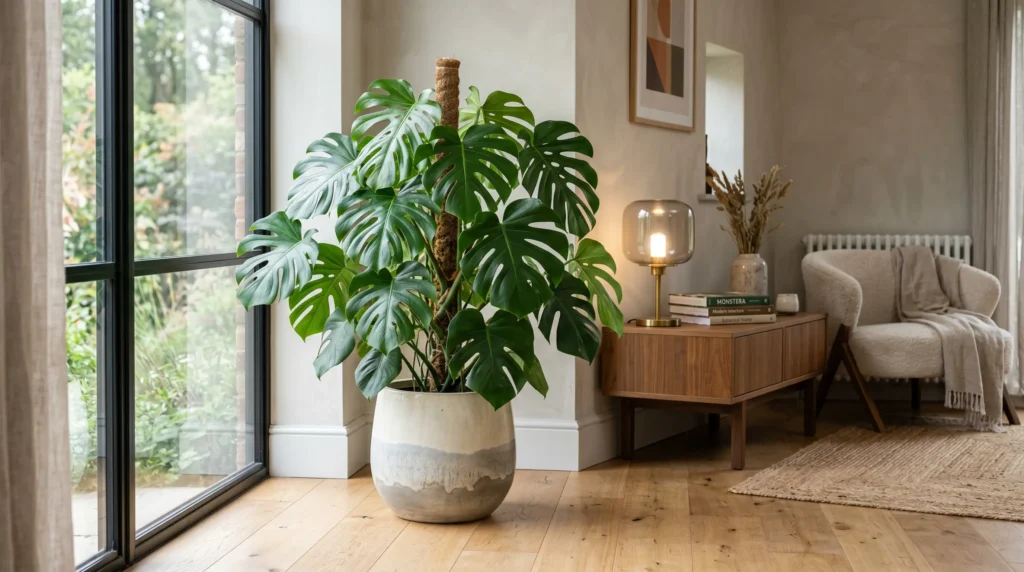
Yes — all parts of Monstera deliciosa are toxic if ingested by cats, dogs, and humans. The plant contains calcium oxalate crystals, which cause intense burning and irritation in the mouth, throat, and digestive tract when eaten.
Toxicity at a Glance
| Who | Risk | Symptoms |
|---|---|---|
| Cats and dogs | Toxic if eaten | Pawing at mouth, drooling, vomiting, loss of appetite |
| Children | Toxic if eaten | Burning mouth, excessive drooling, difficulty swallowing, nausea |
| Adults (skin contact) | Mild irritant | Skin and eye irritation from sap when handling |
The RHS lists Monstera deliciosa as harmful if eaten and as a skin and eye irritant, recommending protective equipment when handling.
What to Do If Your Pet or Child Eats Cheese Plant
- Pets: Call the Animal Poison Line (UK): 01202 509 000 (charged service) or your vet immediately
- Children: Call NHS 111 or take to A&E; bring a sample or photo of the plant
- Rinse the mouth thoroughly with water; do not induce vomiting
Keeping It Safe in a UK Home
- Place on a high shelf or elevated plant stand out of reach of children and pets
- Use a hanging planter for smaller varieties such as M. adansonii
- Wear gloves when repotting or propagating — the sap is a skin and eye irritant
- Wash hands thoroughly after any handling
Where to Buy a Cheese Plant in the UK — Our Honest Guide
Cheese plants are available throughout the UK from high-street garden centres, large DIY stores, and specialist online plant retailers. Prices and quality vary considerably.
What Size to Buy
| Size | Pot Diameter | Approx. Price | Notes |
|---|---|---|---|
| Small | 9 cm pot, 1–3 leaves | £4–£10 | Cheapest; takes years to become a statement plant |
| Medium | 12–15 cm pot, 3–6 leaves | £12–£25 | Best value; establishes quickly |
| Large | 17–21 cm pot, statement size | £30–£80 | Instant impact; ready to train on a moss pole |
UK High Street Options
| Retailer | Notes | Typical Price |
|---|---|---|
| B&Q (Trädgård range) | Widely available in-store; small to medium sizes | £8–£20 |
| IKEA | Very cheap small plants; quality variable but excellent value | £5–£12 |
| Dobbies Garden Centres | Good selection; medium to large sizes; staff advice available | £10–£35 |
| Homebase | Limited but widespread | £8–£18 |
| Marks & Spencer | Quality plants; good gift presentation | £15–£30 |
| Lidl / Aldi (seasonal) | Occasional very low-priced stock — buy when you see it | £4–£8 |
UK Online Plant Shops
| Online Retailer | Notes | Price Range |
|---|---|---|
| Patch Plants (patchplants.com) | Excellent packaging; named plants; UK-grown where possible | £12–£45 |
| Beards & Daisies (beardsanddaisies.co.uk) | Wide variety; plant and pot bundles; good gift option | £14–£60 |
| Bloombox Club | Subscription and one-off delivery; excellent packaging | £15–£55 |
| The Little Botanical | Curated selection; excellent gift packaging | £18–£50 |
| Houseplant.co.uk | Large range; detailed care info on every listing | £10–£50 |
| Amazon UK | Variable quality and seller reliability — check reviews carefully | £8–£40 |
What to Check When Buying In Store
- Avoid plants with yellow or brown leaves — existing stress
- Check the undersides of leaves for mealybugs (white fluffy deposits) or spider mites (tiny specks)
- Roots from drainage holes are normal — the plant just needs repotting soon
- Look for a plant with a new leaf unfurling — a reliable sign of active health
Buying Rare Varieties in the UK
For Thai Constellation, Albo Variegata, and other rarities: Rare Plants UK Facebook groups; Etsy UK plant sellers (check reviews carefully); UK Aroid Society sales events; occasional RHS plant fairs.
Styling Your Home With a Cheese Plant — Ideas for UK Spaces
The cheese plant’s large, architectural leaves make it one of the most versatile houseplants for British interiors — equally at home in a Scandi living room, a boho bedroom, or a contemporary white-painted space.
Room-by-Room Placement Ideas
Living room: Place in a corner with a moss pole — a plant of 1.2 metres becomes a genuine focal point. Pair with a woven basket planter. Works well against exposed brick, grey walls, or white-painted rooms.
Hallway: Often darker than ideal in UK homes. Can work well if a window is present, but may need supplemental light. A large plant makes a strong first impression.
Home office: A medium-sized cheese plant on a plant stand beside a desk softens the space. East-facing office windows are ideal. The plant also absorbs some airborne toxins from paints and furnishings.
Bedroom: Works well where light allows. The large leaves add genuine architectural interest and the plant produces oxygen through the night.
Bathroom: If the bathroom has a window and stays above 15°C year-round, this is close to an ideal environment — high humidity, soft indirect light, consistent warmth. Growth is often noticeably better in bathrooms than in living rooms.
Pot and Planter Recommendations (UK Market)
- Terracotta with saucer: Timeless, breathable — B&Q, Dobbies, garden centres
- Rattan / woven basket covers: Use as cache pots with a plastic nursery pot inside
- Ceramic pots with drainage: Anthropologie, H&M Home, IKEA, TK Maxx
- Elevated plant stands: Next, IKEA, West Elm, and most UK homeware shops
Cheese Plant FAQs
What is a cheese plant?
A cheese plant is Monstera deliciosa, a tropical climbing plant native to the forests of Mexico and Central America. It is one of the most popular houseplants in the UK, recognised by its large, glossy leaves with distinctive holes and splits called fenestrations.
How fast does a cheese plant grow in the UK?
In good conditions — bright indirect light, regular feeding, and adequate warmth — expect one to two new leaves per month from April to September. Growth slows significantly in UK winters due to reduced light and cooler temperatures.
Can I put my cheese plant outside in the UK in summer?
Yes. During warm UK summers (June to August), when overnight temperatures consistently stay above 18°C, a cheese plant can be placed outside in a sheltered, shaded spot. Bring it back inside in September. Never place it in direct full outdoor sun — the leaves will scorch.
How big will my cheese plant get indoors in the UK?
With good care, a cheese plant can reach 2–3 metres tall indoors over several years. Leaves on a mature plant can grow 60–90 cm wide. To control size, restrict the pot size or prune back in spring — cutting at a node allows you to remove significant height without harming the plant.
My cheese plant leaves aren’t splitting — what’s wrong?
Almost always a light issue. Move the plant closer to a window. Note that young plants under one to two years old do not produce fenestrated leaves regardless of light — this is normal development, not a problem.
Are cheese plants and Swiss cheese plants the same thing?
Yes. Both names refer to Monstera deliciosa. “Cheese plant” is the predominant UK term; “Swiss cheese plant” is used internationally and by some UK retailers. Note that Monstera adansonii is sometimes called the “Swiss cheese vine” — it is a different, related plant.
Why is my cheese plant dripping water?
This is called guttation — water droplets exuded through small pores in the leaves, usually overnight. It is completely normal and is a sign of a healthy, well-hydrated plant. It is not a sign of overwatering.
Can a cheese plant purify the air?
Research including the NASA Clean Air Study suggests that Monstera deliciosa can absorb airborne toxins including formaldehyde and benzene. The practical effect in a typical UK home is modest, but it is a genuine benefit alongside the plant’s aesthetic appeal.
Is the cheese plant toxic to cats and dogs?
Yes. All parts of Monstera deliciosa are toxic to cats, dogs, and children if eaten. The plant contains calcium oxalate crystals, causing intense oral irritation, drooling, and vomiting. Contact the Animal Poison Line (01202 509 000) or a vet immediately if a pet eats any part of the plant.
What is the difference between a cheese plant and a Monstera?
“Cheese plant” is the common UK name for Monstera deliciosa. “Monstera” is the genus, which contains around 50 species. When UK plant shops say “monstera,” they almost always mean Monstera deliciosa unless another species is specified. All monsteras belong to the arum family, but they vary considerably in leaf size, hole pattern, and growth habit.
Your Cheese Plant Will Reward a Little Attention
The cheese plant is one of the most forgiving houseplants available to UK buyers. Its requirements are straightforward and its resilience is remarkable. The vast majority of problems — overwatering, insufficient light, dry air from central heating — are all easily corrected once you know what to look for.
The three rules that cover 90% of UK cheese plant care:
- Water only when the top 5 cm of compost is dry
- Keep it within 1–2 metres of a window — and move it closer in October
- In winter, raise humidity to counteract central heating
Get those three things right and the rest will largely take care of itself. The cheese plant will grow, fenestrate, climb its moss pole, and eventually reach the ceiling. That is not a problem. It is the point.
This guide is written for UK home growers. For further reading: The brighton flower company

Leave a Reply