
The Trinitaria plant is an Bougainvillea — a fast-growing, thorny, flowering vine native to tropical South America. “Trinitaria” is the beloved Caribbean and Latin American regional name for this plant, used widely in Colombia, Panama, Puerto Rico, the Dominican Republic, and Venezuela.
If you’re searching for “trinitaria” and wondering whether it’s the same as bougainvillea: yes, it is exactly the same plant. Same species, same spectacular papery blooms, same care requirements — just a different name rooted in Caribbean cultural identity.
This complete guide covers everything: identification, all varieties and colors, step-by-step planting and care, pruning, propagation, troubleshooting, medicinal uses, and a month-by-month calendar. Whether you call it trinitaria, bougainvillea, bugambilia, or paper flower — this is your definitive resource.
Quick Facts: Trinitaria Plant
| Feature | Detail |
|---|---|
| Scientific Name | Bougainvillea spp. |
| Plant Family | Nyctaginaceae (Four-o’clock family) |
| Native Range | Brazil, Bolivia, Peru, Argentina, Paraguay |
| Common Names | Trinitaria, Bougainvillea, Santa Rita, Veranera, Bugambilia, Paper Flower, Papelillo |
| Bloom Colors | Pink, Magenta, Red, Orange, White, Yellow, Purple, Bicolor |
| USDA Hardiness Zones | 9–11 perennial; Zones 4–8 as annual/container |
| Growth Rate | Fast — up to 90 cm (3 ft) per season |
| Mature Size | 1–12 meters (3–40 ft) depending on variety and training |
| Drought Tolerance | High once established |
| Toxicity | Mildly toxic — sap is a skin irritant; mild GI upset in pets |
| Sun Requirements | Minimum 6 hours direct sun daily |
| Soil pH | 5.5–6.0 (mildly acidic) |
What Is the Trinitaria Plant?
The Trinitaria–Bougainvillea Connection
“Trinitaria” is not a separate species — it is the Caribbean Spanish name for the genus Bougainvillea. The plant is botanically identical whether you call it trinitaria in Puerto Rico or bougainvillea in an English-speaking garden center. This dual identity confuses many gardeners, which is why this guide uses both names interchangeably.
Regions that use the name “trinitaria”:
- Colombia
- Panama
- Puerto Rico
- Dominican Republic
- Venezuela
- Parts of the wider Caribbean basin
Other regional names for the same plant around the world:
| Name | Region |
|---|---|
| Bugambilia | Mexico, Philippines |
| Santa Rita | Argentina, Bolivia |
| Veranera | Colombia, Central America |
| Papelillo | Peru |
| Puti Tai Nobiu | Guam |
| Paper Flower | Southeast Asia, English Caribbean |
| Trinitaria | Caribbean, northern South America |
What Does the Trinitaria Plant Look Like?
Trinitaria is a thorny, woody, scrambling vine or shrub known for its intensely colorful papery bracts (not true petals). Here is exactly what to look for:
Leaves:
- Alternate arrangement on the stem
- Ovate to acuminate shape (egg-shaped tapering to a point)
- 4–13 cm long
- Deep green, slightly waxy
The “flowers” (bracts):
- The vivid pink, red, orange, white, or yellow “petals” you see are actually bracts — modified leaves, not true flowers
- Papery, thin texture — this is why it’s called “paper flower”
- Appear in clusters of three
The true flowers:
- Tiny, white, tubular
- Hidden inside the colored bracts
- Usually three per bract cluster
- Lack significant scent
Stems:
- Armed with sharp, hooked thorns with waxy black tips
- Woody and twining with age
- Can reach up to 12 meters (40 ft) if left unpruned
Growth habit:
- Shape-shifting: can be trained as a vine, shrub, hedge, standard tree, or bonsai
- Evergreen in year-round rainfall regions
- Semi-deciduous or fully deciduous during dry seasons or cold winters
Is Trinitaria a Flower, Vine, or Shrub?
Trinitaria is all three, depending on how you grow it. Left to its own devices, it is a scrambling vine that uses its thorns to grip and climb. Pruned and shaped, it becomes a shrub or even a small standard tree. Trained along a wall or trellis, it becomes a spectacular flowering vine. It is one of the most versatile ornamental plants in the world.
Trinitaria Around the World — Names & Cultural Identity {#names-cultural-identity}
Where Does the Trinitaria Plant Come From?
Trinitaria is native to tropical South America, specifically Brazil, Bolivia, Paraguay, Peru, Uruguay, and northern Argentina. It was first documented by Western science during French Admiral Louis Antoine de Bougainville’s voyage of circumnavigation between 1766 and 1769. Botanist Philibert Commerçon made the original collection; Antoine Laurent de Jussieu formally published the genus in 1789.
The name was standardized as “Bougainvillea” in the Index Kewensis in the 1930s. The plant spread globally when Kew Gardens distributed propagated specimens to British colonies across the tropics.
Cultural & Symbolic Significance
Trinitaria/Bougainvillea holds official status in numerous cities and countries:
- National flower of Grenada
- Official flower of: Guam, Tagbilaran (Philippines), Shenzhen and several Guangdong cities (China), Xiamen (China), Ipoh (Malaysia), Camarillo, Laguna Niguel, and San Clemente (California, USA)
- Deeply embedded in Caribbean, Latin American, South Asian, and Mediterranean visual identity
- Associated symbolically in some Latin cultures with passion, protection, and welcome
Why Is It Called “Trinitaria”?
The name “trinitaria” almost certainly references the Holy Trinity, because trinitaria blooms in a structurally trinitarian pattern: three bracts surround three small true flowers in each cluster. The number three is built into the plant’s architecture.
A secondary theory links the name to Trinidad, where the famous hybrid Bougainvillea × buttiana was first discovered in the garden of a Mrs. Butt — making Trinidad literally the birthplace of the most widely cultivated bougainvillea hybrids in the world.
Botanical Profile & Scientific Classification {#botanical-profile}
Scientific Classification
Trinitaria belongs to the genus Bougainvillea, within the family Nyctaginaceae (the four-o’clock family).
| Rank | Classification |
|---|---|
| Kingdom | Plantae |
| Clade | Tracheophytes → Angiosperms → Eudicots |
| Order | Caryophyllales |
| Family | Nyctaginaceae |
| Genus | Bougainvillea Comm. ex Juss. |
| Common species | 4–22 recognized |
| Cultivars | 300+ named hybrids and sports |
Key Species Used in Horticulture
| Species | Key Traits | Best Use |
|---|---|---|
| B. glabra | Smooth stems, fast-growing, slightly more cold-tolerant, evergreen | General garden use, walls |
| B. spectabilis | Large bracts, very vigorous, best in full tropical climates | Large-scale landscape |
| B. peruviana | Most stable species, native pink bract, less variable | Reliable species selection |
| B. × buttiana | Most common hybrid (B. glabra × B. peruviana), parent of 300+ cultivars | Almost all named cultivars |
Key fact: Most of the 300+ named cultivars in commercial cultivation descend from just three parent species, primarily through the hybrid B. × buttiana. Many cultivars originated as spontaneous bud-sports — natural genetic mutations that produce new bract colors or leaf variegation.
Trinitaria Plant Varieties & Colors {#varieties-colors}
Trinitaria Bract Colors at a Glance
Trinitaria comes in nearly every warm color imaginable. Here is a quick-reference color guide:
| Color | Top Cultivar Examples |
|---|---|
| Magenta / Hot Pink | ‘Barbara Karst’, ‘Raspberry Ice’ |
| Deep Red / Crimson | ‘San Diego Red’, ‘Scarlett O’Hara’ |
| Purple | ‘James Walker’, ‘Purple Queen’ |
| White | ‘Miss Alice’, ‘White Stripe’, B. glabra alba |
| Orange | ‘California Gold’, ‘Flame’ |
| Yellow / Golden | ‘California Gold’, ‘Golden Glow’ |
| Salmon / Coral | ‘Rosenka’, ‘Camarillo Fiesta’ |
| Bicolor | ‘Mary Palmer’ (white + pink), ‘Raspberry Ice’ (pink + variegated foliage) |
Top 10 Trinitaria Cultivars — Detailed Comparison
| Cultivar | Color | Size | Special Feature | Best Use |
|---|---|---|---|---|
| Barbara Karst | Deep red-magenta | Large, vigorous | Year-round bloomer in tropics | Walls, fences, Caribbean gardens |
| Miss Alice | White | Compact, thornless | Nearly thornless; RHS Award of Garden Merit | Containers, patios |
| San Diego Red | Bright red | Vigorous | RHS Award of Garden Merit | Covering walls, arbors |
| Rosenka | Salmon-orange → pink | Medium | Color changes as bracts age | Containers, hanging baskets |
| Mary Palmer | Pink + white bicolor | Large | Stunning split-color effect | Specimen plant, focal point |
| James Walker | Deep purple | Large, climbing | Rich, bold purple color | Pergolas, fences |
| Raspberry Ice | Hot pink + variegated foliage | Medium | Cream-edged leaves for year-round interest | Ornamental containers |
| California Gold | Yellow-orange | Vigorous | Rare yellow trinitaria color | Statement garden focal point |
| B. spectabilis | Magenta, pink | Very large | Parent species; dramatic scale | Large landscapes |
| B. glabra alba | White | Medium | Classic “paper flower” look | Walls, tropical gardens |
Double-Flowered vs. Single-Flowered Trinitaria
Single-flowered varieties have the classic papery bract appearance, a better bract-to-foliage ratio, and are generally hardier. Double-flowered varieties produce a more voluminous, ruffled appearance but are slightly more delicate and less cold-tolerant.
Variegated foliage cultivars (such as ‘Raspberry Ice’) provide visual interest even when the plant is not in bloom, making them excellent choices for containers and patios.
Dwarf & Compact Varieties for Small Spaces
| Cultivar | Bract Color | Why It Works for Small Spaces |
|---|---|---|
| ‘Helen Johnson’ | Brick-red | Compact habit; ideal for pots |
| ‘Miss Alice’ | White | Nearly thornless; excellent for balconies and patios |
| ‘Torch Glow’ | Pink-red | Upright, column-like; self-supporting without a trellis |
How to Plant a Trinitaria Plant (Step-by-Step) {#how-to-plant}
When to Plant Trinitaria
- Best planting time: Spring, after the last frost risk has passed and soil has warmed to at least 15°C (60°F)
- Tropical/subtropical climates (Zones 9–11): Plant year-round
- Cooler climates (Zones 4–8): Plant as a summer annual after last frost, or grow in containers to bring indoors in autumn
Choosing the Right Location
Trinitaria must have a location that receives at least 6 hours of direct, unobstructed sunlight daily — this is non-negotiable for reliable blooming.
Additional location requirements:
- Wind protection: Shelter young plants from strong winds; mature plants are wind-tolerant
- Drainage: Avoid low spots where water pools — waterlogged roots are the leading cause of trinitaria death
- Support structure: Plan for a trellis, wall, fence, or pergola from the moment of planting
- Avoid: Areas near swimming pools (falling bracts create mess); under eaves or overhangs that block rainfall
Soil Preparation
Trinitaria thrives in well-draining, mildly acidic soil with a pH of 5.5–6.0.
- Amend heavy clay with coarse sand or perlite to improve drainage
- Incorporate organic compost to improve fertility and soil structure
- Do not plant in compacted or waterlogged soil — this guarantees root rot
If you’re new to preparing soil for flowering plants, our Begonia Plant care guide covers soil and feeding principles for similarly tropical bloomers.
Step-by-Step Planting Instructions
What you need: Trinitaria plant in nursery pot, amended soil, mulch, support structure, watering can
- Dig the hole to twice the width of the root ball and the same depth
- Remove the plant carefully from its nursery container — do NOT disturb the root ball (trinitaria is extremely sensitive to root disturbance and will sulk badly or die if roots are broken up)
- Place the plant at exactly the same level it was in the pot — never bury the crown
- Backfill with amended soil and firm gently to eliminate air pockets
- Water thoroughly at the base — avoid wetting foliage
- Apply mulch in a 5–8 cm (2–3 inch) layer around the base, keeping it away from the stem
- Install support structure immediately so young stems can be trained from the start
- Do NOT fertilize at planting time — wait 4–6 weeks for the plant to settle before its first feed
Critical mistake to avoid: Many gardeners loosen the root ball when planting, thinking it helps the roots spread. With trinitaria, this causes significant transplant shock. Always plant with the root ball fully intact.
Transplanting Trinitaria
Trinitaria deeply dislikes being moved. If transplanting is unavoidable:
- Move with the maximum root ball intact
- Best season: early spring, before the growth flush
- Expect temporary leaf drop (transplant shock) — this is normal and the plant will recover
- Allow 6–12 months after transplanting before expecting strong blooms
Trinitaria Plant Care Guide {#care-guide}
Sunlight Requirements
Trinitaria requires a minimum of 6 hours of direct sunlight daily to bloom reliably.
- Minimum for blooming: 6 hours direct sun
- Optimal: 8+ hours for maximum bract production and color intensity
- Partial shade: Plant survives but produces significantly fewer blooms
- Indoors: South or west-facing window only; supplement with grow lights if needed
- The direct relationship: More sun = more bracts = more vibrant color. Insufficient light is the most common reason trinitaria fails to bloom.
Watering Trinitaria — The Golden Rule
Trinitaria blooms MORE when subjected to mild, periodic drought stress between watering cycles. Slight wilting between waterings actively triggers flowering.
Watering schedule by situation:
| Situation | Watering Frequency |
|---|---|
| Established in-ground plant (summer) | Deep water once per week |
| Container plant (summer) | When top 2–3 cm of soil is dry; typically 2× per week |
| In-ground plant (winter) | Rainfall is usually sufficient; water only if soil is bone dry |
| Container plant indoors (winter) | Once every 10–14 days |
Signs of overwatering: Yellow leaves, mushy stem base, wilting despite wet soil, root rot Signs of
underwatering: Crispy leaf edges, excessive bract drop, very dry soil
Always water at the base of the plant. Wet foliage promotes fungal disease.
Soil & Fertilizer
Trinitaria requires high-potassium (potash) fertilizer to bloom — high-nitrogen fertilizers promote lush foliage at the expense of flowers.
The nitrogen mistake: High nitrogen → abundant green leaves, very few or no bracts. This is the most common fertilizer error with trinitaria.
Feeding schedule:
| Season | Fertilizer Type | Frequency |
|---|---|---|
| Spring (growth phase) | Balanced NPK (e.g., 10-10-10) | Monthly |
| Summer (bloom phase) | High-potassium (e.g., 6-12-6 or tomato fertilizer) | Every 3–4 weeks |
| Autumn/Winter | None | Stop completely |
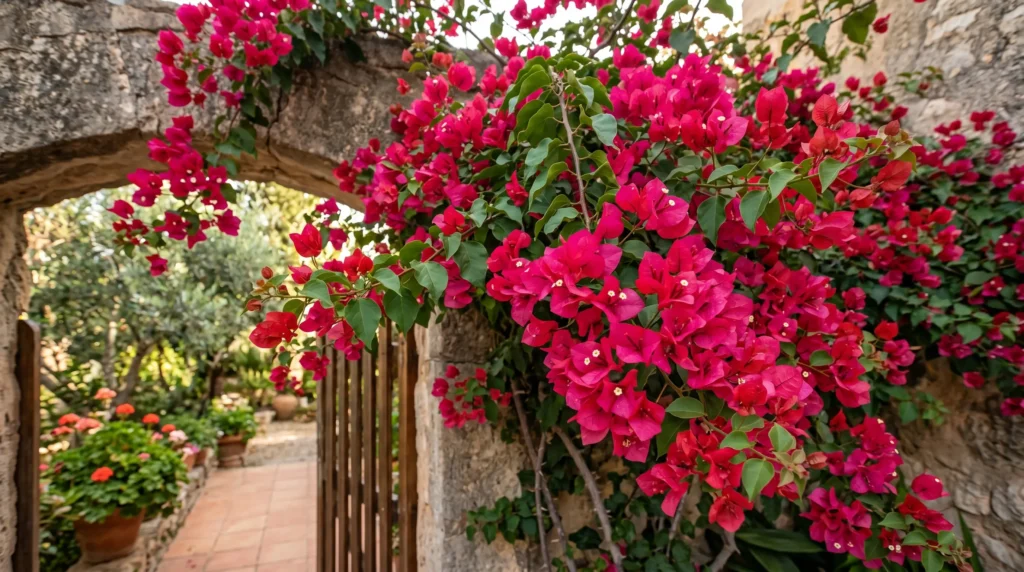
Organic fertilizer options:
- Banana peel compost: high potassium; excellent for bloom promotion
- Bone meal: provides phosphorus; supports flower initiation
Chlorosis (yellow leaves with green veins) signals iron deficiency — common when soil pH is too high (alkaline). Fix with chelated iron foliar spray or acidify the soil with sulfur or acidic mulch.
Temperature & Climate Tolerance
Trinitaria is a tropical and subtropical plant, perennial in USDA Zones 9b–11, and frost-sensitive.
| Temperature | Effect on Plant |
|---|---|
| 16–32°C (60–90°F) | Ideal growth and bloom range |
| Below 10°C (50°F) | Growth slows; chilling stress |
| Light frost | Leaf drop; roots usually survive; regrows in spring |
| Hard frost below -3°C (27°F) | Can kill plant to ground or entirely |
Overwintering container plants in cold climates:
- Move indoors before the first forecast frost
- Place in the brightest available window (south-facing preferred)
- Reduce watering to once every 10–14 days
- Expect leaf drop — this is normal seasonal dormancy
- Resume normal care in spring when nighttime temperatures consistently stay above 10°C (50°F)
Humidity
Trinitaria adapts to both humid and arid conditions. In very humid climates, ensure good air circulation to reduce fungal disease risk. In arid climates, it is highly drought-tolerant once established.
How to Prune Trinitaria Plant {#pruning}
Why Pruning Matters
Trinitaria blooms only on new wood, meaning pruning directly triggers the next bloom cycle. Without pruning, the plant becomes a tangled mass with fewer flowers and poor airflow.
Three reasons to prune:
- Flowers form only on new growth — pruning stimulates new shoots that carry blooms
- Controls size and shape
- Improves airflow, reducing pest and disease pressure
When to Prune Trinitaria
- Best time: After each bloom cycle ends (typically every 6–8 weeks in tropical climates)
- Major annual pruning: Late winter or early spring, before the new season’s growth flush
- Never prune: During peak bloom or active bud formation — you will remove developing flower buds
- In tropical climates: Light pruning can be done year-round after each bloom flush ends
How to Prune Trinitaria — Step-by-Step
What you need: Sharp pruning shears, thick gardening gloves, rubbing alcohol for sterilization
- Sterilize your pruning shears with rubbing alcohol before starting — this prevents the spread of fungal and bacterial disease between cuts
- Put on thick gloves — trinitaria thorns are sharp, hooked, and can cause deep puncture wounds
- Remove dead, diseased, or crossing branches first
- Cut lateral shoots back to 2–3 buds from the main stem
- Remove inward-growing shoots to open up the center and improve air circulation
- For major size reduction: Cut back hard to the main structural branches — trinitaria will recover vigorously
- Dispose of cuttings — do not compost diseased material
- Do not remove more than one-third of total growth in a single pruning session
Training Methods for Trinitaria
| Training Style | Method | Best Result |
|---|---|---|
| Wall espalier | Tie branches horizontally against a sun-facing wall | Maximum bract display; space-efficient |
| Standard tree | Prune to a single trunk; stake for support | Elegant specimen plant |
| Bonsai | Restrict roots in shallow container; slow irrigation | Miniature plant with spectacular blooms |
| Hedge | Plant multiple specimens; prune to uniform height | Living security barrier with color |
| Arbor/Pergola | Guide main stems upward; prune laterals for canopy branching | Overhead flowering shade structure |
The Professional Secret: Prune + Drought = Spectacular Rebloom
After pruning, withhold water for 2–3 weeks (mild drought stress). Then resume normal watering and high-potassium feeding. This prune-and-stress cycle triggers a new bloom flush within 4–6 weeks. In tropical climates, repeating this cycle every 6–8 weeks can produce 4–6 bloom flushes per year.
How to Propagate Trinitaria {#propagation}
Stem Cuttings (Most Reliable — Recommended)
Trinitaria propagates most successfully from semi-hardwood stem cuttings taken in late spring to early summer, with a success rate of 60–80% when rooting hormone is used.
Best time: Late spring to early summer
Step-by-step:
- Select a healthy stem — semi-hardwood (not very young green growth, not fully woody)
- Cut a 10–15 cm (4–6 inch) section just below a node
- Remove all leaves from the lower half; retain 2–3 leaves at the tip
- Dip the cut end in rooting hormone powder
- Insert into a well-draining propagation mix (50% perlite + 50% compost)
- Place in a warm location (21–27°C / 70–80°F) with bright indirect light
- Cover with a clear plastic bag or humidity dome to maintain moisture
- Keep the mix lightly moist — not saturated
- Roots develop in 4–8 weeks
- Harden off gradually before moving to full sun
Success rate: 60–80% with rooting hormone; lower without
Air Layering (For Larger Specimens)
Producing a well-established plant quickly from a mature specimen
- Select a healthy branch 60–90 cm (2–3 ft) long
- Remove a ring of bark 1–2 cm wide around the branch (wound it)
- Dust the wound with rooting hormone
- Wrap the wound with moist sphagnum moss
- Cover with plastic wrap; seal both ends tightly
- Roots appear within 6–10 weeks, visible through the plastic
- Cut below the rooted section and pot up in well-draining mix.For a detailed general guide to semi-ripe cuttings, the RHS Cuttings Propagation Guide is the definitive reference.
Growing from Seed (Least Common)
Seeds are viable but rarely produced in cultivated plants, and germination is slow and unreliable. More importantly, seedlings will not breed true — named cultivar characteristics (specific colors, double flowers, variegated foliage) do not carry over to seed-grown offspring. Seed propagation is not recommended unless you are specifically working on developing new varieties.
Common Propagation Mistakes to Avoid
| Mistake | Why It Fails | Fix |
|---|---|---|
| Using very soft new growth | Too fragile; rots before rooting | Use semi-hardwood — flexible but not soft |
| Using fully woody old growth | Too slow to root | Same — use semi-hardwood |
| Overwatering cuttings | Causes stem rot before roots form | Keep mix moist, not wet |
| Too cool (below 18°C/65°F) | Rooting stops below this temperature | Use a heat mat |
| Skipping rooting hormone | Significantly reduces success rate | Always use rooting hormone |
Growing Trinitaria in Pots & Containers {#containers}
Can Trinitaria Grow in a Pot?
Yes — trinitaria can thrive in containers, and in cold climates it is the only practical way to grow it as a perennial. A key insight: slight root restriction in containers actually promotes flowering, making container-grown trinitaria sometimes bloom more reliably than in-ground plants given excessive root space.
Choosing the Right Container
| Factor | Recommendation |
|---|---|
| Minimum size (dwarf varieties) | 30 cm (12 inch) diameter |
| Minimum size (vigorous varieties) | 45–60 cm (18–24 inch) diameter |
| Best material | Terracotta (breathes well, reduces overwatering risk) |
| Acceptable material | Plastic (works, but requires more careful watering) |
| Drainage | Multiple drainage holes — non-negotiable |
| Avoid | Glazed ceramic without drainage holes |
Container-Specific Care Tips
- Use a fast-draining potting mix — add 30% perlite to standard potting compost
- Feed container plants more frequently than in-ground plants (nutrients leach out faster with regular watering)
- Repot only when clearly root-bound, approximately every 2–3 years — slight root restriction encourages flowering
- Elevate containers on pot feet to improve airflow and drainage
- Move indoors before the first frost; place in the sunniest available window
Trinitaria in Hanging Baskets
Cascading varieties — especially ‘Rosenka’ and ‘Miss Alice’ — are exceptional in hanging baskets. Use a deep basket with excellent drainage. Daily watering may be needed during peak summer heat. The result on a patio, balcony, or pergola edge is spectacular.
Trinitaria Landscaping Ideas {#landscaping}
Classic Landscape Uses
- Wall coverage: Train along walls or fences for a dramatic cascade of color
- Pergolas and arbors: Plant at the base, guide up posts; creates flowering overhead shade
- Privacy hedges: Dense, thorny growth forms a natural, near-impenetrable security barrier
- Slope and erosion control: Ground-cover varieties stabilize slopes and rocky banks
- Coastal gardens: High salt tolerance makes trinitaria excellent near the sea
Companion Planting with Trinitaria
| Companion Plant | Why It Works |
|---|---|
| Plumbago auriculata | Same sun and drought requirements; blue flowers complement trinitaria magenta |
| Lantana | Same conditions; attracts butterflies alongside trinitaria blooms |
| Agapanthus | Structural contrast with trinitaria’s billowing habit |
| Agave / Succulents | Shared drought tolerance; strong textural contrast |
Specialty Uses
- Bonsai: Trinitaria is a popular bonsai subject — thorny angular branches and brilliant blooms create dramatic miniature specimens
- Topiary standards: Trained to a single trunk with a pruned canopy — striking formal focal point
- Espalier on walls: Flat-trained against sun-facing walls to maximize bract display in limited space
Common Pests & Diseases {#pests-diseases}
Common Pests
| Pest | Symptoms | Treatment |
|---|---|---|
| Aphids | Sticky residue (honeydew), distorted new growth, yellowing | Neem oil spray; insecticidal soap; introduce ladybugs |
| Mealybugs | White cottony masses at stem joints | Rubbing alcohol on a cotton swab; neem oil; systemic insecticide for severe cases |
| Scale Insects | Brown waxy bumps on stems; yellowing leaves | Scrape off manually; apply horticultural oil spray |
| Spider Mites | Fine webbing on leaves; stippled, bronzed foliage | Increase humidity; insecticidal soap; neem oil |
| Caterpillars | Chewed leaves; visible frass (excrement) | Bacillus thuringiensis (Bt) spray; hand-picking |
| Iguanas (tropical regions) | Eaten bracts and stripped stems | Physical barriers; repellent sprays; netting |
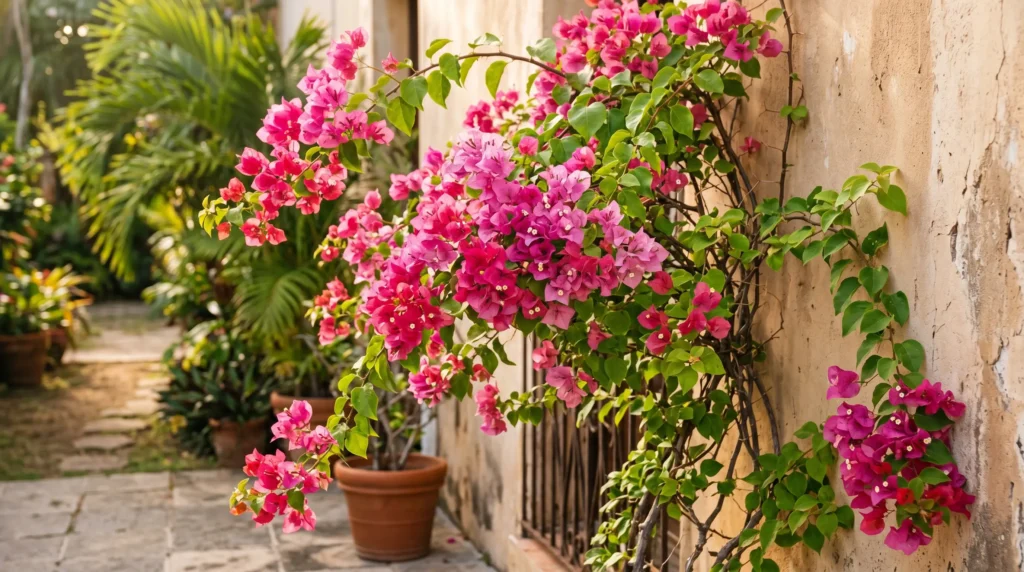
Common Diseases
| Disease | Symptoms | Cause | Treatment |
|---|---|---|---|
| Root Rot | Wilting despite wet soil; dark, mushy roots | Overwatering / poor drainage | Reduce watering; improve drainage; apply fungicide drench |
| Powdery Mildew | White powdery coating on leaves | High humidity + poor airflow | Improve airflow; apply sulfur-based fungicide |
| Leaf Spot | Dark spots on leaves | Fungal or bacterial infection | Remove affected leaves; avoid overhead watering |
| Chlorosis | Yellow leaves with green veins | Iron deficiency in alkaline soil | Apply chelated iron foliar spray; lower soil pH |
| Bract Drop | Premature loss of colored bracts | Cold draft, overwatering, or low light | Identify and address the root cause; ensure stable environment |
Non-Pest Physiological Problems
- Leggy growth with few blooms: Insufficient sun or too much nitrogen fertilizer
- Heavy leaf drop in winter: Normal dormancy in deciduous-climate plants — do not panic or overwater in response
- No blooms after pruning: Either pruned during bud formation, or plant is not receiving sufficient light
Troubleshooting — Why Is My Trinitaria Not Blooming? {#troubleshooting}
This is the most common trinitaria question, and it almost always has a diagnosable cause. Work through this table systematically:
10 Causes of Non-Blooming Trinitaria & How to Fix Each
| # | Cause | How to Diagnose | Fix |
|---|---|---|---|
| 1 | Not enough sunlight | Plant receives fewer than 6 hours of direct sun daily | Relocate plant or remove shade obstacles |
| 2 | Too much nitrogen fertilizer | Lush, dark green leafy growth; zero or few bracts | Switch to high-potassium fertilizer immediately |
| 3 | Overwatering | Soil is constantly wet; leaves yellow | Allow soil to dry between waterings |
| 4 | Pruned at the wrong time | Pruned while buds were forming | Prune only after each bloom cycle has ended |
| 5 | Plant is too young | Plant is under 1–2 years old in its location | Patience — young plants prioritize root establishment before flowering |
| 6 | Root-bound in container | Roots are escaping from drainage holes | Repot to a slightly larger container |
| 7 | Temperature too cold | Nighttime temperatures below 10°C (50°F) | Move indoors or protect from cold |
| 8 | Fertilizing in winter | Fertilizer applied during dormancy period | Stop all fertilizing in autumn; resume in spring |
| 9 | Night-time light pollution | Artificial lights illuminate the plant after dark | Provide true dark periods — short days trigger bloom |
| 10 | Recent transplanting | Plant was moved recently | Allow 6–12 months to re-establish before expecting free flowering |
The Professional Cycle for Year-Round Blooms
In tropical climates, experienced growers use this repeating cycle to produce 4–6 bloom flushes per year:
- Prune after each bloom flush ends
- Withhold water for 2–3 weeks (mild drought stress — some wilting is acceptable)
- Resume watering and apply high-potassium fertilizer
- Wait 4–6 weeks — new bloom flush appears
- Repeat
This prune-drought-feed cycle exploits trinitaria’s natural flowering trigger: mild stress signals the plant to reproduce.
Trinitaria Plant Medicinal & Traditional Uses {#medicinal-uses}
Traditional Medicinal Uses by Region
Important disclaimer: The following describes traditional and folk uses. Clinical evidence in humans is limited. Always consult a qualified healthcare professional before using any plant medicinally.
| Region | Traditional Use | Plant Part Used | Preparation Method |
|---|---|---|---|
| Mexico | Coughs, bronchitis, respiratory inflammation | Flowers (bracts) | Steeped in hot water as a tea |
| Venezuela / Caribbean | Expectorant for excess mucus | Flowers + leaves | Infusion |
| Brazil | Throat inflammation | Flowers | Tea |
| Parts of Latin America | Topical antiseptic; acne management | Leaves | Applied directly to skin |
| Traditional herbalism | Laxative (roots); astringent (leaves) | Roots / Leaves | Separate preparations |
What Science Has Found
Active compounds identified in Bougainvillea species include:
- Bougainvinones A–H: Peltogynoid compounds found in B. spectabilis bark, studied for cytotoxic activity (Do et al., 2016, Journal of Natural Products)
- Flavonoids and betacyanins: Present in bracts; antioxidant properties under investigation
- Botanical insecticide potential: B. glabra has been studied as a botanical insecticide with potential applications in sand fly control, relevant to leishmaniasis prevention in endemic regions
How to Prepare Traditional Trinitaria Tea
What you need: 10–15 fresh, clean trinitaria flowers (bracts and inner true flowers), 500 ml (2 cups) water, strainer, honey (optional)
- Bring 2 cups of water to a gentle boil
- Add the flowers; reduce heat to a low simmer
- Simmer for 5 minutes
- Remove from heat; cover and steep for an additional 10 minutes
- Strain into a cup; add honey if desired
- Traditional use: 1 cup, 2–3 times daily for respiratory relief
Do not use trinitaria preparations during pregnancy. Do not use as a substitute for prescribed medication. Consult a doctor before medicinal use.
Month-by-Month Trinitaria Care Calendar {#care-calendar}
Calendar based on Northern Hemisphere temperate schedule. Tropical growers: adapt to your wet/dry season cycles.
| Month | Primary Tasks |
|---|---|
| January | Minimal watering; no fertilizer; check indoor container plants for pests |
| February | Watch for first signs of new growth; clean and sharpen pruning tools |
| March | Major spring pruning (in cool climates); resume light watering; apply first balanced fertilizer feed |
| April | Increase watering as growth accelerates; apply balanced fertilizer monthly |
| May | First bloom flush expected; switch to high-potassium fertilizer; train new growth onto support structures |
| June | Post-bloom prune; begin 2–3 week mild drought period to trigger second bloom cycle |
| July | Second bloom flush; monitor for aphids in heat; deep water once weekly |
| August | Maintain bloom cycle; reduce nitrogen fertilizer; check for pests |
| September | Post-summer prune if needed; begin reducing fertilizer frequency |
| October | Reduce watering; prepare container plants for indoor move in frost-risk zones |
| November | Move containers indoors before first frost; stop fertilizing entirely |
| December | Full dormancy care; minimal watering; clean up fallen bracts around the plant base |
Is Trinitaria Toxic?
Toxicity Overview
Trinitaria is mildly toxic to humans and pets — it is not lethally dangerous, but caution is warranted.
| Group | Risk Level | Symptoms |
|---|---|---|
| Humans | Mild | Sap contact causes contact dermatitis (skin rash, redness, irritation) |
| Dogs | Mild | Ingestion causes vomiting, diarrhea, lethargy |
| Cats | Mild | Similar gastrointestinal upset to dogs |
| Children | Physical hazard | Sharp thorns cause puncture wounds; keep away from unsupervised children |
Safety Precautions
- Always wear thick gardening gloves when pruning — you face both thorn injury risk and sap exposure risk
- Wash hands thoroughly with soap and water after handling any part of the plant
- Do not use trinitaria preparations medicinally during pregnancy — safety has not been established
- Plant thornless cultivars (such as ‘Miss Alice’) in areas used by children or pets for safer family gardens
- Position plants away from high-traffic children’s play areas if using thorned varieties
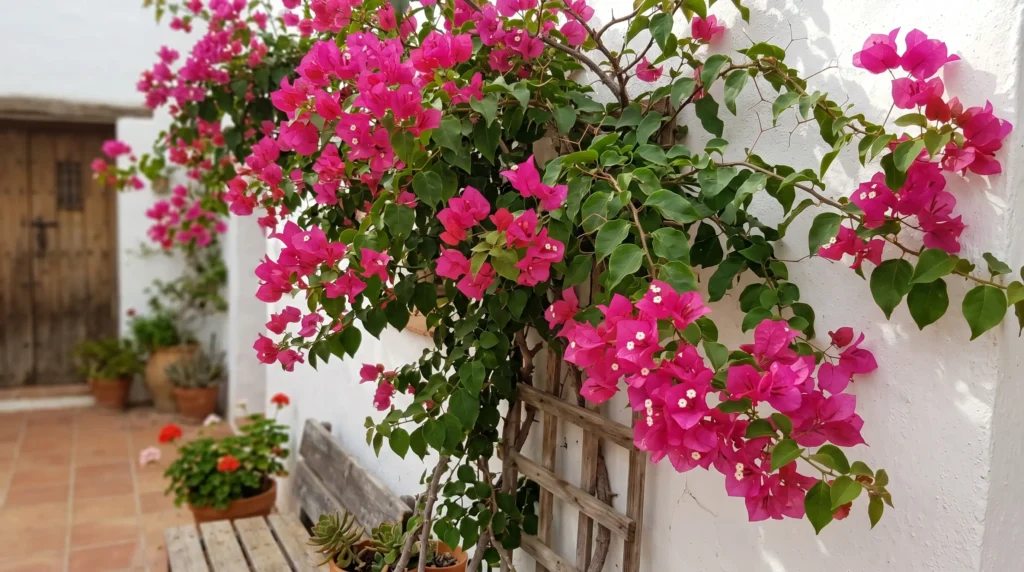
Frequently Asked Questions About the Trinitaria Plant
Q1: Is trinitaria the same as bougainvillea?
A: Yes. “Trinitaria” is the Caribbean Spanish regional name for the genus Bougainvillea. The same plant is called trinitaria in Colombia, Panama, Puerto Rico, the Dominican Republic, and Venezuela. Botanically, it is Bougainvillea spp., belonging to the family Nyctaginaceae. There is no botanical distinction — they are identical.
Q2: How fast does a trinitaria plant grow?
A: Trinitaria is a fast grower. Established plants in warm climates put on 90 cm to 1.2 meters (3–4 feet) of new growth per season. In optimal tropical conditions, mature vines can reach 12 meters (40 feet) in height. Container plants and dwarf cultivars grow more slowly.
Q3: Does trinitaria grow in cold climates?
A: Trinitaria is frost-sensitive and perennial only in USDA Hardiness Zones 9–11. In colder climates (Zones 4–8), it can be grown as a summer annual or kept in containers that are moved indoors before the first frost. With protection, it can survive light frosts and re-sprout from roots in spring.
Q4: Why are my trinitaria leaves turning yellow?
A: Yellow leaves most commonly indicate one of two problems: (1) overwatering or poor drainage, leading to root stress or early root rot, or (2) iron deficiency (chlorosis) in alkaline soil, where yellow leaves show distinct green veins. Check soil moisture first — allow the soil to dry between waterings. If yellowing with green veins persists, apply chelated iron fertilizer and consider lowering the soil pH.
Q5: How long does trinitaria take to bloom after planting?
A: A newly planted trinitaria typically takes 1–2 years to establish its root system before blooming freely. Young nursery plants may produce some blooms in the first season, but consistent, abundant flowering generally begins in year two. Ensure maximum sun exposure, avoid overwatering, and use a high-potassium fertilizer to encourage early blooming.
Q6: Can trinitaria grow indoors?
A: Trinitaria can be kept indoors but struggles without adequate light. It requires at least 6 hours of direct sun daily — a standard that most indoor environments cannot meet. A bright south-facing window or supplemental grow lighting is essential. Trinitaria is better treated as a container plant grown outdoors, brought inside only for winter protection in cold climates.
Q7: How do you make trinitaria bloom year-round?
A: In tropical climates, the prune–drought–feed cycle produces near year-round blooms. After each bloom flush: prune the plant back, withhold water for 2–3 weeks to create mild drought stress, then resume watering and apply a high-potassium fertilizer. Repeat this cycle every 6–8 weeks. Ensure the plant receives maximum direct sunlight at all times — this is the foundational requirement.
Q8: What is the difference between trinitaria bracts and flowers?
A: The colorful “petals” on trinitaria are not petals at all — they are bracts, which are modified leaves. The true flowers are the tiny, white, tubular structures found in clusters of three inside each set of bracts. The bracts evolved to attract pollinators to the inconspicuous true flowers. This is why trinitaria is sometimes called “paper flower” — the bracts have a papery, leaf-like texture rather than a fleshy petal texture.
Q9: Is trinitaria deer-resistant?
A: Yes, trinitaria is largely deer-resistant in practice. Deer typically avoid plants with thorns, sap irritants, and tough foliage. While no plant is completely deer-proof in conditions of extreme hunger, trinitaria’s sharp, hooked thorns make it an unappealing target compared to softer garden plants.
Q10: How do I overwinter trinitaria in a pot?
A: Before the first forecast frost: move the container indoors to the brightest available window (south-facing preferred). Reduce watering to once every 10–14 days. Expect significant leaf drop — this is normal dormancy, not a sign the plant is dying. Do not fertilize. In spring, when nighttime temperatures consistently stay above 10°C (50°F), move the plant back outdoors, gradually acclimating it to full sun over 1–2 weeks, and resume normal care.
Final Thoughts on the Trinitaria Plant
The trinitaria — whether you know it by that Caribbean name or as bougainvillea, bugambilia, Santa Rita, or paper flower — is one of the most spectacular and surprisingly low-maintenance ornamental plants in the world. Its tolerance for drought, heat, and neglect, combined with its capacity to produce multiple vivid bloom flushes per year, makes it an exceptional choice for warm-climate gardens, container patios, and tropical landscapes alike.
The keys to success are simple: maximum sun, disciplined watering (allow the soil to dry), high-potassium fertilizer during bloom periods, and regular pruning after each bloom cycle ends. Master those four principles, and trinitaria will reward you with cascading color season after season.
Choose your variety, find your sunniest wall or patio spot, and start with a healthy cutting or nursery plant this spring.
Related guides: Trinitaria Varieties & Colors | Trinitaria Propagation from Cuttings | Trinitaria in Pots | Why Is My Trinitaria Not Blooming? | Trinitaria Medicinal Uses & Tea
Schema Markup Notes (for developer implementation):
- FAQPage JSON-LD: Apply to all Q&A pairs in Section 16
- HowTo JSON-LD: Apply to planting steps (Section 5) and pruning steps (Section 7)
- Article JSON-LD: Apply to full page with author, datePublished, dateModified fields
- BreadcrumbList: Home > Plants > Trinitaria Plant

Leave a Reply