
Its hardiness rating is H1B, which means it must be kept frost-free and above 15°C at all times. All temperature guidance in this article is given in Celsius.The core problem is this: roughly 90% of fiddle leaf fig guides online are written for American or Australian growers. They assume year-round bright sunshine, warm winters, and air conditioning — none of which describe a British home. UK growers face uniquely low winter light levels, damp cool summers, gas central heating that strips humidity, and draughty Victorian windows. This guide was written specifically for those conditions.
15°C
2–3m
25 yrs
AGM
Know Your Plant — Varieties, Sizes & What to Expect in a UK Home
Two main forms of fiddle leaf fig are sold in the UK: the standard Ficus lyrata tree form and the compact cultivar Ficus lyrata ‘Bambino’. Choosing the right one for your space is the first decision to get right.
Fiddle Leaf Fig Varieties Available in the UK
Standard Ficus lyrata — Tree Form
- Tall, single-trunk habit
- Leaves up to 45cm, deep glossy green
- Reaches 2–3m indoors in the UK
- Best for large rooms, hallways, open-plan living
- Available at Dobbies, RHS garden centres, PlantDrop
- More dramatic statement; slower to recover if stressed
Ficus lyrata ‘Bambino’ — Compact Cultivar
- Maximum height ~1m — ideal for UK flats
- Thicker, more leathery leaves; bushier habit
- More forgiving of lower light — better for north-ish rooms
- Sold at IKEA UK, Dobbies, and PlantDrop
- Excellent choice for first-time FLF owners
- No competitor guide explains this distinction for UK buyers
Bush Form vs Tree Form — Which Should You Choose?
The bush form (multi-stem) is more forgiving for beginners — multiple stems mean losing one leaf or branch doesn’t ruin the silhouette. The tree form (single trunk) is a dramatic statement piece but requires more commitment. Match your choice to your UK home type:
| UK Home Type | Recommended Form | Recommended Variety | Why |
|---|---|---|---|
| Small flat or studio | Bush or compact | Bambino | Low ceilings; limited floor space |
| Victorian terrace with bay window | Tree form | Standard Ficus lyrata | Bay window offers ideal bright indirect light |
| Open-plan new build | Tree form | Standard Ficus lyrata | Height and space to make a statement |
| North-facing room | Bush form | Bambino (more tolerant) | Lower light tolerance; easier to supplement with grow light |
| Conservatory (with indoor access) | Either | Standard Ficus lyrata | Excellent summer light — must be moved inside in October |
How Big Will a Fiddle Leaf Fig Get in a UK Home?
.A well-cared-for FLF can live 25 years or more indoors. It is a genuine long-term investment — which appeals to many UK buyers who prefer quality over disposable houseplants. Set realistic expectations from the start and you will not be disappointed.
Light Requirements — The Make-or-Break Factor in UK Homes
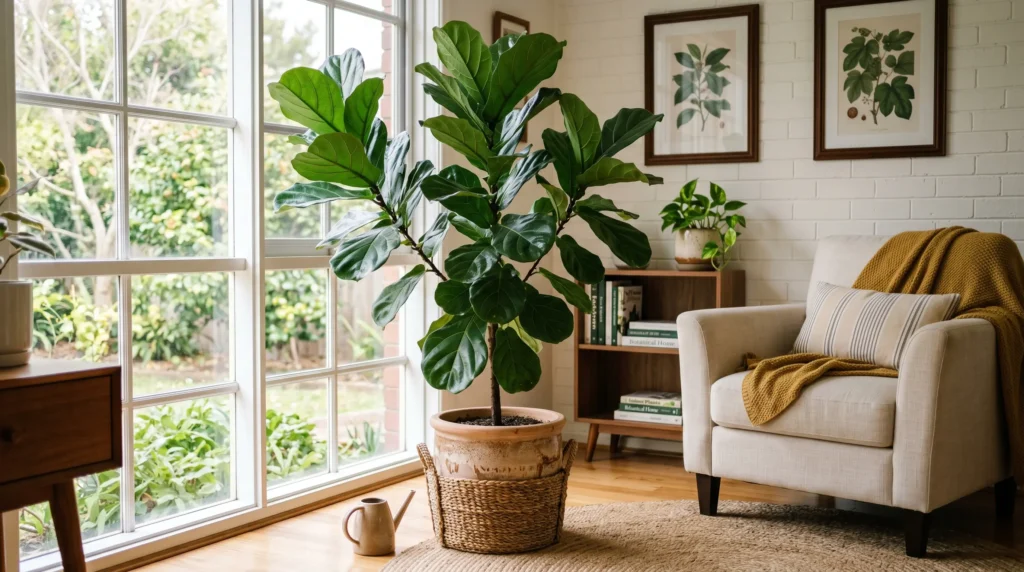
Light is the single most important factor in fiddle leaf fig care in the UK. British winter light levels are dramatically lower than almost anywhere else on earth where FLF care guides are written, and failing to account for this is the root cause of most UK FLF failures.
low-light tolerant alternatives like the ZZ plant.
What Light Level Does a Fiddle Leaf Fig Actually Need?
UK Window Direction Guide
This is the guidance that no American or Australian guide can give you. Window orientation in the UK determines everything:
| Window Direction | Light Quality | FLF Suitability | Notes |
|---|---|---|---|
| South-facing | Bright, indirect most of the day | Best | The UK’s premium FLF position. Place 60–90cm from the glass. |
| West-facing | Strong afternoon sun | Good | Use a sheer curtain in summer to prevent leaf scorch. |
| East-facing | Good gentle morning light | Acceptable | Adequate in summer; supplement with grow light in winter. |
| North-facing | Consistently dim | Insufficient | Almost always too dark. Leads to leggy growth and root rot risk. Requires grow light year-round. |
The UK Winter Light Problem — And How to Solve It
Solutions for the UK winter light problem:
- Move the plant closer to the window in September — within 60cm of a south- or west-facing pane if possible
- Clean the leaves monthly with a damp soft cloth — dusty leaves absorb significantly less light
- Clean the window glass — dirty glass can reduce light transmission by 20–30%
- Use a full-spectrum LED grow light (see below)
UK Light Calendar — Indoor Lux by Season
| Season | Months | Daylight Hours | Approx. Indoor Lux (near south window) | FLF Status |
|---|---|---|---|---|
| Spring | March–May | 11–16 hrs | 800–2,000 lux | Active growth |
| Summer | June–August | 16–17 hrs | 1,500–3,000+ lux | Peak growth |
| Autumn | September–November | 8–12 hrs | 400–1,000 lux | Slowing down |
| Winter | December–February | 7–8 hrs | 100–300 lux | Near-dormant — supplement light |
Grow Lights for UK Winters — What Actually Works
Signs your fiddle leaf fig isn’t getting enough light (especially October–March):
- Long gaps between leaves on the stem (leggy growth)
- New leaves are noticeably pale or smaller than existing leaves
- Mould or green algae appearing on the soil surface
- Increased susceptibility to root rot despite careful watering.
Watering Your Fiddle Leaf Fig — The UK-Specific Rules
Overwatering in low winter light is the single most common cause of fiddle leaf fig death in the UK. The UK’s reduced winter daylight means plants use water far more slowly than in summer — and watering habits must change accordingly.
How to Know When to Water (The Finger Test)
| Season | Watering Frequency | Soil Dryness Test | UK Notes |
|---|---|---|---|
| Spring | Every 7–10 days | Top third dry | Increase gradually as light improves |
| Summer | Every 5–8 days (outdoors may need daily) | Top inch dry | Hot spells may require more frequent checks |
| Autumn | Every 10–14 days | Top third dry | Reduce watering as light drops in September |
| Winter | Every 2–3 weeks | Top half dry | Most common UK mistake: over-watering in winter |
UK Tap Water — What You Need to Know
In hard-water areas, let tap water stand for 24 hours before using (this also allows chlorine to dissipate), or use a water filter. Always use lukewarm water — cold tap water shocks tropical roots, especially in UK winters when water from the tap can be very cold.
How to Water Correctly — The Method That Prevents Root Rot
- Check soil moisture first with the finger test — do not water if the top 3cm is still damp.
- Use lukewarm, room-temperature water. Let cold tap water sit for at least 30 minutes first.
- Water thoroughly until water drains freely from the base of the pot.
- Empty the saucer after 30 minutes — never let the pot sit in standing water.
- Do not water again until the soil has dried to the appropriate level for the season.
Overwatering vs Underwatering: How to Tell the Difference
Overwatering Symptoms
- Lower leaves yellowing and dropping
- Soft, mushy stem base
- Soil consistently wet to the touch
- Musty smell from the pot (root rot)
- Mould growing on soil surface
- Most common October–March in UK
Underwatering Symptoms
- Crispy brown leaf edges
- Dry, curling leaves
- Soil pulling away from pot edges
- General limp wilting
- More common in UK summers or in centrally heated rooms
Temperature, Humidity & Finding the Perfect Spot in a UK Home
A fiddle leaf fig’s ideal temperature range is 18–24°C, with a minimum of 15°C at all times. The two biggest threats in a UK home are gas central heating radiators and cold draughts from Victorian windows and front doors problems that no American guide will ever warn you about.
Temperature — What Your FLF Needs in a British Home
similar challenges face tropical houseplants like the Maranta.
Humidity — Solving the Central Heating Problem
Practical humidity solutions for UK growers (ranked by effectiveness):
- Electric humidifier — the most effective solution; target 50–60% RH. Models from £25–£80 are widely available on Amazon UK.
- Grouping plants together — creates a shared humid microclimate around the foliage.
- Pebble tray with water — place the pot on a saucer of pebbles filled with water (below the drainage holes). Free and effective.
- Regular misting — 2–3 times per week in winter. Mist in the morning and avoid draughty areas. Do not mist in direct strong sunlight.
Best Rooms in a UK Home for Fiddle Leaf Fig
| Room | Suitability | Key Considerations for UK Homes |
|---|---|---|
| South-facing living room | Excellent | Bay window in a Victorian terrace = ideal. Keep 60cm from glass to avoid cold night draught. |
| West-facing living room | Very good | Strong afternoon sun; use a sheer curtain if leaves show scorching. |
| Kitchen (south/west-facing) | Good humidity, check light | Natural humidity from cooking is great; light is often insufficient. Assess honestly. |
| Bedroom (south/west-facing) | Good | Typically cooler at night — keep above 15°C. Good light is still essential. |
| Conservatory | Summer only | Excellent in June–September. Many UK conservatories drop below 10°C at night in winter — must be able to move plant indoors. |
| Hallway | Risky | Cold air from front door openings. Only if south-facing, draught-proofed, and above 15°C at night. |
| North-facing room (any) | Unsuitable without grow light | Insufficient natural light year-round. Requires full-spectrum grow light to compensate. |
Soil, Potting & Feeding — The UK Peat-Free Guide
Since the UK banned peat compost for amateur gardeners in 2024, UK growers must use peat-free alternatives — and choosing the right one for a fiddle leaf fig is crucial, as many budget peat-free composts retain too much moisture.
Best Soil Mix for Fiddle Leaf Figs in the UK
Westland and Miracle-Gro peat-free houseplant composts perform well; perlite and horticultural grit are available at B&Q, Dobbies, and Amazon UK. Avoid standard budget multi-purpose compost without amendment — it retains too much water and increases root rot risk.
Choosing the Right Pot
Terracotta Pots Recommended for UK
- Porous walls allow soil to breathe
- Reduces root rot risk — especially important in UK winters
- Heavy — provides stability for larger plants
- Dries out faster, requiring closer monitoring in summer
- Best choice for most UK conditions
Plastic / Ceramic Pots — Use With Care
- Plastic retains moisture much longer — risky in UK winters
- Ceramic offers a good balance if it has drainage holes
- Always prioritise drainage holes — non-negotiable
- If using plastic, reduce watering frequency further in autumn/winter
Feeding Schedule for UK Seasons
| Season | Months (UK) | Feeding Frequency | Product Type |
|---|---|---|---|
| Spring | March–May | Monthly | Balanced liquid houseplant fertiliser (Baby Bio, Westland, Miracle-Gro) |
| Summer | June–August | Fortnightly | Same as above; can increase to half-strength weekly at peak |
| Autumn | September–November | Every 6–8 weeks | Reduce concentration to half-strength |
| Winter | December–February | Stop or every 8 weeks at quarter strength | The plant is near-dormant; over-feeding when roots aren’t active causes fertiliser burn |
 The UK Seasonal Care Calendar — Month-by-Month Guide
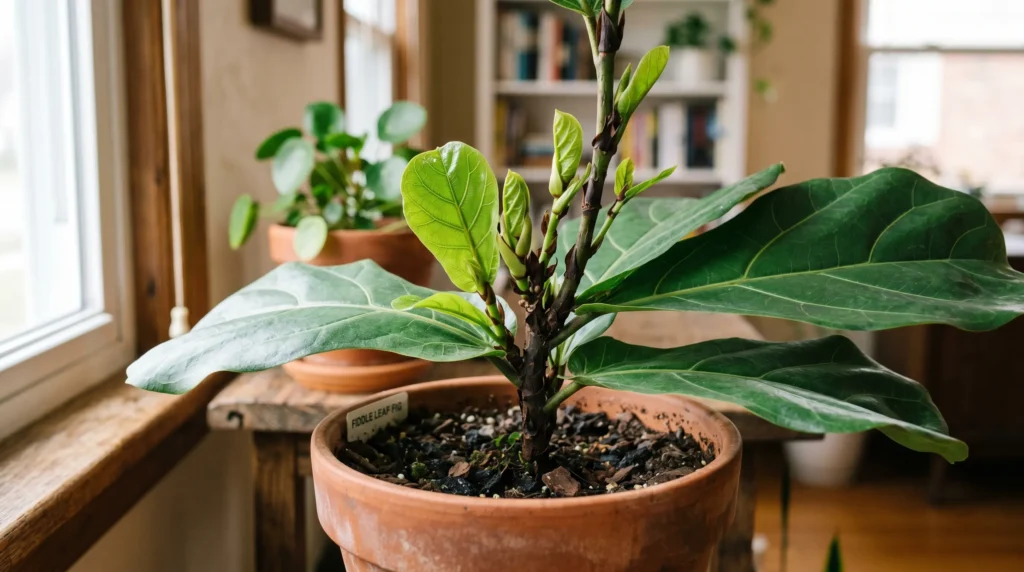
This will gives you exactly what to do with your fiddle leaf fig in each UK season, from the first new leaf in March to winter survival in January.
Spring (March–May): The Growth Season Begins
March is the moment UK FLF owners have been waiting for. As daylight hours lengthen past 11 hours, the plant will begin to push new growth from the tip — a tight, light-green scroll unfurling over several days. .
- Repotting: March–April is the best window. The plant can establish in fresh compost during peak growth.
- Fertilising: Begin monthly feeding with a balanced liquid fertiliser.
- Watering: Gradually increase frequency as the plant becomes more active.
- Position: Move slightly away from the window as direct spring sun can be surprisingly strong.
- Pests: Check leaf undersides for spider mites — they proliferate in the dry conditions left by winter central heating.
Summer (June–August): Outdoor Season in the UK
- Outdoor plants on balconies or patios may need watering every 2–3 days in warm spells — check soil daily.
- Feed fortnightly at peak summer.
- Avoid positions exposed to high winds, which can damage large leaves.
- Protect from heavy rain if the pot has limited drainage.
Autumn (September–November): Preparing for the UK Winter
- Move to a shaded outdoor spot for 1–2 weeks before bringing indoors — this reduces transition shock.
- Expect some leaf drop during the transition. It is normal and should stabilise within 2–3 weeks.
- Once indoors, do not move the plant again — stability matters more than finding the “perfect” spot.
- Install grow light now if needed. Check radiator positions before choosing where to overwinter.
- Stop repotting and pruning for the season.
Winter (December–February): UK Survival Mode
This section does not exist in any competitor guide. UK winters are the most critical period for FLF survival, and the approach is fundamentally different from any other climate.
2.Leaf drop from radiator draughts.
3. Leggy weak growth from insufficient light. Address all three proactively rather than reactively.
UK winter care checklist:
- Water every 2–3 weeks only — always check soil first
- Keep plant at least 60cm from any radiator
- Run a grow light 12–14 hours per day if natural light is low
- Do not move, repot, propagate, or prune
- Mist 2–3 times per week to counteract central heating dryness
- Do not feed — or feed at quarter strength once in 8 weeks maximum
- Wipe leaves monthly to maximise light absorption
Troubleshooting — Brown Spots, Leaf Drop & Common UK Problems
Brown spots on fiddle leaf fig leaves are not a single problem — they are a symptom with at least five distinct causes, each requiring a different solution. Diagnosing the correct cause before taking action is essential.
Brown Spot Diagnosis Guide
Root Rot (Overwatering)
Large, irregular brown patches starting at the leaf edge and centre. Associated with consistently wet soil. Most common October–March. Fix: reduce watering immediately, improve drainage.
Bacterial Infection
Brown spots with yellow halo. Often appears when plant is overwatered in low light. Remove affected leaves. Improve airflow and reduce watering. Cannot be cured — only contained.
Dry Air / Radiator Heat
Crispy brown edges and tips, not spreading inward. Associated with low humidity. Fix: move away from radiators, increase misting or use humidifier.
Sunscorch
Pale, bleached, or tan patches on leaves that face the direct sun. Most common through south-facing windows in June–August or when moved outdoors. Fix: use sheer curtain or move 30cm further from the glass.
Cold Draught Damage
Brown patches appearing after a cold snap, near windows or doors. Often one side of a leaf affected. Fix: move plant away from draught source and draught-proof the window or door.
Pest Damage (Spider Mites)
Tiny yellowish speckles across leaves, possibly with fine webbing on undersides. More common in dry centrally-heated UK homes. Treat with neem oil solution; isolate from other plants immediately.
Leaf Drop — Why Is My FLF Dropping Leaves?
(1) sudden relocation — the FLF is highly sensitive to being moved and may drop leaves within days of a change in position;
(2) overwatering in low winter light, which leads to root rot;
(3) cold draughts from windows, doors, or letterboxes;
(4) radiator heat stress creating hot, dry air around the foliage.
Check all four causes before taking action. If the plant has recently been moved and is otherwise healthy, simply leave it in place and it will stabilise within 2–4 weeks.
UK Pests to Watch For
- Spider mites — most common in dry, centrally-heated UK homes. Look for fine webbing and tiny yellow speckles. Treat with neem oil spray (available at UK garden centres) and increase humidity.
- Mealybugs — white cottony clusters in leaf axils and stem joints. Remove with a cotton bud dipped in diluted isopropyl alcohol.
- Scale insects — brown oval bumps on stems. Treat with neem oil or horticultural soap.
Isolate any infested plant from your other houseplants immediately. Treat weekly for at least three cycles to break the pest life cycle.
How to Propagate a Fiddle Leaf Fig in the UK
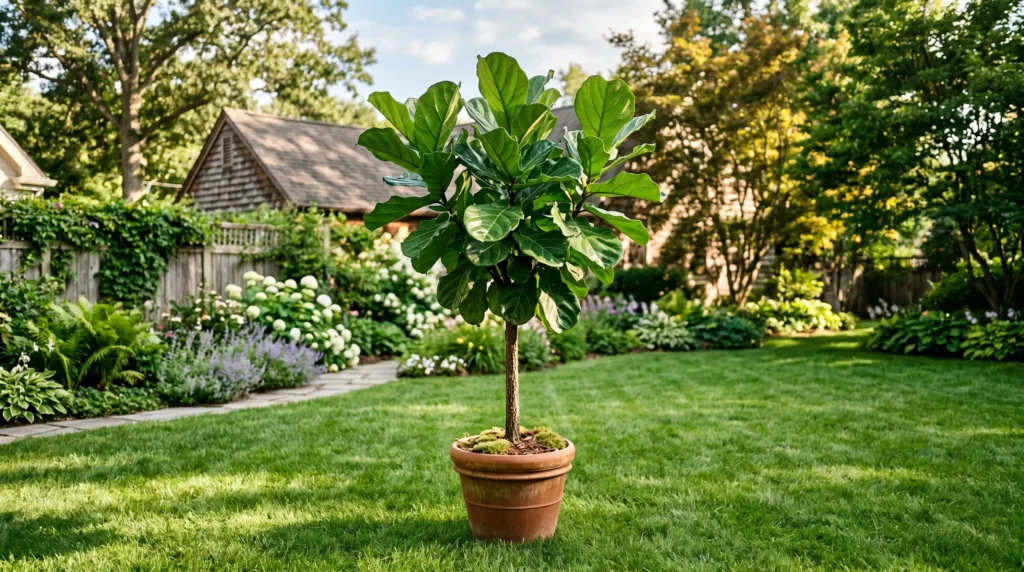
Fiddle leaf fig propagation in the UK must be timed to the British growing calendar — late spring to early summer offers the best conditions, while propagation in autumn or winter will almost always fail.
 Three Propagation Methods — Compared for UK Conditions
| Method | Difficulty | Time to Root | UK-Specific Notes |
|---|---|---|---|
| Stem cutting in water | Easy | 4–8 weeks | Easiest for beginners. Place in bright spot; change water weekly. Pot into peat-free mix when roots reach 5cm. |
| Stem cutting in soil | Intermediate | 6–10 weeks | Higher long-term success rate. Use rooting hormone (Doff or Westland, available at B&Q). Cover with a clear plastic bag to create humidity — vital in dry UK homes. |
| Air layering | Advanced | 6–8 weeks | Best for creating a large new plant from an overgrown FLF. Requires sphagnum moss (available at UK garden centres) and cling film. |
A single leaf cutting will root in water — but it will never develop into a full plant. Without a node (the point where the leaf joins the stem), a cutting has no capacity for stem growth. This is a common and frustrating beginner mistake. Always include at least 15–20cm of stem with your cutting.
Step-by-Step: Water Propagation (Easiest UK Method)
- In late May–July, cut a stem 15–20cm long with 2–3 healthy leaves. Use clean, sharp secateurs.
- Put on gloves immediately — the milky white sap is a skin irritant. Allow the cut end to dry for 30–60 minutes.
- Remove the bottom leaf if it would be submerged in water.
- Place the cutting in a clean glass or jar with lukewarm water. Position in a warm, bright spot (but out of direct sun).
- Change the water every 7 days to prevent bacterial build-up.
- Roots will typically appear within 4–8 weeks. Once they reach 5cm, transfer to your peat-free compost mix.
- Keep the newly potted cutting in a humid, warm spot for the first 4 weeks while it adjusts.
Repotting and Pruning — A UK Grower’s Guide
Repotting should be done in March–April in the UK, as the plant enters active growth. Pruning can be done in spring and early summer to encourage branching and shape. Both activities should be avoided entirely during winter.
Signs Your FLF Needs Repotting
- Roots visibly emerging from drainage holes or circling the pot base
- Soil drying out unusually quickly after watering
- Plant becoming top-heavy and unstable
- Growth has stopped despite good light and watering
How to Repot a Fiddle Leaf Fig in the UK (Step-by-Step)
- Water your plant thoroughly 24 hours before repotting to reduce transplant shock.
- Choose a new pot no more than 5cm larger in diameter than the current one. Ensure it has drainage holes.
- Add a drainage layer of crocks or gravel to the new pot base.
- Prepare your mix: 60% peat-free houseplant compost + 30% perlite + 10% horticultural grit.
- Wearing gloves, gently remove the plant from its current pot. Support the root ball — avoid breaking roots.
- Place in the new pot and backfill with your compost mix, firming gently.
- Water in gently and allow to drain fully.
- Keep in the same position and light conditions for at least four weeks while it establishes.
Pruning for Shape and Health
Pruning encourages branching — cutting just above a leaf node creates two new growth points where there was one. This is how you convert a leggy single-trunk tree into a fuller, bushier shape.
In dusty UK homes, leaf surfaces accumulate a film that significantly reduces light absorption. Wipe leaves monthly with a soft, damp cloth — working from stem to tip. Use leaf shine sparingly and avoid feather dusters, which scratch the waxy cuticle.
Is the Fiddle Leaf Fig Toxic? UK Pet Owner Guide
The fiddle leaf fig is toxic to cats, dogs, and mildly irritating to humans. Its milky white latex sap — released when a leaf is broken or a stem is cut — is the source of irritation. UK pet owners must be aware of both the risks and the available resources.
In the UK, contact the Animal Poison Line on 01202 509000. The RSPCA also offers a 24-hour emergency line at 0300 1234 999. Keep the plant out of reach of pets, particularly cats who may chew on large leaves.
Safe Placement Strategies in UK Homes with Pets
- Elevated position on a high shelf or plant stand out of cat-jumping range
- Wall-mounted bracket (widely available from UK DIY retailers including B&Q and IKEA)
- Dedicated room that pets do not access
- Cat-deterrent mats or citrus peel placed around the pot base
- Bitter spray on lower leaves (available from UK pet retailers)
UK Emergency Contacts — Plant Toxicity
| Organisation | Phone | For |
|---|---|---|
| Animal Poison Line (UK) | 01202 509000 | Pet ingestion emergencies (fee applies) |
| RSPCA Emergency | 0300 1234 999 | 24-hour animal welfare emergencies |
| NHS 111 | 111 | If a child or adult ingests plant material |
Where to Buy a Fiddle Leaf Fig in the UK
Fiddle leaf figs are widely available in the UK from online specialists, garden centres, and high-street retailers. The best source depends on your budget, the size you want, and how important it is to inspect the plant before buying.
What to Look for When Buying — 5-Point Health Checklist
- Firm, upright stem— a wobbly or soft stem suggests root issues
- Glossy, undamaged leaves— no tears, no brown edges, no pale patches
- No brown spots or yellowing— especially check lower leaves
- No pests on leaf undersides— look for webbing (spider mites) or white fluff (mealybugs)
- Roots not massively overflowing drainage holes— some root visibility is fine; a mass of circling roots suggests severe pot-bound stress
How Much Does a Fiddle Leaf Fig Cost in the UK? (2026 Prices)
| Size | Height | Typical UK Price Range | Best Source |
|---|---|---|---|
| Small | 30–50cm | £10–£20 | IKEA, B&Q, M&S |
| Medium | 60–90cm | £25–£50 | Dobbies, PlantDrop, Patch Plants |
| Large tree form | 100–150cm | £60–£120 | Dobbies, RHS garden centres, Patch Plants |
| Statement / Giant | 150cm+ | £150–£300+ | Online specialists, independent nurseries |

Frequently Asked Questions
These questions target Google’s People Also Ask results and are written as self-contained answers that AI systems can quote directly.
1.sudden relocation — the FLF drops leaves within days of being moved;
2. overwatering in low winter light, leading to root rot;
3.cold draughts from windows, front doors, or sash windows;
4.radiator heat stress. Check all four causes before taking action. If the plant was recently moved, return it to its original position and wait 2–4 weeks before doing anything else.
Conclusion: Your UK FLF Journey Starts Here
The fiddle leaf fig has an outsized reputation for being difficult — but that reputation was built on advice written for sunny Californian apartments and Sydney conservatories, not British sitting rooms in January. With care guidance calibrated specifically to UK conditions, the FLF is a very manageable, extraordinarily rewarding plant.
The 5 Golden Rules for UK FLF Success
- Light first — south or west-facing window, or supplement with a grow light in winter
- Water by season — drastically reduce in autumn and winter
- Keep away from radiators and draughts — the two greatest UK-specific threats
- Don’t move it — find a good spot and leave it there
- Patience — slow winters are normal. Growth will return in March
Choose the right variety for your space (Bambino for smaller UK rooms, standard tree form for larger ones), give it the brightest spot you can manage, and approach British winter with a deliberate “less is more” strategy — less water, less feeding, more stability. Follow these principles and your fiddle leaf fig will reward you with decades of bold, architectural beauty.
For more information you can also check this source Flowerbx

Leave a Reply