
Flowering Hibiscus Plant (UK) Feature Hardy Hibiscus Tropical Hibiscus Flowering season July – October May – October UK hardiness To -15°C (all regions) Tender min. 7–10°C Mature height 1.5–3m 0.5–2m ,Sun needed 6+ hours daily 6+ hours daily, Soil pH 6.0–7.0 6.0–7.0 Difficulty Easy — beginner-friendly Intermediate
Most people think Flowering Hibiscus Plant is a tropical plant that can’t survive a British winter. They’re half right — and that half-truth is costing UK gardeners one of summer’s most spectacular flowering shrubs.
The full picture is this: there are two distinct types of hibiscus, and one of them is completely hardy in every corner of the UK, including Scotland. It thrives outdoors year-round, needs almost no maintenance once established, and blooms lavishly from late July right through to October — filling the exact gap in the garden year when roses and lavender have faded and most other shrubs have given up.
The other type — the tropical hibiscus with its glossy leaves and flamboyant orange and crimson blooms — is a brilliant houseplant and conservatory specimen that can spend summers on a sheltered patio and winters on a bright windowsill.
This guide covers both completely. Whether you have a walled London courtyard, a Yorkshire allotment, a Scottish coastal garden, or a Birmingham back terrace, you’ll find everything here: which type to choose, where to plant it, how to care for it month by month, how to prune and propagate it, how to troubleshoot problems, and what to do with the flowers once they’re blooming.
What Is the Flowering Hibiscus Plant Plant? Botany, History and UK Context
What is a Flowering Hibiscus Plant plant?
Flowering Hibiscus Plant is a genus of over 200 species of flowering plants in the family Malvaceae — the mallow family — that includes shrubs, trees, annuals and perennials, grown across temperate and tropical regions worldwide.
The plants share the family with hollyhock, okra, and cotton. In UK gardens, two species dominate: Hibiscus syriacus (the hardy outdoor shrub) and Hibiscus rosa-sinensis (the tender tropical houseplant). Understanding which is which is the single most important thing a UK buyer can know before purchasing.
Botanical Identity
The hibiscus flower is one of the most structurally distinctive in the plant kingdom. Each bloom is trumpet-shaped, with five broad petals surrounding a prominent staminal column — the elongated central tube that carries the stamens and pistil. Individual blooms last only one to two days, but plants produce them continuously over a period of weeks, so the display is sustained rather than fleeting.
Key botanical facts:
- Family: Malvaceae (mallow family)Malvaceae (the mallow family) — shares this with hollyhock, okra, cotton, and native British wildflowers like musk mallow
- Genus: Hibiscus — over 200 species worldwide
- Flower: Trumpet-shaped, 5 petals, prominent staminal column
- Bloom duration: Individual flowers last 1–2 days; continuous over weeks
- Height range: 0.5m (dwarf container types) to 3m+ (mature shrubs in sheltered spots)
History in British Gardens
Flowering Hibiscus Plant syriacus has been grown in British gardens since the late 16th century, making it a genuine heritage plant rather than a recent exotic trend. The name syriacus — “of Syria” — is misleading: the plant is native to China and arrived in Britain via the spice trade routes. It has been a fixture of formal English walled gardens and country house borders for over 400 years.
Flowering Hibiscus Plant rosa-sinensis arrived later, becoming popular during the Flowering Hibiscus Plant when conservatory culture flourished among the wealthy. Empire-era plant collectors brought it back from tropical China, and it became one of the signature plants of the grand Victorian glasshouse.
The species carries significant global cultural weight: it is the national flower of South Korea, Malaysia, and Haiti, and features in the traditional medicine systems of cultures across Africa, Asia, and the Caribbean.
Why Flowering Hibiscus Plant Matters for UK Gardeners
The late-summer colour gap is real. By mid-August, many UK garden favourites — roses, lavender, geraniums, delphiniums — are past their best or cut back. Hardy hibiscus comes into its own precisely then, flowering from late July through October and providing some of the most vivid colour available in an autumn garden.
Beyond aesthetics, hibiscus offers practical benefits for the modern UK gardener:
- Pollinator value: H. syriacus is on the RHS Plants for Pollinators list, attracting bees and hoverflies from July to October when most other pollinator plants have finished
- Versatility: grows in borders, containers, courtyard gardens, and conservatories
- Peat-free compatibility: thrives in peat-free growing media — fully aligned with modern UK gardening practice
- Longevity: a well-placed hardy hibiscus can live and flower for 20+ years
The Two Types of Flowering Hibiscus plant: Hardy vs Tropical — The UK Decision Framework
What are the two types of hibiscus UK gardeners need to know about?
The two main types are Hardy Hibiscus (Hibiscus syriacus), which is fully frost-hardy and suitable for permanent outdoor planting across all UK regions, and Tropical Hibiscus (Hibiscus rosa-sinensis), which is tender and must be overwintered indoors above 7–10°C.
This distinction is the single biggest source of confusion for UK buyers, and getting it wrong is the reason so many people lose plants each winter. The sections below explain both types fully, with a comparison table and a simple decision guide.
Hardy Hibiscus (Hibiscus syriacus) — The UK Outdoor Champion
Hardy hibiscus (Hibiscus syriacus) is a fully frost-tolerant deciduous shrub that survives UK winters down to -15°C without any protection, making it suitable for every region of the country including Scotland.
Also known as Rose of Sharon, Tree Hollyhock, and Shrub Althea, this is the species that appears in the RHS Plant Finder as a tried-and-tested UK performer. Its origins are Chinese, despite the misleading Latin name syriacus.
Key facts — Hardy Hibiscus (H. syriacus):
- Hardiness: Fully hardy to -15°C — all UK regions
- Growth habit: Deciduous shrub; leaves emerge late (May–June — do not panic)
- Flowering season: July to October — single or semi-double blooms
- Flower colours: White, pink, blue-purple, red
- Mature size: 1.5–3m tall
- UK verdict: Beginner-friendly. The safe default for any UK garden.
Tropical Hibiscus (Hibiscus rosa-sinensis) — The UK Houseplant Star
Tropical hibiscus (Hibiscus rosa-sinensis) is a tender evergreen shrub that cannot survive below 7–10°C and must be brought indoors before October in all UK regions.
Also known as Chinese Hibiscus, China Rose, or Hawaiian Hibiscus, this is the species sold in supermarkets and garden centres as a houseplant in colourful 12cm pots. Outdoors on a sheltered patio in summer, it produces spectacular blooms. In a conservatory or bright south-facing room, it can flower from May to October.
Key facts — Tropical Hibiscus (H. rosa-sinensis):
- Hardiness: Tender — minimum 7–10°C (cannot survive UK winter outdoors)
- Growth habit: Evergreen shrub; dark, glossy leaves; compact as a houseplant
- Flowering season: May to October indoors when well-cared for
- Flower colours: Orange, red, yellow, pink, bi-colour
- Mature size: 0.5–2m in a container
- UK verdict: Intermediate difficulty. Best for conservatories, bright rooms, or sheltered summer patios.
Hardy vs Tropical Hibiscus — Side-by-Side Comparison
| Feature | Hardy (H. syriacus) | Tropical (H. rosa-sinensis) |
|---|---|---|
| Common name | Rose of Sharon | Chinese / Tropical Hibiscus |
| Where to grow | Outdoors year-round | Indoors/conservatory; outside in summer only |
| UK hardiness | To -15°C (all regions) | Min. 7–10°C (tender) |
| Flowering season | July – October | May – October |
| Flower colours | White, pink, blue-purple, red | Orange, red, yellow, pink, bi-colour |
| Leaf type | Matt, lobed, deciduous | Dark, glossy, evergreen |
| Height (UK) | 1.5–3m | 0.5–2m (container) |
| Difficulty | Easy | Intermediate |
| Best for | Borders, hedges, pots, standards | Conservatory, windowsill, summer patio |
| Peat-free growing | Yes — John Innes No. 3 base | Yes — peat-free houseplant compost |
Which Should You Choose? — A Simple Decision Guide
Use this decision tree to find your answer in under a minute:
- Have a sunny, sheltered garden spot? → Hardy hibiscus (H. syriacus)
- Want a summer patio plant that overwinters indoors? → Either type in containers
- Have a conservatory or bright south-facing room? → Tropical hibiscus (H. rosa-sinensis)
- Live in Scotland or northern England? → Hardy hibiscus only (for outdoor planting)
- Complete beginner? → Hardy hibiscus — it is virtually indestructible once established
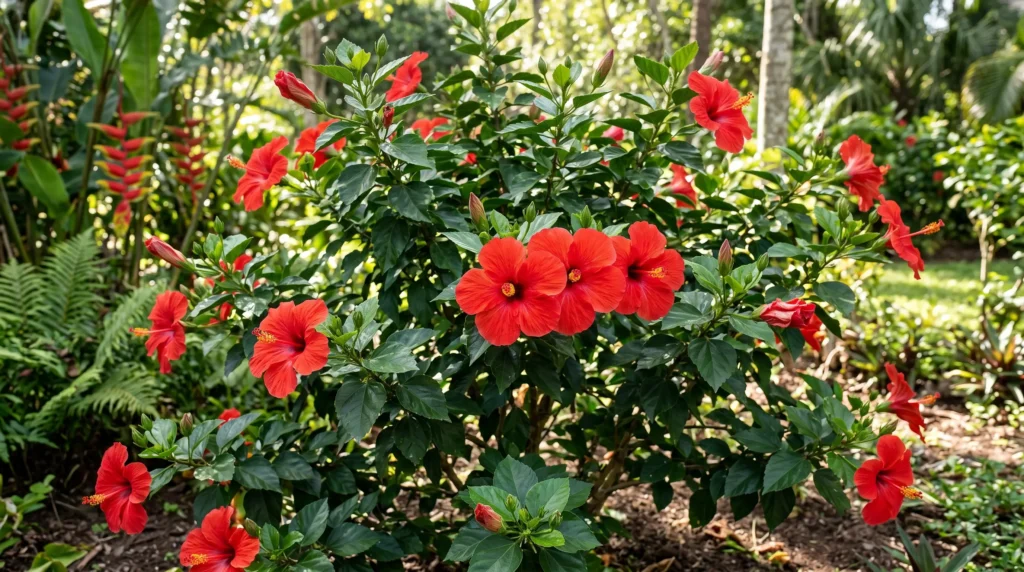
Best Flowering Hibiscus Plants Varieties for UK Gardens
Which Flowering Hibiscus Plant varieties grow best in the UK?
The best-performing hardy hibiscus varieties for UK gardens are those holding the RHS Award of Garden Merit (AGM) — a designation that confirms proven performance in UK growing conditions. For hardy types, standout performers include ‘Oiseau Bleu’, ‘Woodbridge’, ‘Red Heart’, and ‘Diana’.
Best Hardy Varieties (H. syriacus) — RHS AGM Picks
| Variety | Flower | Height | Notes |
|---|---|---|---|
| ‘Oiseau Bleu’ (Blue Bird) | Blue-violet with dark red centre | 2–3m | Most popular; excellent structural shrub; RHS AGM |
| ‘Red Heart’ | White with bold red centre | 2–3m | Crisp contrast; classic cottage-garden choice |
| ‘Woodbridge’ | Deep rose-pink with red eye | 2m | Long-established UK performer; very reliable |
| ‘Diana’ | Pure white, single | 2m | Clean and elegant; RHS AGM holder |
| ‘Hamabo’ | Pale pink with cerise veins | 2m | Soft aesthetic; suits cottage-style planting |
| ‘Lady Stanley’ | White, pink-flushed, semi-double | 2m | Old-fashioned charm; exceptionally long season |
| ‘Pink Giant’ | Large deep pink | 2–3m | One of the earliest to flower (from July) |
| ‘Coelestis’ | Soft violet-blue | 2m | Rare true-blue tone; striking in borders |
Compact and container varieties:
- ‘Little Legends Pink’ and ‘Little Legends White’ — extremely dwarf; ideal for small UK patios and balconies
- ‘Flower Tower’ series — upright columnar habit; excellent for narrow tall containers
- ‘Shintaeyang’ — erect growth; suited to larger containers; early season bloomer
Best Tropical Varieties (H. rosa-sinensis) — Houseplant and Conservatory Stars
| Variety | Flower | Notes |
|---|---|---|
| ‘Cooperi’ (v) AGM | Red flowers; marbled white and olive foliage | RHS AGM; as valuable for foliage as flowers |
| ‘Chiffon’ series | Pastel pinks and creams | Compact habit; exceptionally long flowering season |
| ‘Red Dragon’ | Deep crimson | Dramatic; best suited to conservatories |
| ‘Sunset Glow’ | Warm orange-salmon | Strong tropical feel; excellent pot specimen |
| ‘Double Pink’ | Ruffled double pink | Long-lasting display; beginner favourite |
Lesser-Known Species Worth Trying
Hibiscus moscheutos (Swamp Mallow / Rose Mallow) produces enormous dinner-plate blooms up to 30cm across. It is a perennial that dies back in winter but returns vigorously each spring, and suits boggy or moisture-retentive UK soils.
Hibiscus sabdariffa (Roselle) is grown for its edible calyces — the basis of commercial hibiscus tea. It can be attempted in a UK greenhouse or a very warm sheltered south-facing border in a good summer.
Where to Grow Flowering Hibiscus Plant in the UK: Siting, Soil and the Regional Picture
Where is the best place to grow hibiscus in a UK garden?
The best position for hibiscus in a UK garden is a south or south-west facing spot with a minimum of 6 hours of direct sun per day, sheltered from prevailing winds, in well-drained soil with a pH of 6.0–7.0.
Sun Requirements
Minimum 6 hours of direct sun daily is non-negotiable for reliable flowering. In shade, hibiscus will grow but produce far fewer flowers — this is the most common source of disappointment for UK gardeners who wonder why their plant looks healthy but won’t bloom.
Planting against a warm south-facing wall amplifies available heat and advances flowering by two to four weeks — a meaningful advantage in cooler parts of the UK.
Soil Requirements
- pH: 6.0–7.0 (slightly acidic to neutral); H. syriacus tolerates slightly alkaline soils
- Texture: well-drained loam; tolerates clay, loam, and sand — never waterlogged
- Drainage test: dig a 30cm hole and fill with water. It should drain in under an hour. If not, raise the planting area or incorporate horticultural grit
- Note on colour: slightly acidic soil deepens the blue and purple tones in H. syriacus varieties
Amendment before planting: incorporate two buckets of peat-free compost per plant and horticultural grit if your soil is clay-heavy.
Shelter from Wind
The UK’s prevailing south-westerly winds are actively damaging to hibiscus in bloom. Wind breaks petal stems and causes bud drop — especially in August and September, when the flowering season is at its peak. Ideal sheltered positions include walled courtyards, corners of buildings, and spots backed by an established hedge.
UK Regional Growing Guide
| UK Region | Outdoor Hardy Hibiscus | Practical Notes |
|---|---|---|
| Southern England (London, SE, SW) | Excellent — thrives outdoors | Best flowering; longest season; widest variety choice |
| Midlands & East Anglia | Very good | Sheltered south-facing spots ideal; urban gardens especially good |
| Wales | Good in south and west; challenging in upland areas | Coastal and urban gardens work well |
| Northern England (Yorkshire, Lancashire, NE) | Possible in sheltered urban spots | Choose hardiest varieties such as ‘Oiseau Bleu’ and ‘Woodbridge’; mulch well in autumn |
| Scotland | Hardy varieties only; coastal gardens advantaged | Urban heat island effect helps in cities; ‘Woodbridge’ and ‘Blue Bird’ are best bets |
| Northern Ireland | Good in sheltered areas | Atlantic climate brings rainfall; watch for wind damage more than frost |
Creating a Microclimate in Cooler UK Areas
Gardeners in northern England and Scotland can extend hibiscus performance by engineering a warmer microclimate:
- Plant on a south-facing slope to maximise soil warmth
- Use a dark-coloured container or paint a south-facing wall dark to absorb and radiate heat
- City gardens benefit from the urban heat island effect — urban areas are 2–4°C warmer than surrounding rural land, a significant practical advantage
- Apply fleece over the planting area in early spring to warm the soil two to three weeks before planting
How to Plant Hibiscus in the UK: Step-by-Step
When is the best time to plant hibiscus in the UK?
The best time to plant hardy hibiscus outdoors in the UK is spring (April to May), after the last frost risk has passed. Autumn planting (September to October) is also possible in southern regions. Tropical hibiscus should not be placed outdoors until night temperatures are consistently above 10°C — from mid-May in the south, late May in the north.
When to Plant
| Type | Best planting time | Notes |
|---|---|---|
| Hardy hibiscus (border) | April–May | After last frost risk; most of England and Wales |
| Hardy hibiscus (southern regions) | September–October also possible | Allows root establishment before winter |
| Tropical hibiscus (outdoors) | After mid-May (south); late May (north) | Night temperatures must be reliably above 10°C |
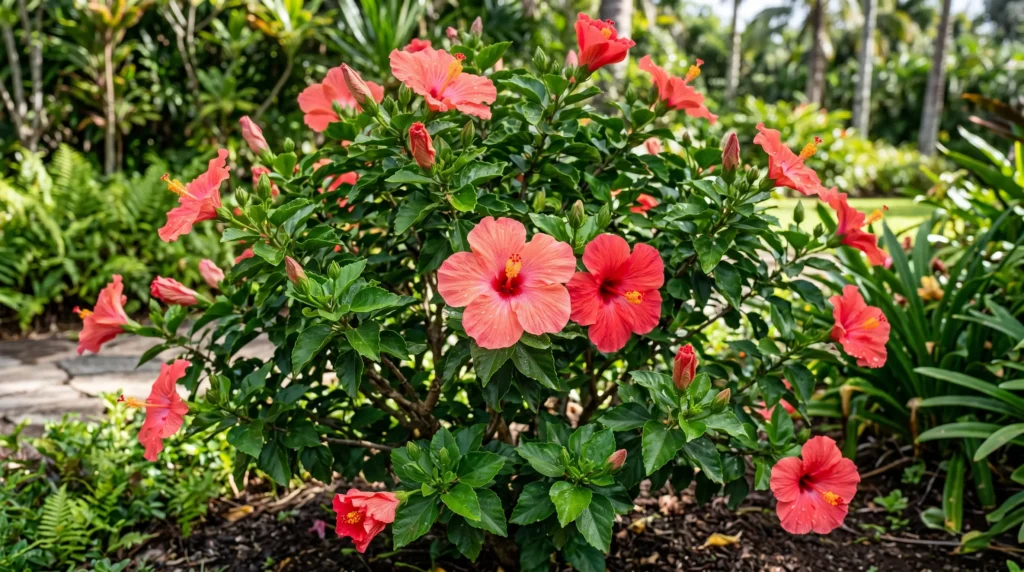
How to Plant Hardy Hibiscus in a Border — Step-by-Step
You will need: Spade, peat-free compost, horticultural grit (if clay soil), mycorrhizal fungi granules (optional but beneficial), bark mulch, watering can or hose
- Choose your spot — south or south-west facing; at least 6 hours direct sun; sheltered from prevailing wind
- Prepare the soil — dig over a 60cm area; work in 2 buckets of peat-free compost; incorporate horticultural grit if soil is clay-heavy
- Dig the planting hole — twice the width of the root ball, same depth as the root ball
- Sprinkle mycorrhizal fungi (e.g. Rootgrow) into the base of the hole — encourages faster root establishment
- Tease out the roots gently from the pot — do not plant pot-bound
- Position the plant — crown (the junction between roots and stems) level with the soil surface
- Backfill with excavated soil mixed with compost; firm gently with your heel
- Water thoroughly — 10–15 litres immediately after planting
- Apply mulch — 5–8cm of bark or compost around the base, not touching the stem
- Stake if exposed — use a single bamboo stake in the first growing season in windy positions
How to Plant Hibiscus in a Container — Step-by-Step
- Choose pot size — minimum 40cm diameter; terracotta or heavyweight containers preferred for stability
- Compost choice — John Innes No. 3 (loam-based) as the base; mix with 20% peat-free multi-purpose for moisture retention
- Add drainage layer — 5cm of crocks or gravel at the bottom before adding compost
- Plant at the same depth as the nursery pot; firm compost around the root ball
- Top-dress with 2cm of gravel to reduce moisture loss and deter pests
- Position — south-facing wall or patio corner; maximum sun exposure
Spacing Guide
- Border planting: 1–1.5m apart to allow for mature spread
- Hibiscus hedge: 60cm apart for a dense flowering screen within three years
- Containers: one plant per 40–50cm diameter pot
Hibiscus UK Care: Month-by-Month Calendar (January to December)
January
Hardy hibiscus is fully dormant. No outdoor action is required. Use this month to plan: order named varieties from specialist nurseries now for spring delivery — the best varieties sell out by March.
Tropical hibiscus indoors: reduce watering to once every seven to ten days, watering only when the top 2–3cm of compost is dry. Keep the plant above 7°C and away from cold draughts and radiators. Expect some yellow leaf drop — this is a normal response to lower light levels in a UK winter.
February
Hardy hibiscus: begin light pruning from mid-February — remove dead, damaged, crossing, or diseased stems back to a healthy bud or framework branch. Do not carry out any major pruning yet.
Tropical hibiscus indoors: as light and temperatures increase from late February, begin increasing watering slightly. If the plant is root-bound (roots emerging from the drainage holes), re-pot into a slightly larger container using fresh peat-free houseplant compost. Begin a weekly balanced liquid feed from late February.
March
Main pruning month for both types — carry out all framework pruning before buds break.
- Hardy hibiscus: shorten previous year’s growth to create a flowering shoot framework; cut vigorous long shoots back to 5–7cm from the base
- Tropical hibiscus: prune back long shoots to 5–7cm from the base; remove non-flowering and straggly stems; tip-prune to encourage a bushy shape
Begin watering as growth resumes. Hardy hibiscus leaves may not appear until May or June — this is completely normal and does not indicate a problem.
April
Planting month for hardy hibiscus in borders — after the last frost risk in most of England and Wales.
Begin feeding hardy hibiscus: apply a slow-release high-potash granular feed (rose granular fertiliser is ideal) around the base of established plants.
Tropical hibiscus indoors: increase watering and switch to a high-potash liquid feed every 10–14 days. Begin hardening off plants if you plan to move them to a conservatory or sheltered patio.
May
Hardy hibiscus leaves emerge — often not until mid-May. This late leafing is entirely normal for this species. Do not assume the plant is dead.
Move tropical hibiscus to a sheltered outdoor position after mid-May in southern UK, or late May in northern UK — but only once night temperatures are reliably above 10°C.
Continue regular feeding. Watch for the first signs of aphids on tender new growth and treat promptly .
June
Hardy hibiscus grows vigorously through June — water weekly if dry; apply mulch if not already done.
Take softwood cuttings from tropical hibiscus for propagation. Deadhead spent blooms on tropical types to encourage continued flowering.
Stop all pruning from June onwards to allow flower buds to set on both types.
July
First flowers appear on the earliest hardy varieties — ‘Pink Giant’ and ‘Woodbridge’ typically open first.
This is peak watering season for container plants. Water daily in hot or dry spells; never let containers dry out completely. Continue high-potash liquid feed every 10–14 days.
Check tropical hibiscus for red spider mite — a common problem in dry, warm conditions (see Section 10).
August
Peak flowering month for hardy hibiscus. The main display runs August through September — this is when the investment in planting pays off.
Enjoy the display and maintain watering and feeding. Take semi-ripe cuttings of hardy hibiscus for propagation (see Section 9). Deadhead hardy hibiscus if desired — not essential but keeps the plant tidy.
September
Hardy hibiscus continues flowering — do not prune yet.
Bring tropical hibiscus indoors before temperatures drop below 10°C — usually early to mid-September in northern UK; late September in the south.
Apply an autumn mulch (10cm of bark or compost) around the base of outdoor hardy plants before the first frosts. Apply the final feed of the season in early September.
October
Reduce watering for outdoor hardy hibiscus as the plant begins to slow down. Do not disturb or prune.
Tropical hibiscus indoors: reduce watering significantly; keep in a bright frost-free position (minimum 7°C).
In hard-frost areas (northern England, Scotland), apply a layer of horticultural fleece to newly planted hardy hibiscus for added root protection through winter.
November
Hardy hibiscus is now fully dormant. Stems may die back after the first hard frosts — this is completely normal for a deciduous shrub. Do not cut back the dead stems yet; they protect the crown through winter.
Tropical hibiscus indoors: semi-dormant phase. Keep watering to an absolute minimum. Remove yellowed leaves promptly. No feeding.
December
Hardy hibiscus: fully dormant. No action needed.
Tropical hibiscus indoors: water once or twice a month only. Maintain above 7°C. Keep away from both cold draughts (near windows) and hot, dry air (near radiators). Dry air from central heating causes bud and leaf drop.
Watering, Feeding and Soil: The Exact Numbers UK Gardeners Need
How often should you water Flowering Hibiscus Plant in the UK?
Established hardy hibiscus outdoors needs watering during dry spells — roughly every 10–14 days. Container-grown hibiscus needs daily watering in summer. Tropical hibiscus indoors should be watered when the top 2–3cm of compost is dry, typically every 2–4 days in the growing season.
Watering Guide
Hardy outdoor hibiscus:
- First growing season: water deeply once a week from April to September; 10–15 litres per session to encourage deep root growth
- Established plants (year 2+): water only during dry spells; every 10–14 days is sufficient in most UK summers
- Containers: water daily in summer; check the compost every day in hot weather — container hibiscus should never fully dry out, and should never sit in standing water
Tropical indoor Flowering Hibiscus Plant:
- Spring to autumn (growing season): water when the top 2–3cm of compost is dry; typically every 2–4 days in summer
- Humidity: mist foliage daily or stand the pot on a tray of damp pebbles; tropical hibiscus drops its flower buds if humidity falls too low — a very common cause of disappointment in UK homes
- Winter: water once per week maximum; only when the top 3–5cm of compost is dry
Feeding Guide — The Key Rule: High Potash, Not High Nitrogen
The most common feeding mistake UK Flowering Hibiscus Plant growers make is using a high-nitrogen feed, which promotes lush leaf growth at the direct expense of flowers.
Hibiscus needs high potassium (potash) to flower well. The practical rule: if a feed has NPK numbers on the label, the third number (K, for potassium) should be the highest.
Recommended feeds:
| Feed Type | Product Example | When to Use |
|---|---|---|
| High-potash granular | Rose granular fertiliser | Apply at the base each spring |
| High-potash liquid | Tomato liquid feed, Chempak High Potash | Every 10–14 days during growing season |
| Balanced liquid (early season only) | Miracle-Gro All Purpose | Early spring before switching to high-potash |
Stop feeding: September for hardy outdoor types; October for tropical indoor types.
Soil pH and Amendments
- Target pH: 6.0–7.0 — test with a simple soil test kit (available at all UK garden centres for under £5)
- To lower pH (make more acidic): apply sulphur chips as a soil amendment
- To raise pH (make less acidic): apply garden lime
- Colour note: slightly acidic soil deepens the blue and purple tones in H. syriacus varieties such as ‘Oiseau Bleu’ — a practical aesthetic consideration
- Annual mulching: apply 5–8cm of bark or homemade compost each spring; keep clear of the stem
How to Prune Hibiscus in the UK: Hardy and Tropical Methods
When and how should you prune Flowering Hibiscus Plant in the UK?
Prune hibiscus in late February to mid-March, before new buds appear. Both hardy and tropical hibiscus flower on the current year’s new growth — pruning at the right time directly generates more flowers. Pruning in autumn or after June reduces flowering.
The Golden Rule: Hibiscus flowers on the current year’s new growth. Prune before growth starts = more flowers. Prune late or not at all = fewer flowers on long, woody, unproductive stems.
How to Prune Hardy Hibiscus (H. syriacus) — Step-by-Step
When: Late February to mid-March — before new buds appear Tools needed: Sharp bypass secateurs; loppers for older wood; clean blades with an alcohol wipe between cuts
Years 1–3 (establishment phase): Do not prune except to remove dead, diseased, or crossing stems. Let the shrub build its framework before imposing shape.
Year 3 and beyond (annual maintenance pruning):
- Step back and assess the overall shape — aim for an open, airy, goblet-shaped structure
- Remove all dead, diseased and damaged stems back to healthy wood
- Remove crossing stems that rub — remove the weaker of the two
- Shorten all main framework branches by one-third to a strong outward-facing bud
- Cut back any vigorous long shoots to 5–7cm from their base
- Remove thin, twiggy, non-flowering shoots from the centre of the plant
- For plants grown as a standard (ball-on-a-stem form): remove all side shoots below the head and any suckers from the base
Optional — hard rejuvenation pruning: Mature overgrown plants can be cut back hard in late spring to generate vigorous new flowering growth. Similar in approach to hard-pruning roses; the plant will recover fully within one season.
After pruning: apply a fresh mulch around the base and begin feeding with a high-potash liquid feed to support the flush of new growth.
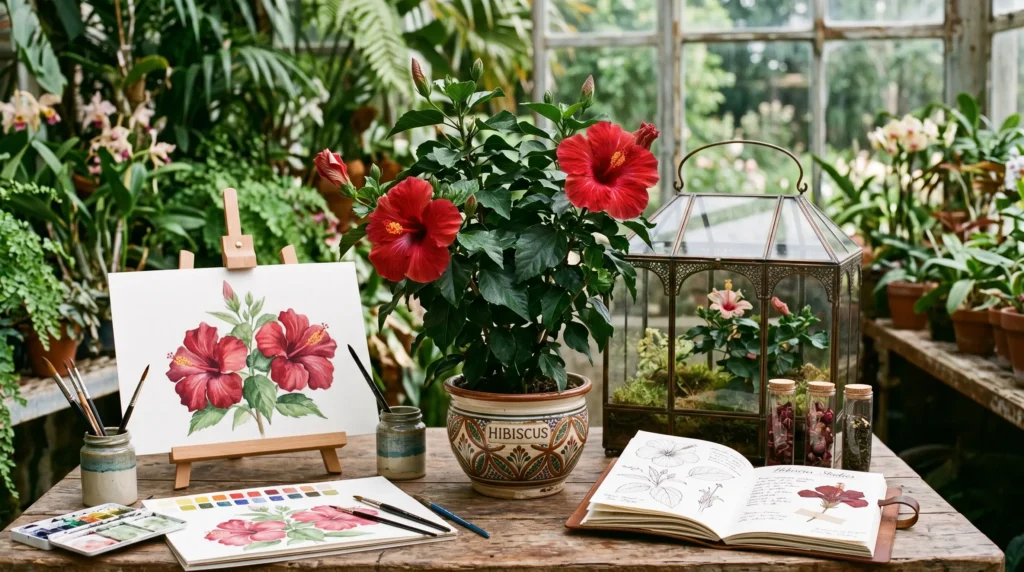
How to Prune Tropical Hibiscus (H. rosa-sinensis) — Step-by-Step
When: Early spring (late February to March) before the growing season begins. Critical: Stop all pruning by June to allow flower buds to form.
- Prune back long shoots to 5–7cm from their base
- Shorten previous year’s growth to leave a framework of main branches
- Remove thin, non-flowering and straggly stems entirely
- Tip-prune young growing shoots to encourage a bushy, compact shape
- With correct annual pruning, tropical hibiscus can survive and flower for 20+ years
Common UK Pruning Mistakes to Avoid
| Mistake | Why It Causes Problems | What to Do Instead |
|---|---|---|
| Pruning in autumn | Triggers tender new growth that gets frost-killed | Prune in February–March only |
| Pruning too late in spring | Delays and reduces flowering season | Prune before you see green buds swelling |
| Leaving dead wood | Attracts disease; reduces airflow | Remove all dead wood each February |
| Over-pruning | Shocks the plant; delays recovery | “If in doubt, take less off” — a light hand is better |
How to Propagate Flowering Hibiscus Plant: Cuttings, Seed and Layering
How do you propagate Flowering Hibiscus Plant in the UK?
Hibiscus can be propagated by softwood cuttings (spring), semi-ripe cuttings (summer), seed (early spring indoors), or layering (mid-summer). Softwood and semi-ripe cuttings are the most reliable methods for UK gardeners. Named varieties do not come true from seed.
Softwood Cuttings (Easiest — Spring)
Best for: Tropical hibiscus (H. rosa-sinensis) | When: May–June
- Select a healthy 10–12cm tip cutting with 3–4 leaves; cut just below a leaf node with a clean, sharp blade
- Remove the lower 2–3 leaves; retain the top 1–2 to continue photosynthesis
- Dip the cut end in rooting hormone powder or gel
- Insert into a small pot of peat-free cutting compost (50/50 perlite and peat-free compost)
- Water in gently and cover with a clear plastic bag or propagator lid to maintain humidity
- Place in warm, bright indirect light — ideally 18–24°C; bottom heat of 24–27°C accelerates rooting
- Roots form in 2–3 weeks — test by gently tugging; resistance indicates rooting
- Pot on into 9cm pots; grow on for a full season before planting out
Semi-Ripe Cuttings (Most Reliable — Summer)
Best for: Hardy hibiscus (H. syriacus) | When: July–August
Take cuttings once the current year’s growth has firmed at the base but remains soft and flexible at the tip. Method is identical to softwood cuttings above. Semi-ripe cuttings root slightly more slowly (3–4 weeks). Overwinter rooted cuttings in a frost-free cold frame or unheated greenhouse; plant out the following May.
Seed Propagation
When: Early spring (March) indoors | Important note: Named varieties do not come true from seed — seed-grown plants will vary in flower colour and form.
- Soak seeds in warm water for 24 hours to soften the seed coat and improve germination rate
- Sow in seed compost at 2–3cm depth; water in
- Germinate at 21–24°C — a heated propagator is ideal; a windowsill above a radiator can work
- Germination in 2–4 weeks; prick out seedlings when large enough to handle
- Grow on in a frost-free environment; seedlings will not flower until year 2–3
9.4 Layering
Layering is the most reliable method for propagating a valued named variety without any cutting or disturbance to the parent plant.
- Bend a low, flexible stem to the ground in mid-summer
- Lightly wound the stem at the point where it will contact the soil (scrape the bark or make a small cut)
- Peg the wounded section into a shallow depression filled with compost
- Cover with further compost and water in
- Roots form in 6–8 weeks
- Sever from the parent plant in autumn once rooting is confirmed; pot on and overwinter in a cold frame
Flowering Hibiscus Pests, Diseases and Troubleshooting
What are the most common problems with hibiscus in the UK?
The most common hibiscus problems in UK gardens are: aphids on new growth, bud drop caused by drought or temperature fluctuation, yellow leaves from overwatering or low light, and failure to flower due to insufficient sun or incorrect feeding. Red spider mite is the most common indoor problem.
Common UK Pests
Aphids are the most frequent pest on hibiscus in the UK, clustering on shoot tips and flower buds in spring and early summer. The organic fix: blast off with a strong jet of water; encourage ladybirds; apply neem oil spray. For severe infestations, insecticidal soap spray is effective.
Red spider mite primarily affects tropical hibiscus kept indoors, especially in dry, centrally heated conditions. Identification: tiny red or orange mites on leaf undersides; fine webbing; leaves appear bronzed and stippled. Prevention is key — maintain high humidity by misting daily or placing the pot on a damp pebble tray. For biological control indoors, the predatory mite Phytoseiulus persimilis is highly effective.
Glasshouse whitefly affects tropical hibiscus in conservatories. Control with yellow sticky traps, insecticidal soap, or the biological control Encarsia formosa.
Scale insects appear as brown, shell-like bumps on stems and excrete sticky honeydew, which leads to sooty mould on the leaves. Remove by hand with a soft brush and soapy water; use a systemic insecticide for severe infestations.
Common UK Diseases
Powdery mildew appears as a white powdery coating on leaves and is worse in dry soil conditions and poor airflow. Prevent by ensuring good ventilation around the plant and maintaining consistent soil moisture. Remove affected leaves; apply sulphur-based fungicide if severe.
Root rot (Phytophthora) is caused by waterlogged soil. The plant wilts despite moist soil, and roots are dark and mushy. Prevention is everything: plant in well-draining soil and never let containers stand in water. If caught early, remove from soil, trim affected roots, and re-plant in fresh, gritty compost.
Botrytis (grey mould) appears as grey fuzzy mould on stems and leaves in cool, damp, poorly ventilated conditions. Prevent by improving airflow and removing dead plant material promptly. Treat with a copper-based fungicide if severe.
The Complete UK Flowering Hibiscus Plant Troubleshooting Matrix
| Symptom | Most Likely Cause | Fix |
|---|---|---|
| Yellow leaves dropping (winter) | Normal dormancy response to low light | Reduce watering; wait for spring |
| Yellow leaves (growing season) | Overwatering or root rot | Check drainage; reduce watering frequency |
| Bud drop before opening | Drought, temperature fluctuation, or low humidity | Water consistently; mist daily; avoid draughts |
| No flowers or very few flowers | Too much shade, high-nitrogen feed, or pruned too late | Move to sunnier spot; switch to high-potash feed; prune earlier |
| Plant not leafing up in spring | Normal — H. syriacus leaves emerge May–June | Be patient; do not discard the plant |
| Wilting despite moist soil | Root rot | Check roots; improve drainage; re-plant in gritty compost |
| Bronzed, stippled leaves | Red spider mite | Increase humidity; apply predatory mites |
| Sticky leaves with sooty mould | Aphids or scale insects | Remove pests; wipe leaves clean |
| White powder on leaves | Powdery mildew | Improve airflow; apply sulphur-based spray |
| Poor flowering after pruning | Pruned too late in spring | Prune in February–March next year |
Expert note: “The golden rule of growing hibiscus is: what you see today was caused by events 2–3 weeks ago. Keep track of inputs — weather, temperature, water, feed — so you can identify the cause of a problem.” — Darren Eminian, President, International Hibiscus Society
Flowering Hibiscus Plant in UK Garden Design: Ideas for Every Space
Mixed Border: Late-Season Anchor Plant
Plant hibiscus at the back of a south-facing border where its height and late-season structure fill a gap that almost no other shrub occupies. The best companion plants work in sequence to extend the display:
- Early season (June–July): Alliums, hardy Geraniums, Salvias, and the pollinator-friendly yarrow — which bridges the gap beautifully before hibiscus comes into bloom
- Mid-season overlap (August–September): Rudbeckias, Sedums, Heleniums — these share the hibiscus peak perfectly
- Structural year-round: Ornamental grasses (Miscanthus, Calamagrostis) echo hibiscus’s upright habit and provide winter interest when hibiscus is dormant
Colour pairings: ‘Oiseau Bleu’ (blue-purple) with pale yellow Rudbeckia creates a classic complementary contrast. ‘Red Heart’ (white with red centre) paired with white Phlox makes for crisp, elegant planting.
Flowering Hedge — An Underused UK Idea
Hibiscus syriacus planted at 60cm spacing creates a spectacular flowering hedge by year three. It is not evergreen, so consider underplanting with an evergreen groundcover for winter structure. A multi-variety planting — ‘Woodbridge’ alternating with ‘Red Heart’, for example — creates a patchwork colour effect across the hedge face.
Container Specimens: Patios, Courtyards and Small Gardens
Hardy hibiscus in a large terracotta or heavyweight container makes a bold statement specimen for summer. Position symmetrically — flanking a front door or either side of a garden entrance — for a formal effect. Train as a standard (ball-on-a-stem) over 3–4 years for a French parterre or contemporary topiary aesthetic.
Creating a Tropical Look Without the Risk
A bold planting combining hardy hibiscus with other architectural plants achieves a Mediterranean or tropical effect that actually survives UK winters:
- Fatsia japonica — dramatic evergreen structure
- Phormium — sword-like foliage; many varieties fully hardy
- Canna (lifted for winter) — tropical-looking leaves and flowers in season
- Melianthus major — deeply architectural; treat as a half-hardy perennial in the UK
Beyond the Garden: Edible Uses, Hibiscus Tea and Wildlife Value
Are Flowering Hibiscus Plant edible?
Yes — both Hibiscus syriacus and Hibiscus rosa-sinensis flowers are edible. Hibiscus flowers are mildly citrusy in flavour and can be used fresh in salads, as dessert garnishes, or brewed into tea.
Edible Uses
Hibiscus flowers have a mild, slightly citrusy taste with a mucilaginous texture similar to okra — unsurprising given they share the same plant family. Fresh petals can be added to salads, used as an edible garnish on desserts or summer drinks, or crystallised for cake decoration. The young leaves of H. syriacus are also edible raw in salads. The flowers of some varieties yield a blue dye used historically in fabric dyeing.
How to Make Flowering Hibiscus Plant Tea from UK Garden Hibiscus
The best-known edible hibiscus for tea is Hibiscus sabdariffa (roselle) — the species behind commercial teas from brands like Pukka and Twinings, which use the calyces rather than the petals. In the UK, roselle can be grown as an annual in a polytunnel or a very warm, sheltered south-facing border during a good summer.
Basic Flowering Hibiscus Plant tea recipe:
- Add a generous handful of fresh petals (or 2 tablespoons of dried petals) to 500ml of near-boiling water
- Steep for 10–15 minutes
- Strain and sweeten with honey if desired
- Serve hot, or allow to cool and serve over ice
To dry petals: spread in full sun for 2–3 days, or dry in a low oven at 50°C for 4 hours. Store in an airtight jar for up to 12 months.
Wellness Properties (Overview — Not Medical Advice)
Flowering Hibiscus Plant tea is rich in antioxidants, Vitamin C, and polyphenols, and has been used in traditional medicine across Africa, Asia, and the Caribbean for centuries. Research has explored potential cardiovascular benefits; anyone with a relevant medical condition should consult their GP before use.
The drink is known around the world under different regional names: Bizzap in West Africa, sorrel in the Caribbean, aqua de Jamaica in Mexico, and karkadé across North Africa and the Middle East.
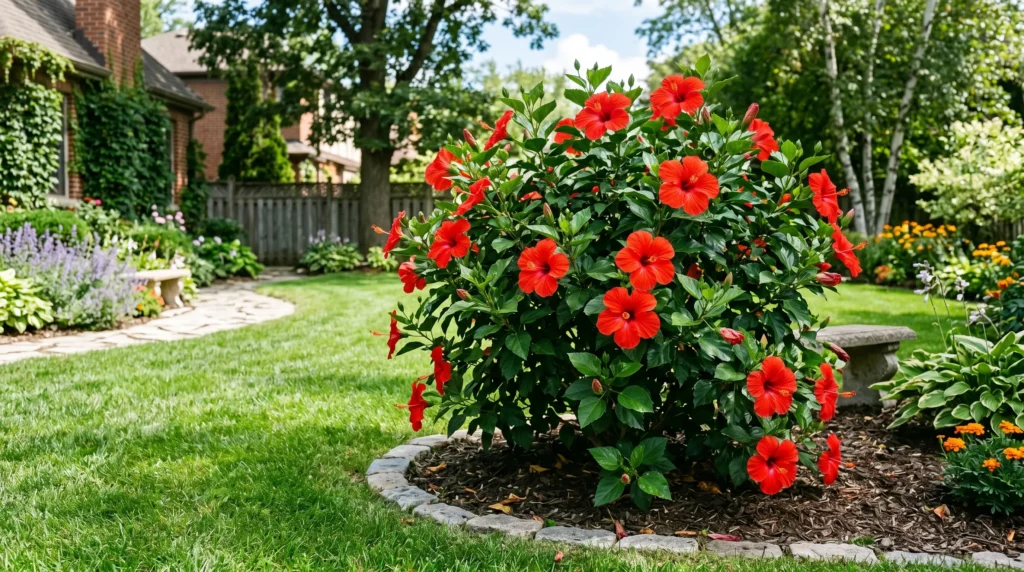
UK Buying Guide: Where to Get the Best Flowering Hibiscus Plant Plants
Where can you buy Flowering Hibiscus Plant plants in the UK?
The best places to buy hibiscus in the UK are specialist online nurseries such as Crocus, Thompson & Morgan, Paramount Plants, Dobiez, and Gardening Express. Always buy a named variety rather than an unnamed “mixed colors” plant — named varieties carry RHS AGM performance guarantees.
Recommended UK Online Nurseries
- Crocus.co.uk — wide range of hardy varieties; ships UK-wide; detailed variety descriptions and customer reviews
- Thompson & Morgan — ‘Little Legends’ and ‘Flower Tower’ series; good for compact-space planting
- Paramount Plants (Crews Hill, London) — specialist mature shrub growers; excellent for larger, more established specimens
- Dobies — reliable hardy varieties at good value
- Gardening Express — competitive pricing; well-grown container specimens
The RHS Plant Finder lists recommended UK suppliers for specific named varieties and is a reliable quality benchmark.
13.2 What to Look for When Buying
Buy: a named variety (e.g. ‘Woodbridge’, ‘Oiseau Bleu’); a 2–5 litre pot-grown plant with healthy green leaf colour and dense, branching stems; plants available in spring (April–May) for immediate planting.
Avoid: plants with yellowing leaves, signs of pest damage, very pot-bound root balls visible at drainage holes, or leggy, drawn-out growth indicating insufficient light in the nursery.
Best buying season: spring (April–May) for immediate planting; autumn for planting in southern regions only.
Garden Centre vs Online Nursery
| Garden Centre | Online Nursery | |
|---|---|---|
| Advantage | See and select the plant; instant purchase; good for impulse buys | Wider variety choice; access to specialist cultivars; home delivery |
| Best for | Adding immediate colour; smaller pot sizes | Specific RHS AGM varieties; compact series; rare species |
| Delivery season | Year-round | Most UK nurseries ship March–October |
Frequently Asked Questions: 12 Questions UK Flowering Hibiscus Plant Growers Actually Ask
Q1: When do hibiscus flowers bloom in the UK?
Hardy hibiscus (H. syriacus) flowers from July to October, with peak display in August and September. Tropical hibiscus can flower from May to October when grown in a warm indoor environment.
Q2: Can hibiscus survive outside in winter in the UK?
Hardy hibiscus (H. syriacus) is fully frost-hardy across all UK regions, surviving down to -15°C. Tropical hibiscus (H. rosa-sinensis) must be brought indoors before temperatures drop below 10°C — it will not survive a UK winter outdoors.
Q3: Why is my hibiscus not leafing out in spring?
Hardy hibiscus is one of the latest deciduous shrubs to produce new leaves — they typically do not appear until May or even June. This is completely normal for the species. Do not assume the plant is dead and discard it.
Q4: Why won’t my hibiscus flower?
The most common causes are: insufficient sunlight (needs 6+ hours of direct sun daily), using a high-nitrogen fertiliser (switch to a high-potash or rose feed), pruning too late in spring (prune in February–March before growth starts), or the plant being too young (allow 3 years for full establishment and reliable flowering).
Q5: How often should I water hibiscus?
Established outdoor hibiscus needs watering in dry spells — roughly every 10–14 days. Container plants need daily watering in summer. Never let containers dry out completely, and never let them sit in standing water.
Q6: What is the best fertiliser for hibiscus in the UK? High-potash feed promotes flowering. Rose granular fertiliser applied in spring and a liquid tomato feed every 10–14 days during the growing season are both ideal. Avoid high-nitrogen feeds — they promote leaf growth at the direct expense of flowers.
Q7: When should I prune hibiscus in the UK?
Prune in late February to mid-March — before new buds appear in spring. Both hardy and tropical types flower on new growth, so early pruning directly generates more flowers. Do not prune after June.
Q8: Can I grow hibiscus in a pot in the UK?
Yes — both hardy and tropical hibiscus grow well in containers. Use at least a 40cm diameter pot with John Innes No. 3 (loam-based) compost. Water daily in summer and feed every 10–14 days with a high-potash liquid feed.
Q9: Is Flowering Hibiscus Plant toxic to dogs or cats?
Hibiscus rosa-sinensis (tropical) can cause mild gastrointestinal upset in dogs and cats if ingested in large quantities. Hardy hibiscus (H. syriacus) is generally considered low toxicity. Always discourage pets from nibbling garden plants.
Q10: How quickly does Flowering Hibiscus Plant grow in the UK?
Hardy hibiscus grows at a medium rate — expect 20–40cm per year in good conditions. A newly planted 2-litre pot will reach 1–1.5m in approximately three years.
Q11: Can I grow Flowering Hibiscus Plant from seed in the UK?
Yes, but seed-grown plants take 2–3 years to reach flowering size, and named varieties will not come true from seed. For reliable performance and known flower colours, buy named varieties from reputable UK nurseries.
Q12: Is Flowering Hibiscus Plant a good plant for pollinators in the UK?
Yes — hibiscus is on the RHS Plants for Pollinators list and provides valuable late-season nectar for bees and hoverflies from July to October, when many other pollinator plants in the garden have already finished.
Conclusion
Flowering Hibiscus Plant is not a difficult plant. It is not a risky plant. It is not a plant that requires a heated greenhouse, a specialist growing medium, or years of horticultural experience.
What it requires is the right choice upfront: hardy hibiscus outdoors in a sunny, sheltered spot; tropical hibiscus in a conservatory or on a bright windowsill. Apply those two criteria correctly, and everything else follows naturally.
Put it in the sun, Feed it with potash, not nitrogen. Prune it in February or March, before the buds break. Mulch it each spring. Water containers daily in summer. And it will reward you with some of the most spectacular late-season flowers available to a UK gardener — year after year, for two decades or more.
If you want to explore further, the following guides take each element deeper:
- How to prune Flowering Hibiscus Plant in the UK — a step-by-step guide
- Hibiscus month-by-month UK calendar — printable version
- How to make hibiscus tea from your garden
- Best companion plants for hibiscus
- Growing hibiscus in pots: the complete UK container guide
Are you growing hibiscus in the UK? Let us know in the comments which variety you’re growing and which region you’re in — it helps other gardeners plan.
for more guide you can visit this source crocus

Leave a Reply