
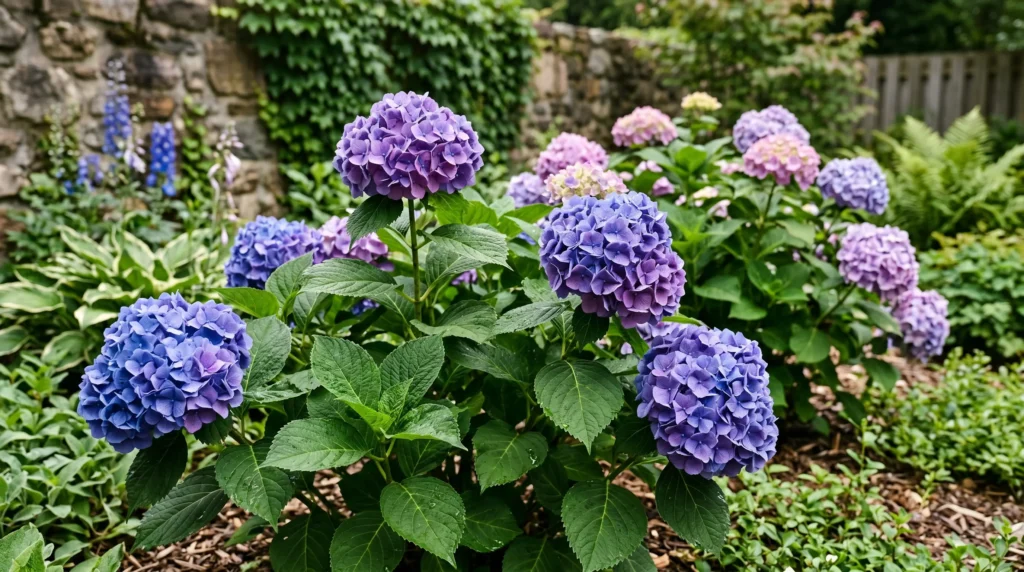
A hortensia plants is the traditional European name for the mophead forms of Hydrangea macrophylla — the same beloved flowering shrub widely sold in UK garden centres as “hydrangea.” The name “hortensia” dates to French botanist Philibert Commerson (1771) and remains the standard term across France, Spain, and the Netherlands. In the UK, hortensia plants thrive in moist, well-drained soil and partial shade, producing spectacular globular flower heads in pink, blue, white, or purple from mid-summer through early autumn.
Introduction
Picture a British cottage garden in July. Domed flower heads the size of dinner plates nod in the afternoon breeze — blowsy blush pinks, cool powder blues, and crisp whites catching the slanted summer light. These are hortensia plants: one of the most rewarding flowering shrubs any UK gardener can grow.
But here’s the question that sends thousands of British gardeners to a search engine every year: “Is a hortensia plants the same as a hydrangea?”
The short answer is yes. Hortensia plants is simply the traditional European name for the mophead forms of Hydrangea macrophylla. The two words refer to the same plant. If you’ve seen “hortensia” plants on a Dutch bulb catalogue, a French florist’s label, or a gardening Instagram account, you’ve been looking at the familiar hydrangea you already know and love — or perhaps, are just about to discover.
This guide covers everything a UK gardener needs to know: the history behind the name, how to choose the right variety, how to match it to your British soil and climate, how to turn your flowers blue (or keep them pink), when to prune without accidentally losing next summer’s blooms, and how to troubleshoot every common problem. Unlike generic care guides, this one is written specifically for British conditions — our soils, our weather, our regional quirks.
What Is a Hortensia Plant? History, Name & Botany
The Name “Hortensia”: A 250-Year Story
“Hortensia” is a 250-year-old common name for Hydrangea macrophylla, first given by the French botanist Philibert Commerson in 1771.
Commerson coined the name on the Bougainville expedition — the first French circumnavigation of the globe — likely in honour of a woman named Hortense. Historians have proposed two candidates: Hortense Barré, his companion on the voyage (the first woman to circumnavigate the globe, travelling in disguise), or Hortense de Nassau, daughter of the Prince of Nassau. The Latin root hortensis, meaning “of the garden,” adds a fitting layer of meaning to the name.
The plant’s journey to Britain is equally fascinating. By 1789, Sir Joseph Banks at Kew Gardens had obtained a mophead hortensia plants — now known as the cultivar ‘Joseph Banks’ — brought from Chinese cultivation via Canton merchants. Within a decade, it was described in horticultural journals as “very common” in British gardens. Napoleon’s stepdaughter Hortense, and possibly Josephine herself, greatly admired these shrubs, which helped spark a European fashion for them in the early nineteenth century. For a time, they were among the most fashionable plants in France and Britain alike.
The name Hydrangea — from the Greek hydro (water) and angeion (vessel) — was formalised by botanist Augustin Pyramus de Candolle in 1830. Contrary to popular belief, it does not refer to the plant’s water requirements; it describes the cup-shaped seed capsule of the plant. The genus now covers 70–75 species worldwide.
Hortensia Plants vs Hydrangea: Are They the Same Plant?
Yes. Hortensia plants and hydrangea refer to the same plant. The difference is in how the words are used:
| Term | What It Refers To |
|---|---|
| Hortensia | Traditional European common name; specifically used for the mophead forms of Hydrangea macrophylla |
| Hydrangea | Scientific genus name covering 70–75 species worldwide |
| Mophead | UK garden centre term for the large, ball-shaped flower heads |
| Lacecap | A flat-topped variety of H. macrophylla — botanically also a hortensia plants, but rarely referred to by that name |
In UK garden centres, you will almost always see these plants sold as “hydrangeas.” The term “hortensia plants” is more prevalent in French, Spanish, and Dutch-language gardening contexts — which is why it appears on so many imported bulb catalogues and European florist labels.
Basic Botany: What Makes a Hortensia plants
A hortensia plants(Hydrangea macrophylla) is a deciduous shrub in the family Hydrangeaceae, native to coastal Japan and China.
Key facts at a glance:
- Two flower types appear in each flower head: large, showy sterile florets on the outside and tiny, star-shaped fertile flowers at the centre.
- The dramatic “petals” are not petals at all — they are sepals, the modified outer casing of the flower. This is a common misconception worth correcting.
- Typical size in UK gardens: 1–1.5 metres in height and spread; some vigorous cultivars reach 2 metres or more.
- Hardiness rating: Most mophead varieties are rated H4–H5 by the RHS (hardy down to −10°C to −15°C), making them suitable for gardens across most of the UK, including much of Scotland.
Types of Hortensia Plants for UK Gardens
There are five main types of hortensia plants(hydrangea) available to UK gardeners, each suited to different conditions and garden styles.
Hortensia Plants / Mophead (H. macrophylla)
The classic hortensia: large, globe-shaped flower heads in pink, blue, white, or purple, on a rounded deciduous shrub. This is the type most widely sold in UK garden centres and the one referred to simply as “hortensia plants” in European tradition.
- Flowers on old wood (last year’s stems) — pruning timing is critical
- Colour changes with soil pH (see Section 6)
- RHS Award of Garden Merit varieties: ‘Mme Emile Mouillère’ (white), ‘Nikko Blue’, ‘Ayesha’ (lilac-pink, lilac-scented), ‘Endless Summer’ (reblooming on both old and new wood), ‘Cityline Paris’
Lacecap (H. macrophylla lacecap)
The lacecap is the elegant counterpart to the mophead: flat, plate-like flower heads with a ring of sterile florets surrounding a centre of tiny, star-shaped fertile flowers.
- More wildlife-friendly than mopheads — the open centre is easily accessible to bees and hoverflies
- Suits naturalistic and woodland-style UK gardens
- Also flowers on old wood; same pruning rules as mopheads
- Good varieties: ‘Veitchii’ (introduced from Japan in the 1860s; RHS AGM), ‘Blue Wave’, ‘Mariesii Variegata’ (attractive cream-edged leaves)
Panicle (H. paniculata)
The most forgiving hydrangea type for UK gardens: cone-shaped flower heads in creamy white that age gradually to pink or dusky rose through summer and autumn.
- Flowers on new wood — can be pruned hard in late winter without losing flowers
- Hardiness H6 — the best choice for cold northern UK regions, exposed coastal gardens, and elevated sites
- No colour change with soil pH
- Highly recommended varieties: ‘Limelight’ (RHS AGM; chartreuse-white fading to pink), ‘Pinky Winky’ (two-tone pink and white), ‘Vanille Fraise’, ‘Phantom’ (exceptionally large heads)
Climbing Hortensia plants (H. petiolaris)
A self-clinging deciduous climber producing flat, white lacecap flower heads in early summer, with attractive peeling bark in winter.
- Solves one of the most common UK garden challenges: thriving on north- or east-facing walls and fences where little else flowers well
- Slow to establish (allow 2–3 years), then vigorous — can reach 10–12 metres
- Beautiful ornamental bark provides winter interest
- RHS AGM; hardiness H5
Smooth / Annabelle (H. arborescens)
An American species producing enormous, creamy-white snowball heads. Flowers on new wood, so it can be cut back hard every year without any risk.
- ‘Annabelle’ is the UK classic; ‘Incrediball’ produces even larger heads with stronger, less floppy stems
- Best for shady spots under trees or in the dappled shade of north-facing borders
- Hardiness H5–H6
Quick-Reference: Which Hortensia plants Is Right for Your UK Garden?
| Type | Best For | Hardiness | Prunes On | Colour Change? |
|---|---|---|---|---|
| Mophead (hortensia plants) | Cottage gardens, containers, classic borders | H4–H5 | Old wood | Yes |
| Lacecap | Wildlife gardens, naturalistic planting | H4–H5 | Old wood | Yes |
| Panicle | All regions including North UK, exposed spots | H6 | New wood | No |
| Climbing | North walls, fences, pergolas | H5 | After flowering | No |
| Smooth / Annabelle | Shade, under trees, low-maintenance borders | H5–H6 | New wood | No |
Where to Plant Hortensia Plants in a UK Garden
The ideal position for a mophead hortensia plants in a UK garden is one that receives morning sun and afternoon shade — conditions naturally provided by an east-facing border.
Light Requirements
- Ideal: Morning sun, afternoon shade — this mirrors a typical British east- or south-east-facing border and prevents flowers from bleaching and leaves from scorching in summer
- Avoid: South-facing walls (too hot and dry in a UK summer); deep shade (reduces flowering significantly)
- Exception: Climbing H. petiolaris thrives on north-facing walls — pair it with fern plants for a stunning fully-shaded planting scheme.l
UK-Specific Positioning Tips
Frost pockets: Young hortensia plants growth emerges in early spring and is vulnerable to late frosts, which are common across the UK Midlands, northern England, and higher-elevation gardens. Avoid planting in low-lying frost pockets. Leave the old flower heads on through winter — they protect the swelling buds immediately below them.
Wind shelter: UK coastal gardens and exposed sites should provide a sheltered position. Strong winds scorch the large leaves of mopheads and rapidly dry out the soil around the roots.
Urban gardens: Hortensia plants cope well with air pollution and the partial shade cast by walls and buildings. They are one of the best flowering shrubs available for UK town gardens and narrow terraced-house borders — tough, adaptable, and spectacular in flower.
Spacing
- Mopheads and lacecaps: 1.2–1.5 metres apart
- Panicle types: 1.5–2 metres apart
- Climbing H. petiolaris: one plant per wall section; self-clings after the first season
Soil Requirements for UK Gardens
Hortensia Plants grow best in moist but well-drained soil, rich in organic matter, with a pH between 5.5 and 6.5 (slightly acidic).
General Soil Needs
They will tolerate neutral to mildly alkaline soils, but blue-flowered varieties cannot produce blue pigments in alkaline conditions and will shift to pink or mauve (explained fully in Section 6).
Understanding UK Soil Types in Relation to Hortensia Plants
Different UK regions have markedly different native soils, and knowing yours will save you time, money, and frustration:
| UK Soil Type | Typical pH | Hortensia Notes |
|---|---|---|
| Clay (Midlands, Thames Valley) | 6.0–7.5 | Nutrient-rich; improve drainage by incorporating grit and compost at planting; hortensia plants can thrive once drainage is addressed |
| Chalk / Limestone (South Downs, Cotswolds, Yorkshire Wolds) | 7.5–8.5 | Blue flowers are not achievable in the ground; use ericaceous containers for blue varieties, or choose pink/white varieties for beds |
| Acid sandy / peaty (Surrey heathlands, much of Scotland) | 4.5–5.5 | Ideal for blue flowers naturally; may need iron and general feeds to compensate for nutrient leaching |
| Loam (many UK lowland gardens) | 6.0–7.0 | Near-ideal conditions; colour can be adjusted easily in either direction with simple amendments |
How to Test Your Soil (UK)
Soil pH test kits are widely available at UK garden centres and online for £5–£10. Test before purchasing plants — it takes five minutes and can prevent years of disappointment. Free soil type maps are also available via the British Geological Survey website.
Improving Chalky UK Soil
If you garden on chalk or limestone:
- Dig in generous quantities of peat-free ericaceous compost or acidic leaf mould at planting
- Grow blue varieties in containers using peat-free ericaceous compost (good UK brands: Melcourt Sylvagrow Ericaceous, John Innes Ericaceous)
- Note: over 70% of UK gardeners bought peat-free compost in 2024 — peat-free options are now well-established and widely available
How to Plant a Hortensia Plants: Step-by-Step
How To Schema: Planting a Hortensia plants in a UK Garden
What you need: Hortensia plant, peat-free compost, watering can or hose, Mulch with a 5–8 cm layer of leaf mould or composted bark — the same approach works beautifully when underplanting hortensia plants with spring bulbs like daffodils.
Best time: September–October or March–May. Avoid midsummer planting and frozen winter ground.
- Dig a planting hole twice as wide and the same depth as the root ball.
- Mix the excavated soil with an equal volume of peat-free compost (50:50 ratio).
- Place the plant in the hole at exactly the same depth it was growing in its pot — never deeper, as burying the crown causes rotting.
- Backfill with the compost and soil mix; firm gently with your heel.
- Water thoroughly until the soil is saturated around the root ball.
- Mulch generously with a 5–8 cm layer of leaf mould or composted bark, keeping the mulch away from the stem.
- Water weekly for the first season, particularly during dry spells.
The Science of Hortensia Plants Colour Change (UK Explained)
Hortensia flower colour in mophead and lacecap varieties is determined by soil pH, which controls whether the plant can absorb aluminium — the element responsible for producing blue pigments.
Why Flowers Change Colour: The pH–Aluminium Mechanism
This colour change applies only to mophead and lacecap forms of H. macrophylla and H. serrata. Panicle, climbing, and smooth hydrangeas do not change colour with soil chemistry.
The mechanism works as follows:
- In acidic soil (pH below 6.0): aluminium is freely available in the soil; the plant absorbs it, and blue/violet pigments form in the flower sepals.
- In alkaline soil (pH above 6.5): aluminium is chemically locked into the soil and unavailable to the plant; flowers remain pink or red.
- White, red, and green-flowered varieties are not affected by soil pH regardless of conditions.
How to Turn Your Hortensia Plant Blue: A UK Step-by-Step Guide
How To Schema: Turning a Hortensia Plants Blue in a UK Garden
- Confirm your variety. You need a mophead or lacecap H. macrophylla — panicle types (e.g. ‘Limelight’) will never change colour, however much you adjust the soil.
- Test your soil pH. If it reads above 6.5, follow the steps below.
- Apply aluminium sulphate according to the manufacturer’s rate and water in thoroughly. This is available from most UK garden centres.
- Water exclusively with rainwater. Tap water across much of the UK — particularly in London and the South East (Thames Water hardness: 200–300 mg/L) — is alkaline and will counteract your efforts.
- Repot (if in a container) into peat-free ericaceous compost.
- Mulch with acidic material: pine needles or bracken both slowly acidify the soil surface.
- Be patient. Results take one full growing season. The flower colour you see this year was determined by what the plant absorbed last year.
Note for chalky UK gardens: If you garden on chalk or limestone soils (South Downs, Cotswolds, Yorkshire Wolds), achieving blue hortensia plants in the ground is extremely difficult. Growing in containers with ericaceous compost and rainwater irrigation is the practical solution.
How to Keep or Create Pink Flowers
If your naturally acidic UK soil is producing blue flowers and you want pink:
- Apply ground limestone or chalk dressing at 75–100g per square metre in winter
- Use a high-phosphorus fertiliser (such as tomato feed), which competes with aluminium uptake
Why Your Hortensia Plants Changed Colour Unexpectedly
A very common UK scenario: a blue hortensia bought in full flower from a Dutch nursery turns pink in the garden over the following year. This happens because the plant was grown in Dutch peat-based ericaceous compost; your UK garden soil is more alkaline than that growing medium.
Other causes include: switching to tap-water irrigation in a hard-water area; using a new fertiliser high in phosphorus; or the fact that soil pH can vary significantly across a garden — sometimes by half a pH unit within a few metres.
Colour Change Quick-Reference Table
| Flower Colour | Soil pH | What to Do |
|---|---|---|
| Deep blue | Below 5.5 | Maintain with rainwater and ericaceous compost |
| Mid blue / mauve | 5.5–6.0 | Apply aluminium sulphate if deeper blue is wanted |
| Purple / lilac | 6.0–6.5 | Transitional zone — adjust in either direction |
| Pink | 6.5–7.0 | Add lime for deeper pink; acidify for blue |
| Vivid pink / red | Above 7.0 | Strongly alkaline soil; blue is not achievable in the ground |
How to Prune Hortensia Plants in the UK
The most important rule in hortensia plants care: prune at the wrong time and you remove next year’s flower buds. The key is knowing whether your variety blooms on old wood or new wood.
Old Wood vs New Wood: The Fundamental Distinction
- Old wood bloomers (mophead and lacecap H. macrophylla): The flower buds that will open next summer are already formed on the stems by late summer of the previous year. Remove those stems and you lose next year’s flowers.
- New wood bloomers (panicle H. paniculata and smooth H. arborescens): These form their flower buds on growth produced in the current season. You can prune them as hard as you like in late winter with no penalty.
How to Prune Mophead and Lacecap Hortensias (Old Wood)
How To Schema: Pruning Mophead Hortensia plants in the UK
When: Mid-spring (April in most UK regions), once the fat green buds are clearly visible.
What you need: Sharp secateurs, gardening gloves.
- From October through to March — do nothing. Leave the old flower heads intact. They protect the tender buds immediately below them from UK frost damage.
- In April, inspect the stems. You will see pairs of plump, bright green buds swelling along the lengths of last year’s stems.
- Cut each stem back to just above the topmost pair of fat, healthy buds — typically just beneath where the old flower head joins the stem.
- Remove at the base any completely dead, weak, or crossing stems that will not contribute to the new season’s framework.
- Do not cut the whole plant back to the ground. This removes all the old-wood stems carrying this year’s flower buds and the plant will not flower that summer.
Light deadhead vs hard renovation prune:
| Approach | When to Use | What Happens |
|---|---|---|
| Light deadhead (cut to fat buds only) | Annual maintenance on healthy plants | Maximum flowering; compact shape maintained |
| Hard renovation prune (one-third of oldest stems to the base) | Every 3–5 years on old, congested plants | Temporarily reduces flowering; renews the plant’s framework over 2 years |
| Cut to the ground | Almost never appropriate for mopheads | Eliminates flowering for 1–2 years; only worth doing on severely diseased plants |
How to Prune Panicle and Smooth Hortensias Plants (New Wood)
When: Late winter to early spring (February–March UK).
- Cut back to 2–3 buds above the previous year’s woody framework
- The harder you cut, the fewer but larger the resulting flower heads
- Safe to prune these varieties to the ground if needed — they will regrow and flower in the same year
How to Prune Climbing Hortensia Plants
- Prune immediately after flowering (typically August)
- Remove only stems growing away from the wall, obstructing windows or gutters, or spoiling the shape
- Avoid heavy pruning — climbing hortensias establish slowly and do not tolerate hard cutting
Common UK Pruning Mistakes
| Mistake | Why It Happens | How to Fix It |
|---|---|---|
| Pruning mopheads in autumn | Tidying up after summer | Resist — leave heads on through winter for frost protection |
| Cutting all stems to the ground | Treating it like a herbaceous perennial | Only smooth H. arborescens responds well to this; never do it to H. macrophylla |
| Pruning too early in spring | Impatience after a long winter | Wait until fat buds are clearly visible, usually April across most of the UK |
| Removing all brown stems | Assuming they’re dead | Do the scratch test: green tissue under the bark = alive; only remove confirmed dead wood |
UK Seasonal Pruning Calendar
| Month | Pruning Action |
|---|---|
| October–February | Leave mopheads and lacecaps completely alone; old heads protect buds from frost |
| February–March | Light tidy on panicle and smooth types; cut to framework buds |
| April | Main prune for mopheads and lacecaps — cut to fat buds |
| May | Remove any remaining frost-damaged tips that are now clearly dead |
| August | Prune climbing H. petiolaris after flowering |
Watering & Feeding Hortensia Plants in the UK
Watering
Hortensia plants are moisture-hungry but not waterlogged plants.
- In UK outdoor beds: water once a week during dry spells between May and September; daily for container-grown plants in summer
- Rainwater is preferable to tap water for blue-flowered varieties — tap water across much of southern England and the Midlands is moderately alkaline (Thames Water hardness: 200–300 mg/L), which gradually shifts blue flowers toward pink over time
- Mulch every spring with a 5–8 cm layer of leaf mould or composted bark to retain soil moisture and regulate soil temperature through summer
- Signs of underwatering: wilting in the morning (not just afternoon sun-related drooping) — water immediately and thoroughly
Feeding
As a general rule, hortensia plants do not need heavy feeding. Excessive nitrogen promotes lush foliage at the expense of flowers.
- Annual spring feed: a balanced, general-purpose fertiliser (Growmore or Fish, Blood & Bone at low rates) applied once in April is usually sufficient
- For blue colour maintenance: use a feed low in phosphorus and higher in potassium — this supports aluminium uptake
- For pink colour maintenance: a high-phosphorus feed (such as tomato feed) competes with aluminium and keeps flowers pink
- Stop feeding by late July. Autumn feeding encourages soft new growth that is highly vulnerable to UK early frosts.
Common Problems, Pests & Diseases in UK Gardens
Why Is My Hortensia Plants Not Flowering?
The most common reason hortensias fail to flower in UK gardens is incorrect pruning — specifically, cutting mophead varieties too hard or at the wrong time of year.
Causes ranked by likelihood:
- Incorrect pruning — cutting mopheads too late or too hard removes next year’s flower buds; the most common mistake in UK gardens
- Late frost damage — spring buds killed by a late cold snap, particularly in frost pockets and exposed northern gardens
- Insufficient sunlight — fewer than 3–4 hours of sun per day reduces flowering significantly
- Young plant — newly planted hortensias often skip their first flowering season; patience is required
- Excessive nitrogen feed — vigorous leafy growth but no flowers; reduce feeding
Pests (UK-Specific)
| Pest | Symptoms | UK Prevalence | Treatment |
|---|---|---|---|
| Aphids | Distorted young shoots; sticky honeydew residue | Common (spring) | Blast off with water; encourage ladybirds; neem oil if severe |
| Hydrangea scale | White waxy deposits on stems | Increasingly common in England and Wales | Systemic insecticide or physical removal in winter |
| Vine weevil | Notched leaf margins; sudden plant collapse (root grub damage — worst in containers) | Common in UK containers | Nematode treatment (Nemasys) applied in August–September |
| Slugs and snails | Young shoots eaten; especially bad in wet UK springs | Very common | Wildlife-friendly ferric phosphate pellets, copper tape, or nematodes |
Diseases
| Disease | Symptoms | UK Conditions | Treatment |
|---|---|---|---|
| Powdery mildew | White powder on leaf surfaces; late summer | Warm, humid UK summers | Improve air circulation; avoid overhead watering; fungicide if severe |
| Leaf spot (Cercospora) | Brown or purple spots on leaves | Damp conditions | Remove affected leaves; improve airflow around plant |
| Botrytis (grey mould) | Grey fluffy mould on stems and flowers | Cool, wet UK autumns | Remove affected parts promptly; reduce overhead moisture |
| Root rot | Sudden wilt; brown, mushy roots | Waterlogged UK clay soils | Improve drainage; never plant in waterlogged spots |
Leaf Colour Problems
Purple leaves in spring: A normal temperature response to cold spring conditions — leaves will green up as weather warms. If it persists into early summer, it may indicate a phosphorus deficiency.
Yellow leaves (chlorosis): Iron deficiency is common in alkaline UK soils — treat with a sequestered iron product or switch to ericaceous compost. This is one of the first signs that a blue hortensia is struggling in unsuitable soil.
Brown leaf edges: Caused by wind scorch, too much direct afternoon sun, or late frost damage. Improve the sheltered position or shade for afternoon hours.
Frost Damage Recovery
Brown or blackened shoots after a late UK frost are a common and largely harmless occurrence. Do not panic-prune.
- Wait until late April or May before assessing damage
- Scratch test: use a fingernail or knife to scratch the bark — green tissue beneath means the stem is alive; only remove wood that is confirmed dead
- Even plants that appear severely frosted will usually recover from the root system
Propagating Hortensia Plants in the UK
The three most reliable methods for propagating hortensias in the UK are softwood cuttings (late spring to midsummer), hardwood cuttings (winter), and layering (any time, but most productive in spring).
Softwood Cuttings: The Best Method (Late May–July)
HowTo Schema: Taking Softwood Hortensia Cuttings
What you need: Sharp knife or secateurs, hormone rooting powder (e.g. Doff, Westland), 50:50 mix of perlite and peat-free compost, small pots, clear polythene bag or propagator.
- Take a cutting 10–15 cm long from non-flowering, healthy new growth — look for soft, green stems.
- Cut just below a leaf node (the point where leaves join the stem).
- Remove lower leaves, leaving 2–3 leaves at the tip; reduce large leaves by half to reduce water loss.
- Dip the cut end in hormone rooting powder and tap off any excess.
- Insert into small pots of 50:50 perlite and peat-free compost; water lightly.
- Cover with a clear polythene bag or propagator lid to maintain humidity.
- Place in a bright spot out of direct sun — a UK greenhouse, shed with a window, or cool conservatory is ideal.
- Rooting takes 4–6 weeks. The cutting has rooted successfully when roots emerge from the drainage holes or you feel gentle resistance when tugged.
- Pot on into individual pots of peat-free compost.
- Overwinter in a cold frame or unheated greenhouse; plant out the following spring.
Hardwood Cuttings (November–February)
- Take pencil-thick stems 20–25 cm long; cut the base cleanly just below a leaf node
- Insert 15 cm deep into a sheltered border trench or a deep pot of gritty compost
- Leave outside over the UK winter — the cold helps stimulate rooting
- New growth and roots will have established by the following spring
Layering: The Easiest Method
- Select a low, flexible stem and bend it to the ground
- Wound the underside of the stem with a shallow cut and dust with rooting powder
- Pin it into a shallow trench filled with compost and cover with soil
- Leave for 12 months without disturbing
- Once the new plant has rooted, sever it from the parent plant and dig it up for transplanting
Hortensia Plants in UK Garden Design
Cottage Garden Planting: The Classic UK Use
Hortensias are quintessential cottage garden plants. Classic combinations that work beautifully in UK gardens:
- Blue hortensia + purple alliums + silver lamb’s ears (Stachys byzantina) — a cool, romantic colour echo
- Pink hortensia + pale climbing roses + white cosmos — the quintessential English summer border
- White hortensia (‘Mme Emile Mouillère’) + lavender + dark foxgloves — elegant and bee-friendly
Companions to plant nearby: roses, lavender, foxgloves, astilbes, Japanese anemones.Other reliable cottage garden companions include yarrow (Achillea millefolium) — its flat flower heads contrast beautifully with the rounded mophead blooms of a hortensia.
Contemporary UK Borders
Panicle hydrangeas (H. paniculata) have become one of the fastest-growing categories in UK garden retail, and it is easy to see why: their cone-shaped flower heads work beautifully in modern and urban settings, require no colour management, and tolerate a wide range of conditions.
- ‘Limelight’ with ornamental grasses (Miscanthus, Molinia) — structural, four-season interest
- ‘Little Lime’ for smaller urban gardens and narrow borders
- ‘Pinky Winky’ as a statement specimen shrub
Containers on UK Patios and Balconies
Many compact mophead varieties thrive in large pots, making them ideal for patios, balconies, and small gardens. Use a minimum pot size of 30–40 cm diameter — hortensias have substantial root systems and will dry out and stress in undersized containers.
- Best compact varieties for pots: ‘Cityline Paris’, ‘Mini Penny’, ‘Bouquet Rose’
- Use peat-free ericaceous compost for blue varieties; peat-free multipurpose for pink or white
- Water daily in summer; feed fortnightly from April to July; protect from hard frosts by wrapping pots in bubble wrap or moving under cover
North-Facing Walls: The UK Gardener’s Challenge Solved
Climbing H. petiolaris is one of the very best plants for a north- or east-facing UK wall. It is one of the few flowering climbers that will produce reliable blooms in truly shaded positions.
A beautiful, low-maintenance combination: climbing hortensia + hardy ferns (Dryopteris, Polystichum) + hostas for a fully shaded planting scheme with three seasons of interest.
Companion Plants for Hortensia Plants(UK)
| Garden Position | Best Companions |
|---|---|
| Shade / part shade | Ferns, hostas, astilbes, Japanese anemones, foxgloves |
| Sun / part shade | Roses, lavender, purple cranesbill (Geranium), speedwell (Veronica), box edging |
| Under tree canopy | Japanese maples, Cornus (dogwoods), pulmonarias, wood anemones |
Hortensia Plants as Cut and Dried Flowers
Cut flowers: Take stems when blooms are fully open — cutting too early causes the stems to collapse. Condition by placing stems in deep water immediately after cutting.
Dried flowers: Two reliable UK methods:
- Hang upside down in bunches in a warm, airy room for 2–3 weeks
- Stand in a small amount of water and allow to dry slowly — this method generally preserves the flower shape best and is recommended for large mophead heads
Dried hortensias hold their colour well for several months and are widely used in autumnal wreaths and arrangements.
Hortensia Plants Safety: Toxicity for Pets & Humans
All parts of the hortensia plant are mildly toxic if ingested, due to the presence of hydrangin, a cyanogenic glycoside.
Key safety facts:
- Safe to handle: Hortensias present no contact risk for most people. Those with sensitive skin may wish to wear gloves when pruning.
- Harmful if eaten: All parts of the plant — leaves, flowers, stems, and bark — are harmful if consumed by humans, dogs, or cats.
- Toxic to dogs and cats: The RHS confirms that hortensias are harmful if eaten by pets.
- Children: The plant is not typically dangerous in a normal garden scenario because the leaves taste unpleasant; however, take care with young children in the garden.
- Not deer-resistant: A consideration for rural UK gardens.
If a pet has ingested any part of a hortensia plants, contact the UK Animal Poison Line: 01202 509 000.
Hortensia Plants UK Month-by-Month Care Calendar
Use this calendar as a year-round reference for keeping hortensia plants in excellent condition in UK gardens.
| Month | Key Tasks |
|---|---|
| January | Check container plants haven’t frozen; water during mild spells if soil is completely dry |
| February | Begin pruning panicle (H. paniculata) and smooth (H. arborescens) types; apply organic mulch around beds |
| March | Hard prune paniculata and arborescens if not done; scratch-test mophead stems; prepare new planting areas |
| April | Main prune for mopheads and lacecaps — cut to fat buds; plant new container-grown specimens; apply balanced spring fertiliser |
| May | Remove frost-damaged tips; water newly planted specimens regularly; watch for aphids on new growth |
| June | First flowers appear on early mophead varieties; water in dry spells; apply second feed if growth looks poor |
| July | Peak flowering season; water regularly — hortensias show stress quickly in dry conditions; cut flowers for vases |
| August | Deadhead spent blooms on mopheads; prune climbing H. petiolaris after flowering; take softwood cuttings |
| September | Late flowers on panicle types; begin reducing feeding; plant new specimens now for spring establishment |
| October | Do not deadhead mopheads — leave old heads on for frost protection; mulch around base with leaf mould; plant bare-root specimens |
| November | Take hardwood cuttings; move tender container plants to a sheltered spot or cold greenhouse |
| December | Enjoy the structural beauty of dried flower heads against winter skies; check container plants; plan next year’s additions |
Frequently Asked Questions
Q: Is a hortensia plants the same as a hydrangea?
Yes. Hortensia plants is the traditional European common name for mophead forms of Hydrangea macrophylla. Both terms refer to the same plant. “Hydrangea” is the scientific genus name covering all 70+ species; “hortensia” specifically describes the mophead type and is the standard word for the plant in French, Spanish, and Dutch. In UK garden centres, these plants are almost always labelled as hydrangeas.
Q: Why isn’t my hortensia plants flowering?
The most common cause is incorrect pruning — cutting mophead or lacecap varieties too hard or too late removes the flower buds that were already formed on last year’s stems. Other causes include frost damage to spring buds, fewer than 3–4 hours of sunlight per day, over-feeding with nitrogen, or a very recently planted specimen still establishing. Check you are pruning in April, only to fat buds, and leaving old stems intact over winter.
Q: Why has my hortensia plants changed colour from blue to pink?
Your garden soil or compost is more alkaline than the conditions the plant was previously growing in. Blue flowers require acidic soil (pH below 6.0) to access aluminium. In neutral or alkaline UK soil — common across much of England, particularly in chalk and limestone regions — the same plant produces pink blooms. Water exclusively with rainwater rather than tap water (alkaline in much of the UK), and add aluminium sulphate, or repot into peat-free ericaceous compost, to restore blue colour over time. Results take a full growing season.
Q: When should I prune my hortensia plants in the UK?
For mophead and lacecap varieties (old wood bloomers): prune in mid-spring, in April, cutting each stem back to the fat green buds just below the old flower head. Leave old heads on through winter as frost protection. For panicle (H. paniculata) and smooth (H. arborescens) types (new wood bloomers): prune in late winter, February to March, cutting back to 2–3 buds above the previous year’s woody framework.
Q: Can I grow hortensia plants in pots in the UK?
Yes. Compact mophead varieties thrive in large pots — use a minimum diameter of 30–40 cm to avoid stress from root restriction. Use peat-free ericaceous compost for blue varieties; peat-free multipurpose compost for pink or white. Water daily in summer and feed fortnightly from April to July. Protect pots from hard frosts by wrapping in bubble wrap or moving to a sheltered spot or unheated greenhouse in November.
Q: Are hortensia plants toxic to dogs and cats?
Yes, mildly. All parts of the hortensia contain hydrangin, a cyanogenic glycoside that is harmful if eaten by dogs or cats. The plant is safe to touch. Contact the UK Animal Poison Line (01202 509 000) immediately if you suspect your pet has eaten any part of the plant.
Q: How do I dry hortensia plants flowers?
Cut fully-open blooms with long stems — cutting before full opening causes them to wilt and collapse. Either hang upside down in bunches in a warm, airy room for 2–3 weeks, or stand them in a small amount of water and allow them to dry slowly over the same period. The second method preserves the natural shape of large mophead blooms most reliably. Dried hortensias hold their colour well for several months.
Q: What is the best hortensia plants for a shady UK garden?
The climbing Hydrangea petiolaris is the top choice for a shaded north- or east-facing wall or fence — one of very few climbers to flower reliably in full shade. For shaded borders and beds, smooth H. arborescens ‘Annabelle’ or lacecap varieties (‘Veitchii’, ‘Blue Wave’) perform well in dappled shade under trees.
Q: What is the hardiest hortensia plants for a cold northern UK garden?
Panicle hydrangeas (H. paniculata), including varieties such as ‘Limelight’, ‘Pinky Winky’, and ‘Phantom’, are rated H6 and are the most reliable choice for exposed sites, elevated gardens, and cold regions of northern England and Scotland. They flower on new wood each year, so late frosts do not damage next season’s blooms.
Conclusion
Hortensias are among the most rewarding flowering shrubs available to UK gardeners. They are tougher and more adaptable than their luxuriant appearance suggests: capable of brightening a north-facing wall, filling a cottage border with colour from July to October, and surviving decades with nothing more than an annual spring prune and a mulch.
The key to success in the UK is matching the right variety to your conditions — particularly your soil type and regional climate — and understanding the one critical rule that trips up most first-time growers: leave the old flower heads on through winter and prune in April to fat buds, not in autumn.
Get those two things right, and hortensias will reward you with some of the most spectacular summer colour of anything you’ll grow in a British garden.

Leave a Reply