
How long do bedding plants last? If you’ve ever planted a tray of petunias in May and watched them fizzle out in August — or wondered whether your geraniums will survive winter — you’ve asked exactly the right question. It’s one of the most searched queries in UK gardening, and the answer depends on far more than “they last one season.”
The confusion usually comes from three overlapping problems: gardeners mixing up annuals and perennials, not knowing which plants can be overwintered, and underestimating how dramatically UK conditions — late frosts, wet summers, regional climate variation — affect display length.
This guide cuts through all of that. You’ll find a 20-plant lifespan reference table, a breakdown of the seven factors that shorten or extend flowering, a step-by-step overwintering guide for tender perennials, a full UK seasonal calendar, a troubleshooting diagnostic for early plant death, and a cost-per-week value analysis — none of which exist in a single place anywhere else online
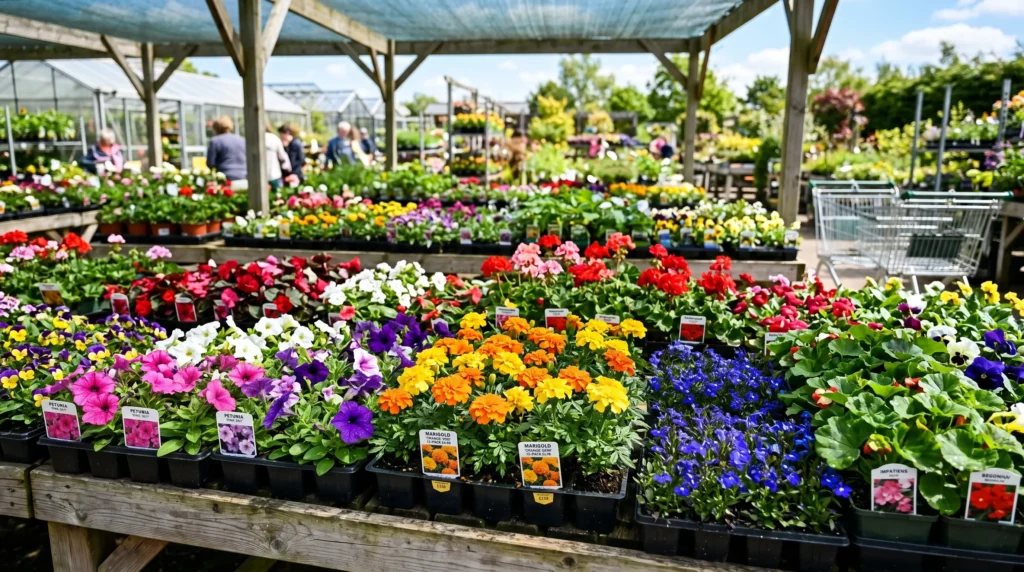 What Does “How Long Bedding Plants Last” Actually Mean?
The lifespan of a bedding plant can refer to three very different things, and confusing them is the root of most gardener frustration.
Biological Lifespan — The Plant’s Natural Life Cycle
The biological lifespan is determined by whether a plant is an annual, biennial, or perennial.
- Annual: Completes its entire life cycle — germination, flowering, seed production, death — in one growing season. Example: petunia, marigold, lobelia.
- Half-hardy annual: A true annual that cannot survive UK frost, so it is treated as a summer-only plant. Example: busy lizzie, cosmos, nicotiana.
- Hardy annual: An annual that can tolerate frost and may self-seed. Example: alyssum, viola.
- Biennial: Takes two full years to complete its life cycle. Year one produces a leafy rosette; year two produces flowers, sets seed, and dies. Example: wallflower, foxglove.
- Tender perennial: Biologically capable of living for many years but cannot survive a UK winter outdoors. Used as annual summer bedding unless overwintered. Example: pelargonium (geranium), fuchsia, begonia.
- Hardy perennial used as bedding: A true perennial planted temporarily for seasonal display. Example: some heucheras and ornamental grasses.
Display Lifespan —How Long Do Bedding Plant Actually Looks Good
The display lifespan is how many weeks a plant actively flowers and remains attractive. This is what gardeners actually care about. A begonia is biologically a perennial but functions as a 16–18 week display plant in a UK summer border before frost ends its season.
Season Lifespan — How Long Before the Environment Ends It
The season lifespan is the window your local UK climate allows a plant to be outdoors. A first autumn frost in October can terminate a plant that was biologically weeks from natural death anyway.
Why this matters: Understanding all three lifespans is the key to avoiding disappointment, planning overlapping displays, and choosing which plants to invest in overwintering.
How Long Do Different Bedding Plants Last? (UK Lifespan Guide)
The table below covers 20 of the most popular bedding plants grown in UK gardens, with realistic flowering windows, average weeks of colour, and overwintering potential. All data is based on UK average conditions; gardeners in Southern England and the South West may gain 2–3 additional weeks at each end of the season.
How to read this table:
- Display Season = the window when the plant is typically in active flower in the UK
- Weeks of Colour = realistic average for a well-cared-for plant in UK conditions
- Overwinterable? = whether the plant can be saved for next year
| Plant | Type | Display Season | Weeks of Colour (UK avg.) | Overwinterable? | Key Notes |
|---|---|---|---|---|---|
| Petunia | Half-hardy annual | May–Oct | 20–22 wks | No | Deadhead 2–3x/week for continuous bloom |
| Geranium (Pelargonium) | Tender perennial | May–Oct | 20–24 wks | Yes (indoors, 5–10°C) | Can last 4–6 years if overwintered |
| Busy Lizzie (Impatiens) | Half-hardy annual | Jun–Oct | 16–18 wks | No | Shade-tolerant; downy mildew risk |
| Lobelia | Half-hardy annual | May–Sep | 16–18 wks | No | Cut back in July for second flush |
| Marigold (French) | Half-hardy annual | May–Oct | 20–22 wks | No | Self-seeds; excellent pest deterrent |
| Begonia | Tender perennial | Jun–Oct | 16–18 wks | Yes (lift tubers) | Lift and store tubers in November |
| Alyssum | Hardy annual | Apr–Oct | 24–26 wks | No | Self-seeds freely; one of longest-display annuals |
| Antirrhinum (Snapdragon) | Half-hardy annual | Jun–Sep | 14–16 wks | Borderline | Short-lived perennial in mild UK winters |
| Verbena | Half-hardy annual | May–Oct | 20–22 wks | Borderline | Takes cuttings well in August |
| Nemesia | Half-hardy annual | May–Aug | 12–14 wks | No | Cut back hard for autumn reflush |
| Salvia | Half-hardy annual | Jun–Oct | 16–20 wks | No | Thrives in hot, sunny UK borders |
| Osteospermum | Tender perennial | May–Sep | 16–18 wks | Yes (cuttings) | Closes in dull, rainy weather |
| Fuchsia | Tender perennial | Jun–Oct | 16–20 wks | Yes (frost-free) | Hardy varieties exist for borders |
| Pansy | Hardy annual/biennial | Oct–Apr | 20–24 wks | Yes (hardy) | The winter bedding hero |
| Viola | Hardy annual | Sep–May | 28–30 wks | Yes (hardy) | Longest display of any common bedding plant |
| Wallflower | Biennial | Apr–Jun | 8–10 wks | N/A | Plant in autumn; flowers the following spring |
| Foxglove | Biennial | May–Jun | 6–8 wks | N/A | Year 1 rosette; year 2 flower spike |
| Cosmos | Half-hardy annual | Jul–Oct | 12–14 wks | No | Self-seeds readily; sow direct |
| Nicotiana | Half-hardy annual | Jul–Sep | 10–12 wks | No | Powerful evening scent; good for borders |
| Tagetes (African Marigold) | Half-hardy annual | Jun–Oct | 16–18 wks | No | Larger, bolder than French marigold |
Standout Plants at a Glance
- Longest display overall: Viola (28–30 weeks, September to May)
- Longest-lived plant with overwintering: Pelargonium (4–6 years)
- Best value summer annual: Petunia (20–22 weeks, easy to maintain)
- Biggest surprise: Winter bedding like pansies and violas outlast most summer bedding in total display weeks
Container vs Border: Does Planting Method Affect Display Length?
Yes — significantly. Border-planted bedding can last 3–4 weeks longer than the equivalent plant in a container, because border soil retains moisture more reliably, root systems access deeper soil, and temperature fluctuations are less extreme. Container-grown bedding dries out faster, becomes root-bound sooner, and demands more consistent intervention.
Things That Affect How Long Bedding Plants Last in the UK
Seven key factors determine whether your bedding plants reach their full potential display lifespan or fail weeks early. Understanding each one gives you direct, measurable control over how long your garden stays colourful.
UK Frost Dates and Your Local Climate
Frost is the single biggest external limiter of bedding plant lifespan in the UK. A single night below -2°C is enough to kill half-hardy annuals and tender perennials outright.
Average last frost dates by UK region:
| Region | Average Last Frost | Safe Outdoor Planting |
|---|---|---|
| Scotland (Highland) | Late May–early June | Early June |
| Northern England | Late April–mid May | Mid May |
| Midlands | Mid April | Late April–early May |
| Southern England | Late March–mid April | Late April |
| South West England / Wales | March | April |
Important: These are averages. The “Beast from the East” cold snap of 2018 brought damaging frosts to southern England in late February. Always check local forecasts before planting out, regardless of calendar date.”Once summer bedding is cleared in October, it’s the perfect moment to start planning your spring display with bulbs like daffodils.”
Whether You Deadhead (and How Often)
Deadheading is the single most impactful thing a gardener can do to extend flowering. When a plant produces ripe seeds, it stops investing energy in new flowers. Removing spent flowers before they set seed keeps the plant in a continuous flowering state.
Deadheading frequency guide:
| Plant | Recommended Frequency | Technique |
|---|---|---|
| Petunia | Every 2–3 days at peak | Cut to first leaf node below spent flower |
| Geranium | Weekly | Snap off entire flower truss at stem base |
| Viola/Pansy | Every 7–10 days | Pinch off at stem base |
| Lobelia | Monthly (cut back) | Trim whole plant by one-third in July |
| Marigold | Every 3–5 days | Snap off spent flower head |
Measurable impact: Regular deadheading can extend the flowering period of petunias, marigolds, and verbena by 4–6 weeks compared with neglected plants.
Common mistake: Only removing the petals, leaving the swelling seed head behind. Always cut back to the leaf node.
Feeding Regime
Bedding plants — especially those in containers — exhaust the nutrients in fresh compost within 4–6 weeks. After that point, without supplementary feeding, flowering slows and plants decline prematurely.
Feeding schedule:
- May–June: Balanced liquid feed (N:P:K roughly equal) to support establishment and early growth
- July onwards: Switch to high-potassium feed (tomato fertiliser works well) to sustain and promote flowering
- Frequency: Weekly liquid feed for containers; monthly granular or liquid for border plants
Measurable impact: Unfed container plants can fail 6–8 weeks earlier than regularly fed equivalents.
Watering Consistency
Inconsistent watering — either drought stress or waterlogging — significantly shortens bedding plant lifespan. The risk varies by situation:
- Containers in summer: Can dry out completely within 24 hours in warm UK conditions. Check daily; water to the point of drainage.
- Border plants: Access deeper soil moisture; require less frequent intervention but still need monitoring during dry spells.
- Overwatering: Creates anaerobic conditions at root level, causing root rot and sudden plant collapse.
Best practice: Check soil to first knuckle depth. If dry at that depth, water deeply. If still moist, wait another day. Morning watering reduces fungal disease risk by allowing foliage to dry during the day.
Planting Position — Sun, Shade, and Wind
The wrong position can reduce a plant’s display lifespan by weeks. Different bedding plants have fundamentally different light requirements:
| Condition | Suitable Plants | Plants to Avoid |
|---|---|---|
| Full sun (6+ hrs direct light) | Petunia, geranium, marigold, verbena, salvia | Busy lizzie, fuchsia (in heat) |
| Partial shade (3–5 hrs) | Begonia, fuchsia, lobelia | Petunia, marigold |
| Full shade | Busy lizzie, some fuchsias | Most summer bedding |
| Exposed/windy | Hardy annuals, low-growing plants | Tall fuchsias, nicotiana |
Wind scorch is an underestimated problem in UK urban gardens, where buildings channel wind and damage tender foliage. Container plants on exposed balconies or terraces are especially vulnerable.
Container vs Border Planting
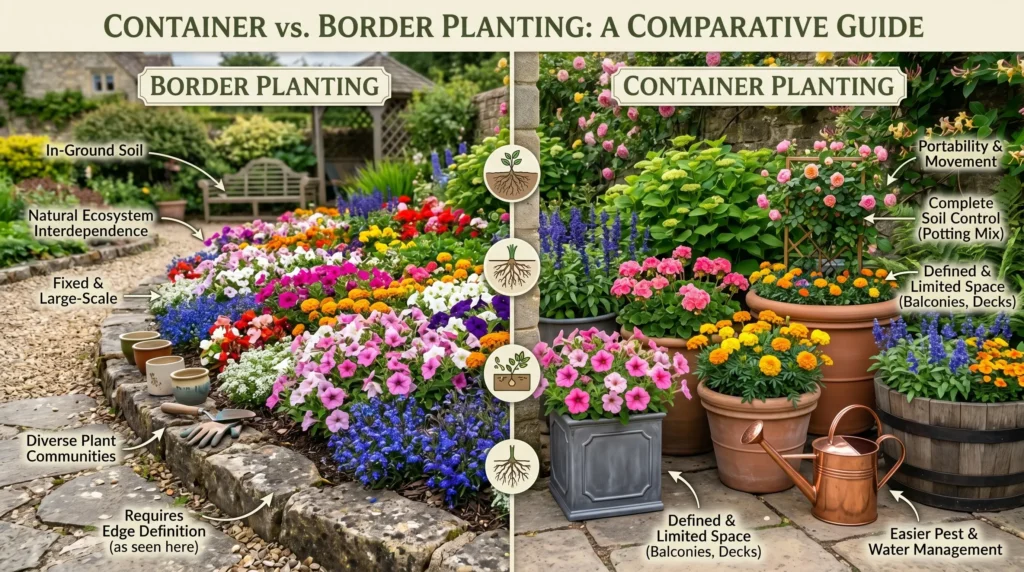
Border-planted bedding consistently outlasts container-planted bedding by 3–4 weeks because:
- Soil temperature is more stable
- Roots access moisture reserves at depth
- Plants are less likely to become root-bound
- Nutrient exhaustion is slower
Container bedding compensates with greater design flexibility, but demands consistent watering and weekly feeding to approach the same display lifespan.
Pest and Disease Pressure
Three threats cause the most premature bedding plant deaths in UK gardens:
- Slugs and snails: Most destructive to young plants in wet UK springs. Seedlings can be wiped out overnight. Use 7 Things That Affect How Long Bedding Plants Last” → Factor 1: copper tape, wool pellets, or nematode treatments.
- Vine weevil: Grubs eat roots from below; the first sign is sudden collapse of an apparently healthy container plant. Treat preventatively with vine weevil nematodes in August.
- Downy mildew: Devastated UK busy lizzie populations between 2011 and 2018. Choose resistant varieties (Impatiens walleriana alternatives, SunPatiens) in wet years.Why Frost Can Still Occur in Late Spring”
How to Extend the Life of Your Bedding Plants (UK Gardener’s Playbook)
How to make bedding plants last longer: Eight proven techniques, applied in sequence through the growing season, can extend the average display lifespan by 4–8 weeks.
Step 1 — Harden Off Before Planting Out
What it is: Hardening off is the process of gradually acclimatising greenhouse-raised plants to outdoor conditions over 7–10 days before planting out.
Why it matters: Plants moved directly from a heated greenhouse or windowsill to a UK garden often suffer transplant shock, which can set growth back by 2–3 weeks or cause permanent damage.
How to do it:
- Place plants outside in a sheltered spot for 2–3 hours on day one
- Increase outdoor time by 1–2 hours per day over 7–10 days
- Begin leaving plants out overnight from day 7 onwards, if no frost is forecast
- Plant out only after hardening is complete and the last frost date has passed for your region
Step 2 — Pinch Out Growing Tips at Planting
What it is: Removing the growing tip of a young plant with finger and thumb to encourage branching and bushy growth rather than single-stem growth.
Plants that benefit most: Petunias, fuchsias, lobelia, snapdragons.
How: Pinch the very tip of the main stem — approximately the top 1–2 cm — between finger and thumb and remove cleanly. Do this once at planting time.
Step 3 — Deadhead Consistently Throughout the Season
What it is: Removing spent flower heads before they develop seeds, to redirect the plant’s energy into new flower production.
How to deadhead correctly:
- Identify spent flowers (petals wilting or dropped; swelling seed pod visible behind)
- Trace the stem down to the first healthy leaf node below the spent flower
- Cut cleanly at that point (or pinch with finger and thumb for soft stems)
- Do not simply remove petals — the seed head must be removed
Step 4 — Feed Weekly from July with High-Potassium Fertiliser
Switch from a balanced spring feed to a high-potassium (high-K) liquid fertiliser — standard tomato feed works well — from early July onwards. Apply every 7 days to containers; every 2–3 weeks to border plants.
Step 5 — Apply the Chelsea Chop in Late June / Early July
What it is: Cutting back bedding plants by approximately one-third in late June to stimulate a second flush of growth and extend the display into autumn.
Plants that respond well: Verbena, nemesia, lobelia, alyssum, salvias.
Expected result: 4–6 additional weeks of flowering after the chop.
How: Using clean, sharp scissors or secateurs, cut the entire plant back by one-third. Water well and feed immediately after cutting.
Step 6 — Water Deeply in the Morning
Morning watering allows foliage to dry during the day, reducing fungal disease risk. Water until it drains freely from container bases. For border plants, water deeply and less frequently rather than shallowly every day — this encourages deeper root development.
Step 7 — Mulch Around Border Bedding Plants
Apply a 5cm layer of bark mulch or garden compost around border-planted bedding after planting. This retains soil moisture, suppresses weed competition, and stabilises soil temperature during the UK’s unpredictable summer weather.
Step 8 — Move Containers to Follow the Season
As the sun’s angle changes through summer, follow it with sun-loving containers. When overnight temperatures drop consistently below 5°C in September/October, move tender containers to a sheltered position, against a south-facing wall, or indoors.
Which Bedding Plants Can You Keep Over Winter?
Overwintering bedding plants — the practice of saving tender perennials through the UK winter for replanting the following spring — is one of the best ways to extend plant lifespan, save money, and reduce garden waste.
Tender Perennials Worth Overwintering
Pelargoniums (Geraniums)
Pelargoniums can live for 4–6 years when overwintered correctly in a frost-free environment.
How to overwinter pelargoniums:
- In October, before the first frost, lift container-grown plants or take them indoors
- Cut back all stems to approximately 10 cm from the base
- Remove all dead or yellowing leaves
- Pot into smaller pots with gritty, free-draining compost if roots are exposed
- Store in a frost-free location at 5–10°C (unheated greenhouse, cool spare bedroom, porch)
- Water only occasionally — enough to prevent the compost from drying completely
- In March, begin watering more regularly and move to a light position
- Harden off in April; plant out after last frost
Fuchsias
Hardy fuchsias can stay in the ground year-round. Cut back to near ground level in spring, and mulch the root zone in autumn. Tender fuchsias require overwintering indoors:
- Keep at a minimum of 5°C
- Reduce watering to bare minimum (once every 3–4 weeks)
- Cut back in March as new growth begins; bring into light
- Hardy fuchsia varieties behave more like hardy perennial border plants and can stay in the ground year-round with a protective mulch.”Spring Bedding
Tuberous Begonias
Tuberous begonias are overwintered as dormant tubers, not as growing plants.
How to overwinter begonia tubers:
- After the first light frost blackens the foliage, cut stems back to 10 cm
- Carefully lift tubers from the ground or container
- Leave tubers on a tray in a dry, airy place for 2–3 weeks to dry out completely
- Remove remaining dried foliage and loose soil
- Store in paper bags or open trays in a cool, frost-free location (5–10°C)
- Check monthly; discard any that show rot
- Start into growth in February/March in barely moist compost
Osteospermum
Rather than overwintering the whole plant, take semi-ripe cuttings in August. Root them in gritty compost in a cold frame through winter. This produces compact, vigorous young plants for the following spring — better performers than aged parent plants.
Penstemons
Semi-hardy penstemons should have their old stems left on through winter — the dead stems provide frost protection for the crown. Cut back in April only, once new growth is clearly visible at the base.
The Overwintering Monthly Calendar (October–April)
| Month | Action |
|---|---|
| October | Lift and pot up tender plants before first frost; take pelargonium cuttings |
| November | Lift begonia tubers; arrange frost-free storage; check stored plants weekly |
| December | Minimal intervention; check for rot and pest damage; keep frost-free |
| January | Check stored plants; begin planning and ordering seeds/plugs |
| February | Begin gentle watering of pelargoniums as new growth appears; start begonias into growth |
| March | Pot on established overwintered plants; begin weekly feeding; bring into brighter light |
| April | Begin hardening off — outside by day, in by night; prepare beds and containers |
Bedding Plants for Every Season: The UK Gardener’s Year
The UK garden can have colour from bedding plants in every month of the year — but this requires understanding that there are three distinct bedding seasons, not one.
Summer Bedding (Plant: May | Display: May–October)
Summer bedding is dominated by half-hardy annuals and tender perennials. Key plants include petunias, pelargoniums, lobelia, busy lizzies, French marigolds, and begonias. Planting out begins after the last frost date for your UK region — typically from late April in the South to late May in Scotland.
Transition cue: When the first frost warning appears in October, it is time to lift tender perennials for overwintering and remove frost-killed annuals.
Autumn Transition (September–October)
The overlap period between summer and winter bedding offers the best opportunity for seamless display. As summer plants fade, plant winter bedding between them rather than waiting for the summer plants to finish.
Good plants for autumn transition: Outdoor cyclamen, ornamental kale and cabbages, asters, rudbeckia, and the first winter pansies and violas.
Winter Bedding (Plant: October | Display: October–April)
Winter bedding is the UK’s most underrated season for garden colour. Hardy pansies and violas can display for 5–6 months — longer than the majority of summer bedding plants — in conditions that would destroy half-hardy annuals.
Key plants: winter pansies, violas, ornamental cabbages, winter heather, outdoor cyclamen, skimmia.
Cold tolerance: Most hardy winter bedding survives down to -8°C. In severe cold snaps, cover with horticultural fleece overnight.
Spring Bedding (Plant: Previous Autumn | Display: March–May)
Spring bedding consists of biennials planted the previous autumn, which overwinter as leafy rosettes and flower in spring”For gardeners wanting colour that bridges the gap between spring bedding and summer displays, long-flowering UK garden perennials like yarrow are worth considering alongside biennials.”. This is the source of considerable confusion.
Biennial explained simply: If you plant a wallflower in September, you will see green leaves all winter and flowers the following April. The plant you buy this year is the plant that flowers next year.
Key plants: wallflowers, forget-me-nots, sweet Williams, foxgloves, polyanthus.
The Full UK Bedding Calendar — Month by Month
| Month | Action | What to Plant or Replace |
|---|---|---|
| January | Plan, order seeds and plug plant catalogues | — |
| February | Sow half-hardy annuals indoors under cover | Plug plants arrive from nurseries |
| March | Continue sowing; harden off earliest plants | Hardy annuals can be sown direct |
| April | Final indoor sowings; harden off | Begin replacing winter bedding with spring types |
| May | Plant out after frost risk passes for your region | Summer bedding goes out |
| June | Deadhead, feed weekly, monitor watering | Fill gaps with late bedding |
| July | Chelsea chop; switch to high-K feed | — |
| August | Take cuttings from tender perennials | Order autumn and winter bedding |
| September | Plant winter bedding between still-flowering summer plants | Winter pansies, violas, cyclamen |
| October | Lift tender perennials; pull out frost-killed summer plants | Plant biennials for next spring |
| November | Store tubers; check overwintered plants | — |
| December | Protect winter bedding in hard freezes with fleece | — |
Why Did My Bedding Plants Die Early? 10 Causes and Fixes
Early bedding plant death is almost always caused by one of ten diagnosable problems. Use this guide to identify the cause and apply the correct fix.
| # | Symptom | Most Likely Cause | Fix |
|---|---|---|---|
| 1 | Wilting immediately after planting | Transplant shock; hardening off skipped | Shade for 3 days; water thoroughly; do not feed yet |
| 2 | Yellowing lower leaves | Nitrogen deficiency in exhausted compost | Begin balanced liquid feed immediately |
| 3 | Dropped flowers; no new buds forming | Plant setting seed | Deadhead everything; apply high-K feed |
| 4 | Sudden collapse of container plants | Vine weevil grub damage to roots | Check roots for white C-shaped grubs; treat with nematodes |
| 5 | Brown, crispy leaf edges | Wind scorch or underwatering | Move to sheltered spot; water deeply |
| 6 | Leggy, sparse growth; pale stems | Insufficient light | Move to sunnier position; pinch out growing tips |
| 7 | Rotting stems at soil level | Overwatering or poor drainage | Improve drainage; reduce watering frequency |
| 8 | Mottled, distorted leaves | Aphid infestation or virus | Treat aphids with insecticidal soap spray; remove affected growth |
| 9 | White powder on leaves | Powdery mildew | Improve airflow between plants; treat with appropriate fungicide |
| 10 | Plant fine until first cold night; then collapses | Frost damage | Cover with fleece in April/May; do not plant out before last frost for your region |
Getting the Best Value From Bedding Plants: Cost Per Week of Colour
The cheapest bedding plants are not always the best value. A simple cost-per-week-of-colour calculation reveals which buying formats and plant types give the best return on investment.
Cost Per Week: How to Calculate It
Formula: Total cost ÷ number of weeks of display = cost per week of colour
Examples:
- A 6-pack of petunias costing £4.00, flowering for 22 weeks = 18p per week
- A single pelargonium pot costing £3.50, flowering for 24 weeks per year, overwintered for 5 years (total 120 weeks) = 3p per week
Cost Comparison: Buying Formats
| Format | Typical Cost | Weeks of Display | Cost Per Week |
|---|---|---|---|
| Seed packet (30+ plants) | £2–£3 | 18–22 wks | 1–2p |
| Plug plants (tray of 12) | £4–£6 | 18–22 wks | 10–16p |
| Garden-ready 6-pack | £4–£8 | 18–22 wks | 10–22p |
| Garden-ready single pot | £3–£5 | 18–22 wks | 8–14p |
| Overwintered pelargonium (5 yrs) | £4 total | ~120 wks | ~3p |
Best-Value Plants for UK Gardeners
- Pelargoniums (geraniums): The best long-term value once the habit of overwintering is established
- Violas and pansies: Longest natural display of any bedding plant; low cost per tray
- Growing from seed: Cheapest option but requires propagation equipment (heated propagator, grow lights or windowsill space) and 6–10 weeks of indoor growing time
Are Bedding Plants Environmentally Friendly? What UK Gardeners Should Know
The sustainability case against annual bedding plants centres on single-use waste: plastic trays, peat-based compost, and plants discarded after one season. But this picture is more nuanced than critics suggest.
Peat-Free Bedding
The RHS has endorsed peat-free growing, and most major UK retailers are phasing out peat-based products ahead of a full UK ban. When buying bedding plants, look for “peat-free” on the label. When growing your own from seed, use certified peat-free compost.
Self-Seeding Varieties: Natural Replanting
Some annuals self-seed so freely they effectively replant themselves each year with no intervention. Good self-seeding varieties include:
- Alyssum — fills gaps naturally
- Lobelia — seeds fall back into containers
- Cosmos — self-seeds in borders
- Nicotiana — prolific self-seeder in sheltered spots
- Verbena bonariensis — persistent self-seeder in borders
Overwintering as the Sustainable Choice
Overwintering tender perennials eliminates the need to buy new plants each spring, reduces plastic tray waste, and saves money. A pelargonium kept for five years uses one-fifth of the resources of buying a new plant annually.
Wildlife Value
Single-flowered bedding varieties are significantly more valuable to pollinators than double-flowered cultivars, whose extra petals restrict access to nectar and pollen.”For maximum wildlife benefit, consider pairing single-flowered bedding with native UK wildflowers that support pollinators such as musk mallow Where possible, choose single-flowered forms of petunias, marigolds, and cosmos.
French marigolds planted alongside vegetables also act as natural pest deterrents — their root secretions deter whitefly and aphids, reducing the need for chemical controls.
Frequently Asked Questions About Bedding Plant Lifespan
Q: Do bedding plants come back every year?
Most bedding plants are annuals and do not come back. They complete their life cycle in one growing season and die naturally, or are killed by autumn frosts. However, tender perennials — including pelargoniums (geraniums), fuchsias, and begonias — can be overwintered indoors and replanted each spring, lasting several years. Hardy annuals like viola and pansy may self-seed, producing new plants the following year without intervention.
Q: How long do petunias last?
Petunias last approximately 20–22 weeks in UK conditions, from planting out in May to the first frosts in October. With regular deadheading every 2–3 days and weekly high-potassium feeding from July, they will flower continuously throughout this period. Without deadheading, petunias typically decline 4–6 weeks earlier.
Q: Are bedding plants perennials?
Some bedding plants are tender perennials, but most popular summer bedding plants are half-hardy annuals. The confusion arises because tender perennials — which can biologically survive for years — are commonly grown as single-season summer bedding in the UK because they cannot tolerate UK winter temperatures outdoors. Pelargoniums, fuchsias, and begonias are tender perennials. Petunias, marigolds, lobelia, and busy lizzies are half-hardy annuals.
Q: How long do geraniums (pelargoniums) last?
As bedding plants, pelargoniums typically display for 20–24 weeks, from May to October. If overwintered correctly in a frost-free location at 5–10°C, the same plant can last 4–6 years, making them one of the best-value bedding plants available. The key is cutting them back hard in October and keeping them barely watered through winter.
Q: Can you keep bedding plants over winter?
Yes — tender perennials can be kept over winter with relatively little effort. Pelargoniums should be cut back and stored at 5–10°C in a frost-free space with minimal watering. Begonia tubers should be lifted after the first frost, dried, and stored in paper bags in a cool shed. Fuchsias can be kept at 5°C minimum with greatly reduced watering. Hardy annuals like violas and pansies can stay outdoors year-round.
Q: How long do hanging basket plants last?
Hanging basket plants typically last 16–20 weeks in the UK, from May to September — slightly shorter than the equivalent plants in a border. This is because baskets dry out faster, roots become restricted sooner, and nutrients are exhausted more quickly. Consistent watering (daily in warm weather) and weekly feeding from July significantly maximise their display period.
Q: When should I replace bedding plants?
Replace summer bedding in September/October once plants show frost damage, stop flowering, or become seriously leggy. Replace winter bedding in April/May as temperatures rise and the plants bolt. The best approach is to overlap: plant the next season’s bedding between the current season’s plants while they are still performing, avoiding any bare-patch period.
Q: What are the longest-lasting bedding plants in the UK?
Violas and pansies offer the longest display, lasting up to 28–30 weeks across autumn and spring. Among summer bedding, petunias and pelargoniums offer the best continuous flowering season at 20–24 weeks each. For lifetime longevity, pelargoniums are unmatched — a single plant can live for 4–6 years with annual overwintering.
Summary
The lifespan of bedding plants is not fixed — it is shaped by the choices you make. An undeadheaded, unfed petunia in a drying-out container might give you 10 weeks of colour. The same plant, deadheaded consistently, fed weekly, and watered every morning, will give you 22 weeks.
The five things that make the biggest difference:
- Know your frost dates — planting out too early in the UK is one of the most common causes of early plant death
- Deadhead consistently — the single highest-impact maintenance task for extending flowering
- Feed weekly from July — switching to high-potassium feed sustains flowering through late summer
- Choose the right plant for the right position — sun-lovers in shade and shade-lovers in full sun both fail prematurely
- Overwinter tender perennials — pelargoniums, fuchsias, and begonias can give years of service for the cost of a single purchase
Think of bedding not as individual purchases, but as a year-round system: summer plants overlapping into autumn, winter plants carrying colour through to spring, biennials planted in autumn for the following spring’s display. With that approach, the question shifts from “how long do bedding plants last?” to “how do I make sure there’s never a gap?”

Leave a Reply