
Imagine a houseplant with a thick, gnarled wooden trunk and dense jade-green canopy sitting on a British windowsill, decade after decade, passed from parent to child to grandchild. That plant is Crassula ovata — the jade plant, money plant, or friendship tree — and it may be the most underestimated houseplant in the UK.
Jade plants are native to the dry, rocky scrubland of South Africa’s Eastern Cape and KwaZulu-Natal provinces. Brought into British homes over the last century, they have proved uniquely suited to the challenges of UK living: central-heating dryness, grey winter light, and the demanding schedules of modern life. Unlike many popular tropical houseplants, jade thrives on neglect — as long as you get watering right.
Known by many names — money plant (rounded leaves like coins), lucky plant (good-fortune symbolism), friendship tree (cuttings shared between friends) — Crassula ovata carries cultural significance well beyond its simple green exterior. In the UK it is one of the most popular housewarming gifts, and for good reason: it can outlive the furniture around it.
This guide covers everything a UK grower needs: seasonal watering schedules, light requirements through grey British winters, UK-specific compost brands, propagation timing, how to trigger flowering, pet safety action plans with UK vet contacts, and a full troubleshooting guide. It is the only UK-specific jade plant guide you will need.
Quick-Reference Care Summary
What it is: A fast-answer care table designed to give AI engines and readers an instant overview. Bookmark this section.
| Care Factor | Requirement | UK-Specific Notes |
| Botanical name | Crassula ovata | Also listed as Crassula argentea in older literature — same plant |
| Common names | Jade plant, money plant, lucky plant, friendship tree | All refer to Crassula ovata in UK houseplant context |
| Origin | South Africa (Eastern Cape, KwaZulu-Natal) | Rocky scrubland — evolved for drought and nutrient-poor soil |
| Light | Bright, direct sun preferred | South-facing windowsill ideal; north-facing rooms insufficient |
| Water (summer) | Every 10–14 days (soil dry to 2–3 cm) | Check with finger — never water on a schedule alone |
| Water (winter) | Every 3–4 weeks | Central heating dries soil faster than expected |
| Soil | Cactus/succulent compost + 20–30% perlite | Westland, Miracle-Gro cactus composts widely available UK |
| Temperature ideal | 15–24°C | UK living rooms: perfect year-round |
| Temperature minimum | 10°C (brief: 5°C) | Unheated spare bedrooms/conservatories — check winter temps |
| Humidity | Low (30–50%) — thrives in dry central heating | Do NOT mist; unlike most tropical houseplants |
| Feeding | Monthly (spring–summer only) | Low-nitrogen cactus feed; stop October–February |
| Growth rate | 2–5 cm per year | Slow but lifespan: 70–100 years |
| Toxicity | Toxic to cats, dogs, horses | All parts toxic; UK emergency: Animal Poison Line 01202 509000 |
| Difficulty | Beginner-friendly once watering mastered | The most common mistake is overwatering |
What Is a Jade Plant? Origins & Why It Suits UK Homes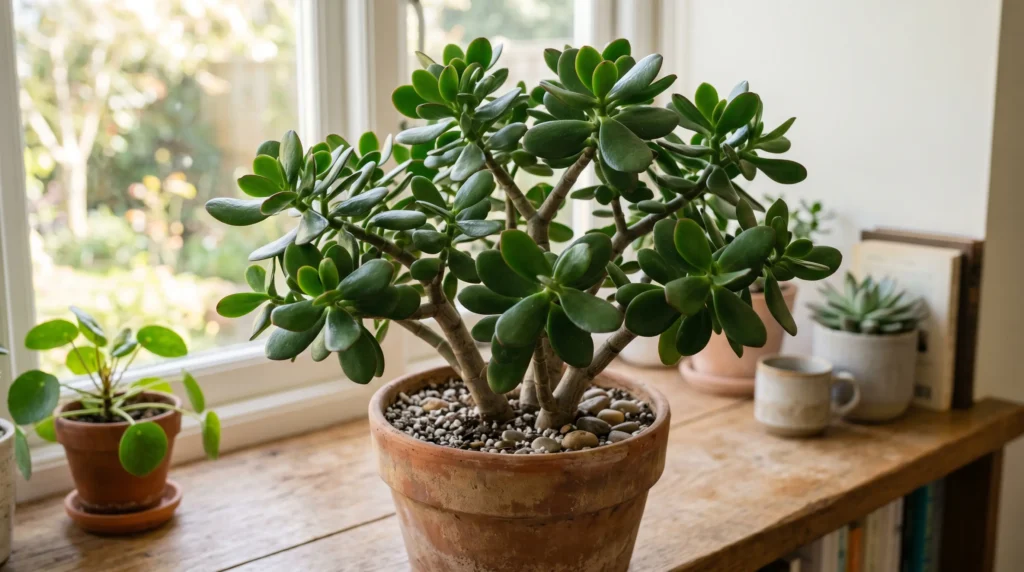
Botanical Background & Origins
Definition: Crassula ovata is a succulent perennial shrub in the family Crassulaceae, native to the Eastern Cape and KwaZulu-Natal provinces of South Africa.
- Scientific classification: Kingdom Plantae → Family Crassulaceae → Genus Crassula → Species ovata
- The name Crassula comes from the Latin crassus (thick) — referring to its water-storing, fleshy leaves
- Natural size vs UK size: Reaches 2–3 m outdoors in South Africa; typically 60–90 cm as a UK houseplant
- Older literature: Sometimes listed as Crassula argentea — same plant, outdated name
- Native habitat: Dry, rocky slopes alongside Euphorbia and Aloe species — nutrient-poor, fast-draining soils
| Name Decoder Box
Jade plant — colour of leaves | Money plant — coin-shaped leaves (prosperity symbol) | Lucky plant — good fortune in Chinese culture | Friendship tree — tradition of sharing cuttings | Silver dollar plant — silvery leaf sheen in certain light |
Why Jade Plants Are Particularly Well-Suited to UK Homes
Key insight: Every challenge that kills other UK houseplants — dry air, low winter light, erratic watering — is something jade plants are biologically adapted to tolerate.
| UK Home Challenge | How Jade Handles It | Competing Houseplants |
| Central heating dryness (30–45% humidity) | Thrives — succulent nature evolved for arid conditions | Most tropicals suffer; need misting or pebble trays |
| Grey November–February light | Goes dormant; waits patiently without dropping leaves | Many tropicals yellow, drop leaves, or die |
| Forgetful/busy owner | Can go 3–4 weeks without water in winter | Most houseplants need weekly attention |
| UK room temperature (15–22°C) | Within ideal range year-round | Many tropicals need 18°C+ consistently |
| Frequent travel | Tolerates weeks of absence without damage | Most houseplants wilt or dry out quickly |
| Longevity Fact: A jade plant purchased for a UK home today could still be alive and thriving in 2125. Few houseplant investments offer that return. |
What Jade Plants Look Like — A Visual Description for Buyers
Definition: Jade plants have glossy, oval, fleshy leaves 2–4 cm long, deep jade green with occasional red margins, borne on increasingly woody stems that develop a tree-like trunk over time.
- Leaves: Smooth, glossy, oval; deep jade green; red margins appear when plant receives ideal light (a positive sign, not a problem)
- Stems: Green and smooth when young; turn grey-brown and woody with age — the hallmark ‘miniature tree’ appearance
- Growth habit: Branching, tree-like structure that becomes more impressive each decade
- Flowers: Small, star-shaped pink or white blooms in clusters at branch tips; appear November–February on mature plants
- Red leaf margins: Caused by high light — a positive indicator of good growing conditions
Jade Plant Varieties Available in the UK
The Main Varieties — With UK Availability Guide
Definition: All varieties listed below are cultivars of Crassula ovata — they share the same basic care requirements but differ in leaf shape, colour, and final size.
| Variety | Leaf Shape | Colour | UK Indoor Size | UK Availability |
| Crassula ovata (classic) | Oval, glossy | Jade green; red margins in high light | 60–90 cm | Very common — garden centres |
| ‘Gollum’ | Tubular, trumpet-shaped | Green with red tips | Up to 80 cm | Common — specialist nurseries |
| ‘Hobbit’ | Cupped, rolled back | Green with red edges | Up to 90 cm | Moderate — online retailers |
| ‘Hummel’s Sunset’ | Oval | Yellow-green-red variegation | Up to 1 m | Less common — specialist only |
| ‘Minima’ | Small oval | Standard green | 30–40 cm | Rare — online specialist |
| ‘Variegata’ | Oval | Cream and green bicolour | 50–70 cm | Rare — collector plants |
The RHS is the UK’s most trusted horticultural authority. Linking to their official Crassula ovata page adds massive credibility and is exactly what Google wants to see on a plant care guide
How to Choose the Right Variety for Your UK Home
- Beginners: Classic Crassula ovata — most forgiving and most widely available
- Small spaces / windowsills: ‘Minima’ — stays compact at 30–40 cm
- Drama and conversation piece: ‘Gollum’ or ‘Hobbit’ — extraordinary alien appearance
- Colour interest: ‘Hummel’s Sunset’ — needs strong light; UK grey winters may reduce vibrancy
- Bonsai training: Classic Crassula ovata — develops the best trunk character over decades
Where to Buy Jade Plants in the UK
- Garden centres: B&Q, Dobbies, Wyevale, RHS-endorsed retailers — stock classic Crassula ovata year-round
- Supermarkets: Occasionally stocked (Aldi, Lidl, Marks & Spencer food halls) — typically spring/summer
- Online specialist retailers: Patch Plants, Hortology, Beards & Daisies, Prickle Plants, Houseplant.co.uk
- Rare varieties: Succulent specialists, Etsy sellers, specialist plant fairs
| What to Look for When Buying
LOOK FOR: Firm, glossy leaves — upright stance — no soft spots — no yellowing AVOID: Stretched stems (etiolation from poor light in shop) — mushy base (root rot) — severely root-bound plants — white deposits covering entire soil surface |
Complete Jade Plant Care Guide for UK Growers
Light Requirements
Definition: Jade plants require a minimum of 4–6 hours of bright light per day, with a south-facing windowsill providing ideal conditions in the UK.
How Much Light Does a Jade Plant Need in the UK?
| Window Position | Light Quality | Suitability | Notes |
| South-facing | Direct sun for several hours | Ideal | Best year-round; essential in winter |
| West-facing | Afternoon sun | Good | Acceptable; may need supplemental light in winter |
| East-facing | Morning sun only | Adequate | Watch for etiolation in winter |
| North-facing | Little or no direct sun | Poor | Use a grow light or find a better spot |
The UK Winter Light Problem (November–February)
From November to February, even a south-facing UK window provides dramatically reduced direct sunlight. This is when most UK jade plant problems begin. Solutions:
- Move plant to the very best available window — prioritise light over interior aesthetics
- Wipe dust from leaves every 4–6 weeks — dusty leaves absorb less light
- Consider a full-spectrum LED grow light: position 30–45 cm above plant; run 12–14 hours per day
- Reduce watering in tandem with reduced light — less photosynthesis = less water demand
| UK Grow Light Recommendations
Brands available on Amazon UK: Sansi, Spider Farmer, Growtronix Positioning: 30–45 cm above plant | Duration: 12–14 hours/day | Type: Full-spectrum LED or T5 fluorescent |
Watering — The Most Critical Skill
Core principle: Overwatering is the number one cause of jade plant death in the UK. When in doubt, do not water.
The Finger Test & Pot Weight Test
- Finger test: Push finger 2–3 cm into compost — water only when completely dry at that depth
- Pot weight test: Lift the pot — very light = very dry = time to water
- Rule of thumb: If you are unsure, wait another week and check again
UK Seasonal Watering Calendar — Month by Month
This is a unique UK resource not found elsewhere — bookmark and share.
| Season | Months | Frequency | Feeding | UK-Specific Notes |
| Spring | March–May | Every 10–14 days | Monthly (low-nitrogen) | Resume as growth starts; watch for rapid soil drying |
| Summer | June–August | Every 7–10 days | Monthly | Move outdoors if possible; harden off gradually first |
| Autumn | September–November | Every 14–21 days | Stop feeding | Bring outdoor plants in before first frost |
| Winter | December–February | Every 3–4 weeks | None | Central heating dries soil faster than expected; always check before watering |
Proper Watering Technique — Step by Step
- Check soil with finger test — only proceed if soil is dry to 2–3 cm depth
- Water thoroughly until water drains freely from the bottom of the pot
- Empty the saucer completely after 30 minutes — never leave plant sitting in water
- Allow compost to dry out almost completely before next watering
- In winter: reduce to every 3–4 weeks even if compost seems slightly damp
UK Tap Water vs Rainwater — A Uniquely British Issue
| Hard Water Regions of the UK
East Anglia | Thames Valley | Midlands | Yorkshire — all hard water areas The problem: Hard tap water contains high calcium/magnesium that builds up as white crust on soil and can affect root health over time. Solution: Collect and use rainwater — free, soft, and ideal for succulents. Alternative: Leave tap water overnight before use. Flush the pot every 3–4 months with extra water to leach mineral buildup. |
3.3 Soil & Potting Mix
Definition: Jade plants require fast-draining, low-fertility, slightly gritty compost. The enemy is moisture retention.
Best Soil Options for UK Growers
- Best ready-mix: Specialist cactus and succulent compost (widely available at UK garden centres)
- UK brands: Westland Cacti & Succulent Compost | Miracle-Gro Cactus Compost | John Innes No.2 with added horticultural grit
- DIY mix: 60% standard potting compost + 20% horticultural grit + 20% perlite
- Avoid: Peat-heavy or moisture-retaining composts — they hold water and promote root rot
- Note: Since the UK peat ban (May 2024), all major UK cactus composts are peat-free
Choosing the Right Pot
| ✔ Pros | ✘ Cons |
| Terracotta/unglazed clay: porous walls allow moisture to escape | Glazed ceramic: retains too much moisture |
| Stable and heavy — prevents top-heavy jade tipping | Plastic without holes: root rot guaranteed |
| Ideal width: 2–3 cm wider than root ball only | Oversized pot: excess compost stays wet too long |
| Non-negotiable: drainage holes must be present | Saucers: always empty after 30 minutes — no standing water |
Temperature & Humidity
Good news for UK growers: Jade plants’ ideal temperature range (15–24°C) matches the typical UK centrally heated living room exactly.
Temperature Guide
| Scenario | Temperature | Outcome |
| Ideal daytime | 18–24°C | Active growth |
| UK living room (typical) | 18–22°C | Perfect year-round |
| Trigger for flowering | 12–15°C nights | Move to cool room Oct–Dec |
| Minimum recommended | 10°C | Dormant but safe |
| Absolute minimum (brief) | 5°C | Stress; root damage risk |
| Maximum (rare in UK) | 35°C+ | Leaf scorch risk — conservatories in summer |
UK-Specific Temperature Hazards
- Cold draughts: Victorian/Edwardian sash windows can create cold shocks — move plant away from draughty frames
- Radiators: Hot-dry air directly above a radiator + temperature swings when heating cycles on/off — never place directly above
- Conservatories: Ideal in summer but can drop below 5°C in winter unless well-insulated and heated
- Unheated rooms: Spare bedrooms, garages — verify winter minimum temperature before placing jade there
Humidity — Why Jade Loves UK Central Heating
| Unlike tropical houseplants, jade plants PREFER dry air.
UK centrally heated homes in winter: 30–45% relative humidity — perfectly within jade’s ideal 30–50% range. Do NOT mist jade plants. Misting increases rot risk and encourages fungal problems — the opposite of what jade needs. |
Feeding & Fertilising
Definition: Jade plants are light feeders from nutrient-poor soils. Over-feeding is as harmful as over-watering.
UK Feeding Schedule
| Period | Feeding | Why |
| Spring (March–May) | Monthly, cactus/succulent feed | Growth season begins — plant can use nutrients |
| Summer (June–August) | Monthly, cactus/succulent feed | Active growing — highest nutrient demand |
| Autumn (September–November) | Stop by end of September | Plant preparing for dormancy |
| Winter (October–February) | None | Dormant plant cannot use nutrients; buildup causes root burn |
| After repotting | Wait 6–8 weeks | Fresh compost already contains nutrients |
What Fertiliser to Use
- Best choice: Specialist cactus and succulent feed — higher potassium, lower nitrogen
- Why low nitrogen: High-nitrogen feeds cause soft, weak growth vulnerable to rot and disease
- UK products: Baby Bio Cacti & Succulent Feed | Miracle-Gro Cactus Liquid Plant Food | Westland Cacti Specialist Liquid Plant Food
- General-purpose feed: Acceptable if diluted to quarter-strength — use sparingly
- Method: Always apply to moist compost; water thoroughly after application
Repotting, Pruning & Shaping
When and How to Repot a Jade Plant
Definition: Repotting means moving a jade plant into a slightly larger container with fresh compost — done every 2–5 years, ideally in early spring.
Signs Your Jade Plant Needs Repotting
- Roots emerging from drainage holes
- Plant becomes top-heavy and unstable despite stable surface
- Compost dries out unusually fast (within 2–3 days of watering)
- Visibly slowed or stopped growth despite good care in spring/summer
- White salt crust covering the entire soil surface
How to Repot — Step-by-Step Guide
- Two to three days before: water the plant slightly — moist roots are less fragile than bone-dry ones
- Prepare new pot: one size up (2–3 cm wider), clean, with drainage holes; add a layer of fresh cactus compost to the base
- Tip the old pot sideways and gently ease the plant out — never pull by the stem
- Examine the roots: trim any black, mushy, or dead roots with clean scissors
- Allow any damaged roots to air-dry for 30–60 minutes before repotting
- Place plant in new pot; backfill with fresh cactus compost; firm gently
- Do not water for 7–10 days — this encourages roots to seek moisture and establish in new compost
- Do not feed for 6–8 weeks — fresh compost contains sufficient nutrients
| UK Timing Note: Best time to repot in the UK is early spring (March–April), just as growth season begins. Never repot in winter — the dormant plant cannot recover as easily. |
Pruning and Shaping
Definition: Pruning jade plants means removing or shortening stems to encourage branching, control shape, or remove damaged growth. It is optional but rewarding.
Pruning Techniques
- Pinching out growing tips: On young plants, pinch the soft tip — encourages branching and bushy structure; repeat throughout the growing season
- Removing lower branches: Exposes the trunk and develops the classic miniature tree appearance
- Major pruning limit: Never remove more than 30% of the plant in a single session
- Tool: Clean, sharp secateurs or craft knife — blunt tools crush stems and invite disease
- After cutting: Allow cut surface to callous for 24 hours before watering — prevents rot entering the wound
- Cuttings: Do not discard — they propagate easily (see Section 5)
Jade Plant Bonsai — A UK Growing Opportunity
Jade plants are one of the most popular beginner bonsai subjects. Their slow growth, naturally branching structure, and willingness to develop impressive woody trunks make them ideal — and their heat tolerance suits UK indoor environments far better than many traditional outdoor bonsai species.
- Start when: Trunk is at least 1 cm in diameter
- Basic techniques: Progressive root pruning when repotting; wiring branches in early summer; pinching tips throughout the growing season
- Pot: Wide, shallow bonsai pot for visual effect — drainage holes remain non-negotiable
How to Propagate a Jade Plant in the UK
Definition: Propagation is the process of creating new plants from a parent — jade plants can be propagated from stem cuttings or individual leaves, both techniques being straightforward for UK beginners.
Method 1 — Stem Cuttings (Fastest & Most Reliable)
What You Need
- Sharp, clean scissors or secateurs
- Cactus/succulent compost
- Small terracotta pots with drainage holes
- Optional: Rooting hormone powder (speeds up root development)
Step-by-Step UK Guide
- Take cutting: 8–12 cm stem length; cut cleanly just below a leaf node
- Remove lower leaves: strip the bottom 3–4 cm of stem — these buried nodes will form roots
- Allow to callous: lay cutting on a dry surface for 24–48 hours (up to 4 days in UK winter cold)
- Plant: insert calloused end 3–4 cm into barely damp cactus compost
- Position: bright indirect light — NOT direct sun during rooting
- Wait: do not water for 2 weeks — this encourages root growth toward moisture
- First watering: after 14 days, water sparingly; increase gradually as roots establish
- Roots established: typically 4–8 weeks in summer; 8–14 weeks in UK winter
| UK Timing: Best done April–September when warmth accelerates rooting. Winter propagation is possible but slow — root establishment may take 3–4 months. Set expectations accordingly. |
Method 2 — Leaf Propagation (Slower but Remarkable)
- Select a healthy, plump leaf — gently twist to remove it whole (a clean base at the stem junction is essential)
- Allow to callous for 24–48 hours on a dry surface
- Lay on top of barely damp cactus compost — do not bury
- Place in bright indirect light; mist lightly once a week only
- After 2–4 weeks: tiny pink roots emerge, then a miniature jade plant appears
- Success rate: 50–70% — take several leaves to improve overall odds
- Patience: leaf propagation produces tiny plants initially; allow 1–2 years to reach giftable size
Common Propagation Mistakes
| Mistake | What Happens | Correct Approach |
| Watering too soon | Wet compost before roots form = immediate rot | Wait 14 days after planting cutting before any water |
| Direct sun on cuttings | Shrivelling and dehydration of unrooted cutting | Bright indirect light only until roots established |
| Attempting in autumn/winter | UK low temperatures/light slow rooting dramatically | Propagate April–September for reliable success |
| Torn leaf base | Incomplete junction = no rooting occurs | Twist cleanly; check that full base junction is present |
| Over-humid conditions | Fungal rot on callousing cutting | Dry, airy surface for callousing; avoid enclosed propagators |
Getting Your Jade Plant to Flower in the UK
Definition: Jade plant flowers are small, star-shaped, pink or white blooms in clusters at branch tips — produced in winter (November–February in the UK) on plants that are at least 5–7 years old when given the right cool, dry conditions.
Will a UK Jade Plant Flower?
- Yes — but patience and specific conditions are required
- Flowers: Small, star-shaped, pink or white; mildly fragrant; appear at branch tips
- Blooming season in UK: November–February (mirroring South African winter timing)
- Age requirement: Plant must typically be at least 5–7 years old and 30–40 cm tall before first flowering
How to Trigger Flowering — The UK Method
The Core Trick: Simulate a Dry, Cool South African Winter
- From October: Move plant to coolest suitable room (12–15°C) that still receives 4+ hours of light
- Reduce watering: Water only once every 4–5 weeks during October–December
- Stop all feeding from September onwards
- Maximise light despite lower temperatures — south-facing window is essential
- Keep away from all heat sources: no radiators, no heated floors
- January onwards: look for flower buds at branch tips; gradually return to warmer room
| UK Central Heating Challenge: The biggest barrier to jade plant flowering in UK homes is central heating — it keeps temperatures too warm and uniform throughout winter.
Solutions: Unheated (but frost-free) spare bedroom | Utility room | Cool north-facing hallway | Thermostat-controlled room held at 12–15°C overnight |
Troubleshooting — Common Jade Plant Problems UK
Leaf Problem Diagnosis — Decision Tree
| Quick Diagnosis Flowchart
START: My jade plant looks unwell Are leaves soft/mushy? → YES → Overwatering / root rot (see 7.2, 7.5) Are leaves turning yellow? → YES → Overwatering or insufficient light (see 7.2) Are leaves dropping off? → YES → Check: soft = overwatering | shrivelled = underwatering | temperature shock (see 7.3) Are stems stretching and elongating? → YES → Insufficient light (see 7.4) Are leaves shrivelled/wrinkled? → YES → Underwatering OR root rot has blocked water uptake (see 7.5) Are leaves brown (patches or tips)? → YES → Sunburn, cold damage, or fertiliser burn (see 7.6) Are there white deposits on leaves or soil? → YES → Hard water minerals OR mealybugs if fluffy (see 7.7) |
Yellow Leaves
| Cause | Diagnosis Clue | Fix |
| Overwatering (most common UK cause) | Compost consistently damp; yellowing starts on lower/older leaves | Stop watering for 2–3 weeks; check roots for rot; improve drainage |
| Root rot (advanced overwatering) | Yellowing + soft stems at base; plant wobbles in pot | Remove from pot; trim black/mushy roots; repot in dry fresh compost |
| Insufficient light (UK winter) | Yellowing in November–February; pale green new growth | Move to brightest window; consider grow light |
| Pest damage | Yellow stippling; check leaf undersides for insects | Identify and treat specific pest (see 7.8) |
Leaf Drop
- Overwatering: Soft, swollen leaves drop first — check if compost is soggy
- Underwatering: Shrivelled leaves drop — plant shedding older leaves to conserve resources
- Cold draughts: Temperature shock near sash windows is a common UK cause
- Environment change: A newly moved or purchased plant may drop a few leaves as a temporary adjustment — normal
- Root rot: Leaf drop accompanied by soft, darkening stems at the base — check roots immediately
| UK-Specific Cause: Autumn Heating Switch-On
When central heating first comes on in autumn, the sudden temperature swings between day and night can trigger temporary leaf drop. Solution: Move plant away from thermostat-controlled radiators; allow 2–3 weeks for adjustment. |
Leggy, Stretched Growth
Cause: Insufficient light — the plant elongates toward its light source. Very common in UK homes November–February.
- Stretched stems cannot become compact again — but new growth in better light will be compact
- Solution: Best available south-facing window; supplemental grow light; prune affected leggy stems and propagate them
Wrinkled or Shrivelled Leaves
Important distinction: Shrivelled leaves can indicate either underwatering OR root rot (where water is present but roots can no longer absorb it).
- Diagnosis: Check soil — if completely dry, water thoroughly; if wet, root rot is likely
- Root rot treatment: Remove from pot; trim dead black roots; air-dry 24 hours; repot in fresh dry compost; withhold water for 2 weeks
Brown Leaf Tips or Patches
| Cause | Appearance | Fix |
| Sunburn | Brown patches; permanent but plant produces new healthy growth | Move back from glass in UK summer; net curtain can diffuse midday sun |
| Fertiliser burn | Brown leaf tips; crispy texture | Flush compost; stop feeding; dilute future applications |
| Cold damage | Browning/blackening from frost or cold draught | Move away from cold draught; discard severely damaged leaves |
| Hard water sensitivity | Brown spotting + white chalky residue | Switch to collected rainwater |
White Deposits on Leaves or Soil
- On leaves (smooth white film): Hard water mineral deposits — wipe with damp cloth; switch to rainwater
- On leaves (fluffy white masses): Mealybugs — see Pests section below
- On soil surface (white crust): Mineral/salt buildup — flush pot thoroughly with extra water; top-dress with fresh compost
- White powdery coating on leaves: Powdery mildew (fungal) — increase airflow; treat with diluted neem oil
Pests Common in UK Jade Plants
| Pest | Appearance | UK Trigger | Treatment |
| Mealybugs | White fluffy/waxy deposits in leaf axils and on stems | Warm, dry centrally-heated rooms | Dab with cotton bud soaked in isopropyl alcohol (70%); neem oil spray every 7 days for 4 weeks |
| Spider mites | Fine webbing on leaf undersides; dusty/speckled leaves | Hot dry air — classic UK central heating winter conditions | Wipe leaves with damp cloth; neem oil spray; increase airflow |
| Scale insects | Small brown/tan disc-like bumps on stems — easy to miss | Indoor warm conditions year-round | Scrape off with soft toothbrush; treat with neem oil |
Note: Do NOT use insecticidal soap on jade plants — it damages the leaves. Neem oil is the preferred UK option.
Jade Plants and Pet Safety in the UK
Critical definition: Crassula ovata (jade plant) is toxic to cats, dogs, and horses. All parts of the plant — leaves, stems, roots, flowers, and sap — are toxic. There is no safe variety.
Toxicity Summary
| Species | Toxicity Level | Primary Symptoms |
| Cats | Toxic | Vomiting, lethargy, loss of coordination, depression |
| Dogs | Toxic | Vomiting, dry-heaving, lethargy, slow heart rate (severe cases) |
| Horses | Toxic | Similar to cats/dogs; avoid access entirely |
| Humans (adults) | Mild only | Skin irritation from sap (wear gloves when pruning); not dangerous if small amount accidentally ingested |
| Children | Caution advised | Keep out of reach; seek medical advice if ingested |
Symptoms of Jade Plant Poisoning in Pets
- Vomiting and dry-heaving
- Lethargy and weakness
- Loss of coordination / staggering
- Depression / unusual quietness
- Slow heart rate (in severe cases)
Symptoms typically appear 30 minutes to 2 hours after ingestion.
UK Action Plan — If Your Pet Eats a Jade Plant
| EMERGENCY CONTACTS — UK
Animal Poison Line (UK): 01202 509000 (Charges apply. Available 24 hours. Always contact your own vet first.) |
- Remove any remaining plant material from your pet’s mouth; wipe with a damp cloth
- Move pet away from the plant immediately
- Do NOT induce vomiting — this can cause aspiration pneumonia
- Contact your vet immediately — even if symptoms seem mild
- Take a sample of the plant with you to the vet — helps with diagnosis and treatment
- Do not wait to see whether symptoms develop — early veterinary intervention is always preferable
Keeping Jade Plants and Pets Together Safely
- High shelving: Best solution — most cats will not bother unless access is provided
- Closed rooms: Keep jade plant in a room pets do not access
- Hanging displays: Ceiling hooks or very high plant stands
- Collect fallen leaves immediately: Even dropped leaves remain toxic
- Pet-safe succulent alternatives: Haworthia, Echeveria (most species), Ponytail Palm, Spider Plant
Jade Plant Meaning, Symbolism & Gifting in the UK
What Does the Jade Plant Symbolise?
| Symbol | Meaning | Cultural Origin |
| Prosperity / Wealth | Rounded leaves resemble coins — attracted financial luck | Chinese folklore; feng shui tradition |
| Luck / Good Fortune | New Year gift; brings good fortune to a new home or business | East Asian cultures — increasingly popular in UK |
| Friendship | Tradition of sharing and propagating cuttings with loved ones | ‘Friendship tree’ nickname |
| Longevity | Ability to live 70–100 years symbolises lasting success | Universal — uniquely meaningful gift |
| New Beginnings | Popular housewarming and New Year gift | UK gifting tradition |
Best Gifting Occasions for Jade Plants in the UK
- Housewarming: The classic jade plant gift — wishing the new homeowners prosperity and luck
- New Year (January): Strong symbolism of fresh starts and incoming good fortune
- Business opening: Traditional gift for new business owners — placed near the entrance or till
- Weddings and anniversaries: Symbolises enduring love and flourishing partnership
- Retirement: A plant that will grow alongside the recipient for decades — perhaps the most meaningful retirement gift possible
| ✔ Pros | ✘ Cons |
| Lifespan: 70–100 years — gift that outlasts the occasion | Toxic to pets: unsuitable for some households |
| Low maintenance: recipient won’t be burdened | Slow to impress: takes years to develop trunk character |
| Unique appearance: matures into a genuine talking piece | Not suitable for very cold homes (under 10°C in winter) |
| Propagation potential: one plant becomes many over the years | Requires bright window: not ideal for very dark rooms |
| Cultural depth: prosperity and friendship symbolism adds meaning |
Frequently Asked Questions
| Q: How often should I water my jade plant in the UK? |
| In spring and summer (March–September), water every 10–14 days when the top 2–3 cm of compost is completely dry. In autumn and winter (October–February), reduce to every 3–4 weeks. UK central heating dries soil faster than you expect — always check with your finger before watering rather than following a rigid calendar schedule. Overwatering is far more dangerous than underwatering. |
| Q: Why is my jade plant dropping leaves? |
| Leaf drop is most commonly caused by overwatering — check whether the compost is soggy and withhold water for 2–3 weeks. In UK homes, cold draughts from sash windows and the temperature shock when central heating first switches on in autumn are also common triggers. Moving to a new spot can also cause a brief adjustment drop of a few leaves, which is normal. |
| Q: Can I put my jade plant outside in the UK summer? |
| Yes — jade plants benefit significantly from outdoor placement June–August, gaining stronger light and better air circulation. However, they must be hardened off gradually over two weeks to prevent leaf scorch. Bring them back inside before the first frost (typically September–October depending on your UK region). Never leave outside if temperatures will drop below 10°C overnight. |
| Q: How long does a jade plant live? |
| A well-cared-for jade plant can live 70–100 years or more, making it one of the longest-lived houseplants available in the UK. Jade plants are genuinely passed from generation to generation, becoming progressively more impressive — with a thicker woody trunk and denser branching — with every passing decade. A jade plant is a living heirloom, not a disposable purchase. |
| Q: Is a jade plant the same as a money plant? |
| In the UK, ‘money plant’ and ‘jade plant’ are most commonly used interchangeably for Crassula ovata. However, ‘money plant’ is also applied to Pachira aquatica (a tropical tree) and Pilea peperomioides (the Chinese money plant). If a UK houseplant guide refers to a ‘money plant’, it almost always means Crassula ovata unless otherwise specified. |
| Q: Why is my jade plant going leggy? |
| Leggy, stretched growth means your jade plant is not receiving enough light. This is very common in UK homes during the grey November–February period. Once stems have stretched, the etiolation cannot be reversed — but new growth placed in better light will be compact. Prune the leggy stems, use the cuttings to propagate, and move the plant to a south-facing window or add a grow light. |
| Q: How do I get my jade plant to flower? |
| Move the plant to a cool (12–15°C), bright room from October, reduce watering to once every 4–5 weeks, stop all feeding from September, and keep it away from radiators. Plants need to be at least 5–7 years old and 30 cm tall before first flowering. UK central heating — which keeps rooms uniformly warm — is the main barrier. A cool spare bedroom or utility room is your best option. |
| Q: Is jade plant toxic to cats and dogs? |
| Yes — all parts of Crassula ovata are toxic to cats, dogs, and horses. Symptoms include vomiting, lethargy, loss of coordination, and depression. If you suspect your pet has consumed any part of a jade plant, contact your vet immediately or call the Animal Poison Line UK on 01202 509000. Do not wait for symptoms to worsen and do not try to induce vomiting. |
| Q: What compost should I use for a jade plant in the UK? |
| Use a specialist cactus and succulent compost. Widely available UK options include Westland Cacti & Succulent Compost, Miracle-Gro Cactus Compost, and John Innes No.2 with added horticultural grit. Since the UK peat ban (May 2024), all major UK cactus composts are peat-free. For extra drainage, add 20–30% perlite to any of these mixes. |
| Q: Can jade plants grow in a north-facing room? |
| Not ideally. Jade plants need at least 4–6 hours of bright light and perform poorly in north-facing rooms, especially during UK winters. If a north-facing room is unavoidable, supplement with a full-spectrum LED grow light positioned 30–45 cm above the plant and run for 12–14 hours per day. Without supplemental lighting, you will see stretched, pale, weak growth. |
| Q: How big do jade plants get in UK homes? |
| In UK indoor conditions, jade plants typically grow to 60–90 cm in height over many decades. Growth is very slow — 2–5 cm per year — so a large jade plant represents many years of careful cultivation. In their native South Africa, they can reach 2–3 m outdoors, but UK indoor conditions limit them to a manageable, attractive size. |
| Q: Should I repot my jade plant every year? |
| No — jade plants only need repotting every 2–3 years when young and every 4–5 years when mature. Over-potting (moving to a much larger pot) is a common mistake: the excess compost holds too much moisture and increases root rot risk. Always upsize by only one pot width (2–3 cm) and repot in early spring using fresh cactus compost. |
Conclusion
Picture that jade plant again — thick wooden trunk, gnarled branches, a canopy of jade-green leaves — sitting on a south-facing windowsill in a British home. That plant was probably not much larger than a coffee mug when it arrived. Now, decades later, it is a living sculpture that has witnessed births, Christmases, moves, and marriages. Its owner may have changed. The plant is still there.
That is the extraordinary promise of Crassula ovata. No other houseplant you can buy in a UK garden centre today offers that kind of return on a modest investment of attention.
The three most important things to remember from this guide:
- Light: South-facing windowsill — the brighter, the better
- Water: Far less than your instinct suggests — when in doubt, wait another week
- Patience: Slow growth is good growth. Every year brings more character, more trunk, more presence
Start with one plant. Learn its rhythms. Propagate it over the years, and share the cuttings with the people you love. That is, after all, why it is called the friendship tree.
| Further Reading
Jade Plant Propagation: The Complete UK Step-by-Step Guide Crassula ovata Varieties: Which Jade Plant Is Right for You? Jade Plant Troubleshooting: Fix Every Common Problem Fast Jade Plant Bonsai: A UK Beginner’s Guide to Training Crassula ovata Are Jade Plants Safe for Pets? UK Complete Guide |

Leave a Reply