
What Are Pond Plants?
Pond plants are aquatic and semi-aquatic plants cultivated within or beside a garden pond to maintain water quality, support wildlife, and provide ornamental beauty. They are not optional — they are the biological engine of any healthy UK pond.
This guide is written specifically for UK gardeners — whether you are establishing your first small container pond or redesigning a large formal water garden. UK climate, UK legality, and UK wildlife are at the centre of every recommendation.
Pond plants in the UK are divided into four distinct planting zones, each occupying a different water depth. Understanding these zones — deep water, submerged, marginal, and bog — is the single most important concept before buying or planting anything.
The Ecological Role of Pond Plants
Pond plants perform five critical ecological functions that no mechanical system can fully replicate:
- Oxygenation: Submerged plants photosynthesise underwater, releasing dissolved oxygen that fish, invertebrates, and amphibians depend on for survival.
- Algae suppression: Floating leaf coverage of 50–70% shades the water surface, blocking the sunlight that fuels algae blooms — without any chemicals.
- Wildlife habitat: Stems, roots, and floating leaves provide breeding sites, shelter, and food for over 100 invertebrate species, plus frogs, newts, dragonflies, and birds.
- Water quality: Aquatic plants absorb the excess nitrogen and phosphorus that would otherwise feed explosive algae growth.
- Natural filtration: In correctly planted wildlife ponds, oxygenating plants can eliminate the need for mechanical pump filtration entirely.
What Makes This Guide Different (UK-Specific)
This guide fills gaps left by every major competitor, including the RHS, WWT, and specialist aquatic nurseries:
- Planting zone depth chart with exact UK measurements
- Full legal guide to banned and restricted species under the Wildlife and Countryside Act 1981
- Month-by-month care calendar calibrated to UK seasons and climate
- Plant quantity calculator guidance for new ponds
- Separate planting plans for wildlife ponds, fish ponds, and container ponds
- UK nursery buyer’s guide with seasonal advice
The 4 Planting Zones ExplainedZone Overview — What Are the 4 Types of Pond Plants?
The four pond planting zones are defined by water depth. Each zone hosts a different category of plant performing a distinct ecological role. Matching plants to the correct zone is essential for establishing a balanced, healthy pond.
| Zone | Depth | Plant Type | Key Role | UK Examples |
|---|---|---|---|---|
| Zone 1 | 45–90 cm | Deep water / water lilies | Surface shade, algae control | Nymphaea, Water hawthorn |
| Zone 2 | 10–90 cm | Submerged oxygenators | Oxygen, nutrient absorption | Hornwort, Water milfoil |
| Zone 3 | 0–15 cm | Marginal shallows | Bank stability, wildlife habitat | Marsh marigold, Water iris |
| Zone 4 | Damp soil | Bog garden / pond edge | Transition zone, pollinators | Purple loosestrife, Meadowsweet |
Zone 1: Deep Water Plants (45–90 cm)
Deep water plants are rooted on the pond floor and float large leaves on the surface to shade the water and suppress algae. They are the most important plants for controlling water clarity in UK ponds.
- Role: Float large leaves on the surface to shade the water and suppress algae.
- Coverage target: The RHS recommends 50–70% of the pond surface be covered by midsummer for maximum algae control.
- Planting method: Aquatic mesh baskets on the pond floor, initially raised on bricks, lowered gradually as the plant grows.
- Key species: Water lily (Nymphaea — choose size by pond dimensions); Water hawthorn (Aponogeton distachyos — flowers in spring and autumn, filling the gap when lilies are dormant).
| Expert Tip: Water hawthorn is the underrated hero of deep water planting. It flowers when water lilies are dormant — giving year-round floating leaf coverage from a single plant. |
Zone 2: Submerged Oxygenating Plants (10–90 cm)
Oxygenating plants grow entirely underwater and perform the most critical ecosystem function in any pond — absorbing nutrients directly through their leaves to starve out algae while releasing dissolved oxygen into the water.
- Absorb excess nutrients through leaves AND roots, directly outcompeting algae.
- Provide dense underwater habitat for invertebrate larvae, tadpoles, and fish fry.
- In wildlife ponds, oxygenators can eliminate the need for an electric pump entirely.
- Best native UK oxygenators: Hornwort (Ceratophyllum demersum) — drop bunches in, no soil needed; Water milfoil (Myriophyllum spicatum); Water crowfoot (Ranunculus aquatilis) — flowers above the surface; Water starwort (Callitriche stagnalis).
Zone 3: Marginal Plants (0–15 cm Depth)
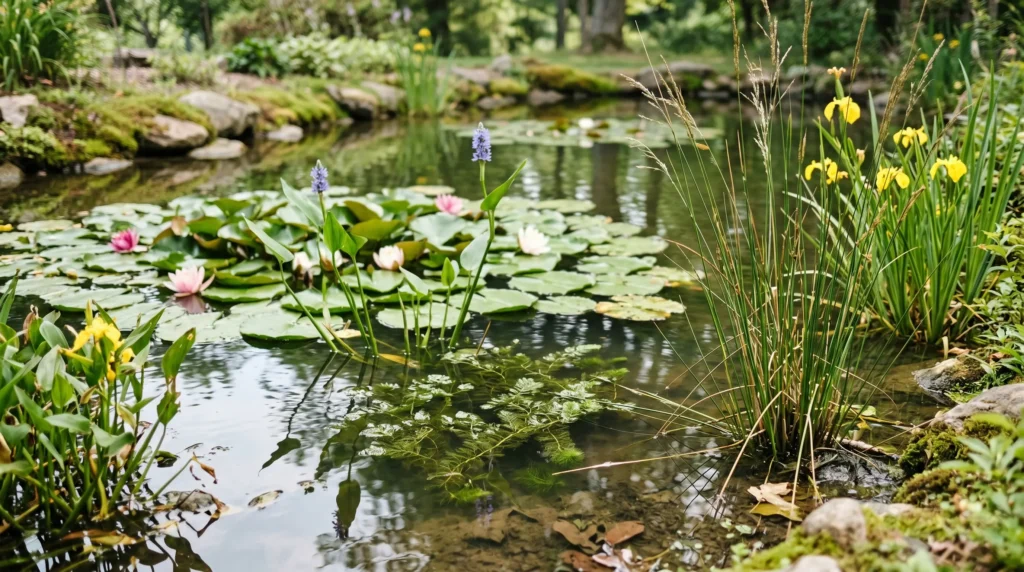
Marginal plants grow in shallow water or wet soil at the pond edge. They are the most visible and ecologically diverse zone, providing structure, wildlife habitat, and seasonal colour throughout the UK growing season.
- Critical for wildlife: tall stems provide climbing platforms for emerging dragonfly and damselfly nymphs.
- Newts wrap individual eggs in broad marginal leaves — these plants are essential for successful breeding.
- Soften the pond edge and create a natural transition from land to water.
- Early-season natives: Marsh marigold (Caltha palustris) — flowers March to May, the first nectar source for queen bumblebees.
- Mid-season: Water forget-me-not (Myosotis scorpioides), Water iris (Iris pseudacorus), Yellow flag iris.
- Late-season: Purple loosestrife (Lythrum salicaria), Water mint (Mentha aquatica), Water figwort.
Zone 4: Bog Garden and Pond Edge Plants
Bog garden plants grow in permanently damp or waterlogged soil at the pond margin — not in the water itself. They act as a transition zone between pond and garden, dramatically increasing the ecological and aesthetic value of any pond.
“Top UK bog garden plants: Ragged robin, Meadowsweet, Royal fern, Skullcap (Scutellaria galericulata) — a native wetland plant that also has fascinating herbal uses, Marsh thistle.”
- Attract a different suite of pollinators than in-pond plants: hoverflies, bees, and butterflies.
- Top UK bog garden plants: Ragged robin (Silene flos-cuculi), Meadowsweet (Filipendula ulmaria), Royal fern (Osmunda regalis), Skullcap (Scutellaria galericulata), Marsh thistle.
- Bog gardens can be created next to any pond using a buried butyl liner filled with moisture-retentive soil.
Best Pond Plants for Wildlife — UK Native Species
Why Native Plants Are Superior for UK Wildlife
Native pond plants are species that evolved naturally in the British Isles alongside the UK’s invertebrates, amphibians, and birds. They are almost always the better choice for wildlife ponds — not because non-native plants are wrong, but because native plants have co-evolved relationships with UK species that non-natives simply cannot replicate.
- Native species support 40× more insect species than non-native equivalents (Freshwater Habitats Trust data).
- Adapted to UK climate, rainfall patterns, and water temperatures — they require significantly less maintenance.
- Spread at a predictable, manageable rate unlike many non-native invasives.
- Using native plants eliminates the legal risk of accidentally introducing a Schedule 9 species.
Wildlife Value by Species — Quick Reference Table
| Plant | Zone | Flowering | Wildlife Benefit | Key Species Supported |
|---|---|---|---|---|
| Marsh marigold | Marginal | Mar–May | First nectar of spring | Queen bumblebees, bee-flies |
| Water forget-me-not | Marginal | May–Sep | Continuous nectar | Hoverflies, small bees |
| Yellow flag iris | Marginal | May–Jul | Dragonfly nymph perch | Damselflies, dragonflies |
| Purple loosestrife | Marginal/Bog | Jun–Sep | High nectar output | Bees, butterflies, moths |
| Water mint | Marginal | Jul–Sep | Pollinator magnet | 50+ insect species |
| Hornwort | Submerged | n/a | Shelter + oxygen | Tadpoles, invertebrate larvae |
| Frogbit | Floating | Jun–Aug | Floating leaf cover | Water boatmen, water beetles |
| Water soldier | Floating | Jun–Aug | Surface platform | Emerging dragonflies |
| Native water lily (Nymphaea alba) | Deep water | Jun–Sep | Leaf shade + shelter | Frogs, fish, waterfowl |
Planting for Specific Wildlife — Targeted Mini-Guides
Pond Plants for Frogs and Toads
Frogs and toads require: shallow water entry and exit points, dense marginal planting for egg-laying, and overwintering cover in the bog garden. Plant selection matters less than pond structure, but the following plants are particularly valuable:
- Water forget-me-not — provides spawning cover and soft stems ideal for egg attachment.
- Marsh marigold — provides early-season emergence cover.
- Any clumping marginal, such as water iris, offers shelter at the pond edge.
| Important: Leave one corner of the pond with a gently sloping beach of gravel or pebbles. This access ramp is more important for frog and toad survival than any plant choice. |
Pond Plants for Newts (Including Great Crested Newts)
Newts have a unique breeding requirement: they wrhttps://www.gov.uk/guidance/great-crested-newtsap individual eggs in the leaves of aquatic plants. Without broad-leaved marginal plants, newts cannot reproduce in your pond, regardless of water quality.
- Best species for newt egg-laying: Water forget-me-not, Brooklime (Veronica beccabunga), Water mint, Broad-leaved pond sedge.
- Great Crested Newts are legally protected under the Conservation of Habitats and Species Regulations 2017.
| Legal Notice: If Great Crested Newts colonise your pond, contact Natural England before undertaking any pond work. Disturbing their habitat without a licence is a criminal offence. |
Pond Plants for Dragonflies and Damselflies
Dragonfly nymphs can live in ponds for up to 5 years underwater before emerging as adults. They are one of the most spectacular indicators of a healthy UK wildlife pond.
- Essential requirement: tall emergent stems for climbing during emergence — irises, rushes, and reeds are ideal.
- Submerged oxygenating plants provide the complex larval habitat nymphs require for multi-year development.
- Critical: leave at least 40–50% of the pond surface open — dragonflies need clear water for hunting.
Pond Plants for Bees and Pollinators
A correctly planted pond creates an unbroken nectar corridor from early spring to late autumn — one of the most valuable pollinator habitats in any UK garden.
“For ponds with a shaded north-facing bank, hardy ferns make an excellent pond-edge companion — they thrive in the permanently damp soil dragonfly nymphs need, and their arching fronds create ideal emergence cover.”
- March–May: Marsh marigold — the single most important early-season nectar plant for queen bumblebees.
- May–September: Water forget-me-not — continuous, reliable nectar for hoverflies and small bees.
- June–September: Purple loosestrife — one of the highest nectar-output plants in any UK garden.
- July–September: Water mint — supports 50+ insect species; one of the most productive pollinator plants.
Water Lilies — The Complete UK Guide
What Is a Water Lily?
A water lily (Nymphaea) is a deep-water aquatic plant rooted on the pond floor, with long stems that carry large floating leaves (pads) and flowers to the surface. They are the single most effective plants for controlling algae through surface shading in UK ponds.
Choosing the Right Water Lily for Your Pond Size
The most common water lily mistake is choosing the wrong size for the pond. An oversized lily will rapidly cover the entire surface; an undersized one will never provide adequate coverage.
| Lily Size | Spread | Pond Depth | Best Pond Size | UK Variety Examples |
|---|---|---|---|---|
| Pygmy (miniature) | 30–50 cm | 15–40 cm | Container / tub pond | N. ‘Pygmaea Helvola’, N. ‘Pygmaea Rubra’ |
| Small | 50–80 cm | 20–60 cm | Up to 3 m² surface | N. ‘Laydekeri Lilacea’, N. ‘Perry’s Baby Red’ |
| Medium | 80–120 cm | 30–90 cm | 3–8 m² surface | N. ‘James Brydon’, N. ‘Chromatella’, N. ‘Attraction’ |
| Large | 120–200 cm | 45–90 cm | 8–20 m² surface | N. ‘Gladstoniana’, N. ‘Sunrise’ |
| Native (Nymphaea alba) | 200 cm+ | 45–90 cm | 20 m²+ only | Only native UK species — large ponds only |
How to Plant a Water Lily — Step-by-Step Guide
Correct planting technique is critical for water lily establishment. Follow these steps in order:
- Choose the right basket: minimum 3 L for small lilies, 10 L+ for medium, 30 L+ for large. Line with hessian to retain compost.
- Fill with specialist aquatic compost or heavy garden loam. Never use peat-based or multipurpose compost — it floats and pollutes the water.
- Plant the rhizome horizontally with the growing tip pointing upwards and exposed at the compost surface.
- Top with 2–3 cm of washed pea gravel to prevent soil clouding and deter fish from disturbing roots.
- Lower in stages: start with 15–25 cm of water over the crown. Move deeper as the plant grows until it reaches full depth by autumn.
- Position away from fountains and waterfalls — water lilies breathe through the upper leaf surface and cannot tolerate splashing.
- Feed each spring by pushing slow-release aquatic fertiliser tablets into the compost near the roots.
Water Lily Care Throughout the Year
- Spring (March–May): Inspect and feed with slow-release fertiliser. If the lily has outgrown its basket, divide and repot before leaves fully open.
- Summer (June–September): Remove fading flowers and yellowing leaves promptly. Thin coverage if exceeding 70% of the pond surface.
- Autumn (October–November): Cut back dying foliage as low as possible and remove from the pond to prevent decay and nutrient release.
- Winter: Hardy UK water lilies need no protection if covered by at least 15 cm of unfrozen water. Never break ice with a hammer — vibrations can stun dormant fish and frogs.
Why Your Water Lily Isn’t Flowering — Troubleshooting
| Problem | Likely Cause | Solution |
|---|---|---|
| No flowers, leaves only | Too much shade | Water lilies need 6+ hours of direct sun daily |
| Leaves piling up above surface | Congested roots | Divide and repot into a larger basket |
| No flowers, newly planted | Too young | Newly planted lilies may take 1–2 seasons to flower |
| No flowers near waterfall | Splashing disrupts leaves | Move basket away from moving water |
| Small flowers, short stems | Too deep | Raise basket — optimal depth 60–85 cm for most varieties |
Oxygenating Pond Plants — Detailed UK Guide
How Do Oxygenating Plants Work?
Oxygenating plants are submerged aquatic plants that photosynthesise underwater, releasing dissolved oxygen directly into the water column. They are the biological foundation of a balanced pond, performing three roles simultaneously: oxygenation, nutrient absorption, and structural habitat provision.
- During daylight: photosynthesise and release dissolved oxygen into the water.
- At night: reverse the process — in heavily stocked fish ponds, excessive oxygenators can temporarily deplete overnight oxygen. Watch for fish gasping at the surface at dawn.
- Absorb dissolved nutrients through leaves, directly outcompeting algae for food.
- Provide complex underwater structure for spawning fish, invertebrate larvae, and sheltering tadpoles.
Best Oxygenating Plants for UK Ponds — Comparison
| Species | Native? | Depth | Basket? | Growth Rate | Best For |
|---|---|---|---|---|---|
| Hornwort (Ceratophyllum demersum) | Yes | Any | No — free-float | Fast | Wildlife + fish ponds |
| Water milfoil (Myriophyllum spicatum) | Yes | 20–90 cm | Yes | Moderate | Wildlife ponds |
| Water crowfoot (Ranunculus aquatilis) | Yes | 10–60 cm | Optional | Moderate | Wildlife + white flowers |
| Water starwort (Callitriche stagnalis) | Yes | 10–50 cm | Optional | Moderate | Small / shaded ponds |
| Water violet (Hottonia palustris) | Yes | 20–50 cm | Optional | Slow | Clear water ponds |
| Curly waterweed (Lagarosiphon major) | BANNED | — | — | — | DO NOT BUY — illegal to sell in UK |
How Many Oxygenating Plants Do You Need?
| How many oxygenating plants do I need for my pond?
The standard UK guideline is 1 bunch of oxygenating plants per 30 cm² of pond surface area as a starting point. For a 2m × 3m pond (6m² surface), start with 10–15 bunches. For fish ponds, increase to 1 bunch per 20 cm² to meet the oxygen demands of fish. |
| Warning Sign: If fish are gasping at the water surface in early morning, oxygen levels are low. Add more oxygenating plants or install aeration immediately — this is a fish emergency. |
Pond Plants for Different Pond Types
Wildlife Ponds
A wildlife pond is designed to maximise biodiversity rather than visual impact. Plant selection in a wildlife pond prioritises native species across all four zones, creating the complex habitat structure that UK amphibians, invertebrates, and birds require.
- Prioritise native species in all four zones — aim for 1–3 oxygenating species + 1 floating/deep water plant + 3–5 marginals + a bog garden edge.
- Leave at least 40–50% of the surface open — dragonflies need open water for hunting.
- No fish: fish eat tadpoles, larvae, and invertebrate eggs that are the ecological foundation of a wildlife pond.
- Avoid fertilisers entirely — nutrient-rich water favours algae over native aquatic plants.
Formal and Ornamental Ponds
Ornamental ponds prioritise visual impact over biodiversity. Non-native plants are acceptable (with legal caveats — see Section 8) and offer a wider range of colours and forms than native species alone.
- Focus on visual impact: water lilies in multiple colours, iris for vertical structure, floating frogbit for delicate texture.
- Regular deadheading and tidying is more important than in wildlife ponds — aesthetics are the priority.
- Consider slow-release aquatic fertiliser programmes for maximum flower production in ornamental varieties.
Fish Ponds
Fish ponds require a different planting approach because fish actively eat most fine-leaved oxygenating plants and can disturb or destroy rooted marginals. Plant choices must account for fish behaviour.
- Hornwort is the exception among oxygenators — fish dislike its texture and generally leave it alone.
- Provide fish cover with water lilies and floating plants — fish use pads as shelter from herons.
- Koi ponds: avoid oxygenating plants entirely; koi will destroy them. Rely on mechanical filtration.
- Goldfish ponds: include water lilies, marginals in weighted baskets, and hornwort.
Small Ponds, Container Ponds, and Tub Ponds
A container pond is a complete self-contained aquatic ecosystem in miniature. Even a 60-litre half barrel can support meaningful wildlife planting and requires no electricity or filter.
- Even a 60-litre half barrel can support 1 pygmy water lily, 2 bunches of hornwort, and 1 small marginal such as water forget-me-not.
- Choose pygmy or miniature varieties of every plant type — scale matters.
- Position in minimum 5 hours of direct sun; top up with rainwater rather than tap water.
- No filter is needed if planted correctly — oxygenators do the biological work.
Shaded Ponds
Most pond plants are sun-loving, but shaded ponds are common in UK gardens. Plant selection can compensate for low light, though expectations must be adjusted.
- Shade-tolerant water lily varieties: ‘James Brydon’, ‘Perry’s Baby Red’, ‘Chromatella’ — all perform better in lower-light conditions than most varieties.
- Water starwort (Callitriche stagnalis) tolerates shade better than hornwort among oxygenators.
- Shade-tolerant marginals: water mint, marsh marigold (tolerates partial shade), lesser celandine.
- Shaded ponds will have lower plant diversity and slower growth — set expectations accordingly.
Month-by-Month Pond Plant Care Calendar — UK
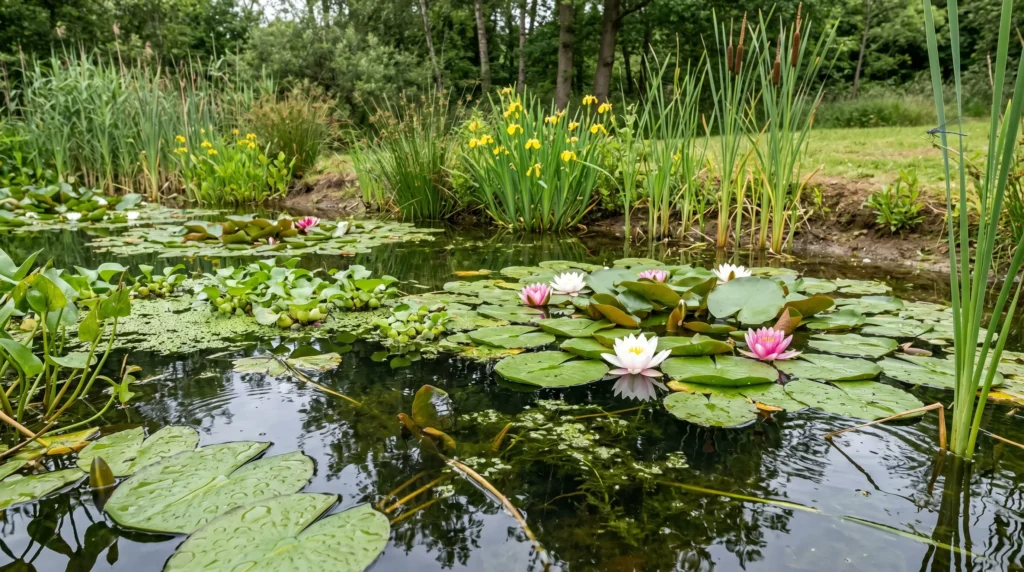
This calendar is calibrated to UK climate zones and seasons — not generic global advice. All timing references assume a typical English Midlands climate; gardeners in Scotland should expect tasks to run 2–4 weeks later in spring.
| Month(s) | Key Task | What to Do |
|---|---|---|
| January–February | Prevent freezing | Float a ball or pond de-icer on the surface. Never break ice by hitting it — vibrations harm overwintering wildlife. Do not disturb the pond floor — amphibians and invertebrates are dormant in the silt. Order new plants now for spring delivery. |
| March–April | Wildlife returns | Frogs and toads begin spawning — avoid disturbance. Inspect water lilies as growth resumes; divide and repot any that have outgrown baskets NOW, before full growth. Marsh marigolds flower from late March — first nectar of the year. Begin introducing new marginals from late April as frosts reduce. |
| May | Peak planting month | The best month to add new pond plants. Water temperature consistently above 10°C — plants establish quickly. Feed established water lilies with slow-release aquatic fertiliser. Frogbit surfaces as tiny plantlets; water soldiers rise from the floor. |
| June–July | Monitor coverage | Aim for 50–70% surface covered with floating leaves. Peak flowering — lilies, irises, purple loosestrife, water mint. Remove spent lily flowers at the stem base before they sink and rot. Remove blanket weed by hand; leave on the pond edge 24 hours for invertebrates to return. |
| August–September | Thin and tidy | Thin oxygenating plants if very dense. Divide overgrown marginals that have burst from baskets. Water hawthorn (Aponogeton) now comes into its own as lilies begin to wind down — provides continued surface coverage. |
| October–November | Prepare for winter | Remove fallen leaves before they sink and decay. Cut back dead marginal stems to just above water level. Lower water lily baskets to full depth before hard frosts. Tidy and mulch the bog garden with leaf mould. |
| December | Dormancy | Minimal work required. Float a ball or polystyrene disc to prevent complete freeze-over. Note areas for improvement in the new year. |
UK Legal Guide — Banned and Invasive Pond Plants
The Law — Wildlife and Countryside Act 1981
The Wildlife and Countryside Act 1981 is the primary legislation governing invasive non-native species in England and Wales. Section 14 of the Act makes it a criminal offence to plant or cause to grow any plant listed on Schedule 9 in the wild.
- Penalties: fines up to £5,000 and/or up to 6 months imprisonment per offence.
- Five aquatic plants are additionally banned from SALE in the UK since April 2014 under the Infrastructure Act 2015.
- Scotland: stricter rules apply under the Wildlife and Natural Environment (Scotland) Act 2011 — any non-native plant introduced to the wild is an offence.
| The 5 Plants Banned From Sale in England, Wales & Scotland: Parrot’s feather (Myriophyllum aquaticum) | Floating pennywort (Hydrocotyle ranunculoides) | Water primrose (Ludwigia grandiflora) | Curly waterweed (Lagarosiphon major) | Australian swamp stonecrop (Crassula helmsii) |
Pond Plants to Avoid — Quick Reference
| Plant Name | Common Name | Legal Status UK | Native Alternative |
|---|---|---|---|
| Myriophyllum aquaticum | Parrot’s feather | BANNED from sale | Water milfoil (M. spicatum) |
| Hydrocotyle ranunculoides | Floating pennywort | BANNED from sale | Frogbit (Hydrocharis morsus-ranae) |
| Lagarosiphon major | Curly waterweed | BANNED from sale | Hornwort (Ceratophyllum demersum) |
| Crassula helmsii | Australian stonecrop | BANNED from sale | Water starwort (Callitriche spp.) |
| Pistia stratiotes | Water lettuce | Schedule 9 (E&W) | Frogbit, water crowfoot |
| Eichhornia crassipes | Water hyacinth | Schedule 9 (E&W) | Water violet (Hottonia palustris) |
| Elodea canadensis | Canadian pondweed | Not banned but invasive | Hornwort, water crowfoot |
How to Safely Dispose of Invasive Pond Plants
Incorrect disposal is one of the most common ways invasive aquatic species enter UK waterways. Follow this procedure without exception:
- NEVER dump pond plants or pond water into local watercourses, rivers, or ditches.
- Place invasive aquatic plant material in sealed bin bags and dispose in general waste only — do NOT compost.
- Dry out invasive aquatic plant material completely before bagging — many species can regenerate from tiny fragments.
- Report sightings of invasive aquatic plants to the GB Non-Native Species Secretariat (NNSS) at www.nonnativespecies.org.
| Key Advice: Always buy pond plants from reputable UK aquatic nurseries that label all species with their full Latin name and comply with Schedule 9. When in doubt, check the government Schedule 9 list at GOV.UK or contact the RHS before purchasing. |
How to Plant and Establish a New Pond — UK Practical Guide
How Much Plant Coverage Does a Pond Need?
| What percentage of a pond should be covered by plants?
Aim for 50–70% of the pond surface covered with floating leaves by midsummer. Ensure at least 30–50% of the surface remains free of floating leaf cover to allow light penetration for submerged plants and wildlife access. A pond with over 80% cover risks overnight oxygen depletion. |
Aquatic Baskets and Planting Compost
Using the correct containers and growing medium is as important as plant selection. The following materials are required:
- Baskets: Always use purpose-made mesh aquatic baskets — the mesh allows water exchange while containing compost. Solid pots are not suitable.
- Compost: Use specialist aquatic compost or heavy garden loam. Never use peat-based or multipurpose compost — it floats and releases excess nutrients that fuel algae.
- Topping: Finish with a 2–3 cm layer of washed pea gravel or rounded pebbles to hold compost in place and deter fish from disturbing roots.
- Lining: Line baskets with hessian before filling to prevent fine soil particles from washing into the water.
Planting Sequence for a New Pond
Follow this sequence for the best establishment results in a new UK pond:
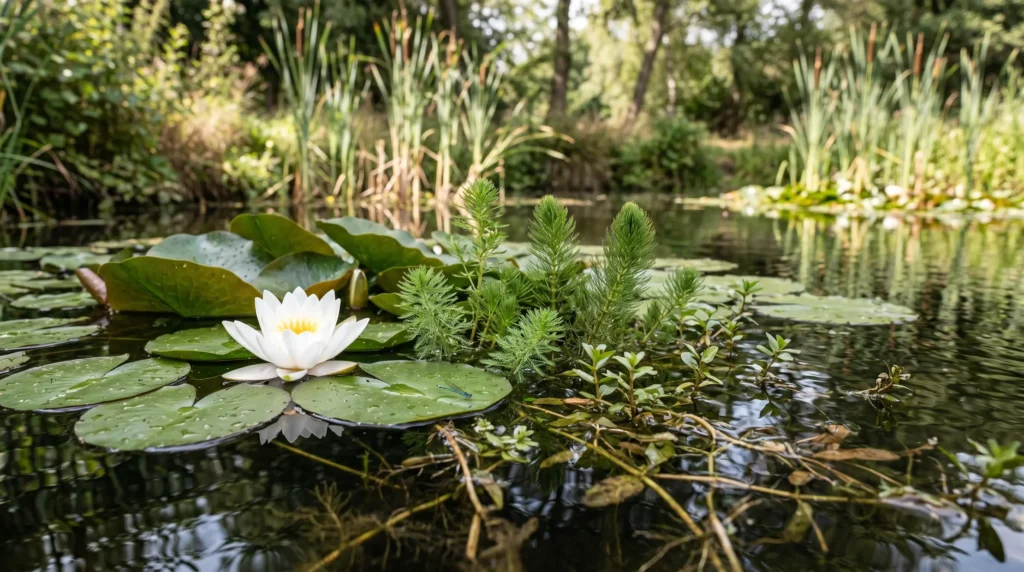
- Plant oxygenators first — drop bunches of hornwort directly into the water without baskets or soil.
- Add deep water plants next — lower in stages on bricks to the correct depth, moving deeper as they grow.
- Plant marginals on pond shelves in aquatic baskets at 0–15 cm depth.
- Establish bog garden plants at the pond edge last — work compost into the liner-retained edge zone.
- Wait 2–4 weeks before adding fish — allow plants to establish and water chemistry to stabilise.
New Pond Green Water — What to Expect
Green water is normal in a new pond. Understanding this process prevents costly and counterproductive interventions.
- All new ponds turn green within weeks — algae fills the available nutrients before aquatic plants establish.
- Do NOT intervene with chemicals or pond clarifiers — this disrupts the natural biological balance that plants are beginning to create.
- Within 6–8 weeks of planting, native aquatic plants will begin outcompeting algae for nutrients.
- The pond should naturally clear by midsummer of the first year if correctly planted with adequate oxygenators and floating leaf coverage.
| The Golden Rule: Patience is the most important skill in new pond establishment. Resist the urge to intervene chemically. The biological balance will establish itself if the pond is correctly planted. |
Buying Pond Plants in the UK — A Buyer’s Guide
What to Look for When Buying UK Pond Plants
- Species labelling: Always buy from suppliers who label plants with their full Latin name — ‘pondweed’ could be a legal native or an illegal invasive.
- UK-grown stock: UK-grown plants are adapted to UK climate, are less likely to carry foreign pests, and reduce the risk of transporting non-native species.
- Condition: Plants should be actively growing, not yellowed or wilted. Avoid plants showing blanketweed or signs of disease.
- Season: The best time to buy is late April through June, when plants are actively growing and will establish quickly.
When to Buy — UK Seasonal Guide
| Season | Best Plants to Buy | Notes |
|---|---|---|
| March–April | Water lilies (bare root) | Best value and establishment; order from specialist UK nurseries in February |
| May–June | All pond plants | Peak season — widest selection; marginals and floating plants establish rapidly |
| July–August | Oxygenators, established marginals | Possible but plants have less time to establish; prices may be higher |
| September onward | Avoid new planting | Plants will not establish before winter. Exception: water hawthorn can be planted in autumn. |
Online vs Garden Centre — UK Buyer Comparison
| Factor | Online (Specialist UK Nurseries) | Garden Centres |
|---|---|---|
| Selection | Far wider range; rare native species available | Limited to popular commercial varieties |
| Labelling | Typically excellent with Latin names and legal compliance | Variable — some centres still sell Schedule 9 species |
| Expertise | Specialist advice; care notes included | Garden centre staff may lack specialist knowledge |
| Price | Competitive; includes delivery to UK mainland | Can be higher; inspect in person before buying |
| Timing | Pre-order spring stock from Feb/March; order by May for best choice | Stock available from April; limited by what is in stock |
FAQ — Quick Answers
| How many pond plants do I need for a 2m × 3m pond?
For a 6 m² pond: 1–2 medium water lilies, 10–15 bunches of oxygenating plants, 4–6 marginal plants, and 2–3 floating plants such as frogbit. Adjust based on your goals — wildlife ponds benefit from denser planting than ornamental ponds. |
| Can I put pond plants straight into the water?
Oxygenating plants like hornwort can be dropped directly into the water without a basket or soil. All other pond plants should be planted in aquatic mesh baskets with specialist aquatic compost, topped with gravel, before being submerged at the correct depth. |
| What is the best pond plant for beginners in the UK?
Marsh marigold (Caltha palustris) is the ideal beginner marginal: UK native, low-maintenance, flowers prolifically from March to May, and tolerates both shallow water and boggy soil. Hornwort is the best beginner oxygenator — no soil, no basket, no effort. Simply drop it in. |
| What pond plants are illegal in the UK?
Five aquatic plants are banned from sale in England, Wales, and Scotland: parrot’s feather (Myriophyllum aquaticum), floating pennywort (Hydrocotyle ranunculoides), water primrose (Ludwigia grandiflora), curly waterweed (Lagarosiphon major), and Australian swamp stonecrop (Crassula helmsii). Never buy these plants regardless of where they are offered. |
| Do pond plants spread into waterways?
Native UK pond plants spread naturally but at a predictable, manageable rate. The five species banned from sale are banned precisely because they escape and devastate UK waterways. Always buy from reputable UK specialist nurseries and never dump pond plants, water, or soil into rivers, ditches, or streams. |
| When is the best time to plant pond plants in the UK?
May is the single best month to plant pond plants in the UK. Water temperature is consistently above 10°C, frosts have passed, and the full growing season lies ahead. Most aquatic plants purchased in May will establish firmly before their first winter. |
| How do I stop my pond going green?
Green water is caused by single-celled algae thriving in nutrient-rich water without enough plant competition. The solution is correct planting: 50–70% floating leaf coverage to shade out algae, combined with sufficient oxygenating plants to absorb excess nutrients. In a correctly planted pond, green water typically clears naturally by midsummer. |
References and Authority Sources
The information in this guide is drawn from and consistent with guidance issued by the following organisations:
- Royal Horticultural Society (RHS) — water gardening and plant cultivation guidance
- Wildfowl & Wetlands Trust (WWT) — UK freshwater wildlife and conservation
- Freshwater Habitats Trust — native aquatic plant data and wildlife value statistics
- GB Non-Native Species Secretariat (NNSS) — invasive species identification and reporting
- Natural England — Great Crested Newt licensing and protected species guidance
- Wildlife and Countryside Act 1981 (as amended) — Schedule 9 species list
- Infrastructure Act 2015 — five aquatic plants banned from sale
- Wildlife and Natural Environment (Scotland) Act 2011 — Scottish non-native species law
| Schema Markup Note (for web implementation): Apply FAQPage schema to Section 10.4, HowTo schema to Sections 4.3 and 9.3, and Article schema with author bio, datePublished, and dateModified to the full article. All zone and species tables are pre-structured for table rich result eligibility. |

Leave a Reply