
A Prunus is a genus of flowering trees and shrubs in the Rosaceae (rose) family. It includes ornamental cherries, plums, peaches, almonds, apricots, blackthorn, and laurels. With over 430 accepted species, Prunus is one of the most diverse plant genera on Earth. Most are fully hardy across the UK (RHS hardiness H4–H6). They are grown for showy spring blossom, edible stone fruit, wildlife value, hedging, and year-round ornamental interest.
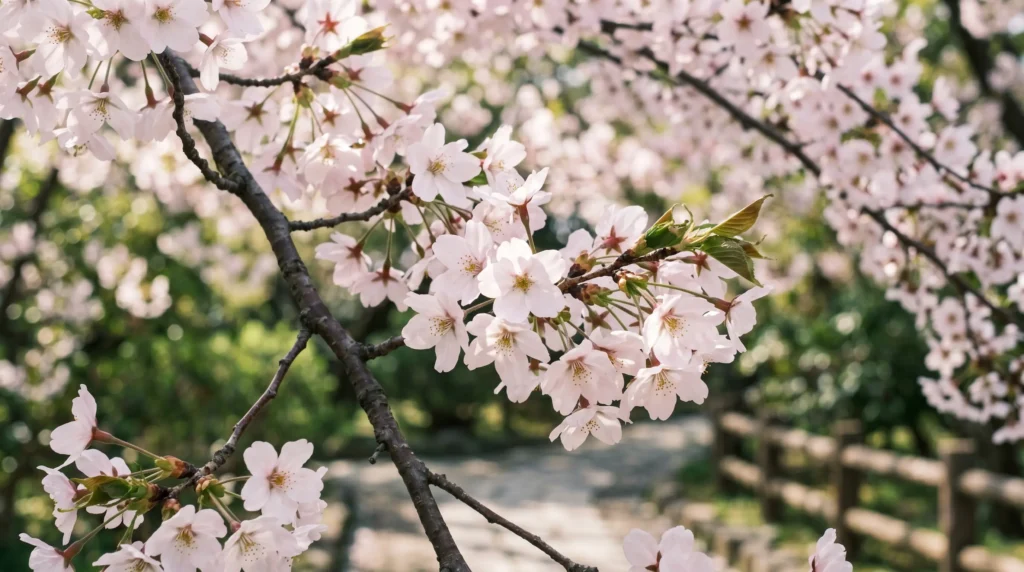
Every March, a quiet transformation sweeps across British streets and gardens. Bare branches that seemed permanent all winter suddenly erupt in clouds of white and pink. Front gardens glow. Parks fill with visitors craning their necks upward. That transformation has one name: Prunus.
But Prunus is far more than a pretty spring moment. It is the genus that gives us cherries, plums, damsons, peaches, almonds, and apricots. It includes the native blackthorn — one of the most ecologically important shrubs in the British landscape — and the evergreen laurels that form millions of UK garden hedges. If you want a tree that delivers blossom, structure, fruit, wildlife value, and autumn colour, the chances are you want a Prunus.
This guide covers everything a UK gardener needs to know: what Prunus actually is, which varieties to choose for your garden size and soil, how and when to plant, a month-by-month care calendar, the correct (and critically important) pruning rules, how to diagnose and treat the most common diseases, and how to use Prunus to support UK wildlife. We have also included a comprehensive FAQ section targeting the questions UK gardeners search for most.
Whether you are planting your first ornamental cherry or troubleshooting a struggling plum tree, this guide has the answers.
Understanding Prunus — What Kind of Tree Are You Actually Getting?
What is a Prunus tree? (Definition)
A Prunus tree is any tree or shrub belonging to the genus Prunus in the family Rosaceae. The genus contains more than 430 accepted species, divided broadly into ornamental flowering types and fruiting stone-fruit types, along with native British species used for hedging and wildlife gardening.
| Group | Examples | Primary Use |
|---|---|---|
| Ornamental Prunus | Japanese flowering cherries, ornamental plums | Spring blossom, foliage, form |
| Fruiting Prunus | Plum, cherry, peach, damson, almond | Edible stone fruit |
| Native/Hedging Prunus | Blackthorn, wild cherry, cherry laurel | Wildlife, boundary screening |
The Prunus Family Explained
All Prunus share the characteristic of producing a single-seeded stone fruit (a drupe) — the hard central “stone” that protects the seed. This is the defining botanical feature that unites flowering cherries with plums, peaches, and blackthorn berries, despite their apparent differences.
- Ornamental Prunus: are grown primarily for their spring blossom and sometimes for ornamental bark (e.g. the polished mahogany stems of P. serrula) or autumn foliage. Many produce small fruit, but it is usually inedible or unpalatable.
- Fruiting Prunus: are cultivated for edible, palatable fruit. They are the backbone of the UK’s kitchen garden and allotment tradition. Varieties are chosen for flavour, yield, and self-fertility.
- Native and hedging Prunus: includes blackthorn (P. spinosa) and wild cherry (P. avium), both native British species with outstanding wildlife value, plus cherry laurel (P. laurocerasus) and Portugal laurel (P. lusitanica), widely used for screening and formal hedging.
Evergreen vs Deciduous Prunus: What Is the Difference?
Most Prunus trees are deciduous — they lose their leaves in autumn and stand bare through winter. Ornamental cherries, plums, almonds, peaches, and native species like blackthorn and wild cherry all follow this pattern.
A small number of Prunus are evergreen — they retain their leaves year-round. These are almost exclusively the laurel species:
- Prunus laurocerasus (cherry laurel) — the most commonly planted evergreen hedge in the UK
- Prunus lusitanica (Portugal laurel) — a more refined, slower-growing alternative
| Feature | Deciduous Prunus | Evergreen Prunus |
|---|---|---|
| Seasonal interest | Spring blossom, summer foliage, autumn colour, winter bark | Year-round screening, white flower spikes in spring |
| Examples | P. ‘Kanzan’, P. avium, P. domestica | P. laurocerasus, P. lusitanica |
| Best use | Specimen trees, orchards, wildlife gardens | Hedging, screening, formal topiary |
| Wildlife value | High (blossom, fruit, native species) | Moderate (flowers for pollinators; berries for birds) |
| Hardiness | Most H6 (fully hardy) | H5–H6 (fully hardy in most UK regions) |
Choosing between them: If year-round screening is your priority, choose an evergreen laurel. If blossom, fruit, autumn colour, or wildlife value are the goal, choose a deciduous species.
What to Expect from Prunus Through the Seasons
Prunus provides garden interest across all four seasons — not just in spring. Understanding the seasonal cycle helps you choose the right variety and provide the right care at the right time.
| Season | What to Expect |
|---|---|
| Winter (Dec–Feb) | Bare branches reveal ornamental bark (P. serrula‘s polished mahogany is spectacular); early varieties may begin budding by January |
| Spring (Mar–May) | The main event — clouds of blossom from January (P. x subhirtella ‘Autumnalis’) through May; peak for most ornamental cherries is April |
| Summer (Jun–Aug) | Full foliage canopy; fruit swells and ripens on fruiting types; cherries ready June–July, plums July–September |
| Autumn (Sep–Nov) | Foliage turns orange, red, yellow; fruit harvest continues; sloes ripen on blackthorn after first frost; berries feed wintering birds |
Prunus Varieties — The Complete UK Selection Guide
Choosing the right Prunus variety is the single most important decision you will make. The wrong variety in the wrong space is a 30-year problem. The right variety, correctly sited, will reward you for decades. This guide organises varieties by use case — not just alphabetically — because that is how UK gardeners actually search.
Best Prunus for Small Gardens and Patios (UK)
What is the best Prunus for a small UK garden? For small gardens, the priority is choosing varieties with a naturally compact habit, slow growth, or columnar (upright) form. The following varieties are proven performers in tight UK spaces.
| Variety | Mature Height | Flower Colour | Why It Works in Small Gardens |
|---|---|---|---|
| P. ‘Amanogawa’ | 4–8m | Pale pink, fragrant, semi-double | Narrow columnar form — ideal for fences and tight beds |
| P. ‘Kojo-no-mai’ | 1–2m | White/pale pink | Truly compact; container-friendly; attractive zigzag branching |
| P. ‘Accolade’ | 5–8m | Light pink, semi-double | Spreading but manageable; RHS AGM; outstanding spring and autumn display |
| P. ‘Spire’ | 5–8m | Pink | Upright habit; RHS AGM; excellent autumn foliage; suits narrow beds |
| P. ‘The Bride’ | 3–4m | Pure white with red anthers | Dense, shrubby form; dramatic contrast of white flowers and red stamens |
| P. ‘Kursar’ | 5–7m | Deep cerise-pink | Early flowering (February–March); relatively narrow |
Container growing: P. ‘Kojo-no-mai’ is the top choice for pots. Use a minimum 50cm diameter container with John Innes No.3. P. persica (peach) on a Gisela 5 or Pixy dwarfing rootstock also works well in containers.
Expert tip: Columnar varieties (‘Amanogawa’, ‘Spire’) are ideal alongside fences, driveways, and narrow side passages where spreading trees would be impractical.
Best Prunus for Larger Gardens and as Specimen Trees
For gardens with space, ornamental Prunus can serve as dramatic focal points — specimen trees with multi-season interest and, in some cases, extraordinary horticultural heritage.
| Variety | Mature Height | Key Feature |
|---|---|---|
| P. ‘Kanzan’ | 8–10m | Britain’s most widely planted ornamental cherry; vivid double pink-purple blossom; reliable and robust |
| P. ‘Tai-haku’ (Great White Cherry) | 7–10m | Enormous pure white flowers; RHS AGM; famously reintroduced to Japan from a Sussex garden |
| P. ‘Shogetsu’ | 5–8m | Wide spreading canopy; large double pink flowers fade to white; beautiful multi-week display |
| P. ‘Ukon’ | 7–8m | Unusual semi-double yellowish-white flowers; bronze-green foliage is highly distinctive |
| P. serrula (Tibetan Cherry) | 8–10m | Grown primarily for polished mahogany-red bark; year-round ornamental feature |
The story of Tai-haku: P. ‘Tai-haku’ was thought extinct in Japan until a horticulturist named Captain Collingwood ‘Cherry’ Ingram discovered a specimen in a Sussex cottage garden in 1923. He propagated it and eventually returned it to Japan. This variety is a direct piece of horticultural history — and one of the finest white-flowered cherries available in the UK.
Weeping Prunus Varieties
A weeping Prunus creates an immediate statement in a garden — a cascading dome of blossom that is unlike any other tree form.
Top UK weeping varieties:
- P. ‘Kiku-shidare-zakura’ (Cheal’s Weeping Cherry) — Rich double pink flowers in April; compact weeping habit; one of the most reliable UK choices. Reaches 3–4m.
- P. ‘Pendula Rosea’ — Pale pink, graceful weeping form; suits naturalistic planting.
Planting tip for weeping Prunus: Weeping trees require adequate space below the canopy as well as above. The branches cascade outward and downward, creating a skirt that extends well beyond the trunk. Avoid dense underplanting close to the base.
Best Fruiting Prunus for UK Allotments and Kitchen Gardens
Fruiting Prunus trees produce stone fruit that can be harvested, eaten fresh, or preserved. The table below covers the best-performing varieties for UK conditions, with self-fertility noted — this matters enormously when you have space for only one tree.
| Fruit Type | Variety | Self-Fertile? | Season | Notes |
|---|---|---|---|---|
| Cherry | P. avium ‘Regina’ | No (needs pollinator) | July | Large, flavoursome dessert cherry; crops heavily when paired |
| Plum | P. domestica ‘Victoria’ | Yes | Aug–Sep | Britain’s most popular garden plum; dual-purpose dessert and cooking |
| Plum | P. domestica ‘Opal’ | Yes | Late Jul | Sweeter and earlier than Victoria; excellent for small gardens |
| Damson | P. domestica ‘Farleigh’ | Partially | Sep | Classic British damson; superb for jam, damson gin, and preserves |
| Peach | P. persica ‘Peregrine’ | Yes | Aug | Best outdoor peach for UK gardens; needs a sheltered, south-facing position |
| Almond | P. dulcis ‘Robijn’ | Yes | Mar (blossom) | Grown in mild UK regions for blossom and nuts; flowers very early |
Self-fertility explained: A self-fertile tree can pollinate itself and set fruit from a single tree. Trees labelled “no” require a compatible variety planted nearby (or grown by a neighbour within about 50m) for a crop. Always check pollination group when purchasing fruiting Prunus.
Rootstocks for Fruiting Prunus Explained
What is a rootstock? A rootstock is the root system onto which a fruiting variety is grafted. The rootstock determines the mature size of the tree — not the fruiting variety itself. This is why the same ‘Victoria’ plum can be a 6m tree or a 2m container specimen, depending on rootstock.
| Rootstock | Suitable For | Final Tree Size | Best Use |
|---|---|---|---|
| Colt | Cherries | 4–6m | Most UK garden cherry trees |
| Gisela 5 | Cherries | 2–3m | Small gardens, containers, or restricted spaces |
| Pixy | Plums, damsons | 2–3m | Small gardens; needs permanent staking |
| St Julien A | Plums, peaches, apricots | 4–5m | Standard UK garden choice for plums and peaches |
Native and Hedging Prunus for UK Wildlife Gardens
- Blackthorn (P. spinosa) — Native UK shrub; white flowers appear before leaves in March–April; produces sloes in autumn; dense thorny habit makes impenetrable hedging; supports over 150 insect species.
- Wild Cherry (P. avium) — The UK’s native cherry; white blossom in April; summer cherries eaten by birds; brilliant autumn colour; excellent for woodland edges and larger gardens.
- Cherry Laurel (P. laurocerasus) — Evergreen; fast-growing; popular garden screen and hedge; fragrant white flower spikes in spring; berries feed birds. Note: leaves are toxic to pets if eaten in quantity.
- Portugal Laurel (P. lusitanica) — More refined alternative to cherry laurel; dark, glossy leaves; white fragrant flowers; excellent for formal hedging and topiary
.
RHS Award of Garden Merit (AGM) Prunus: A Quick Reference
What does RHS AGM mean? The RHS Award of Garden Merit (AGM) is given to plants that perform reliably and consistently well in UK garden conditions, based on trials at RHS gardens. An AGM label is the closest thing UK gardeners have to an independent performance guarantee.For the full and current RHS AGM plant list, including all Prunus varieties that have received the award, visit the RHS plant search directly.”
Selected AGM Prunus varieties for UK gardens:
| Variety | Type | AGM Noted For |
|---|---|---|
| P. ‘Accolade’ | Ornamental cherry | Spring blossom + autumn colour |
| P. ‘Spire’ | Ornamental cherry | Upright habit + reliability |
| P. ‘Tai-haku’ | Ornamental cherry | Outstanding white blossom |
| P. ‘Kiku-shidare-zakura’ | Weeping cherry | Consistent flowering performance |
| P. serrula | Ornamental cherry | Ornamental bark in all seasons |
| P. domestica ‘Victoria’ | Fruiting plum | Reliable crops in UK conditions |
| P. lusitanica | Hedging | Formal hedging performance |
How to Plant Prunus Trees in the UK
How do you plant a Prunus tree in the UK? (Step-by-Step)
Prunus trees are relatively straightforward to plant, but three factors determine success: timing, site selection, and correct planting depth. Follow this guide for a Prunus that establishes quickly and thrives for decades.
When to Plant
Bare-root Prunus trees: Plant between November and March, while the tree is dormant and leafless. Bare-root trees are more economical, establish quickly, and have a better root system than container-grown specimens of the same age. This is the recommended method for most UK gardeners.
Container-grown Prunus trees: Can be planted year-round, but autumn (September–November) is strongly preferred. Mild, moist autumn conditions allow roots to establish before the summer heat stress. Avoid planting in midsummer — the irrigation demand is high and transplant shock risk is elevated.
| Planting Method | Best Season | Cost | Establishment Speed |
|---|---|---|---|
| Bare-root | November–March | Lower | Fast |
| Container-grown | Autumn (preferred); spring | Higher | Moderate |
| Semi-mature | Autumn–spring | High | Requires professional aftercare |
Choosing the Right Spot
Prunus performs best in full sun. Partial shade is tolerated but reduces blossom quantity and fruit production. The following conditions are critical to get right before planting:
- Sunlight: Minimum 5–6 hours of direct sun per day.
- Wind shelter: Protect early-flowering varieties (almonds, P. ‘Kursar’, P. ‘Okame’) from strong spring winds. Wind damages fragile blossom and reduces pollinator access.
- Frost pockets: Avoid low-lying spots where cold air collects overnight — especially important for early-flowering types whose open blossoms can be damaged by a late frost.
- Air pollution: Good news — Prunus tolerates urban air pollution well, making it an excellent choice for UK city gardens.
- Distance from structures: Allow for the mature spread of the tree. Standard rule: distance from walls, fences, and foundations should equal at least half the mature spread.
Soil Requirements for Prunus in the UK
Prunus prefers moderately fertile, moist but well-drained soil with a neutral to slightly alkaline pH (6.0–7.5). It tolerates a wide range of UK soil types, with one critical exception: waterlogged soil will kill a Prunus through root rot and dramatically increases disease susceptibility.
“Avoid waterlogged or boggy ground entirely — Prunus will not survive it. If you have a persistently wet area in your garden, consider using it to create a wildlife pond instead, which pairs beautifully with a Prunus planted at the drier edge.”
| UK Soil Type | Common Regions | What to Do |
|---|---|---|
| Heavy clay | Midlands, North, parts of South East | Improve drainage with horticultural grit; plant on a slight mound; add organic matter |
| Chalk/limestone | South East, Chilterns, Yorkshire Wolds | Add bulky organic matter; Prunus generally tolerates chalk well |
| Sandy/free-draining | East Anglia, Surrey, coastal areas | Mulch heavily to retain moisture; water during establishment |
| Waterlogged/boggy | Variable | Do not plant Prunus — root rot and canker are near-certain |
| Loam | Widely distributed | Ideal; minimal amendment needed |
Step-by-Step Planting Guide
How to plant a Prunus tree — step by step:
- Dig the hole: Make it 2–3 times the width of the root ball but no deeper than the root ball itself. A wide, shallow hole encourages outward root growth.
- Loosen the base: Break up the soil at the bottom of the hole with a fork — but do not add fertiliser directly into the planting hole (this can burn new roots).
- Position the tree: Place the tree in the hole so the graft union (the knobbly join between trunk and roots, usually 10–15cm above soil level) sits above the final soil surface. Planting too deep is one of the most common mistakes with Prunus.
- Backfill: Return the excavated soil around the roots, working it in gently to eliminate air pockets. Do not compact excessively.
- Firm and water: Firm the soil gently with your heel, then water thoroughly — equivalent to approximately 10 litres (one full watering can).
- Mulch: Apply a 7.5cm (3-inch) layer of bark chippings or well-rotted compost in a 60cm ring around the base. Keep mulch away from direct contact with the trunk — a 10cm gap prevents collar rot.
- Stake if needed: Bare-root trees and any tree in an exposed position should be staked. Use a short stake (reaching one-third of the trunk height), not a tall one. A tree that can move slightly in the wind develops stronger roots. Remove the stake after one to two years.
Prunus Spacing Guide
How far apart should Prunus trees be planted? Spacing depends on the mature spread of the variety chosen.
| Tree Type | Minimum Spacing from Other Trees | Spacing from Structures |
|---|---|---|
| Columnar/upright (‘Amanogawa’, ‘Spire’) | 3–4m | 2m |
| Spreading specimen (‘Kanzan’, ‘Tai-haku’) | 6–8m | 5m |
| Weeping (‘Kiku-shidare-zakura’) | 4–5m | 3m |
| Fruiting (standard on Colt/St Julien A) | 4–5m | 3m |
| Fruiting (dwarfing rootstock) | 2–3m | 1.5m |
| Hedging (blackthorn, laurel) | Plant 3 per metre for a dense hedge | N/A |
Prunus Care — A Month-by-Month UK Calendar
A well-timed care routine makes the difference between a struggling Prunus and a spectacular one. This calendar is built specifically for UK growing conditions — including the UK’s unpredictable springs, wet autumns, and mild but grey winters.
January–February
- Inspect trees for signs of silver leaf brackets (purple shelf fungi) or bacterial canker (sunken, gummy patches of bark). Catching disease early greatly improves outcomes.
- Early-flowering varieties (‘Kursar’, ‘Okame’, P. x subhirtella ‘Autumnalis’) may be in blossom by late January. If a hard frost is forecast overnight, protect open flowers with horticultural fleece.
- Order bare-root trees before the season closes in March. This is the best time for planning and purchasing.
- Do not prune. Pruning wounds in winter are high-risk entry points for bacterial canker and silver leaf.
March–April (Peak Blossom Season)
- Enjoy the blossom — most ornamental cherries peak in April.
- Do not prune during this period. Trees in early growth are at their most vulnerable to disease entry through wounds.
- Apply fertiliser in March: a balanced granular feed (e.g. Growmore at 70g per m²) applied around the drip line boosts growth if the tree has seemed slow or pale the previous year.
- Protect peach and nectarine blossom from late frosts with fleece overnight — a single frost event can destroy an entire season’s crop.
- Monitor for peach leaf curl as new leaves emerge. If you see the characteristic red, blistered, distorted growth, remove affected leaves before the white spore bloom appears.
May–June
- May is the start of the safe pruning window (May to August). Any necessary pruning should now wait until May at the earliest.
- Watch for aphids — cherry blackfly colonies on new growth appear in May and June. Treat with insecticidal soap in the evening to protect pollinators, or encourage natural predators by reducing broad-spectrum pesticide use.
- Container Prunus: Begin regular watering as temperatures rise. Trees in pots dry out far faster than those in the ground and need checking every 1–2 days in warm weather.
- Watch for blossom wilt — brownish, withered flowers that fail to drop indicate a fungal infection. Remove affected flower spurs promptly.
July–August (Main Pruning Window)
- This is the best time to prune Prunus. Trees are in full active growth, wounds heal quickly, and the risk of silver leaf and bacterial canker infection is at its lowest.
- Pruning order: Remove dead and diseased wood first, then crossing branches, then shape if required.
- Apply first copper fungicide spray (copper oxychloride) in mid-August on varieties prone to bacterial canker (particularly plums, cherries, and damsons).
- Harvest cherries from July; protect fruiting trees from birds with netting as the crop approaches ripeness.
- Early plums (such as ‘Opal’) ripen from late July.
September–October
- Apply second copper fungicide spray mid-September for canker prevention.
- Begin autumn planting of container-grown and bare-root Prunus from September onwards. Autumn planting gives roots the best possible start.
- Harvest late plums and damsons through September.
- Pick sloes from blackthorn after the first autumn frost — the frost softens the skin and traditionally improves flavour for sloe gin.
- Enjoy autumn colour — many ornamental cherries turn brilliant shades of orange, red, and gold before leaf fall.
November–December
- Apply third copper fungicide spray mid-October (if not already done) for canker-susceptible varieties before leaf fall.
- Bare-root planting season opens. November to March is the best and most economical time to buy and plant Prunus.
- Inspect and adjust stakes and ties — winter winds can loosen stakes and allow the tree to rock. Check that ties are not cutting into the bark (they should be snug but not tight).
- Clear fallen leaves from around the base of the tree — overwintering fungal spores live in leaf litter and clearing them reduces next year’s disease pressure.
How and When to Prune Prunus Trees in the UK
When is the best time to prune a Prunus tree in the UK?
The safest time to prune any Prunus tree is between May and August, when the tree is in active growth and pruning wounds heal quickly. Pruning in autumn or winter — even lightly — opens wounds that remain exposed for months and act as entry points for two serious diseases: bacterial canker and silver leaf.
The Golden Rule: Never Prune Prunus in Autumn or Winter
- Bacterial canker (Pseudomonas syringae) is most active in wet, cool conditions — exactly the UK autumn and winter.
- Silver leaf disease (Chondrostereum purpureum) spreads via airborne spores that peak from September to May. Open wounds are the primary infection route.
- Wounds made in autumn and winter do not callous over until spring — leaving them exposed for up to six months.
The safe window: May to August. In these months, the tree is in active growth, the wound callouses rapidly (often within weeks), and disease spore levels are at their lowest.
The exception: If a branch is diseased, dangerous, or structurally failing, it must be removed immediately regardless of season. Treat the cut surface immediately with a proprietary wound sealant (e.g. Growing Success Prune and Seal).
Tools and Hygiene for Pruning Prunus
Good tool hygiene is not optional with Prunus — it is how diseases travel between trees and between gardens.
- Use sharp, clean tools. Blunt secateurs crush rather than cut, creating ragged wounds that heal poorly and invite infection.
- Sterilise between cuts using 70% isopropyl alcohol or a diluted Jeyes Fluid solution. This is particularly important when removing diseased wood.
- Apply wound sealant to all cuts larger than 2.5cm in diameter.
- Never compost Prunus prunings. Diseased material must be burned or disposed of via council green waste collections. Composting spreads silver leaf spores.
How to Prune Ornamental Cherry Trees
The goal with ornamental Prunus is to maintain the natural form while keeping the canopy open and healthy. These trees do not need heavy pruning — over-pruning is a more common error than under-pruning.
Step-by-step for annual ornamental Prunus maintenance:
Identify and remove the three Ds: Dead, Damaged, and Diseased wood first.
- Remove any branches that cross or rub against each other — crossing branches create wounds that invite disease.
- Remove any inward-growing shoots that reduce airflow through the canopy.
- Stand back and assess the overall shape. Make the minimum number of cuts to achieve the desired result.
- Never remove more than 25% of the tree’s canopy in a single season.
How to Prune Fruiting Prunus Trees
Pruning style varies by fruit type — each requires a slightly different approach:
- Plums and damsons: Aim for an open-centred “goblet” shape — three to five main scaffold branches radiating outward with an open centre that allows light and air into the tree. Annually remove inward-growing and crossing shoots.
- Sweet cherries: Similar open-centre approach to plums. Cherries require minimal pruning once the framework is established — excessive cutting stimulates excessive growth.
- Peaches and nectarines (fan-trained on a wall): Require annual replacement pruning. Remove older wood that has fruited; tie in new shoots to replace it. This keeps the fruiting wood young and productive.
- Almonds: Light pruning only after flowering. Treat like peaches; they share the same vulnerability to silver leaf and canker.
How to Prune Prunus Hedges
Different hedging Prunus require different trimming approaches:
- Cherry Laurel (P. laurocerasus): Always use secateurs, not hedge shears, to avoid the brown-cut-edge effect on the large, glossy leaves. Prune in late spring or early summer. Tolerates hard renovation pruning if overgrown.
- Portugal Laurel (P. lusitanica): Tolerates harder clipping than cherry laurel; suitable for formal topiary shapes. Clip once or twice in the growing season.
- Blackthorn (P. spinosa): Trim annually after fruiting (October, once sloes are harvested). Do not prune between February and August — this is the legal and ethical nesting season for birds, and blackthorn is a primary nesting species for many garden birds.
Prunus Pests and Diseases — Diagnosis and Treatment
How do you identify and treat common Prunus diseases?
The most common Prunus diseases in the UK are bacterial canker, silver leaf, and peach leaf curl. Correct identification is essential — the treatment (and urgency) differs significantly between them. Use the quick diagnostic table at the end of this section to identify symptoms rapidly.
Bacterial Canker — The Most Common UK Prunus Disease
What is bacterial canker on Prunus? Bacterial canker is a disease caused by the bacterium Pseudomonas syringae. It is the most widespread Prunus disease in the UK, affecting ornamental cherries, plums, damsons, and fruiting cherries. Symptoms can appear suddenly and be alarming, but it is manageable with the right approach.
Symptoms:
- Sunken, dead patches of bark that ooze sticky amber gum (called gummosis)
- Small round holes in leaves — the “shothole” effect, where dead brown spots fall out leaving holes
- Shoot dieback in spring — branches that failed to leaf out, or shoots that died shortly after emerging
How to treat bacterial canker:
- Apply copper fungicide (copper oxychloride) three times: mid-August, mid-September, and mid-October.
- Cut out cankered wood to clean, healthy tissue — healthy wood shows no brown staining when cut.
- Treat cut surfaces immediately with wound sealant.
- Burn all prunings — do not compost.
- Improve soil drainage if the affected tree is in wet ground — stress dramatically increases susceptibility.

Silver Leaf (Chondrostereum purpureum)
What is silver leaf on Prunus? Silver leaf is a serious fungal disease caused by Chondrostereum purpureum. It spreads via airborne spores that enter through pruning wounds, particularly those made in autumn and winter. It can kill entire trees.
Symptoms:
- Leaves on affected branches develop a distinctive metallic silver sheen — not a grey powder like mildew, but a genuine metallic silvery appearance
- A cross-section of an affected branch reveals purple-brown staining in the wood
- Purple-brown bracket (shelf) fungi appear on dead wood — this confirms active infection
Treatment:
- There is no chemical treatment available to home gardeners for silver leaf.
- Cut all infected branches back to at least 15cm (6 inches) beyond any visible staining in the wood.
- Burn all removed material immediately — the bracket fungi release billions of airborne spores.
- Trees where the entire canopy shows symptoms are generally beyond saving and should be removed.
Prevention: Follow the May–August pruning window; seal all cuts promptly. This one rule prevents the vast majority of silver leaf infections.
Peach Leaf Curl (Taphrina deformans)
What is peach leaf curl? Peach leaf curl is a fungal disease affecting peaches, nectarines, and almonds. In the UK’s cool, wet springs, it is almost inevitable without preventive action. It does not usually kill trees, but repeated annual defoliation significantly weakens them over time.
Symptoms:
- Newly emerging leaves curl, thicken, and blister in shades of red, orange, or yellow
- As the disease progresses, affected leaves develop a white powdery bloom (spores)
- Leaves fall prematurely, sometimes defoliating the tree entirely
How to prevent peach leaf curl (the RHS approach): The most effective prevention is a rain shelter — a simple lean-to structure of polythene sheeting placed over wall-trained trees from November to mid-May. This keeps rain off the emerging buds and leaves, which is how infection occurs.
How to treat peach leaf curl:
- Remove and bin all infected leaves as soon as you see them — before the white spore bloom appears, if possible. Do not compost.
- Apply copper fungicide or lime sulphur spray after leaf fall (October/November) and again at bud-swell (February) the following year.
- No fungicide is effective once symptoms are visible in spring — prevention is the only reliable strategy.
Aphids on Prunus
Common aphid species: Cherry blackfly (Myzus cerasi) causes curled and distorted new growth with sticky honeydew deposits. Mealy plum aphid is also common on plums and damsons.
How to treat aphids on Prunus:
- Encourage natural predators — ladybirds, lacewings, and hoverflies will control aphid populations if you reduce broad-spectrum pesticide use nearby.
- Insecticidal soap or neem oil applied in the evening protects pollinators while targeting aphids.
- Jet of water from a garden hose dislodges colonies on small infestations — simple and effective.
- Pyrethrin-based insecticides are effective as a last resort but must be applied strictly according to label instructions to avoid harming pollinators.
Honey Fungus (Armillaria spp.)
Honey fungus is one of the most serious threats to Prunus in UK gardens. It spreads underground via black cord-like rhizomorphs (“bootlaces”) from infected roots or stumps.
Symptoms: Sudden wilting and death of the entire plant; white fan-shaped fungal mycelium visible under bark at the base; honey-coloured mushrooms appearing in autumn at the base.
Treatment and management:
- There is no chemical cure. Remove and destroy the entire root system including all stumps.
- Apply Armillatox to the surrounding soil to reduce spread.
- Prevention: Avoid planting Prunus in sites where previous trees died unexpectedly — investigate first.
Quick Prunus Disease Diagnostic Table
| Symptom You Can See | Most Likely Cause | Urgency | Action |
|---|---|---|---|
| Silver, metallic sheen on leaves | Silver leaf | High | Cut out affected wood 15cm past staining; burn |
| Amber gum oozing from bark | Bacterial canker | Medium | Copper fungicide; check pruning hygiene |
| Curled, red/blistered new leaves | Peach leaf curl | Medium | Remove infected leaves; apply copper fungicide in autumn |
| Small round holes in leaves | Bacterial canker (shothole) | Medium | Copper fungicide |
| Curled, sticky shoot tips | Aphids | Low–Medium | Insecticidal soap; encourage predators |
| Purple bracket fungi on dead wood | Silver leaf (confirmed) | High | Remove entire affected branch; burn all material |
| Whole tree wilting and dying | Honey fungus | Critical | Remove entire root system; do not replant Prunus |
| Brown blossoms that don’t fall | Blossom wilt | Medium | Remove affected flower spurs immediately |
Prunus for UK Wildlife and Ecology
Why are Prunus trees good for UK wildlife?
Prunus is one of the most wildlife-rich genera a UK gardener can plant. Ornamental Prunus provide early-season nectar and pollen when most insects are just emerging; fruiting Prunus feed birds and mammals through summer and autumn; and native Prunus species — particularly blackthorn — are among the most ecologically valuable plants in the British landscape.
Why Prunus Is One of the Best Wildlife Trees for UK Gardens
- Ornamental cherries flower before most other garden trees — providing critical early nectar and pollen when queen bumblebees and other pollinators first emerge after winter.
- Fruiting Prunus trees provide food for bullfinches, robins, song thrushes, blackbirds, and redwings through summer and autumn.
- Bark, crevices, and wood cavities in mature trees provide nesting and roosting sites for birds and insects.
- The root systems and leaf litter of Prunus support a rich community of soil invertebrates.
Blackthorn (Prunus spinosa) — The UK’s Native Wildlife Champion
Blackthorn is one of Britain’s most ecologically valuable native shrubs. For wildlife gardeners, it is arguably the single most effective planting choice available.
Why blackthorn matters:
- Flowers in March–April before its leaves emerge — making it a critical early nectar source when pollinators first emerge after winter, at precisely the moment when most other trees are still bare.
- Supports the caterpillars of over 150 moth species, including the rare Black Hairstreak and Brown Hairstreak butterflies — both of which lay eggs exclusively on blackthorn.
- Dense thorny thicreate ckets impenetrable nesting habitat for blackbirds, song thrushes, dunnocks, and yellowhammers.
- Sloe berries feed fieldfares, redwings, and other wintering thrushes through the critical autumn and winter period.
- Acts as a wildlife corridor in hedgerow systems, connecting habitat fragments across farmland and garden landscapes.
Wild Cherry (Prunus avium) — The Native UK Tree
- White blossom in April provides abundant early nectar for bumblebees, honeybees, and hoverflies.
- Summer cherries are eagerly eaten by bullfinches, redwings, mistle thrushes, and small mammals.
- Stunning autumn colour — from yellow through to deep red — before leaf fall provides habitat structure.
- A native tree that has been part of British woodland and hedgerow for thousands of years; its presence signals and supports a mature, functional ecosystem.
Pollinator Value of Ornamental Prunus: What the RHS Says
Many ornamental Prunus carry the RHS Plants for Pollinators designation, confirming their value for bees, butterflies, and other beneficial insects.
Best single-flowered varieties for pollinators (pollen and nectar accessible): P. ‘Accolade’, P. ‘Pink Shell’, P. ‘Okame’, P. avium (wild cherry), P. spinosa (blackthorn)
Important caveat on double-flowered varieties: Double-flowered ornamental cherries such as P. ‘Kanzan’ are spectacular in blossom but have significantly reduced pollen and nectar accessibility due to the modified flower structure. They are less valuable to pollinators than single-flowered types, despite their visual impact.
| Variety Type | Pollinator Value | Notes |
|---|---|---|
| Single-flowered ornamental | High | Open flower structure; accessible pollen and nectar |
| Semi-double ornamental | Medium | Partial accessibility |
| Double-flowered ornamental (‘Kanzan’) | Low | Beautiful but limited wildlife benefit |
| Native species (avium, spinosa) | Very High | Single flowers; ecologically integrated |
How to Design a Wildlife-Friendly Prunus Planting
A wildlife garden benefits most from a layered, mixed approach — combining native species for ecological foundation with ornamental Prunus for extended flowering and visual interest.
A proven UK wildlife Prunus combination:
- Foundation hedge: P. spinosa (blackthorn) — early blossom, nesting habitat, sloes for wintering birds.
- Specimen tree: P. avium (wild cherry) — spring nectar, summer fruit, autumn colour.
- Ornamental highlight: P. ‘Accolade’ or P. ‘Pink Shell’ — RHS Plants for Pollinators; extends the flowering season.
- Underplanting: Early bulbs (snowdrops, crocuses) beneath the canopy extend the pollinator season from February.
Practical wildlife gardening tips:
- Avoid excessive tidying — fallen fruit and leaf litter provide critical invertebrate habitat and feeding opportunities for thrushes and blackbirds.
- Resist the urge to remove deadwood immediately — it is some of the most biodiverse habitat in a garden.
Buying Prunus Trees in the UK — What to Know Before You Buy
What should you look for when buying a Prunus tree in the UK?
Buying a healthy, correctly labelled, well-grown Prunus tree from a reputable supplier is the most important investment you can make. A poor-quality tree from a supermarket or garden centre clearance shelf can take years to recover — if it recovers at all.
What to Look for When Buying
Checklist for buying a healthy Prunus:
Container-grown vs bare-root: Bare-root gives better value and typically better establishment when planted November–March.
Graft union: Should be clearly visible, clean, and fully healed. Avoid trees with a cracked, sunken, or discoloured graft union.
Single clear leader: Standard and feathered trees should have one main stem. Multiple competing leaders indicate a tree that needs corrective pruning before it develops structural weakness.
No crossing branches: Badly placed branches are easier to avoid than to prune out later.
Root check: Gently tip a pot-grown tree out of its container. Roots should be white or cream-coloured and fibrous — not dark, circling, or escaping from the drainage holes (root-bound).
Supermarket trees — often mislabelled, poorly rootstocked, and rootbound.
Any tree showing bark damage, gummosis, or yellowing/mottled leaves on the nursery bench.
Prunus Size Guide — What Do the Terms Mean?
When buying Prunus, suppliers use standard size terms that can be confusing. Here is what they mean in practice:
| Size Term | Description | Approx. Cost | Time to Impact |
|---|---|---|---|
| Whip (60–90cm) | Young, single stem with few or no side branches | Lowest | 3–5 years to establish and begin flowering |
| Feathered (1–2m) | Young tree with side branches (feathers) already forming | Low–Medium | 2–3 years to establish |
| Standard (1.8–2.4m clear stem) | Mature-looking tree with a clean trunk and bushy head | Medium–High | Immediate visual impact; 1–2 years to settle |
| Semi-mature (3m+) | Large specimen; requires professional planting and aftercare | High | Instant landscape effect |
Best Times to Buy Prunus in the UK
| Time of Year | What’s Available | Notes |
|---|---|---|
| November–March | Bare-root trees; wide variety selection | Best value; plant immediately on delivery |
| September–November | Container-grown; autumn-planted | Ideal planting conditions; good establishment |
| April–August | Container-grown only | Available but more demanding to establish; irrigation critical |
Buy from reputable UK specialist nurseries — Hillier, Barcham Trees, Frank P. Matthews, and Ornamental Trees are reliable sources with correctly labelled stock. Avoid supermarket and DIY store trees where rootstock and variety accuracy cannot be guaranteed.
Frequently Asked Questions About Prunus Trees in the UK
Q: When do Prunus trees flower in the UK?
Prunus trees flower between January and May, depending on the species and variety. P. x subhirtella ‘Autumnalis’ produces flowers throughout winter on mild days, often beginning in November. Early ornamental varieties such as P. ‘Kursar’ and P. ‘Okame’ flower in late February to March. The majority of ornamental cherries reach their peak in April. Late-flowering varieties extend the blossom season into May.
Q: How fast do Prunus trees grow?
Growth rate varies significantly by species. Vigorous ornamental cherries such as P. ‘Kanzan’ can grow 30–60cm per year in good conditions. Compact varieties like P. ‘Kojo-no-mai’ grow slowly — approximately 10–15cm per year. Fruiting cherries on vigorous rootstocks (Colt) are relatively fast; on dwarfing rootstocks (Gisela 5) they grow more slowly but begin fruiting earlier.
Q: Can you grow Prunus in a container?
Yes. Compact varieties — particularly P. ‘Kojo-no-mai’ and peaches on a Gisela 5 or Pixy dwarfing rootstock — grow well in large containers (minimum 50–60cm diameter). Use John Innes No.3 compost for weight and nutrient retention. Water regularly in summer (daily in hot weather) and feed with a balanced liquid fertiliser from spring through to midsummer. Repot or top-dress every two to three years.
Q: Why is my Prunus tree not flowering?
The five most common reasons a Prunus fails to flower:
- Too young — trees under 3 years old often do not flower reliably; patience is required.
- Too much shade — Prunus needs at least 5–6 hours of direct sun to flower well.
- Wrong pruning time — pruning in late summer or autumn removes next year’s flower buds.
- Late frost damage — a sharp frost after buds open can destroy the entire blossom display.
- Over-feeding with nitrogen — high-nitrogen fertiliser promotes leafy growth at the expense of flowers.
Q: When is the best time to prune a Prunus tree in the UK?
The best and safest time to prune any Prunus tree in the UK is between May and August. During this period the tree is in active growth, wounds callous over quickly, and the risk of infection from silver leaf (Chondrostereum purpureum) and bacterial canker (Pseudomonas syringae) is at its lowest. Never prune Prunus in autumn or winter — open wounds in cold, wet conditions are highly vulnerable to both diseases.
Q: Are Prunus trees poisonous to humans or pets?
The fruit flesh of Prunus is safe to eat. However, the stones (seeds) contain amygdalin, which breaks down to release hydrogen cyanide when chewed and swallowed in significant quantities. Leaves and bark also contain small amounts. Cherry laurel (P. laurocerasus) leaves are particularly toxic to dogs, cats, and horses if eaten in quantity. Keep pets away from fallen cherry laurel leaves and berries as a precaution.
Q: What is the difference between ornamental and fruiting Prunus?
Ornamental Prunus are selected and bred primarily for spectacular spring blossom and attractive form — they may produce small fruit, but it is usually inedible. Fruiting Prunus (plums, cherries, peaches, damsons, almonds) are bred for palatable, productive fruit crops, and their blossom, while often attractive, is secondary. The choice depends on your priorities: if blossom is the goal, choose ornamental; if you want food production, choose a fruiting variety on an appropriate rootstock.
Q: Are cherry blossom trees native to the UK?
Most ornamental garden cherries (Japanese flowering cherries) are Japanese cultivars or hybrids introduced to the UK, predominantly in the early 20th century by the legendary horticulturist Captain Collingwood ‘Cherry’ Ingram. However, two Prunus species are genuinely native to Britain: wild cherry (Prunus avium), a native woodland tree, and blackthorn (Prunus spinosa), a native hedgerow shrub.
Q: How do I stop birds eating my cherry crop?
The most effective method is netting. Drape fine-mesh fruit netting over the tree once the fruit begins to colour. Ensure the net reaches the ground and is secured at the base to prevent birds entering from below. On larger trees, netting frames or fixed cage structures give better protection. Bird-deterrent products (spinning discs, predator decoys) offer partial and temporary protection only.

Conclusion — Choosing Your Prunus with Confidence
Prunus is, without question, one of the most rewarding and versatile groups of trees and shrubs available to UK gardeners. Whatever your garden size, soil type, or growing goal, there is a Prunus that will excel for you — from the compact ‘Kojo-no-mai’ on a patio, to the majestic Tai-haku as a specimen in a larger garden, to a blackthorn hedge that transforms into one of the most wildlife-rich features in the landscape
- Choose the right variety for your space — use the variety tables in Section 2 to match height, habit, and purpose.
- Plant in the right site — full sun, well-drained soil, and shelter for early-flowering types.
- Prune only in May–August — this single rule prevents the vast majority of serious Prunus disease problems.
- Apply copper fungicide in late summer and autumn — particularly for plums, damsons, and cherries prone to canker.
- Include native species — blackthorn and wild cherry are among the best wildlife planting investments in any UK garden.
Whatever month you are reading this, a Prunus moment is just ahead. Use the month-by-month care calendar in Section 4 to stay on top of seasonal tasks, and explore our related guides below to take your Prunus knowledge further.
Related Guides in This Series
- How and When to Prune Prunus Trees in the UK
- Prunus Diseases: Identifying and Treating Silver Leaf, Bacterial Canker, and Peach Leaf Curl
- The 15 Best Prunus Trees for Small UK Gardens
- Growing Prunus in Containers: A UK Patio Gardener’s Guide
- Blackthorn (Prunus spinosa): The UK’s Best Native Hedging Shrub
- Wildlife-Friendly Gardening with Native Trees

Leave a Reply