
Picture the scene: it is late April, and you are pushing a garden-centre trolley that is dangerously close to toppling under the weight of colour — terracotta pots of trailing Petunias, trays of candy-pink Pelargoniums, and a tangle of electric-blue Lobelia threatening to escape over the side. The Chelsea Flower Show is just weeks away, the Britain in Bloom judging lorry could appear at any moment, and your borders look as bare as January. The excitement is almost unbearable. So is the restraint.
Because here is the thing every experienced UK gardener knows but every beginner discovers the hard way: buy too early, plant too early, and a single cold night can wipe out an entire trolley-load of summer bedding in hours.
This guide exists so that never happens to you again. By the end, you will know exactly which bedding plants to choose for every season, when the last frost risk passes in your specific corner of the UK (Cornwall is very different from the Scottish Highlands), how to plant, feed, and care for your display through the season, how to keep it wildlife-friendly, and how to overwinter your favourites for free plants next year.
Whether you are a first-time gardener with a window box or a veteran with a quarter-acre plot, this is the only bedding plants guide you will need.
What Are Bedding Plants?
| Bedding plants are short-lived, usually highly colourful plants — typically half-hardy annuals, hardy annuals, biennials, or frost-tender perennials — grown specifically to provide a temporary seasonal display in beds, borders, containers, and hanging baskets. They are planted in organised, massed arrangements (a practice called ‘bedding out’) and replaced each season to maintain a fresh, continuous display. |

The Core Definition
Bedding plants are defined by two characteristics: they are temporary (designed to be replaced each season) and they are grown for maximum visual impact through colour, fragrance, or foliage.
The term ‘bedding’ refers to the Victorian practice of ‘bedding out’ — filling prepared garden beds with massed, uniformly planted displays, then lifting and replacing them up to three times per year. The tradition began in the grand estates of 19th-century Britain and was popularised by designers such as John Gibson at Battersea Park. Today, the same principle applies whether you are planting a window box on a first-floor flat or the formal parterre of a stately home.
The Royal Horticultural Society (RHS) defines bedding plants as ‘usually colourful half-hardy, short-lived or annual plants, grown for displays in beds or containers.’ This definition captures the key traits: colourful, short-lived, and display-focused.
Displays are typically rotated across three seasons: spring (February–May), summer (June–October), and autumn/winter (October–February). The cycle is continuous — as one display peaks, the next is already being prepared.
Types of Bedding Plant by Hardiness
Understanding hardiness categories is the single most important piece of knowledge for a UK bedding gardener. It determines when you can plant outside, whether your plants will survive a frost, and how to structure your year. The four main categories are:
| Category | Examples | Sow / Buy | Plant Out (UK) |
| Half-hardy annuals (HHA) | Cosmos, Nemesia, Marigolds, Nicotiana, Petunia | Sow indoors Jan–Mar | After last frost — May to June |
| Hardy annuals (HA) | Cornflower, Calendula, Alyssum, Larkspur, Limnanthes | Sow direct outdoors Mar–May | Spring — frost-tolerant once established |
| Hardy biennials | Wallflower, Foxglove, Sweet William, Forget-me-not | Sow in summer; plant in autumn | Autumn planting for spring display |
| Tender perennials | Pelargonium, Fuchsia, Begonia, Dahlia, Salvia | Buy as plug plants or take cuttings | Late May / June after hardening off |
Why UK Gardeners Love Bedding Plants
Bedding plants deliver high-impact colour faster than virtually any other gardening approach. Five reasons they remain the most popular garden plants in the UK:
- Instant colour: a single planting transforms a bare border or empty pot within days.
- Flexibility: swap the look every season — spring pastels give way to tropical summer brights, then to winter jewel tones.
- Small-space friendly: works in window boxes, balconies, windowsills, pots, and hanging baskets.
- Budget-accessible: a tray of mixed bedding plants costs less than a takeaway coffee per plant.
- Beginner-friendly: most bedding plants forgive mistakes and reward even minimal care with weeks of colour.
The UK Gardener’s Seasonal Calendar
When to plant is the question UK bedding gardeners ask most. The answer depends on two variables: the type of plant (its hardiness) and your location in the UK. This section gives you both — a month-by-month framework and a region-by-region frost guide.
Spring Bedding (February – May Display)
Spring bedding plants are the unsung heroes of the UK garden year. Planted in the previous autumn (September–October), they overwinter in the ground and burst into colour in February — often before any other garden plant stirs.
Best plants for spring bedding:
- Wallflowers (Erysimum cheiri) — intensely fragrant; plant out September/October for March–May flowers; available in a vast range of colours.
- Pansies and Violas — extraordinarily frost-hardy and can survive temperatures as low as -10°C; flower on and off all winter and into early spring.
- Primulas (Primrose) — low-growing, jewel-coloured, ideal for pots and front-of-border displays; combine beautifully with spring bulbs.
- Forget-me-nots (Myosotis) — the classic cottage garden companion; self-seeds freely; pairs brilliantly with tulips.
- Bellis (double daisies) — biennial; plant in autumn for a spring carpet of pink, red, and white buttons.
- Polyanthus — vivid, structured rosettes of colour; shade-tolerant; long-lasting in cool spring conditions.
| KEY TIMING TIP — Spring Bedding
Spring bedding is planted in September and October — the previous autumn. If you are reading this in spring thinking about spring colour, you are one season ahead. Order now for next year, and plant summer bedding in the beds your spring display currently occupies. |
Summer Bedding (June – October Display)
Summer bedding is the most popular and varied category. It includes half-hardy annuals, tender perennials, and some hardy plants that simply perform best in warm conditions. The UK summer bedding season runs from late May (planting) through to the first frosts of October or November.
The Thriller / Filler / Spiller Design Framework
Professional garden designers use a three-element framework when planting containers. This principle works equally well in borders and is the fastest way to create displays that look designed, not random:
- Thriller — the tall, dramatic focal plant that creates height and structure. Examples: Canna lily, tall Cosmos, Salvia guaranitica ‘Black and Blue’, ornamental grasses, Ricinus.
- Filler — bushy, mid-height plants that fill the volume of the container and create a dense, lush background. Examples: Pelargonium, Petunia, Lobularia, Nicotiana, Marigold.
- Spiller — trailing plants that cascade over the edge of pots and hanging baskets, softening the structure. Examples: Lobelia, Bacopa, Surfinia Petunia, Dichondra ‘Silver Falls’, Lysimachia.
Top 10 Summer Bedding Plants for UK Gardens
| Plant | Best Position | Key Feature | Watch Out For |
| Pelargonium (Geranium) | Full sun | Drought-tolerant; slug-resistant | Frost — bring indoors before October |
| Petunia | Full sun | Long-flowering; huge colour range | Slugs; deadhead regularly |
| Begonia | Shade / semi-shade | Ideal for north-facing spots | Overwatering; vine weevil |
| Fuchsia | Partial shade | Superb for hanging baskets | Half-hardy — needs frost-free winter storage |
| Lobelia | Sun / partial shade | Trailing types perfect for basket edges | Dries out fast — water daily |
| Marigold (Tagetes / Calendula) | Full sun | Easy from seed; companion planting benefits | Slugs attracted to young plants |
| Impatiens (Busy Lizzie) | Shade | Few other plants flower as freely in full shade | Downy mildew — choose New Guinea varieties |
| Verbena | Full sun | Butterfly magnet; drought-tolerant | Can get powdery mildew in dry conditions |
| Salvia | Full sun | Outstanding pollinator plant | Some varieties tender — check hardiness |
| Cosmos | Full sun | Easy from seed; excellent cut flower | Slugs on seedlings; stake in exposed sites |
Autumn and Winter Bedding (October – February Display)
Winter bedding is the most overlooked and most rewarding of the three seasonal rotations. Planted in early autumn, it provides colour and structure through the darkest months — and because few UK gardeners bother with it, a well-planted winter container attracts genuine admiration.
- Winter-flowering Pansies and Violas — plant in October; remarkably frost-hardy; will flower on mild winter days throughout the season.
- Ornamental Kale and Cabbage — dramatic, sculptural foliage in purple, white, and pink; colour deepens and intensifies as temperatures drop.
- Cyclamen (hardy varieties, C. hederifolium and C. coum) — plant under trees or in sheltered spots; long-flowering; naturalises in the right conditions.
- Skimmia — compact evergreen shrub often used as seasonal bedding; red berries provide winter structure and interest.
- Winter heathers (Calluna / Erica) — reliable, extremely hardy, and available in white, pink, and purple; pairs beautifully with ornamental grasses and cornus stems.
- Nandina domestica ‘Fire Power’ — brilliant fiery autumn and winter foliage; can be kept as a permanent plant after the season ends.
| PRO TIP — Winter Bedding Timing
Plant winter bedding in early autumn (September–October), not late autumn or winter. Plants need 4–6 weeks to establish a root system before the coldest months arrive. A plant that goes in during October will be anchored and resilient by December; one planted in November struggles and often collapses. |
UK Regional Planting Guide
This is the most practically useful table in this guide. The UK’s climate varies enormously: Cornwall’s last frost typically falls in mid-March, while parts of the Scottish Highlands can experience frost well into June. Planting on the same date in London and Inverness is a recipe for disaster.
Use the table below to find the safe planting-out date for your region. Always keep fleece handy for the two weeks either side of your target date — late frosts are unpredictable in any UK region.
| UK Region | Last Frost (avg.) | Safe Plant-Out Date | Notes |
| Cornwall & Isles of Scilly | Mid-March | Late April | Mildest UK climate; earliest planting in the country |
| South England (London, SE, SW) | Mid-April | Early to Mid-May | Risk of late May frost still exists in some years |
| Midlands & East Anglia | Late April | Mid to Late May | East Anglia particularly prone to late cold snaps |
| Wales & West England | Late April | Mid-May | Wetter climate — watch for slug activity post-planting |
| Northern England | Early May | Late May / Early June | Higher elevation areas need extra caution; micro-climates vary widely |
| Scotland (lowlands) | Early May | Late May / June | Wide variation; coastal west is milder than inland east |
| Scotland (highlands) | May–June | June | Frost possible into June at altitude; choose hardy varieties |
| Northern Ireland | Late April | Mid to Late May | Similar conditions to Northern England; Atlantic coast milder |
Buying Guide — Seeds, Plugs, or Ready-Grown?
There are three routes to bedding plants: growing from seed, buying plug plants, and purchasing ready-grown plants. Each has clear advantages and trade-offs. The right choice depends on your budget, skill level, available space, and how much time you want to invest.
Growing from Seed
Growing bedding plants from seed is the cheapest option by far and gives access to the widest possible range of varieties — including many unusual colours and forms that never appear on garden-centre shelves.
What you need:
- A warm windowsill (minimum 18°C) or a heated propagator
- Seed compost (not general multipurpose — it is too coarse for germination)
- Seed trays or small cell modules
- A well-lit position or supplementary grow lights for leggy seedling prevention
Sowing timeline:
- Half-hardy annuals (Petunias, Marigolds, Cosmos): sow indoors January–March
- Hardy annuals (Calendula, Cornflower, Alyssum): sow direct outdoors March–May
- Biennials (Wallflowers, Foxgloves): sow in summer (May–July) for next spring
| SKILL LEVEL NOTE
Seed-growing is moderately skilled. The main challenges are: maintaining consistent warmth during germination, providing enough light to prevent etiolation (leggy seedlings), and pricking out tiny seedlings without damaging their roots. A heated propagator solves the first problem; a bright south-facing windowsill or LED grow light addresses the second. |
Plug Plants
Plug plants are seedlings grown in small, individual cells by professional nurseries, then dispatched by mail order when they are ready to pot on. They occupy a sweet spot between the effort of seeds and the cost of ready-grown plants.
Plug sizes and what they mean:
- Mini plugs: tiny seedlings requiring immediate potting on into 9cm pots; need several weeks of indoor growing on before hardening off. Most work, lowest cost.
- Standard plugs: more established; pot into 9cm pots or cell trays; need 3–5 weeks before garden-ready.
- Jumbo plugs: large, established plants; can go almost directly into final positions after 1–2 weeks of acclimatisation. Most convenient, highest cost.
Where to order UK plug plants:
- Thompson & Morgan — largest range; reliable mail order
- Dobies of Devon — good value; strong range of traditional varieties
- Suttons Seeds — well-regarded for quality and packing
- Mr Fothergill’s — competitive pricing; wide selection
- Waitrose Garden — premium varieties; good organic options
| WHEN PLUGS ARRIVE
Unpack plug plants immediately on arrival — they will have been in a dark box, possibly for several days. Pot into 9cm pots using multipurpose compost, water gently, and place in a warm, bright position (not direct sunlight). Acclimatise to outdoor conditions over 2–3 weeks before planting out. |
Ready-Grown (Garden-Ready) Plants
Ready-grown bedding plants are the most convenient option. Purchased from garden centres, supermarkets, and online retailers, they require only hardening off (if they have been kept in a heated glasshouse) before planting into their final positions.
Buying tips:
- Best selection: garden centres restock heavily from mid-April; the widest choice is typically mid-April to late May.
- Best value timing: late May when retailers reduce prices to clear stock — plants are fully grown and immediately impactful.
- What to look for: compact, dark green foliage; multiple side shoots; buds rather than fully open flowers (so the plant establishes before flowering peaks).
- What to avoid: yellow leaves (stress, overwatering, or root-bound); leggy stems with sparse leaves (insufficient light at the nursery); wilting despite moist compost (root damage).
- Supermarket bedding: often good value but frequently grown in warm conditions — always harden off before planting, even if sold as ‘garden ready’.
Cost Comparison Table
| Method | Typical Cost | Time Investment | Skill Level | Best For |
| Seeds | £1.50–£4 per packet | High (10–14 weeks) | Moderate | Large quantities, unusual varieties, budget gardeners |
| Mini plug plants | £6–£12 for 12–24 | Medium (6–8 weeks) | Moderate | Enthusiasts with greenhouse or windowsill space |
| Jumbo plug plants | £10–£18 for 12 | Low (2–4 weeks) | Easy | Beginners; smaller quantities; specific premium varieties |
| Ready-grown strips | £3–£6 per strip (6–9 plants) | Very low (days) | Easy | Instant results; convenience; gap-filling |
| Individual pot-grown | £1.50–£4 per plant | Very low | Easy | Statement plants; premium displays; single-variety pots |
Planting and Establishment — Getting It Right
Hardening Off: The Most Important Step
| DEFINITION — What Is Hardening Off?
Hardening off is the process of gradually acclimatising indoor- or greenhouse-raised plants to outdoor conditions — including lower temperatures, wind, and increased UV light. Skipping this step is the single most common cause of bedding plant failure in the UK. |
Plants raised indoors or in heated glasshouses live a sheltered life. Their cell walls are soft, their stomata are adapted to still air, and they have never experienced wind, direct sunlight at outdoor intensity, or temperatures below 15°C. Moving them directly outside is a shock they often do not survive.
Step-by-step hardening off process (2–3 weeks):
- Week 1 — Place plants outdoors for 2–3 hours in a sheltered, dappled-shade spot during the warmest part of the day. Bring back inside before evening temperatures drop.
- Week 2 — Leave plants outdoors all day, including in gentle sunshine. Still bring them inside at night if temperatures will drop below 7°C.
- Week 3 — Leave plants outside overnight during mild weather. If frost is forecast, bring inside or cover with horticultural fleece.
- Plant out permanently once nights reliably stay above 7°C for most tender bedding; above 10°C for heat-lovers such as Begonias and Basil.
A cold frame simplifies the process enormously: open the lid by day, close it at night. After two weeks of this regime, plants are typically ready to go.
Soil Preparation for Borders
- Dig over the bed to one spade’s depth, breaking up any compacted layers and removing perennial weeds, roots, and large stones.
- Improve drainage: in heavy clay soils, work in horticultural grit (at least one barrow load per square metre) to prevent waterlogging.
- Incorporate fertility: dig in well-rotted garden compost or add a balanced granular fertiliser (such as Growmore) at the manufacturer’s recommended rate.
- Target pH: most bedding plants prefer slightly acidic to neutral soil (pH 6.0–7.0). Test with an inexpensive soil pH kit if unsure.
- Rake to a fine tilth and level the surface before planting.
Planting Spacing: The Reference Table
Correct spacing is the difference between a lush, full display and a sparse, disappointing one. Too close and plants compete for light and air, increasing disease risk; too far apart and the border looks empty for half the season.
| Plant | Spacing — Borders | Spacing — Containers |
| Petunia | 25–30 cm | 15–20 cm |
| Pelargonium | 25–30 cm | 20–25 cm |
| Lobelia (upright) | 10–15 cm | 10 cm |
| Begonia | 20–25 cm | 15–20 cm |
| Marigold (French) | 20 cm | 15 cm |
| Marigold (African) | 30 cm | 25 cm |
| Salvia (bedding) | 20–25 cm | 15–20 cm |
| Cosmos | 45–60 cm | Not recommended for containers |
| Impatiens (Busy Lizzie) | 20–25 cm | 15–20 cm |
| Wallflower (spring bedding) | 20–30 cm | 20 cm |
Planting in Containers, Pots and Hanging Baskets
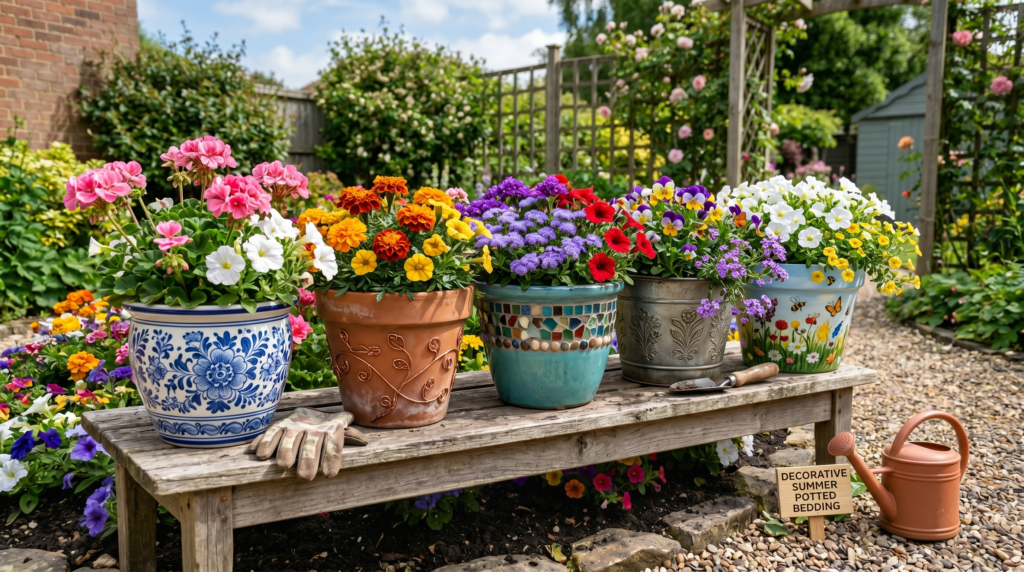
Compost:
Use a good-quality peat-free multipurpose compost. Add a slow-release fertiliser (such as Osmocote) at the manufacturer’s recommended rate when filling containers — this will feed plants for the first 3–4 months without further action.
Drainage:
Every container must have drainage holes. Blocked drainage is the single most common cause of container plant failure. Add a 2–3 cm layer of gravel or broken crocks to the base to prevent the drainage holes from becoming blocked by compost.
Hanging basket specifics:
- Line wire baskets with coconut coir liner — it retains moisture better than moss and is more sustainable.
- Plant through holes in the sides of the liner as well as the top, for a fully clothed basket with no liner visible.
- A standard 30 cm basket holds 5–7 plants. A 40 cm basket accommodates 9–12 plants for a full, lush display.
- Self-watering baskets with built-in reservoirs significantly reduce the daily watering burden in summer.
Window box tips:
- Choose compact or trailing varieties: Surfinia Petunias, Lobelia, Bacopa, mini Pelargoniums.
- Position boxes where they are sheltered from drying wind — a single dry windy day can parch a window box completely.
- On high balconies, use lightweight perlite-mixed compost to reduce weight.
Care, Feeding and Maintenance Through the Season
Watering
Water is the single most important maintenance factor for bedding plants, particularly those in containers. Pots dry out dramatically faster than open ground, and in high summer, even well-established containers may need watering twice a day.
The golden rule: check before you water.
Push your finger 2 cm into the compost. If it feels dry at that depth, water thoroughly — keep going until water flows freely from the drainage holes. If it is still moist, wait.
Signs of underwatering:
- Wilting during the day, even in cool conditions
- Dry, pale, or curling leaves
- Compost pulling away from the edges of the pot
Signs of overwatering:
- Yellowing leaves, especially lower leaves first
- Soft, collapsing stems at compost level
- Mould or algae growing on the compost surface
- Wilting despite wet compost (indicating root rot)
| WATERING BEST PRACTICE
Water in the morning when possible. This gives foliage time to dry before cooler evening temperatures arrive, reducing the risk of fungal diseases such as Botrytis. Avoid overhead watering in full sun — water droplets can act as magnifying lenses and cause leaf scorch. |
Feeding
Container compost, however high-quality, becomes nutrient-depleted within 6–8 weeks. Beyond that point, regular feeding is essential for continued flowering performance.
Feeding schedule:
- At planting: incorporate slow-release granular fertiliser (e.g., Osmocote 6-month formula) into the compost. This eliminates the need for feeding for the first 3–4 months.
- From July onwards: apply a high-potassium liquid feed (tomato feed works perfectly and is widely available) every 7–14 days. High potassium promotes flower production rather than leafy growth.
- What to avoid: high-nitrogen feeds (e.g., lawn feed, general-purpose fertilisers heavy in nitrogen) promote lush foliage at the direct expense of flowers.
Organic options:
- Liquid seaweed feed (e.g., Seasol) — provides micronutrients and improves stress resilience
- Worm castings — excellent slow-release option; work into compost at planting
- Comfrey liquid feed (homemade) — high in potassium; excellent for flowering plants in borders
Deadheading
| DEFINITION — What Is Deadheading?
Deadheading is the removal of spent (dead or dying) flowers before the plant produces and ripens seed. By preventing seed production, you redirect the plant’s energy into producing new flower buds. The result is a significantly extended flowering season — often by weeks or even months. |
Frequency: in peak summer, heavy-flowering plants like Marigolds may need deadheading every 1–2 days. Once or twice a week is sufficient for most bedding plants.
- Technique: pinch or snip just below the faded flowerhead, back to the nearest leaf joint or emerging bud. Don’t leave long stumps, which can harbour disease.
- Low-maintenance alternatives: Pelargoniums, Fuchsias, Impatiens (Busy Lizzie), and Begonias are largely self-cleaning — old flowers drop without intervention.
- Time-saving hack: for plants like trailing Petunias, a single haircut with scissors (cutting back by one-third in mid-season) is faster than individual deadheading and restores flowering vigour.
Pinching Out
Pinching out is the practice of removing the growing tip of a young plant to force it to branch. Each removed tip stimulates two or more new shoots to develop, resulting in a bushier plant with far more flowers than a plant left to grow naturally.
When to pinch out:
When plants are 10–15 cm tall and just establishing — typically 2–3 weeks after potting on or planting out.
How to pinch out:
Using clean fingers or sharp scissors, remove the topmost 2–3 cm of the main stem, cutting or pinching just above a leaf node. This forces the two buds at that node to develop into side shoots.
Best candidates for pinching out:
- Petunia — especially important for grandiflora types that naturally grow leggy
- Pelargonium — creates a fuller, more bushy plant
- Fuchsia — pinch out 2–3 times in succession for a densely branched standard or basket
- Coleus — prevents premature flowering and keeps foliage dense
- Nemesia — extends the flowering season significantly
Common Problems and Solutions
| Problem | Likely Cause | Solution |
| Leggy, pale plants | Insufficient light | Move to a sunnier position; pinch out to encourage bushier regrowth |
| No flowers despite healthy foliage | Excess nitrogen, overwatering, or too shady | Switch to high-potassium feed; improve drainage; consider relocating to a sunnier spot |
| Yellowing leaves | Overwatering, waterlogging, or root disease | Reduce watering immediately; check drainage holes are clear; treat with a copper-based fungicide if root rot is suspected |
| Wilting despite wet compost | Root rot (Pythium) | Improve drainage; reduce watering frequency significantly; if severe, repot into fresh compost and trim dead roots |
| Holes in leaves; slime trails | Slugs and snails | Apply nematode treatment (Nemaslug) in spring; use copper tape on pots; go slug hunting at dusk with a torch; use ferric phosphate pellets (metaldehyde banned since 2022) |
| Sticky residue; distorted new growth | Aphid infestation | Squash by hand; spray with diluted washing-up liquid or neem oil; encourage natural predators (ladybirds, hoverflies) |
| Grey fuzzy mould on foliage | Botrytis (grey mould) | Remove all affected growth immediately; improve air circulation; avoid wetting leaves when watering; apply a copper fungicide |
| Impatiens with pale, downy patches on leaves | Impatiens downy mildew | No cure — remove and bin (not compost) all affected plants. Grow resistant New Guinea Impatiens varieties instead |
Wildlife-Friendly Bedding Plants
Growing bedding plants for pollinators is not a compromise — many of the most effective pollinator plants are also among the showiest and longest-flowering bedding plants available. The key is understanding which flower forms provide accessible nectar and pollen.
The Best Bee and Butterfly-Friendly Bedding Plants
| Plant | Why Wildlife Love It | RHS Pollinator Rated |
| Verbena bonariensis | Magnet for butterflies and bees; long season; self-seeds freely | Yes |
| Salvia (various) | Tubular flowers provide deep nectar; bumblebees especially attracted | Yes |
| Lobularia maritima (Sweet Alyssum) | Honey-scented; powerful hoverfly and bee attractor; flowers for months | Yes |
| Cosmos | Open, simple flowers accessible to all pollinators including smaller bees and hoverflies | Yes |
| Antirrhinum (Snapdragon) | Bumblebees force open the flower to access nectar — a uniquely bumblebee-specific plant | Yes |
| Ageratum houstonianum | Fluffy blue-purple flowers; outstanding late-summer nectar source when many other plants have finished | Yes |
| Nicotiana (Tobacco Plant) | Evening fragrance attracts moths; tubular flowers suit long-tongued bees; good in partial shade | Yes |
Avoiding Harmful Practices
Flower form matters:
Double, frilly, or ‘pom-pom’ flowers — beloved by plant breeders for their showy appearance — are largely useless to pollinators. The extra petals block access to nectar and pollen. Choose single-flowered forms wherever possible.
Slug pellet legislation:
Metaldehyde slug pellets were banned for outdoor garden use in the UK in 2022. The legal alternatives are ferric phosphate pellets (safer for wildlife and pets), nematode treatments (Nemaslug, applied to moist soil in spring), copper tape on pot rims, and physical barrier methods.
Pesticide awareness:
Many mass-produced bedding plants are treated with systemic neonicotinoid insecticides during production. These persist in plant tissue and nectar, harming pollinators even after planting. Look for plants labelled as ‘grown without pesticides’ or ‘bee-friendly’ and favour organically grown plug plants where possible.
Design Ideas and Display
Inspiration
Colour Scheme Ideas
Hot tropical scheme:
Orange African Marigolds + Red Salvia splendens + Yellow Rudbeckia + Bronze Fennel. Bold, cheerful, and highly visible from a distance. Suits a sunny south-facing border.
Cool coastal scheme:
White Lobularia maritima + Blue Lobelia + Silver Dusty Miller (Senecio) + White Bacopa. Elegant and fresh; evokes seaside planting schemes. Works well in containers near a seating area.
Pastel cottage scheme:
Soft pink Cosmos + Lavender-pink Nicotiana + White Gypsophila + Blue Scaevola. Romantic and fragrant; works equally well in borders and large pots. Attracts bees and butterflies throughout summer.
Bold jewel tones:
Deep purple Petunia + Magenta Pelargonium + Lime-green Nicotiana langsdorffii + Black-leaved Ipomoea. Dramatic and contemporary; best in generous-sized containers where the contrast can be appreciated close up.
Classic white:
White Tuberous Begonias + White Alyssum + Silvery Artemisia ‘Silver Mound’. Cool, calming, and elegant; particularly effective in evening light or shaded gardens where the white reads as luminous.
Small Spaces and Balcony Gardens
- Use vertical space: tall, slender containers with trailing plants cascading over railings take up minimal floor space while creating maximum impact.
- Choose self-watering troughs and planters — ideal for balconies where daily watering is impractical.
- Fragrance is especially valuable in outdoor seating areas: Sweet Alyssum, Nicotiana sylvestris, and Stocks (Matthiola incana) all provide evening fragrance within arm’s reach.
- Weight matters on balconies: use lightweight plastic or fibreglass containers rather than terracotta; mix perlite into compost to reduce weight without sacrificing drainage.
Creating Continuous Colour: Spring Through Autumn
The secret to a garden that always looks its best is planning so that seasons overlap and transitions are seamless, not bare. Follow this succession guide:
- February–May: Spring bedding planted the previous October — Pansies, Violas, Wallflowers, Primulas — is at its peak.
- April–May: While spring bedding is finishing, harden off summer bedding ready to plant the moment spring bedding is removed.
- June–October: Summer bedding dominates. Deadhead and feed weekly for maximum performance.
- August: Order winter bedding and spring bedding for the following year. Cut back any summer plants that are becoming untidy.
- October: Replace summer bedding with winter Pansies, Cyclamen, Ornamental Kale, and Skimmia. The transition gap should be days, not weeks.
- January–February: Review, plan, and order seeds and plug plants for the coming season.
| THE OVERLAPPING SEASONS MINDSET
The best bedding gardeners are always working two seasons ahead. In June, as the summer display peaks, they have already ordered autumn bedding. In October, as winter bedding goes in, they are planning the summer display for next year. |
Overwintering Tender Bedding Plants
Buying new bedding plants every year is fine. Saving your best performers from the previous year — for free — is better. Most tender bedding plants are perennial in their native climate; it is only the UK winter that kills them. With modest indoor space and basic care, several can be kept for years.
Plants Worth Overwintering
Pelargoniums (Geraniums) — the easiest and most rewarding:
- Before first frost: cut plants back by half, removing all flowers and yellowing leaves.
- Lift from borders or bring pots inside before temperatures drop below 5°C.
- Store in a cool, frost-free room (5–10°C ideal — a spare bedroom, unheated conservatory, or frost-free greenhouse).
- Water sparingly through winter — once every 3–4 weeks is usually sufficient.
- Bring into warmth and increase watering in March; they will regrow vigorously.
Fuchsias:
- Cut back hard in autumn (to within 10–15 cm of the base for basket/pot types).
- Store in a frost-free garage or shed in their pots; water very occasionally.
- Bring out in April when new growth emerges; begin watering and feeding normally.
Tuberous Begonias and Dahlias:
- After first frost has blackened the foliage, carefully dig up the tubers.
- Allow to dry for a week, then store in dry compost or vermiculite in a cool, frost-free location.
- Check periodically through winter and remove any rotting tubers immediately.
- Pot up and start into growth in March in a warm, bright position.
Osteospermum (African Daisy):
Semi-hardy; may survive mild UK winters in sheltered south-facing positions with fleece protection. To be safe, take cuttings in August (see Section 8.2) as insurance.
Taking Cuttings for Free Plants Next Year
Taking cuttings in late summer is the most cost-effective way to multiply your favourite plants for next year’s display. August to early September is the ideal window — plants are still actively growing, cuttings root readily, and there is time for them to establish before winter.
Step-by-step cutting method:
- Select a healthy, non-flowering shoot tip 8–10 cm long. Non-flowering is critical — flowering shoots use energy to produce flowers, not roots.
- Remove the lower leaves, leaving just 2–3 leaves at the top of the cutting.
- Dip the cut end in rooting hormone powder or gel (optional but significantly improves success rates).
- Insert into a pot of gritty compost (50:50 multipurpose and perlite or coarse grit).
- Cover with a clear plastic bag or propagator lid to maintain humidity. Keep in a warm (18–20°C), bright position but out of direct sunlight.
- Roots typically form in 2–4 weeks. Remove the cover once new growth is visible. Overwinter in a frost-free position.
Best plants to propagate from cuttings:
- Pelargonium — roots in 3–4 weeks; one of the easiest cuttings to take
- Fuchsia — roots in 2–3 weeks; take multiple cuttings as insurance
- Osteospermum — roots in 3–4 weeks; semi-hardy, so always worth taking cuttings
- Coleus — extremely easy; roots in water within days
- New Guinea Impatiens — roots in 2–3 weeks in humid conditions
Frequently Asked Questions
The following Q&A blocks are written to directly answer the questions UK gardeners search for most frequently. Each answer is self-contained and can be referenced independently.
Q: What are bedding plants?A: Bedding plants are short-lived, usually highly colourful plants — typically half-hardy annuals, hardy annuals, biennials, or frost-tender perennials — grown to provide a temporary seasonal display in beds, borders, containers, and hanging baskets. They are planted en masse in organised arrangements (a practice called ‘bedding out’), then replaced each season. Common examples include Petunias, Pelargoniums, Begonias, Pansies, and Wallflowers. |
Q: When should I plant bedding plants in the UK?A: For most of the UK, the safe planting-out window for summer bedding is mid-May to early June, once the risk of frost has passed. In milder areas like Cornwall and the South coast, late April is possible with fleece protection on hand. In Scotland and Northern England, wait until late May or June. Always harden off plants for 2–3 weeks before planting out. Spring bedding (Pansies, Wallflowers) is planted in the previous September and October. |
Q: What is the difference between hardy and half-hardy bedding plants?A: Hardy bedding plants (such as Pansies, Wallflowers, and Polyanthus) can withstand frost and are typically used for spring and winter displays. They can be planted outdoors in autumn and will survive UK winters in the ground. Half-hardy bedding plants (such as Petunias, Pelargoniums, and Begonias) are damaged or killed by frost and can only go outdoors permanently after the last frost of the season — typically May to June in most of the UK. |
Q: How often should I water bedding plants in pots?A: During warm summer weather, bedding plants in containers typically need watering daily — sometimes twice a day in heatwaves. Insert your finger 2 cm into the compost; if it feels dry, water thoroughly until it drains freely from the base. In cooler or overcast weather, every 2–3 days may be sufficient. Self-watering planters with built-in reservoirs significantly reduce watering frequency and are strongly recommended for hanging baskets and window boxes. |
Q: Can bedding plants survive UK winters?A: Most summer bedding plants cannot survive a UK winter outdoors because they are frost-tender. However, some bedding plants are specifically grown for winter displays — including hardy Pansies, Violas, Cyclamen (hardy varieties), Ornamental Kale, and Skimmia — which withstand typical UK winter temperatures. Tender summer bedding plants (Pelargoniums, Fuchsias, Tuberous Begonias, Dahlias) can be overwintered indoors with minimal care and replanted the following spring. |
Q: What bedding plants are best for shade?A: Several excellent bedding plants thrive in shade or partial shade: Busy Lizzies (Impatiens — always choose blight-resistant New Guinea varieties), Begonias (especially tuberous types), Fuchsias, Polyanthus, Primulas, and Foxgloves (biennial). For dappled shade, Lobelia, Mimulus (Monkey Flower), and Nicotiana (Tobacco Plant) also perform well. Avoid full-sun plants such as Marigolds, Petunias, and Pelargoniums in shady positions — they will flower poorly and become prone to disease. |
Q: What are the easiest bedding plants for beginners?A: The easiest bedding plants for beginners are those that are forgiving, long-flowering, and low-maintenance: Pelargoniums (drought-tolerant, slug-resistant, and self-cleaning); Begonias (shade-tolerant and largely self-cleaning); Marigolds — Calendula (easy from seed, long-flowering, pest-deterring); Nasturtiums (nearly indestructible, edible flowers and leaves, direct-sow); and hardy Pansies (frost-hardy, widely available, and flower for months with minimal care). |
Q: Are bedding plants good for bees?A: Many bedding plants are excellent for bees and other pollinators. The best choices include Verbena bonariensis, Salvia (various), Lobularia maritima (Sweet Alyssum), Ageratum, Cosmos, Antirrhinum (Snapdragon), and Nicotiana. Look for the RHS Plants for Pollinators logo when buying. Avoid heavily doubled or frilly flowers — these often lack accessible nectar and pollen and provide little benefit to pollinators despite their visual appeal. |
Q: What is hardening off and why is it important?A: Hardening off is the process of gradually acclimatising indoor- or greenhouse-raised bedding plants to outdoor conditions — including lower temperatures, wind, and higher UV intensity. It takes 2–3 weeks and involves placing plants outdoors for increasingly longer periods before leaving them out overnight. Skipping hardening off is the most common cause of bedding plant failure in the UK. Plants moved directly from a warm house to a cold, windy garden suffer severe shock, wilting, and often death within days. |
Conclusion and Next Steps
Bedding plants are one of gardening’s great pleasures: high-impact, relatively fast, accessible to everyone from the flat-dweller with a single window box to the gardener with a quarter-acre plot, and endlessly renewable with each turning season.
The principles that separate a stunning bedding display from a disappointing one are not complicated. Choose the right plants for your conditions (sun, shade, soil, exposure). Understand your region’s frost risk and resist the urge to plant too early. Harden off every plant that has been grown indoors. Feed generously, deadhead regularly, and water consistently. Plan for the next season while the current one is at its peak.
Do all of that, and your garden will never have a bare or dull week from February’s first Pansies through to November’s last Cyclamen.
And when the season ends, remember: gardening is iterative. Every season teaches you something new — about your soil, your microclimate, your prefe
rences. The best bedding gardeners are not those with the most knowledge, but those who observe carefully, experiment willingly, and come back next year with a slightly better plan.

Leave a Reply