
Imagine a plant that towers sixty metres through the canopy of a Himalayan rainforest — and then thrives just as happily in the corner of a north-facing Edinburgh flat. That is exactly what the rubber plant (Ficus elastica) does.
Its broad, architectural leaves and unapologetically bold presence make it one of the UK’s most enduringly popular houseplants, and for good reason: it is almost designed for British home conditions. It tolerates low light, forgives irregular watering, and shrugs off the dry warmth of central heating that kills more delicate tropical plants outright.
Whether you have just brought home your first plant or are troubleshooting a seasoned specimen, this guide covers everything you need — care, varieties, propagation, pests, toxicity, and the honest truth about that air-purification claim — all calibrated to the rhythms of UK seasons and homes.
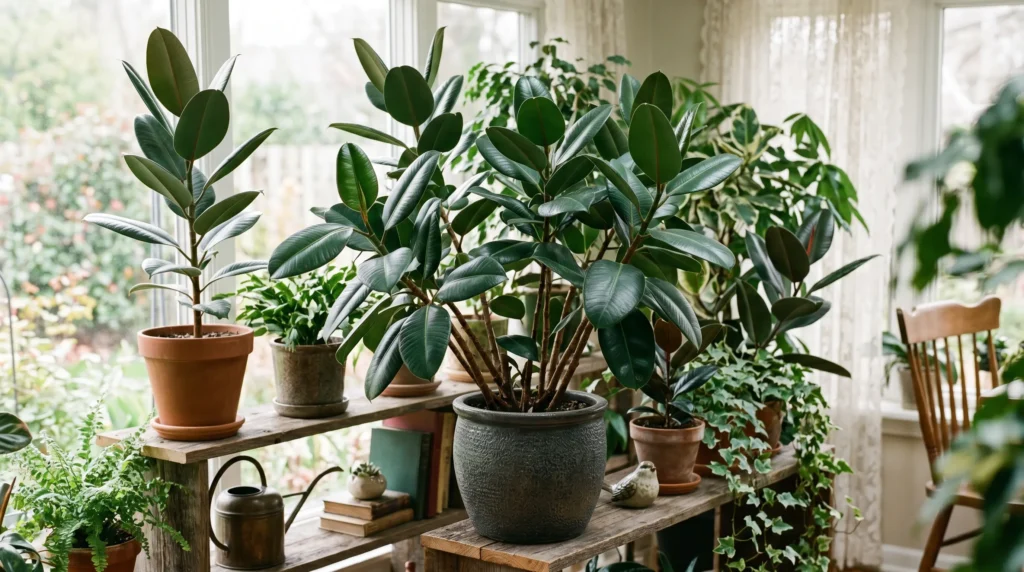
QUICK FACTS
| Common Name | Scientific Name | Family | Native Range |
| Rubber Plant / Rubber Tree | Ficus elastica | Moraceae | NE India, Nepal, Myanmar, Malaysia, Indonesia, S. China |
Quick Care Card
The rubber plant is a tropical evergreen fig native to Southeast Asia, widely grown as a houseplant for its large, glossy leaves and architectural presence.
| Care Factor | Requirements | UK-Specific Note |
| Light | Bright, indirect | East/south-facing window ideal; tolerates north-facing |
| Water (Spring/Summer) | Every 7–10 days | When top 2–3 cm of soil is dry |
| Water (Autumn/Winter) | Every 14–21 days | Reduce significantly; central heating dries soil faster |
| Temperature | 15–25°C | Keep from draughty windows and radiators |
| Humidity | Moderate | Mist leaves 2–3× per week in winter due to central heating |
| Feeding | Monthly (Mar–Aug) | Liquid fertiliser diluted to half strength |
| Repotting | Every 2–3 years | Spring — check for roots through drainage holes |
| Toxic to pets? | Yes — mildly | Keep away from cats and dogs |
| Difficulty | Easy | Ideal for beginners |
A Brief History — From Victorian Parlour Plant to Modern Icon
The rubber plant’s journey from Indian rainforest to Instagram-worthy living room is one of the great houseplant stories. Understanding that journey helps explain why the plant is so well suited to UK homes — and why it keeps coming back into fashion.
Origins and Botanical Discovery
Ficus elastica is native to the tropical forests of Northeast India, Nepal, Myanmar, Malaysia, Indonesia, and southern China, where it grows as a vast, buttress-rooted canopy tree reaching 30 metres or more in the wild. The botanist William Roxburgh formally described the species in 1814 from specimens collected in Northeast India.
The name elastica refers to the plant’s milky white latex sap — the same elastic compound found in latex gloves. In the nineteenth century, before the Para rubber tree (Hevea brasiliensis) took over as the primary commercial source, Ficus elastica was actively tapped for natural rubber across parts of Asia. This distinction is frequently confused in online plant content: the rubber plant is not the source of modern commercial rubber, but it was historically significant in its early production.
Victorian Britain and the Rubber Plant’s Rise
Ficus elastica arrived in British households during the Victorian era and rapidly became a symbol of middle-class prosperity and taste. Its large, dramatic leaves suited the heavy, lavish aesthetic of Victorian parlours and conservatories. More importantly, its tolerance of Britain’s low light levels, cool temperatures, and dim interiors made it uniquely well suited to UK homes — far better than many other tropical imports of the period.
By the mid-twentieth century, however, the rubber plant had fallen out of fashion. It became associated with sterile office waiting rooms and institutional lobbies — a victim of overexposure rather than any actual shortcoming as a houseplant.
The Contemporary Revival
The 2010s and 2020s brought a full-scale revival, driven by the biophilic design movement, a renewed interest in indoor plants as wellness objects, and the visual power of social media. New variegated cultivars — particularly Tineke and Ruby — attracted a younger, design-conscious audience for whom the original dark-green Robusta was perhaps too familiar.
Today, the rubber plant is one of the UK’s consistently top-selling houseplants than other plants, stocked by everyone from IKEA and B&Q to specialist online retailers like Patch Plants and Hortology, and featured in virtually every interior design guide for UK homes.
Eight Rubber Plant Varieties — Which One Is Right for Your UK Home?
What is a rubber plant variety? A rubber plant variety (cultivar) is a selectively bred form of Ficus elastica with distinct leaf colour, growth habit, or pattern. Different cultivars have meaningfully different light requirements and availability in the UK — choosing the right one for your home makes all the difference.
Ficus elastica ‘Robusta’ — The Classic
Deep, glossy dark green leaves. The original houseplant rubber plant, Robusta is the variety most UK buyers will encounter first — on IKEA shelves, in garden centres, and in supermarkets.
- Most tolerant of lower light levels — ideal for north-facing rooms or darker flats
- Easiest to find in UK garden centres and supermarkets (IKEA, B&Q, Dobbies)
- Very forgiving of irregular watering and temperature fluctuations
- Best for: first-time plant owners, darker spaces, budget buyers
- Price range: £8–£25 for small or medium specimens
Ficus elastica ‘Burgundy’ — The Dark Drama
Deep burgundy-red to near-black leaves; undersides maintain rich burgundy colouring. New leaves emerge bright red, creating a spectacular contrast against the dark mature foliage.
- Holds colour best in bright indirect light; reverts to green in low light
- Widely available across UK online retailers — Patch Plants, Hortology, Beards & Daisies
- Best for: bold interiors, dark-coloured decor, statement corners
- One of the most striking varieties for modern and mid-century interiors
Ficus elastica ‘Tineke’ — The Variegated Star
Cream, green, and white variegated leaves with pink-blush new growth sheaths. One of the most popular rubber plant cultivars in UK online retail.
- Requires brighter light than green varieties to maintain variegation
- South or east-facing windowsill ideal; will revert to plain green in low light
- More sensitive to cold draughts than Robusta — avoid cold window placement in UK winters
- Best for: bright, airy rooms, Scandinavian or minimalist interiors
- Higher price point (£20–£60+) — widely available online, less common in garden centres
Ficus elastica ‘Ruby’ — The Pink Statement
Tricolour leaves in green, cream, and pink or red — the most visually dramatic cultivar. Requires the most light of all varieties to maintain its pink colouring.
- Needs a bright south-facing position; supplemental grow lights may be needed in UK winters
- Best for: bright south-facing rooms, collectors, design-led interiors
- More challenging to maintain colour during grey UK winters
Ficus elastica ‘Melany’ — The Compact Choice
Compact growth habit with a tighter, bushier form than standard varieties. Ideal for smaller UK spaces such as flats, shelves, and desks.
- Dark green leaves similar to Robusta but with a more manageable size
- Best for: smaller UK flats, desks, shelves, beginners wanting a compact specimen
- Easy to find in many UK garden centres
Ficus elastica ‘Abidjan’ — The Deep Burgundy
Similar to Burgundy but with even darker, more dramatic colouring and excellent architectural presence in modern minimalist settings.
- Less widely available in UK than Burgundy — mainly online specialist retailers
- Best for: contemporary interiors, dramatic statement spaces
Ficus elastica ‘Belize’ — The Tricolour
Green, cream, and pink variegation similar to Tineke but with stronger pink tones. Sometimes sold interchangeably with Tineke in UK retail — inspect leaves carefully before buying.
- Requires bright indirect light to maintain variegation
- Widely available online through specialist retailers
Ficus elastica ‘Decora’ — The Large-Leaved Classic
Very large, broad leaves create a dramatic statement in spacious rooms. Deep green with a subtle sheen; often confused with Robusta in garden centres.
- Suits large living rooms, conservatories, and open-plan spaces
- Medium difficulty; available in many garden centres
Variety Comparison Table
| Variety | Leaf Colour | Light Need | Difficulty | UK Availability |
| Robusta | Dark green | Low–bright | Very easy | Everywhere |
| Burgundy | Deep red/black | Medium–bright | Easy | Widely available |
| Tineke | Green/cream/white | Bright indirect | Moderate | Online retailers |
| Ruby | Green/cream/pink | Bright (essential) | Moderate | Specialist online |
| Melany | Dark green | Low–bright | Very easy | Garden centres |
| Abidjan | Very dark burgundy | Medium–bright | Easy | Specialist online |
| Belize | Green/cream/pink | Bright indirect | Moderate | Online retailers |
| Decora | Deep glossy green | Medium–bright | Easy | Garden centres |
How to Care for a Rubber Plant in the UK — Complete Guide
What does rubber plant care involve? Rubber plant care covers six core factors: light, watering, temperature, humidity, feeding, and soil. In UK homes, the most common mistakes are overwatering (especially in winter) and placing plants near radiators or cold windows. Every care point below is calibrated to UK seasonal conditions.
Light — What UK Homes Can Realistically Offer
Rubber plants thrive in bright, indirect light — ideally positioned within one to two metres of a south- or east-facing window. The most tolerant variety, Robusta, will cope in a north-facing room. Variegated varieties like Tineke and Ruby need the brightest conditions to maintain their colouring.
- Ideal: bright, indirect light — within 1–2 metres of a south- or east-facing window
- Tolerates: north-facing rooms, lower light (Robusta performs best here)
- Avoid: harsh direct afternoon summer sun through south-facing glass — can scorch leaves
- UK winter: Days can be as short as 8 hours in December. Move plants closer to windows in autumn
- Variegated varieties may benefit from a grow light supplement (12–14 hours per day recommended)
Signs of too little light: leggy growth, leaves losing vibrancy, variegation fading to plain green.
Signs of too much direct sun: pale, bleached patches on leaves, crispy brown edges.
Watering — The Single Most Important Skill
How do you water a rubber plant? Never water on a schedule. Always use the soil test: insert your finger 2–3 cm into the compost. Water when it feels dry at that depth. This single habit prevents the most common cause of rubber plant death — overwatering.
- Spring/Summer: approximately every 7–10 days (more in hot spells or sunny rooms)
- Autumn/Winter: every 14–21 days — the plant enters semi-dormancy and needs significantly less water
- UK heating note: Central heating dries compost faster than expected in winter — check soil weekly
- Water thoroughly until it drains freely from the drainage holes, then wait
- Never let the plant sit in a saucer of standing water — this causes root rot
- Use room-temperature water; cold tap water can shock tropical roots
Overwatering signs: yellow leaves, soft mushy stems at the base, soil that stays wet.
Underwatering signs: drooping leaves, dry crispy leaf edges, very light pot weight.
Temperature and Draughts — The UK Central Heating Challenge
Rubber plants prefer a stable temperature between 15–25°C — consistent with most UK living rooms. The biggest threats in UK homes are not cold weather outdoors but two indoor hazards: radiators and draughts.
- Ideal temperature range: 15–25°C
- Minimum: 10°C — UK conservatories in winter can be problematic
- Radiator danger: Do NOT place directly next to radiators — intense dry heat causes leaf drop and brown tips
- Draught danger: Cold air from opening windows, letterboxes, and poorly sealed doors triggers stress leaf drop
- Pull plants 30–60 cm from windows in winter to avoid cold glass contact
- Hallways and conservatories are often too variable in temperature — choose stable rooms
- Can be moved outdoors to a sheltered, semi-shaded position from June–August; bring in before temperatures fall below 12°C
Humidity — Managing UK Winter Dry Air
UK central heating is one of the most damaging factors for tropical houseplants. It can reduce indoor humidity from a plant-friendly 40–60% down to 20–30%, creating conditions closer to a desert than a rainforest.
- Mist leaves with a spray bottle 2–3 times per week through winter
- Place on a pebble tray filled with water — evaporation increases local humidity
- Group plants together to create a microclimate with naturally higher humidity
- Wipe large leaves monthly with a damp cloth — dusty leaves photosynthesise less efficiently
- A small humidifier placed nearby is the most effective single solution
Feeding — The UK Growing Season Schedule
How often should you feed a rubber plant? Feed only during the active growing season: March through August. Rubber plants are light feeders — once per month with a balanced liquid fertiliser, diluted to half strength. Stop feeding entirely from September through February.
- Feed once per month from March to August only
- Use a balanced liquid fertiliser (equal NPK ratio) or a high-nitrogen liquid feed
- UK products: Baby Bio Houseplant Food, Westland Houseplant Feed, Miracle-Gro Liquid Houseplant Food
- Always apply to moist soil — never to dry compost, which risks root burn
- September–February: stop feeding entirely — the plant cannot use nutrients effectively in semi-dormancy
Soil and Potting Mix — Getting the Drainage Right
What soil does a rubber plant need? The single most critical requirement is excellent drainage. Rubber plants in dense, water-retaining compost are far more likely to develop root rot than those in a free-draining mix.
- Recommended UK mix: 1 part houseplant compost + 1 part perlite + 1 part fine pine bark
- UK compost options: Westland Houseplant Compost, John Innes No. 2, or peat-free alternatives (Sylvagrow, New Horizon)
- pH: slightly acidic to neutral (5.5–7.0) — most UK potting composts fall in this range
- Never use garden soil in pots — too dense, causes waterlogging, introduces pests
- Terracotta pots allow evaporation from the sides, reducing overwatering risk
- Drainage holes are non-negotiable — always remove the nursery pot from decorative cachepots to water and drain
Repotting — When and How
How do you know when to repot a rubber plant? The clearest signs are roots emerging from drainage holes, roots visibly circling the root ball, or a plant that dries out unusually quickly after watering. Repot every 2–3 years, ideally in March or April as growth resumes.
- Go up one pot size only (1–2 inches wider) — oversized pots hold too much moisture
- Water the plant 24 hours before repotting to reduce transplant stress
- Gently loosen outer roots; place in new pot with fresh compost; water well
- Keep out of direct sun for 1–2 weeks after repotting
- Some leaf drop after repotting is normal — do not overwater during adjustment
Pruning and Shaping
When and how do you prune a rubber plant? Prune in late winter to early spring (February–March), just as growth resumes. Always wear gloves — the milky white latex sap irritates skin and stains surfaces.
- Use clean, sharp secateurs or scissors — wipe with alcohol between cuts to prevent disease
- To control height: cut the main stem just above a leaf node — the plant will branch from below the cut
- To encourage bushiness: pinch out the growing tip — redirects energy to lateral growth
- To remove damaged leaves: cut at the stem junction — never pull leaves off
- Treat cuts with cinnamon powder — a natural antifungal that reduces infection risk
- Never remove more than one-third of the plant’s foliage at one time
How to Propagate a Rubber Plant — Two UK-Proven Methods
What is rubber plant propagation? Propagation means creating a new plant from a parent plant. Rubber plants can be propagated by two reliable methods: stem cuttings (easier, suitable for beginners) and air layering (more complex, produces a larger new plant immediately). Both methods work best in UK conditions between May and August.
Stem Cuttings (Recommended for Beginners)
Best time: May–August (active growing season — best rooting success in UK conditions).
What You Will Need
- Clean sharp secateurs
- Rooting hormone powder or gel (optional — Doff Hormone Rooting Powder is widely available in UK)
- Small pot with free-draining compost and perlite mix
- Clear plastic bag or propagation dome
Step-by-Step Instructions
- Choose a healthy stem with at least 2–3 leaf nodes. Cut 10–15 cm just below a node using clean secateurs.
- Remove lower leaves, leaving only 1–2 at the top.
- Allow the cutting to sit for 30–60 minutes so the latex sap dries and seals (reduces rot risk).
- Optionally dip the cut end in rooting hormone powder.
- Insert into moist compost and perlite mix, burying 2–3 cm of stem below the surface.
- Cover with a clear plastic bag or propagation dome to maintain humidity.
- Place in bright indirect light at 18–22°C. Do not place in full sun on a south-facing windowsill.
- After 4–6 weeks, gently tug the cutting — resistance indicates rooting has begun.
Success rate: 60–75% with rooting hormone; 40–60% without.
Air Layering (Recommended for Larger Plants)
Best for: tall, leggy specimens where you want a large new plant immediately. Best time: spring to early summer.
What You Will Need
- Sharp knife or blade
- Damp sphagnum moss
- Clear plastic film
- Tape or twist ties
Step-by-Step Instructions
- Choose a healthy section of stem below a leaf node on a mature branch.
- Make an upward diagonal cut one-third into the stem — do not cut all the way through.
- Keep the cut open using a small piece of toothpick or matchstick.
- Pack damp sphagnum moss around the cut — approximately a tennis-ball sized amount.
- Wrap tightly in clear plastic film and seal both ends with tape.
- Leave in place — roots should appear through the plastic in 6–10 weeks.
- Once roots are well developed, cut the stem below the root ball and pot up in fresh compost.
- Keep the parent plant — it will often produce new growth from below the cut.
Rubber Plant Problems — Diagnose and Fix
This section answers the most common rubber plant troubleshooting questions. Each entry follows the format: Symptom → Most Likely Cause → Fix. Use the diagnostic table below for a quick overview, then read the detailed guidance for root rot and pest control.
Symptom Diagnostic Table
| Symptom | Most Likely Cause | Fix |
| Yellow leaves (older, lower) | Overwatering / root rot | Reduce watering; check roots; repot if rotted |
| Yellow leaves (all over) | Overfeeding or cold draught | Stop feeding; move away from cold windows |
| Drooping leaves (soft) | Overwatering | Allow soil to dry fully; check for root rot |
| Drooping leaves (wilted/dry) | Underwatering or root-bound | Water thoroughly; consider repotting |
| Brown leaf edges | Low humidity / underwatering | Mist regularly; check watering frequency |
| Brown spots (crispy) | Sunscorch or cold damage | Move away from direct sun or cold glass |
| Brown spots (soft/mushy) | Fungal infection or root rot | Improve drainage; remove affected leaves |
| Sudden leaf drop (many leaves) | Cold shock / draught / relocation | Stabilise temperature; do not move plant again |
| Leggy / sparse growth | Insufficient light | Move to brighter position; consider grow light |
| White sticky residue | Mealybug infestation | Wipe with alcohol; apply neem oil |
| Fine webbing on leaves | Spider mites (common in UK winter) | Increase humidity; wipe leaves; neem oil |
| Brown bumps on stems | Scale insects | Scrape off manually; treat with neem oil |
| Variegation fading to green | Too little light | Move to brighter spot; consider grow light |
Root Rot — The Biggest Killer
Root rot is the leading cause of rubber plant death in UK homes, particularly in winter when the plant is semi-dormant and compost stays wet for prolonged periods.
Cause: consistently waterlogged soil — most common in UK winter when growth slows.
Signs: sudden wilting despite moist soil; mushy dark brown or black roots; foul smell from compost.
How to Treat Root Rot
- Remove the plant from its pot and inspect the roots.
- Trim all rotted (dark, mushy) roots with sterilised scissors.
- Dust cuts with cinnamon or sulphur powder to reduce infection.
- Repot in fresh, well-draining compost.
- Do not water for one week; place in bright indirect light.
Prevention: always use the soil finger test; ensure drainage holes are unobstructed; never use a pot without drainage.
Pests Common in UK Homes
Three pests are most frequently encountered on rubber plants in UK homes. All can be effectively managed with prompt treatment.
- Spider mites: most common in UK winter — central heating creates the dry conditions they love. Treat by increasing humidity, wiping leaves with a damp cloth, and applying neem oil spray weekly for four weeks.
- Mealybugs: white fluffy masses in leaf axils. Treat by dabbing with a cotton bud soaked in isopropyl alcohol, then follow up with neem oil spray.
- Scale insects: brown oval bumps on stems. Treat by scraping off with a soft toothbrush and applying neem oil spray.
UK product recommendations: Provanto Ultimate Bug Killer, SBM Bug Clear, or a DIY neem oil solution (5 ml neem oil + 2 ml dish soap + 1 litre water in a spray bottle).
Is a Rubber Plant Safe? Toxicity for Pets, Children and Humans
Are rubber plants toxic? Yes — Ficus elastica is classified as mildly toxic to cats, dogs, and humans. The toxic elements are found in the milky white latex sap. With 57% of UK households owning a pet (PDSA 2023), understanding this risk and how to manage it is essential for most rubber plant owners.
Toxicity Overview
Ficus elastica is classified as Toxicity Class 4 — the lowest category, indicating mild toxicity. The sap contains three key compounds: ficin (a proteolytic enzyme), ficusin (a psoralen, which can cause photosensitivity), and latex proteins that may trigger reactions in latex-sensitive individuals.
- Classified as toxic to cats and dogs by the ASPCA and the Pet Poison Helpline
- The toxic compounds act as irritants rather than systemic poisons
- Toxicity is mild — ingestion of small amounts is unlikely to be life-threatening, but should always be taken seriously
Effects on Cats and Dogs
If a cat or dog chews or ingests rubber plant leaves, the most likely symptoms are gastrointestinal — drooling, vomiting, diarrhoea, loss of appetite, and lethargy. Skin contact with the sap can cause irritation and redness; eye contact may cause temporary burning.
UK Animal Poison Line: 01202 509000 — contact immediately if your pet has ingested rubber plant material. This is a paid service (around £30 per call) but provides expert veterinary guidance.
Effects on Humans
- Skin contact with sap during pruning or propagation can cause contact dermatitis — always wear gloves
- Latex allergy sufferers: exercise extra caution — the sap contains latex proteins that may cross-react
- Children: keep plants out of reach; if sap is ingested, rinse the mouth thoroughly and seek medical advice if symptoms develop
Living Safely with a Rubber Plant as a Pet Owner
- Place the plant out of reach — on high shelving, plant stands, or in rooms pets do not access
- Hang the plant basket-style from ceiling hooks (effective deterrent for cats)
- Use citrus-based deterrent sprays around the pot — effective with most cats
- Pet-safe alternatives to consider: spider plants (Chlorophytum comosum), Boston ferns, or Peperomia species
Do Rubber Plants Actually Purify Air? The Evidence
Do rubber plants clean the air? The short answer is: not meaningfully in a typical UK home. This is one of the most frequently repeated claims in houseplant content, and almost every competitor repeats it uncritically.
The Claim and Where It Comes From
The popular belief that houseplants purify indoor air derives from a 1989 study conducted by NASA researcher Bill Wolverton. That study found that various plants — including Ficus species — removed measurable quantities of volatile organic compounds (VOCs) such as formaldehyde and benzene from the air in sealed test chambers.
What the Science Actually Says
A 2019 meta-analysis published in the Journal of Exposure Science and Environmental Epidemiology examined the cumulative evidence and reached a clear conclusion: to achieve meaningful air purification in a real, ventilated room, you would need hundreds of plants. The BBC’s Gardeners’ World programme and the American Lung Association have both noted that houseplants offer negligible air quality improvement in typical ventilated homes.
The sealed chamber conditions of the 1989 NASA study bear no resemblance to a living room, kitchen, or bedroom with normal air exchange rates.
What Rubber Plants Genuinely Do Offer
- Increase local humidity through transpiration — beneficial in UK homes during heating season
- Provide documented psychological wellbeing benefits — multiple studies link indoor greenery to reduced stress and improved mood
- Contribute to a richer sensory environment and improved aesthetic satisfaction
The honest verdict: grow a rubber plant because it is beautiful, resilient, and demonstrably good for your wellbeing — not because it will meaningfully filter your indoor air.
Where to Buy a Rubber Plant in the UK
UK buyers have a wide choice of sources for rubber plants, ranging from budget supermarket specimens to premium, presentation-quality plants from specialist online retailers. Knowing what to look for when buying will save you from bringing home a struggling plant.
Online Retailers
| Retailer | Best For | Key Differentiator |
| Patch Plants | Quality mid-range, small to large specimens | Carbon-neutral delivery; detailed care cards |
| Hortology | Premium specimens, rare varieties | Excellent packaging; specialist advice |
| Beards & Daisies | Gifting, presentation-ready plants | Beautiful gift packaging and add-ons |
| Happy Houseplants | Variety, competitive pricing | Expert advice blog |
| The Little Botanical | Small or medium gift plants | Styled presentation, terrarium kits |
| IKEA UK | Budget starter plants | Very affordable Robusta — ideal for beginners |
Physical Retailers
- Garden centres: Dobbies, RHS Garden Centres, local independents — typically stock Robusta and Burgundy year-round
- Supermarkets: Asda, Morrisons, Lidl, and Aldi periodically stock small rubber plants (usually Robusta) at £5–£12
- B&Q and Homebase: inconsistent stock but rubber plants appear seasonally
What to Look for When Buying
Look for: firm, upright leaves with no yellowing; healthy green growing tips; no signs of pests on leaf undersides; moist but not soggy compost.
Avoid: yellowing lower leaves (overwatering at source), mushy stems, visible pests, or leggy elongated growth indicating poor light at the supplier.
Size guidance: small plants (25–40 cm) are ideal for beginners — they establish quickly. Large statement specimens (1 m+) cost more but create an immediate impact.
UK Rubber Plant Seasonal Care Calendar
No other rubber plant resource provides a UK-specific seasonal care calendar. The following table gives a month-by-month overview of the key tasks and hazards for each season in British conditions.
| Season | Months | Key Tasks | Watch Out For |
| Spring | Mar–May | Resume monthly feeding; water more regularly; repot if root-bound; propagate cuttings from May | Sudden temperature swings; check for pests emerging from winter |
| Summer | Jun–Aug | Water every 7–10 days; continue monthly feeding; move outdoors if sheltered; wipe leaves monthly | Overwatering in hot spells; direct afternoon sun through glass |
| Autumn | Sep–Nov | Reduce watering to fortnightly; stop feeding by September; move indoors before temperatures drop below 12°C | Draught damage as windows close and central heating begins |
| Winter | Dec–Feb | Water sparingly (every 14–21 days); stop feeding; mist leaves for humidity; wipe dust from leaves monthly | Root rot (cold + wet); spider mites (dry heating); cold window damage |
Frequently Asked Questions (FAQ)
The following Q&A blocks are structured for FAQPage schema markup and target People Also Ask (PAA) positions on Google. Each answer is written to be self-contained and extractable by search engines and AI assistants.
Q: How often should I water a rubber plant in the UK?
A: During spring and summer, water approximately every 7–10 days — but always test the soil first by inserting your finger 2–3 cm deep. If it feels dry, water thoroughly until water runs from the drainage holes. In autumn and winter, reduce to every 14–21 days. Central heating can dry compost faster than expected in winter, so check the soil weekly rather than assuming dormancy means no watering.
Q: Why are my rubber plant leaves drooping?
A: Drooping leaves most commonly indicate overwatering (leaves feel soft and limp) or, less commonly, severe underwatering (leaves feel thin and papery). Check the soil: soggy soil points to overwatering; bone-dry soil indicates thirst. Being root-bound — where roots have no space to grow — can also cause drooping. Check if roots are circling the pot base or emerging from drainage holes.
Q: Why are my rubber plant’s leaves turning yellow?
A: Yellow leaves on a rubber plant typically signal overwatering — especially common in UK winter when the plant is semi-dormant and needs far less water than in summer. Other causes include cold draughts, sudden temperature changes, and very low light. Remove yellow leaves promptly to redirect the plant’s energy, and adjust your watering frequency.
Q: Are rubber plants toxic to cats and dogs?
A: Yes — rubber plants are mildly toxic to cats and dogs. The milky white latex sap contains ficin and ficusin, which can cause drooling, vomiting, and digestive upset if ingested. Keep plants out of reach of pets. If your pet has eaten rubber plant leaves, contact your vet or call the UK Animal Poison Line: 01202 509000.
Q: How big do rubber plants get indoors in the UK?
A: In a typical UK home, rubber plants grow to between 1–3 metres tall, though most indoor specimens stay under 2 metres without pruning. They can gain 30–60 cm per year in good conditions. You can control height by pruning the main stem just above a leaf node — the plant will then branch and become bushier rather than taller.
Q: How do I make my rubber plant grow faster?
A: Provide bright indirect light (the single most important growth factor), feed monthly from March to August with a balanced liquid fertiliser, maintain temperatures above 18°C, and water correctly using the soil test. Repot into fresh compost every 2–3 years. Rubber plants grow most actively between April and September under UK conditions.
Q: Can I put a rubber plant outside in summer in the UK?
A: Yes — rubber plants can go outdoors from June to August in a sheltered, semi-shaded spot. Avoid direct afternoon sun and exposed, windy positions. Bring back indoors before temperatures drop below 12°C, typically late August or early September in most UK regions. Acclimatise gradually — do not move a plant from dim indoors straight into bright outdoor light.
Q: Why is my rubber plant dropping leaves?
A: Sudden leaf drop is almost always caused by environmental stress: relocation shock, cold draughts, a sudden temperature change, or overwatering. It is particularly common after buying a new plant (transport stress) or after moving it to a new position in the home. Stabilise conditions, avoid moving the plant again, and new growth will typically follow within 4–6 weeks.
Q: What is the best compost for a rubber plant in the UK?
A: The best compost for rubber plants prioritises drainage above all else. A recommended UK mix is one part standard houseplant compost (Westland, John Innes No. 2, or peat-free alternatives such as Sylvagrow), one part perlite, and one part fine pine bark. This combination drains freely while retaining enough moisture for healthy roots.
Conclusion
The rubber plant has earned its place as one of the UK’s most enduring houseplants for good reason. It is dramatic enough to make a genuine design statement, forgiving enough for beginners to succeed with it, and adaptable enough to cope with the particular challenges of British homes — short grey winters, central heating, and rooms that may never see direct sunlight.
Give it reasonable light, resist the urge to overwater (especially in winter), keep it away from radiators and cold draughts, and it will reward you with years of bold, architectural growth. Few plants deliver this combination of impact and resilience.
Further Reading
- Rubber Plant Varieties: In-Depth Guide — full cultivar profiles with UK sourcing advice
- How to Propagate a Rubber Plant: Step-by-Step — detailed propagation guide with photos
- Rubber Plant Repotting Guide — when, how, and which compost to use
- Rubber Plant Pests: Identify and Treat — full pest identification and treatment guide
- Pet-Safe Houseplants for UK Homes — curated list of non-toxic alternatives
- Where to Buy Rubber Plants in the UK: 2025 Retailer Guide — updated retailer comparison

Leave a Reply