
The overwhelming majority of succulent plants content online originates from the United States, South Africa, or Australia. These regions share almost nothing climatically with the UK. We receive 1,400–1,800 hours of sunshine per year.” conditions that most succulent plants simply are not bread for” We have cold, wet winters with humidity that regularly sits at 70–85%. Our soil stays damp for months.
And since 2022, our garden centres have been transitioning away from peat-based compost which directly affects how succulent plants absorb moisture
The core insight this guide is built on: In the UK, wet kills succulents faster than cold does. A fully frost-hardy Sempervivum will rot in waterlogged clay just as surely as a tender Echeveria. This single truth — drainage over everything — underpins every recommendation below.
This guide is written specifically for British conditions: our grey skies, our regional climate differences from Cornwall to Caithness, our hard water in the south and soft water in the north, our peat-free garden centres, and the very real anxiety of deciding when to bring tender plants indoors in October.
What Are Succulent Plants?
What is a succulent plant? (Definition)
A succulent plant is any plant that stores water in its fleshy leaves, stems, or roots as an adaptation to survive in arid or semi-arid environments. The word “succulent” comes from the Latin sucus, meaning juice or sap.Succulents have evolved in habitats where rainfall is scarce, unpredictable, or seasonal — the South African Karoo, the Mexican Chihuahuan Desert, the Canary Islands. They cope by filling their tissues with water reserves during wet periods, then drawing on those reserves during drought.
How do succulents plants grow differently from other plants?
Most succulents use a photosynthesis process called CAM (Crassulacean Acid Metabolism). Unlike standard plants, which open their leaf pores (stomata) during the day to absorb CO₂, CAM plants open their stomata at night. This conserves water by avoiding daytime heat and moisture loss.
What this means for UK growers: CAM photosynthesis makes succulents naturally slower-growing than other houseplants. Do not mistake slow growth for a dying plant. A Jade Plant that produces two centimetres of new growth in a UK summer is thriving.
Are Succulent plants and Cacti the Same Thing?
Short answer: All cacti are succulents, but not all succulents are cacti.
The defining feature of a cactus is the areole — a specialised, cushion-like structure unique to the cactus family (Cactaceae) from which spines, flowers, and new growth emerge. No other plant family has areoles. If a spiny plant has areoles, it is a cactus. If it lacks areoles, it is not.
Comparison Table: Succulent plants vs. Cacti
| Feature | Succulents (non-cactus) | Cacti |
|---|---|---|
| Water storage location | Leaves, stems, or roots | Stems (modified) |
| Spines | Usually absent | Present (modified leaves) |
| Areoles (spine pads) | No | Yes — defining feature |
| UK indoor suitability | Most genera | Most genera |
| Outdoor hardiness (UK) | Some (Sempervivum, Sedum) | Very few (Opuntia) |
| Common examples | Echeveria, Aloe, Jade Plant | Mammillaria, Opuntia, Cereus |
Which Plant Families Contain Succulent plants?
Succulents are not a single plant family — they are a survival strategy that has evolved independently across dozens of families. The main families relevant to UK growers are:
- Crassulaceae — Echeveria, Sedum, Sempervivum, Crassula (Jade Plant), Kalanchoe
- Asphodelaceae — Aloe, Haworthia, Gasteria
- Asparagaceae — Agave, Yucca
- Aizoaceae — Lithops (Living Stones), Delosperma (Ice Plant)
- Apocynaceae — Adenium (Desert Rose)
Why Are Succulent plants Well-Suited to Modern UK Life?
- Low maintenance — ideal for busy households and genuinely forgetful waterers
- Long-lived — Jade Plants (Crassula ovata) regularly live 20–30 years with correct care
- Space-flexible — one pot on a windowsill to a full rockery display
- Visually versatile — in 2026, interior designers increasingly treat succulents as living sculpture rather than filler plants
The Complete UK Types and Varieties Guide of succulent plants
How to Read This Section
Each variety below includes a UK Indoor Verdict or UK Outdoor Verdict, an RHS hardiness rating, and UK-specific growing notes. The RHS H1–H7 scale is explained in full in Part 3; a quick reference: H7 = survives anything British winters produce; H1c = indoors only.
Best Succulent plants for Indoor Growing in the UK
Framing context: UK homes receive an average of 1,400–1,800 sunshine hours per year — significantly less than the 2,500–3,500 hours typical of most succulents‘ native habitats. The varieties below have been selected because they tolerate lower light levels and typical UK home humidity. They will not merely survive indoors — they will genuinely thrive.
Echeveria (Echeveria spp.)
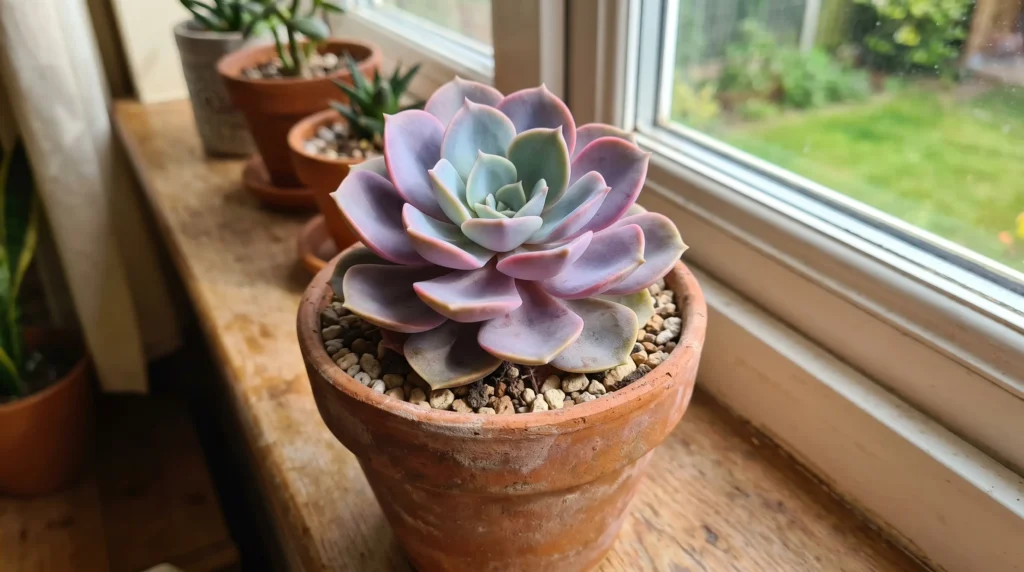
What is Echeveria? Echeveria is a genus of rosette-forming succulents from Central America and Mexico, characterised by symmetrical, geometric leaf arrangements in shades of blue-grey, rose-pink, and purple. Leaves have a powdery or waxy coating called farina.
UK Indoor Verdict: Excellent — south- or east-facing windowsill; needs bright indirect light
Key UK growing notes:
- Watch for etiolation (stretching toward light) in UK winters — rotate pots monthly to maintain compact shape
- Prone to overwatering rot in UK’s cool, low-light winters; reduce watering sharply from October
- RHS hardiness: H2 (frost tender; indoor only except in very sheltered south UK gardens)
Best varieties for UK conditions:
- E. elegans (Mexican Snowball) — compact, silver-blue, very forgiving
- E. ‘Blue Frills’ — ruffled edges, tolerates slightly lower light
- E. pulvinata (Chenille Plant) — soft velvety leaves, more cold-tolerant than most Echeverias
Haworthia (Haworthia spp.)
What is Haworthia? Haworthia is a genus of small, dark green rosette succulents from South Africa, typically featuring white banding, raised tubercles (bumps), or translucent “windows” at the leaf tips that allow light to penetrate to underground photosynthetic tissue.
UK Indoor Verdict: Best genus for low-light UK homes — the only succulent that genuinely tolerates north-facing windowsills
Key UK growing notes:
- H. fasciata (Zebra Plant) and H. truncata are the most widely available
- Tolerates some humidity — suitable for bathrooms and offices, unlike most succulents
- Ideal for desks, shelving, and darker rooms where other succulents fail
- RHS hardiness: H1c (heated glasshouse or indoors only)
Why Haworthia is underrated by UK buyers: Most succulent advice pushes Echeveria and Aloe for beginners. For a typical UK home without a bright south-facing windowsill, Haworthia is the safer, more reliable choice.
Aloe Vera (Aloe barbadensis miller)
What is Aloe vera? Aloe vera is a stemless succulent producing tall, strap-like grey-green leaves with toothed margins. It is one of the most widely cultivated succulents globally, grown both as an ornamental houseplant and for the clear gel inside its leaves, which has documented use in soothing minor burns and skin irritation.
UK Indoor Verdict: Classic UK houseplant; needs south-facing window
Key UK growing notes:
- Common UK mistake: overwatering in winter causes basal rot rapidly in cooler temperatures
- Gel from leaves has genuine first-aid uses — well-documented by the British Pharmacopoeia for minor burns and sunburn
- Produces offsets (“pups”) freely — a single plant becomes several within two to three years
- RHS hardiness: H2
Jade Plant (Crassula ovata)
What is a Jade Plant? The Jade Plant is a tree-like succulent from South Africa with thick, woody stems and oval, glossy dark green leaves. With age, it develops a gnarled, sculptural trunk, making older specimens genuinely impressive statement houseplants.
UK Indoor Verdict: Extremely forgiving — survives neglect, variable light, and wide temperature fluctuations better than almost any other succulent
Key UK growing notes:
- Can live for decades as a houseplant; a 20-year-old Jade Plant can reach 90cm and become a focal piece of a room
- Cultivars of note: ‘Gollum’ (tubular, finger-like leaves), ‘Hobbit’, ‘Sunset’ (yellow and red leaf edges)
- RHS hardiness: H2
Kalanchoe (Kalanchoe blossfeldiana)
What is Kalanchoe? Kalanchoe is a flowering succulent with glossy, scalloped green leaves and clusters of small, long-lasting flowers in red, orange, yellow, or pink. It is one of the most commercially sold flowering houseplants in the UK.
UK Indoor Verdict: Widely available in UK supermarkets and garden centres year-round
Key UK growing notes:
- Flowers last 6–8 weeks; reflowering is possible by giving the plant 6 weeks of 12-hour darkness (simulating short-day conditions)
- TOXICITY WARNING: Can cause vomiting, lethargy, and heart problems in cats and dogs — keep out of reach of pets (RSPCA-aligned guidance)
- RHS hardiness: H1c
String of Pearls (Senecio rowleyanus / Curio rowleyanus)
What is String of Pearls? String of Pearls is a trailing succulent with distinctive, perfectly spherical, bead-like leaves arranged along long hanging stems. It is one of the most visually dramatic succulents for display in hanging pots.
UK Indoor Verdict: Stunning display plant; needs bright light
Key UK growing notes:
- Deceptively difficult to keep in UK conditions — highly prone to overwatering rot, especially in winter
- Pro tip: Terracotta hanging pot plus a very gritty compost mix dramatically improves success rate compared to standard plastic pots
- Not a beginner’s first plant — better chosen once you have mastered watering discipline
Gasteria (Gasteria spp.)
What is Gasteria? Gasteria is a South African succulent with thick, tongue-shaped leaves, often dark green with white spotting or windowing, growing in distinctive stacked pairs. The name comes from the Greek gaster (stomach), referring to the swollen base of the flowers.
UK Indoor Verdict: Significantly underrated low-light performer; more forgiving than Haworthia
Why Gasteria deserves more attention: Almost no mainstream UK succulent guide features Gasteria prominently. It tolerates lower light than most succulents, is very slow to react badly to irregular watering, and produces attractive patterned foliage year-round. An excellent second plant for anyone who has mastered Haworthia.
Lithops (Lithops spp.) — Living Stones
What are Lithops? Lithops are a genus of highly specialised succulents from southern Africa that have evolved to mimic small pebbles as camouflage against grazing animals. Each plant consists of a pair of swollen, fused leaves with a slit at the top from which flowers and new leaf pairs emerge.
UK Indoor Verdict: Intermediate level — strict dormancy watering protocol required; very prone to rot if watered in UK winter
Key UK growing notes:
- Each pair of leaves replaces itself annually; never water during the leaf-replacement process (typically autumn to early spring in UK conditions)
- South-facing windowsill only
- Fascinating as a collector’s plant; not suitable as a first succulent
- RHS hardiness: H1c
Best Hardy Succulent plants for UK Outdoor Growing
The Critical UK Outdoor Growing Rule
“In the UK, wet kills succulents faster than cold does.”
A fully frost-hardy Sempervivum rated to H7 (surviving below -20°C) will rot in a winter of waterlogged clay soil just as quickly as a tender Echeveria. Outdoor growing success in the UK is determined almost entirely by drainage, not by cold hardiness ratings alone.
Before planting any succulent outdoors: ensure the soil drains freely within 30 minutes of watering. If it does not, raise your planting in a bed amended with 30–50% horticultural grit, or use a container.
Sempervivum (Sempervivum spp.) — Houseleeks
What is Sempervivum? Sempervivum (Latin: “always alive”) is a genus of tight, geometric rosette succulents native to mountain regions of Europe and the Middle East. They naturally grow in rocky alpine scree — which explains their extraordinary cold hardiness and preference for sharp drainage.
UK Outdoor Verdict: The single best recommendation for UK outdoor growing
Key UK growing facts:
- RHS hardiness: H7 — survives anything a British winter produces, including prolonged frost, snow cover, and ice
- Produces offsets (smaller rosettes, called “chicks”) freely — one plant fills a container in two to three seasons
- Colours range from near-black to silver-green, lime, burgundy, and deep rose; vary dramatically by season
- Use cases: stone troughs, rockeries, roof gardens, green roofs, wall crevices, between paving
- Requires almost zero maintenance once established — drought-tolerant and self-managing
“Sempervivums are the gateway drug of the succulent world.” — Peter Bint, British Cactus and Succulent Society
Sedum / Stonecrop (Sedum spp.)
What is Sedum? Sedum (stonecrop) is a large genus of mat-forming or upright succulents common across Europe, Asia, and North America. Most UK species have tiny, fleshy leaves and produce clusters of small star-shaped flowers in yellow, white, or pink in summer.
UK Outdoor Verdict: Excellent workhorse plant; naturalises beautifully in rockeries
Best UK varieties:
- S. spathulifolium — silver rosettes, extremely compact, ideal for troughs
- S. acre (Biting Stonecrop) — vigorous yellow-flowering ground cover; will self-seed in gravel
- S. ‘Autumn Joy’ (now Hylotelephium ‘Herbstfreude’) — tall border plant, late-season pink flower heads loved by pollinators
- S. rupestre ‘Angelina’ — golden-tipped trailing variety, excellent in wall gardens
RHS hardiness: H5–H7
Delosperma (Delosperma spp.) — Ice Plant
What is Delosperma? Delosperma (Ice Plant) is a low-carpeting South African succulent producing a long season of vivid, daisy-like flowers in magenta, orange, yellow, and white from June to September. It forms a dense, weed-suppressing ground cover.
UK Outdoor Verdict: Excellent colour value for UK summer; requires more management than Sempervivum
Key UK growing notes:
- RHS hardiness: H4–H5; needs very sharp drainage and a sheltered south-facing position
- Planted at the base of a south wall on grit, Delosperma can overwinter successfully as far north as the English Midlands
- In Scotland and north Wales, treat as an annual or bring a rooted cutting indoors for winter insurance
Aeonium (Aeonium spp.)
What is Aeonium? Aeonium is a genus of architectural succulents from the Canary Islands, producing large rosettes on distinctive woody stems. Colour range from near-black (A. ‘Zwartkop’) to acid yellow-green (A. ‘Sunburst’).
UK Outdoor Verdict: Ideal for coastal UK gardens; excellent in Cornwall, Devon, West Wales, and other mild Atlantic-facing locations
The key distinction that most guides miss: Unlike almost every other succulent, Aeonium grows actively in winter and is dormant in summer. This reversal of the normal succulent cycle means Aeonium tolerates UK winters better than its hardiness rating alone suggests — but it still needs protection from hard frost.
Key UK growing notes:
- RHS hardiness: H3 — not reliably hardy north of the Midlands
- Bring containers indoors or cover in situ with horticultural fleece during cold snaps
- Award of note: Surreal Succulents won RHS Gold at Chelsea Flower Show 2025 with Aeonium hybrids
Agave (Agave spp.)
What is Agave? Agave is a genus of bold, architectural succulents from Mexico and the American Southwest. They produce large, imposing rosettes of thick, spine-tipped, strap-like leaves and are grown primarily for their dramatic form.
UK Outdoor Verdict: For sheltered courtyard gardens and large container displays moved indoors for winter
Key UK growing notes:
- RHS hardiness: H3–H4 depending on variety; needs winter protection in most of the UK
- Agave americana is too large for most UK gardens at eventual 2m+ spread
- Best grown in large containers that can be moved into a frost-free garage or greenhouse for winter
- Handles drought and heat well — excellent in paved, gravel, or south courtyard settings
Opuntia — Prickly Pear (Opuntia humifusa / O. phaeacantha)
What is Opuntia? Opuntia (Prickly Pear) is a genus of flat-padded cacti producing yellow flowers and edible fruit. The species O. humifusa (Eastern Prickly Pear) is one of the very few cacti genuinely hardy enough for UK outdoor cultivation.
UK Outdoor Verdict: One of the few genuinely hardy outdoor cacti for UK gardens
Key UK growing notes:
- RHS hardiness: H5–H6
- Handling warning: Glochids (tiny barbed hairs covering the pads) are far more irritating than they look, embedding deeply in skin and difficult to remove. Always handle with thick leather gloves.
- Needs sharp gravel drainage; suitable for south-facing gravel gardens
Best Succulent plants for Complete Beginners in the UK
The Five Failsafe Starter Succulents for UK Growers
These five varieties have been selected specifically for their tolerance of common beginner mistakes in British conditions — inconsistent watering, sub-optimal light levels, and the temptation to overwater in winter.
| Variety | Why It’s Failsafe in the UK |
|---|---|
| Sempervivum | Outdoor growing; survives complete neglect; H7 — literally unkillable in British winters |
| Jade Plant (Crassula ovata) | Survives variable light and irregular watering; decades of longevity; very forgiving of underwatering |
| Haworthia fasciata | Tolerates north-facing and low-light UK rooms; no bright windowsill required |
| Aloe vera | Universally available; slow to die; forgiving if you remember one rule: water far less in winter |
| Echeveria elegans | Beautiful compact rosette; a south-facing windowsill is genuinely sufficient |
Rare and Collector Succulent plants for UK Enthusiasts
For growers ready to move beyond the mainstream. These varieties reward experience and are covered poorly or not at all by competitor guides.
- × Semponium ‘Destiny’ — Intergeneric hybrid (Aeonium × Sempervivum), bred by Surreal Succulents; RHS Plant of the Year 2022. Combines the hardiness of Sempervivum with the architectural drama of Aeonium. More frost-tolerant than pure Aeonium.
- Haworthia truncata — Extraordinary “window” leaf tips; grows in straight rows rather than rosettes; must be seen in person to appreciate. Bright indoor sill only.
- Aloe polyphylla — The spiral Aloe from Lesotho. A mathematically perfect Fibonacci spiral of toothed leaves. Requires perfect drainage, cool temperatures, and patience. Difficult but breathtaking.
- Faucaria tigrina — Tiger’s Jaw — Interlocking toothed leaves that appear carnivorous; a genuine conversation piece. Unusual and completely maintenance-free indoors.
- Ceropegia woodii — String of Hearts — Trailing heart-shaped leaves with silver marbling; technically classified as a succulent despite its delicate appearance. Excellent in hanging pots at a bright UK window.
Species Quick-Reference Table (UK-Optimised)
| Variety | Best Position | RHS Hardiness | Winter Watering | Beginner Friendly | Indoor / Outdoor |
|---|---|---|---|---|---|
| Sempervivum | Full sun | H7 | Virtually none | Both | |
| Sedum spathulifolium | Full sun | H6 | Minimal | Outdoor | |
| Echeveria elegans | Bright indirect | H2 | Once per month | Indoor | |
| Haworthia fasciata | Low–medium light | H1c | Once per 6 weeks | Indoor | |
| Aloe vera | Bright south-facing | H2 | Once per month | Indoor | |
| Jade Plant | Bright indirect | H2 | Once per 3–4 weeks | Indoor | |
| Aeonium ‘Zwartkop’ | Full sun | H3 | Minimal (winter-active) | Outdoor (mild regions) | |
| Delosperma | Full sun | H4–H5 | None | Outdoor (sheltered) | |
| Lithops | Full south sun | H1c | None (strictly) | Indoor | |
| Agave americana | Full sun, sheltered | H3 | Minimal | Outdoor / Container |
UK Climate — The Truth About Growing Succulent plants Here
Why Most Succulent plants Advice Does Not Apply to the UK
The core problem: Succulents evolved in habitats that share almost nothing climatically with the UK. Their native environments — the South African Karoo, the Mexican Chihuahuan Desert, the Canary Islands — receive 2,500–3,500 sunshine hours annually and experience dry, cold winters with well-drained rocky soils.
The UK reality:
- Average sunshine: 1,400–1,800 hours per year — less than half of most succulents’ native habitats
- Average rainfall: 600–1,500mm per year depending on region (compared to under 250mm in most succulent native ranges)
- Winter humidity: regularly 70–85%, creating conditions that promote fungal rot
- Soil drainage: frequently poor, especially in clay-heavy regions
The Number One Rule for UK Succulent Growing
Wet kills succulents faster than cold in the UK.
This is not an exaggeration. Root rot caused by waterlogged soil is the leading cause of succulent death in UK gardens and homes. A fully H7-rated Sempervivum in waterlogged clay will rot within a single wet winter. Drainage is not one factor among many — it is the single most important factor.
The three drainage solutions for UK growers:
- Raised beds with 30–50% horticultural grit mixed into the soil
- Terracotta pots with drainage holes (never glazed pots without drainage)
- A gravel mulch of 2–3cm depth around the plant base to deflect rain splash and reduce humidity at soil level
UK Regional Growing Differences
| Region | Key Characteristics | Implications for Succulents |
|---|---|---|
| SE England and London | Warmest, lowest rainfall, hard water | Widest range viable outdoors; hard tap water leaves calcium deposits on leaves — cosmetic only |
| SW England (Cornwall, Devon) | Mild winters, high rainfall | Coastal gardens ideal for Aeonium and tender types; drainage is critical |
| Wales and NW England | High rainfall, mild temperatures | Outdoor growing requires sheltered spots; raised beds essential |
| Scotland | Cold winters, variable rainfall | Hardy types only outdoors (Sempervivum, Sedum); most varieties strictly indoor |
| East Anglia | Driest UK region, cold snaps | Good for outdoor varieties; protect against late frosts in April |
How to Read RHS Hardiness Ratings
What is the RHS hardiness scale? The Royal Horticultural Society’s H1–H7 hardiness scale rates a plant’s ability to survive UK temperatures. It is the most reliable guide for UK gardeners, replacing the American USDA zone system used in most international succulent guides.
| Rating | Temperature Threshold | UK Meaning |
|---|---|---|
| H1a / H1b | Above 15°C / above 10°C | Heated glasshouse only — not suitable for any outdoor exposure |
| H1c | Above 5°C | Frost tender — indoor only in all UK regions |
| H2 | Down to 0°C | Unheated glasshouse; survives very mild coastal UK winters with protection |
| H3 | Down to about -5°C | South coast UK with winter fleece protection only |
| H4 | Down to -10°C | Most of England except severe winters |
| H5 | Down to -15°C | Most of the UK including Midlands and northern England |
| H6–H7 | Down to -15°C and below | Exceptionally hardy — Sempervivum and many Sedum; no fear of UK winters |
Practical rule: For reliable, unprotected UK outdoor growing, look for H5 or above. For container growing that comes indoors for winter, H3–H4 gives you many more options.
Essential Care Guide — UK-Tailored
Light: What UK Succulents Actually Need
The baseline rule: Most succulents need bright light for a minimum of 4–6 hours daily. In the UK, this means a south- or east-facing windowsill for the majority of genera.
Light guide by room position:
| Window Position | Suitable Genera |
|---|---|
| South-facing | Echeveria, Aloe, Cacti, Lithops, Kalanchoe — full range |
| East-facing | Echeveria, Jade Plant, Aloe (with some adjustment) |
| West-facing | Jade Plant, Gasteria, Haworthia |
| North-facing | Haworthia and Gasteria only — all others will etiolate |
What is etiolation? Etiolation is the process by which a light-starved succulent stretches toward its light source, producing pale, elongated, weakened growth. In UK winters, even south-facing windows can cause etiolation in December and January when day length drops below 8 hours.
How to prevent winter etiolation in UK homes:
- Rotate pots monthly so all sides receive equal exposure
- Move plants to the brightest available position in October
- For serious growers: a basic LED grow light on a 12-hour timer supplements UK winter light effectively from November to February
Watering: The UK Seasonal Approach
The most important watering rule for UK growers: Water on a seasonal schedule, not a fixed regular one. The UK’s low-light, cool winters mean indoor succulents need dramatically less water from October to March than in summer.
The Soak-and-Dry Method (How-To)
This is the correct watering technique for all succulents in UK conditions:
- Water thoroughly and evenly until water drains freely from the pot’s drainage holes
- Allow all excess water to drain completely — never leave pots sitting in saucers of water
- Wait until the compost is fully dry throughout before watering again — test by inserting a finger 2–3cm into the soil
- In summer, this cycle takes approximately 7–14 days for indoor plants
- In winter, this cycle may take 3–6 weeks or more
UK Seasonal Watering Calendar
| Season | Indoor Frequency | Outdoor (Hardy Types) | Key Notes |
|---|---|---|---|
| Spring (Mar–May) | Every 10–14 days | Begin as temps rise above 10°C | Resume feeding; watch for new growth signals |
| Summer (Jun–Aug) | Every 7–10 days | UK rain often sufficient; monitor dry spells | Water in morning; avoid wetting leaves in heat |
| Autumn (Sep–Nov) | Every 14–21 days | Stop outdoor watering by September | Begin tapering — start dormancy transition |
| Winter (Dec–Feb) | Once every 3–6 weeks | Stop entirely for hardy outdoor types | Danger zone: overwatering in cold = root rot |
Tap water in the UK:
- Hard water regions (SE England, East Midlands) — calcium deposits appear on leaves as white crust. This is cosmetic only; wipe off with a damp cloth. It does not harm the plant.
- Rainwater is ideal for succulents but not essential
- If concerned about chlorine: leave tap water standing for an hour before use to allow chlorine to off-gas
Soil and Pots — Peat-Free UK Edition
Why this matters now: The UK is actively phasing out peat-based compost for retail garden use as part of its environmental commitments. Many UK garden centres now stock peat-free options exclusively. Standard peat-free multipurpose compost, however, retains too much moisture for succulents and should not be used alone.
Recommended UK Compost Mixes
Best all-round UK mix:
John Innes No. 2 (50%) + coarse horticultural grit or perlite (50%)
This is peat-free, freely available in UK garden centres, and provides the sharp drainage essential in British conditions. John Innes is a loam-based compost that holds its structure without compacting, unlike many peat-free alternatives.
For more tender varieties (Echeveria, Lithops):
Specialist cactus/succulent compost (e.g. Westland Cacti & Succulent Compost) + 30% additional perlite
What to avoid:
- Standard multipurpose compost alone — retains too much moisture
- Compost with high moisture-retention polymer beads
- Any compost marketed as “moisture-retaining” or “moisture-control”
Pot Choice Guide
| Pot Type | Verdict | Reason |
|---|---|---|
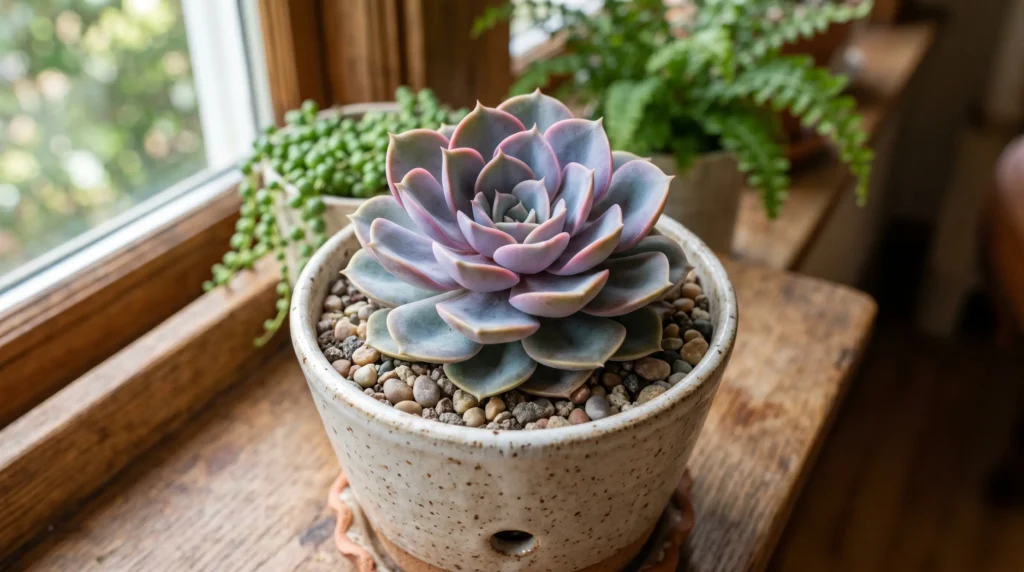
| Unglazed terracotta | Best | Porous walls allow moisture to evaporate through the sides; dramatically reduces rot risk in UK humidity |
| Glazed ceramic with drainage | Acceptable | Drainage holes are essential; glazed walls retain more moisture |
| Glazed ceramic without drainage | Avoid | No drainage = root rot; the most common cause of beginner failure |
| Plastic pot with drainage holes | Acceptable | Budget option; correct drainage makes it workable |
| Glass containers / terrariums | Avoid | No drainage; unsuitable for succulents |
| Metal / tin containers | Avoid | Overheats in sun; prone to rust affecting roots |
Pot sizing rule: Use a pot only 1–2cm wider than the plant’s rootball. Over-potting leaves excess damp compost around the roots, which dramatically increases rot risk in UK conditions.
Feeding
When to feed succulents in the UK:
- Feed only during the growing season: April to September
- Frequency: once per month at half the manufacturer’s recommended dose
- Stop feeding entirely from October — autumn feeding encourages soft, weak growth vulnerable to cold damage
What fertiliser to use:
- Low-nitrogen liquid fertiliser (high nitrogen = excessive soft growth prone to pests and cold damage)
- Tomato feed (potassium-rich) works well as a cost-effective alternative
- Specialist cactus and succulent feed is ideal if available
Repotting
When to repot: Spring (March to April), just as new growth begins and light levels improve. Avoid repotting in winter when plants are dormant and most vulnerable to stress.
Signs your succulent needs repotting:
- Roots growing out of drainage holes
- Plant visibly lifting out of the compost (root-bound)
- Compost breaking down and becoming dense or hydrophobic
How to Repot a Succulent (Step-by-Step)
- Water the plant lightly 24 hours before repotting to ease removal
- Gently remove the plant from its pot; loosen roots carefully by hand
- Shake off old compost; inspect roots — trim any that are brown, mushy, or dead with clean scissors
- Place a layer of horticultural grit (2cm) at the base of the new pot
- Half-fill with fresh John Innes No. 2 + grit mix
- Position the plant centrally at the same depth as before
- Fill around the roots with fresh mix; firm gently
- Top-dress with a thin layer of horticultural grit
- Do not water for 5–7 days — this encourages roots to grow outward in search of moisture
Outdoor Growing in the UK
Choosing Your Outdoor Site
The gold standard: A south-facing wall provides two advantages simultaneously — maximum sun exposure and thermal mass (the wall absorbs heat during the day and releases it overnight, raising the microclimate temperature by 2–3°C).
Site checklist for outdoor succulents:
- South or south-west facing aspect
- Freely-draining soil or raised bed
- Sheltered from prevailing westerly wind (especially for tender varieties)
- Not in a frost pocket (low-lying areas where cold air collects)
- Not under deciduous trees that will drop moisture-retaining leaves onto the plants
Preparing the Ground for Outdoor Succulent plants
For well-draining existing soil: Dig in 30–50% horticultural grit by volume and plant directly.
For clay or heavy soil: Do not attempt to amend clay for succulents — build a raised bed instead. A 20–30cm raised bed filled with 50:50 John Innes No. 2 and horticultural grit gives succulents a permanently free-draining root environment regardless of the soil below.
Gravel mulch: Apply 2–3cm of horticultural grit around all outdoor succulents. This deflects rain splash, reduces humidity at soil level, and prevents the cold, wet conditions that cause crown rot.
Winter Protection for Outdoor Succulent plants
| Hardiness Type | Examples | Protection Needed |
|---|---|---|
| Hardy (H5–H7) | Sempervivum, Sedum, some Delosperma | None — reduce watering, ensure excellent drainage |
| Half-hardy (H3–H4) | Aeonium, some Echeveria | Horticultural fleece from November; or bring containers indoors |
| Tender (H1–H2) | Most Echeveria, Aloe vera, Kalanchoe | Must come indoors before first frost |
The cloche method: A polycarbonate cloche or section of bubble wrap secured over a planted succulent keeps off wet just as effectively as it keeps off cold — and in UK conditions, the wet is often the greater threat. Leave air gaps to prevent condensation building up inside.
RHS-aligned autumn maintenance: Remove fallen leaves and debris from around succulent bases in autumn — accumulated wet leaf matter is a primary cause of fungal rot at the crown.
Container Displays for UK Outdoor Growing
Outdoor container principles:
- Use terracotta or stone containers (weight provides stability in wind; terracotta is frost-hardy to H5)
- Lift containers on feet or bricks to prevent waterlogging of the base drainage holes
- For winter interest: Sempervivum continues to colour through the coldest months
A failsafe UK patio combination:
Sempervivum (multiple cultivars for colour variation) + Sedum spathulifolium + low-growing thyme = a fully self-managing, year-round container requiring almost no maintenance.
Propagation
What is Succulent plants Propagation?
Succulent propagation is the process of producing new plants from a parent plant using leaves, stem cuttings, or naturally produced offsets. Succulents are among the easiest plants to propagate at home, requiring only minimal equipment.
Best propagation window for UK growers: April to early July. Low light and cold from November to February dramatically reduce success rates. Growing under an LED propagation light extends the window for enthusiasts.
Leaf Propagation (Echeveria, Sedum, some Crassula)
How to propagate succulents from leaves (Step-by-Step):
- Select a healthy, plump leaf from the lower part of the stem
- Grip the leaf firmly and twist gently from side to side until it separates cleanly from the stem — do not cut; a clean twist-separation is essential
- Allow the cut end of the leaf to callous over (dry and seal) for 2–3 days in a warm, dry location away from direct sun — skipping this step causes rot
- Lay the calloused leaves on the surface of dry gritty compost — do not bury or push in; simply lay flat
- Mist lightly with a spray bottle every 2–3 days; do not soak
- Tiny rosettes and roots will form at the cut end within 3–8 weeks
- Once the parent leaf has shrivelled fully, pot the new plantlet individually
Stem Cuttings (Jade Plant, Aeonium, Echeveria)
How to propagate succulents from stem cuttings (Step-by-Step):
- Using a clean, sharp knife or scissors sterilised with isopropyl alcohol, cut a healthy stem just below a node (a point where leaves emerge)
- Remove the lower leaves to expose 2–3cm of clean stem
- Allow the cut end to callous for 2–5 days in a warm, dry location
- Insert the calloused cutting into barely moist gritty compost
- Do not water for the first 5–7 days — roots form in search of moisture; early watering delays root formation
- Begin normal watering once the cutting shows resistance when gently tugged (roots established)
Offsets / Pups (Aloe vera, Sempervivum, Agave)
What are offsets? Offsets (also called “pups” or “chicks”) are smaller plants produced vegetatively by a parent succulent. This is the most reliable propagation method for UK growers.
How to propagate using offsets:
- Wait until the offset has developed its own visible root system
- Using a clean sharp knife, detach the offset from the parent plant at the connecting stem
- Allow to callous briefly (24 hours) if the connection point was large
- Pot immediately into individual containers with gritty compost mix
- Water sparingly for the first two weeks while the root system establishes
Pests, Diseases and Common UK Problems
The Most Common UK Problem: Overwatering
Symptoms of overwatering:
- Leaves become soft, translucent, and mushy
- Yellowing or see-through quality to previously firm leaves
- Wilting despite moist compost (counterintuitive but diagnostic)
- Foul smell from the base of the plant
How to rescue an overwatered succulent:
- Remove the plant from its pot immediately
- Gently clear away all compost from the roots
- Allow the root system to air-dry for 24–48 hours
- Trim away any brown, mushy, or foul-smelling roots with clean scissors
- Repot into fresh, dry gritty compost
- Do not water for one week; then resume on a cautious schedule
Pest Identification and Treatment Table
| Pest | Appearance | Damage Caused | UK Treatment |
|---|---|---|---|
| Mealybugs | White fluffy cottony deposits in leaf joints | Sticky honeydew residue; weakened growth | 70% isopropyl alcohol on cotton bud applied directly; follow with neem oil spray |
| Vine Weevil | White C-shaped grubs in the compost | Eat roots; plant suddenly collapses | Biological control — Steinernema nematodes, available from UK garden centres spring/autumn |
| Fungus Gnats | Tiny flies hovering around the compost surface | Larvae damage roots in wet compost | Allow compost to dry completely; yellow sticky traps; top-dress with horticultural grit |
| Scale Insects | Flat brown bumps attached to stems | Sap-sucking; stunted, yellowing growth | Scrape off mechanically; treat with neem oil |
| Aphids | Green or black clusters on new growth | Distorted and curled new growth | Blast off with a strong jet of water; insecticidal soap spray |
Disease and Environmental Problems
Botrytis (Grey Mould): A greyish-brown fuzzy mould caused by UK damp conditions and poor air circulation. Remove all affected plant material with clean scissors; improve airflow around plants; avoid overhead watering.
Root Rot (Erwinia / Fusarium): Caused by overwatering combined with cold. Prevention through seasonal watering discipline and well-draining compost is essential — by the time symptoms appear, the plant is often beyond saving.
Etiolation (Leggy Stretching): The most visible winter problem in UK homes. Move the plant to the brightest available position or supplement with a grow light. Etiolated growth cannot reverse, but new growth will be compact once light improves.
Hard Water Deposits: White mineral crust on leaves — characteristic of SE England’s hard water. Purely cosmetic. Wipe off with a damp cloth. Does not harm the plant.
Styling Succulent plants as Living Art (2026)
The 2026 Interior Trend: Succulents as Living Sculpture
Interior designers in 2026 are treating succulents as architectural objects, not houseplant accessories. The shift is from “collection of small pots on a windowsill” to statement specimens in considered vessels, chosen and placed as deliberately as artwork.
The defining characteristics of the 2026 approach:
- Oversized single specimens as room focal points
- Mono-genus groupings in coordinated vessels of varying height
- Architectural varieties (Agave, Aloe, tall Aeonium) used as floor plants
- Restraint in number; generosity in pot quality
Interior Styling Ideas for UK Homes
The statement specimen: A single large Aeonium ‘Zwartkop’ or tall Aloe in a cast concrete or slate-grey planter against a white wall. Minimal, architectural, and completely low-maintenance once positioned at a bright south-facing window.
The curated collection: Five to seven Echeveria of different varieties in terracotta pots of graduating sizes, arranged on a tray of horticultural sand. Creates a Mediterranean aesthetic requiring nothing more than monthly watering.
The trailing shelf: String of Pearls or Burro’s Tail (Sedum morganianum) in hanging terracotta pots suspended at ceiling height from a south-facing window — maximises the light they need while creating a dramatic cascading effect.
The living trough: An outdoor stone trough planted with twelve or more Sempervivum cultivars in contrasting colours — near-black, silver, burgundy, lime — creates a living mosaic that maintains visual interest year-round and requires almost zero maintenance.
Living walls: Vertical planting frames filled with Sempervivum, Sedum, and low Echeveria are increasingly seen in UK urban gardens and roof terraces. Sempervivum roots shallowly and tolerates the restricted depth of vertical planters extremely well.
Pot Pairing Guide
| Succulent Style | Best Pot Material | Colour Palette |
|---|---|---|
| Rosette types (Echeveria, Sempervivum) | Unglazed terracotta, reconstituted stone | Earth tones, dusty clay, white |
| Architectural (Agave, tall Aloe) | Cast concrete, slate, dark ceramic | Charcoal, slate grey, matte black |
| Trailing (String of Pearls, Burro’s Tail) | Terracotta hanging pot | Natural clay, copper hanger hardware |
| Hardy outdoor (Sempervivum in troughs) | Old stone, hypertufa (DIY lightweight trough) | Mossy stone, weathered natural |
Where to Buy Succulent plants in the UK
UK Specialist Nurseries — Best Quality
Why buy from UK specialist nurseries? British-grown succulents arrive acclimatised to UK light levels and are sold in the correct compost for British conditions. Mass-market imports from the Netherlands and elsewhere frequently arrive in moisture-retaining growing media unsuitable for UK home growing — and often show signs of poor light adaptation.
Recommended UK specialist nurseries:
- Surreal Succulents (Cornwall) — Multiple RHS Gold Medal winners; specialist in Aeonium hybrids and rare varieties; ships UK-wide. RHS Gold, Chelsea Flower Show 2025.
- Southwold Succulent Co. (Suffolk) — British-grown plants in correct compost; particularly good range of hardy outdoor varieties.
- Ottershaw Cacti (Surrey) — 40+ years’ experience; RHS Gold Medal winner; exceptionally wide genus range including rare collector specimens.
- Piccolo Plant Nursery — RHS award winners; strong selection of UK-adapted varieties.
Garden Centres and Retail Stores
| Retailer | Quality | Notes |
|---|---|---|
| Dobbies / Notcutts / RHS Garden Centres | Good | Trained staff; look for RHS-recommended labelling |
| B&Q / Homebase | Variable | Often in inappropriate compost — repot immediately on purchase into gritty mix |
| Aldi / Lidl (seasonal) | Excellent value | Echeveria, Sempervivum and Aloe appear in spring; snap them up — good quality at low cost |
| Supermarkets | Limited range | Useful for gifting; treat as decorative unless you repot into correct compost |
Buying Online in the UK
- Prioritise sellers stating “UK grown” or “acclimatised to UK conditions”
- Check for European import disclaimers — these plants often need immediate repotting
- The RHS Find a Plant tool (available at rhs.org.uk) is an excellent free resource for sourcing specific varieties from UK nurseries
- Check seller reviews specifically for packaging quality — succulents must be packed firmly to prevent compost disturbance in transit
What to Check When Buying Any Succulent plants
- Leaves — firm and plump, not wrinkled, soft, or translucent
- Base and stem — no soft or discoloured areas at soil level (early rot indicator)
- Leaf joints — no white fluffy deposits (mealybug) or brown flat bumps (scale)
- Overall form — compact and symmetrical, not leggy or stretched (etiolated plants from poor retail conditions can take months to recover)
- Pot base — check for healthy white or cream roots; brown mushy roots indicate overwatering in retail conditions
Frequently Asked Questions
These answers are written as self-contained featured snippet targets — concise, factual, and UK-specific.
Q: Can succulent plants survive UK winters outdoors?
Yes — but only the hardiest varieties. The species that reliably survive UK winters outdoors include Sempervivum (houseleeks, RHS H7), Sedum (stonecrop, H5–H7), and some Delosperma (Ice Plant, H4–H5). The critical factor is drainage, not temperature tolerance — most UK outdoor succulent losses in winter are caused by waterlogged soil rather than frost. Tender varieties including Echeveria, Aloe vera, and Kalanchoe must be brought indoors before the first frost.
Q: How often should I water succulent plants in the UK?
Water frequency depends on the season. In summer (June–August), water indoor succulents every 7–14 days using the soak-and-dry method. In winter (November–February), reduce watering to once every 3–6 weeks or less. Outdoor hardy succulents need virtually no watering from October to March. The most common UK mistake is watering too frequently during the cool, low-light winter months, which causes root rot.
Q: What is the best compost for succulent plants in the UK?
The best UK mix is John Innes No. 2 combined 50:50 with coarse horticultural grit or perlite. This combination is peat-free, widely available in UK garden centres, and provides the sharp drainage essential in the UK’s wet climate. Standard multipurpose compost — including peat-free multipurpose — retains too much moisture and should not be used alone for succulents.
Q: Are succulent plants toxic to cats and dogs?
Most succulents are non-toxic to pets, but several common UK varieties are harmful. Kalanchoe can cause vomiting, lethargy, and heart problems in cats and dogs. Euphorbia species produce a white latex sap that is toxic and irritating to skin and mucous membranes. Aloe vera is mildly toxic to pets if ingested. Always check the toxicity of individual species before buying if you have pets — the RSPCA website provides guidance on specific species.
Q: Why is my succulent plants dying?
The most common causes of succulent death in the UK are: (1) Overwatering — particularly in winter — produces soft, mushy, yellowing leaves and mushy stems; (2) Insufficient light — causes pale, leggy, stretched growth (etiolation); (3) Incorrect compost — moisture-retaining mixes cause root rot in UK conditions; (4) Cold damage combined with wet soil — the most dangerous combination in British winters. If the roots are brown and mushy when you remove the plant from its pot, root rot from overwatering is the most likely cause.
Q: When is the best time to repot succulent plants in the UK?
Spring — specifically March to April — is the optimal repotting window in the UK. This coincides with the beginning of the growing season, when light levels improve and new root growth is beginning. Avoid repotting in winter when plants are dormant and most vulnerable to disturbance stress.
Q: Can succulent plants grow in a north-facing UK room?
Most succulents cannot thrive in a north-facing room. The exceptions are Haworthia and Gasteria, which are genuinely low-light tolerant and make excellent choices for darker UK rooms, desks, and offices. All other succulent genera will etiolate (stretch and weaken) without adequate light.
Q: What is the difference between a succulent plants and a cactus?
All cacti are succulents, but not all succulents are cacti. The defining feature of a cactus is the areole — a specialised, cushion-like structure unique to the cactus family (Cactaceae) from which spines, flowers, and new growth emerge. No other plant family has areoles. If a spiny or fleshy plant has areoles, it is a cactus. All other water-storing plants are succulents but not cacti.
Conclusion: Growing Succulent plants in the UK — The Three Rules
Growing succulents successfully in the UK is entirely achievable once you adapt your approach to British conditions. The plants themselves are not difficult — the difficulty comes from applying advice written for hotter, drier climates to our grey, damp islands.
The three rules that govern everything:
- Drainage is non-negotiable — wet kills faster than cold in the UK; if in doubt, add more grit
- Water on a seasonal schedule, not a regular one — dramatically reduce watering from October to March
- Choose your variety for your conditions, not your wishlist — a Haworthia on a north-facing windowsill will outperform a struggling Echeveria every time
For enthusiasts: The British Cactus and Succulent Society (BCSS) has over 70 branches across the UK and holds monthly meetings with decades of accumulated UK-specific growing knowledge. It is the best single next step for anyone moving beyond the beginner stage.
Related guides: How to Water Succulents in the UK (Seasonal Guide) | Best Peat-Free Compost for Succulents UK | Hardy Succulents for UK Gardens: Top 10 | Succulent Winter Care UK | How to Propagate Succulents UK | Where to Buy Succulents UK: Specialist Nurseries Reviewed
Schema Markup Notes for Implementation:
- Apply
FAQPageschema to Part 10 Q&A blocks - Apply
HowToschema to Step-by-Step propagation sections (Parts 6.1, 6.2, 6.3) and Repotting steps (Part 4.5) - Apply
Articleschema to full document with author, datePublished, and publisher properties - Apply
Tablemarkup to all comparison tables for enhanced SERP visibility

Leave a Reply