
Quick-Reference Fact File
What Is a Japanese Maple?
Definition, origins and why the UK climate suits them surprisingly well.
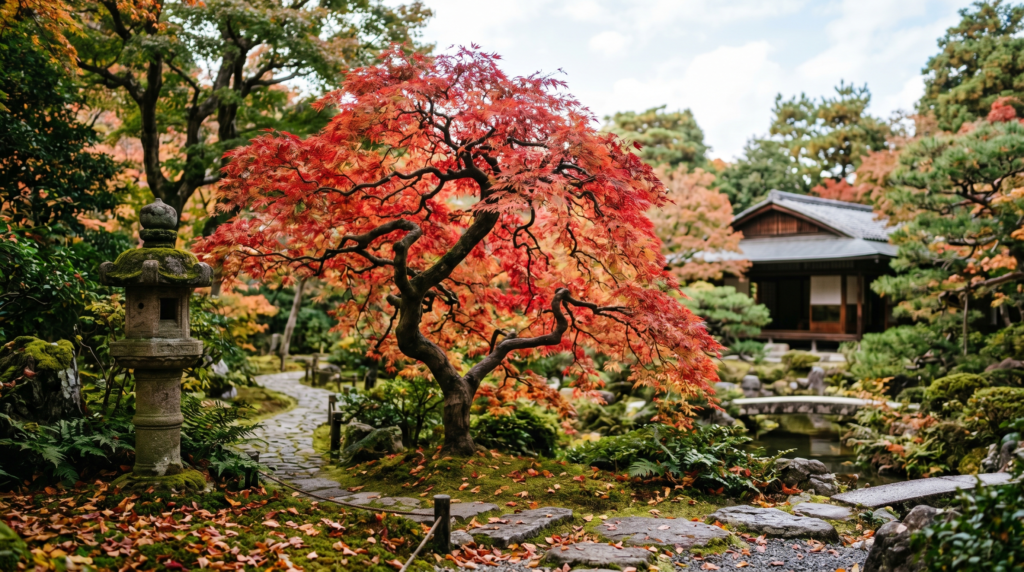
Botanical Background and UK Name
When UK gardeners say “acer,” they almost always mean Acer Palmatum — the Japanese maple. The word Palmatum means “shaped like a hand,” describing the deeply lobed leaf that is the species’ most recognizable feature. Strictly speaking, the term “Japanese maple” covers three closely related species:
- Acer Palmatum — the most common; the parent of the vast majority of cultivars sold in the UK.
- Acer japonicum — the full moon maple; rounder, broader leaves; slightly more shade-tolerant.
- Acer Shirasawanum — less common; notable for golden-foliaged forms such as ‘aureum’.
In Japan, the autumn ritual of travelling to view maple color is called Momiji (紅葉) — a cultural tradition that speaks to the deep emotional resonance of this tree. It was introduced to European gardens in the late 18th century and quickly became a favorite of British gardeners.
How Japanese Maples Fit UK Gardens
Japan’s native maple habitat — cool, moist, partially shaded woodland fringes — maps remarkably well onto the British garden. Our climate has a significant advantage: cool summers mean leaf color holds longer and burns less than in hotter climates. The characteristic red and purple foliage of varieties like ‘Bloodgood’ stays vibrant from April to October in the UK; the same tree in Southern Europe would fade to bronze-green by July.
Cool British summers are actually an asset for Japanese maples. The moderate temperatures prevent the leaf scorch and color fade that afflict these trees in hotter, drier climates — making the UK one of the best places in the world to grow them outside their native range.
Natural woodland garden settings — dappled shade beneath a canopy of larger trees — replicate the maple’s native habitat almost perfectly. Even without an established woodland, a sheltered border with morning sun and afternoon shade in a typical UK back garden closely mimics ideal conditions.
Japanese Maple Varieties: Which One Is Right for Your UK Garden?
The most comprehensive UK variety guide available — 20 profiles with UK-specific performance notes.
Understanding the Main Groups
Before choosing a specific cultivar, understanding the three main species groups will help you match the right plant to your garden:
| Group | Leaves | Typical Size | Key Characteristic | UK Availability |
|---|---|---|---|---|
| Acer Palmatum | Deeply lobed, palmate | Variable (0.5–8m) | Largest group; hundreds of cultivars | Excellent |
| Acer japonicum | Broader, less deeply cut | 3–8m | Outstanding autumn color; shade tolerant | Moderate |
| Acer Shirasawanum | Round, fan-like | 2–4m | Notable golden forms; quieter habit | Specialist |
Within Acer Palmatum, three sub-groups describe the leaf form:
- Palmate (standard lobed): The classic maple leaf shape — 5–9 deeply cut lobes.
- Dissectum (laceleaf / feathery): Leaves are further sub-divided into narrow, feather-like lobes; creates a soft, lacy texture. Always weeping in habit.
- Linearilobum (strap-leaved): Very narrow, strap-like lobes; creates an unusual spidery effect — less commonly grown.
The 20 Best Japanese Maple Varieties for UK Gardens
Red & Purple Foliage — Spring to Autumn
Green-Leaved Upright Varieties
Golden & Yellow-Toned Varieties
Dwarf & Ultra-Compact Varieties
Quick Variety Comparison Table
| Variety | Colour | UK Height | Best Use | RHS AGM | Top Trait |
|---|---|---|---|---|---|
| Bloodgood | Red-purple → scarlet | 4–5 m | Specimen tree | Yes | Reliable colour retention |
| Garnet | Deep red laceleaf | 1.5–2 m | Container / border | Yes | Best all-round dissectum |
| Osakazuki | Green → scarlet autumn | 4–6 m | Autumn colour | Yes | Finest autumn display |
| Sango Kaku | Green / coral bark | 4–6 m | Winter interest | Yes | Year-round appeal |
| Aureum | Soft gold all season | 2–3 m | Shady border | Yes | Best gold for shade |
| Emperor I | Deep red | 4–5 m | Northern UK gardens | No | Late bud break — frost-wise |
| Shaina | Red compact globe | 1–1.5 m | Formal containers | No | No pruning needed |
| Tamukeyama | Deep red-purple | 1.5–2 m | Exposed sites | No | Hardiest dissectum |
| Little Princess | Green → yellow | 0.5–1 m | Tiny spaces, bonsai | No | Smallest UK maple |
| Orange Dream | Orange-yellow → gold | 2–3 m | Three-season colour | Yes | Three-season colour |
The Perfect Position: Siting a Japanese Maple in Your UK Garden
Where you plant your Japanese maple matters more than almost any other decision. Get this right and the tree will thrive for decades.
Light Requirements by Variety Type
| Variety Type | Sun Requirement | UK Notes |
|---|---|---|
| Red & purple (e.g. Bloodgood, Garnet) | Min. 3–4 hours direct sun | Color fades without adequate light; don’t plant in deep shade |
| Green-leaved (e.g. Osakazuki, Viridis) | Dappled to partial shade | Viridis thrives even in north-facing aspects |
| Variegated (e.g. Butterfly, Ukigumo) | Bright indirect / dappled | Most sensitive; afternoon sun causes margin scorch |
| Golden (e.g. Aureum, Orange Dream) | Partial shade essential | Direct afternoon sun causes bleaching and scorch |
Wind Protection — The Critical Factor
In many UK gardens, wind protection is more important than light. Japanese maples — especially the finely cut dissectum forms — are extremely susceptible to wind scorch, which causes the leaf edges to dry and brown, ruining the foliage display for the entire season.
- Coastal gardens: Salt-laden wind is doubly damaging. Use dense windbreak planting or solid fencing before introducing a Japanese maple.
- Exposed hillsides: Avoid unless you can create a sheltered microclimate.
- Corridor sites: Gaps between buildings that funnel wind can be more damaging than a fully open site.
- Frost pockets in valleys: Cold air sinks and collects in low-lying areas. Avoid planting in visible dips or hollows.
Dissectum (laceleaf) varieties are particularly vulnerable to wind scorch. Their fine, feathery leaves have a large surface area-to-mass ratio that desiccates rapidly in drying winds. Always give dissectums the most sheltered position available.
Late Spring Frosts — The UK Grower’s Primary Threat
UK late frosts in April and May are the single greatest risk to Japanese maples. The trees themselves are fully hardy, but the soft new spring growth that emerges in April can be killed overnight by a sharp frost, leaving the tree looking damaged for the entire season. Varieties that break bud early (such as ‘Beni Maiko’) are most at risk; later-breaking varieties (‘Emperor I’) are a safer bet for frost-prone sites.
How to protect: Drape horticultural fleece loosely over the tree on forecast frost nights. A position near a south- or west-facing wall provides residual warmth that can make the difference. Raised beds warm faster than open ground and are worth considering in frost-hollow gardens.
Regional UK Planting Advice
Best UK conditions. Can handle more afternoon sun than elsewhere. City heat islands are a genuine benefit — extend the growing season and reduce hard frost frequency. South West
Generally excellent. Atlantic wind is the primary challenge. Coastal exposure needs managing with windbreaks before planting. Frost risk is lower than elsewhere.
Good conditions. Late frosts are more of a concern than in the South. Shelter from prevailing winds important. Avoid frost pockets in valley gardens.
Achievable with care. Winter cold is tolerated. Site near a warm wall; choose late-budding, hardy cultivars: Emperor I, Tamukeyama, Bloodgood.
Achievable with careful variety selection. West coast warmer and wetter — more suitable than east. Fleece young trees in first two winters. Stick to the hardiest cultivars.
Generally good. Western areas experience more wind — manage with planting belts or solid fencing. Eastern Wales closer to Midlands conditions.
Soil Preparation and Planting Your Japanese Maple
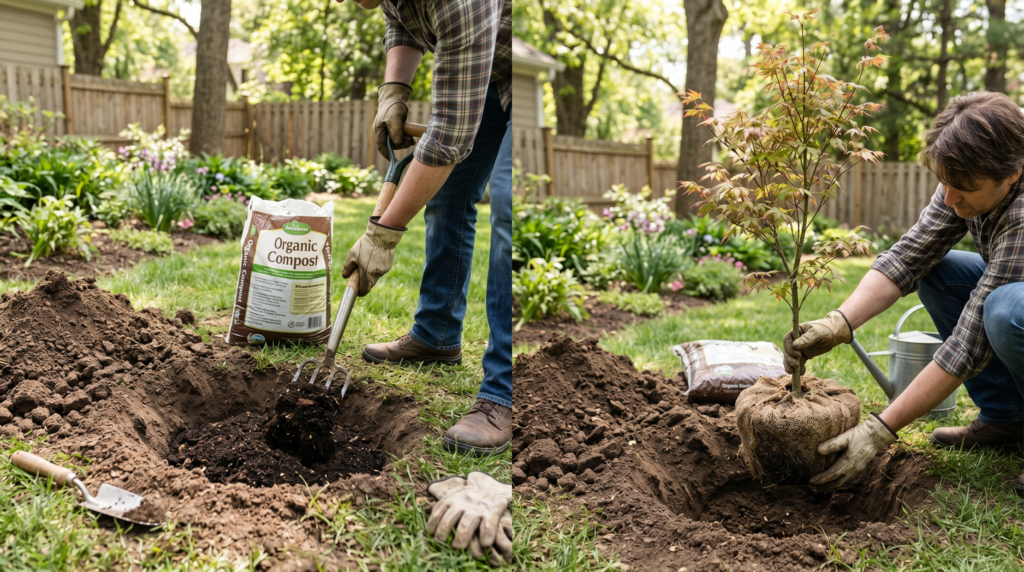
How to prepare the soil, when to plant, and a step-by-step guide for both in-ground and container planting.
What Is the Ideal Soil for a Japanese Maple?
| Soil Type | Challenge | UK Solution |
|---|---|---|
| Clay (common in London, Midlands) | Poor drainage; compaction | Add horticultural grit; raise bed; improve with organic matter |
| Chalky / alkaline (pH >6.5) | Iron/manganese lockout → chlorosis | Grow in containers of ericaceous compost; annual acidifying treatment |
| Sandy / free-draining | Dries out; poor nutrients | Add ericaceous compost; mulch generously
Report
|
