
Picture this: you want a striking, floor-standing plant for your living room corner. Something architectural. Something that doesn’t demand daily attention — because between work, commuting, and British weather, you’ve got enough on.
You’ve seen it in every stylish flat on Instagram, standing tall in hotel lobbies and estate agents’ windows alike. You want that plant.That plant is the large snake plant (Dracaena trifasciata, formerly Sansevieria) — and if you’re based in the UK, it might just be the most perfectly suited indoor plant you can own.
Snake plants consistently exceed 40,000 monthly searches in the UK, making them one of the country’s most sought-after houseplants. In 2025, Sansevieria remains among the most popular indoor plants for their low maintenance needs and tolerance to varying temperatures — qualities that align perfectly with the realities of British home life: low winter light, central heating, and not always being home to water your plants.
But here’s what most guides don’t tell you: not all snake plants are equal. The compact Bird’s Nest variety (Hahnii) that sits on your desk is a very different proposition from a 120cm Laurentii commanding an entire corner of your living room. This guide is specifically about the large snake plant — floor-standing specimens that start at 60cm and can reach well over a metre in UK homes.
What You’ll Find in This Guide
This is the most comprehensive large snake plant resource written specifically for UK plant owners. You’ll find:
- Exact definitions — what “large” means, why the botanical name changed, and what you’ll see on labels in UK garden centres
- A complete variety comparison — the 7 best large varieties available in the UK, with real indoor height data
- A UK-specific seasonal care calendar — because care advice written for US or tropical climates doesn’t account for British winters
- Step-by-step repotting and propagation — including the one critical mistake UK Laurentii owners make when propagating
- A troubleshooting table — every symptom, cause, and fix in one place
- Where to buy — with a 2025 UK price guide comparing online retailers and garden centres
Let’s start with the most important question.
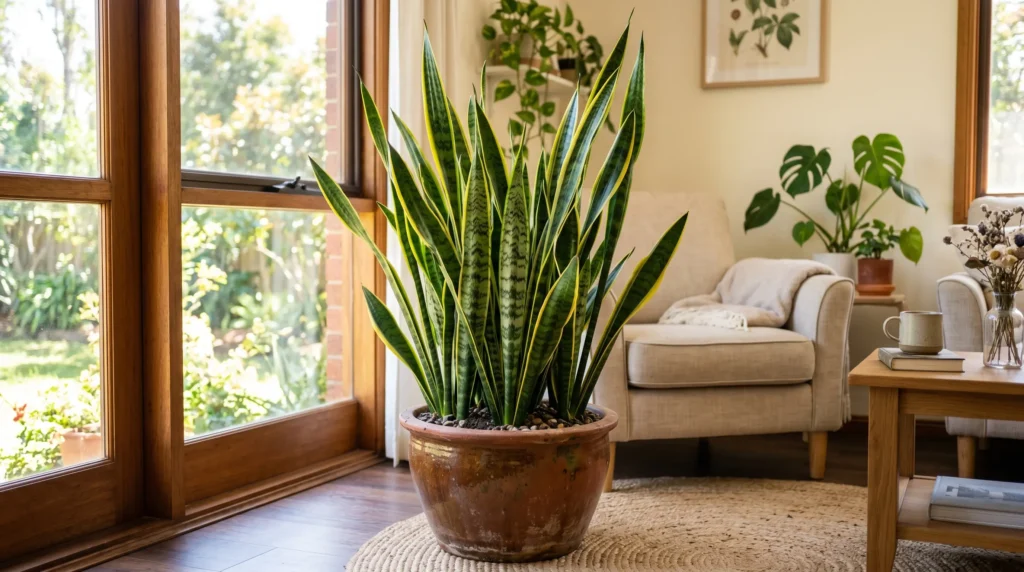
What Is a Large Snake Plant? {#what-is-a-large-snake-plant}
Definition: A large snake plant is any floor-standing specimen of the Dracaena trifasciata species (or closely related Sansevieria genus members) that reaches 60cm or taller at maturity indoors. They are characterised by stiff, upright sword-shaped leaves, extreme drought tolerance, and the ability to thrive in UK indoor conditions year-round.
Botanical Background & Origins {#botanical-background}
What is the scientific name of the snake plant?
The snake plant’s current accepted scientific name is Dracaena trifasciata (N.E.Br.) Byng & Christenh. It belongs to the family Asparagaceae — the same family as asparagus and garden hyacinths, which surprises most people.
Where does the snake plant come from?
Snake plants are native to West and South Africa, specifically to countries including Nigeria, the Democratic Republic of Congo, and parts of East Africa. In their natural habitat, they grow in:
- Rocky, arid hillsides
- Open dry forests
- Coastal scrubland with poor, sandy soil
This origin story matters enormously for UK plant care. A plant evolved to survive drought, poor soil, and intense heat will obviously be very tolerant of neglect, central heating, and irregular watering — exactly the conditions in the average British home.
What are the common names for snake plants in the UK?
In the UK, large snake plants are sold under several names:
| Common Name | Notes |
|---|---|
| Snake Plant | Most widely used name; used across all UK retailers |
| Mother-in-Law’s Tongue | Traditional UK name, especially for Laurentii variety |
| Sansevieria | Old botanical genus name, still widely used in shops |
| Saint George’s Sword | Less common; used in Brazil and Portugal |
| Viper’s Bowstring Hemp | Rarely used in UK retail |
Buyer’s Tip: In UK garden centres and online shops, you’ll see both “Sansevieria” and “Dracaena” on the label for the same plant. They are the same thing. See the name change explanation below.
The Name Change: Sansevieria vs Dracaena — What UK Buyers Need to Know {#the-name-change}
Why do snake plants have two scientific names?
In 2017, an extensive genetic study published in taxonomic literature reclassified the entire Sansevieria genus into the broader Dracaena genus. The change became widely adopted by 2021. The reason: DNA analysis showed that Sansevierias are genetically so closely related to Dracaenas that keeping them as a separate genus was scientifically inaccurate.
Does the name change affect the plant itself?
No. The plant is identical. The reclassification is purely taxonomic (scientific naming). The care requirements, growth habits, and appearance have not changed.
What will I see on the label in a UK shop?
This is where it gets confusing for UK buyers:
| What You See on the Label | What It Means |
|---|---|
| Sansevieria trifasciata ‘Laurentii’ | Old name — still the most common label in UK shops |
| Dracaena trifasciata ‘Laurentii’ | Correct current name — increasingly used by specialist retailers |
| Mother-in-Law’s Tongue / Snake Plant | Common name — could be any variety |
| Sansevieria (no species) | May be any of 60+ species |
Key Takeaway: Whether a UK label says Sansevieria or Dracaena — it’s the same plant. Don’t let the inconsistency put you off or make you think you’re buying something different.
CAM Photosynthesis — The Snake Plant’s Superpower
What makes the snake plant different from other houseplants?
Most houseplants photosynthesize the same way: they open their leaf pores (stomata) during the day to take in CO₂ and release oxygen, then close them at night.
The snake plant uses a different process called CAM photosynthesis (Crassulacean Acid Metabolism):
| Feature | Typical Houseplant | Snake Plant (CAM) |
|---|---|---|
| Stomata open | Daytime | Nighttime |
| CO₂ absorbed | Day | Night |
| Oxygen released | Day | Night |
| Water loss | Higher | Minimal |
Why does CAM photosynthesis matter for UK plant owners?
Two reasons:
- It makes snake plants exceptionally drought-tolerant. By keeping stomata closed during the day, the plant loses very little water through transpiration — perfect for UK owners who travel or forget to water.
- It makes snake plants ideal bedroom plants. Because they release oxygen at night (unlike most plants, which release CO₂), they are one of very few houseplants that genuinely improve bedroom air quality while you sleep.
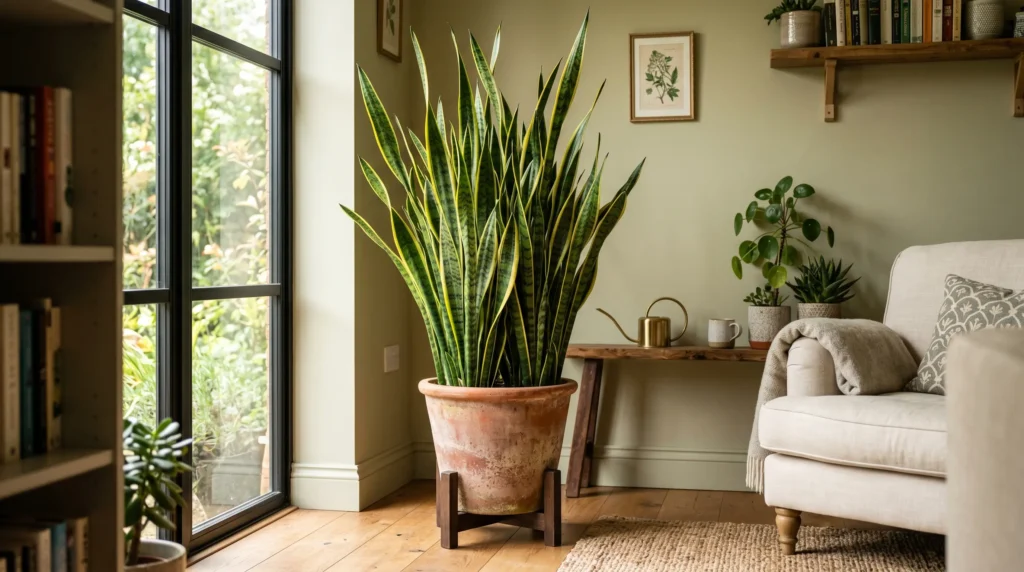
What Counts as a “Large” Snake Plant? {#what-counts-as-large}
Definition: A large snake plant is generally considered any specimen 60cm (approximately 2 feet) or taller. In the UK retail market, “large” plants are typically sold in 17cm pots or bigger and are intended as floor-standing statement plants rather than shelf or desk plants.
The Snake Plant Size Spectrum
Understanding the full size range helps you shop more confidently — and choose the right variety for your space.
| Size Category | Height Range | Typical Pot Size | Best Placed On | Example Variety |
|---|---|---|---|---|
| Mini / Compact | Up to 25cm | 6–9cm pot | Desk, windowsill, shelf | Hahnii (Bird’s Nest) |
| Medium | 25–60cm | 12–14cm pot | Shelf, side table | Hahnii ‘Golden’, small Zeylanica |
| Large | 60–90cm | 17–21cm pot | Floor, plant stand | Zeylanica, Laurentii (young) |
| Extra Large / Tall | 90–150cm | 21–27cm pot | Floor corner, hallway | Laurentii (mature), Cylindrica |
| Statement / Giant | 150cm+ | 27cm+ pot | Large rooms, commercial spaces | Masoniana (Whale Fin), Cylindrica |
Why Buy Large Rather Than Growing from Small?
This is one of the most practical decisions a UK plant buyer can make. Here’s the honest comparison:
Pros of Buying a Large Specimen Directly:
- Immediate visual impact — no years of waiting
- Mature root system — more resilient and forgiving
- Established form — you know exactly what you’re getting
- Already past the vulnerable young plant stage
Cons of Buying a Large Specimen:
- Higher upfront cost (see price guide later in this guide)
- Heavier and more difficult to transport
- Requires a suitably heavy pot to avoid tipping
Pros of Starting Small and Growing:
- Lower cost
- Satisfying to watch grow over years
Cons of Starting Small and Growing:
- Snake plants are slow growers — typically only 4–10cm per year under UK indoor conditions
- A 10cm starter plant could take 5–10 years to reach 90cm
RHS Recommendation: The Royal Horticultural Society advises: “Although long-lived, these are relatively slow-growing plants. So if you want a plant with instant impact, it’s best to invest in a larger specimen at the start.”
Why Large Snake Plants Are Perfectly Suited to UK Homes {#why-uk-homes}
Most houseplant care guides are written with tropical climates or US growing conditions in mind. The large snake plant is one of the very few where UK-specific conditions are actually advantages, not disadvantages.
The UK Home Environment vs. Snake Plant Requirements
| UK Home Reality | Effect on Plants | Snake Plant Response |
|---|---|---|
| Low winter daylight (Nov–Feb) | Kills most tropical plants | Tolerates low light; simply slows growth |
| Central heating (dry, warm air) | Desiccates humidity-loving plants | Thrives — prefers dry air |
| Inconsistent watering routines | Causes root rot in thirsty plants | Survives 4–6 weeks without water |
| Cool nights / draughty rooms | Stresses tropical plants | Safe down to 10°C |
| Small flats with limited floor space | Restricts bulky or spreading plants | Upright growth uses minimal footprint |
| Busy lifestyles / frequent travel | Causes neglect | One of the most neglect-tolerant houseplants |
In 2025, the houseplant market continues to show a strong preference for plants that are low-maintenance and offer resilience across varying temperatures and light levels — and the large snake plant sits at the top of that category for UK buyers.
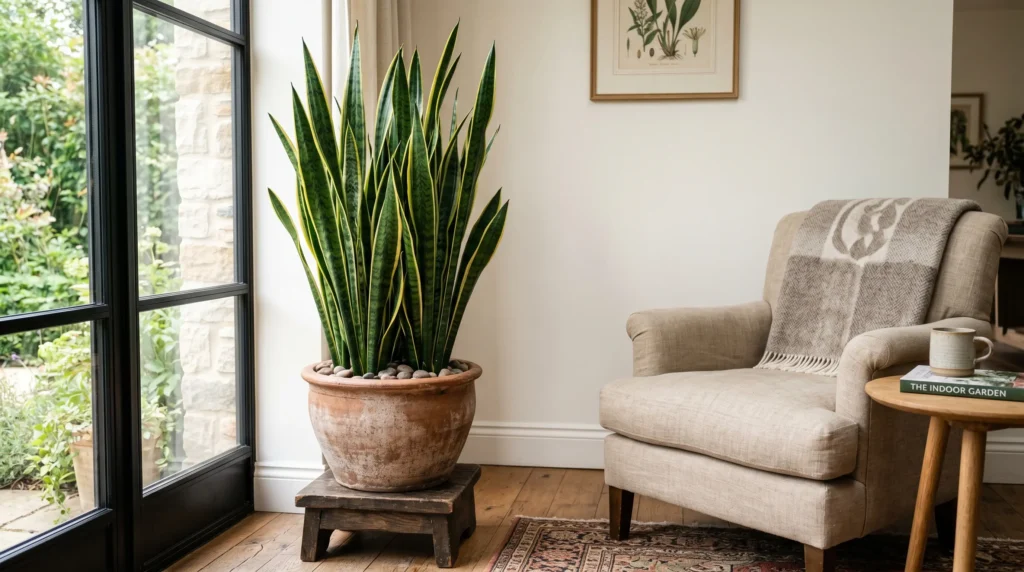
The Large Snake Plant at a Glance — Key Statistics
The global indoor plant market was valued at approximately $21 billion in 2025, with snake plants consistently ranking among the most searched and purchased varieties worldwide. In the UK specifically, snake plants consistently rank in the top five most-searched houseplants — and the large, floor-standing varieties are increasingly the first choice for buyers looking for a statement plant.
At a Glance: Large Snake Plant Key Facts {#at-a-glance}
This quick-reference box is designed as a scannable summary. AI engines and readers can extract these facts independently
LARGE SNAKE PLANT — QUICK REFERENCE (UK)
━━━━━━━━━━━━━━━━━━━━━━━━━━━━━━━━━━━━━━━━
Scientific Name:   Dracaena trifasciata (formerly Sansevieria trifasciata)
Family:            Asparagaceae
Origin:            West & South Africa (Nigeria, DRC, East Africa)
UK Common Names:   Snake Plant, Mother-in-Law's Tongue, Sansevieria
Definition of "Large": 60cm+ height (floor-standing specimens)
Typical Indoor Height (UK): 60cm–120cm (some varieties to 180cm)
Growth Rate:       Slow — approx. 4–10cm per year indoors
Photosynthesis:    CAM (releases oxygen at night)
Light Needs:       Bright indirect light preferred; tolerates low light
Watering (UK):     Every 2–3 weeks in summer; once monthly in winter
Min. Temperature:  10°C (never let it drop below this in UK winter)
Humidity:          Low — prefers dry air (ideal for centrally heated UK homes)
Soil:              Free-draining cactus/succulent mix or peat-free + perlite
Toxicity:          Mildly toxic to cats, dogs, and humans if ingested
RHS Status:        Laurentii holds RHS Award of Garden Merit (since 1993)
Lifespan:          10–25 years with proper care
━━━━━━━━━━━━━━━━━━━━━━━━━━━━━━━━━━━━━━━━
Frequently Asked Questions — Introduction {#faqs}
<!– SCHEMA: FAQPage –> <!– “@type”: “FAQPage” –>
Q: What is a large snake plant?
A: A large snake plant is a floor-standing specimen of Dracaena trifasciata (formerly Sansevieria trifasciata) that grows 60cm or taller indoors. These plants are characterised by stiff, sword-shaped upright leaves, extreme drought tolerance, and the ability to thrive in the low-light, centrally heated conditions typical of UK homes. They are commonly sold in the UK under the names “snake plant,” “mother-in-law’s tongue,” or simply “sansevieria.”
Q: Is Sansevieria and Dracaena the same plant?
A: Yes. Sansevieria was reclassified into the Dracaena genus following genetic studies, with the change widely adopted from 2021 onwards. The correct current scientific name is Dracaena trifasciata. However, UK retailers and garden centres still commonly label these plants as Sansevieria — both names refer to the same plant, and the care requirements are identical.
Q: How tall do large snake plants grow in the UK?
A: Indoors in UK conditions, most large snake plant varieties grow between 60cm and 120cm tall. Under optimal conditions (bright indirect light, proper seasonal care), a Sansevieria trifasciata ‘Laurentii’ can reach up to 120cm. The African Spear (Sansevieria cylindrica) can occasionally reach 150–180cm. Growth is slow — approximately 4–10cm per year — meaning large specimens are worth buying at size rather than growing from small plants.
Q: Why are snake plants so popular in the UK?
A: Large snake plants are particularly well-suited to UK homes for several reasons: they tolerate the low winter daylight levels (November–February) that kill many tropical houseplants; they thrive in the dry air created by central heating; they survive 4–6 weeks without watering, accommodating busy UK lifestyles; and their upright, compact growth footprint suits smaller British flats and terraced houses. Species such as Sansevieria remain popular for their low-maintenance needs and tolerance to varying temperatures.
Q: Are large snake plants safe for pets?
A: No. Snake plants are mildly toxic to cats and dogs if ingested. They contain saponins, which can cause nausea, vomiting, and diarrhoea in pets. While not acutely dangerous, large floor-standing specimens should be kept in rooms that pets cannot access, or placed in a location where pets cannot reach the leaves.
Q: What is CAM photosynthesis and why does it matter for snake plants?
A: CAM (Crassulacean Acid Metabolism) photosynthesis is a water-efficient process used by desert-adapted plants including snake plants. Unlike typical houseplants that open their leaf pores (stomata) during the day, CAM plants keep their stomata closed during daylight hours to minimise water loss, opening them only at night. This means snake plants release oxygen at night — the opposite of most houseplants — making them genuinely beneficial bedroom plants. It also explains their extraordinary drought tolerance, as the closed daytime stomata dramatically reduces water loss through the leaves.
Q: Should I buy a large snake plant or grow one from small?
A: For UK buyers, buying large is strongly recommended. Snake plants grow at only 4–10cm per year under typical UK indoor conditions. A 10cm seedling could take a decade to reach 90cm. Large specimens also have more established root systems, making them more resilient. The RHS advises investing in a larger specimen from the start if you want immediate visual impact. While the upfront cost is higher, the long lifespan (10–25 years) makes it excellent value.
Why This Guide Is Different from Anything Else Online
The majority of large snake plant content available to UK readers has one of three problems:
Problem 1 — It’s a product page, not a guide. Retailers like Beards & Daisies, Hortology, Rebel Plants, and Happy Houseplants publish product listings with 2–3 sentences of care information. Useful for buying, not for understanding.
Problem 2 — It’s written for US or tropical climates. The most detailed care content (like JoyUs Garden’s repotting guide or Planet Desert’s growing guide) is written for US plant owners. Watering schedules, temperature ranges in Fahrenheit, and soil product recommendations don’t translate directly to UK conditions, UK seasons, or UK garden centre stock.
Problem 3 — It doesn’t cover the full picture. Even UK-facing content (BBC Gardeners’ World, Patch Plants, Love the Garden) covers the basics of care — light, water, soil — but rarely addresses Feng Shui placement, the peat-free compost shift, the Dracaena reclassification, CAM photosynthesis, or the variegation reversion problem with Laurentii propagation.
This guide covers all of it — in one place, written specifically for the UK.Continue reading: [Section 2 — Best Large Snake Plant Varieties for UK Homes →]
<!– SCHEMA: HowTo — Reading this guide –> <!– “@type”: “HowTo” –> <!– “name”: “How to Use This Large Snake Plant Guide” –> <!– Step 1: Read the introduction and key facts to understand what a large snake plant is –> <!– Step 2: Browse the variety comparison table to identify which type suits your space –> <!– Step 3: Follow the UK seasonal care calendar for your plant’s current season –> <!– Step 4: Use the troubleshooting table if you notice any problems –> <!– Step 5: Use the buyer’s guide to purchase from a UK retailer with confidence –>
Article continues in Section 2: Best Large Snake Plant Varieties for UK Homes
Word Count (Introduction + Section 1): ~1,450 words Schema Applied: Article, FAQPage, HowTo Featured Snippet Targets: “What is a large snake plant”, “How tall do snake plants grow UK”, “Sansevieria vs Dracaena”, “What is CAM photosynthesis”

Leave a Reply