
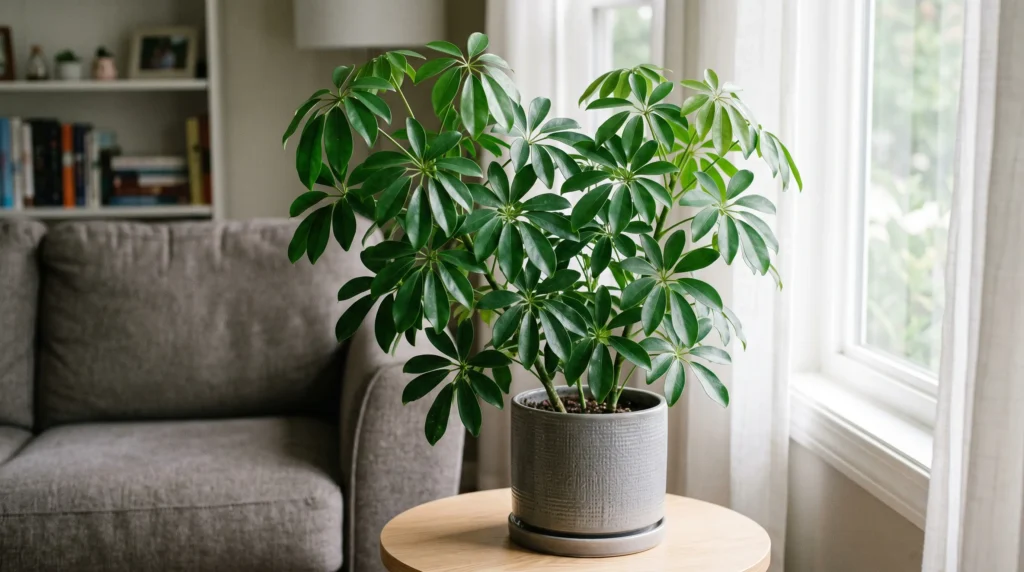
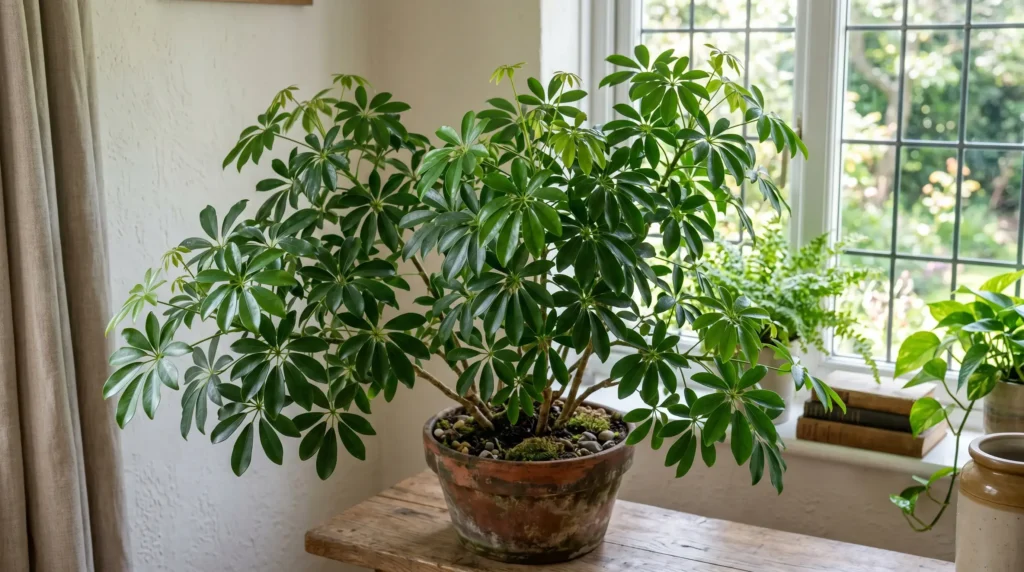
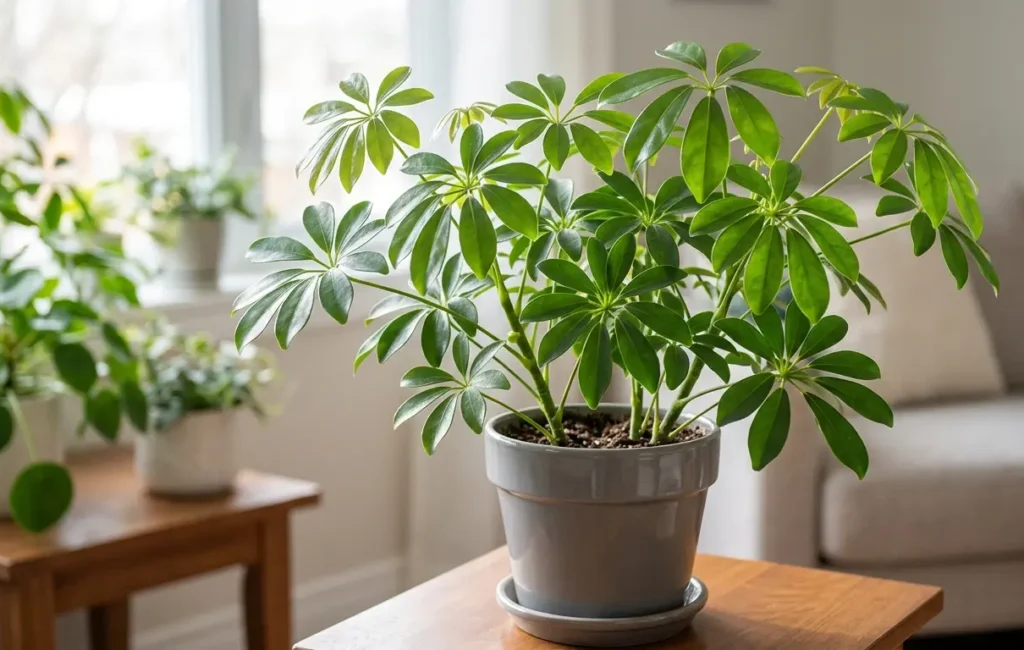
Umbrella plant (Schefflera arboricola, also classified as Heptapleurum arboricola) is an evergreen tropical shrub native to China and Taiwan. It produces clusters of 7-9 glossy leaflets radiating from a central stalk, resembling the spokes of an umbrella. In UK homes it typically grows to 1.5-3 metres indoors and is widely regarded as one of the best large houseplants for British light conditions.
This guide is written specifically for UK conditions: our grey winters, hard tap water, low-light north-facing flats, draughty Victorian sash windows, and gas combi boilers that turn rooms into deserts between October and March. By the time you finish reading, you will know not just how to keep your umbrella plant alive, but how to make it genuinely thrive.
Quick-Reference UK Care Card
Use this table as your instant reference. Full detail on every factor follows in the sections below.
| Care Factor | Your Requirement | UK-Specific Note |
|---|---|---|
| Light | Bright, indirect light preferred | East or north-facing window works well; avoid harsh south-facing summer sun without a net curtain |
| Watering (spring/summer) | When top 4-5 cm of soil is dry | Every 7-10 days typically; use rainwater or filtered water in hard water areas |
| Watering (autumn/winter) | Reduce by 40-50% | Always check soil first — central heating warms pots but slows water uptake |
| Temperature | 15-24 degrees C ideal; minimum 12 degrees C | Keep away from both radiators and cold draughts; never let it touch a cold winter windowpane |
| Humidity | Moderate to high (40-70%) | UK central heating drops humidity to 25-35% — mist, use pebble trays, or a humidifier Oct-Mar |
| Soil | Well-draining, slightly acidic | Peat-free compost (2 parts) + perlite (1 part); pH 6.0-6.5 ideal |
| Fertiliser | Balanced liquid feed, spring to summer | Every 2-3 waterings Mar-Sep; stop entirely Oct-Feb |
| Repotting | Every 2-3 years | Spring only; go up just one pot size; slightly pot-bound is fine |
| Pruning | As needed for shape | Prune only in spring — never prune in winter; always wear gloves |
| Propagation | Stem cuttings (easy) or air layering | Spring cuttings root fastest; use rooting hormone for best results |
| Toxicity | TOXIC to cats, dogs, horses and humans | Calcium oxalate crystals throughout the plant; keep away from pets and children |
| Height indoors (UK) | 1.5 m (compact Nora) to 3 m | Slow in winter; prune to manage height year on year |
What Is the Umbrella Plant?
Definition and Botanical Overview
Umbrella plant : The umbrella plant is the common name for Schefflera arboricola, a compact tropical evergreen shrub in the family Araliaceae. It produces clusters of 7-9 oval, glossy leaflets radiating from a central stalk, giving the appearance of an umbrella canopy. In the UK it is one of the most popular large houseplants, valued for its sculptural foliage, tolerance of indoor conditions, and reported air-purifying qualities.
In UK garden centres and online retailers you will also see it listed as dwarf umbrella plant, umbrella tree, parasol plant, octopus tree, and starleaf. Since 2020, several botanical databases — including the RHS Plant Finder — reclassify Schefflera arboricola as Heptapleurum arboricola. If you search the RHS website and cannot find it under ‘Schefflera’, try ‘Heptapleurum’. At garden centres it is still sold under Schefflera on most labels.
Do not confuse: Cyperus involucratus, an aquatic plant, shares the common name ‘umbrella plant’ but is entirely unrelated. If you are buying an umbrella plant as a houseplant, check the label for Schefflera arboricola or Heptapleurum arboricola.
Origins and Natural Habitat
The umbrella plant originates from the humid subtropical forests of southern China, Taiwan, and parts of South-East Asia. In the wild it grows as an understorey shrub beneath much taller rainforest trees, which is why it has evolved to tolerate lower light levels — a crucial adaptation that makes it well-suited to the notoriously grey light conditions of a British home. Its natural environment receives rainfall year-round, high humidity, and temperatures rarely below 15 degrees C, which directly explains its care requirements.
The Two Main UK Species: Which One Do You Have?
Two species of Schefflera are commonly sold as houseplants in the UK. Understanding which one you have changes how you care for it.
| Feature | Schefflera arboricola (Dwarf Umbrella Plant) | Schefflera actinophylla (Umbrella Tree) |
|---|---|---|
| Common name | Dwarf umbrella plant, parasol plant | Umbrella tree, octopus tree, Queensland umbrella tree |
| Native range | China, Taiwan | Australia, New Guinea |
| UK indoor height | 1.5 m – 3 m | 2 m – 4 m (can exceed this in conservatories) |
| Leaf size | Small-medium (5-10 cm leaflets) | Large (15-30 cm leaflets, deep glossy green) |
| Availability in UK | Very common — Dobbies, B&Q, online retailers | Less common — specialist nurseries, online |
| Light tolerance | Good — tolerates lower UK light levels | Prefers more light; struggles in north-facing rooms |
| Best for | Most UK homes, flats, offices | Large UK homes, conservatories, statement spaces |
| Recommended? | YES — the default choice for UK buyers | Only if you have the space and bright light |
UK Cultivar Guide: Which Variety Should You Buy?
Within Schefflera arboricola there are several named cultivars available in the UK. Each has different light requirements and mature sizes — critical considerations given the wide variation in UK home lighting.
| Cultivar | Foliage | Indoor Height (UK) | Light Needed | Best UK Setting |
|---|---|---|---|---|
| S. arboricola (plain green species) | Deep, uniform glossy green | Up to 3 m | Good — handles lower UK light | Most UK rooms; north-facing flats; offices |
| Nora | Compact, deep green | ~1.5 m | Good — lower light tolerant | Smaller UK rooms, flats, hallways |
| Gold Capella | Green with gold/yellow variegation | Up to 2 m | Needs significantly more light | Bright east- or south-facing UK rooms only |
| Melanie | Green with irregular yellow splashes | Up to 2.5 m | Moderate — variegation fades in low light | Well-lit UK rooms; south or east window |
| S. actinophylla | Large, drooping dark green | 3 m+ | More light required | Large UK homes, conservatories |
UK Flat Warning: Variegated varieties (Gold Capella, Melanie) need significantly more light to maintain their yellow tones. In the typically lower-light conditions of a UK flat or north-facing room, the variegation will steadily fade to plain green. For any room that struggles with light, choose the plain green species or Nora — they are hardier, more forgiving, and will stay lush longer.
Why Is It Called the Lucky Plant? Feng Shui and UK Cultural Context
In Chinese tradition, the umbrella plant is considered a ‘money plant’ — the spreading, reaching leaves are said to symbolise prosperity, wealth, and good fortune. Feng shui practitioners place it in the wealth corner of a room (the far left from the front door) to attract abundance. This cultural significance makes it one of the most popular housewarming and Lunar New Year gifts in UK Chinese and East Asian communities, and increasingly popular as a thoughtful gift more broadly.
NASA research has suggested that Schefflera species may contribute to indoor air purification by absorbing volatile organic compounds (VOCs) such as formaldehyde and benzene. While the effect in a typical room is modest relative to ventilation, it adds to the appeal of a plant that is already handsome, forgiving, and fast-growing.
Light Requirements — Solving the UK Window Problem
The umbrella plant thrives in bright, indirect light — ideally 4 or more hours of good light per day. It tolerates lower light conditions but produces slower growth and, in variegated varieties, loses colour intensity. Direct midday sun causes leaf scorch. In the UK, an east-facing or bright north-facing window is the ideal placement for most of the year.
What Does ‘Bright Indirect Light’ Actually Mean in a UK Home?
‘Bright indirect light’ trips up many UK plant owners because our light is fundamentally different from the tropical and Californian homes these guides were written for. In the UK, even a south-facing window in December delivers only a fraction of the light intensity of a summer midday in Taiwan.
A practical test: bright indirect light means you could comfortably read a book without straining your eyes, but sunbeams are not falling directly on the plant for more than an hour at a time. If your room is dim enough that you need a lamp on during the day, it is too dark for the umbrella plant to thrive — though it will survive.
UK Window Placement Guide — Direction by Direction
| Window Direction | UK Light Quality | Suitable for Umbrella Plant? | Practical Advice |
|---|---|---|---|
| East-facing | Gentle, direct morning sun; bright indirect light rest of day | IDEAL — best UK placement | Position 30-60 cm from the glass; no additional measures needed spring to autumn |
| North-facing | Bright but diffuse indirect light all day; no direct sun | ACCEPTABLE — manageable with care | Choose only plain green species or Nora; growth will be slower; rotate pot quarterly; consider a grow light in winter |
| West-facing | Strong, warm afternoon sun in summer (June-August) | GOOD — with seasonal adjustment | Excellent in autumn, winter, spring; pull back 60-90 cm from glass in June-August to prevent leaf scorch |
| South-facing | Brightest in the UK — direct midday sun in summer | SUITABLE with a net curtain | Best winter position; in summer, filter strong midday sun with a sheer curtain or move back 1-2 m from the glass |
| Conservatory | Bright but temperature extremes are the risk | SEASONAL — spring and autumn ideal | Excellent March-May and September-October; risk of overheating (above 30 degrees C) in July-August; too cold (below 12 degrees C) Dec-Feb without heating |
The UK Winter Light Crisis — October to February
This is the season that defeats more umbrella plants in British homes than any other single factor — and almost no care guide mentions it.
From October to February, UK daylight hours drop to between 7 and 9 hours per day, and overcast skies are the norm for weeks at a time. During this period, the light intensity reaching a plant even in a south-facing room can be less than 20 percent of midsummer levels. Combined with central heating, short days, and cold glass, your umbrella plant enters a period of genuine stress.
Key insight: Leaf drop in autumn is frequently blamed on cold draughts or watering mistakes — and while those matter, the primary trigger is often a sudden reduction in light as days shorten. Move your umbrella plant to your brightest available window from October onwards, even if that means rearranging furniture.
What to Do During UK Winter Low-Light Conditions
- Move to your sunniest window — south or west-facing if you have one. The extra winter sun intensity from a south-facing window is beneficial at this time of year, not harmful.
- Clean the leaves — dust on the leaf surface reduces the amount of light absorbed by up to 30 percent. Wipe leaves gently with a damp, soft cloth every 4-6 weeks.
- Consider a grow light — a full-spectrum LED plant light (6,500 Kelvin colour temperature) placed 30-60 cm above the canopy for 12-14 hours a day can transform a struggling winter plant. Budget options start at around 20-30 pounds on Amazon UK and make a significant difference in north-facing rooms.
- Do not fertilise or repot — the plant is already under stress from reduced light; adding nutrients it cannot use risks fertiliser burn.
- Rotate quarterly — give the pot a quarter turn every 3 months to ensure all sides receive equal light and the plant grows upright rather than leaning.
Signs of Insufficient Light: Leaves becoming smaller and further apart on the stem (leggy growth); stems reaching or leaning strongly toward the window; lower leaves yellowing and dropping; variegated leaves reverting to plain green. All of these signal you need to move the plant to a brighter spot.
Light: Q&A Quick Reference
Q: Can umbrella plants grow in low light?
Yes, but with limitations. The plain green species (Schefflera arboricola) and the compact Nora cultivar will survive in north-facing rooms and shaded positions, but growth will be slow and the plant will not thrive. Variegated varieties (Gold Capella, Melanie) should never be placed in low light — they lose their yellow colouration permanently. For any UK room with limited natural light, a full-spectrum LED grow light used from November to February will make a significant positive difference.
Q: Should I put my umbrella plant in direct sun?
No. Direct midday sun — particularly through a south or west-facing window in summer — will scorch the leaves, leaving brown, bleached patches that cannot recover. Morning sun (east-facing) is fine. For south-facing windows, filter summer sun with a sheer net curtain or move the plant 1-2 m back from the glass.
Watering — The Most Important Skill to Master
Water your umbrella plant thoroughly when the top 4-5 cm of compost feels dry to the touch. Soak the compost until water drains freely from the drainage holes, then wait until the soil reaches that dryness again before watering. Never let the plant sit in standing water. In spring and summer this typically means watering every 7-10 days; in autumn and winter, every 14-21 days.
The Golden Rules of Umbrella Plant Watering
Overwatering is the number one killer of umbrella plants in UK homes — not neglect, not cold, not pests. The plant is far more forgiving of underwatering than of sitting in wet compost for days at a time. Root rot, once established, is difficult to reverse.
- Check before you water — push your finger 4-5 cm into the soil. If it feels moist at all, wait. Only water when that depth feels completely dry.
- Soak thoroughly — when you do water, water until it runs from the drainage holes. Light, surface-only watering encourages shallow roots.
- Empty the saucer — never leave standing water in the drip tray or decorative cache pot. Empty it 30 minutes after watering.
- Use room-temperature water — cold water from the tap in winter can cause leaf drop through thermal shock to the roots.
- Rainwater is best — in hard water areas, always choose rainwater where possible. See the hard water section below.
UK Seasonal Watering Calendar — Month by Month
| Month | UK Conditions | Watering Frequency | Key Notes |
|---|---|---|---|
| January – February | Deep winter dormancy; short days; central heating running | Every 14-21 days | Soil dries slowly; always check with a finger before watering; resist overwatering because the plant looks droopy |
| March – April | Early spring; days lengthening; growth beginning | Every 10-14 days | Start increasing frequency as you see new growth emerge; resume feeding from late March |
| May – June | Active growing season begins; rooms warming | Every 7-10 days | Monitor closely; longer days and warmer rooms mean soil dries faster; feed every 2-3 waterings |
| July – August | Peak UK summer; potential heatwaves | Every 5-8 days | During a heatwave (above 25 degrees C), check daily; pot-dipping immersion method works well this time of year |
| September | Transition month; cooling nights | Every 9-12 days | Begin tapering off; stop feeding by end of September; watch for sudden temperature drops |
| October – November | Heating season begins; humidity crash risk | Every 10-15 days | Central heating creates a false impression of warmth — still check soil manually; begin misting programme |
| December | Winter dormancy; shortest days; full heating | Every 14-21 days | Minimal watering; prioritise humidity management over frequency; no feeding |
The UK Hard Water Problem — and How to Solve It
60%+ of UK homes are in hard water areas — a major, overlooked threat to houseplant health.
Hard water and umbrella plants: Hard water is tap water with elevated concentrations of dissolved calcium and magnesium minerals. When you water your umbrella plant with hard tap water repeatedly, those minerals accumulate in the compost and on the leaf surface. Over time they block the plant’s ability to absorb nutrients — even when you are fertilising correctly — and create characteristic white chalky marks on leaves that many UK owners mistake for disease or pests.
UK Areas Most Affected by Hard Water
- Very hard: London, most of the South East, East Anglia, much of the East and West Midlands
- Hard: parts of Yorkshire, Lincolnshire, Cambridgeshire
- Moderate: parts of the North West, the South West, Wales
- Soft: Scotland (most areas), Northern Ireland, parts of Cornwall, most of the Lake District
Quick check: Pour a small amount of tap water into a clear glass and let it evaporate. If it leaves a white mineral ring inside the glass, your water is hard and your umbrella plant will benefit from the solutions below.
Four UK-Practical Solutions for Hard Water
Solution 1 — Collect Rainwater (Free and Best)
Rainwater is naturally soft, slightly acidic, and free of the chlorine and fluoride added to UK mains water. A simple bucket or watering can left outside during a shower collects enough for several weeks of plant watering. Even in a flat, a bucket on a balcony or outside a window works well. This is the most effective and cost-free solution available to UK plant owners.
Solution 2 — Filtered Water (Convenient)
A standard Brita filter jug (available from Tesco, Argos, Amazon UK at around 25-35 pounds) removes a significant proportion of hard water minerals and chlorine. Fill the jug and leave it overnight before use so the water reaches room temperature. Replace filter cartridges every 4-6 weeks as recommended.
Solution 3 — Water Softener Additive (Most Effective for Tap Water)
Seachem Prime is an aquatic water conditioner (available on Amazon UK for approximately 8-12 pounds for 100 ml) that removes dissolved heavy metals, calcium, chlorine, and chloramine from tap water. Add 2-3 drops per litre of water — a small bottle lasts many months for a few houseplants. You can also use it to wipe down leaves to remove existing mineral deposits.
Solution 4 — Periodic Soil Flushing (Resetting the Compost)
Every 3 months, pour a generous volume of rainwater or filtered water slowly through the compost — far more than a normal watering session. This flushes accumulated mineral salts down through the drainage holes and out of the pot. Do this outside or over a bath or sink, as it produces a large volume of runoff. Allow the pot to drain completely before returning it to its position.
White marks on leaves: Mineral deposits appear as white, dusty or chalky patches on the leaf surface. Do not mistake them for powdery mildew. Wipe gently with a soft cloth dampened with filtered water or a diluted Seachem Prime solution. Do not use commercial leaf shine sprays — they block the leaf’s stomata and impede gas exchange, which harms the plant.
Signs of Watering Problems — Quick Diagnosis
| Symptom | Most Likely Watering Cause | Immediate Action |
|---|---|---|
| Yellow lower leaves; soil is wet | Overwatering / root rot starting | Stop watering immediately; let soil dry fully; check drainage holes are clear |
| Yellow leaves (all over); soil is dry | Under-watering OR mineral lock-out from hard water | Water thoroughly with rainwater; consider soil flush |
| Crispy, brown leaf edges | Underwatering OR low humidity (not a watering issue alone) | Increase watering frequency slightly AND address humidity |
| Drooping leaves; soil is wet | Root rot — roots cannot absorb water | Remove from pot; inspect roots; trim rot; repot in fresh compost |
| Drooping leaves; soil is dry | Severe underwatering | Use pot-dipping immersion method to rehydrate rootball fully |
| White marks on leaves | Hard water mineral deposits | Switch to rainwater; wipe leaves with filtered water cloth |
| Salt crust on soil surface | Fertiliser salt build-up OR hard water accumulation | Flush soil; reduce fertiliser concentration |
Watering: Q&A Quick Reference
Q: How often should I water my umbrella plant in the UK?
Do not follow a fixed schedule — water by soil check. In spring and summer (March-September), water when the top 4-5 cm of compost feels dry, typically every 7-10 days. In autumn and winter (October-February), reduce to every 14-21 days. The key mistake UK owners make in winter is assuming central heating means the soil dries faster. Check the soil manually every time before watering.
Q: Why does my umbrella plant have white marks on its leaves?
White chalky or dusty marks on umbrella plant leaves are almost always mineral deposits from hard tap water — a very common issue in London, the South East, East Anglia, and the Midlands. Switch to rainwater, filtered water, or add a few drops of Seachem Prime to your tap water. Wipe existing deposits off gently with a soft cloth dampened with filtered water. Do not use commercial leaf shine products — they block the leaf stomata.
Temperature and Humidity — Surviving UK Central Heating
Umbrella plant temperature requirement: The umbrella plant prefers temperatures of 15-24 degrees C — a range that corresponds well with typical UK living room temperatures of 18-21 degrees C. It cannot tolerate temperatures below 12 degrees C without leaf drop, and should never be exposed to frost. Avoid sudden temperature swings, cold draughts from windows and doors, and the dry heat blast from radiators.
Ideal Temperature Range and UK Context
The good news: the umbrella plant’s preferred temperature range is almost identical to that of a well-heated UK living room. You do not need to create a special environment. The challenge is not temperature itself, but the side effects of the heating that creates it.
| Temperature | What Happens | UK Situation |
|---|---|---|
| Above 28 degrees C | Growth slows; leaves may wilt; spider mites become more active | Rare in UK homes, except conservatories in July-August |
| 24-28 degrees C | Plant tolerates this; watch for increased water needs | Common in south-facing UK rooms in summer |
| 15-24 degrees C | Ideal growth range — plant is comfortable and growing well | Standard UK living room temperature — perfect |
| 12-15 degrees C | Growth slows; plant is stressed but survives | Unheated UK bedrooms, draughty hallways in winter |
| Below 12 degrees C | Leaf drop begins; roots stop functioning efficiently | UK conservatories Dec-Feb; near external doors; unheated rooms |
| Below 5 degrees C | Severe damage likely; possible death of plant | UK conservatories without heating; sheds; garages — never place here |
The Three Biggest UK Temperature Threats
Threat 1 — Cold Draughts from Windows and Doors
British homes, particularly older Victorian and Edwardian properties, frequently have draughty sash windows, poorly sealed external doors, and letterboxes that admit cold winter air. A plant positioned near any of these will experience rapid temperature fluctuations — from the warm room temperature to near-freezing as a draught passes — which is one of the fastest triggers for mass leaf drop. Keep the umbrella plant at least 60 cm away from external doors and draughty windows during autumn and winter.
Threat 2 — Radiator Proximity
Radiators create a column of very dry, hot air rising directly upward. An umbrella plant positioned directly above or immediately beside a radiator will experience leaf edges browning and crisping within days, and is at far higher risk of spider mite infestation (which loves dry, warm conditions). Maintain a minimum 40-50 cm clearance from any radiator at all times.
Threat 3 — Moving the Plant
The umbrella plant is sensitive to relocation. Each time you move it to a different room, light level, or temperature zone, it may respond with a round of leaf drop as it adjusts. This is normal and not permanent — new growth will follow. The lesson is to find the right position once and leave the plant there, adjusting only for seasonal needs (for example, moving closer to a window in winter).
Humidity — The UK Central Heating Crisis
Why humidity matters for umbrella plants: The umbrella plant evolved in tropical environments with relative humidity of 60-80 percent. UK indoor air in winter, when central heating is running, typically sits at 25-35 percent relative humidity — less than half what the plant needs. This is the primary cause of autumn and winter leaf drop, brown leaf tips, and increased pest vulnerability in UK homes.
Humidity collapse from October to March is responsible for more umbrella plant deaths in Britain than overwatering, underwatering, cold, and pests combined — and it is the factor most consistently ignored in care guides written for other climates.
How to Know If Humidity Is Your Problem
- Brown, crispy tips appearing on otherwise healthy leaves — the most consistent early sign
- Leaf drop beginning in October or November without any change to watering or position
- Fine webbing on leaves or stems (spider mites — which proliferate in dry conditions)
- Overall dull, limp appearance to leaves despite correct watering
- Skin, lips, and throat feeling dry in the same room — if you feel it, your plant does too
Five UK-Practical Solutions for Low Humidity
Method 1 — Pebble Tray (Free; Passive; Always Effective)
Fill a shallow tray or saucer (wider than the pot base) with clean pebbles or gravel to a depth of 2-3 cm. Add water to just below the surface of the pebbles — the pot base must sit above the water line, not in it. As the water evaporates, it raises the humidity in the immediate microclimate around the plant.
Method 2 — Regular Misting (Simple; Free; Immediate Effect)
Fill a clean spray bottle with room-temperature rainwater or filtered water (not hard tap water — the mineral spray will leave white deposits on leaves). Mist the foliage — not the soil — 2-3 times per week during the heating season. Mist in the morning so leaves dry before cooler evening temperatures. This also helps dislodge early-stage spider mites before they establish.
Method 3 — Group Plants Together (Synergistic; Free)
Grouping several houseplants together creates a collective microclimate of higher humidity through shared transpiration — each plant releases water vapour from its leaves, raising humidity for all of them. This works best when plants are within 30-40 cm of each other. Pair the umbrella plant with other moisture-loving plants such as peace lily, ferns, or calathea for the best effect.
Method 4 — Bathroom Placement (Effortless; Space-Dependent)
If your bathroom receives adequate indirect light — ideally from a frosted east or west-facing window — it is the single most naturally humid room in a UK home. Steam from showers and baths naturally raises humidity to 50-70 percent. This is an excellent location for the umbrella plant during winter, provided the light is sufficient.
Method 5 — Plug-In Ultrasonic Humidifier (Most Effective; Worth the Investment)
A small ultrasonic cool-mist humidifier (available at Argos, Amazon UK, Lakeland for 20-45 pounds) is the most reliable solution for serious plant owners. It raises ambient room humidity to a consistent 50-60 percent and benefits not just your plants but also your skin, sleep, and wood furniture during dry British winters. Place it within 1-2 metres of the umbrella plant. Look for models with a built-in hygrometer so you can monitor and maintain the target range. Brands available in the UK include Levoit, Homasy, and TaoTronics.
Temperature and Humidity: Q&A Quick Reference
Q: Why is my umbrella plant dropping leaves?
The three most common causes of leaf drop in UK homes are: (1) sudden humidity collapse when central heating comes on in autumn — the single most common cause, especially if dropping begins in October or November; (2) a cold draught from a window, door, or letterbox; (3) the plant being moved to a new location. To address leaf drop: check the season (autumn drop almost always means humidity), ensure temperatures are stable above 15 degrees C, move the plant away from draughts, and start a humidity management programme immediately — misting, pebble tray, or a humidifier. The plant will stabilise and produce new growth within 4-8 weeks of corrective action.
Q: What temperature is too cold for an umbrella plant in the UK?
Leaf drop becomes likely, and root function deteriorates. This makes unheated conservatories, cold bedrooms, and garages in winter unsuitable locations. The safe minimum is 12 degrees C; the ideal range is 15-24 degrees C. Never position the plant where it touches a cold winter windowpane.
Soil and Feeding — Getting the Foundation Right
Best soil for umbrella plant: The umbrella plant needs well-draining, slightly acidic compost that retains some moisture without becoming waterlogged. The ideal UK mix is two parts peat-free multi-purpose compost combined with one part perlite, creating a light, airy medium with a pH of 6.0-6.5.
Choosing the Right Compost in Post-Peat-Ban UK
Since the retail peat ban came into full effect in England in 2024, standard peat-based composts have been phased out from UK garden centre shelves. Peat-free alternatives vary considerably in their drainage and water-retention properties. For umbrella plants — which need good drainage above all — the right peat-free mix matters.
Recommended UK Compost Products
| Product | UK Retailer | Notes |
|---|---|---|
| Westland Houseplant Compost (peat-free) | B&Q, Homebase, Dobbies, Amazon UK | Specifically formulated for houseplants; good drainage; widely available |
| Growth Technology Houseplant Focus Potting Mix | Amazon UK, specialist online retailers | Excellent structure; nutrient-balanced; peat-free; professional grade |
| Miracle-Gro Premium Houseplant Compost | B&Q, Homebase, Wilko, Amazon UK | Good all-round option; widely available; peat-free formulation |
| RHS Endorsed Peat-Free Compost (Westland) | Dobbies, garden centres nationwide | RHS-tested and endorsed; reliable quality |
The perfect UK mix: Two parts peat-free houseplant compost + one part perlite. Perlite (available at B&Q, Wilko, Amazon UK for around 6-12 pounds per bag) dramatically improves drainage, prevents compaction, and reduces root rot risk. It is the single cheapest and most effective improvement you can make to your umbrella plant’s growing medium.
Feeding Your Umbrella Plant — UK Schedule and Products
How to fertilise an umbrella plant: Feed your umbrella plant with a balanced liquid houseplant fertiliser from March to September, applying it every 2-3 waterings (approximately every 2-4 weeks). Always dilute to half the recommended strength to avoid fertiliser burn. Stop feeding entirely from October to February when the plant is dormant.
UK Fertiliser Products That Work
- Baby Bio Houseplant Food — widely available at Wilko, Sainsbury’s, B&Q, Tesco; balanced NPK; easy to use
- Westland Houseplant Feed — liquid formula; available at most UK garden centres and DIY stores
- Miracle-Gro All Purpose Liquid Plant Food — good availability; balanced feed
- Scotts Osmocote Houseplant Slow Release Granules — convenient alternative to liquid; releases over 6 months; apply in spring
Fertilising Dos and Don’ts
| DO | DON’T |
|---|---|
| Dilute liquid fertiliser to half the stated strength | Apply fertiliser to dry soil — always water first |
| Feed every 2-3 waterings in spring and summer | Feed during October-February dormancy |
| Use a balanced NPK feed (10:10:10 or similar) | Use a high-nitrogen feed — it promotes weak, soft growth |
| Stop feeding if you see brown leaf edges (fertiliser burn) | Continue feeding when growth has stopped |
| Resume feeding in March as new growth appears | Pour undiluted fertiliser concentrate onto roots |
Repotting and Pruning — Keeping Your Plant in Shape
When to Repot Your Umbrella Plant
Repot your umbrella plant every 2-3 years, ideally in spring (April-May) when the plant is entering its active growing season. The plant actually prefers to be slightly pot-bound — only repot when there are clear signs the current pot is too small.
Signs That Your Umbrella Plant Needs Repotting
- Roots are visibly growing out of the drainage holes at the base
- Roots are circling densely around the inside of the rootball when removed
- Water runs straight through the pot immediately after watering, suggesting roots have displaced most of the compost
- Growth has slowed noticeably despite good light, watering, and feeding
- The plant is becoming unstable and top-heavy in its current pot
Do not rush repotting: A pot that is too large for the rootball retains excess moisture in the unused compost, dramatically increasing the risk of root rot. Always go up just one pot size — for example from a 17 cm pot to a 21 cm pot.
How to Repot Your Umbrella Plant — Step by Step
- Water the plant 24 hours before repotting. A well-hydrated root system handles the disturbance of repotting far better than a dry one.
- Choose the right pot — one size up from the current container, with adequate drainage holes. For a tall umbrella plant, choose a pot with a wide, stable base to prevent tipping.
- Prepare the new pot — add a 2-3 cm layer of crocks (broken terracotta pieces), perlite, or gravel at the base to ensure drainage holes are not blocked by compost.
- Add a layer of fresh peat-free compost mixed with perlite.
- Remove the plant — gently squeeze the sides of plastic pots to loosen the rootball. For ceramic pots, run a knife or stick around the inside edge, then tip the plant on its side and ease it out.
- Inspect the roots — healthy roots are firm and white or pale cream. Trim any black, brown, mushy, or rotten roots with clean scissors. Dust cut surfaces with garden cinnamon or activated charcoal to prevent infection.
- Position the plant in the new pot so the top of the rootball sits 2-3 cm below the rim of the pot (to allow for watering).
- Fill around the rootball with fresh compost mix, firming gently with your fingers. Do not pack it down hard — the roots need air pockets.
- Water well until it drains from the bottom, then place in a bright indirect spot.
- Leave undisturbed for 2-3 weeks. Do not fertilise immediately — new roots need time to settle.
Pruning Your Umbrella Plant for Bushier, Healthier Growth
How to prune an umbrella plant: Prune umbrella plants in spring (March-April) by cutting stems just above a node (the point where a leaf attaches). This stimulates the plant to produce 2-3 new shoots from just below the cut, creating a bushier, more compact shape. Never prune in winter.
Key Pruning Rules
- Prune only in spring (March-April) when the plant has the energy to respond with new growth
- Never prune in winter — the plant is dormant and stressed; pruning wounds cannot heal quickly
- Always wear gloves — the sap of Schefflera is a mild skin irritant that can cause contact dermatitis
- Use clean, sharp scissors or pruning shears — blunt cuts crush rather than slice stem tissue
- Cut just above a node or branch fork at a 45-degree angle
Pruning Scenarios and Solutions
| Problem | Pruning Solution | Expected Result |
|---|---|---|
| Plant is tall and leggy with bare lower stems | Cut the main stem back to a desired height, just above a node | Multiple new shoots emerge from below the cut within 4-6 weeks |
| Plant is lopsided or leaning | Prune the longer side back by one-third to create balance | New growth evens out the shape over the following season |
| Plant has one very long, dominant stem | Pinch out the growing tip to redirect energy into side branches | Bushy, branching growth rather than vertical extension |
| Plant is very overgrown (above 3 m in a UK room) | Hard prune back to 60-90 cm in early spring | Vigorous regrowth; use removed sections as propagation cuttings |
| Yellow or damaged leaves | Remove at the stem — these will not recover | Cleaner appearance; plant redirects energy to healthy growth |
Repotting and Pruning: Q&A Quick Reference
Q: When should I repot my umbrella plant?
Repot your umbrella plant every 2-3 years, in spring (April-May) when it is entering its active growing season. Only repot when there are clear signs of being root-bound: roots growing from drainage holes, water running straight through without absorbing, or noticeably slowed growth despite good care. Go up just one pot size — too large a pot increases root rot risk by retaining excess moisture in unused compost.
Q: How do I make my umbrella plant bushier?
Prune the main stems back to just above a leaf node in early spring (March-April). The plant will respond by producing 2-3 new shoots from just below each cut, creating a fuller, bushier shape. For a very leggy plant, you can cut back quite hard — even to 60-90 cm — and it will regenerate vigorously through the spring growing season.
How to Propagate Your Umbrella Plant — Two UK Methods
Umbrella plants are most easily propagated by stem cuttings — a length of healthy stem taken from the plant, rooted in water or moist compost, and grown into a new plant. A second method, air layering, is more advanced but useful for tall, leggy plants. Spring (April-May) is the best time to propagate in the UK, when warmth and light support faster rooting.
Stem Cuttings (Easiest; Suitable for Beginners)
What You Need
- Sharp, clean scissors or a blade (wipe with isopropyl alcohol to sterilise)
- A glass of room-temperature water OR a small pot of moist cutting compost mixed with perlite
- Optional but recommended: hormone rooting powder or gel (Doff Hormone Rooting Powder, available at B&Q and Wilko for approximately 4-6 pounds)
- A clear plastic bag or propagator lid (to maintain humidity around the cutting)
- Warmth: cuttings root fastest at 18-22 degrees C minimum — a propagation heat mat (15-25 pounds, Amazon UK) significantly improves success rates in cool UK rooms
Step-by-Step: Rooting in Water
- Select a healthy stem tip with 3-5 mature leaves. Cut just below a leaf node at a 45-degree angle — the cutting should be 10-15 cm long.
- Remove the lower 1-2 leaves, leaving the cut section of bare stem that will go into the water. Leaving leaves submerged causes them to rot.
- Place the cutting in a jar or glass of room-temperature rainwater or filtered water, with the bare stem submerged and the leaves above the waterline.
- Position in a warm, bright spot (not direct sun) — an east-facing windowsill is ideal in spring.
- Change the water every 5-7 days to prevent stagnation and bacterial growth.
- After 3-6 weeks, white roots 2-4 cm long will appear from the nodes. Once roots reach this length, the cutting is ready to pot up.
- Pot up into a small pot (9-11 cm) filled with fresh peat-free compost and perlite. Handle the fragile new roots gently. Water in well.
Step-by-Step: Rooting in Compost (Higher Long-Term Success Rate)
- Prepare a cutting as above. Dip the cut end into hormone rooting powder or gel — tap off excess powder.
- Push the cutting 3-4 cm deep into a small pot of moist cutting compost or perlite mix. Firm gently around the base.
- Cover the pot and cutting with a clear plastic bag (secured with a rubber band) or place in a small propagator to maintain humidity above 70 percent.
- Place in a warm, bright spot — 18-22 degrees C is ideal. A propagation heat mat ensures consistent base warmth.
- Check every 5-7 days — open the bag briefly to allow air circulation and prevent mould. Mist the compost lightly if it is drying out.
- After 4-8 weeks, gently tug the cutting. Resistance means roots have formed. Begin removing the plastic bag for longer periods each day to acclimatise the cutting.
- Once established (6-10 weeks), pot up into a slightly larger pot with standard houseplant compost mix.
Air Layering (Advanced; Best for Leggy Plants)
Air layering is the technique to use when your umbrella plant has become tall and bare-stemmed — it allows you to create a new, shorter plant from the healthy upper section while it is still attached to the parent, so it never runs short of water or nutrients during rooting.
When to Use Air Layering
- The plant has become very leggy, with 60 cm or more of bare stem below the foliage
- You want to reduce the overall height of the plant and end up with two plants
- Previous stem cutting attempts have failed — air layering has a higher success rate with thick, mature stems
- Best timing: spring (April-May) for fastest rooting; early autumn (August-September) also works
Step-by-Step: Air Layering
- Choose a healthy section of stem 30-50 cm below the growing tip. This will become the top of your new plant.
- Make an upward-angled cut one-third to halfway through the stem, just below a leaf node. Alternatively, remove a ring of bark 3-4 cm wide (ring-barking method).
- Keep the wound open by inserting a small stone, toothpick, or matchstick into the cut.
- Dust the wound with rooting hormone powder.
- Wrap a large handful of damp (not soggy) sphagnum moss around the wound, covering it completely. The moss ball should be roughly the size of a large orange.
- Wrap the moss tightly in clear cling film — seal both the top and bottom edges with tape so the moss cannot dry out.
- Check every 2-3 weeks by looking through the cling film. You will see white roots growing into the moss after 6-12 weeks.
- When roots are 3-5 cm long and numerous, cut the stem just below the moss ball with clean secateurs.
- Remove the cling film carefully, leaving the moss intact around the root ball if possible. Pot the rooted section into fresh compost and perlite, burying the moss ball.
- Water in well and place in a bright indirect spot. The parent plant will sprout new growth from below the cut within a few weeks.
Diagnosing and Fixing Problems — The Complete UK Troubleshooting Guide
The umbrella plant is genuinely robust — most problems are caused by a small number of correctable mistakes, and the plant will recover quickly once those mistakes are addressed.
Master Symptom Diagnosis Table
| Visual Symptom | Root Cause(s) | UK Context | Action |
|---|---|---|---|
| Yellow leaves on lower stems — soil is wet | Overwatering; root rot beginning | Very common in UK winter when we feel the plant looks thirsty despite the heating | Stop watering immediately; check drainage; allow soil to dry fully; if severe, inspect roots and repot |
| Yellow leaves all over — soil is dry | Insufficient light (especially Oct-Feb) OR hard water mineral lock | UK winter low-light is the main culprit | Move to brightest window; switch to rainwater; flush soil to remove minerals; resume balanced feeding |
| Rapid leaf drop — many leaves falling quickly | Sudden temperature change; cold draught; plant moved | Turning on central heating in autumn causes both temperature and humidity shifts simultaneously | Identify the trigger; stabilise temperature above 15 degrees C; increase humidity immediately with misting and pebble tray |
| Leaf drop beginning in October or November | Central heating humidity collapse | Uniquely common in UK homes — central heating drops indoor humidity to 25-35 percent | Begin full humidity management programme: misting 3 times per week, pebble tray, ideally a humidifier |
| Brown, crispy leaf tips | Low humidity AND/OR underwatering | UK winter heating season — dual cause very common | Increase humidity AND check whether soil is drying too fast; address both simultaneously |
| Brown soft patches on stems near soil | Root rot — overwatering | Heavy UK composts or pots without drainage exacerbate this | Remove plant from pot; trim all mushy roots; dust with cinnamon; repot in fresh, well-draining compost |
| Leggy growth — long spaces between leaves | Insufficient light | North-facing UK rooms in winter are the primary cause | Move to a brighter position; add a grow light; prune in spring to reset shape |
| White chalky marks on leaves | Hard water mineral deposits | Very common in London, SE England, Midlands — 60 percent of UK has hard water | Switch to rainwater or filtered water; wipe leaves with filtered water cloth |
| Variegation fading — yellow tones turning green | Insufficient light for variegated varieties | UK winter light levels frequently trigger this in Gold Capella and Melanie | Move to a much brighter position; consider grow light Nov-Feb |
| Sticky, shiny coating on leaves | Scale insect infestation (honeydew secretion) | More common Oct-Apr in warm, dry UK homes | Treat with neem oil; manually remove insects — see pest section below |
| Fine webbing between leaves and stems | Spider mite infestation | Classic UK winter central heating pest — thrives in dry warm air | Increase humidity immediately; wipe with damp cloth; spray neem solution |
| White fluffy masses in leaf joints | Mealybug infestation | Common UK houseplant pest year-round | Dab with isopropyl alcohol; neem oil spray |
UK Pest Guide — Identification, Treatment, and Prevention
Spider Mites (Most Common UK Winter Pest)
Spider mites on umbrella plants: Spider mites (Tetranychus urticae) are microscopic arachnids that feed on leaf cell contents, leaving distinctive stippled, silvery or bronze marks on the upper leaf surface. They thrive in dry, warm conditions — exactly the environment created by UK central heating — making them the most common winter pest for indoor umbrella plants.
How to Identify Spider Mites
- Fine, silk-like webbing between stems, in leaf joints, and across leaf undersides
- Tiny stippled or silvery speckling on the upper leaf surface (where they have fed through the leaf)
- Microscopic red, orange, or pale dots visible on leaf undersides — these are the mites themselves
- Leaves looking dull, dusty, and limp despite correct care
How to Treat Spider Mites — UK Step-by-Step
- Isolate the plant immediately to prevent spread to other houseplants.
- Take the plant to a shower or bath and spray the entire plant (especially leaf undersides) with a strong stream of lukewarm water. This physically removes a significant proportion of mites and their eggs.
- Prepare a neem oil spray: 10 ml cold-pressed neem oil + 2-3 ml washing-up liquid + 1 litre of room-temperature water. Shake well and spray all leaf surfaces, including undersides.
- Repeat the neem spray every 5-7 days for 3-4 weeks to break the egg cycle.
- Increase ambient humidity — spider mites cannot reproduce effectively above 60 percent relative humidity. A humidifier is the most effective long-term deterrent.
- UK product alternatives: Provanto Houseplant Bug Killer (B&Q, Dobbies), Westland Resolva Bug Killer, Bug Clear Ultra.
Scale Insects
Scale insects on umbrella plants: Scale insects are small, brown, oval, shell-like insects that attach themselves to stems and the undersides of leaves. They suck sap and excrete a sticky substance called honeydew that coats the upper leaf surface and can develop into sooty mould — a black, powdery fungal coating.
How to Identify Scale Insects
- Small, brown oval bumps adhered to stems — they look more like plant tissue than insects at first glance
- Shiny, sticky coating (honeydew) on upper leaf surfaces
- Black powdery coating developing on leaves (sooty mould growing on the honeydew)
How to Treat Scale Insects
- Using an old toothbrush or cotton swab dipped in 70 percent isopropyl alcohol (rubbing alcohol — available at pharmacies and Amazon UK for 4-8 pounds per bottle), scrub the shells off each stem individually.
- Spray the entire plant with a neem oil solution (same formula as for spider mites).
- For severe infestations, use a systemic insecticide such as Provanto Ultimate Bug Killer or Bayer Garden Insect Killer — systemic products are absorbed by the plant and kill sap-sucking insects through feeding.
- Repeat treatment every 7-10 days for 4 weeks.
- Monitor closely after treatment — scale insects are persistent and a single surviving egg can restart the infestation.
Mealybugs
Mealybugs on umbrella plants: Mealybugs are soft-bodied insects protected by a white, waxy, cotton-like coating. They cluster in the joints between leaves and stems, in the growing tips, and at the base of leaf stalks. Like scale insects, they feed on sap and produce honeydew.
How to Treat Mealybugs
- Dab each visible mealybug cluster directly with a cotton bud soaked in 70 percent isopropyl alcohol. The alcohol dissolves the wax coating and kills the insect on contact.
- Follow with a full-plant neem oil spray to reach any insects hidden deeper in the leaf joints.
- Repeat every 5-7 days for 4-6 weeks — mealybug eggs are extremely persistent.
- Inspect all new plants before bringing them into your home, and quarantine new purchases for 2 weeks.
Root Rot and Leaf Spot Disease
Root Rot (Most Serious Disease)
Root rot is caused by Phytophthora and Pythium fungal pathogens that thrive in waterlogged soil. It begins at the roots and progresses upward, turning stems soft and brown at the base. By the time visible symptoms appear above soil, the infection is often advanced.
- Early signs: persistent yellowing of lower leaves despite reduced watering; slight softness in the lower stem
- Late signs: plant wilting despite wet soil; brown mushy patches on the stem at soil level; foul smell from the compost
- Treatment: remove plant from pot; trim all brown, mushy roots back to healthy tissue; dust cut surfaces with powdered garden cinnamon (a natural antifungal); repot in completely fresh, dry peat-free compost with increased perlite; reduce future watering significantly
Leaf Spot Disease
Bacterial or fungal leaf spot manifests as brown or black spots with yellow halos on leaves. Unlike mineral deposits (which are powdery and dry), leaf spot patches are soft and spread over time.
- Cause: overwatering, poor air circulation, or water sitting on leaves for extended periods
- Treatment: remove affected leaves; improve air circulation; avoid wetting leaves during watering; treat with a copper-based fungicide if spreading
Umbrella Plant Toxicity — UK Pet and Child Safety Guide
Is the umbrella plant toxic?: Yes. The umbrella plant (Schefflera arboricola) is toxic to cats, dogs, horses, and humans. The toxic agents are calcium oxalate crystals present throughout all parts of the plant — leaves, stems, bark, roots, and sap. Ingestion causes oral irritation, vomiting, drooling, and loss of appetite.
IMPORTANT: This section is for informational purposes only and does not replace professional veterinary or medical advice. If your pet or child ingests part of an umbrella plant, contact a qualified professional immediately using the numbers provided below.
Toxicity by Species — What to Expect
| Who | Symptoms if Ingested | Severity | Action Required |
|---|---|---|---|
| Dogs | Vomiting, drooling, oral irritation and burning, loss of appetite, diarrhoea, lethargy | Moderate | Contact your vet immediately; do NOT induce vomiting unless directed by a vet |
| Cats | Vomiting, excessive drooling, lethargy, loss of appetite, oral pain | Moderate | Contact your vet or Animal Poison Line immediately; monitor closely |
| Horses | Gastrointestinal upset; distress | Moderate | Contact your vet immediately |
| Adult humans | Burning and irritation of the mouth and throat; nausea; vomiting if large quantity consumed | Low-Moderate | Contact NHS 111 if significant ingestion; seek immediate help if a child ingests any amount |
| Young children | Oral pain and burning; nausea; possible vomiting | Moderate | Call NHS 111 (free, 24/7) or 999 if the child shows signs of distress; take a photo of the plant |
| Skin contact (all) | Mild irritation, redness, or rash from contact with sap during pruning | Low | Wash affected area with soap and water; avoid eye contact |
UK Emergency Action Plan — If Your Pet Eats Umbrella Plant
- Stay calm and remove any remaining plant material from your pet’s mouth if it is safe to do so — do not put your fingers in their mouth if they are distressed.
- Do NOT attempt to induce vomiting unless a vet specifically instructs you to do so.
- Call your vet immediately. If it is out of hours:
- Animal Poison Line (UK): 01202 509 000 — operates 24 hours, 7 days. Note: a charge applies per call.
- PDSA Emergency: visit pdsa.org.uk and use the Find a Vet tool for your nearest emergency pet hospital.
- Veterinary Poisons Information Service (VPIS): your vet can contact the VPIS on your behalf for specialist advice.
- Take a clear photo of the plant and, if possible, take a leaf to the vet to assist with identification.
- Note the time of ingestion and, if possible, roughly how much was eaten — this helps the vet assess the risk.
UK Emergency Action Plan — If a Child Ingests Umbrella Plant
- Call NHS 111 (free, 24/7) immediately for guidance — do not wait to see if symptoms develop.
- If the child is in distress, struggling to breathe, or appears seriously unwell, call 999.
- Rinse the child’s mouth gently with water.
- Do NOT induce vomiting.
- Have the plant available for identification, or take a photo.
Prevention is better than cure: Place umbrella plants on tall shelves or in rooms that pets and young children cannot access. If you have very curious pets or very young children, consider choosing a pet-safe alternative such as a spider plant (Chlorophytum comosum) or a calathea, both of which are non-toxic and provide a similar dramatic tropical foliage effect.
Handling Safety for Adults — Pruning and Propagation
Adults pruning or propagating umbrella plants may experience mild skin irritation from contact with the milky sap. The sap of Schefflera contains calcium oxalate crystals. While a single brief contact is unlikely to cause serious irritation, repeated or extended skin exposure can cause contact dermatitis in sensitive individuals.
- Always wear clean gardening gloves when pruning, repotting, or taking cuttings
- Avoid touching your face, eyes, or mouth during and after handling the plant
- Wash hands thoroughly with soap and water after any contact with the plant
- If sap contacts your eyes, flush immediately with clean water for 15 minutes and seek medical advice
Toxicity: Q&A Quick Reference
Q: Is the umbrella plant toxic to cats and dogs?
Yes — umbrella plants (Schefflera) are toxic to cats, dogs, and horses due to calcium oxalate crystals throughout the plant. Ingestion causes vomiting, drooling, and oral irritation. If your pet eats part of the plant, contact your vet immediately or call the Animal Poison Line on 01202 509 000 (24 hours a day, 7 days a week — a call charge applies). For child ingestion, call NHS 111 immediately.
Q: Is the umbrella plant safe to have in a home with children?
The umbrella plant is toxic to humans, including children. Ingestion of leaves, stems, or sap causes oral burning, irritation, and potentially vomiting. If you have young children who explore by touching and tasting, place the plant out of reach on a high shelf or in a room they cannot access unsupervised. If a child ingests any part of the plant, call NHS 111 immediately.
Where to Buy an Umbrella Plant in the UK — 2026 Guide
Where to buy umbrella plants in the UK: Umbrella plants are available at most major UK garden centres including Dobbies, Blue Diamond, and selected B&Q branches, as well as online at houseplant.co.uk, Waitrose Garden, Happy Houseplants, and Prickle Plants. Prices range from approximately 8 pounds for small specimens to 65 pounds or more for large established plants. Online retailers offer the widest variety of cultivars.
UK Retailer Directory 2026
| Retailer | Type | Price Range | Availability | Notes |
|---|---|---|---|---|
| Dobbies Garden Centres | In-store | 12 – 45 pounds | Good — most large branches | Check the houseplant section; good stock rotation; knowledgeable staff |
| Blue Diamond Garden Centres | In-store | 15 – 55 pounds | Good | Often stock variegated varieties; quality generally high |
| B&Q | In-store | 8 – 28 pounds | Variable — seasonal | Larger stores have better selection; quality can vary; very accessible prices |
| Homebase | In-store | 8 – 25 pounds | Variable | Similar to B&Q; check your local branch before travelling |
| Waitrose Garden (online) | Online | 18 – 60 pounds | Good — consistent stock | Schefflera arboricola Melanie and standard varieties stocked regularly; reliable packaging |
| TESCO (larger stores) | In-store | 8 – 18 pounds | Limited | Basic green variety; useful for budget buyers; check the seasonal plant display |
| houseplant.co.uk | Online | 12 – 75 pounds | Excellent — wide cultivar range | UK specialist; carefully checked before dispatch; 1-2 day delivery |
| Happy Houseplants | Online | 18 – 80 pounds | Good | Peat-free focus; ethically sourced; good packaging; UK-grown options |
| Prickle Plants | Online | 15 – 65 pounds | Good | UK-based; strong online community; good customer service |
| Etsy UK sellers | Online (marketplace) | 10 – 55 pounds | Variable | Good for unusual and rare cultivars; always check seller reviews and dispatch method |
| Independent UK nurseries | In-store | 10 – 50 pounds | Variable by region | Best quality; UK-grown plants acclimatised to British conditions; ask specifically for UK-grown stock |
What to Check Before You Buy — A UK Buyer’s Checklist
Inspect for Pests
- Look on the underside of several leaves for spider mites (tiny dots and fine webbing), scale insects (brown oval shells stuck to stems), or mealybugs (white fluffy clusters in leaf joints)
- Check the top of the soil surface for fungus gnats — tiny flies hovering just above the compost
- Reject any plant showing signs of infestation — once pests enter your home, they spread rapidly to other houseplants
Assess the Foliage
- Look for dense, compact growth — avoid plants that are very tall and spindly with widely spaced leaves
- Leaves should be glossy and firm — dull, limp, or yellowing leaves suggest the plant has been in poor conditions
- Check that variegated cultivars have vivid, distinct colour — faded variegation at the point of sale indicates prior low-light exposure
Ask These Questions in a Garden Centre
- ‘How long has this plant been in stock?’ — recently arrived plants establish better than those sitting on shelves for weeks
- ‘Has it been treated for pests recently?’ — if yes, ask what was used and whether it is safe for pets
- ‘Is this UK-grown or imported?’ — UK-grown plants are already acclimatised to British light and temperature conditions.
UK Price Guide 2026
| Plant Size | Pot Size | Typical UK Price | Notes |
|---|---|---|---|
| Small / starter plant | 9 – 12 cm pot | 8 – 18 pounds | Good for beginners; will take 2-3 years to become a statement plant |
| Medium | 14 – 17 cm pot | 18 – 35 pounds | Most common purchase size; begins making an impact in 6-12 months |
| Large / floor plant | 21 – 28 cm pot | 35 – 65 pounds | Immediate impact; excellent value vs years of growing from small |
| Extra large / specimen | 30 cm + pot | 65 – 120+ pounds | Statement piece; usually only available from specialist online retailers |
Styling the Umbrella Plant in a UK Home — 2026 Interiors
Why umbrella plants suit UK interiors in 2026: The umbrella plant is ideally positioned for 2026 UK interiors trends, which centre on intentional wellbeing planting — choosing plants that actively improve how a space feels rather than impulse buys chosen purely for novelty. Structural, long-lived, calming, and air-purifying, the umbrella plant is the opposite of a trend-driven purchase: it is a plant that rewards long-term ownership.
Best Rooms for the Umbrella Plant in a UK Home
| Room | Suitability | What Works Well | What to Watch |
|---|---|---|---|
| Living room | Excellent | Corner floor placement; pairs with sofas, bookshelves; creates focal point | Avoid positioning directly next to radiators |
| Home office or study | Excellent | Reduces perceived stress; floor plant beside desk adds structure | Ensure adequate light; grow light useful in north-facing offices |
| Hallway | Good (light-dependent) | Adds drama to an often-neglected space; tall varieties make an architectural statement | Only works with an adequate light source — east-facing front door or skylight ideal |
| Bedroom | Good | Calming presence; air-purifying; compact varieties work on dressers | Ensure room does not drop below 12 degrees C at night; keep away from open windows in winter |
| Bathroom | Excellent (light-dependent) | Naturally high humidity benefits the plant significantly | Requires at least a frosted east- or west-facing window; avoid if light is very limited |
| Conservatory | Excellent — seasonally | Bright light and warmth in spring and autumn are ideal | Too hot in summer (above 30 degrees C); too cold in unheated conservatory Dec-Feb |
2026 UK Styling Trends — How to Display Your Umbrella Plant
The Intentional Wellbeing Plant — 2026’s Defining Trend
The UK houseplant market in 2026 has shifted decisively away from impulse buying and toward intentional greenery — plants chosen specifically for how they make a space feel. The umbrella plant fits this perfectly: it is large enough to make a genuine spatial impact, structured enough to anchor a room, and calm enough not to overwhelm it.
Pot and Planter Choices for 2026 UK Interiors
- Textured terracotta — the dominant UK interior pot trend of 2026; raw, earthy finishes work beautifully with the umbrella plant’s glossy green leaves; choose unglazed terracotta for a natural look, or speckled grey ceramics for a contemporary setting
- Woven rattan or seagrass cache pots — excellent for concealing a plastic nursery pot while adding warmth and texture; widely available at IKEA, H&M Home, Next Home, and Dunelm
- Sculptural ceramics — in 2026, the pot itself is a design statement; look for tactile, handmade-look ceramics at independent UK homeware shops and Etsy
- Avoid: plain black plastic pots on display, highly reflective or metallic finishes that clash with the organic leaf texture
Companion Plants — Creating an Indoor Jungle
The umbrella plant works beautifully as the tall layer in a layered indoor plant display. Pair it with:
- Monstera deliciosa (Swiss cheese plant) — same care needs; bold complementary leaf shapes
- Peace lily (Spathiphyllum) — low light tolerance matches; adds white flowers for contrast
- ZZ plant (Zamioculcas zamiifolia) — extremely low maintenance; dark, glossy leaves complement Schefflera well
- Trailing pothos — drape over a shelf or climb a moss pole beside the umbrella plant for a layered jungle effect
- Calathea or Maranta — medium height; patterned leaves create visual interest at mid-level
UK styling note: In 2026, the most-followed UK interior designers are styling indoor jungles with three height layers — a trailing or low ground plant, a mid-height statement plant, and a tall tree-like plant. The umbrella plant is perfect for the tall layer role, while remaining more compact and manageable than a rubber plant or fiddle leaf fig.
Frequently Asked Questions — Complete UK Q&A
These are the most common questions UK umbrella plant owners ask — answered directly, concisely, and completely for AI and human readers alike.
Q1: What is an umbrella plant?
The umbrella plant (Schefflera arboricola) is an evergreen tropical houseplant native to China and Taiwan. It produces clusters of 7-9 glossy leaflets radiating from a central stalk, resembling the shape of an umbrella. In UK homes it typically grows to 1.5-3 metres indoors, tolerates lower light levels well, and is one of the most popular large houseplants for British conditions.
Q2: How often should I water my umbrella plant in the UK?
Water when the top 4-5 cm of compost feels completely dry to the touch. In spring and summer (March-September) this is typically every 7-10 days. In autumn and winter (October-February), reduce to every 14-21 days. The most common mistake UK owners make is overwatering in winter.
Q3: Why is my umbrella plant dropping leaves?
Autumn leaf drop in UK homes is most commonly caused by the humidity collapse that occurs when central heating comes on. UK indoor air in winter drops to 25-35 percent relative humidity — far below the 50-70 percent the umbrella plant needs. Other causes include cold draughts near windows or doors, a sudden change in position, or temperatures falling below 12 degrees C. New growth will follow within 4-8 weeks.
Q4: Is the umbrella plant toxic to cats, dogs, or children?
Yes. The umbrella plant is toxic to cats, dogs, horses, and humans due to calcium oxalate crystals throughout all parts of the plant. Ingestion causes oral burning, drooling, vomiting, and loss of appetite. For pets, contact your vet immediately or call the Animal Poison Line on 01202 509 000 (24 hours, 7 days — charge applies). For children, call NHS 111 immediately.
Q5: Why does my umbrella plant have white marks on its leaves?
White chalky marks on umbrella plant leaves are almost always calcium and magnesium mineral deposits from hard tap water — a very common issue affecting over 60 percent of UK homes, particularly in London, the South East, East Anglia, and the Midlands. Switch to collected rainwater, filtered water (using a Brita jug), or add 2-3 drops of Seachem Prime per litre to your tap water. Do not use commercial leaf shine sprays.
Q6: Can I grow an umbrella plant outdoors in the UK?
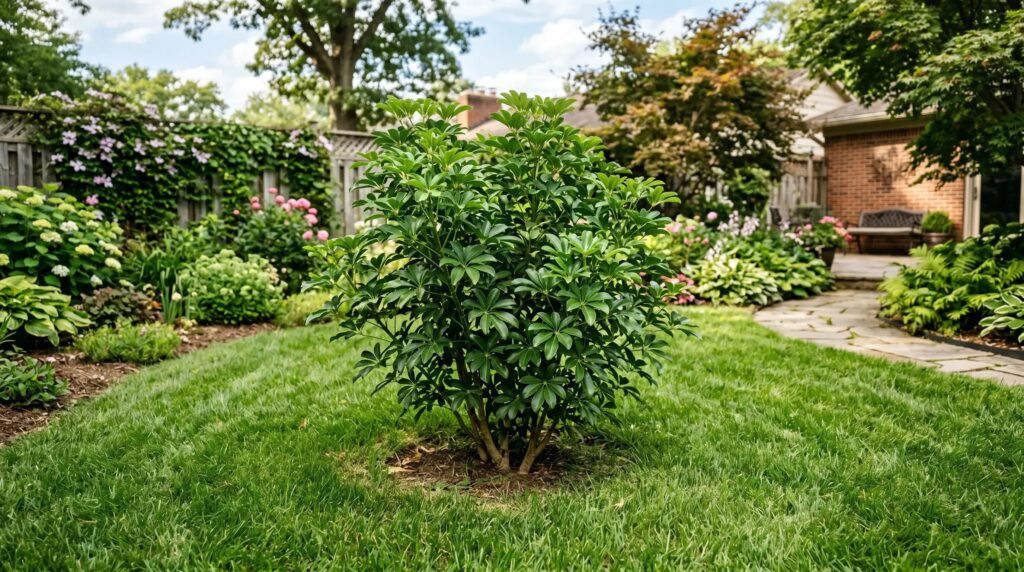
Not year-round — umbrella plants are frost-tender and cannot survive UK winters outdoors. However, you can place them in a sheltered, partially shaded outdoor spot from June to mid-September when temperatures are reliably above 15 degrees C. Acclimatise the plant gradually by moving it outside for a few hours each day before leaving it out permanently, and bring it back indoors before night temperatures fall below 12 degrees C — usually by mid-September in most UK regions.
Q7: Why is my umbrella plant leggy with long gaps between the leaves?
Leggy growth with widely spaced leaves and elongated, weak stems is almost always caused by insufficient light. Move it to a brighter position — ideally an east-facing window or the brightest available spot in your home. Once you have corrected the light, prune the leggy stems back in spring to just above a node, and the plant will branch out with healthier, more compact growth.
Q8: What is the best compost for an umbrella plant in the UK?
The ideal UK mix is two parts peat-free multi-purpose houseplant compost combined with one part perlite. Good UK brands include Westland Houseplant Compost (peat-free), Growth Technology Houseplant Focus Potting Mix, and Miracle-Gro Premium Houseplant Compost. The addition of perlite dramatically improves drainage and significantly reduces root rot risk — it is the single most impactful change most UK owners can make to their plant’s growing medium.
Q9: How tall will my umbrella plant grow indoors in the UK?
The compact cultivar Nora stays around 1.5 metres, making it ideal for UK flats and smaller rooms. Growth slows significantly during the low-light UK winter. Regular pruning in spring will keep the plant at any height you choose — cut the main stem just above a node and it will branch out rather than continue growing taller.
Q10: Where can I buy an umbrella plant in the UK in 2026?
Umbrella plants are stocked at most large UK garden centres (Dobbies, Blue Diamond) and some B&Q branches, priced from around 8 pounds for small plants to 65 pounds or more for large floor specimens. Online, houseplant.co.uk, Waitrose Garden, Happy Houseplants, and Prickle Plants are reliable UK retailers with good packaging for postal delivery. For unusual cultivars such as Gold Capella or Nora, search Etsy UK sellers and check reviews carefully before purchasing.
Q11: How do I increase humidity for my umbrella plant in winter?
The five practical methods UK owners use are:
(1) Place a shallow pebble tray filled with water below the pot so the pot base sits above the waterline — as water evaporates it raises local humidity.
(2) Mist the foliage 2-3 times per week with room-temperature rainwater or filtered water.
(3) Group the umbrella plant with other houseplants so their collective transpiration raises humidity. (4) If the bathroom has adequate light, move the plant there for winter — steam from showers raises humidity naturally.
(5) Use a small ultrasonic humidifier (20-45 pounds from Argos or Amazon UK) placed within 1-2 metres of the plant.
Q12: Why is my Gold Capella umbrella plant losing its yellow colour?
If your plant is in a north-facing room or has been moved away from a window, the variegation will fade to plain green — this is an irreversible loss for those specific leaves. Move the plant to your brightest available position, ideally an east- or south-facing window. From November to February, add a full-spectrum LED grow light to compensate for UK winter low-light conditions.
Conclusion: Your Umbrella Plant Will Thrive With the Right UK Knowledge
The umbrella plant is not a difficult plant. What it is, is a plant that fails when it receives generic, non-UK-specific care advice — and thrives spectacularly when its owner understands the specific conditions of a British home.
The five most important things to remember for UK owners:
- Hard water is your silent enemy. If you live in London, the South East, or the Midlands, switch to rainwater or filtered water. It costs nothing and makes a genuine, measurable difference.
- Central heating is your plant’s biggest seasonal challenge. When the radiators come on in October, start your humidity management programme immediately — misting, pebble tray, or a small humidifier. Do not wait for the leaves to start dropping.
- UK winter means less light than your plant needs. Move it to your brightest window from October to February. Consider a grow light for north-facing rooms.
- Less is more with watering. Check the soil with your finger before every single watering. Overwatering kills more umbrella plants in the UK than any other single factor.
- Prune in spring, not winter. A confident spring prune transforms a leggy, bare-stemmed plant into a lush, bushy specimen within a single growing season.
Follow these principles consistently, and your umbrella plant will reward you with years of glossy, architectural, air-purifying beauty — one of the best large houseplants for British homes at any price.
Check out our complete umbrella plant care guide on Howtogrowgreens
For additional reference, you can check this source.

Leave a Reply