
The rosemary plant (Salvia rosmarinus) is a hardy, evergreen perennial shrub native to the Mediterranean coastline, prized in British gardens for its aromatic, needle-like leaves, early spring flowers, and remarkable versatility across the kitchen, the medicine cabinet, and the flower border.Close your eyes and brush your fingers across a sprig of rosemary.
That sharp, piney, almost resinous scent — warm and slightly camphor-edged — has been used for thousands of years to flavour food, preserve memory, and heal the body. It is the same plant Roman soldiers brought north through Gaul, that medieval herbalists prescribed for headaches, and that Shakespeare’s Ophelia pressed into a bouquet for remembrance. Today, it grows in gardens from Cornwall to Caithness, thriving with what can only be described as cheerful neglect.
What this guide covers: This is the complete UK resource for the rosemary plant — covering its botanical identity, the best varieties for British conditions, a step-by-step growing guide, month-by-month care calendar, pruning and propagation, common problems, health benefits, culinary uses, garden design ideas, British folklore, and a full FAQ. Whether you are planting your first pot or want to understand why an established shrub is struggling, you will find the answer here.
Rosemary Plant Profile: Botanical Identity & Classification
What Family Does Rosemary Belong To?
Rosemary belongs to the family Lamiaceae — the mint family — which also includes lavender, thyme, sage, basil, and oregano. All Lamiaceae members share characteristic square stems and aromatic foliage rich in essential oils.
The Great Name Change: Why Is Rosemary Now Called Salvia rosmarinus?
Until 2017, rosemary was classified as Rosmarinus officinalis, occupying its own genus. In a landmark phylogenetic study by Bryan T. Drew and co-authors, DNA sequencing revealed that the Rosmarinus genus was embedded within the broader Salvia genus. The Royal Horticultural Society adopted the name change in 2019. Rosemary is now officially Salvia rosmarinus.
“The Royal Horticultural Society adopted the name Salvia rosmarinus in 2019 following the phylogenetic reclassification. For the most up-to-date UK cultivation advice aligned with this change, see the RHS official rosemary growing guide.”
Practical note for UK gardeners: You will still encounter plants labelled Rosmarinus officinalis in garden centres — this is simply the old name. Both refer to the same plant. The common name ‘rosemary’ is unchanged.
| BOTANICAL CLASSIFICATION TABLE |
| Kingdom: Plantae
Order: Lamiales Family: Lamiaceae (mint family) Genus: Salvia Species: Salvia rosmarinus Synonym: Rosmarinus officinalis (still used in horticulture) IUCN Status: Not Evaluated |
Physical Description
Rosemary is immediately recognisable by its narrow, needle-like evergreen leaves — dark green on top, pale silvery-grey below — arranged along woody, branching stems. The leaves are 2–4cm long and release a strong aromatic scent when bruised due to their high essential oil content.
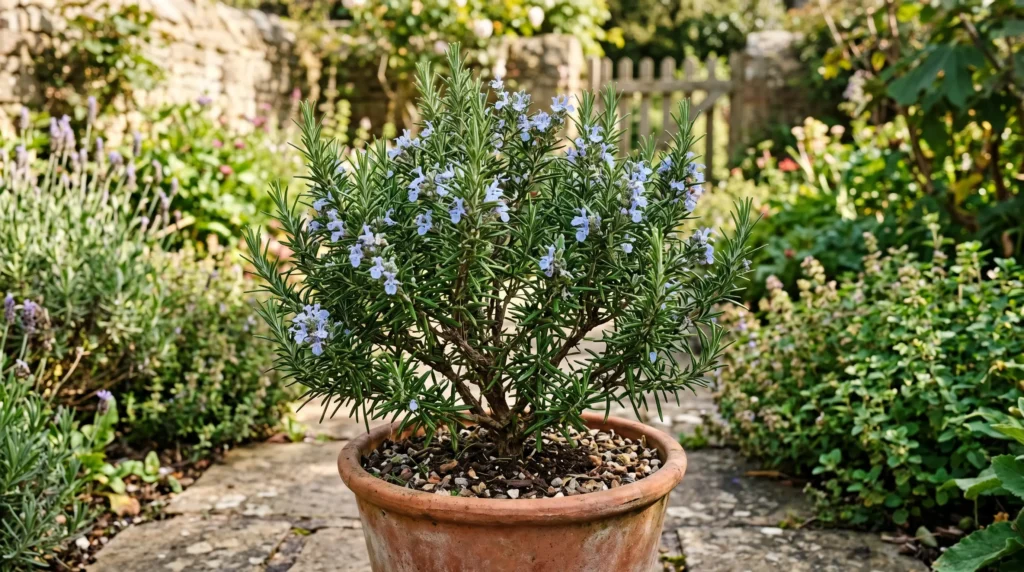
Flowers appear from late winter through to late spring (February to June in the UK), and sporadically through summer. They are small, two-lipped, and most commonly pale blue or violet, though cultivated varieties include white and pink. The flowers are rich in nectar and are among the first spring food sources for bumblebees.
Native habitat: Rocky Mediterranean coastlines, where shallow, alkaline, fast-draining soils and intense sun predominate. Understanding this origin explains every growing requirement: rosemary needs what its home provides — sunshine, sharp drainage, and lean soi
Best Rosemary Varieties for UK Gardens: Complete Comparison Guide
There are over 30 cultivated varieties of rosemary available in Britain, varying significantly in hardiness, height, growth habit, flower colour, and culinary quality. Choosing the right variety for your garden, region, and purpose is the single most important decision a UK rosemary grower makes.
UK Rosemary Variety Comparison Table
| Variety | Height | Habit | Flower Colour | Hardiness | Best For | RHS AGM |
| Miss Jessopp’s Upright | Up to 1.5m | Upright, columnar | Pale blue | Hardy to -15°C | All-round UK gardens, hedging, cooking | Yes |
| Arp | Up to 1.5m | Upright | Pale blue | Hardiest: -15°C+ | Scotland, Northern England, exposed sites | No |
| Prostratus (Trailing) | 20–30cm | Prostrate, trailing | Pale blue | Less hardy: -5°C | Walls, banks, containers (sheltered) | No |
| Capri | 60–80cm | Semi-trailing dome | Pale blue | Hardy to -10°C | Compact gardens, containers | No |
| Lady in White | 80cm | Upright | White | Hardy to -10°C | Ornamental, white flower gardens | No |
| Rosea | 80cm–1m | Upright | Pink | Hardy to -10°C | Cottage gardens, ornamental borders | No |
| Tuscan Blue | Up to 1.5m | Vigorous, upright | Deep blue | Hardy to -8°C | Culinary use, Mediterranean borders | No |
| Majorca Pink | 60cm | Compact, bushy | Pink | Hardy to -8°C | Patio containers, small gardens | No |
Which Rosemary Variety Should I Choose?
| QUICK DECISION GUIDE |
| Best all-rounder for any UK garden: Miss Jessopp’s Upright — reliable, hardy, excellent for cooking and hedging.
Best for Scotland, Northern England & exposed sites: Arp — the hardiest cultivar available, surviving temperatures below -15°C. Best for walls, slopes and raised bed edges: Prostratus — beautiful trailing habit. Grow in a sheltered south-facing position. Best for small gardens and patio containers: Capri or Majorca Pink — compact and manageable. Best for culinary flavour: Tuscan Blue — intense aromatic oil content; widely used in Italian and Mediterranean cookery. Best for white or pink flowers: Lady in White or Rosea — ornamental impact in mixed borders. |
A Critical Buying Tip: Choose British-Grown Rosemary
Rosemary is classified as a high-risk host plant for Xylella fastidiosa — a devastating bacterial disease with no cure that has already destroyed olive groves and lavender fields across southern Europe. The UK government and the RHS both advise purchasing British-grown rosemary plants to eliminate the risk of importing infected stock from affected European countries.
Practical rule: When buying from a UK garden centre or online nursery, look for ‘British-grown’ or ‘UK-grown’ on the label. If in doubt, ask. Propagating from cuttings taken from an established UK plant is the safest and most cost-effective approach.
How to Grow Rosemary in the UK: Complete Step-by-Step Guide
Growing rosemary in the UK is straightforward, provided two non-negotiable conditions are met: full sun and sharp drainage. Get those right and rosemary will largely look after itself for fifteen years or more. Get them wrong and no amount of care will save it.
Step 1: Choose the Right Position
Rosemary needs full sun — a minimum of 6 to 8 hours of direct sunlight daily. A south- or west-facing wall or border is ideal in the UK, providing reflected warmth and shelter from cold northerly and easterly winds. The sunnier the position, the stronger the essential oil content and aroma of the leaves.
Can rosemary grow in shade? Rosemary will survive in partial shade but will not thrive. Shaded plants produce leggy, weak growth with significantly reduced aromatic oils and are far more susceptible to fungal diseases.
Step 2: Prepare the Soil
The ideal soil for rosemary is free-draining, low-to-average fertility, and slightly alkaline to neutral — precisely the opposite of what most gardeners are taught to provide for their plants.
“For gardeners in northern England or Scotland where outdoor planting is riskier, container growing is the most reliable approach — the same principle applies to many Mediterranean-origin plants. Our guide to growing plants in containers UK covers the drainage and compost principles that apply directly to potted rosemary.”
| SOIL REQUIREMENTS AT A GLANCE |
| Ideal soil type: Loam, chalk, sandy — anything free-draining
pH range: 6.5–7.5 (neutral to slightly alkaline) Fertility: Low to average — rich, fertile soil causes soft, disease-prone growth Avoid: Heavy clay, waterlogged ground, low-lying areas that retain moisture Heavy clay fix: Raise planting area, dig in horticultural grit or sharp sand, use raised beds or containers Acidic soil fix: Add garden lime to raise pH toward 7.0 before planting |
Step 3: Plant Rosemary Correctly (How-To Steps)
- Choose your planting time — spring (after the last frost, typically March–May in the UK) is best. Autumn planting (September) also works well in milder southern regions.
- Select your plant — British-grown, healthy plug plant, 9cm pot, or established 2L shrub. Check for signs of rosemary beetle or yellowing.
- Prepare the planting hole — dig a hole twice the width of the root ball and no deeper.
- Improve drainage if needed — mix in one part horticultural grit to two parts existing soil. If your soil is clay-heavy, build a small raised mound to plant into.
- Plant at the right height: Set the plant so the root crown sits level with or very slightly above the soil surface. Burying the stem causes crown rot.
- Backfill and firm — do not add compost or additional feed. Rosemary prefers lean soil.
- Water in well — a thorough single watering to settle the roots.
- Mulch with gravel, not bark: A 5cm gravel mulch around the base keeps stems dry, suppresses weeds, and reflects warmth upward. Avoid bark mulch — it retains moisture and increases rot risk.
- Space plants 45–90cm apart (depending on variety) to allow airflow and future growth.
Step 4: Watering Rosemary in the UK
The cardinal rule: overwatering kills more rosemary in UK gardens than anything else — including frost. Once established (after the first growing season), rosemary is drought-tolerant and should be treated as such.
| Growth Stage | Watering Frequency |
| Year 1 (establishment) | Water during dry spells — when top 3–4cm of soil is dry |
| Established plants (Year 2+) | Only water during prolonged drought; otherwise leave alone |
| Container-grown plants | Allow compost to dry out between waterings; never let it sit in water |
| Winter | Minimal or none — cold + wet soil is the root rot recipe |
Step 5: Feeding Rosemary
Rosemary requires almost no feeding. Over-feeding with nitrogen-rich fertilisers causes exactly the kind of soft, sappy growth that attracts pests and collapses in cold weather.
- Recommended: One light application of a balanced organic fertiliser in early spring (March). This is optional for established plants in good soil.
- Avoid: High-nitrogen feeds (any NPK with N above 10). These produce weak, cold-susceptible growth.
- Container plants: Feed lightly in spring and summer with a balanced liquid feed at half the recommended strength.
Regional UK Growing Notes
| UK Region | Growing Advice |
| South East & East Anglia | Ideal conditions — most varieties thrive outdoors year-round. Gravel gardens and Mediterranean borders work well. |
| South West & Wales (west coast) | Wetter climate — prioritise drainage. Polytunnel growing is effective for wetter western areas. |
| Midlands | Good conditions — choose AGM varieties. Mulch container plants in hard frosts. |
| Northern England | Choose Arp or Miss Jessopp’s Upright. Grow in containers that can be moved under cover in severe winters. |
| Scotland | Grow in containers. Arp is the hardiest choice. Sheltered south-facing walls essential for outdoor planting. |
| Coastal gardens | Excellent performer — rosemary is salt-tolerant and thrives with coastal exposure and fast drainage. |
Rosemary Plant Care: Month-by-Month UK Calendar
A structured month-by-month care calendar for rosemary does not exist on any other major UK gardening website. This one is written specifically for British conditions, with notes for northern and southern regions where timing differs.
| Month | Care Tasks |
| January | Dormant. Check for rosemary beetle damage. Inspect container plants under shelter. Do not prune or feed. Order new plants from specialist nurseries. |
| February | Dormant. Remove any dead or frost-damaged stems with clean secateurs. Avoid disturbing the plant. Days lengthening — growth may begin by month’s end in southern England. |
| March | Growth resumes. Apply a single light dressing of balanced organic fertiliser. Move overwintered container plants back outdoors on frost-free days. Harden off gradually. |
| April | Main planting window opens. Plant young rosemary after the last frost (typically mid-April in southern England, late April–early May further north). Take softwood cuttings from shoot tips. |
| May | Flowering peak (March–May in the UK). Bees highly active. Harvest generously — this encourages fresh growth. Do not prune yet — wait for flowers to finish. |
| June | Post-flowering: prune lightly immediately after blooms fade — trim back by up to one-third of green growth. Take semi-ripe cuttings. Peak harvest for culinary use. |
| July | Prime semi-ripe cutting season. Established plants very drought-tolerant — do not water unless very prolonged dry spell. Watch for rosemary beetle (green and purple striped). |
| August | Continue semi-ripe cuttings (July–September window). Hot, dry weather suits rosemary well. Check container plants — they may need occasional watering. |
| September | Last planting window — plant outdoors for establishment before winter. Reduce watering. Take final semi-ripe cuttings. Start moving tender trailing varieties under shelter. |
| October | Apply gravel mulch around the base to protect roots and keep stems dry. Stop feeding entirely. Move container plants to a sheltered position (cold greenhouse or against a south-facing wall). |
| November | Full dormancy begins. Protect young (first-year) plants with horticultural fleece during hard frosts. Do not prune until spring — leave structure to protect the plant. |
| December | Dormant. No pruning, feeding or watering needed. Established plants hardy to -10°C will need no protection. Young plants in pots: bring under cover if temperatures drop below -5°C. |
How to Prune Rosemary and Take Cuttings: UK Guide
Why Pruning Rosemary Matters
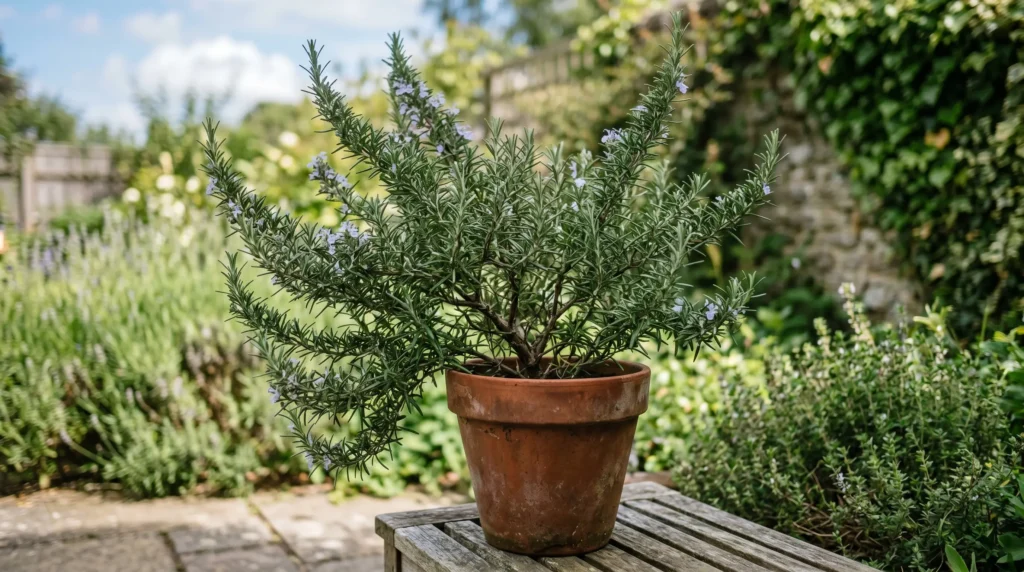
Rosemary that is never pruned becomes woody and bare at the base within five to seven years, producing little useful growth. Annual pruning redirects energy into fresh leafy stems, extends the plant’s productive life to 15–20 years, and maintains an attractive, bushy shape.
How to Prune Rosemary: Step-by-Step
- When: Prune immediately after flowering, typically June in southern England. Never prune in autumn or winter — this stimulates soft growth that cold weather kills.
- The golden rule: Never cut into old brown wood. Unlike lavender, rosemary does not regenerate from woody stems. Cut only green, leafy growth.
- Use clean, sharp secateurs. Blunt tools crush stems and invite disease.
- Remove up to one-third of the plant’s green growth. This is the safe pruning limit.
- Shape the plant as you prune — trim for a compact, mounded or columnar form depending on variety.
- For hedges: Prune to 60cm height in early summer to promote bushy, dense regrowth. Space plants 45cm apart.
- Leggy plants: Gradually restore shape by trimming a little more each year. Severe renovation pruning rarely works on rosemary — it is usually better to take cuttings and start afresh.
How to Propagate Rosemary from Cuttings (Best Method for UK Gardeners)
Propagating rosemary from cuttings is the most reliable and cost-effective way to multiply plants in the UK. Semi-ripe cuttings taken between July and September have the highest success rate.
| STEP-BY-STEP: SEMI-RIPE ROSEMARY CUTTINGS (JULY–SEPTEMBER) |
| Step 1: Select a healthy, non-flowering shoot from this year’s growth that has started to firm up slightly at the base — this is ‘semi-ripe’.
Step 2: Cut a stem of 8–10cm just below a leaf node using clean secateurs. Step 3: Strip the leaves from the lower two-thirds of the cutting, leaving 3–4 pairs of leaves at the tip. Step 4: Dip the cut end in rooting hormone powder (available at all UK garden centres). Step 5: Insert into a 50/50 mix of compost and perlite (or horticultural grit) in a 9cm pot with good drainage. Step 6: Cover with a clear polythene bag or propagator lid. Place in a warm, bright location — not direct sun. Temperature: 18–21°C. Step 7: Roots develop in 4–8 weeks. Test gently — if the cutting resists a gentle pull, roots have formed. Step 8: Pot on into a 1L pot of gritty compost. Grow on under cover through the winter. Plant outdoors in spring. |
Layer Propagation (No-Equipment Alternative)
Layering works well for trailing or semi-trailing varieties. Select a long, flexible stem and bend it to the ground. Bury a 10cm section under 2–3cm of gritty soil, leaving the tip exposed. Pin it in place with a wire peg or a stone. Keep the area moist. After 8–12 weeks, roots will form at the buried section. Sever from the parent plant and pot up
Common Rosemary Problems in the UK: Diagnosis & Solutions
Rosemary is generally a trouble-free plant, but a small number of problems — almost all preventable — account for the vast majority of failures in UK gardens. Here is how to identify and fix each one.
| Problem | Cause | Solution |
| Wilting / yellowing leaves | Root rot from overwatering or waterlogged soil — the #1 killer in UK gardens | Improve drainage immediately. Reduce watering. If in a pot, repot into gritty compost. Remove rotten roots. |
| Woody, bare base | Insufficient or absent pruning over several years | Prune by one-third of green growth annually after flowering. If too woody, take cuttings and start a new plant. |
| Leggy, weak, pale growth | Insufficient sunlight, or excess nitrogen feeding | Move to a sunnier position. Stop feeding. Prune back gently to stimulate compact regrowth. |
| Not flowering | Too much shade, soil too acidic, or over-pruning | Relocate to full sun. Test soil pH and adjust with lime. Ensure you are not pruning before flowering. |
| Brown patches after frost | Young or container plants exposed to hard frost without protection | Remove dead stems to healthy green growth in spring. Protect first-year plants with fleece next winter. |
| Rosemary Beetle | Chrysolina americana — iridescent green/purple striped beetle increasing in the UK, especially in the south | Hand-pick beetles and larvae (grey, slug-like). Shake stems over a sheet to dislodge them. Use pyrethrum spray as a last resort. |
| Powdery Mildew | Fungal disease caused by poor air circulation and high humidity | Improve airflow by pruning. Avoid overhead watering. Remove affected stems. Spray with potassium bicarbonate solution. |
| Root Rot (Phytophthora) | Fungal pathogen thriving in waterlogged, poorly drained soil | Prevention only: sharp drainage, avoid clay soils, gravel mulch around base. Infected plants cannot be cured. |
| Xylella fastidiosa risk | Bacterial disease imported on non-UK-grown stock | Prevention only: always buy British-grown rosemary. There is no treatment once a plant is infected. |
How to Harvest and Store Rosemary from Your UK Garden
Rosemary is an evergreen and can be harvested year-round — one of its great advantages over annual herbs. However, timing, technique, and storage method all affect flavour quality.
When to Harvest Rosemary for Best Flavour
The afternoon rule: Essential oil concentration in rosemary peaks in the early afternoon on warm, sunny days — after the morning dew has dried and before the heat of the day dissipates the volatile oils. Harvest between noon and 2pm on dry days for the most aromatic sprigs.
The growing season (spring and summer) produces the most tender, flavourful new shoots. Winter harvests are perfectly usable but the leaves will be slightly tougher.
How to Harvest Without Damaging the Plant
- Pull small sprigs (up to 10cm) away from the main stem by hand for everyday kitchen use.
- Use clean secateurs for larger branches or when harvesting for drying.
- Never remove more than one-third of the plant at a time — rosemary is slow to regrow and heavy harvesting stresses the plant.
- Cut from the tips of new growth — avoid cutting into old woody stems.
How to Dry and Store Rosemary
| Storage Method | How To | Shelf Life |
| Drying (recommended) | Spread on a baking tray in an airing cupboard, or hang in bunches in a warm, dry room. Leaves are dry when they crumble easily. | 6–12 months in an airtight jar, away from light |
| Fresh in water | Stand stems in a glass of water like cut flowers. Keep at room temperature. | 7–10 days |
| Infused oil | Pack fresh sprigs into a sterilised bottle, cover with good olive oil. Use within 2 weeks. Refrigerate. | 2 weeks (refrigerated) |
| Freezing | Not recommended — rosemary loses flavour and turns brown when frozen. | N/A — avoid |
Rosemary in the Kitchen: British Cooking, Baking & Drinks Guide
Rosemary is one of the most versatile culinary herbs available to British home cooks. Its strong, piney, slightly resinous flavour pairs exceptionally well with fat and richness, making it the natural companion to the great British roast — and far more besides.
Flavour Profile and Cooking Principles
Flavour profile: Piney, camphor, woodsy, with a hint of citrus and bitterness. The flavour is assertive and holds up well to high heat and long cooking times — unlike delicate herbs such as basil or tarragon.
Classic British Rosemary Pairings
- Roast lamb with rosemary and garlic: The definitive British combination. Stud a leg of lamb with garlic and rosemary sprigs, roast on a bed of onions.
- Roast potatoes: Toss in goose fat or olive oil with fresh rosemary sprigs and flaky sea salt. The heat crisps the needles into fragrant seasoning.
- Roast chicken: Stuff the cavity with a lemon, garlic, and rosemary. Tuck sprigs under the skin for perfumed, golden flesh.
- Pork: Rosemary-rubbed pork belly or shoulder is a staple of British gastropub menus.
- Casseroles and stews: Add a sprig early in the cooking process — remove before serving as the woody stem is inedible.
- Tomato-based sauces and baked fish: A sprig of rosemary transforms a simple tomato sauce or a fillet of sea bass.
Rosemary in Baking (A Growing UK Trend)
- Rosemary focaccia: The UK’s fastest-growing artisan bread. Dimple the dough, press in rosemary sprigs and sea salt, drizzle with olive oil, and bake until golden.
- Rosemary and sea salt shortbread: A Scottish twist on a classic — the herb’s resinous note cuts through buttery sweetness beautifully.
- Rosemary-infused honey: Warm honey gently with a sprig of rosemary for 10 minutes. Strain and bottle. Excellent on cheese boards or drizzled over yoghurt.”A kitchen herb garden paired with a soft fruit patch is one of the most rewarding combinations a British home gardener can create. If you enjoy harvesting fresh flavours from your own plot, our complete guide to growing strawberries at home UK is the natural next step.”
Rosemary in Drinks and Cocktails
- Rosemary gin and tonic: Muddle a small sprig in the glass before adding gin — or use it as a garnish with a slice of lemon. London dry gin works particularly well.
- Rosemary simple syrup: Dissolve equal parts sugar and water with two sprigs of rosemary over low heat. Strain and cool. Use in cocktails, lemonades, and mocktails.
- Rosemary tea: Steep 1–2 teaspoons of fresh rosemary leaves in boiling water for 5–8 minutes. Strain. Add honey to taste. Mildly earthy and warming.
Fresh vs Dried Rosemary: When to Use Each
| Fresh Rosemary | Dried Rosemary | |
| Intensity | Brighter, more herbal and floral | More concentrated, slightly more bitter |
| Best for | Marinades, garnishes, infusions, roasting | Slow-cooked dishes, spice rubs, baking |
| Conversion | 1 tablespoon fresh | = 1 teaspoon dried |
| UK availability | Year-round from the garden | Year-round from the jar |
| Edible whole? | Leaves yes; woody stems no | Crumbled leaves only |
| MEDICAL DISCLAIMER |
| The information in this section is provided for informational purposes only and does not constitute medical advice. Rosemary used in cooking is safe for the vast majority of people. For medicinal use, dosages, or if you take prescription medication, always consult your GP or a qualified healthcare professional. |
Rosemary Plant Health Benefits: What the Evidence Actually Shows
Rosemary has been used medicinally for thousands of years across Europe and the Mediterranean. Modern science has begun to investigate many of these traditional uses — with some compelling, and some more modest, findings.
Key Bioactive Compounds in Rosemary
| Compound | What It Does |
| Rosmarinic acid | Powerful antioxidant and anti-inflammatory; may reduce allergic reactions |
| Carnosic acid | Antioxidant; shown in studies to slow cancer cell growth and protect brain cells |
| Carnosol | Anti-inflammatory; studied for potential anti-tumour activity |
| 1,8-Cineole (eucalyptol) | The compound responsible for rosemary’s characteristic scent; studied for cognitive effects |
| Ursolic acid | Anti-inflammatory; supports liver health |
Rosemary for Hair Growth: What the Research Shows
High-search-volume question: Does rosemary oil help hair growth?
A widely cited 2015 clinical trial published in SkinMed Journal compared rosemary oil directly with 2% minoxidil (a common hair loss treatment) in patients with androgenetic alopecia (pattern baldness). After six months, both groups showed statistically equivalent increases in hair count. The rosemary oil group reported significantly less scalp itching as a side effect.
| HOW TO USE ROSEMARY OIL FOR HAIR GROWTH |
| Method 1 — DIY rosemary oil: Simmer 3–4 sprigs of fresh rosemary in 250ml of a carrier oil (jojoba or coconut oil) over very low heat for 20 minutes. Cool, strain, and bottle.
Method 2 — Commercial rosemary oil: Use 3–5 drops of pure rosemary essential oil diluted in a tablespoon of carrier oil — never apply essential oil neat to the scalp. Application: Massage into the scalp for 2–3 minutes, 2–3 times per week. Leave on for at least 30 minutes before washing. Timeline: Clinical studies show results after 3–6 months of consistent use. Patience is essential. Precaution: Discontinue if scalp irritation occurs. Not a replacement for medical treatment for significant hair loss. |
Memory and Cognitive Function
The association between rosemary and memory is ancient — Greek scholars wore rosemary garlands during examinations. Modern research offers partial support. A 2012 study by Dr Mark Moss at Northumbria University found that people working in a room diffused with rosemary aroma scored significantly higher on prospective memory tests — the ability to remember to do something in the future.
Researchers attribute this to 1,8-cineole — a key compound in rosemary essential oil that has been detected in the bloodstream after inhalation and is thought to inhibit the breakdown of acetylcholine, a neurotransmitter involved in memory.
Digestive Health
Rosemary has been approved by Germany’s Commission E for the treatment of dyspepsia (nonspecific digestive discomfort). Traditional use across Europe includes rosemary infusions for bloating, sluggish digestion, and liver support. The herb is thought to stimulate bile production and support gallbladder function.
Antioxidant and Anti-Inflammatory Properties
Rosmarinic acid and carnosic acid — both abundant in rosemary — are well-documented antioxidants. Laboratory studies suggest these compounds may protect cells against oxidative stress, which is implicated in chronic diseases including type 2 diabetes, cardiovascular disease, and some cancers. Large-scale human clinical trials are still needed, but the mechanistic evidence is promising.
Safety and Precautions
| Group | Advice |
| Pregnant women | Avoid medicinal doses — rosemary can stimulate uterine contractions. Culinary quantities in cooking are considered safe. |
| Blood thinner medication (warfarin) | Rosemary may enhance anticoagulant effects. Consult your GP before using medicinally. |
| ACE inhibitors / diuretics | Rosemary may interact. Consult your GP. |
| Epilepsy | High doses of rosemary essential oil may trigger seizures in susceptible individuals. |
| General culinary use | Safe for all. No restrictions apply. |
Rosemary in UK Garden Design: Ideas, Styles & Companion Plants
Mediterranean Garden Style
Rosemary is the structural anchor of the Mediterranean garden — a planting style that has surged in popularity across the UK as gardeners seek lower-maintenance, drought-tolerant borders. Pair upright rosemary with lavender, thyme, sage, santolina, and cistus in a gravel or stone-mulched bed for a garden that evokes the south of France and requires almost no watering once established.
Cottage Garden Style
Upright rosemary varieties provide year-round structural interest in the cottage garden, holding their form through winter when surrounding perennials have died back. Plant among hardy geraniums, alliums, and salvia for a relaxed, fragrant combination.
Formal Hedging
Best variety for hedging: Miss Jessopp’s Upright. Plant 45cm apart in a single row and clip to 60cm after flowering each year for a neat, fragrant, low-maintenance formal hedge.
Container and Patio Design
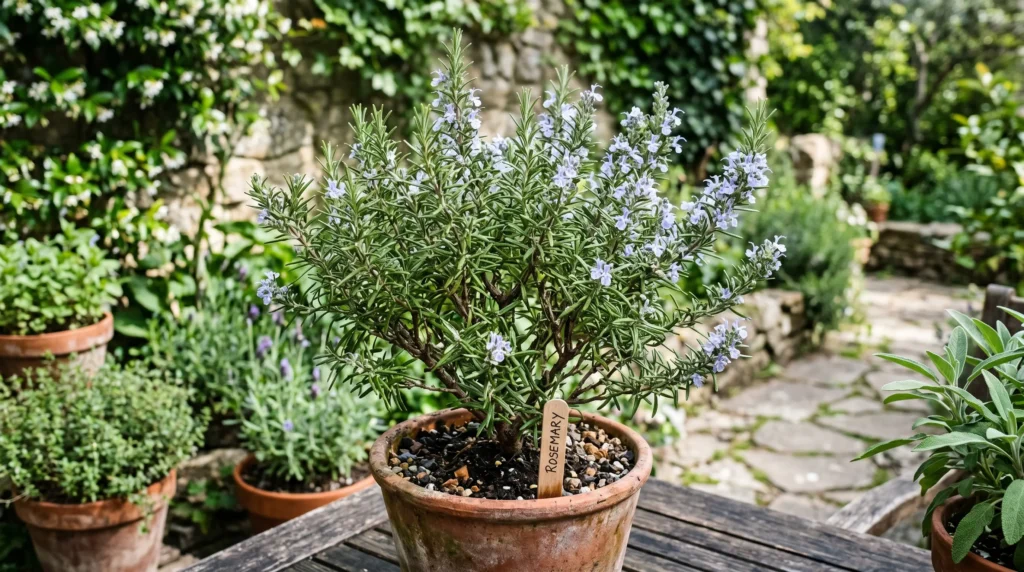
Rosemary is an excellent container plant for British patios and balconies. Use terracotta pots — their porosity improves drainage and their thermal mass helps insulate roots. Trailing varieties such as Prostratus create a dramatic effect cascading over pot edges or wall tops.
Rosemary as a Pollinator Plant
Rosemary flowers in early spring (March–May in the UK) — one of the first significant nectar sources available after winter. This makes it genuinely valuable for supporting early-season bumblebee populations, including the buff-tailed bumblebee (Bombus terrestris). The RHS lists rosemary as a ‘Plants for Pollinators’ plant.
“Rosemary’s early spring flowers (March–May) pair beautifully in a pollinator border with late spring and early summer bulbs. Alliums, which flower just as rosemary finishes, are the perfect succession planting partner — see our Allium Plants UK Garden Guide for variety recommendations and growing advice.”
Companion Planting with Rosemary
| Plant | Companion Effect |
| Sage | Good companion — both share Mediterranean growing needs; similar spacing and care requirements |
| Thyme | Excellent companion — compatible growing conditions; together form a productive herb bed |
| Lavender | Natural pairing — similar soil and sun needs; extends the pollinator season either side of rosemary’s flowering |
| French beans | Rosemary is thought to deter Mexican bean beetles and other bean pests |
| Brassicas (cabbage, broccoli) | Rosemary aroma may confuse and deter cabbage moth and cabbage white butterflies |
| Carrot | Rosemary may mask carrot scent and deter carrot root fly |
| Mint | Avoid — mint requires moist soil, the opposite of rosemary’s needs |
| Basil | Avoid planting in the ground together — different water requirements; fine in separate containers |
Rosemary History, British Folklore & Cultural Symbolism
Where Does the Name ‘Rosemary’ Come From?
The name rosemary derives from the Latin ros marinus — ‘dew of the sea’ — a reference to its native Mediterranean coastline habitat, where the plant grows wild above the salt-spray line on rocky clifftops. The name is unrelated to the female name Rose or Mary, though popular folklore frequently makes this connection.
Ancient History
- Ancient Egypt: Rosemary sprigs have been found in pharaonic tombs dating to 3000 BCE, placed as offerings and to preserve the dead.
- Ancient Greece: Students wore rosemary garlands during examinations — the connection between rosemary and memory is at least 2,500 years old. Greek healers used it to stimulate circulation and lift mood.
- Ancient Rome: Roman soldiers brought rosemary north through Europe. It was used in cooking, medicine, and religious ceremony, and was grown in monastery gardens across Britain from the early medieval period.
British Folk Traditions and Folklore
No other herb has deeper roots in British folk culture than rosemary. The traditions recorded across England, Wales, and the Channel Islands reveal a plant that was simultaneously protective, lucky, and profoundly symbolic.
- ‘Rosemary for remembrance’: The most famous rosemary association in British culture comes from Shakespeare’s Hamlet (c.1600): Ophelia says, ‘There’s rosemary, that’s for remembrance; pray you, love, remember.’ The association predates Shakespeare — rosemary was carried at funerals across England and Wales for centuries.
- Wedding tradition: Brides carried rosemary in their bouquets as a symbol of fidelity and remembrance. Sprigs were dipped in scented water and given to wedding guests. This tradition persisted across England and parts of Wales into the twentieth century.
- Good luck charm: Planting rosemary by the front door was a widespread English tradition believed to bring good fortune to the household — and to keep away witches and evil spirits, as recorded in Suffolk as recently as 1989.
- ‘Where rosemary flourishes, the woman rules’: A widely recorded English proverb, reflecting the superstition that rosemary thriving in a garden indicated female authority in the home. Some men were known to secretly uproot thriving rosemary for this reason.
- Never buy rosemary — it must be given: A tradition recorded in Gwent, Wales, and across several English counties holds that purchasing rosemary brings bad luck. The plant should always be received as a gift.
- Hair and dandruff remedy: Boiling rosemary in water and using the cooled liquid as a hair rinse is a tradition recorded across multiple English counties — a folk practice that modern research on rosemary’s DHT-blocking properties has given new credibility.
Rosemary in Modern British Commemoration
ANZAC Day and Remembrance Sunday: Rosemary sprigs are worn and laid at war memorials on both occasions in the UK and Australia, continuing the ‘for remembrance’ tradition. Fresh sprigs are regularly placed at London war memorials in Southwark and elsewhere.
Hungary Water (c.1370): The first recorded alcohol-based perfume — made from rosemary flowers steeped in alcohol — was reportedly created for Queen Elizabeth of Hungary. It remained in production for centuries and is an important milestone in European perfumery history
Where to Buy Rosemary Plants in the UK (2025 Guide)
Why Buying British-Grown Matters
The single most important factor when purchasing rosemary in the UK is choosing British-grown stock. Rosemary is classified as a high-risk host for Xylella fastidiosa — a bacterial disease with no cure that has devastated plant populations across southern Europe. Importing infected plants poses a real threat to UK gardens.
Types of Rosemary Plant Available
| Plant Type | Approximate Price | Pros | Cons |
| Plug plants | £1–3 each | Cheapest; good for bulk planting | Require more aftercare; slower to establish |
| 9cm pot plants | £3–6 each | Good balance of cost and size; widely available | Smaller than established shrubs |
| 2–3L established shrubs | £8–15 each | Best for beginners; faster to establish and harvest from | Higher cost per plant |
| Supermarket ‘kitchen herb’ pots | £1–2 | Extremely cheap; can be potted on outdoors | Multiple plants in one pot need separating; roots often pot-bound |
Where to Buy: UK Sources
- RHS Plant Finder (rhs.org.uk): The best free tool for finding specialist UK nurseries stocking specific rosemary varieties near you.
- Specialist herb nurseries: Norfolk Herbs (norfolkherbs.co.uk), Jekka’s Herb Farm (jekkas.com), Poyntzfield Herb Nursery (Scotland) — all sell UK-grown stock of multiple varieties.
- RHS Plants (rhsplants.co.uk): AGM-verified plants dispatched from their nursery partners. Reliable and rigorously quality-controlled.
- Garden centres: Dobbies, Blue Diamond, and most independent garden centres carry rosemary spring through autumn. Quality varies — check for British-grown labelling.
- Online mail order: Check dispatch method (bare-root or pot), pot size, and whether the nursery is UK-based. Reputable online nurseries dispatch in protective packaging to prevent root damage.
- Supermarket pots: Tesco, Sainsbury’s, and M&S sell kitchen rosemary pots for under £2. These can be carefully separated into individual plants and potted on outdoors in spring — a cost-effective way to get multiple plants.
Rosemary Plant FAQ: The UK’s Most-Asked Questions Answered
The following Q&A pairs are written for clarity and concision, optimised to appear in Google’s People Also Ask feature and AI knowledge snapshots. Each answer is self-contained.
Q: Is rosemary a perennial in the UK?
A: Yes. Rosemary (Salvia rosmarinus) is a hardy evergreen perennial in the UK. It does not die back in winter and keeps its leaves year-round. Once established, it can survive temperatures down to -10°C to -15°C depending on the variety, making it reliably perennial across most of Britain.
Q: Does rosemary come back every year in the UK?
A: Yes. Rosemary is an evergreen perennial and does not die back each year. Provided it is planted in a well-drained, sunny position, it will remain in leaf and growth year-round. It is not an annual herb and does not need to be replanted each season.
Q: How long does a rosemary plant live in the UK?
A: A well-cared-for rosemary plant can live for 15 to 20 years in UK conditions. The key to longevity is annual pruning after flowering (to prevent woodiness), sharp drainage, and a sunny position. Even with good care, many gardeners choose to replace plants every 7–8 years with vigorous young cuttings.
Q: How often should I water rosemary in the UK?
A: Established rosemary (over 1 year old) in UK garden soil requires almost no supplemental watering — it is drought-tolerant and the UK’s rainfall is typically sufficient. Water only during prolonged dry spells of two weeks or more. Container-grown rosemary needs watering when the top 3–4cm of compost is dry, but should never sit in standing water.
Q: Can rosemary grow in shade in the UK?
A: Rosemary will survive in partial shade but does not thrive. It requires a minimum of 6–8 hours of direct sunlight daily for best growth, flavour, and flowering. Shaded rosemary produces leggy, weak growth with poor aromatic oil content and is more susceptible to fungal diseases.
Q: When does rosemary flower in the UK?
A: Rosemary typically flowers from late February through to May or June in the UK, depending on variety and location. In mild southern regions, flowering can begin as early as February. In northern England and Scotland, the main flush is April to June. Some varieties produce a second, lighter flush in late summer and autumn.
Q: Why is my rosemary turning brown and dying?
A: The most likely cause is root rot, caused by overwatering or waterlogged soil — the single most common cause of rosemary death in UK gardens. Check drainage immediately. Other causes include frost damage to young plants, rosemary beetle infestation, or natural woodiness from lack of pruning. Cut back to healthy green growth; if the base is entirely brown and dead, the plant cannot recover.
Q: Can I grow rosemary indoors in the UK?
A: Yes, but with difficulty. Rosemary indoors needs a south-facing window with at least 6 hours of direct light, good airflow, and excellent drainage. Central heating creates dry air that rosemary tolerates, but insufficient light is the most common reason indoor rosemary fails. A grow light supplement can help in winter. Outdoor growing is strongly preferred in the UK.
Q: Is rosemary frost-hardy in the UK?
A: Yes. Most established rosemary plants are frost-hardy across the UK, tolerating temperatures down to -10°C to -15°C. The hardiest variety, Arp, survives below -15°C. Young plants in their first year and trailing varieties (such as Prostratus) are less frost-tolerant and should be protected with fleece or moved under cover during hard frosts.
Q: How do I stop rosemary going woody?
A: The only effective prevention is annual pruning immediately after flowering (typically June in the UK). Cut back up to one-third of the green, leafy growth — never cut into old brown wood, as rosemary will not regenerate from it. If a plant is already severely woody, take cuttings to propagate new plants, as rosemary rarely recovers from heavy renovation pruning.
Q: Can I use supermarket rosemary to grow a new plant?
A: Yes. Supermarket rosemary pots (sold as kitchen herbs in Tesco, Sainsbury’s, and elsewhere) typically contain several individual seedlings. These can be separated carefully, potted into gritty compost in individual 9cm pots, and grown on outdoors in spring. You can also take cuttings from fresh supermarket sprigs and attempt to root them — success rate is variable but possible.
Q: Is rosemary safe for dogs and cats?
A: Rosemary is generally considered non-toxic to dogs and cats in small quantities. The ASPCA does not list rosemary as toxic to either species. However, very large quantities may cause gastrointestinal upset in pets. Rosemary essential oil should never be applied to or ingested by pets. If concerned, consult your veterinarian.
Q: What is the difference between rosemary and lavender?
A: Rosemary (Salvia rosmarinus) and lavender (Lavandula spp.) are both Mediterranean herbs in the Lamiaceae family with similar growing requirements. Key differences: rosemary has narrow, needle-like dark green leaves and a piney, savoury aroma; lavender has softer, grey-green leaves and a floral, sweet scent. Rosemary is primarily culinary and ornamental; lavender is primarily ornamental and aromatic. Rosemary flowers are small and blue; lavender flowers are tall purple spikes.
Q: How big does rosemary grow in the UK?
A: Most upright rosemary varieties reach 1 to 1.5 metres in height and 60–90cm in spread after several years in the UK. Compact varieties such as Capri and Majorca Pink stay at 60–80cm. Trailing varieties (Prostratus) grow to 20–30cm in height but can spread to 1 metre or more. Growth is slow — expect 15–30cm of new growth per year in UK conditions.
Conclusion: Your Three Golden Rules for Rosemary Success in the UK
If you take nothing else from this guide, take these three principles. They separate thriving rosemary from struggling rosemary in almost every UK garden failure we have described above.
| THE THREE GOLDEN RULES |
| RULE 1 — FULL SUN: Plant in the sunniest spot you have. A south-facing wall or border with 6+ hours of direct sun daily is non-negotiable. Shade produces weak, flavourless growth.
RULE 2 — SHARP DRAINAGE: Never plant in clay, waterlogged, or moisture-retentive soil. Amend with grit, build a raised mound, or grow in a well-drained container. The number one killer of rosemary in the UK is wet roots, not frost. RULE 3 — BENIGN NEGLECT: Rosemary thrives on neglect. Do not overwater, overfeed, or overprune. One annual trim after flowering and a single light spring feed is all that is needed. Then step back and let the plant do what it does best. |
Start with one plant — ideally Miss Jessopp’s Upright from a British nursery, planted into a gritty, sunny border in spring. By summer, you will be harvesting; by autumn, you will be taking cuttings to make more. Within three years, rosemary will be as permanent a fixture in your kitchen as salt.
Further reading on this site: How to Prune Rosemary · The Best Herbs for a UK Garden · Mediterranean Garden Design for British Conditions · Rosemary Hair Growth Oil: Step-by-Step Guide
SCHEMA IMPLEMENTATION NOTES (FOR DEVELOPER)
- Implement FAQPage schema for all Q&A pairs in Section 14
- Implement HowTo schema for Section 6 (Cuttings) and Section 4 (Planting steps)
- Implement Article schema with dateModified, author, and publisher fields
- Add Table markup for all comparison tables
- Breadcrumb schema: Home > Herb Guides > Rosemary Plant

Leave a Reply