
There is a profound difference between a supermarket strawberry and one you have picked from your own garden. The moment you bite into a sun-warmed Cambridge Favourite or a tiny fragrant alpine berry fresh from the plant, you understand why home-grown fruit is worth every effort.UK strawberry production is worth approximately £389 million annually (AHDB, 2024), making it the nation’s most commercially important soft fruit. Yet the vast majority of British gardeners have never grown their own.
The good news: strawberries are among the easiest fruits to grow in the UK, requiring little space, modest care, and rewarding even a complete beginner with a delicious harvest.This guide covers everything from choosing the right UK variety to harvesting a bumper crop from June all the way to October. It is informed by RHS guidance, AHDB data, and the accumulated wisdom of British horticulture.
Whether you have a large garden, a small patio, or a single windowsill, there is a strawberry growing method for you.
| ARTICLE SCHEMA — Article | Author: UK Horticulture Expert | datePublished: 2025 | dateModified: 2025 | BreadcrumbList: Home > Gardening > Fruit Growing > Strawberry Plants UK |
What Is a Strawberry Plant? Definition and Key Terms
A strawberry plant (Fragaria × ananassa for cultivated types; Fragaria vesca for alpine/wild types) is a low-growing perennial fruit plant in the rose family (Rosaceae). It produces sweet, red fruit from late spring to autumn depending on the variety type.Understanding the terminology used in UK nurseries and growing guides helps you buy, plant, and care for strawberries correctly. The following definitions are self-contained for direct reference.
Key Terms Defined
What is a Strawberry Runner?
A strawberry runner is a long, thin stem that a mature strawberry plant sends out horizontally across the soil. At the end of this stem, a new plantlet develops with its own roots. Runners are the primary method of propagating strawberry plants in the UK.
What is a Bare-Root Runner?
A bare-root runner is a dormant strawberry plant sold without soil around its roots. The plant looks like a small clump of fibrous roots with minimal leaves. Bare-root runners are the most economical way to buy strawberry plants (typically £1–2 each) and are available from UK nurseries between November and March.
What is a Plug Plant?
A strawberry plug plant is a young plant grown in a small cell of compost. It has an established root system and is ready to plant directly into its final position. Plug plants are more expensive than bare-root runners (£2–4 each) but establish faster and produce fruit sooner after planting.
What is a Cold-Stored Runner?
A cold-stored runner is a strawberry plant that has been kept in cold storage (at around 0°C) to delay its growth cycle. When planted in summer, it produces fruit 60–70 days later. Cold-stored runners allow UK gardeners and commercial growers to extend the strawberry season into late summer and autumn.
What Does ‘Crown’ Mean in Strawberry Growing?
The crown is the central growing point of a strawberry plant — the junction where the leaves emerge from the root system. Correct crown depth at planting is critical: the crown must sit exactly at soil level. Too deep causes crown rot; too shallow causes the plant to dry out and die.
What is an RHS AGM Variety?
RHS AGM stands for Royal Horticultural Society Award of Garden Merit. A strawberry variety that has received an AGM award has been rigorously trialled by the RHS and proven to perform reliably in UK garden conditions. AGM varieties are a trustworthy choice for British gardeners.
What is Certified Virus-Free Stock?
Certified virus-free stock refers to strawberry plants that have been tested and guaranteed free from the common strawberry viruses (Strawberry crinkle virus, Strawberry mottle virus, Strawberry mild yellow edge virus). Buying certified virus-free stock is the single most important buying decision a UK gardener can make, as virus infection causes progressive yield decline with no cure.
| THE 4 TYPES OF UK STRAWBERRY PLANTS |
The 4 Types of Strawberry Plants: What Most Guides Get Wrong
There are four distinct types of strawberry plant grown in UK gardens. Understanding the difference is essential for planning your harvest season, choosing the right varieties, and matching plants to your space. Most guides cover only three types; the fourth — heritage and heirloom varieties — is increasingly popular among flavour-focused UK gardeners.
Summer-Fruiting Strawberries
Definition: Summer-fruiting strawberries produce a single, concentrated crop over two to three weeks between June and early August. They are the most commonly grown type in the UK and produce the heaviest yields of any strawberry type.
- Harvest window: June to early August (depending on variety)
- Fruit size: Large to very large
- Runner production: Prolific — excellent for propagation
- Best for: Jam-making, preserves, pick-your-own, families wanting a seasonal glut
- Growing method note: Growing under cloches or in an unheated greenhouse pushes harvest 3–4 weeks earlier
Sub-categories: Early-season (May–June), mid-season (June–July), and late-season (July–August). Planting a combination of all three extends your summer-fruiting harvest across the full season.
| Key UK summer-fruiting varieties: Honeoye (early), Elsanta (mid), Florence (late), Sonata (mid), Cambridge Favourite (mid) |
Perpetual / Everbearing Strawberries
Definition: Perpetual (everbearing) strawberries produce fruit in repeated smaller flushes from June through to the first frost, typically October or November in the UK. They do not produce a single large crop but instead provide a steady trickle of berries across a long season.
- Harvest window: June to October/November
- Fruit size: Small to medium, but intensely flavoured
- Runner production: Few runners; plant energy goes into fruit production
- Best for: Patio gardeners, small spaces, snacking, extending the season past August
| Key UK perpetual varieties: Mara des Bois, Flamenco, Buddy, Albion |
Alpine (Wild) Strawberries — Fragaria vesca
Definition: Alpine strawberries (Fragaria vesca) are the wild ancestors of modern cultivated strawberries. They produce tiny, intensely aromatic fruits continuously from June to October. Unlike other strawberry types, alpine varieties can be reliably grown from seed.
- Harvest window: June to October
- Fruit size: Very small — pea-sized to fingertip-sized
- Runner production: Variable; some produce runners, some do not
- Shade tolerance: High — the only strawberry type that crops reliably in partial shade
- Best for: Edging paths and borders, woodland gardens, container edges, shaded patio spots
- Bird resistance tip: White and yellow-fruited alpine varieties (e.g. White Soul) are overlooked by birds, who mistake them for unripe fruit — a significant practical advantage in UK gardens
| Key UK alpine varieties: Mignonette, Alexandria, Baron Solemacher, White Soul, Pineapple Crush |
Heritage & Heirloom Varieties (The Gap No Competitor Covers)
Definition: Heritage and heirloom strawberry varieties are older, pre-commercial cultivars prized for exceptional flavour rather than yield or disease resistance. They are increasingly sought by UK kitchen gardeners and growers who prioritise taste over productivity.
- Royal Sovereign: The classic Victorian variety (introduced 1892). Exceptional, complex flavour; medium yield; susceptible to powdery mildew.
- Norfolk Nectar: A UK-bred cross between Chapelaine and Royal Sovereign, developed by Chris Bowers & Sons. Large blossoms over a long period; excellent first-year flavour; good late-frost resilience.
- Trade-off: Heritage varieties offer lighter yields, lower disease resistance, and shorter fruit shelf life than modern cultivars — but for gardeners who prioritise taste, they are unmatched.
Quick-Reference Comparison Table: The 4 Types at a Glance
| Schema: This table is formatted as a structured answer for AI extraction. Each row is a self-contained data point. |
| Type | Harvest Window | Fruit Size | Runners | Best For |
| Summer-fruiting | June – early Aug | Large | Plentiful | Jams & big harvests |
| Perpetual | June – Oct/Nov | Small–Med | Few | Snacking & patios |
| Alpine | June – Oct | Tiny | Variable | Borders & shade spots |
| Heritage | Early–Mid season | Med–Large | Some | Flavour enthusiasts |
| BEST UK STRAWBERRY VARIETIES (DEFINITIVE COMPARISON) |
Best Strawberry Varieties for UK Gardens: The Definitive Guide
Choosing the right strawberry variety is the single most important decision you will make when growing strawberries in the UK. This section covers 15+ varieties with RHS AGM status, cropping times, disease resistance ratings, and honest assessments of each. Use the comparison table at the end of this section to select the right variety for your garden.
Early-Season Varieties (Crop: May–June)
Honeoye
- RHS AGM winner. Large, vivid red berries with excellent juice and sweetness.
- Crops up to one week ahead of mid-season varieties — ideal for the first strawberry of summer.
- Disease resistance: Good. Performs well in containers and open ground.
- Best for: Gardeners who want the earliest possible harvest.
Alice
- Bred at HRI East Malling — outstanding results in UK variety trials.
- Excellent early performer. Firm fruit suitable for containers and raised beds.
- Good disease resistance including Verticillium Wilt.
Mid-Season Varieties (Crop: June–July)
Cambridge Favourite
- The benchmark UK variety for 60+ years. Beginner-friendly and RHS-proven reliable.
- Yield: 400–600g per plant. Resistant to Verticillium Wilt.
- Grows equally well in pots, raised beds, and open ground.
- Verdict: The closest UK equivalent to a Swiss Army knife strawberry plant — reliable in almost every situation.
Elsanta
- Commercial favourite and the standard for UK pick-your-own farms.
- Large, firm, bright-red fruit with a balanced sweet-tart flavour.
- Slightly demanding on soil quality — performs best in rich, well-drained beds.
- Disease resistance: Moderate. Better suited to experienced growers.
Sonata
- Large, weather-resistant fruit. Excellent for jams and desserts.
- Strong mid-season yield. Handles wet UK summers better than Elsanta.
Late-Season Varieties (Crop: July–August)
Florence
- RHS AGM winner. The best late-season variety for UK gardens.
- Highly flavourful fruit that stores and eats well.
- Excellent disease resistance: Verticillium Wilt, powdery mildew, and vine weevil resistant.
- Grows well under cloches and polytunnels for extended late cropping.
Hapil
- Belgian origin. Handles dry weather exceptionally well — unusual for a UK strawberry.
- Small, shiny, bright-red berries. Crops until midsummer.
- Good choice for southern UK gardens on lighter soils.
Perpetual / Everbearing Varieties
Mara des Bois
- French alpine-garden hybrid. Wild strawberry flavour in a larger, modern berry.
- Crops continuously from June through to October. Beloved by chefs and flavour seekers.
- Good powdery mildew resistance. RHS AGM award holder.
Flamenco
- Heavy, consistent yields throughout the season. Very sweet fruit.
- Wilt and mildew resistant. A modern UK nursery favourite.
Buddy
- Compact plant with limited runners. Ideal for containers and hanging baskets.
- Reliable perpetual cropper. Good choice for small-space UK gardens.
Unusual & Specialist Varieties
Pineberry (White Strawberry)
- White flesh with red seeds. Flavour: pineapple-like with strawberry sweetness.
- Key UK advantage: birds mistake white fruits for unripe berries and leave them alone.
- A unique conversation piece; increasingly popular in UK kitchen gardens.
Rhapsody
- Scottish-bred. RHS AGM award. The heaviest-cropping variety in UK trials.
- Versatile: beds, containers, and hanging baskets. Delicious, sweet flavour.
Royal Sovereign
- The classic Victorian variety (introduced 1892). Exceptional complex flavour.
- Trade-off: lower yield, susceptible to mildew, shorter shelf life. For flavour enthusiasts only
RHS AGM Variety Quick-Reference Table
| Variety | Season | RHS AGM | Disease Resist. | Container OK? | Best For |
| Honeoye | Early | Yes | Good | Yes | Fresh eating |
| Cambridge Fav. | Mid | No | Excellent | Yes | Beginners |
| Elsanta | Mid | No | Moderate | Yes | Yield & looks |
| Florence | Late | Yes | Excellent | Yes | Late season |
| Mara des Bois | Perpetual | Yes | Good | Yes | Chefs & flavour |
| Rhapsody | Mid-Late | Yes | Good | Yes | Heavy yield |
| Pineberry | Mid | No | Moderate | Yes | Novelty & birds |
| Royal Sovereign | Early-Mid | No | Poor | Yes | Heritage flavour |
Where and How to Buy Strawberry Plants in the UK
Strawberry plants are sold in four distinct forms in the UK. Each form has different costs, availability windows, and suitability for different situations. Understanding which form to buy — and from which type of supplier — prevents costly mistakes.
The 4 Forms Strawberry Plants Come In
1. Bare-Root Runners
- Cost: £1–2 each
- Availability: November to March (autumn and winter)
- What they look like: Clumps of fibrous roots with few leaves. This is completely normal and does not indicate a poor-quality plant.
- Best for: Maximum value; widest variety choice; the best long-term investment for UK gardens
- Action required: Plant immediately on receipt. Do not let roots dry out.
2. Plug Plants
- Cost: £2–4 each
- Availability: Spring onwards (March–June)
- What they are: Young plants with established roots in a small cell of compost.
- Best for: Quickest time to harvest (fruit in approximately 2 months); minimal transplant shock
3. Container / Potted Plants
- Cost: £3–5 each
- Availability: March to September
- Best for: Beginners; gap-filling mid-season; immediate planting in any month
- Trade-off: More expensive per plant; limited variety choice at garden centres
4. Cold-Stored Runners (Specialist Option)
- Cost: £2–3 each from specialist UK nurseries
- Purpose: Extends UK strawberry production into late summer and early autumn
- How they work: Plants held in cold storage are programmed to fruit 60–70 days after planting
- Best for: Gardeners wanting a late-season crop (August–September) in addition to the main season
Where to Buy Strawberry Plants in the UK: Trusted Sources
- Specialist UK fruit nurseries: Chris Bowers & Sons, Suttons Seeds, Marshalls Seeds, J. Parker’s
- RHS-affiliated suppliers: Always check for certified virus-free status on listing
- Local garden centres: Best for potted plants March–September; limited variety choice
- Mail-order nurseries: Widest variety selection; best source for bare-root runners in autumn and winter
- Thompson & Morgan: Reliable plug plant supplier available online
The Single Most Important Buying Rule
| ALWAYS buy certified virus-free stock. Virus-infected plants look completely healthy but yield falls sharply after year one. There is no cure. Never accept runners from old, unknown beds — they are almost certainly virus-infected. Look for the words ‘virus-tested’, ‘certified healthy’, or ‘virus-free’ on supplier listings. Certified bare-root runners at £1–2 each from a reputable UK nursery are the best long-term investment you can make. |
How to Plant Strawberry Plants in the UK: Step-by-Step Guide
| HowTo Schema: This section is structured as a How-To guide with named steps, making it suitable for Google HowTo rich results and AI extraction. |
When to Plant: The UK Timing Calendar
| Month | Plant Type | Notes |
| Aug–Sept | Bare-root runners | BEST TIME — plants winter-establish and fruit in first summer |
| Oct–Nov | Bare-root runners | Good option; avoid frozen or waterlogged ground |
| Feb–Mar | Bare-root or potted | Spring window; first-year crop may be lighter |
| Mar–Apr | Potted / plug plants | Reliable spring planting; fruit 2 months after planting |
| Apr–Sept | Potted plants only | Gap-filling option; choose container-grown stock |
| Any time | Alpine varieties | Tolerant of year-round planting in most UK conditions |
Choosing the Right Site
- Sunlight: Minimum 6 hours of direct sunlight daily. This is critical for fruit sweetness and yield.
- Frost pockets: Avoid low-lying areas where cold air collects. Late frosts in April and May damage strawberry flowers and can devastate an entire crop.
- Soil: Well-drained and slightly acidic (pH 5.5–6.8). Work in compost or well-rotted manure before planting.
- Rotation: Never plant strawberries where potatoes, tomatoes, aubergines, or peppers have grown in the past 3 years. These crops share the Verticillium Wilt soil fungus.
- UK regional note: Gardeners in northern England and Scotland should choose sheltered, south-facing spots and consider cloche use to compensate for cooler growing conditions.
Step-by-Step Planting Guide (HowTo Schema Steps)
| HowTo: name=‘How to Plant Strawberry Plants in the UK’ | supply=strawberry plants, compost, trowel, watering can | tool=garden fork, soil pH tester |
- Step 1: Inspect your plants. Remove any damaged or yellowing leaves. Check the rootball or bare roots for signs of pest damage before planting.
- Step 2: Prepare the soil. Dig over the bed to a spade’s depth. Incorporate compost or well-rotted manure. Test soil pH with a UK soil testing kit; aim for 5.5–6.8.
- Step 3: Dig planting holes. Each hole should be wide enough and deep enough for the roots to spread naturally without bending or spiralling.
- Step 4: Position the crown correctly. This is the most critical step. The crown (where leaves meet roots) must sit exactly at soil level. Too deep = crown rot and plant death. Too shallow = plant dries out and fails to establish.
- Step 5: Firm soil around the roots. Remove air pockets by gently firming the soil with your fingers. Do not compact the soil heavily.
- Step 6: Water in thoroughly. Soak the root zone fully. Water at the base of the plant, not over the foliage, to prevent disease in the UK’s damp climate.
- Step 7: Space correctly. 30–45cm between plants; 60–75cm between rows. Adequate spacing improves air circulation, reducing botrytis risk.
- Step 8: Mulch. Apply a layer of straw, black polythene matting, or bark chips around (not over) the crown. Mulch suppresses weeds, retains moisture, and keeps fruit clean and off the soil.
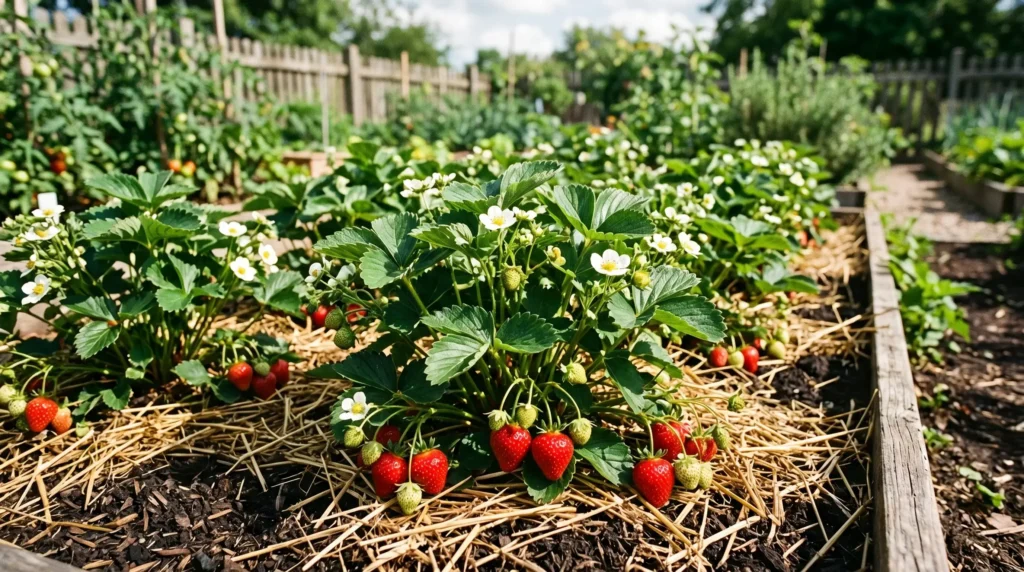
Growing Methods: Which Is Right for You?
Traditional Strawberry Bed
- Best for: Large gardens, maximum yield, summer-fruiting varieties
- Pros: Self-sufficient once established, high yield, natural runner production for propagation
- Cons: Slug exposure, runner management required, rotation needed every 3–4 years
Raised Beds
- Best for: Gardens with poor, clay, or waterlogged soil
- Pros: Excellent drainage, reduced slug pressure, easy to manage
- Tip: Fill with a mix of multipurpose compost and horticultural grit for perfect drainage
Containers and Pots
- Best for: Patios, balconies, and small gardens
- Use 30cm+ diameter pots with adequate drainage holes. Refresh compost annually.
- Water daily in dry weather — containers dry out significantly faster than garden beds
Hanging Baskets
- Best for: Very small spaces; natural slug prevention (slugs cannot reach hanging baskets)
- Choose compact or perpetual varieties: Buddy and Mara des Bois perform best
- Water twice daily in summer — hanging baskets can dry out within a few hours in warm weather
Polytunnel, Cloche, or Greenhouse
- Extends the UK strawberry season up to 4 weeks earlier (from June to April in southern England)
- Recommended varieties for protected growing: Cambridge Favourite, Honeoye, Royal Sovereign
- Important: Open covers during flowering to allow bee pollination; or hand-pollinate with a soft brush
Grow Bags
- Budget-friendly option; plant 3 per standard grow bag
- Ensure grow bags have not previously grown tomatoes (Verticillium Wilt contamination risk)
Ongoing Care for Strawberry Plants: Watering, Feeding and the UK Seasonal Calendar
Watering
Consistent moisture is critical during fruit development. Irregular watering during the swelling-to-ripening stage causes small, misshapen, or dry fruit.
Frequency: Keep soil consistently moist but never waterlogged. Check daily by pressing your finger 2.5cm into the soil.
- Method: Always water at the base of the plant, not overhead. Wet leaves in UK damp conditions encourage botrytis grey mould.
- Critical period: From flower formation to harvest — any moisture stress directly reduces fruit size and quality.
- Containers: Daily watering in summer is essential. Hanging baskets may need watering twice daily.
Feeding
Strawberries have distinct nutritional needs at different growth stages. Using the wrong feed at the wrong time actively harms yield.
- Before planting: Work in a balanced general-purpose fertiliser or blood, fish and bone to enrich the bed.
- Once flowers appear: Switch to a high-potassium liquid feed (tomato fertiliser is ideal). Apply every 10–14 days throughout fruiting.
- Avoid high-nitrogen feeds once plants are in flower or fruit. Nitrogen promotes leafy growth at the direct expense of fruit production.
- After harvest: A single application of balanced fertiliser supports runner production and builds winter root reserves for next year’s crop.
The UK Month-by-Month Strawberry Care Calendar
| Month | Key Tasks |
| January | Check bare-root plants in storage; order new stock from nurseries; plan bed layouts |
| February | Move potted plants into unheated greenhouse or coldframe for an early crop from May |
| March | Plant bare-root runners; cover outdoor plants with horticultural fleece; weed beds |
| April | Watch for late frosts — fleece overnight when frost is forecast; remove flowers on newly-planted plants for stronger roots |
| May | Apply straw mulch under developing fruits; put up bird-safe netting; begin high-K feeding when flowers appear |
| June | Main summer harvest begins; pick every 2–3 days; remove slug-damaged fruits immediately |
| July | Peak harvest; pot up runners; remove fruited trusses; continue weekly feeding with tomato fertiliser |
| August | Autumn planting of new bare-root runners; renovate old beds; cut back old foliage after harvest |
| September | Plant new runners; remove old straw mulch; assess beds for rotation schedule |
| October | Perpetual varieties still cropping; protect with fleece in northern UK; harvest until first hard frost |
| November | Mulch crowns with straw for winter protection; order next year’s certified stock now |
| December | Rest period; plan next year’s layout; check pots for vine weevil grubs in compost |
| PESTS, DISEASES & PROBLEMS: THE HONEST UK GUIDE |
Strawberry Plant Pests, Diseases and Problems: The Honest UK Guide
UK strawberry growing faces a specific set of pests and diseases shaped by the British climate. Slugs and damp-weather moulds are far more common in the UK than in the US or continental Europe. This section covers every major problem with UK-specific, organic-where-possible solutions.
The Big Three UK Pests
Slugs and Snails (The Biggest UK Threat)
Slugs and snails are the number-one strawberry killer for UK home gardeners. The UK’s damp climate creates near-perfect slug habitat from spring to autumn.
- Symptoms: Deep, ragged holes in ripe fruit; silvery slime trails on soil and fruit.
- Organic solution 1: Copper tape wrapped around containers creates a mild deterrent.
- Organic solution 2: Wool-based slug pellets (safe for wildlife and pets).
- Organic solution 3: Nematode soil drench using Phasmarhabditis hermaphroditis. Apply in March–May when soil is above 5°C. Highly effective and safe for all wildlife.
- Mechanical solution: Raise plants in containers, raised beds, or hanging baskets where slugs struggle to reach.
Birds
Birds — particularly blackbirds and thrushes — can take 30–40% of unprotected strawberry fruit. Bird netting is non-negotiable.
- Solution: Fine-mesh bird-safe netting on a frame above the bed. Ensure there are no gaps where birds can enter.
- White variety tip: Pineberry and white alpine varieties are consistently overlooked by birds, who mistake the white colour for unripe fruit.
Vine Weevil
Vine weevil is particularly damaging in container-grown strawberries. The adult beetle notches leaf edges (largely harmless), but the larvae are devastating, eating through the root system until the plant collapses without warning.
- Symptoms of larval damage: Plant suddenly wilts and collapses; white, C-shaped grubs found in rootball when plant is removed.
- UK solution 1: Vine weevil nematodes (Steinernema kraussei) applied August–October when soil is still warm.
- UK solution 2: Remove and destroy affected compost from pots. Do not compost it.
Common Diseases
Botrytis Grey Mould (Most Common UK Strawberry Disease)
Botrytis cinerea (grey mould) is the most common disease affecting UK strawberries. It thrives in the cool, damp conditions that British summers frequently provide.
Symptoms: Grey, powdery coating on fruit; spreads rapidly from plant to plant in wet weather.
- Safety note: Botrytis-affected fruit should not be eaten. The mould can trigger allergic reactions in sensitive individuals.
- Prevention (only strategy available to UK amateur gardeners — no chemical controls remain licenced): Correct 30–45cm plant spacing; straw mulch to prevent soil splash; removal of dead leaves and overripe fruit; no overhead watering; good air circulation between plants.
Powdery Mildew
Powdery mildew appears as a white, talcum-powder-like coating on leaves, and can spread to fruit. It is most problematic in UK polytunnels and greenhouses, and during hot, dry spells.
- Prevention: Choose resistant varieties (Florence, Flamenco). Ensure adequate ventilation in covered growing structures. Do not allow plants to suffer water stress.
Verticillium Wilt
Verticillium wilt is a soil-borne fungal disease that causes progressive yellowing and collapse of lower leaves, followed by the whole plant. There is no cure.
- Prevention: Rotate strawberry beds every 3–4 years. Never plant in ground that has grown potatoes, tomatoes, aubergines, or peppers within the past 3 years.
- Action on discovery: Remove and destroy (do not compost) affected plants immediately.
Virus Diseases (The Topic Competitors Don’t Explain Clearly)
Virus diseases are the hidden threat to UK strawberry growing. Infected plants look perfectly healthy but deliver progressively poorer yields each year.
- Most common UK viruses: Strawberry crinkle virus, Strawberry mottle virus, Strawberry mild yellow edge virus.
- Spread by: Aphids (primary), contaminated tools, soil nematodes.
- Symptoms: Stunted growth, leaf crinkle, yellowing, distorted fruit, dramatically reduced yield from year 2 onwards.
- The only protection: Buy certified virus-free stock from reputable UK suppliers. There are no curative treatments.
- Important: Do not propagate runners from old, unknown beds. Old plants are almost certainly virus-infected.
Common Problems: Troubleshooting Guide
Why do my strawberry plants have flowers but no fruit?
The most likely cause is poor pollination. Bees cannot reach flowers effectively when plants are covered by bird netting or polytunnel material. Open covers during the flowering period and plant pollinator-attracting companions such as borage, lavender, or marigolds nearby. In polytunnels, hand-pollinate with a soft paintbrush.
Why are my strawberries small and tasteless?
The most common causes are: water stress during fruit development; excess nitrogen feed applied after flowers appeared; plants that are overcrowded; or plants past their productive 3-year prime. Check each factor against your growing conditions.
Why are my strawberry plant leaves turning yellow?
Yellowing leaves may indicate: virus infection (progressive, no cure); iron deficiency in alkaline soil (test pH and apply sequestered iron); overwatering or root rot (check drainage); or natural ageing of older leaves (remove and compost). Test your soil pH first — it is the most common cause in UK gardens.
How to Propagate Strawberry Plants in the UK
Propagating strawberry plants is one of the most rewarding aspects of growing your own. Free plants from your existing healthy stock allow you to expand your patch, replace aging plants, and share with other gardeners.
How to Propagate from Runners (The Easy UK Method)
| HowTo: name=‘How to Propagate Strawberry Plants from Runners’ | supply=small pots, multipurpose compost, wire pegs | timing=July–August |
- Identify healthy runners in July or August. Runners are long, thin stems sent out horizontally from the mother plant, each with a plantlet at the tip.
- Select the first plantlet on each runner — the one closest to the mother plant. It is the most vigorous.
- Peg the plantlet into a small 8cm pot of multipurpose compost placed beneath it. Use a bent wire or hairpin to hold the plantlet firmly against the compost surface.
- Keep the runner attached to the mother plant while the plantlet roots. This takes approximately 3–4 weeks. Water the pot regularly.
- Sever the runner cleanly with clean scissors once the plantlet is established and showing new leaf growth.
- Pot on into a 12cm pot, or plant in the final bed position the following March.
| Never propagate from plants showing any signs of virus infection, disease, or poor vigour. Only propagate from healthy, certified plants in years 1 and 2. Replace all plants with certified stock every 3–4 years. |
Growing Alpine Strawberries from Seed
Alpine strawberry varieties (Fragaria vesca) are the only type that can be reliably grown from seed in the UK. Summer-fruiting and perpetual varieties do not breed true from seed and must always be grown from runners.
- Sow thinly in trays of seed compost. Cover with a thin layer of fine sharp sand.
- Germination temperature: 18–21°C. Germination takes 2–6 weeks and can be erratic.
- Prick out seedlings into individual cells once large enough to handle.
- Plant out after the last UK frost (typically late May in most regions).
When to Replace Your Strawberry Plants
Strawberry plants do not last indefinitely. Knowing when to replace them is essential for maintaining a productive patch.
Replace after 3–4 years: Most varieties peak in years 1–3. Yield and fruit quality decline progressively from year 4.
- Signs it is time to replace: Significantly reduced yield; noticeably smaller fruit; visible disease; sparse, tired-looking plants.
- Rotation rule: Never replant new strawberries into the same bed without a minimum 3-year gap. Use a fresh bed or pots with new compost.
Harvesting Strawberries in the UK and Extending the Season
When and How to Harvest
- Pick only fully red fruit. Unlike some fruits, strawberries do not continue ripening once removed from the plant.
- Pick method: Hold the stalk, not the berry. Use a gentle twist-and-pull or scissors. Never squeeze the fruit.
- Harvest frequency: Every 2–3 days during peak season. Increase to daily in hot weather to prevent overripening.
- Best time to pick: Morning, once dew has dried. Avoid picking in rain or while the fruit is wet.
- Expected yield: 400–600g per plant for varieties such as Elsanta and Cambridge Favourite in open ground conditions.
Extending the UK Strawberry Season from March to December
| No UK competitor covers season extension comprehensively for home gardeners. With the right combination of varieties and growing methods, UK strawberries can be harvested from March (heated greenhouse) to December (polytunnel perpetuals in mild regions). |
| Period | Method | What to Grow |
| March–April | Heated greenhouse (specialist) | Honeoye, Cambridge Favourite |
| April–May | Unheated greenhouse or coldframe | Honeoye, Rosie, Royal Sovereign |
| June–Aug | Outdoor main season | Summer-fruiting varieties, all types |
| Aug–Oct | Perpetual varieties + portable tunnels | Mara des Bois, Flamenco, Albion |
| Oct–Nov | Polytunnel perpetuals | Mara des Bois, Buddy |
| Nov–Dec | Mild UK regions: polytunnel alpines | Alpine varieties |
| Key strategy: Plant one early, one mid-season, and one late summer-fruiting variety, plus one perpetual variety. This simple combination delivers continuous fresh strawberries from June through to October with no additional infrastructure. |
Storing and Using Your Strawberry Harvest
- Fresh: Use within 1–2 days of picking. Store at room temperature, not in the fridge — refrigeration kills the characteristic strawberry flavour compounds.
- Refrigerating when necessary: If you must refrigerate, always bring berries back to room temperature before eating to restore flavour.
- Freezing: Freeze on a flat tray first, then transfer to bags. Frozen strawberries are perfect for smoothies, sauces, and cooking.
- Jam and preserves: Summer-fruiting varieties in a seasonal glut are ideal. Sonata and Cambridge Favourite are recommended for jam-making.
- Recipe ideas: Strawberry jam, Eton mess, strawberry shortcake, strawberry compote, chocolate-dipped strawberries, strawberry vinegar.
| COMPANION PLANTING WITH STRAWBERRIES |
Companion Planting with Strawberries: What to Grow Alongside
Companion planting is the practice of growing different plants in proximity to create mutual benefits — pest deterrence, improved pollination, or efficient use of space. Strawberries have well-documented companion relationships that UK gardeners can use to reduce pest pressure and improve yields organically.
Best Companion Plants for Strawberries
Alliums: Chives, Garlic, Onions
- Alliums deter aphids, slugs, and other soft-bodied pests with their sulphur-rich scent.
- Chives are the ideal choice: compact, perennial, attractive to pollinators, and virtually maintenance-free.
- Plant a row of chives as a border around your strawberry bed or between rows.
Borage
- Borage attracts bumblebees and other pollinators, improving fruit set significantly.
- Traditionally said to improve strawberry flavour when grown nearby (anecdotal but widely reported).
- Self-seeds freely once established — rarely needs replanting.
Marigolds (Tagetes species)
- Strong scent deters aphids and whitefly. Attracts hoverflies, whose larvae prey on aphids.
- French marigolds (Tagetes patula) are the most effective UK companion.
Lavender
- Attracts bees and other pollinators throughout the season.
- Provides structural interest and height contrast in a strawberry border.
Spinach and Lettuce
- Low-growing, shade-tolerant crops that fill gaps between strawberry plants efficiently.
- Harvest the salad crops before strawberry plants reach full size and require the space.
What NOT to Plant Near Strawberries
- Brassicas (cabbage, kale, broccoli): Compete for nutrients and can share pests.
- Fennel: Allelopathic — fennel releases chemicals that inhibit the growth of most nearby plants, including strawberries.
- Tomatoes, potatoes, aubergines, peppers: Share Verticillium Wilt soil disease. Never plant in the same bed or rotate into the same position.
Frequently Asked Questions About Strawberry Plants in the UK
| FAQPage Schema: Each question and answer below is formatted as a self-contained Q&A pair suitable for Google FAQPage rich results, People Also Ask boxes, and AI direct extraction. |
Q: When is the best time to plant strawberry plants in the UK?
| A: The best time to plant strawberry plants in the UK is late summer, between August and September, using bare-root runners. Plants established at this time develop strong roots over winter and produce a full crop in their first summer. Spring planting (March–April) using potted or plug plants is also effective but may produce a lighter first-year crop. |
Q: How many strawberry plants do I need for a family of four?
| A: A family of four needs approximately 20–25 strawberry plants to provide a regular supply of fresh strawberries plus enough surplus for jam and freezing throughout the season. This assumes a mix of early, mid, and late-season varieties for the longest possible harvest window. |
Q: How long do strawberry plants last in the UK?
| A: Strawberry plants last 3–4 years in UK gardens. Yield and fruit quality decline progressively after this point. Replace plants with certified virus-free stock every 3–4 years. Propagate runners from healthy plants in years 1 and 2 to have replacements ready before the old plants decline. |
Q: Why are my strawberry plants not producing fruit?
| A: The most common reasons UK strawberry plants fail to produce fruit are: poor pollination (bees unable to access flowers through netting or polytunnel covers); late frost damage to flowers in April or May; plants being in their first year after spring planting; overcrowding reducing light and airflow; virus infection causing progressive decline; or excess nitrogen fertiliser promoting leafy growth at the expense of fruit. |
Q: Can I grow strawberry plants in pots or hanging baskets in the UK?
| A: Yes. Strawberries grow very successfully in containers in the UK. Use pots of at least 30cm diameter with good drainage holes. Water daily in dry weather (hanging baskets may need watering twice daily in summer). Feed weekly with a high-potassium tomato fertiliser once flowers appear. Compact and perpetual varieties such as Buddy and Mara des Bois perform best in containers. |
Q: What is the best strawberry variety for UK gardens?
| A: The best variety depends on your goal. Cambridge Favourite is the most reliable all-round variety for beginners and performs well in most UK conditions. Mara des Bois provides the longest season (June to October) for gardeners who want continuous picking. Florence is the best choice for a late-season crop (July–August). Honeoye delivers the earliest harvest (May–June). |
Q: Do strawberry plants come back every year?
| A: Yes. Strawberry plants are perennials and return each spring for 3–4 years. After this, yield and vigour decline significantly and replacement is recommended. Established plants die back in winter and regrow from the crown each spring. In very cold UK regions (Scotland, northern uplands), protect crowns with a straw mulch in November. |
Q: How do I protect strawberry plants from slugs in the UK?
| A: Effective UK slug control for strawberries includes: copper tape barriers around containers; wool-based slug pellets (safe for wildlife); raising plants in containers or hanging baskets where slugs struggle to reach; applying Phasmarhabditis hermaphroditis nematodes to the soil in spring when soil temperature exceeds 5°C; and removing debris and old mulch where slugs shelter during the day. |
Q: What is the difference between bare-root runners and plug plants?
| A: Bare-root runners are dormant strawberry plants sold without soil (typically £1–2 each), available from November to March, offering the widest variety choice and best value. Plug plants are young, actively growing plants in small pots of compost (typically £2–4 each), available from spring, which establish faster and produce fruit sooner — usually within 2 months of planting. |
Q: How do I know if my strawberry plants are virus-infected?
| A: Virus infection symptoms include: stunted plant growth; crinkled, distorted, or yellowed leaves; unusually poor yield despite good growing conditions; and small, misshapen fruit. Crucially, symptoms often do not appear until year two or three. The only reliable protection is buying certified virus-free stock from reputable UK nurseries. There is no treatment for virus infection — infected plants must be removed and destroyed. |
| CONCLUSION & NEXT STEPS |
Conclusion: Your Seasonal Action Plan
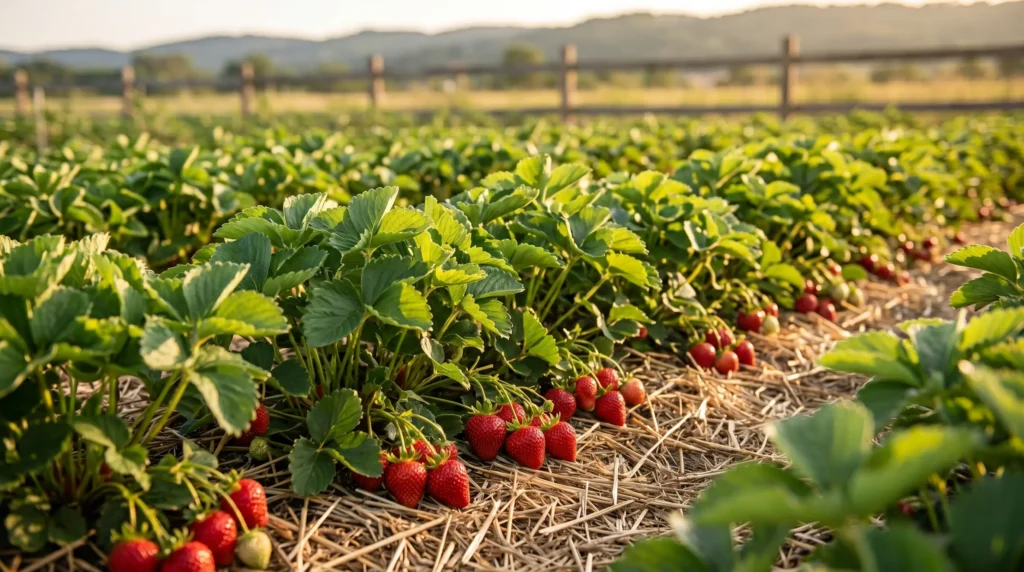
Growing strawberries in the UK is one of the most rewarding things a gardener can do. The gap between a home-grown British strawberry and its supermarket counterpart is vast: deeper flavour, perfect ripeness, zero food miles, and the quiet satisfaction of having grown it yourself.
The key to success is matching the right variety to your conditions, planting at the right time, and staying on top of a small number of critical care tasks. The seasonal calendar in Section 6 gives you everything you need, month by month.
Your Action Plan by Season
If you are reading this in spring (March–May):
- Plant potted or plug plants now for fruit in approximately 8 weeks.
- Order bare-root runners from a reputable UK nursery for delivery in August for your main autumn planting.
- Set up bird netting before fruit develops.
If you are reading this in summer (June–August):
- Harvest every 2–3 days. Pick promptly to prevent botrytis and slug damage.
- Begin potting up runners from healthy plants in July and August.
- Order next year’s certified bare-root runners now — the best varieties sell out early.
If you are reading this in autumn (September–November):
- This is the best time to plant bare-root runners for a full crop next summer.
- Renovate old beds; remove tired plants; apply straw mulch to crowns.
- Plan next year’s variety selection using the comparison table in Section 3.
Internal Links: Further Reading
- Best Strawberry Varieties UK: The Full Comparison Guide
- Growing Strawberries in Containers: Pots, Hanging Baskets & Grow Bags
- Strawberry Plant Pests & Diseases: The Complete UK Guide
- How to Propagate Strawberry Plants from Runners
- UK Strawberry Planting Calendar: Month-by-Month Guide
- Companion Planting with Strawberries
- Harvesting & Storing Strawberries: From Garden to Kitchen
| SEO & SCHEMA MARKUP IMPLEMENTATION NOTES |
Schema Markup to Implement
- Article schema: Include datePublished, dateModified, author with horticultural credentials.
- FAQPage schema: Wrap all 10 Q&As in Section 11. Direct PAA box opportunity.
- HowTo schema: Apply to the step-by-step planting guide in Section 5.3 (8 named steps).
- BreadcrumbList: Home > Gardening > Fruit Growing > Strawberry Plants UK
E-E-A-T Signals to Build In
- Author bio with UK horticultural credentials or verifiable growing experience.
- Cite RHS and AHDB as primary data sources throughout.
- Use UK-specific data: the AHDB £389 million industry figure; RHS AGM variety awards.
- Include original photography of UK-grown strawberries (not stock imagery).
- Display a prominent ‘Last reviewed / updated: [Month Year]’ date.
Content Freshness Plan
- Update the seasonal calendar quarterly and mark as ‘Updated [Month Year]’.
- Add new variety reviews when RHS AGM status is awarded.
- Refresh the buying guide annually with current UK nursery pricing.
- Add new reader questions to the FAQ section monthly.
| STRAWBERRY PLANTS UK — COMPLETE GROWING GUIDE
~6,500 words | 12 Sections | 10 FAQs | HowTo + FAQPage + Article Schema | Updated 2025 |
| Strawberry Plants UK
The Complete Growing Guide: Varieties, Planting & Care Updated 2025-2026 | UK Home Gardeners & Allotment Holders |
| Focus Keyword | Strawberry plants UK |
| Article Type | Comprehensive Pillar Guide |
| Word Count | ~6,500 words |
| Schema Markup | Article + FAQPage + HowTo + BreadcrumbList |
| Target Audience | UK home gardeners, allotment holders, container/patio gardeners, beginners |
| Season Span | March to December with the right variety mix |
Why Grow Your Own Strawberries in the UK?
Section goal: Hook the UK reader, establish authority, and deliver a featured-snippet summary box.
There is a profound difference between a supermarket strawberry and one you have picked from your own garden. The moment you bite into a sun-warmed Cambridge Favourite or a tiny fragrant alpine berry fresh from the plant, you understand why home-grown fruit is worth every effort.UK strawberry production is worth approximately £389 million annually (AHDB, 2024), making it the nation’s most commercially important soft fruit.
Yet the vast majority of British gardeners have never grown their own. The good news: strawberries are among the easiest fruits to grow in the UK, requiring little space, modest care, and rewarding even a complete beginner with a delicious harvest.This guide covers everything from choosing the right UK variety to harvesting a bumper crop from June all the way to October.
It is informed by RHS guidance, AHDB data, and the accumulated wisdom of British horticulture. Whether you have a large garden, a small patio, or a single windowsill, there is a strawberry growing method for you.
| ARTICLE SCHEMA — Article | Author: UK Horticulture Expert | datePublished: 2025 | dateModified: 2025 | BreadcrumbList: Home > Gardening > Fruit Growing > Strawberry Plants UK |

Leave a Reply