
Yarrow plant (Achillea millefolium) is a hardy, herbaceous perennial wildflower native to the UK and found across the whole of Britain. This versatile yarrow plant produces flat-topped clusters of tiny white or pink flowers from June to October, has finely divided, feathery aromatic leaves, and thrives in poor, dry, well-drained soil. It is both a beloved garden plant and one of Britain’s most ancient medicinal herbs.
Quick Reference: Yarrow Plant Facts at a Glance
| Feature | Detail |
|---|---|
| Latin name | Achillea millefolium L. |
| Family | Asteraceae (daisy family) |
| Common names | Yarrow, milfoil, nosebleed plant, soldier’s woundwort, thousand-leaf, devil’s nettle, carpenter’s weed |
| Plant type | Hardy herbaceous perennial |
| UK native? | Yes — native to all four nations |
| Height | 30–80 cm (12–32 in) |
| Spread | 40–60 cm |
| Flowering season | June to October (occasionally November) |
| Flower colour | White or pale pink (wild); yellow, red, orange, pink (cultivars) |
| RHS Award of Garden Merit? | Yes — multiple cultivars |
| RHS Plants for Pollinators? | Yes |
| Insects supported | 100+ species |
| UK hardiness | H7 (fully hardy; survives −20°C) |
| Toxic to pets? | Yes — toxic to cats, dogs and horses |
| MHRA regulated? | Yes — since April 2014 for herbal medicinal products |
Introduction
Sixty thousand years ago, someone placed yarrow flowers in a grave. The grave was in what is now Iraq, and the person being buried was a Neanderthal. The discovery — made at Shanidar Cave in the 1960s — made yarrow plant one of the earliest plants ever linked to deliberate human use.
Today, that same yarrow plant grows along almost every roadside verge, meadow margin, and chalk downland across the UK. It flowers in the garden borders at RHS Chelsea. It appears in the pocket of the wild food forager, the drying rack of the home herbalist, and the seed mix of the conservation officer restoring a wildflower meadow. Very few plants manage to be all of these things at once.
This guide covers everything a UK reader needs to know about yarrow: how to identify it in the wild, how to grow it in a garden, which cultivars to choose, how it supports wildlife, what it has been used for medicinally for millennia, how to manage it in a lawn, and why the yarrow plant belongs at the heart of any nature-friendly UK garden.
What Is Yarrow plant? Botanical Profile and Identification
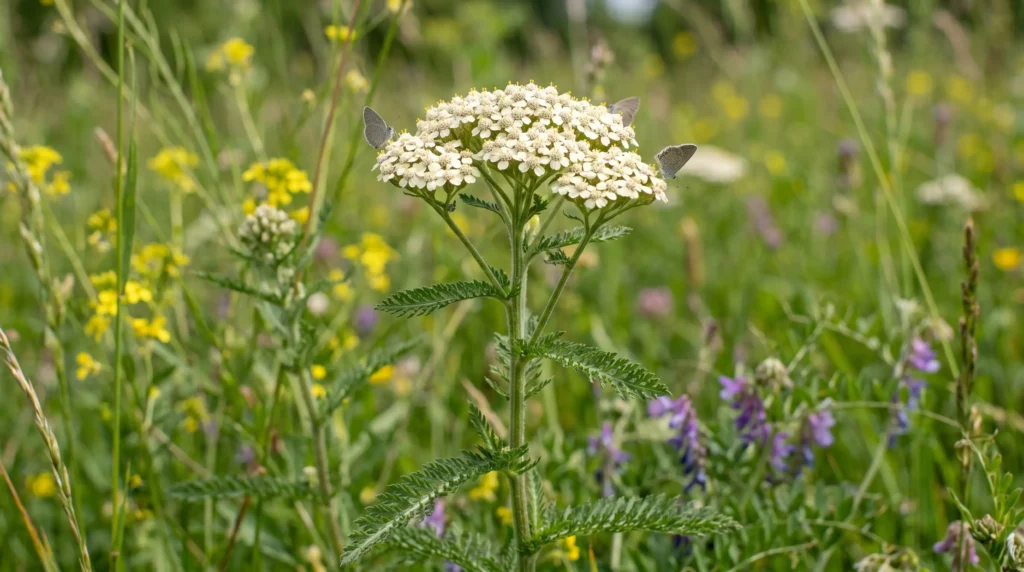
Achillea millefolium is the scientific name for common yarrow. “Achillea” honours the Greek hero Achilles, who according to legend used the plant to treat battlefield wounds. “Millefolium” is Latin for “thousand-leaved,” a reference to the plant’s finely divided, feathery foliage.
It belongs to the family Asteraceae (the daisy family), which also includes chamomile, sunflowers, and dandelions. Within this family it sits in the genus Achillea, which contains around 250 species worldwide. Achillea millefolium is the most widespread of these, native across temperate Eurasia and North America.
How to Identify Yarrow plant in the UK: A Step-by-Step Field Guide
Yarrow is one of Britain’s most distinctive wildflowers once you know what to look for. Use this five-point identification checklist:
1. The leaves — feathery and aromatic Yarrow leaves are the most reliable identification feature. They are finely divided — bipinnately or tripinnately cut — giving them a feathery, fern-like appearance. Run your fingers through them: they smell distinctively spicy and aromatic, somewhere between chamomile and pine. The leaves are dark grey-green, 5–20 cm long, and arranged spirally up the stem. Basal leaves are larger and more stalked; stem leaves become shorter and stalkless higher up.
2. The stem — erect, hairy and tough The stems are erect, slightly hairy, and notably tough — they can withstand mowing, foot traffic, and grazing. They are unbranched below the flower head. A single plant may produce several stems from its rootstock.
3. The flowers — flat-topped clusters, not umbels The flowers form flat-topped clusters called corymbs (a common mistake is to call them umbels — they are not). Each cluster is made up of many tiny individual flower heads, each comprising 3–8 small white or pink ray florets around yellowish disc florets. The individual florets are only 3–4 mm across, giving the whole flower head a dense, packed appearance.
4. The scent — spicy and camphorous Crush a leaf or flower between your fingers. Yarrow has a distinctive spicy, slightly bitter, camphorous scent — noticeably different from the sweet smell of chamomile. This scent is one of the quickest ways to confirm identification.
5. The root system — deep and creeping Below ground, yarrow has a deep fibrous root system (to 20 cm) combined with creeping rhizomes. This is why it forms spreading patches in lawns and meadows.
Yarrow plant vs Common UK Lookalikes: Safety Identification Table
Important: Always confirm identification using ALL features listed above before foraging any plant. If in any doubt, do not pick or consume.
| Plant | Similarity to Yarrow | How to Tell Them Apart | Safe? |
|---|---|---|---|
| Wild carrot (Daucus carota) | Similar flat-topped white flower clusters | Has a single tiny purple floret in centre; distinctly hairy stem; carrot-like scent when stem broken | Yes — but ID carefully |
| Hemlock (Conium maculatum) | Similar white flower clusters | Purple-spotted, hollow, hairless stem; strong musty unpleasant smell; no feathery leaves | NO — DEADLY POISONOUS |
| Hogweed (Heracleum sphondylium) | Similar flower structure | Much larger plant (up to 2 m); much broader, coarser leaves; can cause severe burns in sunlight | Edible young only; risky |
| Ground elder (Aegopodium podagraria) | White flower clusters | Broader, less divided leaves; no aromatic scent; triangular stems | Edible young |
| Chamomile (Chamaemelum nobile) | Feathery leaves, aromatic | Single daisy-like flowers with yellow centre and white ray petals; apple-scented | Yes |
| Tansy (Tanacetum vulgare) | Similar feathery leaves | Button-like yellow flowers only — no white ray petals; much stronger, camphorous smell | Toxic in quantity |
| Pineapple weed (Matricaria discoidea) | Similar small flowers | Pineapple scent; no white ray petals (yellow-green cones only) | Yes |
Where Does Yarrow plant Grow in the UK?
Yarrow plant is one of the most common and widely distributed wildflowers in Britain. It is found across England, Scotland, Wales, and Northern Ireland, from sea level up to approximately 1,200 metres in the Scottish Highlands.
Its preferred habitats include:
- Chalk and limestone grassland — one of the UK’s most threatened habitats, where yarrow is a key native species
- Road verges and motorway banks — tolerates pollution, exhaust, and compacted soils
- Lawns — particularly sparse, dry, or chalky lawns where grass struggles
- Meadows and pasture — a natural component of traditional hay meadows
- Coastal grassland and dunes — tolerates salt spray and thin, sandy soils
- Disturbed ground and field margins — one of the first colonisers of bare soil
What yarrow needs from its soil: It thrives in soils with a pH of 4.7–8.0, tolerates poor, dry, and gravelly conditions, and is notably absent from waterlogged ground and deep woodland shade. It is considered an indicator plant for loam soils. The roots penetrate to 20 cm and can access moisture unavailable to shallower-rooted plants.
The Chemistry of Yarrow plant : What Makes It Work
Yarrow’s medicinal and aromatic properties come from a complex mixture of chemical compounds. The key constituents include:
- Volatile oils (0.2–1.0% of dry weight): The essential oil is characteristically blue-coloured due to the presence of chamazulene, a sesquiterpene with significant anti-inflammatory activity. Research has shown that chamazulene carboxylic acid — a breakdown product of yarrow’s proazulenes (including matricin) — inhibits cyclooxygenase-2 (COX-2) activity, comparable in mechanism to ibuprofen. Other major oil components include 1,8-cineole, camphor, borneol, and sabinene.
- Flavonoids: Apigenin, luteolin, quercetin, kaempferol, rutin — these are the primary antioxidant and anti-inflammatory compounds.
- Tannins: Responsible for the plant’s astringent action on tissues, relevant to wound healing and staunching blood flow.
- Salicylic acid: A natural anti-inflammatory compound structurally related to aspirin.
- Bitter principles: Contribute to digestive stimulation and bile flow.
Yarrow contains chamazulene (anti-inflammatory, blue essential oil component), flavonoids including apigenin and quercetin (antioxidant), tannins (astringent), and salicylic acid (anti-inflammatory) — together giving it wound-healing, anti-inflammatory, digestive, and diaphoretic properties.
Best Yarrow plant Varieties for UK Gardens
What Are the Best Yarrow Cultivars to Grow in the UK?
The best yarrow cultivars for UK gardens are those that have received the RHS Award of Garden Merit (AGM) — a reliable guide to plants proven to perform well in UK conditions. Beyond AGM winners, the choice depends on garden size, colour preference, and intended use (borders, cutting, wildlife, pots).
RHS Award of Garden Merit Yarrow Cultivars
These cultivars have been assessed by the Royal Horticultural Society and found to perform reliably across UK growing conditions:
| Cultivar | Flower Colour | Height | Spread | Best Use |
|---|---|---|---|---|
| ‘Coronation Gold’ | Deep golden yellow | 60–90 cm | 45 cm | Borders, cutting, drying — long-lasting colour |
| ‘Moonshine’ | Lemon yellow; silver-grey foliage | 45–60 cm | 45 cm | Smaller gardens, pots, front of border |
| ‘Fanal’ (‘The Beacon’) | Rich blood red to crimson | 60–75 cm | 45 cm | Bold colour impact; mixes well with grasses |
| ‘Cerise Queen’ | Bright cerise pink | 50–60 cm | 45 cm | Cottage gardens; long flowering period |
| ‘Terracotta’ | Rusty orange-amber, ageing to cream | 60–75 cm | 45 cm | Prairie-style planting; stunning aged effect |
| ‘Summerwine’ | Deep wine-purple red | 60 cm | 45 cm | Reliable, upright; excellent with silver foliage |
| ‘Walter Funke’ | Intense brick red | 60–70 cm | 45 cm | Upright habit; warm-toned schemes |
Choosing Between Wild Yarrow plant and Garden Cultivars
Wild yarrow (A. millefolium, straight species) and garden cultivars serve very different purposes. Here is how to decide:
| Consideration | Wild Yarrow (A. millefolium) | Garden Cultivars |
|---|---|---|
| Wildlife value | Exceptionally high — 100+ insect species | Good, but lower than wild type |
| Medicinal use | Best — use white-flowered species only | Not recommended for medicinal use |
| Foraging | Yes — all parts edible | Not recommended |
| Garden impact | Subtle; naturalistic | Bold; wide colour range |
| Spreading habit | Can spread vigorously via rhizomes | Generally more contained |
| Cost | Inexpensive; easily raised from seed | More expensive; usually from plugs or pots |
| Best application | Wildflower meadows, wildlife gardens, naturalistic planting | Borders, cutting gardens, containers, formal schemes |
Achillea Species Beyond millefolium
Several other Achillea species are grown in UK gardens:
| Species | Character | Height | UK Garden Use |
|---|---|---|---|
| A. filipendulina (fern-leaf yarrow) | Tall, stiff; mustard-yellow flowers | 90–120 cm | Back of border; excellent for drying |
| A. ptarmica ‘The Pearl’ | White pompom flowers; moisture tolerant | 60–75 cm | Cutting garden; tolerates heavier soils |
| A. tomentosa (woolly yarrow) | Ground-hugging; bright yellow; silver leaves | 10–20 cm | Rock gardens, alpine troughs, dry walls |
| A. ‘Moonshine’ (hybrid) | Silver foliage; pale sulphur-yellow | 45–60 cm | Front of border; long season |
Where to Buy Yarrow Plants and Seeds in the UK
- Garden centres: Named cultivars widely available as pot-grown perennials spring–summer
- Wild species seed: Naturescape (Nottinghamshire), Emorsgate Seeds (Norfolk), Habitat Aid (Somerset), MeadowMania
- RHS-endorsed suppliers: Check the RHS Find a Plant database for AGM cultivar stockists
- Online: Sarah Raven’s Kitchen & Garden, Crocus, Thompson & Morgan stock a good cultivar range
How to Grow Yarrow plant in the UK — Complete Grower’s Guide
How Do You Grow Yarrow plant in the UK?
Yarrow is one of the easiest perennials to grow in the UK. It thrives in full sun, tolerates poor and dry soils, needs minimal watering once established, rarely needs feeding, and comes back reliably every year. The main mistakes UK gardeners make are planting it in shade, overwatering, and overfeeding — all of which cause weak, floppy stems.
UK Yarrow plant Planting Calendar
How-To Schema: Yarrow Growing Timeline
| Month | Task |
|---|---|
| February–March | Sow seeds indoors on the surface of moist seed compost (light germinates) |
| March–April | Pot on seedlings once 2–3 true leaves appear |
| April | Harden off young plants outdoors over 10–14 days |
| April–May | Plant out after last frost risk (most of UK: after mid-April) |
| May–June | Direct sow outdoors when soil has warmed to 10°C+ |
| June–October | Flowering period; deadhead after first flush for second bloom |
| July–August | Deadhead to encourage second flowering flush in Sept–Oct |
| September | Divide established plants if needed (alternative to spring) |
| October–November | Plant out pot-grown plants for spring establishment OR cut back spent growth |
| March (following year) | Cut back old stems as new growth appears; divide every 2–3 years |
Choosing the Right Site: Soil, Sun, and Aspect
What conditions does yarrow need?
- Sunlight: Full sun is best — a minimum of 6 hours of direct sun per day. Yarrow tolerates light partial shade but will produce fewer, weaker flowers and taller, floppier stems the more shade it receives.
- Soil type: Well-drained to dry soils. Yarrow thrives in poor, sandy, chalky, or gravelly ground — the kind of soil where many other plants struggle. It does not need fertile soil; in fact, overly rich or fertile soil causes floppy stems and can reduce flowering.
- Soil pH: Tolerant of a wide range — pH 4.7 to 8.0. Grows naturally on acid heathland and alkaline chalk downland.
- Moisture: Avoid permanently wet or waterlogged soil. This is the one condition yarrow genuinely dislikes — waterlogged roots cause rot and disease.
- Aspect: South-facing or west-facing positions are ideal. Excellent for coastal gardens, chalk gardens, and sloping south-facing banks.
UK tip: Yarrow is a particularly good choice for gardens on chalk or limestone, and for those in drier parts of eastern England where summer drought can stress other perennials.
How to Grow Yarrow plant from Seed (Step-by-Step)
How-To Schema: Sowing Yarrow from Seed
What you need: Yarrow seed, seed trays or small pots, peat-free seed compost, a warm windowsill or heated propagator.
Step 1 — Sow indoors (February–March) Surface-sow yarrow seed onto moist peat-free seed compost. Do not cover — yarrow is a light-dependent germinant and needs light to trigger germination. Press seeds gently onto the surface.
Step 2 — Provide warmth and light Place on a warm, bright windowsill or in a propagator at 18–24°C. Keep compost moist but not wet. Germination typically occurs within 7–21 days.
Step 3 — Pot on (March–April) Once seedlings show 2–3 true leaves (distinct from the initial seed leaves), carefully prick out and pot individually into 9 cm pots of peat-free multipurpose compost.
Step 4 — Harden off (April) Begin hardening off seedlings — place outside in a sheltered spot for increasing periods each day over 10–14 days. This acclimatises plants to outdoor temperatures and wind before they go into the ground.
Step 5 — Plant out (late April–May) After the last frost risk has passed, plant into their final position. In most of the UK this means after mid-April (earlier in the south-west and Wales, later in Scotland and northern England).
Step 6 — Direct sowing outdoors (May–June) Alternatively, direct sow onto a fine, weed-free seedbed from May onwards when soil temperature has reached at least 10°C. Rake to a fine tilth, surface sow, and keep moist until germination. Seedlings will flower in their second year.
Planting Spacing and Depth
- Spacing: 45–60 cm between plants. Yarrow forms spreading clumps 40–50 cm wide, so adequate space prevents overcrowding.
- In meadows: Plant 4–6 wild yarrow plants per square metre for a natural, mixed effect.
- Depth: Plant at the same depth as the nursery pot. Do not bury the crown.
- After planting: Water well. Beyond this initial settling-in water, established yarrow rarely needs irrigation.
Ongoing Care: What Yarrow plant Needs (and Doesn’t Need)
Watering Water regularly in the first growing season, particularly during dry spells. Once established (usually from the second year), yarrow is drought-tolerant and very rarely needs irrigation in the UK, even through dry summers.
Feeding Feeding yarrow is almost always counterproductive. Overly fertile soil produces tall, floppy stems and reduces flowering. At most, apply a thin layer of garden compost as a mulch in spring. Never use high-nitrogen fertiliser.
Deadheading Remove spent flower stems by cutting back to the base (or to a side shoot lower on the stem) after the first flush of flowering, typically in late July or early August. This encourages a second flush of flowers in September–October.
Dividing Every 2–3 years, lift and divide established clumps in March–April or September. Using a garden fork, lift the whole clump, split into sections (discard the congested, worn-out centre, and replant vigorous outer sections). Division rejuvenates the plant and controls its spread.
Cutting back for winter Yarrow can be left standing through autumn and winter — the seed heads provide food for small birds and the stems offer some insulation for the crown. Cut back to ground level in late autumn or in early spring as new growth begins.
Growing Yarrow plant in Pots and Containers
Yarrow can be grown successfully in containers, though it performs better in the ground. Here is how to get the best results:
- Pot size: Use containers at least 30–40 cm in diameter and depth. Yarrow roots deeply and a small pot will restrict it.
- Compost mix: Use 50% peat-free multipurpose compost and 50% horticultural grit or perlite. Good drainage is essential.
- Position: Full sun only — at least 6 hours per day.
- Watering: Water more frequently than in-ground plants, but always allow the compost to dry slightly between waterings. Never allow to sit in water.
- Feeding: A very light application of balanced organic fertiliser in spring only.
- Winter care: Container-grown yarrow is vulnerable to having its root ball freeze solid. In cold spells below −10°C, move pots to a sheltered spot or wrap in horticultural fleece. Alternatively, plunge pots into soil to insulate roots.
- Best varieties for pots: Compact cultivars work best — ‘Moonshine’, ‘Little Moonshine’, ‘King Edward’ (low-growing species A. tomentosa).
Yarrow in a Wildflower Meadow
Yarrow is one of the ten most important plants for a UK wildflower meadow. It is robust, long-flowering, drought-tolerant, and provides food and habitat for an exceptional range of insects through the late summer when many other meadow plants have finished.
Recommended companion plants for a UK yarrow meadow:
- Oxeye daisy (Leucanthemum vulgare)
- Field scabious (Knautia arvensis)
- Knapweed (Centaurea nigra)
- Bird’s-foot trefoil (Lotus corniculatus)
- Meadow buttercup (Ranunculus acris)
- Ragged robin (Lychnis flos-cuculi) — for moister areas
Meadow management regime:
- Allow yarrow and all meadow plants to flower and set seed (June–September)
- Mow once in late September or October with blades set high (7–10 cm)
- Leave the cut material to dry for 2–3 days so seeds can fall, then remove (do not compost on-site — this would enrich the soil)
- Never add fertiliser to a wildflower meadow — this favours coarse grasses over wildflowers
Common Problems, Pests and Diseases
Yarrow is notably resistant to most pests and diseases. However, a few issues can arise:
| Problem | Cause | Solution |
|---|---|---|
| Powdery mildew | Poor air circulation; too much shade; drought stress | Improve ventilation; move to sunnier spot; water at base in dry weather |
| Floppy stems | Soil too rich or moist; insufficient sun | Plant in leaner soil; reduce or eliminate feeding; full-sun position |
| Spider mites | Hot, dry conditions | Blast with water; improve air circulation |
| Thrips | Causes silvery leaf discolouration | Remove badly affected growth; use insecticidal soap |
| Root rot | Waterlogged soil | Improve drainage; do not plant in low-lying wet spots |
| Spreading too aggressively | Rhizomatous spread; prolific self-seeding | Divide regularly; deadhead before seed sets; edge clumps annually |
Yarrow plant for Wildlife — The Complete UK Guide
Why Is Yarrow plant So Good for UK Wildlife?
Yarrow is one of the most ecologically valuable plants a UK gardener can grow.
It appears on the RHS Plants for Pollinators list and supports over 100 species of insect — a figure that is exceptional even among British wildflowers.
The plant achieves this through a combination of features: its flat-topped flower heads offer an accessible landing platform for insects of many body sizes; its extended flowering season (June to October) bridges the late-summer gap when many other flowers have finished; its pollen and nectar are accessible to a wide range of insect types; and its foliage is used as a larval food plant by dozens of moth species — not just a nectar pit stop.
Which Wildlife Does Yarrow plant Support in the UK?
Pollinators
- Bees: Honey bees, bumblebees (including buff-tailed, common carder, and red-tailed), solitary bees including mining bees and mason bees
- Butterflies: Common blue, painted lady, heath fritillary, small tortoiseshell, gatekeeper, small copper, meadow brown
- Hoverflies: Multiple species, including Episyrphus balteatus (marmalade hoverfly) — important aphid predators
Moths (Larval Food Plant) Yarrow is a larval food plant for at least 42 species of moth and micro-moth in the UK — an unusually high number. Named species include the cinnabar, ruby tiger, mullein wave, and frosted orange.
Beetles and True Bugs Yarrow is particularly attractive to aphid-eating beetles and true bugs, including ladybirds (Coccinellidae) and ground beetles (Carabidae). This makes it a useful natural pest-control plant near vegetable gardens.
Birds Cavity-nesting birds, including the common starling, are documented to line their nests with yarrow. It is thought the aromatic volatile oils may help suppress nest parasites and bacteria. The seed heads are also visited by goldfinches and other small seed-eating birds.
Yarrow plant and the No-Mow May Movement
Yarrow is one of the most valuable plants for No-Mow May, the Plantlife UK initiative encouraging gardeners to leave lawns uncut throughout May to support early insects.
- Yarrow flowers from June in most years, so it is not the primary May beneficiary — but its foliage present in May provides habitat and the plant provides structure for ground-nesting bees
- Its low-growing foliage tolerates being mowed and returns quickly
- A lawn with yarrow, clover, and bird’s-foot trefoil is considerably more wildlife-valuable than a monoculture ryegrass lawn
Tapestry lawn note: For gardeners interested in replacing a conventional lawn with a wildlife-rich alternative, yarrow combined with wild thyme (Thymus praecox), chamomile (Chamaemelum nobile), and clover (Trifolium repens) creates a drought-resistant, fragrant, low-maintenance “tapestry lawn” that requires only occasional high-cut mowing.
Yarrow plant for Land Restoration in the UK
Yarrow plays a practical role in UK conservation beyond domestic gardens:
- Chalk grassland restoration: An essential component of seed mixes used by conservation organisations to re-establish chalk and limestone grassland — the UK’s most species-rich and threatened grassland habitat
- Road verge enhancement: Widely used in verge management schemes by councils and organisations like Plantlife UK and the Wildlife Trusts to improve biodiversity on road margins
- Arable reversion: Used in seed mixes to return arable land to species-rich grassland; its deep root system helps break up compacted agricultural soils
- Biodynamic preparations: Used in Rudolf Steiner’s Biodynamic Preparation 502 — yarrow flowers packed in a stag’s bladder and buried over winter, then added to compost
Yarrow plant Medicinal Uses — A UK Herbal Guide
Medical disclaimer: The following information is provided for educational and historical interest only. Yarrow plant is a potent herb and some preparations may interact with medications or cause adverse reactions in sensitive individuals. Always consult a qualified medical herbalist, GP, or pharmacist before using any herbal preparation for health purposes, particularly if you are pregnant, breastfeeding, taking prescription medicines, or have any health condition.
What Are the Medicinal Uses of Yarrow plant?
Yarrow plant (Achillea millefolium) has been used medicinally for at least 60,000 years and remains an important herb in British herbal medicine today. Its main traditional uses are wound healing, fever management, digestive support, circulatory health, and menstrual support.
In the UK, herbal medicines containing yarrow are regulated by the MHRA (Medicines and Healthcare products Regulatory Agency). Since April 2014, all herbal medicines sold commercially in the UK must carry the Traditional Herbal Registration (THR) logo. Registered yarrow-containing products are approved for the symptomatic relief of rheumatic pain and general muscular aches, based on traditional use.
The History of Yarrow in British Herbal Medicine: A Timeline
60,000 years ago Yarrow found alongside other medicinal plants in a Neanderthal burial at Shanidar Cave, Iraq — one of the earliest known examples of human plant use.
13th century BCE (approx.) Greek legend links yarrow to Achilles; Homer’s Iliad references the centaur Chiron teaching Achilles to use it on the battlefields of Troy. The plant became known as herba militaris (“soldier’s herb”).
10th century CE Yarrow appears in Bald’s Leechbook and the Lacnunga — two of the oldest surviving Anglo-Saxon medical texts written in Old English. It was used for wounds, fevers, and chest ailments, reflecting both practical medicine and spiritual plant work.
1597 English herbalist John Gerard documents yarrow in his Herball or Generall Historie of Plantes, noting its use as a wound herb and its paradoxical reputation for both causing and curing nosebleeds.
1600s English botanist and herbalist Nicholas Culpeper classifies yarrow as a plant under Venus and recommends it for wounds, inflammation, and menstrual disorders. Medieval households also used yarrow as a strewing herb — scattered on floors for its protective and cleansing aromatic properties.
1931 British herbalist Maude Grieve documents yarrow extensively in A Modern Herbal, her authoritative reference still cited today. She notes its dual haemostatic action — capable both of stopping and, in some circumstances, stimulating bleeding — reflecting its complex physiological activity.
2014–present MHRA regulates all commercially sold herbal medicines in the UK, including yarrow products. The British Herbal Medicine Association (BHMA) continues to document yarrow’s traditional indications and supports its use within registered herbal practice.
Key Traditional Medicinal Uses of Yarrow
Wound Healing (Vulnerary and Haemostatic Action) Yarrow’s most ancient and consistent use is the treatment of cuts, grazes, and wounds. The tannins create an astringent effect on tissues, constricting blood vessels and reducing bleeding. The essential oil components provide antimicrobial activity. Fresh leaves can be bruised and applied directly to minor cuts as a field dressing — a practice documented from Neanderthal times through to World War I, when soldiers in the field reportedly used it when medical supplies ran out.
Fever Management (Diaphoretic Action) Yarrow promotes sweating (diaphoresis), which helps the body regulate temperature during a fever. A traditional “fever tea” combines yarrow, elderflower, and peppermint in equal parts, drunk hot at the onset of a cold or fever. This combination remains popular among UK herbalists today.
Digestive Health (Bitter Tonic and Antispasmodic) The bitter principles in yarrow stimulate digestive secretions, increase bile flow from the gallbladder, and have antispasmodic effects on the smooth muscle of the gut. This makes it useful for sluggish digestion, IBS-type cramping, and loss of appetite. Its action is similar to chamomile, though stronger and more bitter.
Menstrual Health (Uterine Tonic) Yarrow has a long tradition of use for menstrual disorders — used to regulate heavy bleeding, ease cramping, and tone the uterine muscle. This is noted in both Culpeper’s writings and the BHMA monograph. Note: This tonic action means yarrow should be avoided entirely during pregnancy.
Circulatory Support The aerial parts have been used traditionally as a blood tonic and circulatory stimulant. The BHMA notes its use for mildly elevated blood pressure as part of a wider herbal protocol under professional guidance.
Active Constituents and How They Work
| Compound | Type | Medicinal Action |
|---|---|---|
| Chamazulene | Sesquiterpene (in essential oil) | Anti-inflammatory; COX-2 inhibition (similar mechanism to ibuprofen) |
| Apigenin, luteolin, quercetin | Flavonoids | Antioxidant; anti-inflammatory; antispasmodic |
| Tannins | Polyphenols | Astringent; haemostatic (staunches bleeding); tissue-tightening |
| Salicylic acid | Phenolic acid | Anti-inflammatory; related to aspirin |
| 1,8-Cineole, camphor | Monoterpenes (essential oil) | Antimicrobial; decongestant; aromatic |
| Bitter glycosides | Sesquiterpene lactones | Digestive stimulant; bile flow; appetite |
| Isovaleric acid | Fatty acid | Antispasmodic |
How to Make Yarrow Tea (Step-by-Step)
How-To Schema: Making Yarrow Tea
What you need: Dried yarrow aerial parts (flowers and leaves), a teapot or mug with a lid, hot water, optional: dried elderflower, peppermint or honey to improve taste (yarrow is bitter).
Step 1: Measure 1–2 teaspoons of dried yarrow aerial parts per 250 ml of water. (Fresh herb: use 1 tablespoon of fresh chopped material.)
Step 2: Pour freshly boiled water over the herb.
Step 3: Cover the mug or teapot immediately with a lid (or a saucer). This is important — yarrow’s volatile oils, which carry many of its medicinal properties, will escape in the steam if the vessel is left uncovered.
Step 4: Steep for 10–15 minutes.
Step 5: Strain and drink. Add honey to balance the bitter taste. For a fever tea, combine equal parts yarrow, dried elderflower, and dried peppermint.
Yarrow is just one of the key species that makes a British wildflower meadow thrive. For a full step-by-step guide to establishing one in your garden — including soil preparation, seed selection, and the right mowing regime — see our dedicated guide: how to create a UK wildflower meadow from scratch.
Dose (traditional): Up to three cups per day, for up to two weeks. Do not use long-term without professional guidance.
Yarrow Safety, Side Effects and Contraindications
| Concern | Detail |
|---|---|
| Skin allergy | Contact dermatitis is possible, particularly in those sensitive to other Asteraceae plants (ragwort, chrysanthemums, feverfew). Patch test before topical use. |
| Pregnancy | Do not use. Yarrow is a uterine stimulant. |
| Breastfeeding | Avoid. Insufficient safety data. |
| Blood-thinning medication | Potential interaction — consult GP or pharmacist before using. |
| Pets | Toxic to dogs, cats and horses. Keep pets away from plants and preparations. |
| Allergy to Asteraceae | Those with known allergies to daisy family plants (including chamomile, feverfew, ragwort, chrysanthemums) should avoid yarrow. |
| Surgery | Discontinue use at least two weeks before planned surgery due to possible effects on blood clotting. |
Yarrow plant in Lawns — Weed or Wildlife Wonder?
Is Yarrow a Weed?
Yarrow is a UK native wildflower that can become an unwanted lawn plant — but whether it is a “weed” depends entirely on what kind of lawn you want. In a fine, formal lawn, its feathery foliage and spreading habit are unwelcome. In a wildlife-friendly or naturalistic lawn, yarrow is a positive presence that increases biodiversity, tolerates drought, and adds seasonal flowering interest.
The RHS’s position is clear: allowing yarrow to grow in a species-rich lawn or grassy meadow is a good way to boost the garden’s biodiversity and is not a problem to be solved.
Why Does Yarrow plant Appear in Your Lawn?
Yarrow is most likely to establish in UK lawns under these conditions:
- Sparse, thin grass — yarrow colonises gaps where grass is struggling
- Dry, chalky, or sandy soil — its natural habitat; it outcompetes grass under drought conditions
- Compacted soil — yarrow’s deep roots can penetrate compacted ground that grass struggles with
- Low fertility — yarrow thrives on poor soil where grass grows weakly
- Bare patches — left by drought, disease, or scarification; yarrow is a rapid coloniser
- Spread mechanisms — rhizomes extend 7–20 cm per year; seeds are wind-dispersed and can travel in bird droppings
How to Remove Yarrow plant from a Lawn (Without Herbicides)
Why avoid herbicides? Yarrow is resistant to many selective lawn weedkillers, so herbicide treatment is often ineffective and pollutes the garden environment unnecessarily. Non-chemical methods are more reliable.
How-To Schema: Removing Yarrow from a Lawn
Step 1 — Hand fork individual plants For isolated yarrow plants, use a hand fork to dig out the entire root system, inserting the fork to its full depth (at least 20 cm) to remove as much rhizome as possible. Wear gloves — contact with yarrow leaves can cause skin irritation in sensitive people.
Step 2 — Treat large patches For significant infestations, use a spade or border fork to remove the whole patch, working systematically. Accept that some rhizome fragments will remain — repeat treatment the following season.
Step 3 — Dispose responsibly Do not add yarrow roots, rhizomes, or seed heads to a home compost bin — standard composting temperatures do not reliably kill yarrow. Use a council green waste bin or take to a local household recycling centre.
Step 4 — Re-seed bare patches After removal, overseed bare patches with a vigorous grass seed mix immediately in spring (April–May) or early autumn (August–September). Dense, healthy grass is the best long-term defense against yarrow recolonization.
Step 5 — Improve lawn health Follow an annual programme of aeration, scarification, top-dressing, and appropriate feeding to encourage thick, healthy grass growth. Yarrow plant is unlikely to re-establish in dense turf.
The Case for Keeping Yarrow in Your Lawn
| Reason to Keep Yarrow | Detail |
|---|---|
| Wildlife value | Supports 100+ insect species; 42 moth species use it as a larval food plant |
| Drought tolerance | Stays green through UK summer dry spells when grass turns brown |
| No-Mow May aligned | Supports Plantlife UK’s campaign for lower-maintenance, more biodiverse lawns |
| Aesthetics | White flowers from June add visual interest to an otherwise green lawn |
| Tolerates mowing | Can be kept short by regular mowing and returns from its rootstock |
| Soil health | Deep roots mine calcium, magnesium, and phosphorus from subsoil, benefiting neighbouring plants |
Yarrow plant as a Cut Flower and for Drying
Is Yarrow Good as a Cut Flower?
Yes — yarrow is an excellent cut flower with a vase life of 7–14 days and exceptional qualities as a dried flower. Its flat-topped flower heads provide structure and texture in arrangements, and named cultivars offer a wide color range from white and cream through yellows, oranges, reds, and pinks.
Cutting and Conditioning Fresh Yarrow
- When to cut: When approximately 80% of the florets in the flower head are open. Cut in the morning before the heat of the day.
- How to cut: Cut stems to just above a leaf node or side shoot, leaving enough stem for the plant to regenerate and bloom again.
- Conditioning: Strip lower foliage from the stem immediately. Place in deep, clean water for 2–4 hours before arranging (this “conditions” the stems, significantly extending vase life).
- Vase life: 7–14 days in fresh water, changed every 2 days.
- Companion plants in arrangements: Grasses (Stipa, Pennisetum), lavender, knapweed, scabious, alliums, agapanthus, veronicastrum, echinops.
Best cutting cultivars by colour:
| Colour | Recommended Cultivar |
|---|---|
| Golden yellow | ‘Coronation Gold’, ‘Parker’s Variety’ |
| Lemon yellow | ‘Moonshine’, ‘Taygetea’ |
| Deep red/crimson | ‘Fanal’, ‘Walter Funke’ |
| Warm orange-terracotta | ‘Terracotta’, ‘Paprika’ |
| Pink | ‘Cerise Queen’, ‘Lilac Beauty’ |
| White (wild) | A. millefolium (straight species), A. ptarmica ‘The Pearl’ |
How to Dry Yarrow Flowers: Step-by-Step
How-To Schema: Drying Yarrow
Step 1: Cut stems when flowers are fully open but before they begin to go over or brown at the edges. Choose a dry day.
Step 2: Remove all foliage from the lower two-thirds of each stem. Foliage traps moisture and causes mold during drying.
Step 3: Bundle 5–8 stems together. Secure with a rubber band rather than string — the band tightens naturally as the stems shrink during drying, preventing the bundle from falling apart.
Step 4: Hang upside down in a cool, dark, well-ventilated space — an outbuilding, spare room, or shed (not a damp garage). Avoid direct sunlight, which fades the colours significantly.
Step 5: Check after 2 weeks. Stems are ready when the flower heads feel papery and the stems snap cleanly rather than bending.
Result: Dried yarrow retains its structure for 12 months or more and retains a subtle, pleasant scent. Gold and yellow cultivars hold their colour best; reds and pinks fade to softer shades.
Uses for dried yarrow plant: Wreaths, dried bouquets, potpourri, autumnal displays, natural dyeing.
Using Yarrow plant as a Natural Dye
Yarrow flowers produce yellow to olive-green shades as a natural fabric dye — a traditional British craft use dating to at least the medieval period.
- Colour range: Bright yellow (alum mordant), green-yellow (iron mordant), olive-green (chrome mordant)
- Method: Simmer fresh or dried yarrow flowers with pre-mordanted wool or plant-fibre yarn for 45–60 minutes. Allow to cool in the dyebath for deeper colour take-up.
- Mordant needed: Yes — unmordanted fabric takes very little colour.
Foraging Yarrow plant in the UK — A Safe Guide
Is Yarrow Edible?
Yes — yarrow plant (Achillea millefolium) is edible, and all above-ground parts of the plant can be consumed. However, it is bitter and medicinal in taste, so it is used in small quantities as a culinary herb rather than as a main ingredient. The young leaves in early spring are the most palatable.
Critical safety note: Before foraging any wild plant, confirm identification using ALL the features described in Section 1. Never pick from sprayed land, roadsides with heavy traffic, or near industrial sites. If there is any doubt about identification — do not consume.
What Does Yarrow plant Taste Like?
Yarrow plant has a complex, somewhat bitter, peppery, and aromatic flavour — comparable to a mixture of chamomile, tarragon, and mild tobacco. The taste becomes more bitter and intense as the season progresses; young spring leaves are the most mild.
When and Where to Forage Yarrow plant in the UK
| Plant Part | Best Season | What to Look For |
|---|---|---|
| Young leaves | March–May (before flowering) | Small, bright green, highly aromatic |
| Flowers | June–September | Fully open, fresh, no browning |
| Dried aerial parts (for tea) | July–August (peak oil content) | Harvest on dry days; dry quickly |
Best foraging sites: Wildflower meadows, old chalk grassland, garden borders (your own), rural road verges away from traffic and spraying. Always identify using the full checklist from Section 1, including the aromatic scent test.
How to Use Yarrow plant in the Kitchen
Young leaves (March–May)
- Chop finely and add sparingly to green salads — the bitter, aromatic flavour works well with other strong ingredients like blue cheese, walnuts, or a sharp dressing
- Add to omelettes or scrambled eggs (as you would chives or tarragon)
- Stir small quantities into soups or vegetable broths in the last few minutes of cooking
Flowers (June–September)
- Use as a garnish on savoury dishes — visually striking and pleasantly aromatic
- Add to herb butter: blend with softened butter, lemon zest, and chives
- Steep in good-quality vinegar for 2–3 weeks for a flavoured condiment
- Infuse in honey (gentle heat) for a herbal honey
Yarrow ale — Britain’s pre-hop bittering herb Before hops (Humulus lupulus) became the standard bittering agent for British beer in the 15th–16th centuries, yarrow was one of several herbs used in a herbal ale blend called gruit. Yarrow adds bitterness, preservative properties, and aromatic complexity. It can still be added to home-brewed ales — use dried flowering tops in the last 15 minutes of the boil, as you would with any bittering hop addition.
What to Avoid When Foraging Yarrow
- Never confuse with hemlock (Conium maculatum) — see the identification table in Section 1. Hemlock is deadly poisonous and has been confused with yarrow by inexperienced foragers.
- Avoid flowering plants with purple-spotted hollow stems (this is hemlock).
- Do not forage in large quantities — yarrow is medicinal and should be used in small amounts.
- Avoid entirely if pregnant (uterine stimulant action).
- Avoid if you have known allergies to the daisy family.
Yarrow plant in British Folklore and History
What Is the History of Yarrow in Britain?
Yarrow has a documented history in the British Isles stretching back over a thousand years in written records, and in practice far longer. It is embedded in Anglo-Saxon medicine, Celtic folklore, and the everyday domestic culture of British households from medieval times through to the early twentieth century.
The Achilles Legend: Why Is Yarrow plant Called Achillea?
Yarrow is named Achillea after the Greek warrior Achilles, who — according to legend — used the plant to treat his soldiers’ wounds during the Trojan War. The centaur Chiron is said to have taught Achilles the herb’s healing properties. In some versions of the myth, yarrow is said to have sprung from the rust of Achilles’ spear.
Homer’s Iliad references the use of wound herbs by Greek soldiers, and the association between Achilles and yarrow was sufficiently embedded in classical culture for the Roman natural philosopher Pliny the Elder to document it. The plant’s alternative name herba militaris — “soldier’s herb” — reflects the same tradition.
Yarrow plant in Anglo-Saxon Britain
Yarrow plant appears in two of the most important Anglo-Saxon medical texts in existence: the Lacnunga and Bald’s Leechbook, both dating to the 10th century CE and written in Old English. These manuscripts — among the earliest medical texts in the English language — record yarrow plant preparations for wounds, fevers, and chest ailments.
Anglo-Saxon plant medicine combined practical observation with spiritual practice: herbs were gathered with spoken words and applied with ritual intention. Yarrow plant, with its association with protection and the boundary between life and death, fitted naturally into this framework. The common name “gearwe” (Old English) remains of uncertain etymology, but the plant was clearly well-known and widely used across early medieval England.
Yarrow plant in British Folklore: Customs and Beliefs
Yarrow plant was one of the most symbolically loaded plants in British folk culture. Its associations ranged from protection and healing to love divination and supernatural vision.
East Anglia: As late as 1900, yarrow plant was believed to avert spells and sickness. It was hung on cradles for protection and scattered on doorsteps on Midsummer Eve. Yarrow-stuffed cushions were used as household protective charms in the Fens.
The Hebrides: In Scottish island tradition, a leaf of yarrow plant held against the eyes was said to deliver a vision or premonition of future events.
Love divination: A widespread British folk custom involved stuffing yarrow into the nostrils while reciting a charm — typically a verse asking for a vision of one’s future spouse. If the nose began to bleed, the charm was said to have worked.
The nosebleed paradox: Yarrow plant was simultaneously called the “nosebleed plant” for its reputed ability to both stop and start nosebleeds — a paradox noticed by herbalists from Gerard (1597) to Grieve (1931), and which reflects its genuine dual haemostatic activity depending on preparation and dose.
Nicholas Culpeper (1652): The English herbalist and astrologer classified yarrow as a plant governed by Venus and recommended it for wounds, inflammation, and women’s complaints. His Complete Herbal (1652) brought yarrow into the homes of ordinary English people and remains in print today.
Strewing herb: Medieval British households scattered yarrow plant on earthen floors alongside rushes and other aromatic herbs — the aromatic volatile oils acted as a natural insect repellent and air freshener.
Yarrow Plant in British Brewing History
Before hops became the standard bittering agent for British ales in the 15th–16th centuries, yarrow plant was a key ingredient in the herbal ale blend known as gruit. Gruit was a mixture of wild herbs — typically yarrow plant, bog myrtle (Myrica gale), and wild rosemary (Ledum palustre) — used to bitter, flavour, and preserve ale. The transition from gruit to hopped ale in England is documented from the mid-15th century, when hops were introduced from the Low Countries.
Frequently Asked Questions About Yarrow plant(UK)
Q: What is yarrow plant used for?
Yarrow plant (Achillea millefolium) is used for four main purposes: (1) as a garden perennial for borders, wildflower meadows, and containers; (2) as a wildlife plant supporting 100+ insect species including bees, butterflies, and moths; (3) as a traditional medicinal herb for wound healing, fever management, digestive support, and menstrual health; and (4) as a cut flower and dried flower for arrangements and crafts.
Q: Does yarrow plant come back every year in the UK?
Yes. Yarrow plant is a fully hardy herbaceous perennial rated H7 by the RHS — it survives temperatures down to −20°C. It dies back above ground in autumn and returns reliably from its rootstock every spring. No winter protection is needed in any part of the UK.
Q: Is yarrow plant invasive in UK gardens?
Yarrow can spread vigorously via creeping rhizomes and self-seeding, particularly the wild species. It is not classified as an invasive non-native species (it is a UK native plant) but it can spread beyond its intended area. Control spreading by dividing plants every 2–3 years and deadheading before seeds set. Named cultivars are generally less aggressive spreaders than the wild species.
Q: What is the difference between yarrow plant and achillea?
They are the same plant. “Yarrow” is the common English name for Achillea millefolium and also loosely applied to the whole genus Achillea. Garden centres often sell ornamental cultivars under the name “achillea” to differentiate them from the white-flowered wild yarrow. All achilleas are yarrows; not all yarrows are the white wild form.
Q: When does yarrow plant flower in the UK?
Yarrow plant typically flowers from June through to October in the UK, with peak flowering in July and August. In warm, sheltered positions it may begin flowering in late May. Deadheading after the first flush of flowering (in July–August) encourages a second wave of blooms in September–October.
Q: Is yarrow plant toxic to dogs and cats?
Yes. Yarrow plant (Achillea millefolium) is toxic to dogs, cats, and horses. Symptoms of ingestion can include vomiting, diarrhoea, excessive drooling, lethargy, and skin irritation. If you suspect your pet has eaten yarrow, contact your vet. Keep pets away from yarrow plants and from any herbal preparations containing yarrow.
Q: Can you grow yarrow plant in shade?
Yarrow plant requires full sun and performs poorly in shade. It will tolerate very light partial shade (3–4 hours of sun per day) but will produce fewer and weaker flowers, develop taller and floppier stems, and become more susceptible to powdery mildew in shaded conditions. For shaded gardens, consider other native alternatives such as wood avens (Geum urbanum) or meadowsweet (Filipendula ulmaria) for moisture, or wild marjoram (Origanum vulgare) for drier, partially shaded spots.
Q: Is yarrow plant resistant to slugs and deer?
Yes. Yarrow plant is notably resistant to slugs, snails, deer, and rabbits — primarily because of its aromatic volatile oils, which these animals find unpalatable. This makes it a particularly valuable plant for UK gardens that suffer from deer browsing or slug damage.
Q: How do I make yarrow tea?
To make yarrow tea: use 1–2 teaspoons of dried yarrow aerial parts (or 1 tablespoon of fresh chopped herb) per 250 ml of boiling water. Cover the mug immediately (to keep in volatile oils) and steep for 10–15 minutes. Strain and drink. The taste is bitter — add honey, or blend with dried elderflower and peppermint to improve flavour. Drink up to three cups per day. Do not use for more than two weeks continuously without professional guidance. Avoid entirely in pregnancy.
Q: Where can I buy yarrow plants and seeds in the UK?
Named cultivars are available at most UK garden centres spring through summer. For wild species and UK-provenance seed (important for biodiversity projects and foraging), specialist wildflower suppliers include Naturescape (Nottinghamshire), Emorsgate Seeds (Norfolk), Habitat Aid (Somerset), and MeadowMania. The RHS Find a Plant database lists AGM cultivar stockists. Online generalists including Sarah Raven, Crocus, and Thompson & Morgan stock a good range of cultivars.
Q: Is yarrow plant good for soil?
Yes. Yarrow plant benefits soil in several ways: its deep roots (to 20 cm) draw up calcium, magnesium, and phosphorus from deep in the subsoil, making these nutrients available near the surface; it fixes soil on slopes and banks with its extensive rhizome network; its presence can be an indicator of loam soil; and in biodynamic horticulture it is used in compost preparations (Preparation 502) to activate nutrient cycling.
Conclusion
Yarrow plant is, in the most practical sense, indispensable. It is a reliable perennial for the border that asks almost nothing in return; a wildflower meadow essential that outperforms most commercial alternatives; a herbal medicine that British households used for more than a thousand years; a forager’s ingredient with a fascinating culinary history; and a wildlife habitat that supports more insect species per square metre than almost any other plant you could choose.
For UK gardeners specifically, yarrow offers something that many ornamental plants cannot: it belongs here. It evolved alongside our insects, our birds, our soils, and our climate. The chalk downlands of the South Downs, the meadows of the Cotswolds, the verges of rural Scotland — yarrow is native to all of them. Planting it is not just good gardening; it is an act of ecological restoration, however small the scale.
If you grow one new plant this year, make it yarrow.

Leave a Reply