
Britain’s Most Beloved Spring Bulb
Daffodils are flowering bulb plants belonging to the genus Narcissus, family Amaryllidaceae — the most widely grown spring-flowering bulbs in the United Kingdom.
There are more than 27,000 registered cultivars in the RHS International Daffodil Register, yet just one native British species — Narcissus pseudonarcissus, the Lent Lily — has shaped centuries of Welsh identity, inspired Wordsworth’s most famous poem, and carpeted Herefordshire’s ancient woodlands every March. For UK gardeners, daffodils are unmatched: hardier than tulips, resistant to deer and squirrels, capable of naturalising and multiplying year after year, and reliable through even the most unpredictable British springs.
This guide covers everything in one place: botany and history, all 13 RHS divisions, UK-specific planting and care, varieties matched to your garden situation, toxicity and pet safety with UK emergency contacts, Welsh cultural heritage, where to see wild daffodils, and a month-by-month care calendar that no other resource provides.”For UK-specific guidance on daffodil poisoning in pets, read the Animal PoisonLine’s official advice on daffodils or call 01202 509 000 immediately.”
Daffodil Quick Facts
| Detail | Information |
|---|---|
| Scientific name | Narcissus spp. |
| Family | Amaryllidaceae |
| UK native species | Narcissus pseudonarcissus (Lent Lily / Wild Daffodil) |
| RHS Divisions | 13 |
| Registered cultivars | ~27,000+ |
| UK flowering season | January–May (variety dependent) |
| Hardiness | RHS H6 (hardy to −20°C) |
| National symbol of | Wales |
| Toxic to | Humans, dogs, cats, horses |
| UK emergency (pets) | Animal Poison Line: 01202 509 000 |
| UK emergency (humans) | NHS 111 |
What Are Daffodils? Botany & Background
What Is a Daffodil? — Botanical Identity
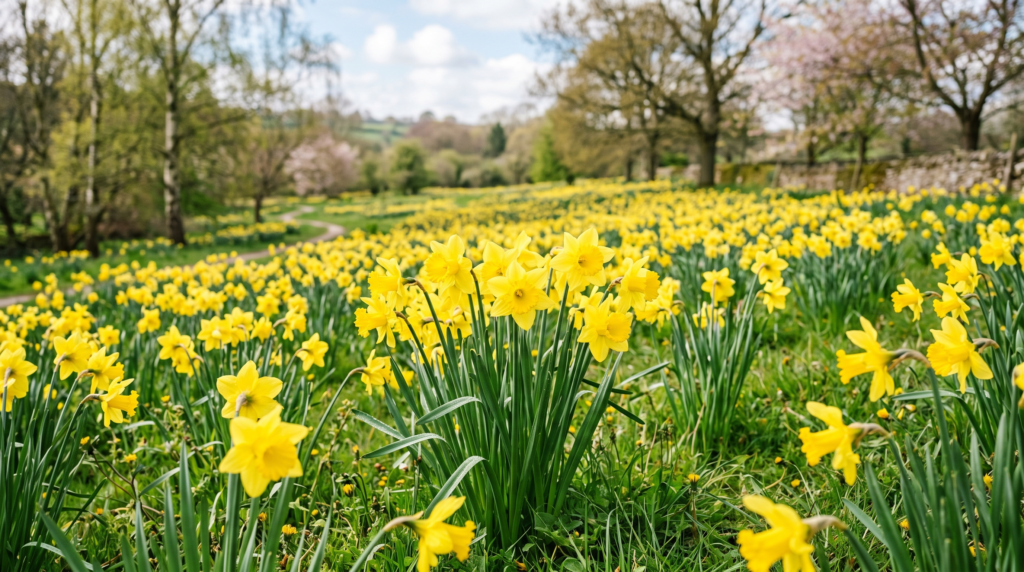
A daffodil is any plant in the genus Narcissus, a group of spring-flowering bulbs native to Southern Europe and North Africa. The words “daffodil” and “narcissus” are interchangeable: Narcissus is the scientific genus name, while “daffodil” is the common English name for the same plant.
Every daffodil flower shares the same fundamental anatomy:
- Six tepals — the petal-like segments that form the outer ring of the flower
- A corona — the central trumpet or cup that projects outward from the tepals
- A single stem (in most divisions) emerging from an underground bulb
The word “daffodil” most likely evolved from the Old English affodyle, meaning “that which comes early” — a reference to its status as one of the first flowers to emerge in the British year. Some etymologists trace it further to the Dutch de asphodel.
Britain’s Only Native Daffodil: Narcissus pseudonarcissus
The Wild Daffodil, Narcissus pseudonarcissus, also called the Lent Lily, is the only daffodil species native to Britain. It is smaller and more delicate than modern garden varieties, growing to around 35 cm, with pale creamy-yellow tepals surrounding a deeper yellow trumpet.
How to identify the Wild Daffodil:
- Pale yellow or near-white outer tepals (distinctly two-toned)
- Deeper golden-yellow, narrower trumpet
- Smaller overall than cultivated varieties — typically 15–35 cm tall
- Grows in ancient woodlands, old meadows, and hedgerow margins
- Flowers late February to early April, depending on location
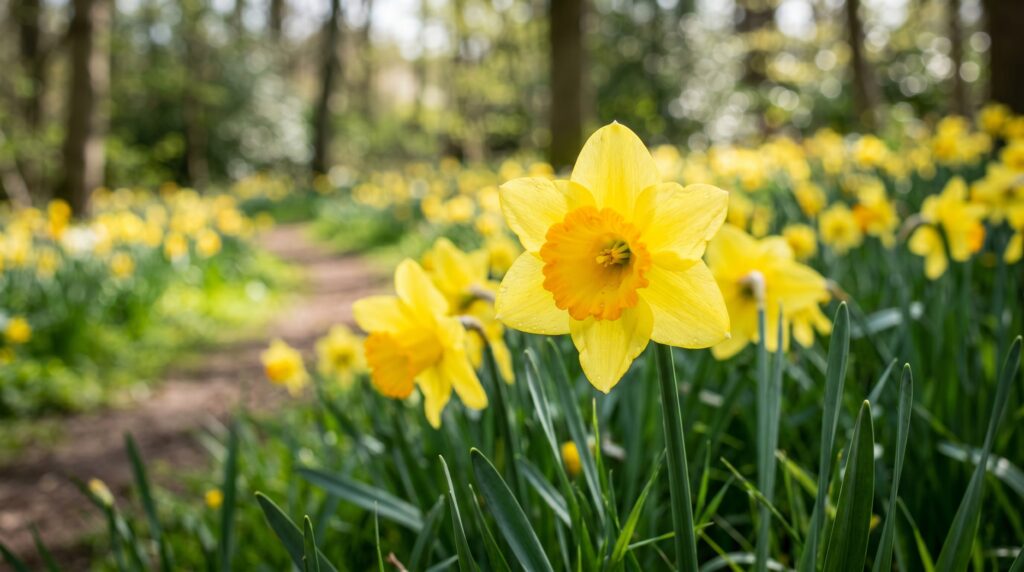
The Tenby Daffodil (N. pseudonarcissus subsp. obvallaris) is a distinct subspecies found wild in and around Tenby, Pembrokeshire, South Wales. Unlike the common wild daffodil, the Tenby Daffodil is uniformly deep golden-yellow throughout — both tepals and trumpet — with short, stiff stems that stand upright in wind. It is considered the true traditional daffodil of Wales and has been grown in local gardens for centuries.
Conservation note: Wild daffodil populations across England and Wales declined dramatically in the 19th and 20th centuries due to agricultural intensification and habitat loss. Today, picking wild daffodils is illegal under the Wildlife and Countryside Act 1981, and many wild sites are protected. Always observe — never pick.
The Greek Myth Behind the Name
The genus name Narcissus comes from Greek mythology. In the myth, Narcissus was a beautiful hunter who, having spurned the love of the nymph Echo, was cursed by Nemesis to fall in love with his own reflection in a pool. Unable to leave his reflection, he withered and died on the bank — and where his body lay, the narcissus flower bloomed in his place. The myth is the origin of the word narcissism. In medieval symbolism, the daffodil came to represent unrequited love, vanity, and the transience of life, while also symbolising renewal and the arrival of spring.
The 13 RHS Divisions of Daffodils Explained
“For the full official classification system, visit the RHS Daffodil Growing Guide — the definitive UK reference for all Narcissus divisions and recommended varieties. “The Royal Horticultural Society classifies all daffodils into 13 divisions based on flower form, number of blooms per stem, and genetic origin. Understanding the divisions helps you choose the right variety for your garden.
| Division | Name | Key Characteristic | UK Examples |
|---|---|---|---|
| 1 | Trumpet | One flower per stem; trumpet ≥ length of tepals | ‘King Alfred’, ‘Dutch Master’, ‘Mount Hood’ |
| 2 | Large-cupped | One flower per stem; cup more than ⅓ but less than full tepal length | ‘Carlton’, ‘Ice Follies’, ‘Jetfire’ |
| 3 | Small-cupped | One flower per stem; cup less than ⅓ of tepal length | ‘Actaea’, ‘Barrett Browning’ |
| 4 | Double | Multiple layers of tepals or corona segments | ‘Tahiti’, ‘White Lion’, ‘Cheerfulness’ |
| 5 | Triandrus | Nodding heads; 2–6 flowers per stem | ‘Thalia’, ‘Hawera’, ‘Ice Wings’ |
| 6 | Cyclamineus | Swept-back (reflexed) tepals; early flowering | ‘Jetfire’, ‘February Gold’, ‘Jack Snipe’, ‘Peeping Tom’ |
| 7 | Jonquilla | Fragrant; multi-headed; slender, rush-like leaves | ‘Pipit’, ‘Quail’, ‘Sweetness’ |
| 8 | Tazetta | Multi-headed; often fragrant; includes paperwhites | ‘Minnow’, ‘Geranium’, ‘Paperwhite’ |
| 9 | Poeticus (Pheasant’s Eye) | Latest-flowering; white tepals; tiny red-rimmed cup | ‘Actaea’, ‘Pheasant’s Eye’ |
| 10 | Bulbocodium | Hoop-petticoat form; tiny funnel corona; species-like | N. bulbocodium |
| 11 | Split-corona | Corona split at least ⅓ of its length (butterfly daffodils) | ‘Cassata’, ‘Palmares’, ‘Lemon Beauty’ |
| 12 | Miscellaneous | Doesn’t fit any other division | Various hybrids |
| 13 | Species & wild hybrids | True species and naturally occurring hybrids | N. pseudonarcissus, N. cyclamineus |
Choosing the Right Daffodil for Your Garden
The best daffodil variety depends on your garden’s conditions, your intended use, and when you want flowers. The table below matches UK garden situations to proven varieties.”If you enjoy planting ornamental bulbs, you might also love growing alliums — for a full guide see our Allium Plants: Complete Guide to Growing UK Garden Bulbs.”
Varieties by Garden Situation (UK-Specific)
| Garden Situation | Best Varieties | Why They Work |
|---|---|---|
| Small pots & containers | ‘Tête-à-tête’, ‘Jetfire’, ‘Topolino’, ‘Minnow’ | Compact growth, wind-resistant, flower early |
| Naturalising in lawns | ‘Carlton’, ‘King Alfred’, ‘February Gold’, ‘Peeping Tom’ | Vigorous, spreads reliably, robust stems |
| North-facing or partial shade | ‘Actaea’, ‘Jenny’, ‘Jack Snipe’, ‘Thalia’ | Tolerates lower light without losing flowering |
| Cut flowers for vases | ‘White Lion’, ‘Cheerfulness’, ‘Erlicheer’, ‘Geranium’ | Long stems, good vase life, fragrant |
| Fragrance | ‘Cheerfulness’, ‘Erlicheer’, jonquil varieties, Paperwhites | High fragrance rating; especially Div. 7 & 8 |
| Extended season (Jan–May) | ‘February Gold’ → ‘Carlton’ → ‘Pheasant’s Eye’ | Stagger planting for 4-month continuous bloom |
| Coastal or exposed gardens | ‘Tête-à-tête’, ‘Jetfire’ | Short-stemmed, storm-resistant |
| Clay soil (common in UK) | ‘Carlton’, ‘King Alfred’, ‘February Gold’ | Tolerant of heavier, wetter ground |
| Wildlife and pollinators | N. pseudonarcissus, open-cup jonquils | Native species; accessible nectar for bees |
| Indoor forcing | Paperwhites, ‘Topolino’, ‘Jetfire’ | Suited to warmth without full outdoor chill period |
Successional Planting for January–May Bloom
Successional planting means choosing varieties from different flowering periods and planting all of them in autumn, so daffodils bloom continuously from January through to May.
Most gardeners plant one or two varieties and enjoy flowers for three or four weeks. By choosing across all three flowering periods, you can have daffodils in your garden for up to four months:
- Early (January–February): ‘Rijnveld’s Early Sensation’, ‘February Gold’, ‘Jetfire’
- Mid-season (March): ‘Carlton’, ‘Ice Follies’, ‘Tête-à-tête’, ‘Dutch Master’
- Late (April–May): ‘Cheerfulness’, ‘Pheasant’s Eye’, ‘Actaea’, ‘Thalia’
Keep a simple bloom diary in your first year — note which varieties flowered when, so you can refine your selection annually.
What to Look for When Buying Daffodil Bulbs
Bulb quality directly affects flowering success. When buying daffodil bulbs, apply these checks:
- Size: Larger bulbs produce more flowers. A “double-nosed” bulb (with a visible secondary nose or offset) will produce two separate flowering stems.
- Firmness: Squeeze gently — reject any bulb that is soft, spongy, mouldy, or shrivelled.
- RHS Award of Garden Merit (AGM): A reliable UK quality mark. AGM varieties have been trialled by the RHS and proven reliable in UK conditions.
- Peat-free and organic options: UK consumer demand for sustainably grown bulbs is growing rapidly. Look for peat-free labelling from specialist nurseries.
Best time to buy in the UK:
- August–October: Best selection available; soil still warm enough for early planting
- November–January: Discounted bulbs; still viable, but may take a season to fully establish
How to Plant Daffodils in the UK — Step-by-Step Guide
How to Plant Daffodil Bulbs in the UK
Daffodil bulbs should be planted in the UK between September and November, at a depth of two to three times the bulb’s own height, in well-drained soil with the pointed tip facing upwards.
When to Plant Daffodil Bulbs in the UK
| Timing | Advice |
|---|---|
| September (ideal) | Soil is still warm; roots establish strongly before winter frosts |
| October | Still good; aim to finish planting by month’s end in Scotland and Northern England |
| November | Viable; later flowering possible in first season but bulbs establish well for future years |
| December–January | Rescue planting — bulbs will likely still flower; catch up fully in subsequent seasons |
Regional note: Gardeners in Scotland and Northern England should aim to finish planting by the end of October, before ground frosts make digging difficult and slow root establishment.
Where to Plant Daffodils
Daffodils grow best in a sunny, well-drained position with fertile, neutral to slightly acidic soil (pH 6.0–7.0).
Key considerations:
- Sunlight: Full sun preferred; partial shade tolerated by some varieties (see Section 2 table)
- Drainage: The single most important factor. Waterlogged soil causes bulb rot — avoid low-lying areas or heavy clay without amendment
- UK clay soil: Improve drainage by working in horticultural grit and well-rotted garden compost before planting. No need to add gravel beneath individual bulbs.
- Avoid: Deep shade; south-facing slopes that bake dry in summer; frost pockets in valleys
How Deep and How Far Apart to Plant
Plant daffodil bulbs at a depth of two to three times their own height, pointed tip upwards.
| Bulb type | Planting depth | Spacing |
|---|---|---|
| Standard varieties | 10–15 cm | 8–10 cm apart |
| Miniature varieties | 5–8 cm | 5–8 cm apart |
| Container planting | 8–10 cm (closer is fine) | 1 bulb-width apart |
Always orient bulbs with the pointed (nose) end facing upward and the flat or concave base plate facing downward.
Step-by-Step Planting Instructions
Step 1: Prepare the soil Dig over the planting area to one spade’s depth. Remove weeds and large stones. For clay soils, work in a bucket of grit and some well-rotted compost per square metre to improve drainage.
Step 2: Mark out your planting area For natural-looking drifts in borders, scatter bulbs loosely by hand and plant them where they land. For lawns, use the same scatter-and-plant method. For containers, plan to pack bulbs more densely for impact.
Step 3: Dig holes to the correct depth Use a bulb planter (a cylindrical tool that removes a core of soil) for speed and consistency. For lawn naturalising, a long-handled bulb planter avoids kneeling. A spade-slit method — slicing the turf and folding it back — works well for larger areas.
Step 4: Place bulbs correctly Set each bulb at the correct depth, pointed tip up, base plate down. Do not force bulbs into compacted soil — this damages the basal plate and root formation.
Step 5: Backfill and firm Replace the soil and firm gently — avoid compacting. For containers, cover with compost to within 2–3 cm of the pot rim.
Step 6: Water in Water thoroughly after planting if the soil is dry. In a typical wet UK autumn, additional watering is rarely needed.
Step 7: Label your planting Mark planting areas with weatherproof labels — bulbs are invisible underground and easy to accidentally dig up.
Planting Methods for Specific Situations
In borders: Plant in odd-numbered groups (5, 7, or 9 bulbs) for a natural, unstructured appearance. Interplant with late-season perennials — hostas, hardy geraniums, or ferns — whose emerging foliage will mask the dying daffodil leaves in May and June.
In lawns (naturalising): Scatter bulbs randomly across the lawn area and plant where they fall. Do not mow the lawn until all daffodil foliage has yellowed and died back completely — a minimum of six weeks after flowering. Complete the final autumn lawn mow by late October, before shoots begin to emerge.
In containers (lasagne planting): Layer different varieties at different depths in the same pot — earliest-flowering, shortest varieties at the top layer; later, taller varieties lower down. This technique, called “lasagne planting,” maximises a container’s display period. Use peat-free John Innes No. 2 or No. 3 compost, ensure the pot has drainage holes, and raise containers off the ground in wet winters to prevent waterlogging.
For indoor forcing: Most daffodil varieties need 12–16 weeks of cold (2–5°C) to trigger flowering. Pot bulbs in autumn, store in a cold but frost-free place (an unheated shed or garage), then bring indoors once shoots reach 5 cm. Paperwhites (N. tazetta) are the exception — they require no chilling period and can be planted directly indoors.
Daffodil Care — Month-by-Month UK Calendar
Daffodils are low-maintenance once established, but the actions you take — or don’t take — in the weeks after flowering determine how well they perform the following year.”As daffodils fade in late spring, it’s the perfect time to introduce summer colour — read our Complete UK Guide to Bedding Plants for what to plant next.”
The Complete UK Daffodil Care Calendar
| Month | What to Do |
|---|---|
| August–September | Buy and plant new bulbs; prepare soil; order from specialist suppliers before stock runs out |
| October | Finish planting all bulbs; complete final lawn mow; water in if soils are unusually dry |
| November–February | Check pots haven’t waterlogged; protect container bulbs from prolonged hard frost |
| February–March | First shoots appear; apply a balanced slow-release fertiliser as growth starts |
| March–April | Peak flowering; deadhead spent blooms as they fade; do NOT cut any foliage |
| April–May | Continue deadheading; late varieties (Pheasant’s Eye, Thalia) still in bloom |
| May–June | Allow foliage to die back naturally — minimum 6 weeks from last flower; do not tie leaves |
| June–July | Lift and divide any overcrowded clumps; store lifted bulbs in dry, cool conditions |
After-Flowering Care — The Most Important Step
The most critical phase of daffodil care is the six weeks after flowering, when the leaves must be left completely undisturbed to replenish the bulb for next year.
Daffodil leaves photosynthesize energy that is stored in the bulb throughout May and June. If you cut, tie, fold, or braid the leaves — even neatly — you interrupt this process and the bulb will produce fewer or no flowers the following year.
The six-week rule: Do not cut, mow, or remove daffodil foliage until it has turned yellow, become limp, and withered naturally — a minimum of six weeks after the last flower has faded.
Common mistakes to avoid:
- Tying foliage into knots or rubber bands — this blocks photosynthesis just as surely as cutting
- Applying lawn weedkiller while leaves are still green
- Cutting the lawn over naturalised bulbs before foliage has died back
- Applying nitrogen-heavy fertiliser — this promotes lush leaf growth at the expense of flower buds forming inside the bulb
Feeding correctly: As flowers begin to fade, apply a potassium-rich fertiliser (a tomato feed works well and is widely available in the UK). High potassium supports bulb development and next year’s flower production. Stop feeding once the foliage starts to yellow.
How to Deadhead Daffodils
Deadheading daffodils — removing spent flower heads — redirects the plant’s energy from seed production back into the bulb.
How to deadhead correctly:
- Wait until the flower has fully faded and petals have dropped or are drooping
- Pinch or cut the flower head at its base, just behind the swelling ovary
- Leave the entire stem and all leaves completely intact — they continue to photosynthesize
- Do not deadhead if you wish to collect seed (seed takes 3–5 years to flower from germination)
Lifting, Dividing, and Storing Bulbs
Divide daffodil clumps every three to five years, or whenever flowering begins to decline — a sign that the bulbs have become overcrowded underground.
How to lift and divide:
- Wait until foliage has fully died back (June or July in most UK gardens)
- Use a garden fork — not a spade — to loosen the soil around the clump, working outward to avoid piercing bulbs
- Lift the clump and separate bulbs by hand, peeling offsets away carefully
- Inspect each bulb: firm and healthy bulbs replant; soft, mouldy, or hollow bulbs discard
- Replant immediately in their new position, or store dry in paper or net bags in a cool, dark, well-ventilated place
Pests, Diseases & Common Problems
Why Daffodils Won’t Flower (“Blindness”)
“Blindness” is the term used when daffodil plants produce leaves but no flowers. It is the most commonly searched daffodil problem among UK gardeners. There are seven main causes:
| Cause | How to Fix It |
|---|---|
| Overcrowding (most common) | Lift and divide clumps; replant with more space |
| Foliage removed too early last year | Wait minimum 6 weeks post-flowering in future |
| Planted too late or too shallow | Replant at correct depth (2–3× bulb height) next season |
| Insufficient sunlight | Move bulbs to a sunnier position |
| Bulbs too small at purchase | Buy bulbs graded at 12 cm circumference or larger |
| Drought during spring growth | Water in dry spells as shoots emerge |
| Nitrogen-heavy feeding | Switch to high-potassium fertiliser |
Blind bulbs usually recover within one or two seasons once the underlying cause is corrected.
Pests
Narcissus Bulb Fly (Merodon equestris)
The narcissus bulb fly is a large hoverfly that mimics a bumblebee in appearance. It lays eggs at the base of leaves in late spring; the larvae tunnel into the bulb and cause soft rot from the inside.
- Identification: Hollow or rotten bulbs discovered when lifting in summer; larvae visible inside
- Prevention: Earth up the soil around stems after flowering to make egg-laying harder; cover the planting area with fine horticultural fleece from April to June
Narcissus Eelworm (Ditylenchus dipsaci)
A microscopic nematode that causes characteristic distorted, stunted leaves with pale or yellow rings — a symptom known as “spikkels.”
- No chemical treatment is available to home gardeners
- Destroy all affected bulbs and plant material immediately — do not compost
- Do not replant any narcissus species in the same soil for at least three years
Slugs and Snails
Attack emerging shoots in early spring. Prevention: apply horticultural grit around container bases; use biological nematode treatment (Nemaslug) from March onwards in warmer soil.
Squirrels
Less of a problem than with tulips — the alkaloids in daffodil bulbs deter most squirrels — but damage is still possible. Plant bulbs inside wire mesh bulb baskets, or peg chicken wire over planting areas.
Diseases
Basal Rot (Fusarium oxysporum f. sp. narcissi) The most common fungal disease of daffodils. Causes pink or white fungal growth at the base of the bulb, a rotten smell, and collapse of growth.
- Spreads in warm, waterlogged soil
- Destroy affected bulbs; do not compost; improve drainage before replanting
Narcissus Leaf Scorch (Stagonospora curtisii) Red-brown lesions appearing on leaf tips, especially in wet springs.
- Remove and destroy affected leaves
- Avoid overhead watering
Smoulder (Botrytis narcissicola) Grey mould developing on leaves and flowers during cool, damp conditions.
- Improve air circulation around plants
- Remove affected material promptly; do not leave debris at the base of plants
Yellow Leaves — What They Mean
Yellow leaves appearing after flowering is normal and expected — it is the natural die-back process and not a sign of disease. Do not remove them.
Yellow leaves during active spring growth may indicate:
- Waterlogging — check drainage
- Narcissus eelworm — look for distortion and pale yellow rings
- Nitrogen deficiency — apply a balanced fertiliser in early spring
Daffodils as Cut Flowers
Why Daffodils Need Special Treatment in Vases
Daffodils exude a sticky, alkaloid-rich sap that is toxic to other cut flowers — particularly tulips — by clogging the vascular tissue of companion stems. This is the reason why daffodils should always be conditioned separately before mixing with other flowers.
Pros and cons of daffodils as cut flowers:
| Pros | Cons |
|---|---|
| Widely available in the UK from February | Sap harms other flowers if not conditioned |
| Excellent vase life when properly conditioned | Some varieties have heavy heads that droop |
| Many varieties are highly fragrant | Double varieties less suitable than singles |
| Inexpensive; often grown in your own garden | Cannot use standard cut-flower food |
| Long stems available on many cultivars |
The Complete Guide to Daffodils in the UK: Growing, Varieties, Care & Everything In Between
The best vase life comes from cutting at the right stage and conditioning correctly before arranging.
- Cut in early morning when stems are turgid (full of water) and temperatures are cool
- Harvest at the “goose-neck” stage — when the bud has bent over but has not yet opened. Flowers last longest when cut at this stage
- Use clean, sharp scissors or secateurs and cut at a 45° angle to maximise water uptake
- Place immediately in cold water in a separate bucket — do not mix with other flowers yet
- Condition for 12–24 hours in a cool, shaded place. The alkaloid sap will leach into the water during this period, making the daffodils safe to arrange with other flowers
- Do not use standard flower food designed for mixed bouquets — it is formulated for other species and will not benefit daffodils
After conditioning, change the water daily and re-cut stems at a 45° angle every two days for maximum longevity. Keep away from direct sunlight, heat sources, ripening fruit (which emits ethylene gas), and draughts.
Best UK Varieties for Cutting
| Variety | Division | Why It’s Good for Cutting |
|---|---|---|
| ‘White Lion’ | 4 (Double) | Long stems, creamy-white, excellent vase presence |
| ‘Cheerfulness’ | 4 (Double) | Fragrant, multi-headed, sturdy stems |
| ‘Erlicheer’ | 4 (Double) | Intensely fragrant; multiple small heads |
| ‘Geranium’ | 8 (Tazetta) | Multi-headed, strongly fragrant, long-lasting |
| ‘Jetfire’ | 6 (Cyclamineus) | Early, compact, cheerful in small arrangements |
The British-Grown Daffodil Movement
Choosing British-grown daffodils supports UK growers, reduces food miles, and delivers fresher flowers with a longer vase life than imported blooms.
The UK has a long tradition of commercial daffodil growing, concentrated in:
- Cornwall and the Isles of Scilly — the earliest and longest-established tradition; Cornish daffodils available from February
- Lincolnshire — large-scale bulb and cut-flower production
- Wales — particularly West Wales, supporting local heritage varieties
Cornwall daffodils typically reach peak supply in February; UK-wide supply peaks in March and April.
To find British-grown daffodils: look for “UK-grown” or “British-grown” labels at florists; seek out growers in the Flowers from the Farm network, a UK cooperative of small-scale cut-flower growers.
Are Daffodils Poisonous? Toxicity & Pet Safety
EMERGENCY CONTACTS Pets: Animal Poison Line — 01202 509 000 (24/7, charges apply) Humans: NHS 111 (free, 24/7) Out-of-hours vet: Contact your registered veterinary practice
Are Daffodils Poisonous to Humans?
Yes. All parts of the daffodil plant — flowers, leaves, stems, and especially the bulbs — are toxic to humans.
Active toxic compounds:
- Lycorine — an alkaloid with strong emetic (vomiting-inducing) properties; the primary toxin
- Calcium oxalate crystals — cause intense irritation to the mouth, throat, and digestive tract
- Narcissine and other alkaloids — present throughout the plant
The bulb contains the highest concentration of all toxins and is the most dangerous part. Incidents of poisoning most commonly occur when daffodil bulbs are mistaken for onions, leeks, or shallots in cooking — documented cases have occurred in the UK and globally.
Symptoms of ingestion in humans:
- Nausea, vomiting, diarrhoea, abdominal pain
- In severe cases: cardiac arrhythmia, low blood pressure, tremors, convulsions
If a person ingests any part of a daffodil: Contact NHS 111 immediately. Do not induce vomiting unless directed by a medical professional.
Skin contact: Prolonged handling of daffodil sap causes contact dermatitis known as “daffodil rash” — a well-documented occupational condition among bulb handlers and florists. Always wear gloves when planting bulbs or handling cut daffodils.
Are Daffodils Poisonous to Dogs?
Yes. Daffodils are highly toxic to dogs and are one of the most dangerous spring plants in UK gardens for canine safety.
All parts are toxic; the bulbs contain the highest toxin concentration. Dogs are most commonly poisoned by digging up and chewing bulbs, or by chewing leaves and flowers in the garden.
Symptoms of daffodil poisoning in dogs:
- Drooling and excessive salivation
- Vomiting and diarrhoea
- Abdominal pain and lethargy
- In severe cases: cardiac irregularities, low blood pressure, respiratory distress, tremors, convulsions
If your dog has eaten any part of a daffodil:
- Do not wait for symptoms to develop
- Contact the Animal Poison Line: 01202 509 000 immediately (charges apply; 24/7)
- Or contact your vet directly
Prevention:
- Fence off or use chicken wire to protect planted bulb areas
- Store unused bulbs in a closed container, out of reach of pets
- Check garden borders before allowing unsupervised access in spring
Are Daffodils Poisonous to Cats?
Yes. Daffodils are toxic to cats via the same compounds — lycorine, calcium oxalate crystals, and other alkaloids. Cats are especially sensitive and are more likely to chew leaves than to dig up bulbs. Symptoms mirror those seen in dogs. Contact the Animal Poison Line (01202 509 000) or your vet immediately if you suspect ingestion.
Are Daffodils Poisonous to Horses?
Yes. Grazing horses can be harmed by daffodils, though they typically avoid them due to the plant’s bitter taste. Risk increases when grazing is sparse and horses have less selective foraging options. Symptoms include colic, trembling, excessive salivation, and in severe cases, cardiac irregularities. Do not allow daffodils to naturalise in fields grazed by horses.
Toxicity Summary Table
| Species | Risk Level | Most Common Exposure | Emergency Contact |
|---|---|---|---|
| Humans | Moderate–High | Bulbs mistaken for food; skin contact | NHS 111 |
| Dogs | High | Chewing bulbs, leaves, flowers | Animal Poison Line: 01202 509 000 |
| Cats | High | Chewing leaves | Animal Poison Line: 01202 509 000 |
| Horses | Moderate | Grazing; scarce forage conditions | Emergency vet |
| Rabbits | High | Foraging on leaves and stems | Emergency vet |
Safe Garden Practices
- Always wear waterproof gloves when planting or handling daffodil bulbs
- Store bulbs in clearly labelled containers — never in bags resembling food storage
- Create a pet-free zone around daffodil plantings using low fencing or garden edging
- Never induce vomiting in a pet yourself — always seek professional veterinary advice immediately
Daffodils in British Culture & History
The Welsh National Flower — History and Meaning
The daffodil is one of the two national emblems of Wales, alongside the leek, and is worn by the Welsh people on St David’s Day, 1 March, in honour of Wales’s patron saint.
The precise origin of the daffodil as a Welsh emblem is debated, but the most widely cited account attributes its popularisation to David Lloyd George, the Welsh-born Liberal statesman who served as Prime Minister from 1916 to 1922. Lloyd George wore a daffodil at the investiture of the Prince of Wales at Caernarfon Castle in 1911, and the gesture caught public attention. In Welsh, both the daffodil and the leek share a common linguistic root: the daffodil is called cenhinen Bedr (“Peter’s leek”), while the leek is cenhinen. This linguistic overlap explains how the two plants became intertwined as Welsh symbols.
The Tenby Daffodil (N. pseudonarcissus subsp. obvallaris) is considered the true traditional Welsh daffodil — a uniformly deep golden-yellow variety found wild around Tenby in Pembrokeshire, cultivated in Welsh gardens long before modern hybrids existed.
St David’s Day, 1 March, is marked across Wales with school eisteddfodau (cultural festivals), civic parades in Cardiff and other cities, and the wearing of daffodils — a tradition now as deeply rooted as the flower itself. The daffodil’s natural bloom time in Wales coincides almost exactly with St David’s Day, reinforcing the association organically.
Daffodils in British Literature
The most famous poem in the English language about daffodils — William Wordsworth’s “I Wandered Lonely as a Cloud” — was inspired by a walk at Ullswater in Cumbria in April 1802.
Wordsworth and his sister Dorothy encountered a long stretch of wild daffodils (N. pseudonarcissus) growing along the lakeshore. Dorothy described the scene in her journal; Wordsworth later transformed it into the poem we know today, published in 1807 and revised in 1815. The poem’s lasting cultural power — generations of British schoolchildren have memorised it — has shaped how the nation collectively imagines daffodils: windswept, free-growing, an uncomplicated symbol of joy and the return of spring.
It is worth noting that what Wordsworth saw was not a garden cultivar but the small, two-toned wild species — the same plant that survives today in Herefordshire’s woodlands and the Lake District’s margins.
The Daffodil as a Symbol of Hope
The daffodil is the symbol of two of the UK’s most prominent cancer charities.
- Marie Curie’s Great Daffodil Appeal uses the daffodil as a symbol of hope and life, raising millions of pounds each year through sponsored volunteer collections to fund hospice nursing care for people with terminal illness.
- Cancer Research UK has also used the daffodil as a fundraising emblem during spring campaigns.
The flower’s associations with renewal, the end of winter, and new beginnings make it a natural and widely understood symbol of hope in British charitable culture.
Daffodils in Greek Mythology — The Origin of the Name
The genus Narcissus is named after the Greek mythological figure Narcissus, a beautiful hunter who fell in love with his own reflection. According to the myth, Narcissus rejected the love of the nymph Echo and was punished by Nemesis, the goddess of retribution, who made him fall hopelessly in love with his own image in a still pool. Unable to leave, he wasted away and died on the bank — and daffodils bloomed where he had lain.
The myth gave the English language the word narcissism (excessive self-admiration), and the genus its scientific name. In medieval European symbolism, the daffodil was associated with vanity and unrequited love, but also with rebirth — death and renewal appearing in a single flower.
Where to See Daffodils in the UK
The best places to see daffodils in the UK range from ancient woodland carpets of wild N. pseudonarcissus to spectacular cultivated displays at National Trust and RHS gardens.
Wild Daffodil Hotspots
| Location | County | Peak Season | Notes |
|---|---|---|---|
| Fownhope & Dymock Woods | Herefordshire | Mid–late March | “The Golden Triangle” — one of the UK’s densest wild daffodil populations |
| Wye Valley | Herefordshire / Monmouthshire | March | Riverside drifts along woodland edges; walks accessible from Symonds Yat |
| Kingsgate Park | Gloucestershire | Mid-March | Part of the Dymock daffodil trail |
| Dunsford Nature Reserve | Devon (National Trust) | March | Ancient woodland carpeted with Lent Lilies |
| Farndale | North Yorkshire (North York Moors) | Late March–April | The famous Farndale Daffodil Walk along the River Dove |
| Ullswater, Lake District | Cumbria | March–April | The landscape that inspired Wordsworth |
Garden Displays
| Garden | Location | Peak Season | What to See |
|---|---|---|---|
| RHS Wisley | Surrey | March–April | Large-scale spring display with rare and AGM varieties |
| Anglesey Abbey | Cambridgeshire (National Trust) | February–March | Early cultivars along the famous winter walk |
| Powis Castle | Powys, Wales | March | Terraced gardens with spectacular spring bulbs |
| Sissinghurst Castle Garden | Kent (National Trust) | March–April | Naturalistic daffodil planting in the orchard |
| Borde Hill Garden | West Sussex | March–April | Extensive woodland and garden spring bulb display |
Tips for Visiting Wild Daffodil Sites
- Peak season in England: Mid-March to early April (weather-dependent; cooler springs push flowering later)
- Wales and West: Late February to March
- Scotland and North: Late March to April
- Check your local Wildlife Trust’s website for seasonal daffodil walk events and updated bloom reports
- Photography tip: Overcast light eliminates harsh shadows and works better for pale yellow flowers than bright sunlight; early morning gives still air and clean backgrounds
Growing Daffodils for Wildlife
Why Daffodils Matter for Pollinators
Daffodils are among the earliest spring flowers available to pollinators, providing nectar and pollen at a critical time of year when few other flowers are in bloom.
Key UK pollinators that visit daffodils:
- Bumblebees — especially early-emerging queens such as the Buff-tailed and Early Bumblebee (Bombus terrestris and B. pratorum)
- Solitary bees — including Hairy-footed Flower Bees (Anthophora plumipes)
- Hoverflies — several species that overwinter as adults and are active from late February
Best varieties for pollinators: Single-flowered, open-cup forms offer the most accessible nectar and pollen. Wild N. pseudonarcissus and Division 7 Jonquilla varieties are particularly good. Heavily double and frilled forms are less accessible — the layered petals make it difficult for bees to reach nectar.
Wildlife-Friendly Planting Tips
- Naturalise single-flowered varieties in grass to create extended early-spring foraging habitat
- Combine daffodils with other early bulbs — snowdrops (January–February), winter aconites (February), and crocus (February–March) — to create a succession of pollen and nectar sources from January onwards
- Avoid using insecticide sprays during flowering, when foraging insects are present
- Leave foliage to die back naturally — the decaying leaf matter provides habitat for small invertebrates at the base of the planting
Frequently Asked Questions
What is the best time to plant daffodil bulbs in the UK?
The best time to plant daffodil bulbs in the UK is between September and November. September is ideal, as the soil is still warm enough to allow roots to establish before the first frosts. Bulbs planted as late as January will still flower, though they may take a season to fully perform.
How deep should I plant daffodil bulbs?
Plant daffodil bulbs at a depth of two to three times their own height. For standard varieties this is typically 10–15 cm; for miniature varieties, 5–8 cm. Always plant with the pointed tip facing upward and the flat basal plate facing downward.
Why are my daffodils not flowering?
The most common reasons daffodils fail to flower are: overcrowded bulbs, foliage cut too early in previous years, planting too late or too shallow, insufficient sunlight, and nitrogen-heavy feeding. The condition is called “blindness.” Identify the cause, correct it, and bulbs typically recover within one to two seasons.
Are daffodils poisonous to dogs?
Yes. All parts of the daffodil are toxic to dogs, with the bulbs containing the highest concentration of toxins — primarily lycorine and calcium oxalate crystals. Symptoms include vomiting, drooling, diarrhoea, and in severe cases, cardiac irregularities. If your dog has eaten any part of a daffodil, contact the Animal Poison Line (01202 509 000) or your vet immediately.
Should you deadhead daffodils?
Yes — removing spent flower heads stops the plant expending energy on seed production and redirects it into bulb development. Snap or cut the flower head off cleanly, leaving the entire stem and all leaves completely intact. Never cut or remove foliage until it has yellowed and withered naturally, at least six weeks after flowering ends.
What is the difference between a daffodil and a narcissus?
There is no difference — they are the same plant. “Narcissus” is the scientific genus name used by botanists; “daffodil” is the common English name for the same plant. The name “narcissus” is sometimes used informally to refer specifically to smaller, multi-headed types (such as tazettas and jonquils), but botanically, all daffodils are narcissi.
Can you grow daffodils in pots?
Yes — daffodils grow very well in containers. Use peat-free John Innes No. 2 or No. 3 compost, ensure the pot has drainage holes, and plant bulbs slightly closer together than you would in the ground. Dwarf varieties such as ‘Tête-à-tête’ and ‘Jetfire’ are especially well-suited to pot growing. Refresh the top layer of compost each year.
What are daffodils toxic to besides dogs?
Daffodils are toxic to cats, horses, rabbits, and humans. The bulbs are the most dangerous part for all species. Always wear waterproof gloves when planting to avoid contact dermatitis (“daffodil rash”).
Why are daffodils the national flower of Wales?
The daffodil became associated with Wales in the 19th century and was popularised as a national symbol by Welsh Prime Minister David Lloyd George, who wore it at the 1911 Investiture of the Prince of Wales. Its Welsh name, cenhinen Bedr (“Peter’s leek”), linked it to the leek — the older Welsh emblem. It blooms naturally around St David’s Day (1 March), reinforcing the cultural association. The Tenby Daffodil (N. pseudonarcissus subsp. obvallaris), found wild in South Wales, is considered the true native Welsh daffodil.
How long do daffodils bloom?
Individual daffodil blooms last one to three weeks, depending on the variety and temperature — cooler conditions extend bloom time. By planting early, mid-season, and late-flowering varieties together in autumn, UK gardeners can have daffodils in bloom continuously from January through to early May — a four-month flowering window.
Daffodil Troubleshooting Quick-Reference
| Problem | Most Likely Cause | Solution |
|---|---|---|
| No flowers (blindness) | Overcrowding; foliage cut too early; too much shade | Lift and divide bulbs; allow 6-week foliage die-back; move to sunnier spot |
| Yellow leaves in spring | Normal post-flowering die-back; or waterlogging | If during active growth, check drainage; do not overwater |
| Soft, rotten bulbs | Basal rot (Fusarium) or bulb fly larvae | Remove and destroy; do not compost; improve drainage before replanting |
| Stunted, distorted growth | Narcissus eelworm | Destroy all affected material; rest the bed from narcissus for 3+ years |
| Flowers flop over | Wind exposure; planted too shallow; variety too tall | Choose shorter varieties; plant at correct depth; stake if needed |
| Leaves but no blooms (second year) | Foliage removed too early the previous year | Improved aftercare this season; patience — may recover in one to two years |
| Mould on leaves in wet spring | Narcissus smoulder (Botrytis) | Improve air circulation; remove and bin affected leaves |
| Brown lesions on leaf tips | Leaf scorch (Stagonospora curtisii) | Remove affected leaves; avoid overhead watering |
| Bulbs hollow or empty | Narcissus bulb fly larvae | Discard affected bulbs; cover with fleece in spring |
Conclusion
Daffodils are the quintessential British garden bulb — resilient enough to outlast generations of gardeners in the same spot, culturally rooted in the landscape and literature of these islands, and generous enough to reward even a beginner’s efforts with armfuls of flowers every spring.
Plant in autumn, let them rest undisturbed, and resist the urge to tidy the foliage too soon — that is the essence of daffodil growing. Choose for your conditions using the variety guide above, sequence your planting for bloom from January to May, and within a few years you’ll have self-sustaining drifts that need nothing from you but a little patience.

Leave a Reply