
A begonia plant is a member of the genus Begonia — one of the five largest flowering plant genera on Earth, with over 2,000 accepted species. They are native to tropical and subtropical forests worldwide and grown for their long-lasting colour, shade tolerance, and remarkable diversity of form.Begonias thrive where most flowering plants struggle — in dappled shade, under trees, on north-facing windowsills.
That shade tolerance, combined with an almost endless variety of flower shapes and foliage patterns, makes them one of the most universally planted genera in gardens and homes.
Key Identification Features
Every begonia shares three consistent botanical traits that allow confident identification:
- Asymmetrical leaves — one side is always larger than the other. No other common houseplant genus has this as a defining characteristic.
- Three-winged seed capsule — female flowers carry a distinctive winged ovary directly behind the petals.
- Separate male and female flowers on the same plant — begonias are monoecious. Male flowers are showier; female flowers bear the seed capsule and persist longer.
At a Glance — Begonia Plant Facts
| Feature | Detail |
|---|---|
| Botanical Name | Begonia spp. |
| Family | Begoniaceae |
| Species Count | 2,000+ accepted species; thousands of cultivars |
| Native Range | Tropical & subtropical Americas, Africa, Asia |
| USDA Hardiness | Zones 9–11 (perennial outdoors); Zones 3–8 (annual/overwinter) |
| Hardiest Species | B. grandis — hardy to Zone 6 / 0°C |
| Height Range | 6 inches to 5+ feet, depending on variety |
| Bloom Season | Summer to first frost (outdoor); year-round (some indoor types) |
| Flower Colours | All colours except blue — white, pink, red, orange, yellow |
| Toxicity | Toxic to cats and dogs; generally safe for humans to handle |
| Key Identifier | Always-asymmetrical leaves; three-winged seed capsules |
Pros and Cons of Growing Begonias
Advantages
- Thrives in shade where few plants flower
- Flowers continuously from summer to frost
- Enormous variety — foliage AND flowering types
- Suitable for pots, baskets, borders, indoors
- Deer and rabbit resistant
- Easy to propagate at home for free
- Tuberous types can be saved and reused for years
Disadvantages
- Toxic to cats and dogs (especially tubers)
- Overwatering kills plants quickly
- Most types need frost protection
- Rex types fussy about humidity
- Susceptible to powdery mildew in still air
- Tuberous types require annual storage management
Begonia History, Origins & Cultural Significance
The begonia was first formally described in 1690 by French botanist Charles Plumier during a Caribbean expedition, and named in honour of Michel Bégon — the French governor of Saint-Domingue (now Haiti) and a passionate patron of botany. The genus name first appeared in print in 1700, and was formally adopted by Carl Linnaeus in his landmark Species Plantarum in 1753.
Timeline: Begonia Through the Ages
| Date | Event |
|---|---|
| 20–65 million years ago | Begonia genus likely originates in Africa during the Paleogene–Miocene period, based on phylogenetic inference |
| Mid-16th century | Spanish priests encounter native begonias in Central and South America |
| 1690 | Charles Plumier formally documents six new species in the Antilles; names the genus Begonia for Michel Bégon |
| 1700 | Name “Begonia” appears in print for the first time, in a publication by Joseph Pitton de Tournefort |
| 1753 | Carl Linnaeus merges original species into Begonia obliqua in Species Plantarum — name used ever since |
| 1821 | Wild Brazilian begonia reaches Berlin’s Botanical Garden; later hybridised into modern wax begonias |
| 19th century | Victorian plant hunters bring hundreds of species to Europe; first commercial breeding boom begins |
| 20th century | Modern hybridisation creates Rieger, Dragon Wing, and Sun-tolerant varieties |
| Present | Over 2,000 accepted species; new species still being described, especially from China and Southeast Asia |
Begonias in Chinese Culture
The begonia has been woven into Chinese culture since at least the 14th century, known as Qiu Haitang (秋海棠) — “Autumn Crabapple.” Classical Tang and Song dynasty poetry uses the begonia to symbolise melancholic, unrequited longing. A famous legend from the Cailan Zazhi (採蘭雜志) describes a woman whose tears, shed while mourning her lost husband, fell to the earth and bloomed into begonias — giving the flower its poetic association with love, sacrifice, and resilient beauty.
In contrast, the practice of feng shui assigns begonias an entirely positive role: red and pink begonias placed near the entrance or southeast corner of a home are believed to encourage harmony, wealth, and good fortune. During Lunar New Year celebrations, begonias are exchanged as gifts to attract prosperity and ward off negative energy.
Victorian Floriography
In the elaborate Victorian language of flowers (floriography), the begonia was assigned a complex dual meaning: gratitude combined with caution, or a direct warning to “beware.” Cultural historians suggest this meaning derived from the plant’s lopsided leaves and the mildly sour, potentially irritant sap of certain species. By the 20th century, as the begonia became a garden staple, this severe meaning softened into associations with appreciation, quiet strength, and individuality.
Types of Begonia Plants — The Complete Guide
Begonias are classified into three primary groups based on their root system: fibrous-rooted, rhizomatous, and tuberous. Each group has different care requirements, growth habits, and seasonal behaviour. Knowing which group you have is the single most important step in growing begonias successfully.
The Three Root Groups at a Glance
| Root Type | Key Sub-Types | Grown For | Goes Dormant? | Best Use |
|---|---|---|---|---|
| Fibrous-rooted | Wax, Cane/Angel Wing, Dragon Wing | Flowers & foliage | No | Bedding, containers, houseplants |
| Rhizomatous | Rex, standard rhizomatous | Foliage primarily | No (may slow in winter) | Foliage houseplant |
| Tuberous | Tuberhybrida, Rieger/Elatior, Hardy grandis | Flowers (mostly) | Yes (most types) | Hanging baskets, pots, shade borders |
Fibrous-Rooted Begonias
Wax Begonias (Begonia ×semperflorens-cultorum)
Wax begonias are the world’s most popular bedding begonias — compact, fibrous-rooted plants named for their glossy, waxy-looking foliage. They flower continuously from spring to frost and tolerate a wider range of light conditions than any other begonia.
Wax Begonia
- Height
- 15–30 cm (6–12 in)
- Flowers
- Red, pink, or white
- Light
- Sun to partial shade
- Best for
- Edging, window boxes, containers
- Notable
- ‘Whopper’, ‘Senator’, ‘BIG® Red’, ‘Surefire®’
Angel Wing / Cane
- Height
- 30 cm – 1.5 m (1–5 ft)
- Flowers
- Dangling clusters; red, pink, white
- Light
- Bright indirect light
- Best for
- Tall indoor specimens, shady borders
- Notable
- ‘Sophie Cecile’, ‘Torch’, ‘Looking Glass’
Dragon Wing
- Height
- 40–60 cm (15–24 in)
- Flowers
- Deep red or pink; continuous
- Light
- Morning sun / partial shade
- Best for
- Beds, hanging baskets, pots
- Notable
- Very versatile; tolerates more sun than most
Rhizomatous Begonias
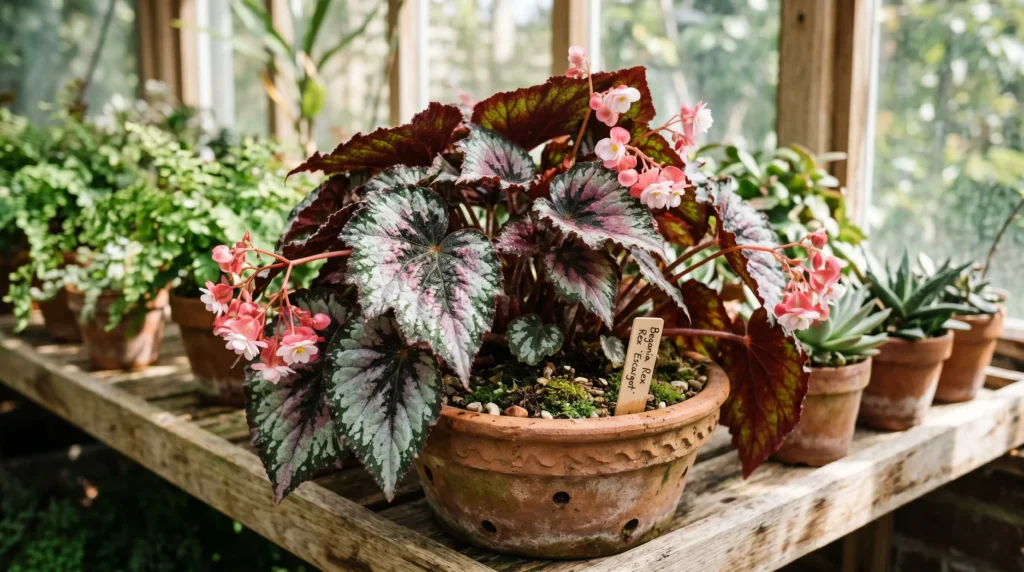
Rex Begonias (Begonia rex-cultorum)
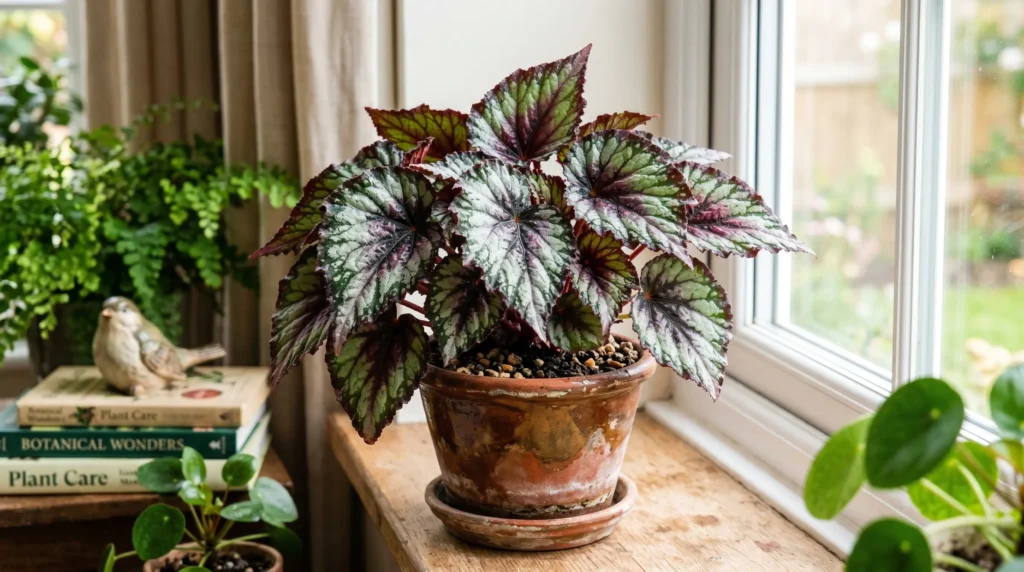
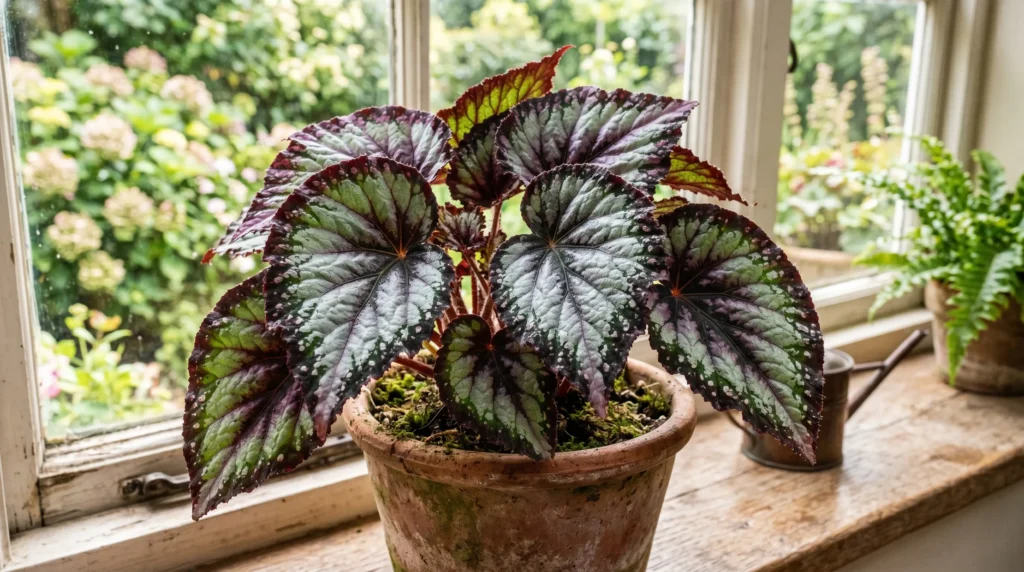
Rex begonias are rhizomatous begonias cultivated almost entirely for their dramatically patterned foliage — displaying swirling patterns in combinations of silver, burgundy, deep purple, forest green, and rose pink. They are native to northeastern India and Southeast Asia and prefer warm, humid, low-light conditions.
Rex Begonia
- Height
- 30–45 cm (12–18 in)
- Key appeal
- Spectacular foliage patterns
- Light
- Bright indirect — never direct sun
- Humidity
- Needs 50–70%+
- Notable
- ‘Escargot’, ‘Fireworks’, ‘Midnight Twist’, ‘Beleaf Maui Sunset’
Polka Dot (B. maculata)
- Height
- 45–90 cm (18–36 in)
- Key appeal
- White-spotted leaves, red undersides
- Light
- Bright indirect light
- Type
- Cane-type; technically fibrous
- Notable
- Most searched begonia on social media
Tuberous Begonias
Standard Tuberous Begonias (Begonia ×tuberhybrida)
Tuberous begonias grow from underground food-storage tubers and produce the largest, most dramatic flowers in the genus — up to 15 cm (6 inches) across, in rose-like, camellia-like, or carnation-like forms. They go fully dormant in winter and must be stored as dry tubers until the following spring in cold climates.
Tuberous (Standard)
- Height
- 30–90 cm (12–36 in)
- Flowers
- Huge; rose/camellia-like; all colours
- Light
- Partial shade
- Dormancy
- Yes — store tubers over winter
- Notable series
- ‘Non-Stop’, ‘Illumination’, ‘Million Kisses’
Rieger / Elatior (B. ×hiemalis)
- Key appeal
- Winter-blooming houseplant
- Bloom season
- Autumn–spring (short-day triggered)
- Light
- Bright indirect; winter sun acceptable
- Temperature
- Best at 15–18°C (60–65°F)
- Notable series
- ‘Solenia®’, ‘Amstel Batik’
Hardy Begonia (B. grandis)
- Hardy to
- USDA Zone 6 / 0°C (with mulch)
- Flowers
- Soft pink or white; late summer
- Special feature
- Aerial bulbils; self-sows
- Dormancy
- Dies back to ground; re-sprouts in spring
- Best for
- UK/Zone 6 shade gardens; naturalising
Full Type Comparison Table
| Type | Height | Light | Dormant? | Difficulty | Best Use |
|---|---|---|---|---|---|
| Wax (Semperflorens) | 15–30 cm | Sun to shade | No | Easy | Bedding, edging, containers |
| Dragon Wing | 40–60 cm | Morning sun / shade | No | Easy | Beds, baskets, pots |
| Angel Wing / Cane | 30–150 cm | Bright indirect | No | Easy–Moderate | Tall indoor, shady borders |
| Rex | 30–45 cm | Bright indirect | No | Moderate | Indoor statement plant |
| Polka Dot (maculata) | 45–90 cm | Bright indirect | No | Easy–Moderate | Trendy houseplant |
| Tuberous (tuberhybrida) | 30–90 cm | Partial shade | Yes | Moderate | Hanging baskets, pots |
| Rieger / Elatior | 30–45 cm | Bright indirect | Partial | Moderate | Winter houseplant |
| Hardy (B. grandis) | 45–60 cm | Partial shade | Yes (in-ground) | Easy | UK/Zone 6 shade garden |
Begonia Plant Care — The Complete Guide
Begonias need bright indirect light, careful watering (neither too wet nor too dry), well-draining soil, moderate humidity, and light feeding during the growing season. The single most important rule: never let a begonia sit in waterlogged soil. Overwatering causes root rot and is the leading cause of begonia death.
Light Requirements
Most begonias perform best in bright, indirect light — the equivalent of a spot that receives morning sun but is shaded from harsh afternoon sun. Placing a begonia in too much shade reduces flowering and causes leggy growth; too much direct sun causes leaf scorch.
| Light Level | Effect on Begonias | Suitable Types |
|---|---|---|
| Full sun (6+ hrs direct) | Risk of scorch | Bronze-leaf wax begonias only |
| Morning sun / afternoon shade | Ideal for most | Wax, Dragon Wing, tuberous |
| Bright indirect / dappled shade | Best for foliage types | Rex, Angel Wing, rhizomatous |
| Medium indirect (north window) | Acceptable | Wax begonias; reduced flowering |
| Deep shade | Poor performance | No begonia type thrives |
East or north-facing windowsills are ideal for most indoor begonias. For south or west-facing windows, filter with a sheer curtain. In low-light homes or during winter, supplement with an LED grow light for 12–14 hours per day.
Watering Begonias — The Most Critical Skill
Water begonias when the top 2.5–5 cm (1–2 inches) of soil feels dry to the touch — roughly every 5–7 days in warm weather. Always water at the base of the plant, never over the leaves. Empty saucers after 30 minutes. Never let any begonia sit in standing water.
Overwatering vs. Underwatering — How to Tell the Difference
| Symptom | Overwatering | Underwatering |
|---|---|---|
| Leaves | Yellow, mushy, or dropping | Brown crispy edges; wilting |
| Stems | Soft, dark, mushy at base | Limp but still firm |
| Soil | Constantly wet; smells musty | Bone dry; pulling from pot edges |
| Roots (if you check) | Brown, mushy — root rot | Dry, tan — healthy-looking |
| Fix | Stop watering; improve drainage; repot if roots are rotten | Water thoroughly; check drainage isn’t blocked |
Do not mist begonia foliage directly. Water droplets sitting on leaves in still air are the primary cause of powdery mildew and botrytis grey mould. Raise humidity via a pebble tray, humidifier, or grouping plants together instead.
Best Soil for Begonias
The best soil for begonias is a light, well-draining mix rich in organic matter, with a slightly acidic pH of 5.5–6.5. Begonias cannot tolerate heavy, compacted, or waterlogged soils.
Recommended mix: 50% peat-free multi-purpose compost + 30–40% perlite or horticultural grit + 10–20% fine bark or coco coir. Never reuse old, depleted potting compost from previous seasons, and avoid garden soil in containers.
Temperature & Humidity
| Requirement | Ideal Range | Minimum | Notes |
|---|---|---|---|
| Temperature | 15–24°C (60–75°F) | 10°C (50°F) | Frost is fatal to all but B. grandis |
| Humidity | 50–60% | 40% | Rex begonias prefer 60–75% |
| Winter minimum | 13–18°C (55–65°F) | 10°C (50°F) | Rieger begonias bloom best at 15–18°C |
Fertilising Begonias
Feed begonias every 4–6 weeks during the growing season (spring and summer) with a liquid fertiliser suited to their growth stage. Stop feeding entirely in winter.
| Season / Goal | Fertiliser Type | Frequency |
|---|---|---|
| Spring (new growth) | Balanced (N-P-K 10-10-10) | Every 4–6 weeks |
| Summer (flowering) | High phosphorus (5-10-5) or tomato feed | Every 4–6 weeks (outdoor tuberous: weekly) |
| Foliage types (Rex, Angel Wing) | Higher nitrogen (e.g. 20-10-10) | Every 4–6 weeks |
| Autumn | Half-strength balanced | Monthly; taper off |
| Winter | None | Stop completely |
Pruning & Deadheading
- Wax begonias — self-cleaning; flowers drop naturally. No deadheading needed.
- Tuberous begonias — pinch off faded blooms just below the flower to encourage continuous flowering.
- Cane / Angel Wing — pinch growing tips when stems reach 15 cm to encourage bushiness; remove old, bare canes to the base.
- Rex begonias — minimal pruning; remove leggy or bare stems; pinch to shape only.
- All types — always use clean, sharp scissors; cut ½ inch above a leaf node; wipe blades with isopropyl alcohol between plants.
How to Plant Begonias (Indoors & Outdoors)
Plant begonias outdoors only after all risk of frost has passed and night-time temperatures are consistently above 10°C (50°F). In the UK this is typically late May to early June; in USDA Zone 7–8 from late April.
When to Plant Outdoors — By Region
| Location | Safe Planting Time |
|---|---|
| UK — South/Southwest | Mid-May |
| UK — Most regions | Late May to early June |
| UK — Scotland / North | Early June |
| USDA Zone 5–6 | Late May–early June |
| USDA Zone 7–8 | Late April–May |
| USDA Zone 9–11 | Year-round (perennial) |
How to Plant Begonia Tubers — Step by Step
This HowTo covers the correct method for starting tuberous begonias from tubers for the best results.
-
Identify top from bottomThe tuber has a hollow, concave (dipped) side — this is the top, where shoots emerge. The rounded, convex side faces downward.
-
Prepare your containerFill a shallow tray or 10 cm (4-inch) pot with 7–10 cm of moist, free-draining compost. A mix of multi-purpose compost and perlite works well.
-
Position tubers correctlyPlace tubers hollow/concave-side facing UP, so the top sits level with or just slightly below the compost surface. Do not bury deep.
-
Water sparinglyCompost should be barely moist, not wet. Overwatering before shoots appear is the most common cause of tuber rot.
-
Provide warmth and lightPlace in a warm spot at 18°C (64°F) with bright indirect light. A heated propagator or warm windowsill is ideal.
-
Wait for shoots, then pot onGreen shoots emerge in 2–4 weeks. Once 3–5 cm tall, pot on into individual containers or plant outdoors after all frost risk has passed.
Planting Begonias in Beds and Borders
-
Choose the right siteSelect a spot with dappled shade or morning sun, sheltered from strong wind and harsh afternoon sun.
-
Prepare the soilDig in garden compost and horticultural grit to improve drainage and fertility.
-
Wait for frost-free conditionsPlant out only after last frost has passed and night temperatures are reliably above 10°C (50°F).
-
Plant at correct spacingSpace plants 15–30 cm (6–12 inches) apart depending on variety. Plant at the same depth as the nursery pot.
-
Firm in and water wellFirm soil gently around roots; water thoroughly; keep watered regularly until established.
How to Propagate Begonias — All Methods
Begonias can be propagated by stem cuttings, leaf cuttings, division, tuber division, and seed. The correct method depends on the type of begonia you have — using the wrong method is the most common reason propagation fails.
Propagation Methods — Quick Comparison
| Method | Best For | Difficulty | Time to Roots | Success Rate |
|---|---|---|---|---|
| Stem cutting | Cane, wax, fibrous, tuberous | Easy | 3–6 weeks | High |
| Leaf petiole cutting | Rex, rhizomatous | Easy | 6–10 weeks | Good |
| Vein/wedge leaf cutting | Rex | Moderate | 8–12 weeks | Moderate |
| Division | Rhizomatous, clumping types | Easy | 2–4 weeks | High |
| Tuber division | Tuberous types | Moderate | 2–3 weeks to sprout | Good if done correctly |
| Seed | All types (advanced) | Advanced | 14–21 days to germinate | Variable |
Stem Cutting Propagation
Best for: Wax, cane, angel wing, dragon wing, and tuberous begonias. Best time: spring to early summer.
-
Select a healthy stemChoose a non-flowering stem from the parent plant. Avoid stems showing any signs of disease or pest damage.
-
Cut below a nodeUsing clean, sharp scissors, cut a section 5–10 cm (2–4 inches) long, just below a leaf node.
-
Prepare the cuttingRemove all lower leaves; retain 2–3 leaves at the tip. Optional: dip the cut end in rooting hormone powder.
-
Insert into rooting mediumPlace in moist perlite, vermiculite, or cuttings compost. Do not use potting mix (too rich — causes rot).
-
Cover and waitCover with a clear plastic bag or propagator lid to maintain humidity. Keep at 18–22°C in bright indirect light.
-
Pot on when rootedRoots form in 3–6 weeks. Pot on into individual pots of well-draining compost once roots are 2–3 cm long.
Leaf Cutting — Petiole Method (Rex & Rhizomatous)
-
Cut a healthy leaf with its stalkRetain 2–3 cm of the leaf stalk (petiole). Use a clean, sharp blade.
-
Insert at 45° anglePush the petiole diagonally into moist compost, so the leaf stands upright like a flag.
-
Maintain humidityCover with a propagator lid or clear bag. Keep at 18–20°C.
-
Wait for plantletsNew plantlets emerge from the base of the petiole in 6–10 weeks. Pot on when they have 2–3 leaves of their own.
Tuber Division (Tuberous Types)
-
Wait for spring growth pointsIn spring, when stored tubers show visible shoots 1–2 cm tall, they are ready for division.
-
Cut with a sterile knifeUsing a clean, sharp knife, cut the tuber so each section has at least one visible shoot or bud.
-
Treat cut surfacesImmediately dust all cut surfaces with sulphur powder or cinnamon to prevent fungal rot.
-
Allow to callousLeave cut sections in a warm, dry place for 24 hours before planting to allow the surface to seal.
-
Plant hollow-side upPlant each section in barely moist compost, concave side facing up; water very sparingly until growth is established.
Begonia Seasonal Care Calendar
What you do with your begonias changes significantly with each season. The calendar below covers UK timing; adjust by 2–4 weeks for colder (Scotland, northern US) or warmer (southern England, USDA Zone 8+) regions.
Spring (March–May)
- Bring stored tubers out; start indoors at 18°C
- Resume watering & light feeding for houseplants
- Repot root-bound plants into fresh compost
- Take stem cuttings for propagation
- Harden off outdoor plants gradually
- Plant out after last frost (UK: late May)
Summer (June–August)
- Main growing and flowering season
- Water regularly; don’t allow to fully dry out
- Feed every 4–6 weeks (outdoor tuberous: weekly)
- Deadhead fading blooms on tuberous & cane types
- Pinch back leggy growth for bushiness
- Monitor for powdery mildew and pests
Autumn (September–November)
- Taper off feeding from September
- Reduce watering as growth slows
- Bring tender types indoors before 10°C nights
- Stop watering tuberous as foliage yellows
- Lift tuberous begonias before first hard frost
- Pot up wax begonias for indoor winter display
Winter (December–February)
- Store dry tubers at 7–10°C in frost-free location
- Check stored tubers monthly; remove any rotting
- Overwintered houseplants: keep barely moist
- Rieger/Elatior begonias: peak flowering season
- Late February: check for early sprouting tubers
- Plan and order new varieties for spring
How to Overwinter Begonias
The method for overwintering begonias depends entirely on the type: tuberous begonias are stored as dry dormant tubers; fibrous and rhizomatous types are kept growing indoors as houseplants.
Overwintering Tuberous Begonias — Step by Step
Start this process in early autumn. Tuberous begonias naturally signal the end of the season as their leaves begin to yellow — this is your prompt to act before the first hard frost.
-
Reduce watering from SeptemberStop feeding; water less frequently as growth naturally slows and days shorten.
-
Wait for natural die-backAllow foliage to yellow and begin to collapse naturally — forcing this process harms the tuber’s food reserves.
-
Lift before hard frostCarefully dig the whole plant with a garden fork, working at least 30 cm from the base. A bruised or cut tuber may rot in storage.
-
Check for vine weevil grubsShake the root zone; look for white, C-shaped larvae and remove them. These grubs hollow out tubers and cause storage rot.
-
Dry the whole plantLay the entire plant — foliage still attached — in a warm, dry, frost-free place for 5–10 days. Bring indoors at night if frost threatens.
-
Remove the stemWhen fully dry, the main stem should detach cleanly from the tuber with a gentle twist. If it resists, dry for 2–3 more days.
-
Inspect and treat tubersExamine each tuber; cut away any rotted tissue; dust cut surfaces and any soft spots with sulphur powder or cinnamon.
-
Pack individually and storePlace each tuber in a separate paper bag (prevents disease spreading between tubers). Pack into a cardboard box with dry vermiculite or barely dry compost.
-
Store correctly all winterStore at 7–10°C (45–50°F) in a cool, dark, frost-free location — a garage, shed, or unheated spare room is ideal. Check monthly; discard any badly rotted tubers.
Overwintering Fibrous Begonias (Wax, Cane, Dragon Wing)
These types do not go dormant. They can be brought indoors and kept as houseplants all winter.
- Bring indoors before temperatures drop below 10°C (50°F)
- Inspect carefully for mealybugs and spider mites before bringing inside; treat if needed
- Position near a bright east or north-facing window
- Reduce watering significantly — water only when top 2.5 cm of compost is dry
- Stop feeding; resume only when new spring growth appears
- Optional: cut back by up to one-third to a more manageable size
Overwintering Summary Table
| Begonia Type | Method | Storage Temp | Key Risk |
|---|---|---|---|
| Tuberous (tuberhybrida) | Dig, dry, store tubers | 7–10°C | Tuber rot if too damp |
| Wax (semperflorens) | Keep as houseplant | 13–18°C | Leggy growth from low light |
| Cane / Dragon Wing | Keep as houseplant | 13–18°C | Root rot if overwatered |
| Rex | Year-round houseplant | 15–20°C | Low humidity → crispy leaves |
| Hardy (B. grandis) | Leave in ground + mulch | Hardy to 0°C | Frost on emerging spring shoots |
| Rieger / Elatior | Keep as houseplant | 13–16°C | Overheating stops flowering |
Begonias as Houseplants
Many begonias make excellent permanent houseplants, thriving indoors year-round with the right conditions. The best indoor begonias include Rex, Angel Wing, Rieger/Elatior, Polka Dot (B. maculata), and the architectural ‘Gryphon’ series.
Best Begonias for Indoor Growing
| Variety | Key Appeal | Light Need | Care Level | Special Note |
|---|---|---|---|---|
| Rex begonia | Dramatic foliage patterns | Bright indirect | Moderate | Needs high humidity |
| Angel Wing / Cane | Tall; flowers year-round | Bright indirect | Easy | Pinch for bushiness |
| Polka Dot (B. maculata) | Spotted leaves, red undersides | Bright indirect | Easy–Moderate | Most-photographed begonia |
| Rieger / Elatior | Winter flowers | Bright indirect; winter sun OK | Moderate | Blooms up to 6 months |
| Begonia ‘Gryphon’ | Large, architectural foliage | Low–bright indirect | Easy | Tolerates lower light well |
| Wax begonia | Continuous flowers | Low–bright indirect | Very easy | Best beginner houseplant |
Indoor Placement Rules
- Best windows: East-facing (morning sun) or north-facing (bright indirect)
- South or west windows: Always filter with a sheer curtain in spring and summer
- Minimum light: 4–6 hours of indirect light daily; supplement with an LED grow light in low-light homes
- Rotate the pot a quarter-turn every 2–4 weeks for even, balanced growth
- Keep away from radiators and heating vents — dry heat harms begonias
- Avoid cold draughts from windows and doors in winter
B. maculata has become one of the most searched houseplants globally, with its olive-green leaves scattered with white spots and dramatic burgundy-red undersides. It’s a cane-type begonia that grows upright to 60–90 cm, flowers in small white clusters, and is easier to care for than its dramatic appearance suggests. Key needs: bright indirect light, moderate watering, and regular pinching to prevent legginess.
Begonias in Containers & Hanging Baskets
Begonias are among the finest container plants available, and trailing tuberous begonias in particular are arguably the most spectacular hanging basket subjects you can grow.
- Pot choice: Always use containers with large, unobstructed drainage holes. Terracotta is breathable and reduces overwatering risk; plastic retains moisture longer.
- Compost: Multi-purpose compost and perlite (2:1); mix in slow-release fertiliser granules at planting time.
- Container watering: More frequent than in-ground planting — check daily in summer; hanging baskets may need watering twice daily in hot weather.
- Feeding containers: Every 2 weeks with liquid fertiliser during the growing season (nutrients wash out faster in pots).
- Self-watering containers are excellent for begonias — they maintain even moisture and prevent both over and underwatering.
Hanging Basket Planting Guide
For a lush hanging basket of trailing tuberous begonias:
- Use 3–5 tubers in a 30 cm (12-inch) basket
- Moisture-retentive liner; compost mixed with water-retaining granules
- Position in a sheltered spot with morning light and afternoon shade
- Feed weekly with high-potash liquid fertiliser once in full growth
Recommended Container Combinations
| Role | Begonia Choice | Companion Plants |
|---|---|---|
| “Thriller” (centrepiece) | Angel Wing / upright tuberous | Hostas, tall ferns |
| “Filler” | Wax begonias | Impatiens, coleus |
| “Spiller” (trailing) | Trailing tuberous begonia | Fuchsia, bacopa, lobelia |
Common Begonia Problems, Pests & Diseases
Most begonia problems trace back to three root causes: incorrect watering, insufficient humidity, or poor air circulation. Identifying the correct cause before taking action is essential — the fix for overwatering is the opposite of the fix for underwatering.
Symptoms, Causes & Solutions — Master Table
| Symptom | Most Likely Cause | Action |
|---|---|---|
| Yellow leaves | Overwatering; low light; low nitrogen | Check soil moisture; reduce watering; move to brighter spot; feed |
| Brown crispy leaf edges | Underwatering; low humidity; sunburn | Water more consistently; boost humidity; move from direct sun |
| Drooping / wilting | Underwatering OR root rot from overwatering | Feel soil — dry = water; soggy = reduce water, check roots |
| Leggy, stretched stems | Insufficient light | Move closer to window; add grow light |
| White powder on leaves | Powdery mildew (fungal) | Improve airflow; apply potassium bicarbonate; remove affected leaves |
| Grey fuzzy growth on stems | Botrytis grey mould | Remove all affected material immediately; improve ventilation |
| Brown spots on leaves | Fungal disease / sunburn / pests | Identify cause: check light, inspect for bugs, test soil moisture |
| Bud drop | Temperature shock; inconsistent watering | Stabilise temperature; maintain even soil moisture |
| Pale / white leaves | Too much direct sunlight | Move to indirect light immediately |
| Mushy dark stem base | Root rot (Pythium / Rhizoctonia) | Remove; trim rotten roots; repot in fresh dry compost |
| Sudden leaf drop | Overwatering in winter; cold exposure; being moved | Reduce water; protect from cold; minimise repositioning |
Common Pests
Mealybugs
What they look like: White, cottony clusters in leaf joints and on undersides of leaves. Treatment: Dab individual colonies with isopropyl alcohol on a cotton bud; spray the whole plant with neem oil or insecticidal soap every 7 days for 3–4 weeks. Prevention: Quarantine all new plants for two weeks before introducing to your collection.
Spider Mites
What they look like: Tiny red or brown dots; fine webbing on leaves; reddish dusty film on undersides. Most common in hot, dry conditions. Treatment: Increase humidity; spray with neem oil or insecticidal soap every 5–7 days; repeat until clear.
Vine Weevil (UK)
Adults: Notch leaf margins at night. Larvae: White, C-shaped grubs that eat roots — the first sign is often sudden, unexplained plant collapse. Treatment: Apply biological control nematodes (Steinernema kraussei) to soil in autumn or early spring; inspect and remove grubs physically when repotting.
Common Diseases
Powdery Mildew
Appearance: White or grey powdery coating on leaves and stems. Cause: Warm, humid, poorly ventilated conditions; water on foliage. Prevention: Never mist leaves; space plants for airflow. Treatment: Potassium bicarbonate solution or sulphur-based fungicide; remove badly affected leaves and bin (do not compost).
Root Rot (Pythium / Rhizoctonia)
Cause: Persistently waterlogged soil. Symptoms: Wilting despite moist soil; yellowing; mushy, dark roots. Treatment: Remove plant; trim all brown/black roots with sterile scissors; dust with sulphur powder; repot in fresh, dry compost; do not water for several days.
Botrytis Grey Mould
Appearance: Fuzzy grey mould on dying leaves, flowers, and soft stems. Cause: Cool, damp, stagnant air. Treatment: Remove all affected material; improve ventilation significantly; apply a suitable fungicide if problem persists.
Are Begonias Toxic to Pets & Humans?
Pet Safety — Important Information
Yes — all parts of the begonia plant are toxic to cats and dogs. The tubers (bulbs) are the most potent part. Compounds including soluble calcium oxalates cause oral irritation, excessive drooling, vomiting, and difficulty swallowing. In cats, significant ingestion may also affect the kidneys.
If you suspect your pet has eaten a begonia:
- Contact your vet immediately
- UK — Animal Poison Line: 01202 509000
- US — ASPCA Animal Poison Control: 888-426-4435
- US — Pet Poison Helpline: 800-213-6680
Toxicity Summary Table
| Subject | Toxic? | Most Toxic Part | Symptoms |
|---|---|---|---|
| Cats | Yes — toxic | Tubers (most potent) | Drooling, vomiting, oral irritation, potential kidney effects |
| Dogs | Yes — toxic | Tubers (most potent) | Drooling, vomiting, oral irritation |
| Humans (adults) | Mild / handling safe | Sap (skin irritant in some) | Skin irritation possible; edible in small amounts with care |
| Children | Keep out of reach | All parts | Stomach upset if significant amount consumed |
Edible Uses (with Important Caution)
Despite the mild toxicity note above, begonia flowers and young leaves have a subtly tangy, citrus-like flavour and have been used in Southeast Asian cuisines in small quantities — appearing in salads and as edible garnishes. Most begonias contain oxalic acid in their tissues; safe in small amounts but potentially problematic in large quantities, particularly for people with kidney conditions or oxalate sensitivity. Only consume begonias if you are absolutely certain they are pesticide-free and have verified the species is edible.
Begonia Symbolism, Meaning & Cultural Significance
The begonia symbolises balance, harmony, gratitude, caution, and individual beauty. Its symbolic meaning varies across cultures: in the Western flower language it represents caution and gratitude; in Chinese culture it stands for love, longing, and good fortune.
Meaning by Flower Colour
Red — Deep passion, respect, undying loyalty
Pink — Gentle love, warmth, gratitude
White — Purity, innocence, new beginnings
Yellow — Cheerfulness, optimism, joy
Orange — Enthusiasm, creativity, vitality
Begonia Meaning Across Cultures
| Culture / Era | Meaning / Symbolism | Context |
|---|---|---|
| Victorian England (floriography) | Caution; “beware”; gratitude combined with warning | Sent as a nuanced message in bouquets; meaning linked to lopsided leaves and sour sap |
| Classical China (Tang/Song poetry) | Melancholic longing; unrequited love; sacrifice | Woman’s tears bloomed into begonias while mourning her lost husband |
| Contemporary Chinese culture | Good luck, prosperity, femininity | Called the “flower concubine”; exchanged at Lunar New Year to attract fortune |
| Feng shui | Harmony, wealth, positive energy | Red/pink begonias placed near entrance or southeast corner of home |
| Modern Western | Gratitude, quiet strength, individuality | Given as thank-you gifts, housewarming, and appreciation gestures |
When to Give Begonias as a Gift
Begonias are appropriate gifts for: thank-you occasions, welcoming someone to a new home, good wishes for recovery, expressions of appreciation for a steady friendship, and as a nuanced “I’m grateful but please take care” message — a nod to their Victorian heritage.
Companion Planting with Begonias
The best companion plants for begonias share similar requirements: moist, well-draining soil, tolerance of partial shade, and moderate humidity.
| Companion Plant | Why It Works | Best Pairing |
|---|---|---|
| Hostas | Bold architectural foliage creates dramatic contrast; both thrive in moist partial shade | Tuberous or cane begonias alongside large hosta clumps |
| Ferns (Boston, Lady, Maidenhair) | Identical light and humidity needs; complementary feathery texture | Rex begonias with ferns in shaded indoor container |
| Impatiens | Classic companion; same shade tolerance; extends colour range to lilac and white | Wax begonias + impatiens for shade borders |
| Fuchsias | Excellent hanging basket companion; both need shelter and consistent moisture | Trailing tuberous begonias + trailing fuchsias |
| Caladiums | Exotic foliage partnership; shared humidity preference | Rex begonias + caladiums in shaded containers |
| Coleus | Vibrant foliage contrast; sun or shade forms available | Wax begonias + coleus in mixed summer pots |
| Astilbes | Feathery flower plumes contrast with bold begonia blooms; share moisture and shade | Hardy B. grandis + astilbes in UK shade borders |
Begonias are reliably deer and rabbit resistant — an excellent choice for gardens under browsing pressure. In North American gardens, bright red and orange begonias also attract hummingbirds.
Frequently Asked Questions (FAQ)
These self-contained Q&A blocks cover the most-searched begonia questions. Each answer is written to function as a standalone response.
A begonia plant is a flowering or foliage plant from the genus Begonia (family Begoniaceae), containing over 2,000 known species native to tropical and subtropical regions of the Americas, Africa, and Asia. Begonias are grown for their brightly coloured blooms, dramatically patterned leaves, or both — and are widely used as houseplants, bedding plants, container specimens, and hanging basket subjects. All begonias share the same distinctive identification feature: always-asymmetrical (lopsided) leaves.
In USDA Zones 9–11 (frost-free climates), most begonias are perennials that survive year-round outdoors. In cooler zones, most are grown as annuals and replaced each year. Tuberous begonias can be saved year after year by lifting and storing their tubers over winter, then replanting each spring. Hardy begonias (Begonia grandis) are perennial down to Zone 6 and the UK, dying back to the ground in winter and re-sprouting reliably each spring.
Water begonias when the top 2.5–5 cm (1–2 inches) of soil feels dry to the touch — roughly every 5–7 days in warm weather, and much less in autumn and winter. Always water at the base of the plant, never over the leaves. Empty saucers after 30 minutes; never let any begonia sit in standing water. Overwatering — not underwatering — is the most common cause of begonia death, causing root rot that is difficult to reverse once established.
Most begonias prefer bright, indirect light — a spot with morning sun and afternoon shade is ideal. Wax begonias with bronze foliage are the most sun-tolerant and can handle several hours of direct sun. Rex, rhizomatous, and tuberous types prefer shade and will scorch in harsh direct sun. No begonia performs well in deep shade. As a general rule: if a begonia has large, thin, patterned leaves, keep it in shade; if it has small, waxy, or bronze leaves, it can take more sun.
Yes — all parts of the begonia plant are toxic to cats and dogs, with the tubers being the most potent part. Compounds including soluble calcium oxalates cause oral irritation, excessive drooling, vomiting, and difficulty swallowing. In cats, significant ingestion may affect the kidneys. If you suspect your pet has eaten a begonia, contact your vet immediately. UK: Animal Poison Line 01202 509000. US: ASPCA Animal Poison Control 888-426-4435.
Yellow leaves on a begonia most commonly indicate overwatering and waterlogged roots. Other causes include insufficient light (leaves pale and yellow in very low light), nitrogen deficiency (uniform yellowing of older leaves), root bound conditions, or natural leaf ageing (oldest leaves yellow as new growth emerges). Check soil moisture first — if the compost is consistently wet, reduce watering frequency immediately and ensure the pot has adequate drainage. If the soil is dry, the yellowing may be caused by underwatering, though this is less common.
To encourage more flowers from a begonia: ensure it receives adequate bright indirect light (insufficient light is the most common reason for poor flowering); switch to a high-phosphorus fertiliser such as a tomato feed during the growing season (phosphorus promotes flower production over leaf growth); deadhead spent blooms on tuberous and cane types; avoid over-feeding with nitrogen (promotes foliage at the expense of flowers); ensure the plant is not severely root-bound; and maintain consistent watering — drought stress causes bud drop.
To overwinter begonia tubers: in autumn, reduce watering and allow foliage to die back naturally. Before the first hard frost, lift the whole plant carefully with a fork. Lay it in a warm, dry, frost-free place for 5–10 days until the stem detaches cleanly. Inspect tubers — cut away any rotted areas and dust with sulphur powder. Store each tuber individually in a paper bag packed in a cardboard box with dry vermiculite at 7–10°C (45–50°F) in a cool, dark, frost-free location. Check monthly through winter. In spring (March–April), bring tubers into warmth and start in shallow trays of barely moist compost.
The best compost for begonias is a light, well-draining mix at a slightly acidic pH of 5.5–6.5. A recommended blend is 50% peat-free multi-purpose compost, 30–40% perlite or horticultural grit, and 10–20% fine bark or coco coir. This combination provides moisture retention without waterlogging. Avoid dense, peat-heavy composts that compact over time, heavy garden soil, and reused potting mix from previous seasons. Begonias are also sensitive to being over-potted: choose a container only 2.5–5 cm larger than the current root ball.
Tuberous, rhizomatous, and cane begonias can live for many years — even decades — with proper care. Some Angel Wing cane begonias kept as houseplants are reported to be 10–15 years old or more. Hardy begonias (B. grandis) are long-lived perennials in the garden. Wax begonias are typically treated as annuals in the garden but can be potted up and kept indefinitely as indoor houseplants. The key to longevity in all types: consistent care, correct watering, appropriate light, and repotting into fresh compost every 1–2 years.
The hardiest begonia for UK gardens is Begonia grandis (the Hardy Begonia), which tolerates temperatures down to 0°C (32°F) and can be left in the ground through a UK winter with a thick protective mulch. It dies back completely to the ground in winter and re-sprouts reliably each spring. It produces soft pink or white flowers in late summer, grows 45–60 cm tall, and uniquely produces small aerial bulbils in its leaf axils that drop and self-sow, gradually naturalising into a lovely clump. It is ideal for UK shade gardens and borders under deciduous trees.
In most of the UK, only Begonia grandis (the Hardy Begonia) can reliably be left in the ground year-round, with a protective mulch over winter. All other begonias are tender and will be killed by UK frosts. Tuberous begonias must be lifted and stored indoors before the first frost. Wax, cane, and dragon wing begonias can be brought inside as houseplants for the winter. In very mild, frost-free parts of the UK (south Cornwall, sheltered city gardens), wax begonias may occasionally survive a mild winter outdoors, but this cannot be relied upon.

Leave a Reply