
Late summer in the Norfolk Broads. A wall of vegetation lines a damp ditch — tall, branching, architectural stems rising well above head height, each one carrying a cluster of perfect spherical flower heads no bigger than a large marble, flushed ghostly white and violet against the heavy green of the bankside. This is Small Teasel (Dipsacus pilosus), one of Britain’s most quietly impressive native wildflowers — and one of its most overlooked.
The name is a little misleading. “Small” refers only to the flower heads, not the plant itself. In the right conditions, Small Teasel reaches 1.5 metres or more, sometimes overtaking its more famous relative, Common Teasel (Dipsacus fullonum), in sheer presence. Yet while Common Teasel appears on countless roadsides and appears in virtually every wildflower seed mix, Small Teasel remains largely unknown outside botanical circles — a specialist of damp, calcareous woodland edges, streambanks, and hedgerows, patchily distributed across central and eastern England and parts of Wales.
This guide covers everything you need to know about Small Teasel: how to identify it with confidence, where to find it in the UK, why it matters for wildlife, how to grow it in your garden, its overlooked history, and how to contribute to its recording and conservation. Whether you are a wildlife gardener wanting to add something genuinely special to a damp corner, a naturalist looking for a new botanical target, or a conservationist working on habitat restoration — this is the resource you have been waiting for.
Quick Facts: Small Teasel at a Glance
This structured summary is designed for AI-assisted search and featured snippets.
| Feature | Detail |
|---|---|
| Scientific name | Dipsacus pilosus L. |
| Common name | Small Teasel |
| Family | Caprifoliaceae (subfamily Dipsacoideae; formerly Dipsacaceae) |
| Plant type | Biennial |
| Height | Up to 1.5 m (occasionally more) |
| Flowering period | July–September |
| Flower colour | White with violet / brown-black anthers |
| UK range | England and Wales; mainly central and eastern England |
| Preferred habitat | Damp woodland edges, riverbanks, hedgerows on calcareous soils |
| Wildlife value | Bumblebees, long-tongued bees, hoverflies, goldfinches, siskins |
| Conservation status | Not threatened; locally common within core range |
| Seed availability | Specialist UK suppliers only (harder to find than Common Teasel) |
What Is Small Teasel? Botanical Identity and Classification
What Is Small Teasel?
Small Teasel (Dipsacus pilosus) is a native British biennial wildflower with distinctive small, globular white flower heads, found in damp, calcareous habitats across central and eastern England and parts of Wales.Small Teasel is a biennial that takes two years to flower — a growth pattern shared by many plants used in wildflower meadow creation, including Yellow Rattle.”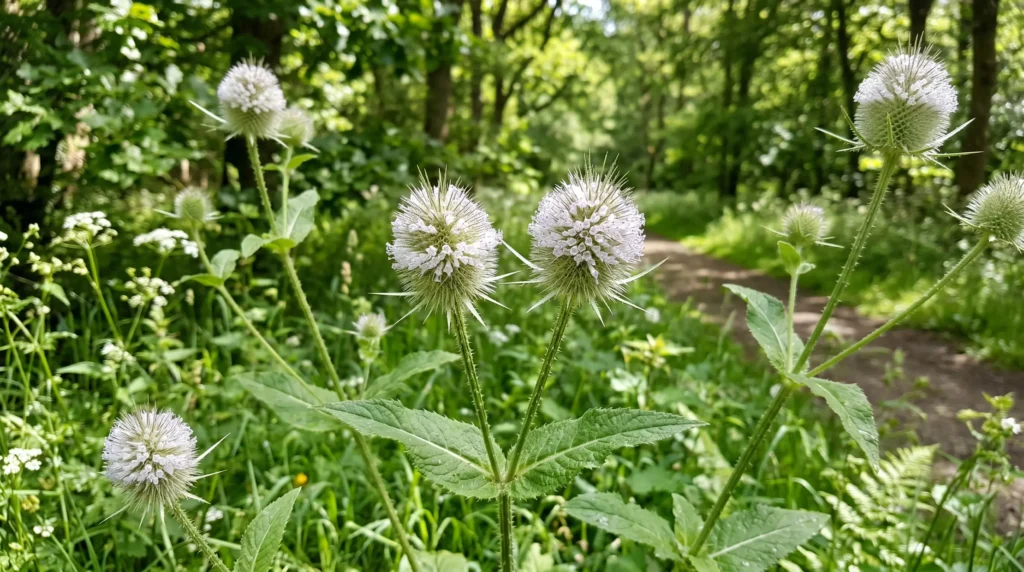
It is closely related to Common Teasel (D. fullonum) but is a separate species, readily distinguished by its spherical flower heads, white flowers with dark anthers, smoother main stem, and preference for shaded, damp habitats rather than open sunny ground.
Scientific Name and Plant Family
Scientific name: Dipsacus pilosus L. (the L. denotes that Carl Linnaeus first formally described the species).
Family: Small Teasel now sits within Caprifoliaceae — the Honeysuckle family — as part of the subfamily Dipsacoideae. Until relatively recently, teasels were placed in their own distinct family, Dipsacaceae; this reclassification is one that most species profiles have yet to update, making it a significant point of accuracy for this guide.
This taxonomic placement means Small Teasel is a surprisingly close relative of:
- Devil’s-bit Scabious (Succisa pratensis)
- Field Scabious (Knautia arvensis)
- Elder (Sambucus nigra)
- Honeysuckle (Lonicera periclymenum)
Etymology: The genus name Dipsacus derives from the Greek dipsa, meaning “thirst” — a reference to the water that collects in the leaf axils (most pronounced in Common Teasel, whose fused opposite leaves form a small basin or “moat”). The species epithet pilosus comes from Latin, meaning “hairy,” describing the stem and leaf surfaces.
Where Does the Name “Small” Come From?
The name “Small Teasel” refers specifically to the size of the flower heads, not the overall plant — a critical clarification that most sources overlook.
- Small Teasel’s flower heads are globular (spherical) and approximately 25 mm across.
- Common Teasel’s flower heads are large, oval, and conical — up to 80–90 mm long.
- Despite the name, the plant itself frequently equals or exceeds Common Teasel in height, reaching 1.5 m or more in ideal conditions.
This distinction matters for identification: if you are expecting a small, modest plant, Small Teasel in full growth will surprise you.
A Biennial Life Cycle: What Does That Mean?
A biennial is a plant that completes its life cycle across two growing seasons: it germinates and establishes in year one, then flowers, sets seed, and dies in year two.
Here is how this plays out for Small Teasel:
| Year | What Happens |
|---|---|
| Year 1 | Seeds germinate in spring or autumn; plant produces a flat rosette of broad, hairy basal leaves; a deep taproot establishes; no flowers appear |
| Year 2 | The stem “bolts” upward in late spring; the plant branches and flowers from late July; seeds ripen in September; the plant dies after seeding |
Why this matters for gardeners: You will not see flowers in the first year of growth. If you sow seeds in spring or autumn, expect only a leafy rosette until the following summer. This is not a sign that something has gone wrong — it is how the plant is designed.
How to Identify Small Teasel: A Step-by-Step Visual Guide
How Do You Identify Small Teasel?
Small Teasel is identified by its small, perfectly spherical white flower heads (approximately 25 mm across) with violet or dark anthers, its relatively smooth main stem, its branched habit, and its preference for damp, partially shaded habitats. It flowers from July to September.
The Flower Heads
The flower heads are the most important and most distinctive identification feature of Small Teasel.
- Shape: Globose (perfectly spherical), approximately 25 mm in diameter. This rounded shape is the first and most reliable identification clue.
- Flowers: Numerous small, whitish individual florets cover the head. Each floret has four white petals, with the lower petal bending slightly downward to form a small lip.
- Anthers: The stamens bear violet to brown-black anthers, giving the white flower head a subtly purple-tinged or speckled appearance at close range.
- Bracts: Long, narrow, spine-tipped green bracts protrude from between the flowers. These are hairy and pointed — handle with care.
- Pedicels: Each flower head sits on a slender stalk (pedicel) arising from branched upper stems.
- Blooming pattern: Like Common Teasel, the individual florets open progressively in a circular ring around the head — not all at once. This provides a steady nectar source for pollinators over several weeks.
The Stems and Prickles
Main stem characteristic: The main stems of Small Teasel are relatively smooth — one of the clearest distinctions from Common Teasel, whose stems are heavily ridged and thickly covered in prickles.
Key details:
- Main stem: Smooth to lightly hairy; far less prickly than Common Teasel
- Upper flowering stems and flowerhead bracts: Spiny
- Prickles on flowering stems: Soft
- Bracts between flowers: Sharp-tipped
- Overall habit: Branched, with multiple flowerheads on lateral stems; tall and architectural, easily reaching 1.5 m in good conditions
The Leaves
Leaves change in shape and character depending on where on the plant they are:
- Basal leaves (Year 1 rosette): Oval, long-stalked, distinctly hairy, and toothed around the margins. They form a flat rosette close to the ground. The midrib on the underside bears prickly hairs.
- Lower stem leaves (Year 2): Oval with a toothed margin and a light-coloured central midvein; hairy on both surfaces.
- Upper stem leaves: Narrower than lower leaves, and crucially — they bear a pair of small, unequal leaflets at the base of the leaf stalk where it meets the stem. This leaflet pair is a highly specific botanical identifier that is absent from most competitor descriptions.
- General surface: Covered in prickly hairs of varying length throughout.
The Seed Heads
The seed heads of Small Teasel are structurally interesting and ecologically valuable long after the flowers have faded.
- Shape: Rounded and globose — retaining the spherical form of the flower head, in contrast to Common Teasel’s elongated oval seed head.
- Texture: Spiny, with long bracts surrounding the seeds.
- Colour: Green in late summer, turning brown through autumn and persisting through winter.
- Wildlife value: Goldfinches and other finches use the seed heads in autumn and winter to extract seeds. The persistent structure also provides invertebrate shelter.
- Craft use: The dried heads can be harvested from midsummer and retain their shape well for dried flower arrangements, autumn wreaths, and interior displays.
Quick ID Checklist: Small Teasel in the Field
Use this checklist to confirm a Small Teasel sighting. All six features together make a definitive identification.
- Flower head: rounded and spherical (not elongated like Common Teasel)
- Flowers: white with violet or dark anthers
- Main stem: relatively smooth (not heavily prickly)
- Plant: tall and branched, with multiple flower heads
- Upper leaves: small leaflet pair visible at the leaf base
- Habitat: damp, partially shaded — not open fields or roadsides
- Flowering period: July to September
Potential Confusion Species
Small Teasel can be confused with a small number of related or superficially similar species. Here is how to tell them apart:
| Species | Key Difference from Small Teasel |
|---|---|
| Common Teasel (D. fullonum) | Oval/conical flower head; lilac-purple flowers; heavily prickly ridged stem; open sunny habitats |
| Cut-leaved Teasel (D. laciniatus) | Rare introduction; deeply cut, almost lobed leaves immediately distinguish it |
| Fuller’s Teasel (D. sativus) | Cultivated origin; hooked spine tips on flower bracts; extremely rare in the wild in UK |
The most common confusion is with Common Teasel. The globular (vs conical) flower head and white (vs purple) flowers resolve this in seconds when the plant is in bloom. See Section 5 for the full comparison.
Where Does Small Teasel Grow in the UK? Distribution and Habitats
Where Is Small Teasel Found in the UK?
Small Teasel is native to England and Wales, with its strongest populations in central and eastern England. It favours damp, calcareous woodland edges, riverbanks, and hedgerows, and requires periodic soil disturbance to maintain populations.
National Distribution
Small Teasel has a naturally restricted and patchy UK distribution:
- Core range: Central and eastern England — the East Midlands, East Anglia, and parts of the Thames Valley represent its heartland.
- South and south-east England: Present but less consistent; populations vary by habitat availability.
- Wales: Present but less common; largely confined to suitable river valleys and limestone woodland edges.
- South-west England: Uncommon.
- Northern England: Rare; populations thin out significantly north of the Midlands.
- Scotland: Very rare; isolated records only.
- Ireland: Very rare.
Global range: Outside Britain, Small Teasel is native across much of Europe and extends east through the Caucasus to Iran. It is thus primarily a species of temperate Eurasia, with Britain marking the north-western edge of its natural range — which partly explains its restricted distribution here.
Up-to-date distribution records are held on the NBN Atlas (species.nbnatlas.org); visiting the Small Teasel species page there will show the current dot distribution map across Britain and Ireland.
Preferred Habitat: What Small Teasel Needs
Small Teasel is a habitat specialist, requiring damp, calcareous soils and the light shade of woodland edges. It does not grow in the open sunny habitats where Common Teasel thrives.
Core habitat types where Small Teasel occurs:
- Damp woodland edges and clearings — the archetypal habitat; look for it at the transition between canopy and open ground
- Riverbanks and streambanks — particularly in East Anglia, where it grows beside dykes and drainage channels
- Hedgerows — especially those bordering damp ground or watercourses
- Scrub margins — where light penetrates and some disturbance occurs
- Ditch edges and fenland margins — in counties like Norfolk and Cambridgeshire
- Quarries and disturbed calcareous waste ground — a secondary habitat, reflecting its dependence on soil disturbance for germination
What it avoids: Open grassland and roadside verges (Common Teasel’s territory); heavily shaded, closed-canopy woodland; dry, acidic soils.
Soil requirement: Damp, calcareous (lime-rich, alkaline to neutral) soils are essential. On acidic soils, Small Teasel is rarely found.
Key UK Sites and Notable Locations
Small Teasel has well-documented populations at several notable sites:
- Ted Ellis Nature Reserve, Wheatfen, Norfolk — a classic East Anglian fen site with a long-documented colony beside Penguin Dyke
- Workmans Wood, Gloucestershire — an example of the woodland-edge habitat at its most typical
- River Waveney valley, Syleham (Norfolk/Suffolk border) — a productive river valley site
- River Thames floodplains, Oxfordshire and Berkshire — floodplain woodland edge populations
If you want to find Small Teasel near you, the NBN Atlas and iRecord (irecord.org.uk) are the best starting points. Both show submitted records by location, and you can submit your own sightings through iRecord. The BSBI (Botanical Society of Britain and Ireland) co-ordinates botanical recording across the UK and runs county floras that often include Small Teasel records.
Seasonal Spotter’s Guide: What to Look For and When
| Month | What to Look For |
|---|---|
| April–May | Flat rosettes of oval, hairy, toothed leaves on damp disturbed ground near woodland edges and watercourses |
| June | Stems beginning to bolt upward; branching stems visible; look near rivers and woodland margins |
| July–August | Peak flowering; globular white and violet flower heads; best time to confirm identification |
| September | Flowers fading; seeds ripening; goldfinches begin to visit seed heads |
| October–March | Persistent brown spiny seed heads; structural winter interest; visible against bare vegetation |
Small Teasel and Wildlife: An Underappreciated Ecological Powerhouse
What Wildlife Does Small Teasel Support?
Small Teasel is an important late-summer wildlife plant, providing nectar for long-tongued bees and other pollinators from July to September, and seeds for goldfinches, siskins, and sparrows through autumn and winter.
A Pollinator Magnet
Small Teasel’s white flowers are rich in nectar and particularly well-suited to long-tongued pollinators that can access the deep florets:
- Bumblebees (Bombus spp.) — particularly long-tongued species such as Garden Bumblebee (B. hortorum) and Buff-tailed Bumblebee (B. terrestris)
- Butterflies — including Meadow Brown, Gatekeepers, and late-season Whites
- Hoverflies — a range of species visit the flowers for pollen
- Notable invertebrate visitors recorded from teasel species include Barbut’s Cuckoo Bumblebee, European Golden Longhorn beetle, and Common Copperback
Why teasels are exceptional for pollinators: The individual florets open progressively in a ring around the spherical head — not all at once — meaning a single flower head provides nectar continuously for several weeks. This makes Small Teasel far more valuable, per plant, than a species that flowers all at once and finishes quickly.
The Goldfinch Connection: Bird Value
Small Teasel’s persistent seed heads are an important late-season food source for seed-eating birds, most notably goldfinches (Carduelis carduelis).
- Goldfinches are well-documented using teasel seed heads in autumn and early winter, clinging to the spiny structures to extract seeds with their fine, pointed bills
- Siskins (Spinus spinus) and House Sparrows also exploit teasel seed heads
- The seed heads persist through winter, providing food value long after flowering has ended — which is why leaving seed heads standing through winter is the single most wildlife-positive thing you can do with your Small Teasel plants
Specialist Invertebrate Associations
Small Teasel supports several invertebrate species with specific associations:
- Chromatomyia ramosa (Agromyzid fly): larvae mine the leaves of teasel and scabious species — a specialised association that makes Small Teasel a host plant for this rarely-seen leaf miner
- Podosphaera dipsacacearum: a parasitic powdery mildew fungus with a specific association with teasel species — its presence is an ecological indicator of habitat quality
- Ramularia silvestris: causes characteristic leaf spots; another plant-specific fungal association
- The spiny stems and dense seed heads provide structural shelter and refugia for a range of invertebrates
Water-Holding Leaves: The Key Difference from Common Teasel
Small Teasel does NOT form the water-collecting “moats” that make Common Teasel famous. This is a commonly misunderstood point.
Common Teasel (D. fullonum) has fused, opposite leaves that join around the stem, forming a small basin that fills with rainwater. This feature — sometimes called “Venus’ bath” — is well-documented for Common Teasel and is associated with various folk beliefs about its healing properties.
Small Teasel’s leaves do not fuse in the same way, so this water-collecting moat is absent. However:
- The hairy leaf surfaces channel moisture effectively
- The plant’s characteristic habitat (damp woodland edge, streambank) means it is rarely moisture-stressed
- The microhabitat created by leaf surfaces is still valuable to invertebrates
If you are trying to decide which species you are looking at and you can see water pooling in the leaf axils, it is almost certainly Common Teasel.
Small Teasel as an Ecological Indicator
Small Teasel’s presence or absence in a site can serve as a useful ecological indicator for habitat managers and conservationists.
Because Small Teasel requires soil disturbance for germination:
- Its presence signals an appropriate balance of disturbance and stability in the habitat
- Its disappearance from a site may indicate over-shading (canopy closure) or excessive vegetation stability (lack of management)
- It often reappears after management interventions such as coppicing, path clearance, or bank regrading — and then disappears again as vegetation recovers
This dynamic, disturbance-dependent ecology makes Small Teasel a useful “early warning” species in woodland-edge and riparian habitat management.
Small Teasel vs Common Teasel: How to Tell Them Apart (and Which to Choose)
What Is the Difference Between Small Teasel and Common Teasel?
Small Teasel (D. pilosus) has small, spherical white flower heads with dark anthers, a smooth main stem, and grows in damp, shaded habitats. Common Teasel (D. fullonum) has large, oval, conical lilac-purple flower heads, a heavily prickly ridged stem, and favours open, sunny ground.
Definitive Comparison Table: Small Teasel vs Common Teasel
| Feature | Small Teasel (D. pilosus) | Common Teasel (D. fullonum) |
|---|---|---|
| Flower head shape | Globose / spherical | Oval / conical |
| Flower head size | ~25 mm across | Up to 80–90 mm long |
| Flower colour | White with violet / dark anthers | Lilac / purple |
| Main stem texture | Relatively smooth | Strongly ridged; heavily prickly |
| Water-collecting leaf moats | Absent | Present (fused opposite leaves form a basin) |
| Typical height | Up to 1.5 m | Up to 2 m |
| Preferred habitat | Damp woodland edges, riverbanks, hedgerows | Open grassland, roadsides, waste ground |
| Shade tolerance | Partial shade to sun | Full sun preferred |
| UK range | Central and eastern England mainly | Widespread across England; common |
| Flowering period | July–September | July–August |
| Historical textile use | None recorded | Used to raise the nap on wool (fulling) |
| Garden suitability | Moist, partly shaded spots; specialist | Full sun; widely available; easy |
| UK seed availability | Specialist suppliers only | Widely available |
Pros and Cons: Which Should You Grow?
Common Teasel — Pros:
- Easy to source; widely available in most wildflower seed mixes
- Tolerates dry, sunny, and open conditions
- Large, dramatic flower heads visible from a distance
- Extremely easy to establish
Common Teasel — Cons:
- Can self-seed prolifically and become dominant
- Not suitable for damp, shaded spots
- Very widely planted; less distinctive in a wildlife garden
Small Teasel — Pros:
- Thrives in damp, partially shaded spots that Common Teasel cannot tolerate
- A genuine botanical rarity in gardens — a talking point for visitors
- Spherical seed heads are proportionally elegant and excellent for wreath-making
- Fills a wildlife role in a niche habitat many gardens have under-utilised
Small Teasel — Cons:
- Harder to source; specialist suppliers only
- More exacting habitat requirements
- Seeds may require stratification for reliable germination
- First-year rosette only — patience needed
Recommendation: If your garden has a damp, partially shaded corner — near a pond, stream, or north-facing border — Small Teasel is the superior choice and will thrive where Common Teasel would struggle. For open, sunny, well-drained conditions, choose Common Teasel. If space allows, growing both creates a longer pollinator season and serves a wider range of invertebrates.
How to Grow Small Teasel in Your UK Garden: A Complete Guide
Can You Grow Small Teasel in a UK Garden?
Yes. Small Teasel can be grown successfully in UK gardens provided you can offer damp, calcareous (alkaline to neutral) soil and partial shade. It is well suited to wildlife gardens, naturalistic planting schemes, damp borders, and pond or streamside settings.
Is Small Teasel Right for Your Garden?
Best suited to:
- Wildlife and naturalistic gardens
- Damp borders under partial tree or hedge canopy
- Pond edges, streambanks, and boggy areas
- North- or east-facing borders with reasonable moisture retention
- Large gardens where it can self-seed and naturalise
Not ideal for:
- Small, formal, or highly manicured gardens
- Dry or sandy soils without supplemental watering
- Full, deep shade (it will not flower)
- Very small pots — the taproot makes container growing challenging long-term
Soil and Site Requirements
| Requirement | Detail |
|---|---|
| Soil type | Damp, calcareous (alkaline to neutral); moist but not waterlogged; heavier soils are tolerated |
| Soil pH | Neutral to alkaline (pH 6.5–8) |
| Light | Partial shade to full sun; performs best with some shelter and dappled shade |
| Moisture | Consistently moist; particularly important during establishment |
| Position | Woodland edge, north-facing border, near a pond, under a hedgerow |
Sourcing Seeds and Plants in the UK
Small Teasel seeds are harder to find than Common Teasel — a fact almost no supplier or competitor makes clear, and one that catches many gardeners off guard when they begin searching.
UK specialist suppliers (as of 2025):
- Emorsgate Seeds / Wildseed.co.uk — seed available in small packets; suitable for conservation projects
- GrowWilder — pot-grown plants available (9 cm pot)
- BetterPlanting — plants and seeds
- RHS Plant Finder — useful for locating nurseries with plants in stock
Sourcing tip: As BBC Gardeners’ World notes, “seed is hard to find.” Frame this as a specialist plant choice, not a reason to give up — the additional effort is part of what makes Small Teasel such a rewarding addition to a wildlife garden.
How to Grow Small Teasel from Seed: Step-by-Step
What you need: Small Teasel seeds, seed trays or direct planting area, damp calcareous soil, patience.
Steps:
- Choose your sowing time. Autumn (September–October) is best for direct sowing outdoors — seeds will naturally experience cold stratification over winter and germinate the following spring.
- For spring sowing, stratify the seeds first. Mix seeds with slightly damp horticultural sand, seal in a labelled bag, and refrigerate for 6–8 weeks before sowing. This mimics winter cold and significantly improves germination rates.
- Prepare the sowing site or tray. Soil should be damp and weed-free. A light, open seed compost works for trays; for direct sowing, loosen the top 5 cm of soil.
- Sow at 0.5 cm depth. Do not bury seeds too deeply. Germination can be erratic — do not discard a tray just because nothing has appeared in the first few weeks.
- Transplant when seedlings are large enough to handle — spacing plants 30–45 cm apart in the final position.
- Move to final position while young. Small Teasel develops a deep taproot quickly. Transplant before the plant becomes root-bound in a pot; once the taproot is established, disturbance becomes harmful.
- Water regularly until established — particularly through any dry spells in the first growing season. Once established, mature plants are more drought-tolerant but still prefer consistently moist conditions.
- Wait. In year one, you will have a leafy rosette only. Flowers will appear in year two.
Ongoing Care
- Watering: Regular watering is important until established. Mature plants are relatively self-sufficient in a damp site but benefit from supplemental watering in dry summers.
- Feeding: No feeding required in reasonably fertile soils.
- Pests: Slugs can be damaging in wet years — BetterPlanting documented significant slug damage on their plants in the wet summer of 2024. Physical barriers or wildlife-safe deterrents are advisable in the first year.
- Pruning: None needed. Leave seed heads standing through winter for maximum wildlife benefit — goldfinches, sparrows, and siskins will thank you.
- Self-seeding: Small Teasel will self-seed where conditions suit. Unlike Common Teasel, it rarely becomes invasive; it tends to persist in suitable patches. Light forking of the soil around plants in autumn can encourage new seedlings by providing the soil disturbance the seeds need to germinate.
Harvesting and Drying Seed Heads
If you want to use Small Teasel’s beautiful rounded seed heads in dried arrangements:
- Harvest heads when fully formed but before they turn completely brown — typically midsummer to late summer
- Cut stems to your desired length; handle carefully as bracts are sharp
- Hang upside down in small bundles in a dry, well-ventilated room or shed
- Allow two to three weeks for full drying
- Dried heads retain their spherical shape beautifully and are popular in autumn wreaths, Christmas arrangements, and natural table decorations
Wildlife tip: If you can spare some stems, leave the majority standing until late winter — the wildlife value of standing seed heads far exceeds the decorative value of dried ones.
Companion Plants for a Small Teasel Wildlife Scheme
Small Teasel works beautifully alongside other damp-loving native wildflowers in a naturalistic planting:
| Plant | Why It Works |
|---|---|
| Devil’s-bit Scabious (Succisa pratensis) | Same plant family; same damp, calcareous habitat preference; flowers slightly later |
| Purple Loosestrife (Lythrum salicaria) | Shares damp habitat; tall, structural; excellent for pollinators |
| Meadowsweet (Filipendula ulmaria) | Classic damp meadow companion; strongly fragrant; flowers before Small Teasel |
| Yellow Flag Iris (Iris pseudacorus) | Pond or streamside companion; structural contrast |
| Marsh Thistle (Cirsium palustre) | Architectural companion for wet woodland edge; excellent for bumblebees |
| Common Fleabane (Pulicaria dysenterica) | Late-season pollinator plant for damp grassland edges |
Small Teasel in British History: Folklore, Textile Heritage, and Folk Medicine
What Is the Historical Significance of Small Teasel?
Small Teasel has no direct recorded role in the British textile trade or traditional medicine, but it shares the landscape heritage of Common Teasel and carries its own folk associations and a modern revival in natural craft.
The Teasel and the British Cloth Trade
To understand Small Teasel’s historical context, it helps to understand why teasels matter in British history at all.
Common Teasel (D. fullonum) — and especially the cultivated Fuller’s Teasel (D. sativus) — was a cornerstone of the British wool industry for centuries. Teasel heads were mounted on boards or frames and used to “raise the nap” on woven wool cloth — a process called fulling. The hooked bracts of the teasel head were ideal for this purpose: they gripped the surface of the cloth and raised the fibres without tearing them. The species epithet fullonum — meaning “of the fullers” — directly commemorates this use.
Small Teasel has no recorded equivalent use. Its globular heads, softer bracts, and woodland-edge habitat meant it would never have been gathered in the quantities needed by fullers. However, Small Teasel would have been a familiar sight in the same river valleys and woodland edges where fulling mills operated — growing beside the watercourses that powered them.
Folk Names and Folklore
Teasels accumulated a rich vocabulary of folk names across Britain:
- Barber’s brushes — for the bristled seed head
- Shepherd’s rod — for the tall, straight stem
- Venus’ bath or Venus’ basin — for the water-collecting leaf moats (applicable to Common Teasel)
- Gypsy’s comb — a reference to the spiny head
- Hutton weed — a regional name
Small Teasel’s Welsh name — crib y pannwr, meaning “the fuller’s comb” — is linguistically interesting. It suggests some folk association with the cloth trade despite no documented practical use, perhaps simply because of the shared morphology with Common Teasel or its presence in cloth-working landscapes.
The name Dipsacus itself, from Greek thirst, speaks to a long-observed relationship between the plant and water — a relationship more pronounced in Common Teasel than in Small.
Traditional and Folk Medical Associations
European herbals through the medieval and early modern period occasionally mention teasels in the context of folk medicine. The water collecting in Common Teasel’s leaf moats was said to have healing properties — particularly for eye complaints, skin conditions, and warts. Culpeper noted teasel in his English Physician (1652), associating it with healing and cleansing uses.
As Small Teasel lacks the water-collecting moats, such folk remedies are not directly applicable to this species. Neither species is considered medicinally significant today, and teasels do not appear in modern clinical herbalism.
Reassuringly: Small Teasel has no reported toxicity to humans, pets, or livestock.
Small Teasel in Modern Craft and Design
The last decade has seen a significant revival of interest in dried botanical materials for wreath-making, natural Christmas decorations, and artisan floral design. Small Teasel has found a new audience through this movement.
- The compact, perfectly spherical seed heads are proportionally more refined than Common Teasel’s large oval heads — lending themselves well to small-scale arrangements, miniature wreaths, and naturalistic table displays
- Paired with grasses such as Tufted Hair-grass or Quaking Grass, and the seed heads of Meadowsweet or Field Scabious, Small Teasel makes an exceptional component of an all-British, all-native dried flower bundle
- Craft and floristry suppliers have noted growing demand for “unusual native seed heads” — Small Teasel sits squarely in this premium niche
Small Teasel and Conservation: Recording, Ecology, and the Bigger Picture
Is Small Teasel a Conservation Priority Species?
Small Teasel is not currently classified as threatened in the UK. It is considered locally common within its core range in central and eastern England. However, its naturally patchy distribution and dependence on specific habitat conditions and soil disturbance make local populations sensitive to changes in land management.
Conservation Status
| Status | Detail |
|---|---|
| GB Red List status | Not threatened (Least Concern) |
| UK classification | Common within core range |
| Distribution trend | Patchy; locally stable where managed well |
| Main threats | Habitat loss, over-shading from canopy closure, loss of damp woodland edge habitat, agricultural drainage |
Within its core range, Small Teasel is a relatively secure species. Outside this range — in the north of England, Wales, and Scotland — populations are thin and local. Decline would be expected at any site that becomes heavily shaded or heavily managed in ways that eliminate soil disturbance.
Why Soil Disturbance Matters: The Key to Understanding Small Teasel Ecology
Small Teasel seeds require soil disturbance for successful germination — this is the single most ecologically important fact about the species for conservation and land management purposes.
Practical implications:
- Populations can appear suddenly on disturbed ground — after path clearance, winter flooding, coppicing, or bank regrading — and then disappear again as vegetation stabilises and closes over
- This sporadic appearance and disappearance can make accurate recording challenging; a site with no Small Teasel one year may have dozens of plants three years after appropriate management
- Sites managed with light, irregular disturbance — woodland ride management, coppicing, path clearing, controlled poaching by livestock — are consistently more likely to support Small Teasel
- In contrast, sites left to scrub up, or heavily mowed or suppressed, will lose Small Teasel over time regardless of soil type
Conservation implication: Maintaining Small Teasel populations is primarily a question of maintaining sympathetic habitat management — not of transplanting or supplementary sowing, though these can help at appropriate sites.
Recording Small Teasel in the UK: How to Contribute
Wildlife recording is one of the most direct ways a naturalist or gardener can contribute to conservation. Here is how to record Small Teasel:
- NBN Atlas (species.nbnatlas.org): the national repository for UK species distribution data; Small Teasel records are visible here and can be submitted via partner schemes
- iRecord (irecord.org.uk): the main platform for submitting biological records online; records are reviewed by local experts and feed into national datasets
- BSBI (Botanical Society of Britain and Ireland): co-ordinates botanical recording across the UK; county recorders can advise on local schemes and will always welcome records of Small Teasel
- NatureSpot: particularly valuable for Leicestershire and Rutland records, with detailed local data
Photography guidance for records: The most useful photographs for botanical recording are (1) the whole plant in its habitat, (2) a close-up of the flower head, and (3) an upper leaf clearly showing the small leaflet pair at the leaf base.
Small Teasel in Biodiversity Net Gain Projects
Small Teasel is a UK native species and qualifies for inclusion in habitat creation and restoration projects under the Biodiversity Net Gain (BNG) framework.
The BNG framework, introduced through the Environment Act 2021, requires many new development projects in England to demonstrate a net gain of at least 10% in biodiversity. Native wildflowers are central to meeting BNG metrics through habitat creation.
Small Teasel is particularly appropriate for:
- Riparian habitat strips alongside watercourses and drainage channels
- Woodland edge creation schemes in the lowland English landscape
- Native wildflower schemes on calcareous soils — especially on river floodplains
- Conservation seed supply: Emorsgate Seeds offers Small Teasel seed for conservation-scale projects
Small Teasel FAQ — Your Questions Answered
Q: Is Small Teasel rare in the UK?
A: Small Teasel is not rare within its core range in central and eastern England, where it is classed as locally common by the Wildlife Trusts. However, it has a naturally patchy distribution due to its preference for specific damp, calcareous habitats and its requirement for soil disturbance to germinate. It becomes uncommon in Wales and south-west England, rare in northern England, and very rare in Scotland.
Q: What is the difference between Small Teasel and Common Teasel?
A: The most obvious difference is the flower head. Small Teasel (D. pilosus) has small, spherical flower heads (approximately 25 mm across) with white flowers and dark violet anthers. Common Teasel (D. fullonum) has large, oval, conical flower heads up to 90 mm long with lilac or purple flowers. Small Teasel also has a smoother main stem, prefers damp and partially shaded habitats (rather than the open, sunny spots Common Teasel favours), lacks Common Teasel’s water-collecting leaf moats, and has a more restricted UK distribution.
Q: Can I grow Small Teasel in my garden?
A: Yes — provided you can give it the right conditions. Small Teasel needs damp, partially shaded ground on calcareous (lime-rich) to neutral soil. A spot near a pond, stream, damp border, or north-facing bed works well. It is harder to source than Common Teasel, but seeds and plants are available from specialist UK wildflower suppliers including Emorsgate Seeds, GrowWilder, and BetterPlanting.
Q: When does Small Teasel flower?
A: Small Teasel flowers from late July through to early September. Being a biennial, it will not flower in its first year of growth — the plant produces only a basal rosette of leaves in year one and flowers in year two.
Q: Why is it called “Small” Teasel if it can grow so tall?
A: The name refers specifically to the size of the flower heads, not the overall plant. Small Teasel’s globose flower heads are approximately 25 mm across — much smaller than Common Teasel’s large oval heads. Despite this, the plant itself frequently reaches 1.5 m or more, sometimes equalling or exceeding Common Teasel in height in ideal conditions.
Q: Is Small Teasel good for wildlife?
A: Yes, Small Teasel is an excellent wildlife plant. Its white flowers attract long-tongued bees, bumblebees, butterflies, and a range of other pollinators from late July through September. The persistent seed heads are used by goldfinches, siskins, and sparrows in autumn and winter to extract seeds. The spiny structure also provides invertebrate habitat, and the plant supports several specialist invertebrate and fungal associations.
Q: Does Small Teasel self-seed?
A: Yes, Small Teasel will self-seed where conditions are suitable — particularly where there is some degree of soil disturbance. Unlike Common Teasel, it does not spread aggressively. It tends to persist in suitable patches rather than colonising large areas, making it a well-behaved addition to a managed wildlife garden.
Q: Where can I buy Small Teasel seeds or plants in the UK?
A: Small Teasel is less commonly available than Common Teasel. Specialist UK wildflower suppliers stocking it include Emorsgate Seeds (wildseed.co.uk), GrowWilder, and BetterPlanting. The RHS Plant Finder is a useful tool for locating nurseries with plants currently in stock. Expect to plan ahead — it sells out at some suppliers.
Q: Is Small Teasel toxic to dogs or other pets?
A: No. Small Teasel has no reported toxicity to humans, pets, or livestock. The prickly stems and leaf bracts may cause minor skin irritation if handled roughly, so wearing garden gloves when planting or harvesting is advisable.
Q: How do I tell if I have found Small Teasel and not another species?
A: The key features to confirm are: a perfectly spherical (not elongated) flower head approximately 25 mm across; white flowers with violet or dark anthers; a relatively smooth main stem; an upper leaf with a small pair of leaflets at the leaf base; and a damp, shaded or semi-shaded habitat near water or woodland. If all of these match, you have Small Teasel. Photographing the whole plant, the flower head, and the upper leaves will allow expert verification via iRecord if you are unsure.
Small Teasel — A Wildflower Worth Knowing
Small Teasel occupies a curious position in the British wildflower landscape: architecturally impressive, ecologically rich, historically intriguing — and almost entirely overlooked. It sits in the shadow of its larger-headed relative, Common Teasel, despite offering everything a wildlife gardener or naturalist could want: long-season pollinator interest, goldfinch attraction, structural winter beauty, specialist ecological associations, and the quiet satisfaction of growing something genuinely uncommon.
If you have a damp, partly shaded corner of a garden or a pond edge in need of structure, Small Teasel deserves a place there. If you are a naturalist in central or eastern England, it deserves a place on your botanical target list. And if you are involved in habitat restoration or Biodiversity Net Gain planning, it deserves a place in your species palette.
What to do next:
- Find it: Visit the NBN Atlas Small Teasel page to explore UK distribution records and find known populations near you
- Record it: If you find Small Teasel, submit a record via iRecord — every confirmed sighting contributes to national conservation data
- Grow it: Source seeds or plants from a specialist UK wildflower supplier and try it in a damp, calcareous spot in your garden
- Photograph it: Close-ups of the flower head, upper leaves, and whole plant — all three are useful for records and identification
- Read further: Common Teasel — Complete UK Guide | UK Wildflowers for Damp Shade | How to Attract Goldfinches to Your Garden | How to Record UK Wildflowers with iRecord and the BSBI
External Resources and Further Reading
| Resource | URL | What It Offers |
|---|---|---|
| NBN Atlas | species.nbnatlas.org | UK distribution maps and submitted records for D. pilosus |
| iRecord | irecord.org.uk | Submit your own Small Teasel sightings |
| BSBI | bsbi.org | UK botanical recording; county recorder contacts |
| RHS Plant Finder | rhs.org.uk/plants | Locate nurseries stocking Small Teasel |
| Emorsgate Seeds | wildseed.co.uk | UK conservation-grade seed supplier |
| Wildlife Trusts | wildlifetrusts.org | Species profiles and local Wildlife Trust contacts |

Leave a Reply