
Musk mallow (Malva moschata) is a hardy, native British wildflower with pale pink, saucer-shaped flowers and a delicate musky fragrance. It flowers from June to September, grows to around 90cm, thrives in dry sunny spots, and supports pollinators, butterflies, and moths. Every part of the plant is edible. It has been valued in British gardens, folklore, and herbal medicine for over 2,000 years.
Britain’s Most Overlooked Native Wildflower
Imagine walking a dry English lane in late July. The verge is long-uncut, the afternoon warm. A faint scent drifts up — something warm, slightly sweet, ancient. You look down and find it: a loose cluster of pale pink saucer flowers, each one paper-thin and finely veined, rising above a spray of feathery leaves. This is musk mallow, Malva moschata, and it has been growing in British hedgerows, pastures, and churchyards for longer than most of our oldest buildings have stood.
Musk mallow is native to southern England and now grows throughout the British Isles. The Ancient Greeks used it to decorate the graves of friends. Anglo-Saxon healers called it St Simeon’s herb. Victorian lovers used it to send coded messages of being “consumed by love.” Today, it is listed on the RHS Plants for Pollinators register, used in wildflower meadow seed mixes, harvested by foragers for salads and herbal tea, and increasingly chosen by UK gardeners who want beauty, wildlife value, and low maintenance in a single plant.
This guide covers everything you need to know about musk mallow in a UK context: how to identify it, how to grow it, how to troubleshoot problems, which wildlife it supports, how to forage and cook with it, its rich traditional medicine history, its extraordinary place in British folklore — and how to source it today. Whether you are a gardener, a naturalist, a forager, or simply someone who spotted a pretty pink flower on a verge and wanted to know more, you are in the right place.
What Is Musk Mallow? — Plant Profile & Key Facts
What is musk mallow?
Musk mallow (Malva moschata) is a hardy herbaceous perennial wildflower in the family Malvaceae, native to southern England and naturalised across the British Isles. It produces pale pink, five-petalled, saucer-shaped flowers from June to September, grows to around 30–90cm in height, and releases a subtle, warm, musky fragrance — strongest in warm weather and when flowers are brought indoors.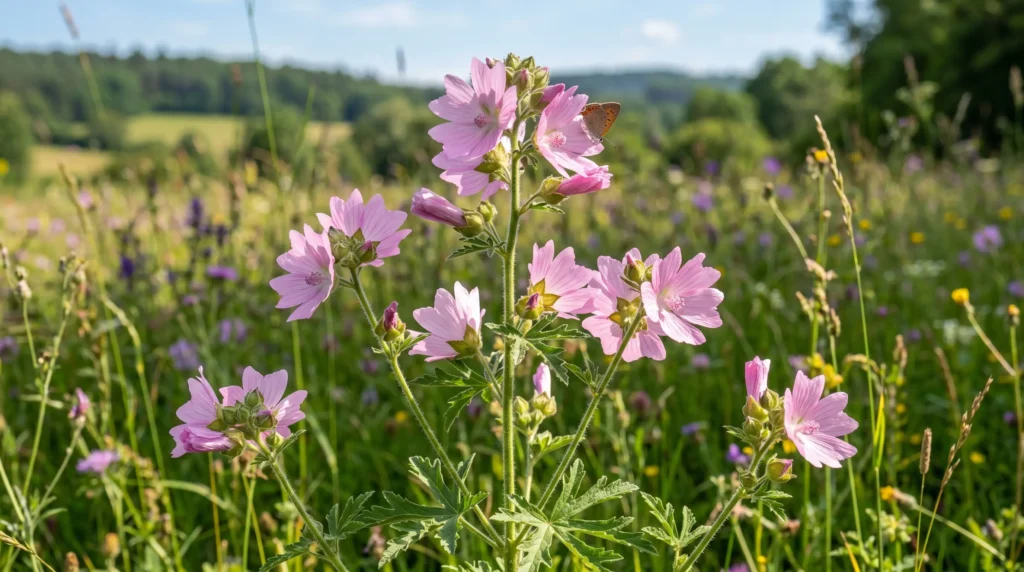
At a Glance: Musk Mallow Key Facts
| Feature | Detail |
|---|---|
| Latin name | Malva moschata |
| Family | Malvaceae (mallow family) |
| Common names | Musk mallow, St Simeon’s herb |
| Type | Hardy herbaceous perennial |
| Height | 30–90cm (up to 1m) |
| Spread | Up to 90cm |
| Flowering season | June–September (peak July–August) |
| Flower colour | Pale pink; occasionally white |
| Flower size | 40–60mm across |
| Scent | Delicate, warm, musky fragrance |
| UK native status | Native to southern England; naturalised across British Isles |
| Conservation status | Green (Least Concern) |
| RHS Plants for Pollinators | Yes — confirmed listing |
| Soil preference | Well-drained, moderately fertile; tolerates thin and chalky soils |
| Sun requirement | Full sun; tolerates partial shade |
| Hardiness | Fully hardy to −35°C (H7) |
| Lifespan | Short-lived perennial, typically 2–4 years |
| Self-seeds? | Yes, freely and without being invasive |
| Edible? | Yes — all parts: leaves, flowers, seeds, roots |
| RHS Award | AGM varieties available |
Why Musk Mallow Is Worth Growing in the UK
Musk mallow offers four distinct benefits that very few native plants can match simultaneously:
- Garden beauty: Long flowering season (June–September), elegant branching stems, pink or white blooms
- Wildlife value: Listed on the RHS Plants for Pollinators register; caterpillar food plant for two butterfly species
- Edibility: All parts of the plant are edible; used in salads, as a thickening agent, and as herbal tea
- Low maintenance: Drought-tolerant once established; self-seeds; requires no feeding beyond spring fertiliser
How to Identify Musk Mallow in the UK
What does musk mallow look like?
Musk mallow is a bushy, upright plant with pale pink flowers 40–60mm across, deeply feathery upper stem leaves, and a faint musky scent. It is most easily distinguished from related mallows by its very finely cut, almost lacy upper leaves — a feature no other common UK mallow shares.
Musk Mallow Identification: Step-by-Step
Use the following checklist to confirm a plant is musk mallow:
Step 1 — Look at the flowers. The flowers are saucer-shaped, 40–60mm wide, and pale pink with five petals. Each petal has fine, darker pink veins and a slightly notched tip. White-flowered plants occur but are less common. At the centre of each flower is a column of purple-tipped stamens fused into a characteristic mallow “tube.”
Step 2 — Check the leaves — the key ID feature. Musk mallow has two distinct leaf types on the same plant:
- Basal leaves (at the base): broadly rounded, slightly lobed — similar to other mallows
- Stem leaves (on flowering stems): deeply and narrowly cut into fine, feathery segments — this is the defining feature
If the upper leaves look lacy and almost fern-like, you have musk mallow. This leaf dimorphism is unique among common UK mallows and the most reliable identification tool.
Step 3 — Smell the plant. On a warm day, gently rub a leaf or flower between your fingers. Musk mallow produces a distinctive warm, musky scent. The fragrance is faint in the open but becomes noticeably stronger indoors or in an enclosed space. No other common UK mallow has this scent.
Step 4 — Check the stems. Stems are erect, branched, and covered in soft hairs. Some hairs have a purple or reddish base — a subtle additional ID clue.
Step 5 — Check the seed pods. After flowering, musk mallow produces flat, disc-shaped seed pods known as mericarps, arranged in a ring like a wheel of cheese — giving mallows their folk name “cheese plant” or “bread and cheese” in some counties.
Where to Find Musk Mallow in the UK
- Primary range: England and Wales, especially south and central England
- Secondary range: Parts of Scotland (less common in the north) and parts of Northern Ireland
- Wild habitats: Dry roadside verges, field margins, hedgerows, pastures, chalk and limestone grassland, railway cuttings, churchyards, old meadows
- Churchyard concentration: Musk mallow clusters around old churchyards across England — a direct legacy of Anglo-Saxon grave-planting traditions that persist to this day
- London sightings: Found on Hampstead Heath, in woodland burial grounds, and in naturalised wildflower plantings across the city
Expert tip: If you spot musk mallow in northern England, it has almost certainly arrived through a wildflower seed mix rather than spreading naturally. Botanists at Kew note that the plant likely did not reach Ireland through natural spread — its presence there reflects deliberate introduction.
Musk Mallow vs Common Mallow vs Marsh Mallow — How to Tell Them Apart
What is the difference between musk mallow, common mallow, and marsh mallow?
These three plants belong to the same family (Malvaceae) but are distinct species with different appearances, habitats, and uses. The key differences are flower size and colour, leaf shape, scent, and preferred habitat.
Full Comparison Table
| Feature | Musk Mallow (Malva moschata) | Common Mallow (Malva sylvestris) | Marsh Mallow (Althaea officinalis) |
|---|---|---|---|
| Flower size | Large: 40–60mm | Medium: 25–40mm | Medium: 25–40mm |
| Flower colour | Pale, soft pink or white | Purple-pink with bold dark veins | Pale pink, almost white |
| Petal shape | Broad, slightly notched | Broad, clearly notched | Narrower, less notched |
| Stem leaves | Deeply feathery, finely cut | Shallowly and broadly lobed | Softly lobed, velvety |
| Leaf texture | Slightly hairy | Slightly hairy | Densely velvety/felted |
| Stem hairs | Fine, some purple-tipped | Stiff and spreading | Dense, short, velvety |
| Scent | Yes — distinctive musky smell | None | Faint |
| Height | 30–90cm | 45–90cm | 60–120cm |
| Typical habitat | Dry grassland, chalk, sunny verges | Disturbed ground, waste, roadsides | Coastal marshes, saltmarsh, ditches |
| UK distribution | S. England; naturalised throughout | Throughout Britain (very common) | Local; mainly SE coastal England |
| Edibility | All parts edible | All parts edible | All parts edible; root most prized |
| Medicinal strength | Mild–moderate | Moderate | Strong — especially root |
| Garden value | Excellent — long-flowering | Good — robust | Good — architectural |
| Wildlife value | Very high — specific butterfly link | High — generalist pollinators | High |
Quick ID Summary
- Pale pink + feathery leaves + musky scent = Musk mallow ✓
- Purple-pink + bold dark veins + no scent + rounded leaves = Common mallow ✓
- Velvety-felted leaves + coastal/wet habitat = Marsh mallow ✓
The Complete UK Growing Guide
How do you grow musk mallow in the UK? Musk mallow grows best in a sunny position with well-drained, moderately fertile soil. It is easy to raise from seed, tolerates drought once established, self-seeds freely without becoming invasive, and requires very little ongoing care. It is suitable for beginners and experienced gardeners alike.
Is Musk Mallow Right for Your Garden?
Best for:
- Cottage gardens
- Wildflower meadows and meadow-style borders
- Wildlife and pollinator gardens
- Sensory gardens (fragrance + texture)
- Dry and gravel gardens
- Rewilding projects
- Containers (surprisingly successful with the right care)
Not ideal for:
- Permanently waterlogged or heavy clay soil
- Dense shade
- Very exposed or windswept positions without shelter
Pros and Cons of Growing Musk Mallow
| Pros | Cons |
|---|---|
| Long flowering season (June–September) | Short-lived (2–4 years); needs regular propagation |
| Fully hardy — needs no protection in most UK winters | Can become leggy in overly rich soil |
| Supports pollinators, butterflies, and moths | May need staking in exposed positions |
| Edible and medicinal | Susceptible to powdery mildew in humid conditions |
| Self-seeds without being invasive | Seedlings take a full season to flower |
| Drought-tolerant once established | Less effective in heavy shade |
| Fragrant cut flower | Seeds are small and fiddly to harvest in bulk |
Soil, Site & Preparation
What soil does musk mallow need?
Musk mallow thrives in well-drained, moderately fertile soil. It tolerates thin, chalky, or sandy soils and performs remarkably well during dry summers — one of the reasons it thrives on road verges where water drains quickly.
- Soil type: Well-drained; sandy, loamy, or chalky. Tolerates poor, thin soils. Avoids waterlogged or acid soils.
- Soil pH: Neutral to slightly alkaline (pH 6.5–8)
- Sun: Full sun is ideal. Tolerates partial shade with reduced flowering.
- Preparing the soil: Clear weeds. For poor compacted soil, loosen to 15cm and work in a little compost. For already well-drained soil, no amendment is usually needed — overly rich soil produces leafy, flower-poor plants.
- Spacing: Plant 45cm apart to allow airflow and reduce mildew risk.
- Wind: In northern or exposed UK locations, choose a sheltered position or provide windbreak planting.
Important: Do not add excessive compost or fertiliser before planting. Musk mallow flowers most freely in moderately poor soil. Rich soil encourages lush leaf growth at the expense of blooms.
Growing Musk Mallow from Seed: Step-by-Step How-To
How do you grow musk mallow from seed? Sow seeds 0.5cm deep in moist compost indoors in March–April, or directly outdoors in autumn. Expect germination in 14–42 days. Thin or plant out to 45cm apart. Plants typically flower in their second year from spring-sown seed.
Indoor Sowing (Recommended for Reliable Results)
- Fill trays or small pots with moist seed compost in March or April.
- Press seeds 0.5cm deep into the compost. Do not sow too deep — light aids germination.
- Place in a cold frame, unheated greenhouse, or cool windowsill. Musk mallow does not need warmth to germinate; cool conditions are better than warm.
- Water gently and keep the compost consistently moist but not wet.
- Expect germination in 14–42 days.
- Prick out seedlings when they develop their first true leaves. Always handle by a leaf — never by the fragile stem.
- Pot up individually into 9cm pots and grow on until roots fill the pot.
- Harden off over a fortnight by placing pots outside in a sheltered spot during the day, bringing them in at night.
- Plant out after the last frosts (typically mid-May in most of England and Wales; late May in northern England and Scotland), 45cm apart.
Direct Outdoor Sowing
- Prepare a weed-free seedbed in late spring (April–May) or autumn (September–October).
- Press seeds into the soil surface, spacing roughly 10cm apart.
- Lightly rake or press into contact with the soil.
- Water the seedbed and keep moist until germination.
- Thin seedlings to 45cm apart when large enough to handle.
Autumn outdoor sowing takes advantage of natural cold stratification over winter and often produces stronger, more uniform germination than spring sowing.
Ongoing Care
Watering: Water regularly for the first season until plants are established. Mature plants are highly drought-tolerant and require watering only during prolonged dry spells.
Feeding: Apply a balanced general-purpose fertiliser (e.g., Growmore or fish, blood and bone) in spring. Avoid nitrogen-heavy feeds — they promote leaves over flowers.
Deadheading: Remove spent flowers regularly to extend the flowering season significantly and encourage further blooms. Allow some flowers to go to seed in late summer to encourage self-seeding.
Cutting back: Musk mallow is a perennial that dies back to ground level in autumn. Cut stems back to the base after they die back. Fresh rosettes of leaves will emerge the following spring.
Staking: In rich soils or exposed positions, stems can become floppy. Provide discreet stakes or grow through a support ring in early summer before plants reach full height.
Mulching: A light mulch of compost around the base in spring helps retain moisture during dry spells and suppresses competing weeds.
Propagation Methods
By seed: The easiest and most reliable method. Self-seeded plants around the parent are free to pot up and move. Collected seed remains viable for several years when stored in a cool, dry, dark place.
By softwood cuttings: Take 8–10cm cuttings from stems or basal shoots in early summer. Remove lower leaves, dip in rooting hormone, and insert into gritty compost in a cold frame. Rooting typically takes 3–4 weeks. This is the recommended method for preserving specific cultivars.
By division: Established clumps can be divided in spring as growth begins. Lift the root clump, divide into sections with at least one growing point each, and replant at the same depth.
Important: Because musk mallow is a short-lived perennial, the RHS specifically recommends regular propagation — every 2–3 years — to maintain plantings. Always have young plants coming on in reserve.
Growing Musk Mallow in Containers
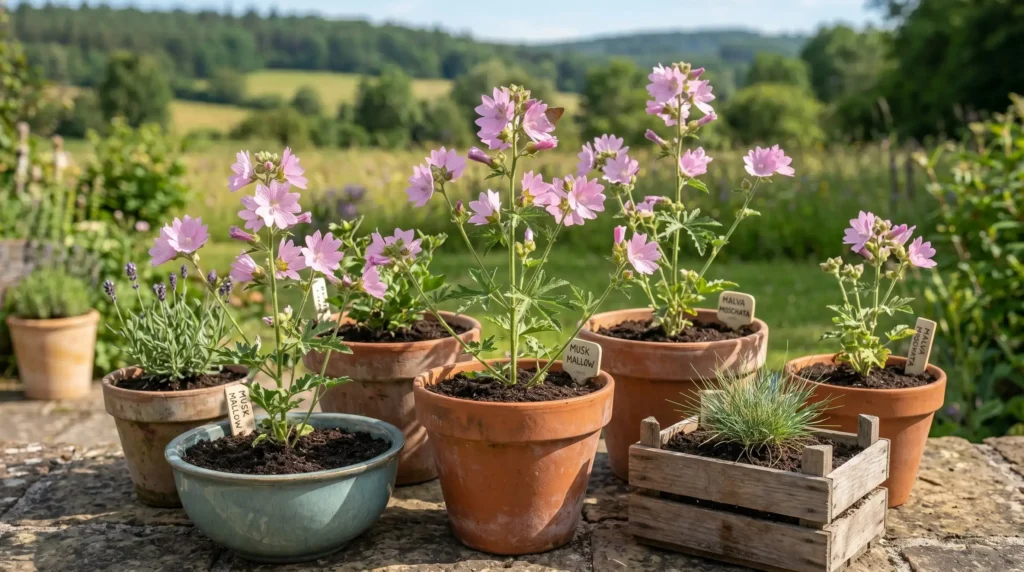
Musk mallow grows surprisingly well in containers — useful if you have no garden or want to grow it on a patio or balcony.
- Container size: Minimum 30cm wide and 30cm deep; larger is better
- Compost: Well-draining multipurpose compost mixed with 20–30% horticultural grit
- Watering: More frequent than garden plants — check daily in warm weather; mallow wilts quickly but recovers well if watered promptly
- Feeding: Liquid tomato feed fortnightly during the growing season (high potash promotes flowers)
- Overwintering: Move containers to a sheltered spot or unheated greenhouse in harsh winters; the crown is fully hardy but roots in pots are more vulnerable to prolonged freezing
UK Month-by-Month Musk Mallow Calendar
When do you do what with musk mallow in the UK?
Here is the complete seasonal calendar for growing musk mallow in British conditions, from planning in January to seed collection in autumn.
| Month | Task |
|---|---|
| January | Plan planting. Order seeds from UK specialist wildflower suppliers. |
| February | Continue planning. Check stored seeds for viability. Source compost and trays. |
| March | Begin indoor sowing — 0.5cm deep in moist compost trays in a cold frame or cool windowsill. |
| April | Continue sowing indoors. Prick out germinated seedlings into individual pots when first true leaves appear. Begin direct sowing outdoors in mild areas. |
| May | Harden off indoor-raised plants. Plant out after last frosts (mid-May in south; late May in north). Plant 45cm apart in final position. |
| June | First flowers appear. Begin deadheading to extend season. Water if dry. |
| July | Peak flowering. Harvest flowers and young leaves for culinary use. Continue deadheading. Cut flowers for indoor arrangements — fragrance increases indoors. |
| August | Peak flowering continues. Begin allowing some flowers to set seed for self-seeding or collection. Harvest seeds before pods fully open. Take softwood cuttings for propagation. |
| September | Collect seed pods as they ripen (check daily — they split suddenly). Allow self-seeding. Sow collected seeds directly outdoors for autumn germination. Flowering continues until first frosts. |
| October | Plant autumn-sown seeds directly for cold stratification. Leaves begin to yellow. Observe self-seeded rosettes appearing. |
| November | Stems die back. Cut back to ground level. Mark plant positions clearly to avoid disturbing crowns. |
| December | Rest period. Plan for next year. Crown overwinters at soil level. |
Pests, Diseases & Troubleshooting
What problems affect musk mallow?
Musk mallow is generally robust and pest-resistant, but it can be affected by powdery mildew, rust fungus, aphids, and slugs — particularly in humid conditions or on seedlings. Most problems are preventable through good spacing and site selection.
Common Problems, Symptoms & Solutions
| Problem | Symptoms | Cause | Solution |
|---|---|---|---|
| Powdery mildew | White powdery coating on leaves and stems | Humid air; overcrowding; overhead watering | Space plants 45cm+; water at the base; improve airflow; remove affected leaves |
| Rust fungus | Orange-brown pustules on undersides of leaves | Fungal infection; often in damp conditions | Remove and bin (not compost) affected leaves promptly; avoid wetting foliage; ensure good drainage |
| Aphids | Clusters of small insects on new shoots and buds | Soft new growth; high nitrogen | Attract ladybirds and lacewings; blast off with water; avoid over-feeding |
| Slugs & snails | Ragged holes in leaves, especially seedlings | Moist conditions | Copper tape around pots; beer traps; encourage hedgehogs and thrushes; use slug nematodes |
| Mallow flea beetle | Small circular holes punched in leaves | Beetle feeding | Usually cosmetic; healthy established plants outgrow damage; no treatment usually needed |
| Poor/no flowering | Lush leafy growth; few or no blooms | Over-rich soil; too much nitrogen; insufficient sun | Move to poorer soil; stop feeding; ensure full sun |
| Leggy, floppy stems | Long, weak stems that flop over | Insufficient sunlight; too little airflow | Move to sunnier position; provide support; thin neighbouring plants |
| Plant dying after 2–3 years | Gradual decline; reduced vigour | Normal short-lived perennial behaviour | Allow self-seeding; take cuttings; sow fresh seeds annually |
| No self-seeding | No seedlings appearing around parent plant | Soil is mulched too heavily; pods collected before ripe | Leave some soil bare around plants; allow some pods to open naturally |
Troubleshooting FAQ
Q: Why is my musk mallow not flowering?
The most common reasons are: insufficient sunlight (move to a position receiving at least 6 hours of direct sun daily); overly rich soil (which promotes leafy growth — reduce or stop fertilising and consider transplanting to poorer ground); or plants being too young (first-year seedlings from spring sowing rarely flower — expect flowers from year two).
Q: My musk mallow died over winter — is it dead?
Probably not. Musk mallow is a herbaceous perennial that dies back completely to ground level each autumn. The crown overwinters underground and sends up fresh growth in spring, typically from April. Wait until late April before assuming a plant has died.
Q: Is musk mallow spreading too aggressively?
Musk mallow self-seeds readily but is not considered invasive. Unwanted seedlings are easy to remove when small. If you want to control self-seeding, deadhead all flowers before seed pods form.
Q: Can I grow musk mallow in shade?
Musk mallow tolerates partial shade but flowers significantly less freely. In deep shade, plants become leggy and may not flower at all. For best results, choose a position receiving at least 5–6 hours of direct sunlight daily.
Musk Mallow’s Wildlife & Ecology Value in the UK
What wildlife does musk mallow support?
Musk mallow is a confirmed RHS Plants for Pollinators species that attracts bumblebees, solitary bees, hoverflies, and butterflies. The Wildlife Trusts species profile confirms its value as a summer nectar and pollen plant for road verge and hedgerow habitats across the UK.. It is a specific caterpillar food plant for the Painted Lady butterfly and the Mallow moth. Few native wildflowers support such a diverse range of species simultaneously.Yellow rattle (Rhinanthus minor) — Suppresses coarse grasses in meadow; allows musk mallow to establish more easily
Why Musk Mallow Matters for UK Biodiversity
The UK has lost over 97% of its traditional wildflower meadows since the 1930s. Insects that depend on meadow species have declined in parallel: around 35% of UK bee species are now under threat. Musk mallow is one of a relatively small group of native wildflowers that can be grown in ordinary gardens and deliver meaningful, measurable wildlife value.
Pollinators: The Bees and Hoverflies
Musk mallow flowers produce both nectar and abundant pollen. The open, saucer-shaped flower is particularly accessible to:
- Bumblebees — especially short-tongued species including the buff-tailed bumblebee (Bombus terrestris) and white-tailed bumblebee (Bombus lucorum); bees emerge from musk mallow flowers visibly coated in pale yellow pollen
- Solitary bees — including leafcutter bees, which also use mallow leaves to line their nests
- Hoverflies — multiple species visit the flowers for pollen; hoverflies are important secondary pollinators and pest controllers (their larvae eat aphids)
- Butterflies — several nectar-feeding species including Gatekeepers, Meadow Browns, and Small Skippers visit musk mallow in flower
Caterpillar Food Plant: Three Species Depend on It
This is where musk mallow becomes genuinely special for UK wildlife gardeners.
1. Painted Lady butterfly (Vanessa cardui) The Painted Lady is one of Britain’s most beloved insects — a migratory species that travels from North Africa and southern Europe each spring, sometimes in extraordinary numbers. In the UK, musk mallow is one of its primary caterpillar food plants. Female Painted Ladies arriving in summer actively seek out mallows on which to lay their eggs. Growing musk mallow creates a direct breeding opportunity for this spectacular species.
2. Mallow Skipper (Carcharodus alceae) A rare butterfly in the UK, the Mallow Skipper depends exclusively on mallow species. Musk mallow is among the host plants that support this species.
3. Mallow moth (Larentia clavaria) The Mallow moth’s caterpillars feed exclusively on mallow species. Musk mallow in your garden directly supports this often-overlooked but ecologically important moth.
What this means in practice: A single musk mallow plant in a UK garden can support pollinators, provide breeding habitat for a migratory butterfly, and host a specialist moth — making it one of the highest wildlife-value investments per square foot available to British gardeners.
Companion Planting for a UK Wildlife Garden
Plant musk mallow alongside these native UK species for maximum ecological benefit:
| Companion Plant | Latin Name | Why It Works |
|---|---|---|
| Field scabious | Knautia arvensis | Classic meadow companion; same July–August peak; attracts different pollinators |
| Greater knapweed | Centaurea scabiosa | Same dry habitat; supports additional butterfly species including Marbled White |
| Oxeye daisy | Leucanthemum vulgare | White flowers contrast beautifully; same well-drained soil preference |
| Marjoram | Origanum vulgare | Peaks simultaneously; beloved by bumblebees and Small Tortoiseshells |
| Cornflower | Centaurea cyanus | Annual contrast; bees love both; classic cottage-garden pairing |
| Yellow rattle | Rhinanthus minor | Suppresses coarse grasses; allows musk mallow to establish more easily in meadow |
| Meadow cranesbill | Geranium pratense | Overlapping flowering window; same soil; contrasting blue-purple colour |
| Birdsfoot trefoil | Lotus corniculatus | Low-growing; shares dry grassland niche; supports Common Blue butterfly |
Musk Mallow in a Sensory Garden
Musk mallow is an excellent choice for sensory garden planting schemes thanks to:
- Fragrance: The warm musky scent on warm days; enhanced strongly indoors
- Texture: Deeply feathery leaves are distinctive and engaging to touch
- Visibility: Large pale pink flowers are easily visible at distance and in low light, making the plant useful for visitors with low vision
- Sound: A fully flowering plant buzzing with bees provides an immersive auditory experience
Musk Mallow Foraging & Edibility Guide
Is musk mallow edible?
Yes — all parts of musk mallow are edible, including the leaves, flowers, seeds, and roots. Leaves have a mild, pleasant flavour and can be eaten raw or cooked. Flowers are used as decorative edible garnishes. Seeds have a nutty taste. All parts can be made into herbal tea.
Foraging Safety Disclaimer: Always identify wild plants with 100% certainty before eating. If in any doubt, consult a qualified expert. Never forage from areas that may have been sprayed with pesticides or herbicides, and always follow the UK Countryside Code — take only what you need and leave plenty for wildlife.
Which Parts Are Edible?
Leaves Musk mallow leaves are mild, slightly mucilaginous (giving them a slightly smooth, gel-like texture when chewed), and broadly pleasant-tasting. Young spring leaves are the most tender and palatable.
- Eat raw in salads — add texture and mild flavour
- Cook like spinach — wilts well
- Use as a thickening agent in soups and stews (the mucilage content works like okra, a fellow member of the Malvaceae family)
- An excellent perennial substitute for lettuce from spring through to mid-summer
Flowers The flowers have a delicate, slightly milder flavour than the leaves. They are best used raw to preserve their beautiful appearance.
- Add whole to salads as an edible garnish
- Float in chilled soups and drinks
- Freeze in ice cubes for summer cocktails and elderflower pressé
- Use to decorate desserts and celebration cakes
- Infuse in white wine vinegar for a blush-pink, lightly floral dressing
Seeds Seeds have a pleasant, nutty flavour reminiscent of sunflower seeds. They are small (each “seed” is actually a ring of individual mericarps) and slightly fiddly to harvest, but rewarding as a wild snack.
- Eat raw directly from the plant as a snack
- Harvest when still slightly green for the best flavour — before the pods fully dry
Roots The roots are edible and can be boiled or made into tea. They are rarely used in British cooking — the leaves and flowers offer far more culinary versatility.
Culinary Ideas for Musk Mallow
Wild Summer Salad Combine young musk mallow leaves with watercress, nasturtium flowers, and cucumber. Dress with lemon, honey, and a little olive oil. Add musk mallow flowers as a garnish.
Musk Mallow Flower Ice Cubes Place fresh flowers face-down in an ice cube tray. Fill halfway with water and freeze. Top up with water and freeze again (double-freezing centres the flower). Use in elderflower pressé, gin and tonic, or water.
Musk Mallow Thickened Soup Use a large handful of young musk mallow leaves in place of okra in any vegetable soup or stew. Their mucilage naturally thickens the broth.
Musk Mallow Herbal Tea Steep 1 teaspoon of dried leaves and flowers in just-boiled water for 10 minutes. Strain and sweeten with honey. Mildly sweet, pleasantly aromatic.
UK Foraging: When and Where
| Part | Best Harvest Time | Where to Look |
|---|---|---|
| Young leaves | March–June (most tender) | Established plants in sun; spring rosettes |
| Flowers | July–August | Dry roadside verges, field margins, churchyards |
| Seeds | August–September | As seed pods begin to dry and open |
| Roots | Autumn | Established plants — harvest sparingly |
Where to forage: Dry roadside verges (unsprayed), chalk downland, old meadow margins, churchyard grassland, and hedgerow edges. In London, Hampstead Heath and certain churchyard wildflower areas support populations.
Foraging etiquette: Never strip a plant. Take no more than a third of any one plant’s leaves or flowers. Leave seed heads for wildlife. Avoid any site that might be sprayed — particularly roadside verges near intensively farmed land.
Herbal & Medicinal Uses of Musk Mallow
Medical Disclaimer: The information below describes traditional and historical uses only. It does not constitute medical advice. Always consult a qualified medical professional or registered herbalist before using any plant for medicinal purposes.
What are the medicinal properties of musk mallow?
Musk mallow contains mucilage — a gel-forming substance — that gives it soothing, anti-inflammatory properties. All parts of the plant are traditionally described as demulcent (soothing to mucous membranes), emollient (softening to skin), expectorant (helping loosen mucus), and mildly laxative.
The Key: What Is Mucilage?
Mucilage is a thick, gel-like substance produced by the cells of musk mallow (and other members of the Malvaceae family). When leaves or roots are boiled or infused in water, the mucilage is released, creating a coating, soothing effect on irritated tissues. This is why mallows have been used for sore throats, coughs, irritated digestive systems, and inflamed skin for thousands of years — the mucilage literally coats and protects the irritated surface.
Nutritional Profile
Musk mallow is also nutritionally useful as a food:
- Rich in vitamins A, B, and C
- Contains meaningful amounts of magnesium, potassium, and calcium
- Leaves provide dietary fibre
Traditional Medicinal Uses in British Folk Medicine
Respiratory system
- Soothing sore throats — a cold infusion of leaves or roots coats the throat
- Coughs and bronchitis — musk mallow was a historical ingredient in British cough syrups
- Hoarseness — gargling with musk mallow tea
Digestive system
- Heartburn and acid reflux — the mucilage coats the oesophagus
- Indigestion and gastric irritation
- Colitis — mild anti-inflammatory effect on the gut lining
- Gentle laxative — historically used for children; the mildest safe option
Skin
- Poultice for burns, bruises, and minor wounds — crushed fresh leaves applied directly
- Bee and insect stings — the anti-inflammatory properties reduce swelling
- Rashes and eczema — a poultice or infused oil applied topically
- Dry or chapped skin — the mucilage is deeply hydrating
Eyes
- Historically used as an eyewash for inflammation (the St Simeon tradition — not recommended by modern herbalists)
Urinary system
- Traditional use as a diuretic — mildly promotes urination
- Historical use for urinary gravel and bladder inflammation (noted in British Medicinal Plants, 1891)
Musk Mallow vs Marshmallow Root: What’s the Difference?
Both plants produce soothing mucilage but differ significantly in potency and typical use:
| Aspect | Musk Mallow | Marsh Mallow (Althaea officinalis) |
|---|---|---|
| Mucilage content | Moderate | Very high (especially root) |
| Medicinal strength | Mild–moderate | Strong |
| Best preparation | Leaf/flower tea or poultice | Root decoction or cold infusion |
| Availability in UK | Common | Local (coastal) |
| Garden growing | Easy | Easy |
| Flavour of tea | Mild, slightly musky | Bland, very smooth |
| Traditional use | Coughs, skin, mild digestive | Coughs, throat, gut (all stronger) |
How to Make Musk Mallow Tea (Traditional Method)
- Harvest 1 teaspoon of fresh or dried musk mallow leaves and/or flowers
- Place in a mug or teapot with a strainer
- Pour over water that has just come off the boil (not a full rolling boil — hot water preserves more mucilage)
- Steep for 10 minutes with a lid on
- Strain and sweeten with honey if desired
- Drink warm for coughs and sore throats; allow to cool for digestive issues
For a cold-infused version (which preserves more mucilage), steep the plant material in cold water for 4–8 hours, then strain.
History, Folklore & the Victorian Language of Flowers
What is the history of musk mallow in Britain?
Musk mallow has a documented history of use spanning over 2,000 years — from Ancient Greek funeral rites to Anglo-Saxon medicine, medieval Christian symbolism, and Victorian floriography. It is one of Britain’s most historically resonant native wildflowers.
Ancient Greece: A Flower for the Dead
The story of musk mallow in human culture begins in Ancient Greece. The Greeks used musk mallow to decorate the graves of their friends and loved ones — not out of mourning, but as a mark of affection and remembrance. The plant’s soft, perfumed flowers made it a natural choice for honouring those who had passed.
Alongside its funerary role, Greek physicians held musk mallow in high regard medicinally. The physician Dioscorides, writing in the first century AD, praised mallows as a remedy for a wide range of conditions. Pliny the Elder, his Roman contemporary, made a claim that has echoed through herbal literature ever since: “Whosoever shall take a spoonful of the Mallows shall that day be free from all diseases that may come to him.”
Roman Britain and Early English Use
When the Romans brought their plant knowledge to Britain, mallow’s reputation came with them. Horace and Martial reference the laxative properties of mallow leaves in their writing. Virgil notes goats’ fondness for mallow foliage — a practical agricultural observation that tells us the plant was abundant and well-known in the ancient landscape.
The Anglo-Saxons: Graves, Healing, and St Simeon’s Herb
The Anglo-Saxons continued the Greek practice of planting musk mallow on graves. The custom persisted so strongly in Britain that old churchyards across England still have populations of musk mallow today — living archaeological evidence of a burial tradition stretching back over a thousand years. In Austria, where similar traditions persisted independently, musk mallow remains a common churchyard plant to this day.
In Anglo-Saxon medicine, musk mallow was listed as mealwe and used for a broad range of complaints. But its most striking folk identity came through its association with St Simeon — the figure from the Gospel of Luke who awaited the infant Jesus at the Temple.
The St Simeon legend: Musk mallow became known as “St Simeon’s herb” through a tradition holding that Simeon cured his blindness by bathing his eyes in a solution made from the plant — restoring his sight so he could recognise the baby Jesus as the Messiah. The legend gave rise to a specific folk ritual: if you dug up a musk mallow root before sunrise on St Simeon’s Day (8 October), it could be worn as an amulet against eye disease, or made into a tincture to treat cataracts and blindness. The tradition persisted in British rural medicine well into the early modern period.
Medieval Christian Symbolism: The Plant of Forgiveness
In Christian symbolism, musk mallow acquired a specific spiritual meaning rooted in its name. The word Malva derives from the Greek malakos — meaning “soft.” The plant’s gentle, downy leaves and soothing medicinal properties made it a natural symbol of softening and forgiveness: specifically, the softening of a hardened heart toward a person who had wronged one. In an age when flowers carried spiritual meaning as richly as scripture, musk mallow in a churchyard said something deliberate about forgiveness and grace.
The physician Galen added a contrasting note: he considered musk mallow an anaphrodisiac — a plant that cooled the passions and reduced sexual desire. This reputation for calming intense emotion is directly contradicted by what happened when musk mallow reached the Victorians.
The Victorian Language of Flowers: “Consumed by Love”
Victorian Britain developed a sophisticated coded language using flowers — floriography — in which specific plants carried specific meanings. The system allowed feelings to be communicated that polite society forbade saying aloud. Flowers were sent as messages, and the recipient needed a “flower dictionary” to decode them.
Musk mallow’s meaning in Victorian floriography was: “consumed by love,” persuasion, and weakness.
This was a wildly different message from its medieval reputation as a cooler of passions. In Victorian hands, musk mallow became romantic and dangerous — the botanical equivalent of a love potion. To send someone a sprig of musk mallow was to declare yourself overwhelmed by feeling for them, while simultaneously admitting that such overwhelming emotion was a kind of weakness. It was high-stakes floriography.
This Victorian symbolism is experiencing a resurgence: the language of flowers has become a significant trend in UK bridal and gift culture, with musk mallow appearing in “wildflower bride” bouquets specifically for its historical meaning.
A Timeline of Musk Mallow in History
| Period | Use or Significance |
|---|---|
| Ancient Greece | Grave decoration; praised by Dioscorides and Pliny as a medicine |
| Roman period (1st–4th C) | Brought to Britain; laxative, digestive, and anti-inflammatory uses |
| Anglo-Saxon period | Grave planting; St Simeon’s herb; eye medicine ritual on 8 October |
| Medieval | Christian symbolism — forgiveness; Galen’s anaphrodisiac classification |
| Tudor & Stuart | Listed in herbals (Culpeper, Gerard); cough syrups and poultices |
| Georgian | “A Modern Herbal” (Grieve) documents British folk uses |
| Victorian | Victorian language of flowers — “consumed by love, persuasion, weakness” |
| 20th C | Declined as a medicinal plant; persisted as a wildflower and garden plant |
| 21st C | Rewilding movement; RHS Pollinators list; foraging renaissance; revived interest |
Varieties, Cultivars & Where to Buy Musk Mallow in the UK
What varieties of musk mallow are available in the UK? Three main forms are available: the native pink-flowered species (Malva moschata), the white-flowered cultivar ‘Snow White’ (also sold as ‘Alba’), and various dwarf forms. For wildlife gardens, the native pink species is strongly preferred.
Variety Comparison
| Variety | Flower Colour | Height | Wildlife Value | Best For | Where to Buy |
|---|---|---|---|---|---|
| Malva moschata (native) | Pale pink | 60–90cm | Excellent | Wildflower meadows, wildlife gardens, foraging | Specialist wildflower nurseries |
| ‘Snow White’ / ‘Alba’ | White | 60–90cm | Good | Cottage borders, wedding gardens, mixed borders | RHS Plants, garden centres |
| Dwarf forms | Pink or white | 30–45cm | Good | Containers, small borders | Specialist online nurseries |
The Wildlife Verdict on Varieties
The native pink-flowered form attracts more pollinators than white cultivars. Research consistently shows that bees preferentially visit flowers with UV-reflective patterns — which native pink musk mallow has, and which selective breeding can diminish. For maximum wildlife impact, always choose the native pink species.
Where to Buy Musk Mallow in the UK
Specialist Wildflower Nurseries (best for native provenance)
- Meadowmania (meadowmania.co.uk) — seeds and 9cm pot plants
- Naturescape (naturescape.co.uk) — seeds
- Plant Wild / Blooming Wild Nursery (plantwild.co.uk) — plants
- Cumbria Wildflowers (cumbriawildflowers.co.uk) — plug plants
- Wildflower Favours (wildflower-favours.co.uk) — plants and seeds
- Seed Revolution (seedrevolution.co.uk) — seeds
General Garden Retailers:
- RHS Plants (rhsplants.co.uk) — ‘Snow White’ plants
- Mr Fothergill’s (mr-fothergills.co.uk) — seeds
- Jekka’s (jekkas.com) — seeds and 2L plants
Foraging the Wild Plant: If you spot musk mallow in the wild on public land (a roadside verge, a churchyard open to the public), you may legally collect a small amount of seed for personal use under the Wildlife and Countryside Act 1981 — provided you do not uproot the plant, which is prohibited.
Musk Mallow & the UK Rewilding Movement
Is musk mallow a good plant for rewilding?
Yes. Musk mallow is one of the best native wildflowers for rewilding UK garden spaces. It establishes readily on poor soils, self-seeds without becoming invasive, tolerates drought, and supports an exceptional range of wildlife from the first season of flowering.
Why Musk Mallow Suits the Rewilding Moment
Britain’s rewilding movement has expanded dramatically beyond large estate-scale projects into urban gardens, suburban borders, and council verges. Musk mallow fits this domestic rewilding context well:
- Pioneer species: Establishes on thin, dry, and compacted soils where other wildflowers struggle
- Self-sustaining: Provides seed for future generations without gardener intervention
- Not aggressive: Does not spread laterally by rhizome or runners; self-seeding is manageable
- Drought-resilient: Increasingly important as UK summers become drier and hotter
- Native provenance available: Can be sourced as genuinely UK-native seed (important for ecological authenticity)
No Mow May and the Road Verge Connection
The Plantlife “No Mow May” campaign has become one of the UK’s most widely adopted conservation initiatives. Musk mallow is a direct beneficiary: as roadside verge mowing regimes are delayed into late summer, established verge populations of musk mallow — many of them descendants of ancient plantings — are allowed to flower and set seed for the first time in years.
If your local council mows verges before musk mallow has set seed (typically before September), you can contact them to request a late-mowing policy for specific verge sections. Plantlife’s “Every Flower Counts” survey also invites members of the public to record musk mallow sightings — contributing directly to national biodiversity data.
How to Start Rewilding with Musk Mallow
Year 1 — Site preparation:
- Choose a sunny, well-drained area — even a small strip at the garden edge
- Remove perennial weeds thoroughly
- Sow yellow rattle (Rhinanthus minor) in autumn — this parasitic annual weakens coarse grasses and opens space for wildflowers
- Sow musk mallow seeds in autumn or spring (direct into the prepared area)
Year 2 — Establishment: 5. Allow yellow rattle to weaken the grass through spring 6. Musk mallow rosettes establish and may flower by late summer 7. Cut the area once in September after seed set; remove all cuttings to avoid enriching the soil
Year 3 onwards — Maintenance: 8. The musk mallow population self-sustains through annual self-seeding 9. A single late-summer cut each year (removing all cuttings) maintains the wildflower meadow dynamic indefinitely
Growing Musk Mallow as a Cut Flower
Does musk mallow make a good cut flower? Yes — musk mallow is an excellent cut flower with a relatively long vase life, a branching habit that gives natural-looking arrangements, and — uniquely — a fragrance that noticeably intensifies when flowers are brought indoors. This makes it one of the few wildflowers to improve the experience of being in a room.
Why the Fragrance Gets Stronger Indoors
In the open air, musk mallow’s scent disperses quickly and registers as a subtle, warm background note. Indoors, the fragrance accumulates in the enclosed space rather than dispersing — making a vase of musk mallow scent a whole room. This characteristic has been documented in British herbal literature for centuries and is one of the plant’s most distinctive qualities.
Cutting & Conditioning Tips
- Cut in the morning: after the dew has evaporated, when stems are fully hydrated
- Choose stems: with 2–3 open flowers and several buds — buds will continue to open in the vase
- Cut at an angle: with sharp, clean scissors or secateurs to maximise water uptake
- Place immediately in deep, cool water — musk mallow wilts quickly if left out of water
- Remove all leaves below the waterline :to prevent bacterial growth
- Change the water every two days
- Keep away from direct sun and heat — cool rooms extend vase life
Expected vase life: 5–7 days for cut stems; individual flowers last 2–3 days but are continuously replaced by buds opening.
Cutting Garden Combinations
Musk mallow combines beautifully with:
- Oxeye daisy — white daisy contrast against pink mallow
- Field scabious — lilac-blue pincushion flowers
- Cornflower — blue contrast; similar stem length
- Grasses — Stipa tenuissima or meadow grasses for airy texture
- Yarrow (Achillea millefolium) — flat white or yellow heads anchor the arrangement
Frequently Asked Questions About Musk Mallow
This FAQ section is structured for featured snippet extraction.
Q: What is musk mallow?
A: Musk mallow (Malva moschata) is a hardy, native British wildflower in the Malvaceae family. It is a perennial plant growing 30–90cm tall, with pale pink, saucer-shaped flowers 40–60mm across, deeply feathery leaves, and a distinctive warm, musky fragrance. It flowers from June to September and is native to southern England but now found throughout the British Isles.
Q: Is musk mallow native to the UK?
A: Yes. Musk mallow is native to southern England and is considered naturalised throughout England, Wales, and parts of Scotland and Northern Ireland. It is found wild in dry grassland, roadside verges, hedgerows, pastures, and old churchyards. Its range has expanded northward through wildflower seed mixes and garden escapes.
Q: When does musk mallow flower in the UK?
A: Musk mallow flowers from June through to September in the UK, with the peak flowering period in July and August. In warm, sheltered, sunny positions, flowering can begin in late May. Individual flowers last only a day or two, but a well-established plant continuously produces new buds throughout the season.
Q: How do you grow musk mallow from seed?
A: Sow seeds 0.5cm deep in moist compost indoors in March–April in a cold frame or cool windowsill; germination takes 14–42 days. Alternatively, sow directly outdoors in autumn for natural cold stratification. Prick out or thin seedlings to 45cm apart. Plants typically flower in their second year from spring sowing. Seeds can also be sown outdoors in spring.
Q: What soil does musk mallow need?
A: Musk mallow prefers well-drained, moderately fertile soil. It performs best in sandy, loamy, or chalky soils and is one of the most drought-tolerant UK native wildflowers once established. Avoid waterlogged conditions and overly rich soil — high fertility promotes leafy growth at the expense of flowers.
Q: Is musk mallow good for bees and pollinators?
A: Yes — musk mallow is on the RHS Plants for Pollinators confirmed list. Its open, saucer-shaped flowers are highly accessible to bumblebees, solitary bees, and hoverflies. Bees are often seen emerging from musk mallow flowers visibly coated in pale yellow pollen. It also provides nectar for several butterfly species.
Q: What butterflies does musk mallow support?
A: Musk mallow is a caterpillar food plant for the Painted Lady butterfly (Vanessa cardui) — one of Britain’s most spectacular migratory insects — and the Mallow Skipper (Carcharodus alceae). It also supports the Mallow moth (Larentia clavaria), whose caterpillars feed exclusively on mallow species.
Q: Is musk mallow edible?
A: Yes — all parts of musk mallow are edible. Leaves can be eaten raw in salads or cooked like spinach; they have a mild, pleasant flavour and act as a thickening agent in soups due to their mucilage content. Flowers make beautiful edible garnishes. Seeds have a nutty taste. All parts can be made into herbal tea. Always confirm identification before foraging.
Q: What does musk mallow smell like?
A: Musk mallow has a subtle, warm, musky fragrance — gentle and pleasant in the open air, but noticeably stronger when flowers and leaves are touched, and significantly stronger when the flowers are brought indoors. The scent has been described as warm, slightly sweet, and faintly animal-like — similar to the musk of deer, which is the origin of the plant’s common name.
Q: What is the difference between musk mallow and common mallow?
A: The key differences are: musk mallow (Malva moschata) has larger flowers (40–60mm), pale pink colour, deeply feathery stem leaves, and a distinctive musky scent. Common mallow (Malva sylvestris) has smaller flowers (25–40mm), purple-pink colour with bold dark veins, broadly lobed rounded leaves, and no scent. Musk mallow grows in dry grassland; common mallow prefers disturbed ground.
Q: How long does musk mallow live?
A: Musk mallow is a short-lived perennial, typically surviving 2–4 years before declining. It compensates by self-seeding freely — a healthy plant will produce seedlings around itself that naturally replace the parent plant. The RHS recommends taking cuttings or sowing fresh seeds regularly to maintain plantings.
Q: Is musk mallow invasive in the UK?
A: No. Musk mallow is not considered invasive in the UK. It self-seeds readily but produces seedlings that are easily removed if they appear in unwanted positions. It spreads at a manageable, moderate rate and does not spread vegetatively by rhizomes or runners.
Q: Where can I buy musk mallow plants or seeds in the UK?
A: For native wildflower provenance, specialist suppliers include Meadowmania, Naturescape, Cumbria Wildflowers, Plant Wild, and Seed Revolution. The ‘Snow White’ cultivar is available from RHS Plants and mainstream garden centres. Seeds are also sold by Mr Fothergill’s and Jekka’s Herb Farm.
Q: What is the folklore significance of musk mallow?
A: Musk mallow has a rich folkloric history. The Ancient Greeks and Anglo-Saxons used it to decorate graves. It was known as St Simeon’s herb — linked to a legend of miraculous healing of blindness. In Christian symbolism it represents forgiveness. In the Victorian language of flowers it symbolises being “consumed by love, persuasion, and weakness.” The word mallow itself comes from the Greek malakos, meaning “soft.”
Q: Can musk mallow be grown in a container?
A: Yes. Musk mallow grows well in containers at least 30cm wide and deep, filled with multipurpose compost mixed with 20–30% horticultural grit. Water regularly (containers dry out faster than garden soil) and feed with liquid tomato fertiliser fortnightly. Move to a sheltered spot in very harsh winters.
Q: What are the medicinal properties of musk mallow?
A: Musk mallow contains mucilage — a soothing gel-like substance released when the plant is steeped in water. Traditionally it has been used for coughs and sore throats, digestive complaints including heartburn and indigestion, skin irritations as a poultice, and mild urinary discomfort. All parts of the plant have traditionally been described as demulcent, emollient, anti-inflammatory, and mildly laxative. Always consult a qualified herbalist before medicinal use.
The Case for Growing Musk Mallow
Musk mallow is one of the most versatile and historically meaningful native wildflowers available to UK gardeners. In a single plant, it offers:
- Beauty: across an exceptionally long flowering season, from June to September
- Wildlife value: that is measurable — confirmed pollinators, two butterfly species, a specialist moth
- Edibility: across every part: leaves, flowers, seeds, and roots
- Fragrance: that improves the moment you bring flowers indoors
- History: stretching from Ancient Greek gravesides to Anglo-Saxon churchyards to Victorian love letters
- Resilience: in the face of drought, poor soil, and the kinds of difficult conditions where more demanding plants struggle
It is native. It is hardy. It self-seeds without becoming a nuisance. It needs almost nothing from you once established, and it gives back enormously in beauty, scent, and wildlife.
If you grow one new wildflower this year, make it musk mallow.
Further Reading & Resources
- RHS Plant Profile: rhs.org.uk — search ‘Malva moschata’
- Wildlife Trusts Species Guide: wildlifetrusts.org/wildlife-explorer/wildflowers/musk-mallow
- Plantlife No Mow May: plantlife.org.uk/no-mow-may
- Plants for a Future Database: pfaf.org — Malva moschata
- Jekka McVicar on Musk Mallow: jekkas.com
- A Modern Herbal (Mrs M. Grieve, 1931): botanical.com — foundational reference for British herbal traditions

Leave a Reply