
Maranta is a genus of approximately 50 tropical perennial plants in the family Marantaceae, native to the rainforests of Central and South America — primarily Brazil. The most widely grown species, Maranta leuconeura, is a popular houseplant celebrated for its richly patterned, velvety leaves and its remarkable habit of folding its leaves upward every night like hands held in prayer — a behaviour called nyctinasty.
The Botanical Definition
- Kingdom: Plantae
- Family: Marantaceae (the “prayer plant” family)
- Genus: Maranta (approximately 50 species)
- Most common species: Maranta leuconeura
- Named after: Bartolomeo Maranta (1500–1571), an Italian physician, botanist, and co-founder of a botanical garden in Rome who studied plant movements
The genus sits within the family Marantaceae alongside several other well-known genera: Calathea (now largely reclassified as Goeppertia following DNA studies from 2012), Stromanthe, and Ctenanthe. All are informally called “prayer plants” because all share nyctinastic leaf movement. However, Maranta leuconeura is widely considered the true prayer plant — its leaf movement is the most pronounced of all genera in the family.
Natural Habitat: The Brazilian Rainforest Floor
Where does Maranta grow in nature? Maranta leuconeura grows wild on the floor of tropical rainforests in Brazil, specifically in the states of Pernambuco and Mato Grosso do Sul. In its native habitat, the plant lives in:
- Deeply filtered, dappled light beneath a dense forest canopy
- Consistently high humidity of 70–80%+ year-round
- Warm, stable temperatures with no frost, ever
- Rich but well-draining soil with excellent organic matter content
- Spreading horizontally across the forest floor via rhizomes (underground root-like stems)
This habitat context is the single most important thing to understand about Maranta care. Every care decision — pot shape, watering frequency, placement, soil mix — should aim to replicate the conditions of that Brazilian rainforest floor. A shallow wide pot mirrors its spreading growth. High humidity mimics the forest air. Filtered light recreates the canopy’s shade.
Two Key Maranta Species
| Species | Common Name | Primary Use |
|---|---|---|
| Maranta leuconeura | Prayer Plant / Herringbone Plant | Ornamental houseplant |
| Maranta arundinacea | Arrowroot | Food crop (edible starch used in cooking) |
Maranta arundinacea (arrowroot) has been cultivated as a food crop for over 8,000 years and is the world’s primary source of arrowroot starch — used in baking, thickening sauces, and baby food. It is a close botanical relative but an entirely different plant in terms of appearance and use.
The Science of Nyctinasty — Why Does a Prayer Plant Move?
What is nyctinasty? Nyctinasty is the scientific term for the daily opening and closing of plant leaves in response to changes in light levels. In Maranta, the leaves lie flat and spread during the day to maximise light absorption, then fold upward to near-vertical at night — a movement of up to 90 degrees. The word comes from the Greek nyx (night) and nastos (close-pressed).
How the Pulvinus Makes It Happen
The mechanism driving this movement is a specialised organ called the pulvinus — a thickened, joint-like structure located at the base of each leaf stalk (petiole), where the leaf connects to the stem.
How the pulvinus works:
- During daylight: Light signals cause potassium ions (K⁺) and water to flow into the cells on the lower side of the pulvinus. This increases turgor (water pressure), causing the lower cells to swell and push the leaf downward and flat, maximising surface area for photosynthesis.
- As darkness falls: The ion flow reverses. Water moves out of the lower pulvinus cells and into the upper cells. The upper cells swell; the lower cells shrink. This shift in pressure pulls the leaf upward into its vertical, folded “prayer” position.
- The cycle repeats every 24 hours, governed by the plant’s internal circadian clock — not just by the presence or absence of light, though light is the main trigger.
AI Snapshot — How does a prayer plant move? The pulvinus — a swollen joint at the base of each leaf stalk — drives the movement. As light levels change, potassium ions shift between cells on opposite sides of the pulvinus, altering water pressure. This causes the leaf to either flatten (daytime) or fold upward (night). The whole cycle is governed by the plant’s circadian rhythm.
Why Does Maranta Do This?
Scientists believe nyctinasty serves several survival functions:
- Moisture conservation: Folded leaves present less surface area to the night air, reducing water lost through transpiration overnight
- Pest deterrence: Vertical folded leaves are harder for nocturnal insects to land on and feed from
- Temperature regulation: Folded leaves trap a layer of warmer air close to the stem, offering mild thermal protection
A 2020 bio-engineering study found that the pulvinus mechanism was so elegant that engineers used it as the model for a soft robot capable of moisture-driven movement — a direct application of Maranta’s biology to materials science.
What “Not Praying” Tells You About Your Plant’s Health
The prayer movement is a health diagnostic tool. A Maranta with healthy, active leaf movement is receiving the right conditions. A Maranta that has stopped moving its leaves is telling you something is wrong — typically one or more of these:
- Humidity is too low (most common cause)
- Watering is inconsistent
- Light levels are insufficient
- Temperatures are too cold or too warm
- The plant is newly stressed (repotting, move, pest treatment)
Movement typically resumes within 2–3 days of correcting the underlying problem.
Maranta Varieties — Complete Identification Guide
How many Maranta varieties are there? The genus Maranta contains approximately 50 species, but only two naturally occurring varieties of Maranta leuconeura are found in the wild. All other named varieties available commercially are cultivars — plants selectively bred or selected by horticulturalists.
For the official UK horticultural classification and cultivation details of both naturally occurring varieties, refer to the Royal Horticultural Society’s Maranta leuconeura plant profile — the definitive botanical reference for UK growers.
The Two Wild Varieties (Naturally Occurring)
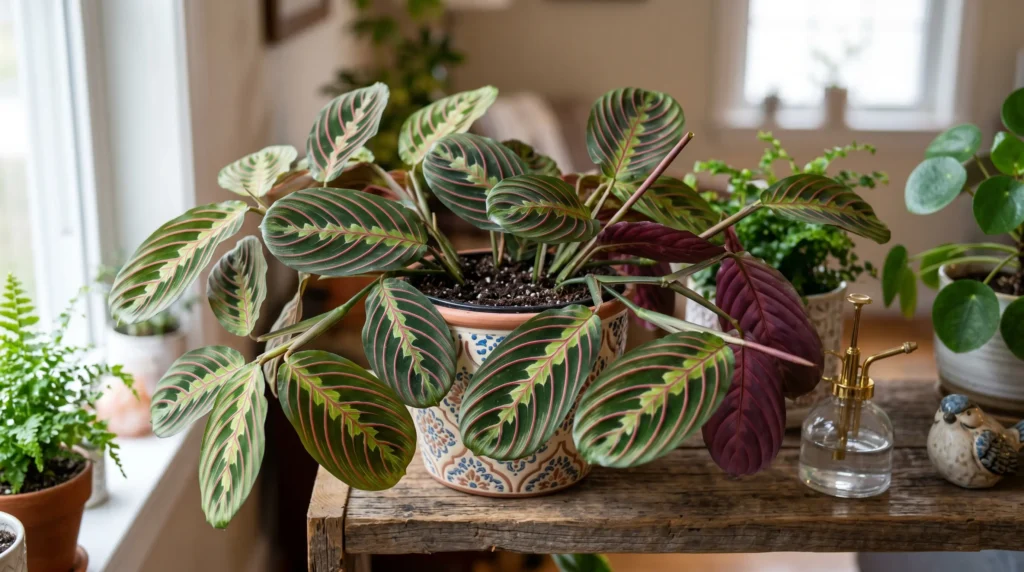
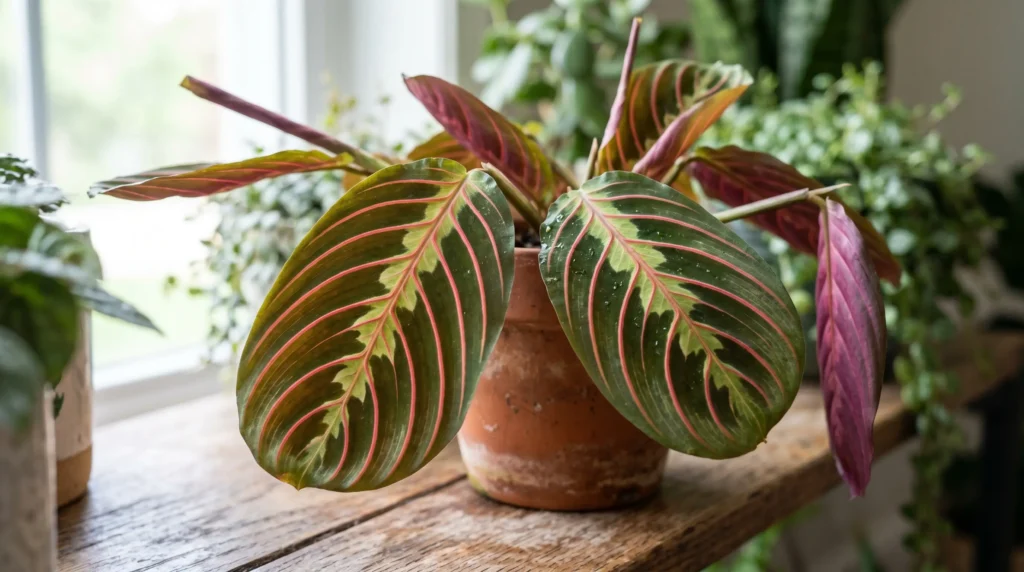
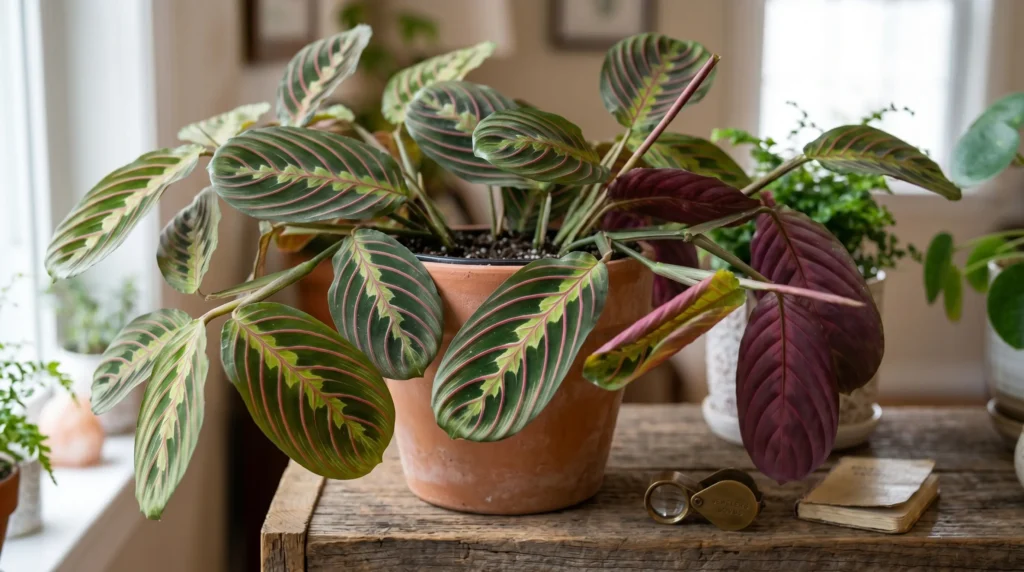
1. Maranta leuconeura var. erythroneura — The Red Prayer Plant / Herringbone Plant
- Leaf colour: Deep, velvety green
- Vein colour: Vivid red, branching outward in a herringbone (fishbone) pattern
- Leaf underside: Rich reddish-purple
- Centre marking: Lighter yellow-green feathering along the midrib
- Availability: Most widely sold; found in most garden centres and supermarkets
- Care note: Most sensitive to direct sun of all varieties — colours bleach quickly
2. Maranta leuconeura var. kerchoveana — Rabbit’s Tracks / Green Prayer Plant
- Leaf colour: Soft blue-green to mid-green
- Pattern: Dark brown oval blotches flanking the central vein, resembling paw prints
- Leaf underside: Silvery-green with fine veining
- Centre marking: Subtle lighter midrib
- Availability: Less common than erythroneura; found in specialist nurseries
- Care note: Slightly more forgiving of lower light conditions
Popular Cultivated Varieties (Human-Selected Cultivars)
| Cultivar Name | Key Features | Rarity | Notes |
|---|---|---|---|
| ‘Fascinator’ (Tricolor) | Red veins + cream-yellow feathering; often mislabelled as erythroneura | Common | The “classic” tricolor look |
| ‘Lemon Lime’ / ‘Marisela’ | Electric chartreuse and lime-green veins; no red | Moderate | Most light-sensitive cultivar |
| ‘Massangeana’ / ‘Black’ | Near-black leaves with silver-white central vein | Less common | Dramatic collector’s piece |
| ‘Kim’ | Purple-spotted leaves with white streaks | Uncommon | Growing in collector popularity |
| ‘Dottie’ | Playful mix of hues with prominent spots | Uncommon | Compact, striking appearance |
| ‘Portobello’ | Larger-than-average leaves, bold patterns | Rare | Almost painterly effect |
| ‘Silver Band’ (2024–25) | Silvery band along the leaf centre | Very rare | Currently trending |
| ‘Cat Moustache’ | White whisker-like markings near leaf tips | Rare | Unique, conversation-piece plant |
| Variegated Kerchoveana | Cream-white variegation over rabbit tracks pattern | Extremely rare | Slow-growing; highly collectible |
New discoveries: Scientific studies in South America in 2020 and 2024 confirmed the existence of new Maranta species, including dwarf varieties not yet available commercially.
How to Identify Which Maranta Variety You Have
Step 1 — Check the vein colour first:
- Red or pink veins = erythroneura family (‘Herringbone’, ‘Fascinator’, ‘Tricolor’)
- Lime/chartreuse veins = ‘Lemon Lime’ / ‘Marisela’
- Dark brown oval spots (no distinct veins) = kerchoveana (‘Rabbit Tracks’)
- Silver-white central band = ‘Massangeana’ or ‘Silver Band’
Step 2 — Check the leaf underside:
- Reddish-purple = almost certainly erythroneura or Fascinator
- Silvery-green = kerchoveana
Step 3 — Check the midrib area:
- Yellow-green feathering along the centre line = Fascinator/Tricolor
How to Care for Maranta — The Complete Guide
Quick Care Summary: Maranta thrives with bright indirect light, consistently moist but never waterlogged soil, 50%+ humidity, temperatures of 18–27°C, and filtered or rainwater. It is more forgiving than Calathea but repays attentive care with vivid colour and active leaf movement.
Light — Getting It Right
What light does Maranta need? Maranta leuconeura needs bright, indirect light. It evolved on the rainforest floor under a dense canopy, so it is adapted to filtered, dappled light — never direct sun.
Ideal placement:
- 3–6 feet (90–180 cm) from an east-facing window — receives gentle morning light; protected from harsh afternoon sun
- North-facing window — sufficient indirect light; colours may be slightly less vivid
- A bathroom with a frosted window — the combination of filtered light and natural humidity is close to ideal
- Offices lit by fluorescent or LED lighting (10–12 hours per day) — Maranta tolerates artificial light well
Too much light — signs and fix:
- Bleached, washed-out leaf colour
- Brown, crispy patches on leaf surface (scorching)
- Faded red or green pigmentation
Fix: Move the plant further from the window or add a sheer curtain to diffuse light.
Too little light — signs and fix:
- Leggy, elongated stems reaching toward the window
- Small new leaves with less defined patterns
- Leaf colours fading or becoming uniform green
- Leaf movement (praying) becoming less pronounced
Fix: Move the plant to a brighter spot or add a grow light positioned 30 cm (12 inches) above the plant for 10–12 hours daily.
Rotate your plant 90 degrees every 2–3 weeks to ensure all sides receive even light exposure and growth remains balanced.
AI Answer — Can Maranta grow in low light? Yes, Maranta leuconeura will survive in lower light conditions — one of its advantages over Calathea. However, in low light (below 200–400 lux), growth slows significantly, leaf patterns fade, and the characteristic prayer movement becomes less pronounced. For best colour and vigour, bright indirect light is strongly preferred.
Watering — The Most Misunderstood Element
How often should you water Maranta? Water Maranta leuconeura when the top 1 inch (2.5 cm) of soil feels dry to the touch. In summer this is typically every 4–5 days; in winter, every 7–10 days. Never allow the soil to dry out completely, and never leave the plant sitting in standing water.
Water Quality: The Hidden Cause of Brown Tips
Most guides tell you to water a prayer plant regularly. Very few tell you what water to use — and this is where most owners go wrong.
Maranta leuconeura is sensitive to:
- Fluoride — the most common cause of brown leaf tips, even at normal tap water concentrations
- Chlorine — damages root cells and causes leaf edge burn over time
- Dissolved minerals (calcium, magnesium, lime) — accumulate in soil, raising pH and preventing nutrient uptake
- Cold water — shocks the roots; always use room-temperature water
Best water sources (ranked):
| Rank | Water Type | Notes |
|---|---|---|
| 1 | Rainwater | Best option; naturally soft, correct pH |
| 2 | Filtered water (carbon filter or RO) | Removes chlorine and fluoride effectively |
| 3 | Distilled water | Pure, but use with fertiliser as it lacks minerals |
| 4 | Tap water left 24 hours | Chlorine evaporates; fluoride remains (partial fix) |
| 5 | Straight cold tap water | Avoid if possible; will cause tip burn over time |
Soil flushing: Every 2–3 months, water the plant heavily until water flows from drainage holes for 30–60 seconds. This flushes accumulated mineral salts from the soil, preventing toxic build-up.
Overwatering vs. Underwatering — How to Tell the Difference
| Symptom | Overwatering | Underwatering |
|---|---|---|
| Leaves | Yellow, soft, mushy edges | Brown, dry, crispy edges |
| Stems | Soft, dark at the base | Firm but wilting |
| Soil | Constantly wet, possible smell | Dry, pulling away from pot edges |
| Roots | Brown, mushy, rotten smell | White/tan, firm but sparse |
| Leaf movement | Reduced (stress) | Reduced (dehydration) |
How often should I water a prayer plant? Water every 4–5 days in summer and every 7–10 days in winter, using room-temperature filtered or rainwater. Water when the top 1 inch of soil is dry. Never let the plant sit in water, and never let it dry out completely. Always use filtered or rainwater to prevent fluoride and chlorine damage.
Humidity — What Maranta Actually Needs
What humidity does Maranta need? Maranta leuconeura needs relative humidity of at least 50%, and ideally 60% or higher. This reflects its origin in the perpetually humid Brazilian rainforest, where humidity routinely exceeds 70%.
How to Increase Humidity — Methods Ranked by Effectiveness
| Method | Effectiveness | Notes |
|---|---|---|
| Humidifier | (Best) | Place 60–90 cm from plant; maintains consistent humidity |
| Pebble tray with water | (Good) | Never let the pot base touch the water; evaporation raises local humidity |
| Plant grouping | (Moderate) | Plants transpire together, raising local humidity slightly |
| Bathroom placement | (Very good) | Naturally steam-rich environment |
| Misting | (Ineffective) | Raises humidity for ~30 minutes only; can cause fungal leaf spots |
The misting myth: Misting is one of the most commonly recommended tips for prayer plants — and one of the least effective. The humidity boost from misting lasts less than 30 minutes. Worse, water sitting on leaves in still air promotes fungal leaf spot. A small humidifier is a far better investment.
Winter warning: Central heating reduces indoor humidity to 20–30%, which is the single biggest cause of Maranta deterioration in winter. If you live in a temperate climate with cold winters and central heating, a humidifier is not optional — it is essential.
How do I increase humidity for my Maranta? The most effective method is a small ultrasonic humidifier placed 60–90 cm from the plant. A pebble tray partially filled with water under the pot also helps. Misting is widely recommended but ineffective — it raises humidity for less than 30 minutes and risks fungal disease. Bathrooms with frosted windows are naturally good spots for Maranta.
Temperature — The Comfort Zone
What temperature does Maranta prefer? The ideal temperature range for Maranta leuconeura is 18–27°C (65–80°F). The plant does not tolerate cold, drought, or frost.
- Minimum: 15°C (60°F) — below this, leaves curl, growth halts
- Fatal: Frost or temperatures below 10°C (50°F)
- Avoid: Cold draughts, air conditioning vents directed at the plant, radiators
Maranta can be grown outdoors year-round only in USDA Hardiness Zones 11–12, where frost does not occur. In cooler climates, it is a permanent indoor plant.
Soil — The Right Mix for Long-Term Health
What soil does Maranta need? Maranta leuconeura needs a soil mix that is simultaneously moisture-retentive and free-draining, at a slightly acidic pH of 5.5–6.0. Standard potting compost is often too dense — it retains too much moisture and suffocates the rhizomes.
DIY Maranta Soil Recipe (Recommended)
2 parts peat moss OR coco coir (moisture retention + slight acidity)
1 part perlite               (drainage + aeration)
1 part orchid bark            (air pockets, prevents compaction)
Why these ingredients:
- Coco coir (preferred over peat in 2025) is more sustainable, holds moisture well, and maintains a consistent slightly acidic pH
- Perlite prevents waterlogging and helps the soil dry at the right rate (roughly 7 days between waterings)
- Orchid bark creates air pockets that keep roots oxygenated and prevent the anaerobic conditions that cause root rot
If using pre-mixed compost: Add 20% extra perlite + 20% orchid bark to standard houseplant potting mix to improve drainage.
Never use: Garden soil (compacts indoors, may carry pests/pathogens), heavy clay compost, or any mix without drainage material.
Fertilising — Feeding Without Burning
How do you fertilise Maranta? Feed Maranta leuconeura with a balanced liquid fertiliser (10-10-10 or 10-15-10) diluted to half the recommended strength, every two weeks during the growing season (spring through late summer).
| Season | Feeding Frequency | Strength |
|---|---|---|
| Spring | Every 2 weeks | Half strength |
| Summer | Every 2 weeks | Half strength |
| Autumn | Once per month | Half strength |
| Winter | None | — |
Why half strength? Maranta is sensitive to over-fertilisation. Excess salts accumulate in the root zone, causing the same brown tip damage as fluoride in tap water. When in doubt, dilute further rather than feeding more.
Signs of over-fertilising: White crust on soil surface (salt build-up), brown leaf edges, yellowing tips. Fix: Flush the soil heavily with plain water; withhold fertiliser for 4–6 weeks.
Organic alternative: Diluted worm casting tea (1:10 ratio) or fish emulsion at quarter-strength. These release nutrients slowly and are far less likely to cause salt burn.
Do not feed in winter. The plant is in a rest phase; feeding dormant roots causes toxin build-up without the growth to use the nutrients.
Repotting — When and How
When should you repot Maranta? Repot Maranta leuconeura when you see roots emerging from drainage holes, or when the soil dries out unusually fast (a sign the pot is full of roots). This typically occurs every 2–3 years. Repot in spring, when the plant is actively growing and recovery is fastest.
Pot selection:
- Choose a pot only 1–2 inches (2.5–5 cm) larger than the current one. An oversized pot holds too much moisture, increasing root rot risk.
- Maranta spreads horizontally, not vertically — wide, shallow pots are more suitable than tall, deep ones.
- Terracotta pots allow the soil to breathe and dry faster — ideal for owners who tend to overwater.
- Glazed ceramic or plastic pots retain moisture longer — suitable for owners who are forgetful with watering.
After repotting:
- Hold fertiliser for 4–6 weeks (fresh soil has enough nutrients; adding fertiliser stresses recovering roots)
- Water lightly; keep in bright indirect light
- Expect slight drooping for 1–2 weeks — this is normal
Seasonal Care Calendar
Note: This section does not appear in any competitor article. It is a unique differentiator.
| Season | Priority Actions |
|---|---|
| Spring | Repot if root-bound. Resume fertilising. Increase watering as growth accelerates. Take cuttings for propagation. Check for pests as new growth emerges. |
| Summer | Water every 4–5 days. Feed every 2 weeks. Watch for spider mites (heat + dry air). Move plants away from air conditioning vents. Enjoy peak leaf colour and active movement. |
| Autumn | Reduce feeding to monthly. Ease back watering. Bring any outdoor plants inside before temps drop below 15°C. Check plant humidity as heating begins. |
| Winter | Stop fertilising entirely. Water every 7–10 days. Prioritise humidifier use — heating reduces indoor humidity to 20–30%. Expect slower growth, less vivid colouring, and reduced leaf movement. This is normal dormancy, not decline. |
How to Propagate Maranta — Step-by-Step Guide
Can you propagate Maranta leuconeura? Yes — Maranta is one of the easiest tropical houseplants to propagate. The two most reliable methods are stem cuttings (in water or soil) and root division. The best time to propagate is spring to early summer, when the plant is growing actively and success rates are highest.
Stem Cuttings in Water (Recommended for Beginners)
How to Propagate Maranta in Water:
- Choose a healthy stem with at least one node (the slightly raised joint where a leaf meets the stem) and 2–3 leaves
- Sterilise your scissors with 70% isopropyl alcohol or hold briefly over a flame — this prevents bacterial infection
- Cut just below a node — make a clean, diagonal cut to increase the surface area for root development
- Remove lower leaves that would be submerged in water — submerged leaves rot and introduce bacteria
- Place the cutting in a clear jar or glass of room-temperature filtered water, node submerged, leaves above the waterline
- Position in bright indirect light — a windowsill with no direct sun is ideal
- Change the water weekly to prevent bacterial growth
- Wait 3–6 weeks — roots will appear at the node, typically growing 2–5 cm in this period
- Transfer to soil once roots reach 2–4 cm (1–1.5 inches). Do not wait longer — very long water roots are fragile and struggle to adapt to soil
- Post-transfer care: Keep soil consistently moist for 4 weeks; cover loosely with a clear bag for the first 10–14 days to ease the transition
Stem Cuttings in Soil
How to Propagate Maranta in Soil:
- Prepare the same cutting as for water propagation (below-node cut, lower leaves removed)
- Optional: Dip the cut end in rooting hormone powder or gel — increases success rate by approximately 20%
- Fill a small pot with propagation mix (50% perlite + 50% coco coir — no nutrients, to encourage root growth)
- Insert the cutting 2–3 cm deep so the node is buried in the mix
- Water lightly until the mix is evenly moist but not saturated
- Cover with a clear plastic bag or humidity dome to maintain 70–80% humidity around the cutting
- Place in bright indirect light — avoid direct sun, which will dehydrate the cutting before roots form
- Lift the cover for 30 minutes daily for airflow; mist the inside of the bag if the mix starts to look dry
- Test for roots after 4 weeks: Gently tug the stem. Resistance = roots have formed
- Gradually acclimate to open air over 1 week by extending the uncovered time each day
Root Division (Fastest Results)
Success rate: ~90% | Timeline: 2–4 weeks to establishment
Division is the most reliable propagation method and is best performed during repotting, when the root ball is already exposed.
How to Propagate Maranta by Division:
- Water your plant thoroughly 24 hours before you plan to divide it — a well-hydrated plant survives the stress better
- Remove the plant from its pot by gently inverting and tapping the base
- Examine the root ball — identify natural separation points where rhizome clusters can be separated
- Gently pull the clumps apart using your fingers. If roots are tightly tangled, use clean scissors to cut — but aim to preserve as much root as possible on each division
- Each division must have: at least 2–3 stems, a section of rhizome, and visible healthy (white/tan, firm) roots
- Pot each division in fresh, moist potting mix; firm the soil gently around the roots
- Water lightly and place in bright indirect light
- Expect some drooping for 1–2 weeks — the plant is re-establishing its root system. Do not overwater in response.
- Withhold fertiliser for 4–6 weeks post-division
How do I propagate a Maranta prayer plant? The three methods are: (1) Stem cuttings in water: cut below a node, place in filtered water, roots form in 3–6 weeks. (2) Stem cuttings in soil: cut below a node, plant in perlite/coco coir mix, cover with humidity dome, roots in 4–8 weeks. (3) Division: separate root clumps when repotting; each section needs stems + rhizome + roots. Best time: spring or early summer. Success rate for division: ~90%.
Maranta Problems — Symptom Diagnosis & Treatment
What are the most common Maranta problems? The most common issues with Maranta leuconeura are brown leaf tips (from fluoride/chlorine in water or low humidity), yellowing leaves (from overwatering or underwatering), loss of leaf movement (from low humidity or inconsistent watering), and root rot (from consistently waterlogged soil).
Leaf Problem Diagnostic Chart
| Symptom | Most Likely Cause | Secondary Cause | Fix |
|---|---|---|---|
| Brown leaf tips | Fluoride/chlorine in water | Low humidity | Switch to filtered/rainwater; boost humidity |
| Brown patches on surface | Direct sun scorching | — | Move plant away from window |
| Yellow leaves (all over) | Overwatering | Underwatering | Check soil + roots; adjust watering |
| Yellow leaves (lower only) | Normal shedding | Root-bound | Normal if only 1–2 leaves; repot if many |
| Pale, washed-out colour | Too much direct light | Too little light | Assess direction of exposure; adjust |
| Curling leaves + brown tips | Low humidity | Underwatering | Raise humidity; check soil moisture |
| Curling leaves (no browning) | Cold draught | Temperature stress | Move away from windows/vents in winter |
| Circular dark leaf spots | Fungal leaf spot (from misting) | Poor airflow | Remove affected leaves; improve ventilation |
| Drooping (soil is moist) | Root rot | Root-bound | Check roots; repot if mushy |
| No leaf movement | Low humidity or light | Newly stressed | Raise humidity; increase indirect light |
| White crust on soil | Mineral/salt build-up | Over-fertilising | Flush soil; switch to filtered water |
Why Is My Prayer Plant Not Praying? (Full Diagnosis)
Why has my Maranta stopped folding its leaves at night? This is the most-searched Maranta problem. The leaf movement (nyctinasty) depends on the pulvinus having sufficient water pressure to operate — meaning adequate humidity, consistent watering, and appropriate light are all essential. When any of these fails, the movement stops.
Diagnosis checklist — work through in order:
- Check humidity first — Use a hygrometer. If below 50%, this is almost certainly the cause. Add a humidifier.
- Check watering — Was the plant allowed to dry out completely? Dehydrated pulvinus cells cannot generate movement. Water thoroughly and maintain consistent moisture.
- Check light — Is the plant receiving any direct sun? Or is it in a very dark corner? Both extremes impair the light-triggered movement mechanism. Move to bright indirect light.
- Check night light — Are artificial lights on in the room after dark? The movement is triggered by reduced light. Even moderate artificial lighting at night can prevent the folding response.
- Check temperature — Below 15°C, the plant becomes too cold-stressed to power the movement.
- Check for recent stress — Repotting, pest treatment, or moving the plant can temporarily suspend movement. Give 4–6 weeks for recovery.
Test: Check your plant at 9–10 PM. Leaves should be folded upright. Check again at 8–9 AM — leaves should be flat. Active movement in both directions = healthy plant.
Why is my prayer plant not praying? The most likely causes in order are: 1) humidity below 50% (most common), 2) inconsistent or insufficient watering, 3) too little or too much light, 4) artificial light left on at night disrupting the circadian trigger, 5) temperature below 15°C. Correct the environment and movement should resume within 2–3 days.
Common Pests: Identification & Treatment
Spider Mites
- Identification: Fine webbing on leaf undersides; leaves appear dusty or stippled with tiny yellow dots
- Cause: Low humidity + warm, dry air (classic summer or winter heating problem)
- Treatment: Wipe leaves with a damp cloth; apply neem oil spray or insecticidal soap to all leaf surfaces; repeat every 7 days for 3 weeks; raise humidity above 50%
Spider mites and fungus gnats affect many tropical houseplants in UK homes. Our spider plants care guide covers how this common companion plant handles the same conditions — and why the two make excellent shelf partners in humid rooms.
Fungus Gnats
- Identification: Tiny dark flies hovering around the soil; larvae in soil damage roots
- Cause: Consistently overwatered, wet soil
- Treatment: Allow soil surface to dry between waterings; apply yellow sticky traps; use hydrogen peroxide soil drench (1 part 3% H₂O₂ to 4 parts water) to kill larvae
Mealybugs
- Identification: White, cottony fluff in leaf joints and along stems
- Treatment: Dab with 70% isopropyl alcohol on a cotton bud; apply neem oil spray; repeat weekly
Scale Insects
- Identification: Small brown or tan bumps adhered to stems
- Treatment: Scrape off manually with a soft toothbrush; apply neem oil; repeat for 3–4 weeks
Prevention rule: Inspect the undersides of all leaves monthly. Isolate any new plant for 2 weeks before introducing it to your collection. Maintain good airflow — still, stagnant air is a pest incubator.
Root Rot — How to Rescue a Dying Maranta
What causes root rot in Maranta? Root rot occurs when soil remains waterlogged for extended periods, allowing anaerobic bacteria and fungi (particularly Pythium and Phytophthora species) to colonise and destroy the root system.
Signs of root rot:
- Leaves turn yellow and soft, despite moist soil
- A foul, musty smell from the soil
- Stem base feels soft or mushy
- Plant wilts even when watered
Emergency rescue steps:
- Remove from pot immediately — do not wait
- Shake off all old soil — rinse roots gently under room-temperature water
- Inspect roots: Healthy roots are white or tan and firm. Rotten roots are brown, black, or grey — soft and may fall apart when touched
- Cut away all rotten roots with sterilised scissors — cut back to healthy tissue
- Disinfect: Dip roots in dilute hydrogen peroxide solution (1 part 3% H₂O₂ : 3 parts water) for 5 minutes; allow to air-dry for 20–30 minutes
- Repot into fresh, dry soil in a clean pot with excellent drainage holes
- Water very sparingly for the first 3–4 weeks — once the top 2 inches (5 cm) feel dry
- Do not fertilise until the plant shows active new growth (typically 6–8 weeks)
How do I save a Maranta with root rot? Remove from the pot immediately, cut away all brown/mushy roots with sterilised scissors, dip the root system in dilute hydrogen peroxide solution, allow to air-dry, and repot in fresh well-draining soil. Water very sparingly for 4 weeks. Recovery is possible if at least 30–40% of the root system is still healthy.
Maranta vs. Calathea and Other Prayer Plants
What Is the Difference Between Maranta and Calathea?
Maranta vs. Calathea is the most common comparison question in the prayer plant world. Both are in the Marantaceae family, both fold their leaves at night, and both originate from tropical South America — but they are distinct genera with notable differences in appearance, care difficulty, and resilience.
Important botanical note: Most plants sold as “Calathea” today are botanically Goeppertia, following a DNA-based reclassification published around 2012. Commercial nurseries and garden centres continue using the name Calathea, so this article uses both terms.
| Feature | Maranta leuconeura | Calathea / Goeppertia |
|---|---|---|
| Difficulty | Easy–Moderate | Moderate–Difficult |
| Water sensitivity | Moderate (prefers filtered) | High (very sensitive to minerals) |
| Humidity tolerance | Tolerates 40–50% short-term | Needs 60%+ consistently |
| Light tolerance | Good — survives lower light | Poor — fades quickly in low light |
| Leaf movement | Very pronounced nightly folding | Less dramatic, more gradual |
| Leaf texture | Soft, slightly velvety | Stiffer, more rigid, waxy |
| Growth habit | Horizontal, trailing/spreading | Upright, clumping, bushy |
| Root system | Rhizomatous (spreading) | Tuberous clumps |
| Recovery from neglect | Good | Poor |
| Availability | Widely available | Common |
| Best for | Beginners to intermediate | Intermediate to advanced |
What is the difference between Maranta and Calathea? Both are “prayer plants” that fold leaves at night. Maranta is easier: it tolerates lower humidity, is less sensitive to tap water, and recovers better from occasional neglect. Calathea (botanically Goeppertia) is more demanding, needs consistently high humidity and filtered water, and does not tolerate any variation in care as well. For beginners, Maranta is the better choice.
Maranta vs. Stromanthe and Ctenanthe
| Feature | Maranta | Stromanthe | Ctenanthe |
|---|---|---|---|
| Difficulty | Easy–Moderate | Moderate | Moderate–Difficult |
| Leaf colour | Green with markings | Bold pink/red undersides | Longer, narrower, striped |
| Growth | Low, spreading | Taller, more upright | Medium height |
| Availability | Very common | Common | Less common |
| Best for | All levels | Intermediate | Intermediate–Advanced |
Recommendation: For anyone new to the Marantaceae family, start with Maranta leuconeura. It is the most forgiving, the most widely available, and arguably the most visually rewarding, with its dramatic leaf movement and striking patterns.
Maranta Safety — Toxicity, Pets & Children
Is Maranta toxic? No. Maranta leuconeura is non-toxic to cats, dogs, and humans. It is listed as a non-toxic plant by the ASPCA (American Society for the Prevention of Cruelty to Animals) and the Pet Poison Helpline. All commercially available varieties share this non-toxic status.
Key Safety Facts
- Cats: Non-toxic — a nibble may cause mild stomach upset due to plant fibre, but no serious toxicity
- Dogs: Non-toxic — same as cats; only mild digestive discomfort from eating large quantities
- Children: Non-toxic — no harmful compounds identified
- Best practice: Even non-toxic plants are best kept out of easy reach of small children and pets — not for toxicity reasons, but to protect the plant from damage
How Maranta compares to popular alternatives:
| Plant | Toxic to Pets? | Notes |
|---|---|---|
| Maranta leuconeura | No | One of the safest tropical houseplants |
| Calathea / Goeppertia | No | Also non-toxic |
| Pothos (Epipremnum) | Yes | Contains insoluble calcium oxalates |
| Philodendron | Yes | Contains calcium oxalates |
| Peace Lily (Spathiphyllum) | Yes | Toxic to cats and dogs |
| Snake Plant (Sansevieria) | Mildly toxic | Can cause nausea |
Maranta’s combination of pet safety, striking appearance, and active leaf movement makes it one of the best houseplant choices for households with animals and young children.
Cultural & Symbolic Meaning
Across cultures, prayer plants carry symbolism rooted in their distinctive nightly movement. They are frequently associated with:
- Gratitude and mindfulness — the “praying” posture evokes thankfulness
- Spiritual protection — in some traditions, the nightly folding is seen as a form of blessing
- Resilience — the plant’s ability to recover from neglect has made it a symbol of perseverance in plant communities
Displaying Maranta — Best Rooms, Pots & Styling Ideas
Best Rooms for Maranta
Bathroom: The top choice. Natural steam from showers and baths provides ambient humidity. A frosted window delivers perfectly filtered, indirect light. M
If you’re building a low-light-friendly plant shelf or looking for companions that thrive in similar conditions, our Aglaonema plant guide covers one of the best low-to-medium light tropical houseplants — an excellent pairing with Maranta in darker UK rooms.
aranta thrives here with minimal additional care.
Kitchen: Steam from cooking helps; natural light is usually good. Keep away from direct heat from the hob or oven.
Bedroom: Maranta’s air-purifying properties (documented in a 2024 study showing reduced CO₂ levels) make it a thoughtful bedroom choice. Its nightly movement is a calming visual ritual.
Living Room: Works well in bright corners, away from south-facing windows. Pair with a humidifier for best results.
Office: Tolerates artificial lighting well. Studies suggest living plants in workspaces improve focus and reduce stress — Maranta’s gentle movement adds a dynamic, living quality to desk environments.
Display Styles
Hanging baskets: Maranta’s natural trailing and horizontal growth habit suits hanging displays beautifully. The spreading leaves cascade downward in a lush, full display.
Terrariums (open or closed): The enclosed, humid microclimate of a terrarium is close to Maranta’s natural habitat. Ideal for smaller cultivars.
Shelf layers: Place Maranta at mid-shelf height beneath taller plants (Monstera, Ficus, Bird of Paradise) that provide natural shade — this mimics the rainforest floor arrangement exactly.
Grouped displays: Pairing Maranta with other humidity-loving plants (Stromanthe, Ferns, Calathea) creates a mutually beneficial microclimate through shared transpiration.
Pot Selection Guide
| Pot Type | Pros | Cons | Best For |
|---|---|---|---|
| Terracotta | Breathable; dries faster; classic aesthetic | Heavy; breaks easily | Overwater-prone owners |
| Glazed ceramic | Retains moisture longer; beautiful | Less drainage control | Forgetful waterers |
| Plastic nursery pot | Lightweight; excellent drainage | Not decorative | Inside a decorative outer pot |
| Wide shallow dish | Mirrors natural spreading habit | Less common in shops | Show displays |
| Hanging basket | Showcases trailing growth | Dries faster (more watering) | Trailing display |
Buying Maranta — How to Choose a Healthy Plant
What to Look For at a Nursery or Garden Centre
Step 1 — Inspect leaf undersides first: Turn a few leaves over. Pests (mites, mealybugs, scale) hide here. Refuse any plant with webbing, white fluff, or sticky residue.
Step 2 — Check stem firmness: Stems should feel firm and upright. Soft, mushy, or dark-at-the-base stems indicate root rot or disease.
Step 3 — Assess leaf colour: Colour should be vivid and true-to-type. Pale, washed-out, or uniformly green leaves suggest the plant has been kept in light that is too bright or too dark. Pattern clarity is a sign of good health.
Step 4 — Look for yellow leaves: One or two yellow lower leaves = mild stress (normal during transport). Many yellow leaves throughout the plant = overwatering or root problems. Avoid.
Step 5 — Check if it prays: If you can observe the plant in the evening, healthy leaves should be folding upward. No movement = stressed plant.
Step 6 — Roots: A little root show at drainage holes = well-established. Heavily root-bound = needs immediate repotting (which adds to your initial effort and cost).
What to Do When You First Bring Your Maranta Home
- Quarantine for 2 weeks — keep new plants away from your existing collection; inspect daily for pests
- Inspect for pests thoroughly — check every leaf underside before placing near other plants
- Assess the nursery soil — commercial growing mixes are formulated for nursery conditions (frequent watering, perfect light, regular flushing), not home conditions. Plan to repot into a home-appropriate mix within 6–8 weeks
- Acclimate gradually — nurseries often have high light; sudden placement in a dark corner causes shock. Introduce to your chosen spot over 2 weeks
- Do not fertilise immediately — allow 4–6 weeks for the plant to settle before feeding
Frequently Asked Questions About Maranta
.
Q: What is Maranta leuconeura?
A: Maranta leuconeura, commonly called the prayer plant, is a tropical perennial houseplant from Brazil’s rainforests. It is famous for its strikingly patterned leaves that fold upward at night in a movement called nyctinasty. It belongs to the family Marantaceae and is non-toxic to pets and humans.
Q: Why is it called a prayer plant?
A: The plant is called a prayer plant because its leaves fold upward at dusk to a near-vertical position, resembling hands pressed together in prayer. This daily movement is called nyctinasty and is driven by water pressure changes in a specialised organ called the pulvinus at the base of each leaf stalk.
Q: How often should I water a Maranta?
A: Water Maranta when the top 1 inch of soil feels dry — approximately every 4–5 days in summer and every 7–10 days in winter. Always use room-temperature filtered or rainwater. Never let the plant sit in standing water, and never let the soil dry out completely.
Q: Why are my Maranta leaves turning yellow?
A: Yellow leaves on a Maranta most commonly indicate overwatering — check whether the soil has been staying wet for too long and reduce watering frequency. Yellow lower leaves occasionally shed naturally as the plant grows. If yellowing is widespread and accompanied by wilting despite moist soil, suspect root rot: remove the plant from its pot and inspect the roots immediately.
Q: Why are my Maranta leaf tips turning brown?
A: Brown leaf tips on Maranta are almost always caused by fluoride or chlorine in tap water, or by low humidity. Switch to filtered water or collected rainwater, and boost ambient humidity to 50%+ using a humidifier. Note: existing brown tips are permanent — trim them neatly at a slight angle with sterilised scissors. New growth will be clean once conditions are corrected.
Q: Why is my prayer plant not praying (not folding at night)?
A: A Maranta stops moving its leaves when one or more conditions fail: humidity below 50% (most common), inconsistent or insufficient watering, too little indirect light, artificial lights left on at night, or temperatures below 15°C. Identify and correct the environmental factor — movement typically resumes within 2–3 days.
Q: Is Maranta toxic to cats and dogs?
A: No. Maranta leuconeura is non-toxic to cats, dogs, and humans — confirmed by the ASPCA and Pet Poison Helpline. It is one of the safest tropical houseplants for pet-owning households.
Q: What is the difference between Maranta and Calathea?
A: Both are prayer plants that fold leaves at night. Maranta is easier to care for — it tolerates lower humidity, is less sensitive to tap water minerals, and recovers better from occasional neglect. Calathea (botanically reclassified as Goeppertia after 2012 DNA studies) is more demanding and requires consistently high humidity and filtered water. For beginners, Maranta is the better choice.
Q: Can Maranta grow in low light?
A: Maranta leuconeura will survive in lower light conditions (a significant advantage over Calathea). However, below 200–400 lux, growth slows significantly, leaf patterns fade, and nyctinastic movement becomes less pronounced. For best results — vivid colour, strong pattern, active movement — bright indirect light is strongly recommended.
Q: How do I propagate Maranta?
A: Maranta can be propagated by stem cuttings in water (70–80% success), stem cuttings in soil (60–75% success), or root division during repotting (~90% success). The best time is spring to early summer. For water propagation: cut a stem below a node, place in filtered water, and transfer to soil once roots reach 2–4 cm (3–6 weeks).
Q: How fast does Maranta grow?
A: Maranta grows at a moderate rate — approximately 5–10 new leaves per growing season under optimal conditions (bright indirect light, high humidity, consistent watering, and biweekly feeding in spring and summer). Variegated cultivars typically grow more slowly. Growth slows significantly in winter.
Q: Can I keep Maranta outdoors?
A: Maranta leuconeura can grow outdoors year-round only in frost-free climates (USDA Hardiness Zones 11–12). In temperate climates, it can be placed outside in a shaded or partially shaded spot in summer, but must be brought indoors before temperatures fall below 15°C (60°F). Never expose it to frost.
Q: When should I repot my Maranta?
A: Repot Maranta when roots begin emerging from drainage holes, or every 2–3 years in spring. Choose a pot only 1–2 inches larger than the current one. Maranta spreads horizontally, so wide, shallow pots suit it better than tall, deep ones.
Q: Does Maranta purify the air?
A: Maranta leuconeura has demonstrated air-purifying properties. A 2024 study found it can reduce indoor CO₂ levels. Like many houseplants, it also removes trace volatile organic compounds (VOCs) including formaldehyde and benzene. While it should not be considered a replacement for ventilation, it contributes positively to indoor air quality.
Q: What is the best humidity for a Maranta?
A: The ideal humidity for Maranta leuconeura is 50–60% or higher. Below 40%, browning leaf tips and reduced leaf movement are common. A small ultrasonic humidifier is the most effective way to maintain consistent humidity. Misting is largely ineffective, raising humidity for less than 30 minutes.
Key Takeaways — The 5 Principles of Maranta Care
- Understand its origin. Maranta leuconeura is a Brazilian rainforest floor plant. Every care decision should aim to replicate that environment: filtered light, consistent warmth, high humidity, and moisture-retentive but never waterlogged soil.
- Water quality matters more than most owners realise. Brown tips are not always a humidity problem — they are often fluoride and chlorine damage from tap water. Use filtered or rainwater as your default.
- Humidity is non-negotiable. Below 50% RH, Maranta suffers. A small humidifier is the single most impactful investment for this plant.
- The leaf movement is your health indicator. A Maranta that prays enthusiastically every evening is a healthy, happy plant. A plant that has stopped moving is a plant telling you something needs to change.
- It is more forgiving than Calathea, but not indestructible. Maranta rewards consistent care. It will survive occasional neglect — but will thank you for attention to the details that most guides skip: water quality, soil composition, and seasonal adjustment.

Leave a Reply