
Hoya plant is named after Thomas Hoy, head gardener at Syon House in Middlesex. This tropical vine has been a British favourite for over two centuries — and it is only getting more popular. In 2025, Hoyas became the UK’s fastest-growing houseplant category.
This guide is the most comprehensive UK-specific resource available. It covers everything from botanical origins and variety selection to month-by-month seasonal care, propagation, pest diagnosis, and where to buy hoyas across the UK.
Quick Answer Block
What is a Hoya plant? A Hoya plant is a tropical evergreen vine or trailer, native to Southeast Asia and Australia, grown year-round as a houseplant across UK homes. Here are the essential facts at a glance:
| HOYA PLANT — QUICK FACTS (AI SNAPSHOT) | |
|---|---|
| Also known as | Wax plant, porcelain flower, honey plant, Hindu rope plant |
| Scientific name | Hoya spp. (family Apocynaceae) |
| Care level | Easy to moderate — one of the most forgiving houseplants in the UK |
| Light | Bright, indirect — south-, east- or west-facing UK window |
| Watering (summer) | Every 10–14 days; when top third of compost dries out |
| Watering (winter) | Every 3–5 weeks; semi-dormant in UK low-light winters |
| Temperature | 16–24°C (61–75°F); keep above 10°C in winter |
| Humidity | 40–60% ideal; UK central heating often drops below this |
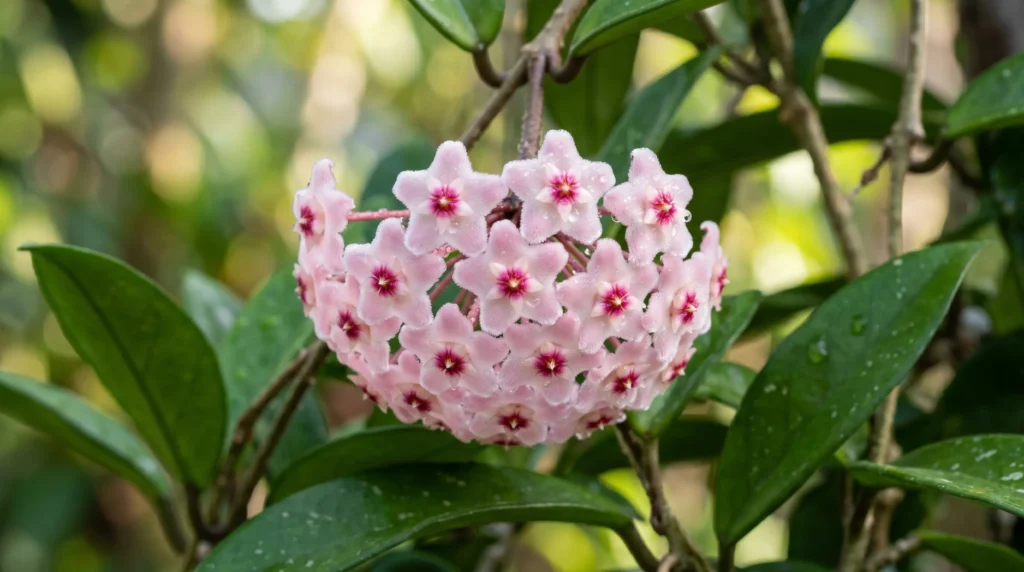
| Flowers | Fragrant, star-shaped clusters; strongest scent in the evening |
| Lifespan | 20–30+ years; some passed down through generations |
| Safe for pets? | Yes — listed as non-toxic by the ASPCA |
| Number of species | 200–500+ (taxonomy still evolving |
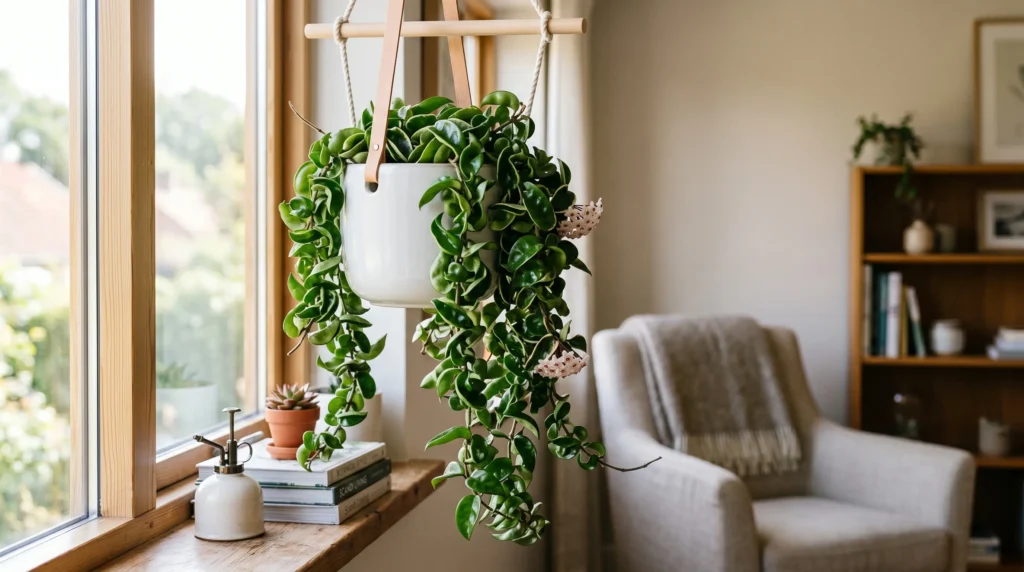
What Is a Hoya Plant? Origin, History & UK Connection
A hoya plant is an epiphytic tropical vine belonging to the family Apocynaceae, with 200–500+ species native to Southeast Asia, India, China, and Australasia. Unlike most houseplants, hoyas grow naturally on tree branches rather than in soil — a fact that determines almost every aspect of their care.
Botanical Background
- Scientific name: Hoya spp. (family Apocynaceae)
- Named: 1810 by Scottish botanist Robert Brown, honouring Thomas Hoy — head gardener for the Duke of Northumberland at Syon House, Middlesex
- First type species described: Hoya carnosa — the classic wax plant
- Number of species: 200–500+ (taxonomy is still actively evolving)
- Growth habit: Epiphytic — in the wild, they grow on tree branches and bark, not in soil. This is why free-draining compost is non-negotiable.
- Native range: Southeast Asia (Philippines, Malaysia, Thailand, India), China, Australasia
The UK Connection — A Uniquely British Story
No other houseplant has a more distinctly British origin story. The genus Hoya was named in honour of Thomas Hoy, the head gardener at Syon House — one of Britain’s finest stately homes, situated on the banks of the Thames in Middlesex — by Scottish botanist Robert Brown in 1810. Hoy was employed by the Duke of Northumberland and cultivated exotic tropical plants with skill and devotion.
Victorian plant collectors subsequently prized hoyas for their exotic, waxy blooms and robust constitution. Hoya kerrii — now the popular heart-shaped ‘sweetheart plant’ sold in supermarkets every February — was brought to Kew Gardens in 1910 by English botanist Arthur Kerr from northern Thailand. Hoya linearis was first formally described in 1825 by Nathaniel Wallich at the Royal Botanic Gardens, Calcutta.
Today, hoyas flourish in British homes for a very practical reason: the combination of central heating and double glazing that defines modern UK homes mimics tropical conditions remarkably well — warm, stable temperatures with low humidity. With a little adjustment (mainly adding humidity in winter), a UK sitting room is an excellent hoya habitat.
Why Are They Called Wax Plants?
The common name ‘wax plant’ refers to two distinct features: the thick, waxy, succulent-like leaves and the porcelain-like texture of the flowers themselves, which appear almost too perfect to be real. Other common UK names include:
- Porcelain flower — for the bloom’s ceramic-smooth appearance
- Honey plant — for the nectar the flowers produce, which can drip from the blooms
- Hindu rope plant — specifically for Hoya compacta, whose tightly twisted, rope-like stems give a dramatic sculptural effect
Benefits of Growing Hoya Plants — Snapshot
HOYA BENEFITS AT A GLANCE
| Air purifying | Studies (University of Georgia) show H. carnosa removes VOCs including benzene, octane, and toluene from indoor air |
| Pet & child safe | Listed as non-toxic to cats and dogs by the ASPCA — one of the safest popular houseplants |
| Exceptionally long-lived | Typically 20–30 years; some specimens are passed down through UK families across generations |
| Low maintenance | Tolerates missed waterings and low-humidity conditions better than most tropical houseplants |
| Collector’s appeal | 200–500+ species means there is always a new variety to discover — a lifetime hobby in one genus |
| Fragrant blooms | Many varieties scent the room at dusk — vanilla, cinnamon, honey — without any effort from the grower |
Hoya Plant Quick Care Reference Table
Use this table as your at-a-glance reference for all core hoya care requirements. All temperatures are given in Celsius (UK standard), with Fahrenheit equivalents in brackets. All measurements are metric.
| CARE FACTOR | WHAT HOYA NEEDS | UK-SPECIFIC TIP |
|---|---|---|
| Light | Bright, indirect light; some direct morning sun is beneficial | South-, east- or west-facing window. Move back from glass in winter. |
| Temperature | 16–24°C (61–75°F) ideal; minimum 10°C (H. carnosa), 16°C (H. bella) | Keep away from radiators AND cold draughts from sash windows — both cause leaf drop. |
| Watering (Spring/Summer) | When top third of compost dries out — roughly every 10–14 days | Check with finger test, not a schedule. UK summer heat speeds drying. |
| Watering (Autumn/Winter) | Reduce significantly: every 3–5 weeks in December–February | Semi-dormancy in UK winters means very low water needs — overwatering is the #1 killer. |
| Humidity | 40–60% ideal; above 40% minimum | UK central heating can drop indoor humidity to 20–30%. Use pebble trays or group plants. |
| Compost | Free-draining, airy mix — NOT dense multipurpose compost alone | 1 part peat-free compost + 1 part perlite + 1 part orchid bark. UK peat ban in effect. |
| Feeding | Spring and summer only — high-potassium liquid feed every 2 weeks | Tomorite (tomato feed) is widely available in UK garden centres and works excellently. |
| Repotting | Every 3+ years; only when roots emerge from drainage holes | Hoyas bloom better when slightly rootbound — do NOT rush to repot. |
| Pruning | Minimal — trim leggy growth above a leaf node only | NEVER cut the peduncles (flower stalks) — they rebloom year after year from the same spur. |
| Propagation | Stem cuttings (2 nodes minimum) in water or sphagnum moss | Best time in UK: March–June. Roots appear in 2–6 weeks. |
| Toxicity | Non-toxic to cats, dogs, and children (ASPCA listed) | Milky sap can irritate sensitive skin — wash hands after handling. |
See our guide on propagating clematis for comparison techniques that also work with Hoya.“
Popular Hoya Varieties Available in the UK
With 200–500+ species to choose from, the hoya genus can feel overwhelming. This section profiles the varieties most commonly available in UK shops and online retailers, organised by difficulty level, so you can find the right hoya for your home and experience.
Beginner-Friendly Varieties
Hoya carnosa — The Classic Wax Plant
What it is: The original and most widely available hoya. Hoya carnosa is an RHS Award of Garden Merit (AGM) holder with thick, oval, dark-green waxy leaves and sweetly fragrant pink-and-white star-shaped flower clusters.
- Difficulty: Easy — the most forgiving hoya for UK beginners
- Best UK placement: South- or west-facing living room
- Key cultivars: ‘Tricolor’ AGM (variegated pink/cream/green), ‘Krimson Queen’, ‘Krimson Princess’, ‘Compacta’ (Hindu Rope)
- Why UK growers love it: Tolerates low humidity better than most hoyas — ideal for centrally heated British sitting rooms
Hoya lanceolata subsp. bella — The Miniature Wax Plant
What it is: An RHS AGM holder with a compact trailing habit, small waxy leaves, and delicate white flowers with pink-lilac centres. One of the best hoyas for UK bathrooms.
- Difficulty: Easy to Moderate
- Best UK placement: Bright bathroom shelf or hanging pot in a humid room
- Ideal window: East-facing bathroom with frosted glass — gets light without harsh direct sun
Hoya linearis — The String Curtain
What it is: An RHS AGM holder with long, narrow, needle-like leaves cascading from trailing stems, producing small white fragrant flowers. One of the most visually dramatic hoyas.
- Difficulty: Moderate
- Best UK placement: Tall hanging planter in a stairwell, bay window, or conservatory (summer only)
- UK display tip: Allow stems to cascade at least 60cm for full visual impact
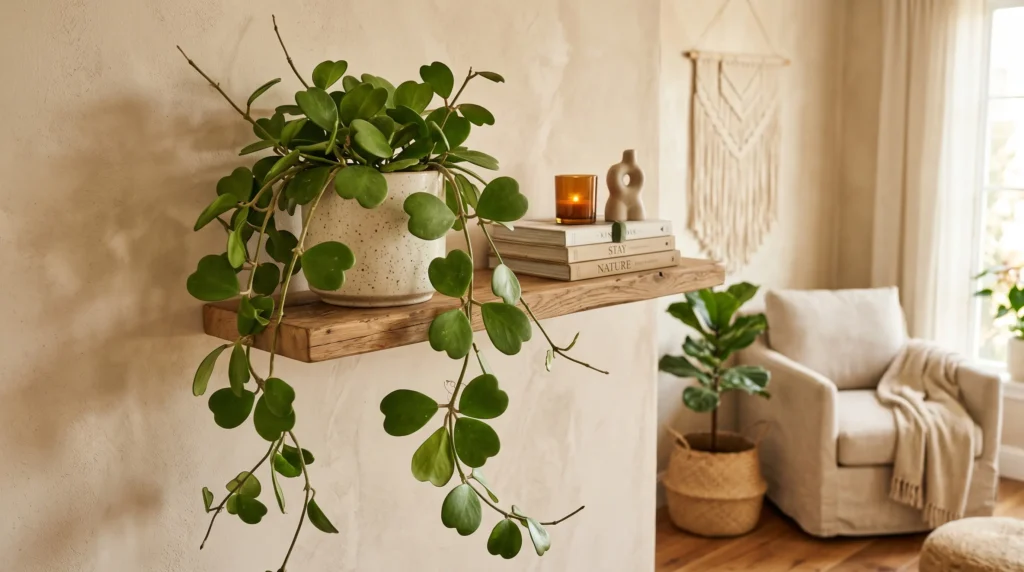
Hoya kerrii — The Sweetheart / Lucky Heart Plant
What it is: Instantly recognisable by its large, thick, heart-shaped leaves. Commonly sold in UK supermarkets and florists around Valentine’s Day.
CRITICAL UK BUYER WARNING: Single-leaf cuttings — the kind sold in tiny pots for £3–8 — cannot produce new growth without a stem node. They will stay alive for months but never develop into a full plant. Always buy a plant with at least one stem and multiple leaves.
- Difficulty: Easy (full plant)
- Best UK placement: Bright spot with some direct morning sun
Intermediate Varieties
Hoya pubicalyx — The Silver-Splashed Hoya
What it is: Long, lance-shaped leaves with attractive silver flecking; flowers range from pale pink to deep burgundy-red depending on light exposure.
- Difficulty: Easy to Moderate
- Best UK placement: Bright south-facing window — the most free-flowering readily available hoya
- Why it stands out: Blooms readily and reliably — a great first ‘collector’ hoya beyond carnosa
Hoya australis — The Australian Wax Plant
What it is: A vigorous grower with large rounded leaves and heavily fragrant white flowers. Ideal for training on a conservatory trellis.
- Difficulty: Easy
- Best UK placement: Heated conservatory or large bright room with structural support
- Note: Listed as potentially toxic to livestock; safe for cats, dogs, and children
Hoya obovata — The Large-Leaf Hoya
What it is: Large, round, dark-green leaves often splashed with silver markings. Drought-tolerant and very forgiving — increasingly available in UK garden centres.
- Difficulty: Easy
- Best UK placement: Any bright indirect spot; tolerates occasional missed waterings
Hoya curtisii — The Spade Hoya
What it is: Small spade-shaped leaves with striking silver-green patterning. Slow-growing but architecturally beautiful.
- Difficulty: Moderate
- Best UK placement: Bright filtered light; excellent for small UK flats and desk displays
Collector & Statement Varieties
Hoya compacta — The Hindu Rope Plant
What it is: Tightly curled, rope-like leaves create one of the most dramatic foliage houseplants available in the UK. Slower to establish than standard carnosa, but deeply rewarding.
- Difficulty: Moderate
- Best UK placement: Hanging display in conservatory or bay window
- Collector note: Variegated versions such as ‘Mauna Loa’ are rare and highly sought-after; expect to pay £40–100+ from specialist UK retailers
Hoya polyneura — The Fishtail Hoya
What it is: Flat, elongated leaves with dramatic dark fishbone veining. Native to Himalayan foothills — slightly more cold-tolerant than other species.
- Difficulty: Moderate
- Best UK placement: Bright east-facing window; cascades beautifully from a shelf
Hoya lacunosa — The Cinnamon-Scented Hoya
What it is: Tiny textured leaves and small white flowers with a powerful cinnamon-like fragrance. Blooms multiple times a year — one of the most rewarding hoyas for scent.
- Difficulty: Moderate
- Best UK placement: Warm bright bathroom or kitchen; the humidity suits it well
Krimson Queen vs. Krimson Princess — The Comparison
| FEATURE | Krimson Queen | Krimson Princess |
|---|---|---|
| Variegation position | White/pink on leaf edges | White/cream in leaf centre |
| Reversion risk | Moderate in low light | Higher — reverts more easily to green |
| Light requirement | Brighter than standard carnosa | Brighter than standard carnosa |
| UK availability | Common — garden centres and online | Common — slightly more sought-after |
| Price range | £10–22 | £12–25 |
Variety Selection — Quick Reference Table
| Variety | Foliage Feature | Flower Scent | Difficulty | Best For |
|---|---|---|---|---|
| H. carnosa | Classic oval, waxy | Sweet vanilla (evening) | Easy | Beginners, any room |
| H. bella | Small, compact trailing | Light, sweet | Easy-Mod | Bathrooms, hanging |
| H. linearis | Needle-like curtain | Light | Moderate | Statement displays |
| H. kerrii | Heart-shaped thick leaves | Mild | Easy | Gifts, slow growers |
| H. pubicalyx | Silver-flecked lance leaves | Musky-sweet | Easy-Mod | Free-flowering |
| H. australis | Large rounded | Very fragrant | Easy | Conservatories |
| H. compacta | Rope-twisted curls | Sweet | Moderate | Hanging displays |
| H. polyneura | Fishbone dark veining | Mild | Moderate | Collectors |
| H. lacunosa | Tiny, textured leaves | Cinnamon! | Moderate | Fragrance lovers |
| H. obovata | Large round, silver splash | Sweet | Easy | Beginners, bold look |
How to Care for a Hoya Plant in the UK — Full Guide
Light: Finding the Perfect UK Window
Light is the single most important variable in Hoya care in the UK — and the one most commonly underestimated, particularly in the darker months from November to February.
Best UK window orientations:
- South-facing: Best in autumn and winter when UK light is weak. Provides maximum daily light. Move plants 30–60cm back from glass in summer to avoid scorching.
- East-facing: Ideal year-round for most varieties. Gentle morning sun is ideal; no risk of afternoon scorching.
- West-facing: Good year-round; afternoon sun is more intense than morning — check for scorching in summer.
- North-facing: Possible for foliage-only display; Hoyas in north-facing rooms rarely flower.
UK-specific issue: Between November and February, even south-facing UK windowsills can receive too little light for active growth. Consider supplementing with a grow light (12–14 hours per day) during this period if you want your hoya to remain vigorous rather than dormant.
‘Sun stressing’ is a technique used by some collectors to deliberately expose hoyas to slightly more light, inducing pink or red pigmentation in the foliage. It can be effective but requires gradual acclimatisation — abrupt exposure causes white scorched patches that do not recover.
Watering: The Rule UK Growers Most Often Break
The core rule: Water a Hoya plant when the top third of its compost has dried out — not on a fixed schedule. Overwatering is the leading cause of Hoya death in UK homes.
| UK SEASONAL WATERING SCHEDULE | |
|---|---|
| Spring (Mar–May) | Every 10–14 days; use finger test — insert finger 3–4cm into compost |
| Summer (Jun–Aug) | Every 10–14 days; check more frequently near radiators or in conservatories |
| Autumn (Sep–Nov) | Reduce to every 2–3 weeks as daylight shortens |
| Winter (Dec–Feb) | Every 3–5 weeks; semi-dormancy means very low water needs |
| UK tap water tip | UK water is often hard (high limescale). Let tap water sit overnight before use, or collect rainwater |
| Never do this | Never leave the pot sitting in a saucer of water; never water into flower clusters |
Compost & Potting Mix — The UK Peat-Free Approach
Hoyas are epiphytes — in nature they grow on tree bark, not in soil. Their roots need air circulation. Dense, water-retentive compost is their enemy.
Recommended UK mix: 1 part peat-free multi-purpose compost + 1 part perlite + 1 part orchid bark. This creates the free-draining, airy root environment Hoyas need.
- Peat-free alternatives: Coco coir-based mixes work well and align with UK government peat reduction policy (2026 onwards)
- Ready-made option: Cactus & succulent compost with added perlite — widely available at B&Q and Dobbies
- Pot choice: Terracotta pots allow better airflow and reduce overwatering risk. Plastic or glazed pots retain moisture longer — useful in summer, risky in winter.
- Drainage is non-negotiable: Every pot must have drainage holes. No exceptions.
Temperature & Humidity — Adapting Tropical Plants to British Homes
| FACTOR | UK GUIDANCE |
|---|---|
| Ideal temperature | 16–24°C — most UK living rooms achieve this perfectly in spring/summer |
| Winter minimum | 10°C for H. carnosa; 16°C for H. bella. UK windowsills can drop to 5–8°C in January — move plants 30cm back from glass. |
| Radiator risk | Placing hoyas directly above or beside a radiator causes leaf scorch and bud drop. Keep at least 50cm away. |
| Central heating humidity | UK heating systems can drop indoor humidity to 20–30% in winter. Hoyas prefer 40–60%. |
| Humidity solutions | Pebble tray with water beneath pot; grouping plants; occasional gentle misting in summer (NOT winter — cold still air + moisture = botrytis risk) |
| Draughts | Cold draughts from older sash windows are a hidden killer in UK winter. Check all window seals. |
Feeding — UK Seasonal Fertiliser Schedule
- Spring (March–May): Begin monthly feeding as daylight increases — use a balanced liquid feed
- Summer (June–August): Feed every 2 weeks with a high-potassium liquid fertiliser — Tomorite (tomato feed) is widely available in UK garden centres and works excellently
- Autumn (September–November): Reduce to monthly feeding
- Winter (December–February): Stop feeding entirely — the plant is semi-dormant
- Flowering boost: Switch to a high-phosphorus feed (e.g., 5-10-5 ratio) 4–6 weeks before expected bloom period
- After repotting: Do not feed for 6 weeks — disturbed roots cannot absorb nutrients effectively
Repotting — Less Is More
The most counterintuitive Hoya care rule: do not rush to repot. Hoyas bloom more prolifically when their roots are slightly constricted — a phenomenon called being ‘rootbound.’
- When to repot: Every 3+ years, or only when roots are visibly emerging from drainage holes
- Best UK timing: Spring (March–April) as daylight and temperature increase
- Pot size: Go only one size up — maximum 5cm (2 inches) wider in diameter
- Method: Water 24 hours beforehand; handle roots gently; use fresh compost mix; do not feed for 6 weeks post-repot
- Aftercare: Keep in a warm spot; avoid direct sun for 2 weeks following repotting
Pruning & Training
The single most important Hoya rule: NEVER cut the peduncles (short flower stalks/spurs). These are the points from which new flowers form year after year. Removing them delays flowering by at least one full season.
- Do NOT remove long leafless tendrils — these are future growth points that will leaf up over time
- Pruning for shape: Cut just above a leaf node to manage leggy growth
- Training options: Wire loop or hoop, trellis, moss pole, bamboo tripod, hanging basket, or allow to trail from a high shelf
| PROS — Reasons to Grow Hoyas | CONS — What to Watch For |
|---|---|
| Exceptionally long-lived (20–30+ years) | Require free-draining compost (not standard) |
| Slow to first flower (2–3 years) | UK winter overwatering is a common killer |
| Pet and child safe (ASPCA) | Bud drop if moved during budding |
How to Get Your Hoya to Flower in the UK
How to get a Hoya to flower is the most-searched Hoya question in the UK — and the one most competitors answer poorly. This section covers the biology, the seven practical steps, and the scent profiles of popular varieties.
Why Hoyas Bloom at Night — The Biology
Hoyas evolved to be pollinated by moths in their native tropical habitats. Moths are nocturnal, which is why most Hoya varieties produce pale, star-shaped flowers and release their strongest fragrance in the evening and at night. Understanding this evolutionary strategy helps UK growers position plants where they can best appreciate the evening scent — a south-facing living room or bedroom windowsill is ideal.
The 7 Keys to Flowering Success in UK Conditions
How does a Hoya produce flowers? Flowering requires seven conditions to align simultaneously. Address all seven and a mature Hoya in the UK will flower reliably:
- Mature plant: Most Hoyas require 2–3 years of growth before they flower for the first time. Patience is essential — there is no shortcut to maturity.
- Sufficient light: Insufficient light is the single most common reason UK hoyas do not flower. Bright indirect light is the minimum; some direct morning sun is better. Move to a south-facing window in winter.
- Rootbound condition: Keep the plant snug in its pot. A slightly rootbound hoya flowers more prolifically than one in a pot with excess space.
- Do not move when budding: Once buds have formed, the plant must not be moved or subjected to changes in light. Bud drop is almost certain if conditions change after bud initiation.
- Winter cool-down: A brief cooler, drier rest period in winter (10–15°C, minimal watering for 4–6 weeks) mimics tropical dry seasons and can trigger a strong spring flowering response.
- Phosphorus boost: Switch to a high-phosphorus liquid feed (the middle number in the NPK ratio, e.g. 5-10-5) approximately 4–6 weeks before the expected bloom period — usually February–March in the UK.
- Preserve the peduncles: Flowers form on the same short stalks year after year. Never remove them. Mark them with a small piece of string or a twist tie so they are never accidentally cut.
What Hoya Flowers Smell Like — Variety by Variety
Scent profiles vary dramatically between species — a key differentiator for UK buyers choosing between varieties. Note that all scents are strongest in the evening:
| VARIETY | SCENT PROFILE |
|---|---|
| H. carnosa | Sweet vanilla and chocolate — strongest at night; deeply pleasant in a living room |
| H. lacunosa | Warm cinnamon and spice — one of the most distinctive and immediately recognisable floral scents |
| H. bella | Light, honey-sweet — subtle and appropriate even in a bedroom |
| H. pubicalyx | Musky-sweet — richer than carnosa; pleasant but best enjoyed in a larger room |
| H. australis | Rich, intensely floral — can be overpowering in a small UK room; better suited to a conservatory |
| H. obovata | Subtle vanilla-adjacent — light enough for any room |
| H. linearis | Light and fresh — pleasant without being assertive |
After Flowering — What to Do
- Do NOT remove the spent peduncle — leave it in place. The same spur produces flowers again next season.
- Resume your normal feeding schedule after flowering ends.
- Watch for a second flush: well-established specimens commonly reflower within the same year.
- Reduce watering slightly after flowering to encourage the plant to rest before its next growth phase.
How to Propagate Hoya Plants — Step-by-Step UK Guide
How to propagate a hoya plant: Hoyas are propagated most reliably from stem cuttings with at least two nodes. The best time in the UK is spring (March–May) or early summer (June), giving cuttings maximum growing season before UK winter.
Water Propagation (Easiest for Beginners)
- Take a healthy stem cutting with at least 2 nodes (the bumps or joints on the stem) and 1–2 pairs of leaves. Cut cleanly just below a node using clean, sharp scissors or a sterilised knife.
- Remove the bottom pair of leaves so no foliage sits in water — submerged leaves rot and encourage bacterial growth.
- Place the cutting in a clean glass or jar of room-temperature water. Ensure nodes are submerged; leaves must remain above the waterline.
- Position in bright indirect light. Avoid full sun, which heats the water and promotes bacteria.
- Change the water every 3–4 days to keep it fresh and oxygenated.
- Roots appear in 2–6 weeks. In UK winters, expect the longer end — warmth accelerates rooting.
- When roots reach 3–5cm in length, transfer to a small pot of prepared hoya compost mix.
- Keep the newly potted cutting humid and warm (above 18°C) for 2 weeks; ease gradually into normal care conditions.
Sphagnum Moss Propagation
- Take a 2-node cutting as above.
- Wrap the node section in damp (not soaking) sphagnum moss — squeeze the moss to remove excess water before wrapping.
- Place in a clear plastic bag or small propagation box to maintain humidity.
- Keep in a warm, bright spot — 21–24°C is ideal. A propagation heat mat is useful in UK spring.
- Open the bag briefly every 2 days for airflow to prevent mould and disease.
- Roots become visible through the moss in 3–5 weeks. Pot up when roots are 3–5cm long.
Air Layering (For Established Stems)
Air layering is an intermediate technique suitable for established plants with long, woody stems. Wound the stem at a node point, apply damp sphagnum moss around the wound, wrap tightly with cling film and seal both ends, then wait 4–8 weeks for roots to develop through the moss.
Critical UK Buyer Warning — Hoya kerrii Leaf Cuttings
IMPORTANT: Hoya kerrii single-leaf cuttings — sold widely in UK supermarkets and florists around Valentine’s Day — cannot grow into new plants unless the cutting includes a stem node. A single leaf will stay alive for months or even years (it is succulent and stores water) but will never develop into a full climbing plant.
Hoya Plant Problems, Pests & Diseases — UK Diagnosis Guide
The following tables allow you to diagnose the most common hoya problems seen in UK homes and conservatories, with UK-specific seasonal context that most general guides miss.
Symptom Diagnosis Table
| SYMPTOM | LIKELY CAUSE | UK CONTEXT | FIX |
|---|---|---|---|
| Yellow leaves | Overwatering, rootbound, nutrient deficiency | UK winter: reduced light + overwatering is the most common combination | Reduce watering; check for root rot; resume feeding in spring |
| Dropping leaves | Cold draught, overwatering, sudden light change | UK sash windows: cold draughts in winter are a hidden killer | Move away from draughts; check compost dryness |
| Brown leaf tips | Low humidity, fluoride in tap water, too much sun | UK hard water areas: high limescale common | Use rainwater; increase humidity; move from direct sun |
| No flowers | Insufficient light, peduncles removed, too young | UK November–February: light levels often insufficient for bud initiation | Brighter spot; check peduncles intact; patience |
| Bud drop | Plant moved during budding, draughts, watering change | Very common UK issue when plants are relocated to new rooms | Do NOT move once buds are visible; stabilise all conditions |
| Black/mushy stems | Root rot from overwatering | UK winter overwatering during semi-dormancy — the #1 killer | Remove affected roots; repot in fresh dry mix; reduce watering |
| Sticky residue | Mealybug, scale, or aphid honeydew | Scale insects peak in centrally heated UK homes in winter | Identify pest; treat with neem oil or insecticidal soap |
| White cottony patches | Mealybugs — the most common hoya pest in the UK | Most prevalent in warm, dry, centrally heated UK interiors | Dab with isopropyl alcohol; treat with neem oil weekly x 4 |
| Pale/washed-out leaves | Too much direct sun or sun scorch | UK south-facing windows can scorch from May onwards | Move back from glass; add sheer curtain |
| Slow/no growth | Low light, winter dormancy, or rootbound | Normal UK October–February; resume growth in March | Normal in winter; resume feeding in March |
Common UK Pests — Identification & Treatment
Mealybugs — Most Common
- Appearance: White cottony or waxy lumps in leaf axils, stem joints, and on leaf undersides
- Treatment: Dab individual bugs with isopropyl alcohol on a cotton bud. Then spray the whole plant with neem oil solution (5ml neem oil + 1ml washing-up liquid per litre of water). Repeat every 5–7 days for 3–4 weeks without skipping.
- Prevention: Inspect all new plants before bringing indoors; quarantine new additions for 2 weeks in a separate room
Scale Insects
- Appearance: Brown or tan waxy bumps on stems and leaf undersides — often mistaken for part of the plant
- Treatment: Scrape off physically with a soft toothbrush or fingernail; follow with neem oil spray treatment
- UK note: More prevalent in centrally heated UK homes in winter when conditions are warm and dry
Spider Mites
- Appearance: Fine silky webbing on leaves; tiny moving specks visible under a magnifying glass; stippled pale leaf surface
- Treatment: Increase humidity (spider mites thrive in dry conditions); wash leaves thoroughly with water; neem oil spray; insecticidal soap
- UK note: Dry central heating in UK winters is a primary driver of spider mite infestations
Diseases
- Root rot (Pythium/Phytophthora): The result of overwatering. Shows as black or mushy stems at compost level. Remove affected roots, dust with cinnamon or a proprietary fungicide, repot in fresh dry mix, and significantly reduce watering going forward.
- Botrytis (grey mould): Grey fuzzy patches on leaves or flowers. Caused by the combination of cold + wet conditions + still air — a risk in UK winters. Remove affected parts; improve airflow around the plant; never mist in winter.
- Powdery mildew: White powdery coating on leaf surfaces. Rare on hoyas but possible in high-humidity conditions. Treat with a potassium bicarbonate spray.
- Leaf spot disease: Brown spots with yellow halos; can be bacterial or fungal. Remove affected leaves; avoid wetting foliage when watering.
UK Hoya Care Calendar — Month by Month
No UK competitor provides a month-by-month hoya care calendar. This table gives you precise, season-specific guidance aligned with UK climate conditions, daylight hours, and central heating patterns.
| MONTH | UK CONDITIONS | HOYA CARE TASKS |
|---|---|---|
| January | Cold, dark; central heating on | Minimal watering (every 4–5 weeks); no feeding; keep above 10°C; move back 30cm from cold glass; check for pests (spider mites peak) |
| February | Still cold; days lengthening slightly | Continue minimal watering; watch for signs of new growth emerging; continue spider mite vigilance; begin researching new varieties for spring |
| March | Days lengthen rapidly; spring warmth begins | Resume monthly feeding (balanced feed); begin increasing watering frequency; ideal time to repot or take cuttings; move closer to windows |
| April | Warmer; noticeably more daylight | Increase watering to every 2–3 weeks; begin fortnightly feeding; move to bright spot; check for mealybugs as warmth increases |
| May | Good light; warmer; risk of direct sun scorching | Water every 10–14 days; protect from strong south-facing glass; consider moving vigorous species to a sheltered patio if temperatures consistently above 16°C at night |
| June | Long days; best growing season begins | Peak growth; water every 10–14 days; fortnightly feeding; enjoy flowering; train new growth on hoops or trellises; do NOT move plants showing buds |
| July | Hottest month; risk of scorching | Increase watering check frequency; move back from south-facing glass; enjoy peak evening scent; take stem cuttings for propagation now |
| August | Warm; days starting to shorten | Continue care; take any remaining cuttings before end of month; prepare to bring outdoor plants back inside if night temperatures approach 16°C |
| September | Cooling; reduced daylight | Reduce feeding to monthly; begin reducing watering; bring outdoor hoyas inside before nights drop below 16°C; harden off gradually by bringing in at night first |
| October | Cool; low light; central heating switching on | Reduce watering to every 3 weeks; stop feeding; move plants to brightest spot; watch humidity drop as heating activates — set up pebble trays |
| November | Dark, cold; central heating in full use | Water every 4–5 weeks; no feeding; consider a grow light for plants in darker spots; maintain pebble tray humidity; check for spider mites |
| December | Darkest month; coldest nights | Minimal intervention — 1 watering session for most plants; keep frost-free; enjoy the plants from a distance; plan next year’s variety additions |
Buying Hoya Plants in the UK — A Practical Guide
Where to Buy Hoyas in the UK
- Online specialist retailers: Grow Tropicals, Plants for All Seasons, Hortology, Harriet’s Plants — widest variety ranges and best plant quality
- Garden centres: B&Q, Dobbies, Wyevale — stock mainly H. carnosa and kerrii; good for seeing plants before purchase
- RHS plant fairs and shows: Excellent for rare varieties and direct expert advice
- Facebook Marketplace / UK plant swap groups: Good for cuttings and unusual collector species at low cost; buy from trusted sellers with reviews
- Supermarkets: Aldi and Lidl occasionally stock Hoyas (usually kerrii around Valentine’s Day); basic varieties only and single-leaf cuttings are common — see the buyer warning in Section 4
What to Check Before Buying
- Healthy, firm leaves with no soft, yellowing, or translucent patches
- No visible pests — check stem joints and leaf undersides carefully before purchase
- Healthy root system — not compacted solid (severely rootbound) or bare in oversized compost
- For Hoya kerrii: ensure the cutting has at least one stem node and multiple leaves — not a single leaf in a pot
- For variegated varieties: check for healthy, consistent variegation; avoid heavily reverted (mostly green) plants unless they are significantly discounted
- Ask about provenance if possible: UK-grown plants acclimatise better than recently imported specimens
UK Price Guide (2025–2026)
| VARIETY | APPROX. PRICE (UK) | NOTES |
|---|---|---|
| H. carnosa (standard) | £5–15 | Widely available; cheapest entry point into the genus |
| H. carnosa ‘Tricolor’ AGM | £10–20 | Common in UK garden centres and online |
| H. kerrii (single leaf) | £3–8 | Cannot become a full plant without a node — see Section 4 |
| H. kerrii (full plant) | £15–30 | This is the version worth buying |
| H. linearis | £15–25 | Increasingly available from UK online retailers |
| H. pubicalyx | £12–22 | Excellent value; widely available; free-flowering |
| H. compacta (Hindu Rope) | £15–30 | Worth finding a quality established specimen |
| H. compacta (variegated) | £40–100+ | Rare; specialist retailers and RHS fairs only |
| H. polyneura | £20–40 | Growing UK availability in 2025–26 |
| Rare/collector species | £30–200+ | Specialist fairs, online plant community auctions |
Displaying Hoya Plants in UK Homes
Best Rooms for Hoyas in UK Homes
| ROOM | WHY IT WORKS | BEST VARIETY |
|---|---|---|
| Living room (south/west window) | Ideal light; creates a beautiful focal point as a trailing or climbing specimen | H. carnosa, H. pubicalyx, H. compacta |
| Conservatory | Perfect in spring–summer; too cold in winter unless heated | H. australis, H. carnosa (vigorous climbers) |
| Bathroom | Higher humidity suits many varieties; ensure adequate light | H. bella, H. linearis, H. lacunosa |
| Kitchen windowsill | Warm and bright; splashes and drips are less problematic | H. carnosa, H. pubicalyx, H. obovata |
| Bedroom | Light evening fragrance from carnosa is a pleasant addition; avoid very small rooms with highly fragrant species | H. carnosa, H. bella |
| Home office / study | Low-maintenance nature suits a desk or shelf; air-purifying properties add a wellbeing benefit | H. kerrii, H. carnosa, H. obovata |
Display Ideas for UK Interiors
- Hanging baskets: Classic and effective — shows off trailing growth beautifully. Ideal for H. linearis, H. bella, and H. compacta.
- Wire hoop: Train H. carnosa or H. pubicalyx in an arch for a statement living sculpture. Wire hoops are widely available at UK garden centres.
- Shelf cascading: Allow vines to trail down from a high shelf — dramatic in a stairwell or hallway.
- Macramé hanger: Very popular in UK interiors 2024–2026; suits any trailing hoya and works beautifully in a bedroom or living room.
- Moss pole / trellis: For vigorous climbers such as H. australis in a conservatory. Allows the plant to reach its full potential height.
- Terracotta pot cluster: Group different hoya varieties with contrasting textures and sizes for a curated indoor garden effect.
Hoyas as UK Gifts — A Seasonal Guide
| OCCASION | RECOMMENDED VARIETY | NOTE |
|---|---|---|
| Valentine’s Day | H. kerrii (‘Sweetheart Plant’) | IMPORTANT: Buy a full plant with a stem, not a single-leaf cutting |
| Mother’s Day | H. carnosa ‘Tricolor’ or ‘Krimson Queen’ | Beautiful, forgiving, and exceptionally long-lasting — the perfect lasting gift |
| Housewarming | H. australis or H. pubicalyx | Easy, vigorous, and impressively large — a plant that fills a new home with life |
| Wedding / Anniversary | A well-established H. carnosa with multiple vines | A plant that outlasts the occasion — symbolically meaningful and practically beautiful |
| Christmas | H. lacunosa | The cinnamon-fragrant variety is a wonderful — and unexpected — winter gift |
Hoya Plant UK — Frequently Asked Questions (FAQ Schema)
The following questions and answers are structured for FAQPage schema markup. Each answer is self-contained.
Are Hoya plants easy to care for?
Yes — hoyas are among the most forgiving houseplants available to UK growers. They tolerate irregular watering, adapt to a range of light conditions, and are resistant to most common pests. The primary challenges are avoiding overwatering (especially in UK winters) and providing sufficient light to trigger flowering. Overall, they suit beginners and experienced plant parents alike.
How often should I water a Hoya plant in the UK?
In spring and summer, water every 10–14 days when the top third of compost feels dry. In autumn, reduce to every 2–3 weeks. In winter, water every 3–5 weeks — hoyas enter a semi-dormant state during low UK light levels and need far less water than most growers expect. Always use the finger test rather than a fixed schedule.
Why is my Hoya plant not flowering?
The most common reasons in UK homes are: insufficient light (move to a brighter south- or west-facing window), peduncles (flower stalks) having been accidentally cut off, the plant being too young (most hoyas take 2–3 years to first flower), or the plant having been moved after buds formed. A winter cool-down period and switching to a high-phosphorus feed in early spring also encourage flowering.
Are Hoya plants toxic to cats and dogs?
Hoyas are listed as non-toxic to cats and dogs by the ASPCA — one of the few popular flowering houseplants to hold this designation. The milky sap can cause mild skin irritation, and eating large quantities of any plant may cause mild digestive upset in pets. As a sensible precaution, keep hoyas out of easy reach of very young or curious animals.
Can Hoya plants grow outside in the UK?
Hoyas can be moved to a warm, sheltered patio or doorstep during UK summers (May–September) when temperatures consistently remain above 16°C at night. They must come back inside before autumn temperatures drop. Hoyas cannot survive UK winters outdoors and must never be left out during frost or temperatures below 10°C (H. carnosa) or 16°C (H. bella).
How long do Hoya plants live?
With good care, Hoyas are exceptionally long-lived — typically 20–30 years, and some specimens are passed down through UK families across generations. Hoya carnosa, in particular, is known to outlive its owners when given appropriate conditions. They are among the longest-lived houseplants widely available in the UK.
Why is my Hoya dropping leaves?
Leaf drop in UK Hoyas is most commonly caused by cold draughts — particularly from older sash windows in winter — overwatering, or a sudden change in light levels. Check the plant’s position: it should be away from exterior draughts, at least 50cm from any radiators, and moved back from cold glass during January and February when UK windowsills can fall below 8°C.
What is the best compost for Hoya plants in the UK?
A free-draining, airy mix is essential. The recommended UK recipe is: one part peat-free multi-purpose compost, one part perlite, and one part orchid bark. This mirrors the bark-and-air environment hoyas grow in naturally as epiphytes. Ready-made cactus compost with added perlite also works well. Avoid heavy, water-retentive multipurpose composts — these cause root rot in hoyas.
What is the UK name for a Hoya plant?
The most common UK name is ‘wax plant’ or ‘wax vine,’ referring to the thick waxy leaves and porcelain-like flowers. Other names include ‘porcelain flower,’ ‘honey plant’ (for the nectar-producing blooms), and ‘Hindu rope plant’ (specifically for Hoya compacta). The genus name Hoya honours Thomas Hoy, head gardener at Syon House in Middlesex, after whom the genus was named in 1810 — giving Hoyas an authentically British identity.
Can I grow a Hoya plant in my bathroom?
Yes — a bathroom with adequate natural light is an excellent location for many hoya varieties. The higher humidity found in bathrooms suits H. bella and H. linearis especially well. The ideal is a frosted east- or south-facing bathroom window. Avoid cold north-facing bathrooms with poor light — Hoyas will survive but not thrive, and will not flower.
When is the best time to repot a Hoya in the UK?
The best time to repot a hoya in the UK is spring — specifically March or April — when increasing daylight and warming temperatures stimulate new root growth. Avoid repotting in autumn or winter when the plant is semi-dormant. Remember that Hoyas flower better when slightly rootbound, so repot only when roots are visibly emerging from drainage holes — typically every 3+ years.
Conclusion — The Hoya Plant, Britain’s Perfect Houseplant
The Hoya plant is, in almost every respect, the ideal houseplant for UK homes. It arrived in Britain carrying a uniquely British name — bestowed in honour of a Middlesex gardener over two centuries ago — and has never looked more relevant than it does today.
Long-lived, low-maintenance, safe for pets and children, capable of purifying indoor air, and able to deliver fragrant, porcelain-perfect blooms year after year, Hoyas reward the grower generously in exchange for modest, well-timed attention.The variety market in the UK continues to expand rapidly.
Species and cultivars that were collector rarities just five years ago — Hoya polyneura, the variegated compacta forms, and increasingly exotic linearis selections — are appearing in specialist UK online retailers and at RHS plant fairs with growing regularity. There has never been a better time to begin, or to expand, a UK hoya collection.
Use this guide as your permanent reference — revisit the care calendar each month, consult the diagnosis table when problems arise, and explore the variety profiles when you are ready to grow your collection. With the right care and a little patience, your Hoya will be growing, flowering, and filling your home with scent for decades to come.

Leave a Reply