
Agapanthus is a summer-flowering perennial grown from fleshy rhizomes, producing tall stems topped with globe-shaped clusters of trumpet-shaped flowers in shades of blue, purple, and white. It blooms from July to September and is one of the most architecturally striking plants available to UK gardeners.
Planting Agapanthus in the UK at a Glance
Use this box to get started immediately. Full detail on every point follows below.
| Key Factor | What You Need to Know |
|---|---|
| Best time to plant | March to May (bare roots from late March; pots any time spring–summer) |
| Position | Full sun — minimum 6 hours of direct sunlight per day |
| Aspect | South- or west-facing border preferred |
| Soil | Well-drained, fertile loam; add horticultural grit to clay soils |
| Planting depth | 5–10 cm deep; rhizome nose pointing upward |
| Spacing | 30 cm apart in borders |
| Hardy or tender? | Deciduous = hardy (to −10°C); Evergreen = frost-tender |
| Container tip | Slightly pot-bound roots = more flowers |
| Flowering season | July to September; some varieties extend to October |
| Feeding | High-potash liquid feed (tomato feed) every 2 weeks, April–July |
| Toxic? | Yes — mildly toxic to pets and humans; wear gloves when handling |
Why Agapanthus Belongs in Every UK Garden
Every UK garden has a problem it doesn’t talk about: the midsummer gap. By late June, the spring flush of tulips and alliums is long gone. By August, the reliable summer workhorses — roses, salvias, geraniums — are either exhausted or looking tired.
The months of July through September are precisely when most borders run out of ideas.Planting agapanthus plants solves this problem completely.Agapanthus delivers its full drama exactly when most plants go quiet.
The tall, upright flower stems — rising 60 cm to 1.2 m above bold, strap-like foliage — carry spectacular spherical heads of trumpet-shaped flowers in deep blue, pale lilac, inky purple, or crisp white. They bloom from July and persist well into September, holding their shape and colour with a reliability that few late-summer plants can match. Nothing looks quite like them. Nothing else does quite the same job.
The reason many UK gardeners hesitate is understandable: agapanthus looks exotic. It looks like something that belongs in a sunnier, warmer country — and historically, it was treated that way, lifted and stored each winter like a dahlia or a tender gladiolus. That old-fashioned caution is no longer necessary for most varieties.
The key is understanding one fundamental distinction — hardy or tender — and this guide will make that decision effortless. Once you know which type of agapanthus you have, everything else falls into place: where to plant it, how to care for it through the seasons, and how to protect it over winter based on where you live in the UK.
This is the most comprehensive guide to growing agapanthus in the UK available online. It covers every aspect from variety selection to a month-by-month care calendar, regional overwintering advice for every part of the country, and a diagnostic guide for the single most common problem — agapanthus that refuses to flower. Whether you’re planting your first rhizome in a pot on a patio or establishing a full border drift, everything you need is here.
What Is Agapanthus Origins and Botany
Agapanthus is a flowering perennial native to Southern Africa, belonging to the family Amaryllidaceae. It grows from fleshy, strap-rooted rhizomes (not true bulbs, despite being commonly sold as such), producing clumps of bold, strap-like leaves and tall, bare stems topped with rounded umbels of trumpet-shaped flowers. The plant’s name comes from the Ancient Greek: agape meaning love, and anthos meaning flower — “flower of love.”
Despite its common names — African Lily and Lily of the Nile — agapanthus has no connection to the Nile basin. It originates from the Cape region of South Africa and the surrounding highlands, where it grows in rocky, sun-baked positions with excellent drainage. Understanding this origin explains precisely what agapanthus needs in a UK garden: sun, sharp drainage, and warmth.
Common names for agapanthus
- African Lily
- Lily of the Nile (geographically misleading — it’s South African)
- Blue Lily
- Agapanthus (the botanical name, now widely used as the common name)
Key botanical facts
| Fact | Detail |
|---|---|
| Family | Amaryllidaceae |
| Grown from | Fleshy rhizomes (often incorrectly called bulbs) |
| Lifespan | Long-lived perennial; established clumps persist for decades |
| Flowering season | July–September (UK); some varieties extend to October |
| Height range | 20–150 cm, depending on variety |
| Flower colours | Deep blue, pale blue, lavender, purple, white, bicolour |
| Origin | Southern Africa (Cape region, Drakensberg highlands) |
Why “agapanthus bulbs” is a misnomer worth understanding
Most nurseries and garden centres sell agapanthus as “bulbs.” Technically, this is incorrect — agapanthus grows from rhizomes, which are thick, fleshy, horizontal underground stems with spreading roots. True bulbs (like tulips or daffodils) are self-contained food stores with a papery outer layer. Rhizomes behave differently: they spread laterally, dislike being planted too deeply, and are more vulnerable to rot if kept wet.
This distinction matters practically. Unlike a tulip bulb, an agapanthus rhizome should be planted with its growing tip (nose) barely covered — just 5 cm beneath the soil surface. Deeper planting delays flowering significantly. Understanding this prevents one of the most common planting mistakes.
The two fundamental types of agapanthus
All agapanthus falls into one of two fundamental categories. This distinction is the single most important piece of information for any UK gardener.
1. Deciduous agapanthus
- Loses all foliage in autumn and dies back completely over winter
- Hardy to −10°C or below (RHS hardiness ratings H4–H5)
- Can be grown in open ground across most of the UK
- Requires only a crown mulch for winter protection in most regions
2. Evergreen agapanthus
- Retains its foliage year-round
- Hardy only to approximately −5°C (RHS hardiness rating H3)
- Best grown in containers in the UK so they can be moved indoors for winter
- Suited to open ground only in the mildest UK gardens (SW England, coastal Wales)
Hardy or Tender? The Decision That Changes Everything for UK Gardeners
Q: Are agapanthus hardy in the UK?
Answer: It depends entirely on the variety. Deciduous agapanthus are reliably hardy across most of the UK and can stay in open ground year-round with a crown mulch. Evergreen agapanthus are frost-tender and need protection below −5°C, making containers the safest growing method for most UK gardens.
“All growing advice in this guide is developed in line with the RHS agapanthus growing guide and expanded with UK regional detail, a monthly care calendar, and toxicity guidance that the RHS guide does not currently include.”
This single question — hardy or tender? — determines everything: where you plant, how much maintenance is required, and whether your plant survives a typical UK winter. Getting this right is the difference between a thriving long-lived plant and a disappointment. No other aspect of agapanthus cultivation is more important.
“All growing advice in this guide is developed in line with the RHS agapanthus growing guide and expanded with UK regional detail, a monthly care calendar, and toxicity guidance that the RHS guide does not currently include.”
Deciduous agapanthus: the UK gardener’s reliable choice
Deciduous agapanthus are varieties that lose all of their foliage in autumn and remain dormant underground through winter before re-sprouting in spring.
Why deciduous varieties are best for most of the UK:
- They are significantly hardier than evergreen types — the RHS rates the hardiest deciduous varieties at H5 (surviving −15°C)
- Their strategy of dying back in autumn protects the rhizome from frost more effectively than evergreen foliage does
- They can be grown in open ground throughout most of England, Wales, and in sheltered Scottish gardens
- They require only a 7–10 cm mulch of bark chip or straw over the crown as winter protection
- They are lower maintenance — no lifting, no indoor storage required
For any UK garden north of the Midlands, or in an exposed or frost-prone location, choose deciduous agapanthus exclusively.
Evergreen agapanthus: beautiful but demanding in the UK
Evergreen agapanthus are varieties that retain their strap-like leaves through winter. They are mostly derived from Agapanthus praecox and related species from warmer South African coastal regions.
Why evergreen varieties need more care in the UK:
- They are significantly less frost-hardy — most survive only to −5°C before foliage and rhizomes are damaged
- Their retained foliage draws moisture into the plant over winter, increasing vulnerability to freezing
- In most UK gardens they must be moved indoors or into a frost-free greenhouse before the first frosts
- They perform best as container plants in the UK, precisely because containers can be relocated
Where evergreen agapanthus can survive outdoors: In very mild UK gardens — the Scilly Isles, coastal Cornwall, parts of SW Devon, and sheltered south-facing urban spots — evergreen agapanthus can overwinter outside with fleece protection. Everywhere else, treat them as tender container plants.
How to tell if your agapanthus is deciduous or evergreen
| Method | What to Look For |
|---|---|
| Ask the nursery or retailer | The most reliable method — always ask before buying |
| Check the label for hardiness rating | H4 or H5 = deciduous and reliably hardy; H3 = evergreen and tender |
| Look for the RHS AGM mark | Award of Garden Merit varieties have been trialled in UK conditions |
| Leaf width | Broader, wider leaves often indicate evergreen types; narrower leaves are typically deciduous |
| Check in autumn | If foliage yellows and dies back naturally by November, it’s deciduous |
Comparison: Deciduous vs Evergreen Agapanthus in UK Conditions
| Feature | Deciduous | Evergreen |
|---|---|---|
| UK hardiness | H4–H5 (to −15°C) | H3 (to −5°C) |
| Open ground in most of UK | Yes | No (except mildest areas) |
| Winter protection needed | Mulch only | Bring indoors / frost-free |
| Best growing method | Border or container | Container preferred |
| Maintenance level | Low | Medium–high |
| Flowering reliability | High | High when conditions correct |
| Best for: N England / Scotland | Yes | Not recommended |
| Best for: SW England / Coastal | Yes | Yes (with care) |
Pros and Cons: Deciduous Agapanthus
Pros:
- Fully hardy in most of the UK — survives in open ground without lifting
- Only needs a simple mulch for winter protection
- Low maintenance once established
- Large range of colours and sizes available
- Performs reliably year after year
Cons:
- Border looks bare from November through March
- Foliage re-emerges late (May) — gap in border interest through spring
- Does not suit gardeners who want year-round foliage structure
Pros and Cons: Evergreen Agapanthus
Pros:
- Provides year-round foliage structure
- Some varieties offer attractive glossy, broad leaves
- Striking as container specimens on patios
- Some modern varieties bred for improved hardiness
Cons:
- Frost-tender — must be moved indoors in most UK regions
- Higher maintenance (autumn lift, indoor storage, spring hardening off)
- Requires greenhouse or suitable frost-free space
- More expensive to buy
- Can perform poorly if stored in warm or dark conditions
Best Agapanthus Varieties for UK Gardens
Q: Which agapanthus varieties are best for UK gardens?
The best agapanthus varieties for UK gardens are deciduous types with RHS H4 or H5 hardiness ratings. The most reliable choices include Headbourne Hybrids (the hardiest group), ‘Storm Cloud’ for northern gardens, ‘Blue Giant’ for dramatic border impact, and ‘Lilliput’ for containers and small spaces. For mild gardens, evergreen varieties like ‘Queen Mum’ and ‘Fireworks’ perform well in containers.
“For full guidance on vine weevil identification, its lifecycle, and all available biological and non-chemical treatments, see the RHS vine weevil biological control guidance.”
Complete variety comparison table
| Variety | Type | Height | Flower Colour | RHS Hardiness | Best For |
|---|---|---|---|---|---|
| Headbourne Hybrids | Deciduous | 60–90 cm | Blue range (varied) | H5 (−15°C) | Borders throughout UK; northern gardens; beginners |
| ‘Storm Cloud’ | Deciduous | 80–100 cm | Dark navy blue | H5 (−15°C) | Northern England, Scotland, exposed sites |
| ‘Blue Giant’ | Deciduous | 1.0–1.2 m | Clear mid-blue | H4 (−10°C) | Back of border; statement mass planting |
| ‘Lilliput’ | Deciduous | 30–45 cm | Pale blue | H4 (−10°C) | Front of border; containers; small gardens |
| ‘Exmoor’ | Deciduous | 45–60 cm | Deep cobalt blue | H4 (−10°C) | Front/mid border; compact gardens |
| ‘Windsor Grey’ | Deciduous | 100+ cm | Silvery grey-blue | H4 (−10°C) | Gravel gardens; statement drifts |
| ‘Midnight Blue’ | Semi-evergreen | 75 cm | Deep indigo-purple | H3–H4 | Sheltered south-facing borders |
| ‘Black Jack’ | Deciduous | 60–80 cm | Very dark purple | H4 (−10°C) | Dramatic colour combinations; pairs with warm tones |
| ‘Queen Mum’ | Evergreen | 80 cm | White flowers, blue at tips | H3 (−5°C) | Containers; mild gardens; patios |
| ‘Fireworks’ | Evergreen | 90 cm | Blue/white bicolour | H3 (−5°C) | Containers; patios; mild coastal gardens |
| ‘Twister’ | Evergreen | 75 cm | White and blue | H3 (−5°C) | Containers; feature planting |
Varieties by gardening situation
For Northern England and Scotland:
Choose only H5-rated deciduous varieties. Headbourne Hybrids and ‘Storm Cloud’ are the safest choices — both have been reliably hardy in UK trials and tolerate exposed, colder conditions. Avoid evergreen types entirely unless you have a frost-free greenhouse.
For the Midlands and most of England:
The full range of H4 deciduous varieties performs well. ‘Blue Giant’ creates spectacular back-of-border impact; ‘Lilliput’ is perfect for pot groupings on a sunny patio.
For SW England, Cornwall, and mild coastal gardens: You have the widest choice. Hardy deciduous varieties will thrive with minimal protection. Well-sheltered evergreen varieties like ‘Queen Mum’ can survive outdoors in a very mild winter with fleece, though containers remain the safest approach.
For small gardens and containers: Choose ‘Lilliput’ (30–45 cm) or ‘Exmoor’ (45–60 cm). Both flower reliably in pots, have the full agapanthus visual impact, and are easy to manage over winter.
For gravel and Mediterranean-style gardens: ‘Windsor Grey’ is exceptional — the silvery-grey flower heads shimmer at dusk and look outstanding planted in drifts against gravel or pale stone. Pair with alliums, lavender, and Stipa tenuissima.
What does the RHS Award of Garden Merit (AGM) mean?
The RHS Award of Garden Merit is given to plants that perform reliably well in UK garden conditions. When you see the AGM symbol on an agapanthus label, it means the variety has been assessed by the RHS and found to be: reliably available; easy to grow and care for; resistant to pests and diseases; and performing consistently in UK trials. For agapanthus specifically, the AGM is a valuable indicator because it filters out varieties that may look beautiful in a catalogue but underperform in the British climate.
When to Plant Agapanthus in the UK
Q: When is the best time to plant agapanthus in the UK?
The best time to plant agapanthus bare roots and rhizomes in the UK is late March through April, once soil temperature has risen above 10°C and the risk of hard frost has passed. Potted agapanthus plants can be planted at any point from spring through summer. Autumn planting is possible but risky without established roots before winter.
Planting times by form
Bare roots and rhizomes (the most common form sold in spring):
- Plant from late March through to the end of April
- Soil must have warmed above 10°C — cold wet soil causes rhizomes to sit dormant and rot
- Never plant into frozen or waterlogged ground
- Pre-soak bare roots in a bucket of water for 1–2 hours before planting to rehydrate the fleshy roots
Potted plants (available spring through summer, often sold in flower):
- Can be planted any time from April through August
- More resilient than bare roots — established root system tolerates disturbance better
- More expensive, but you see exactly what you are getting before it goes in the ground
- Water the pot thoroughly the night before planting
Autumn/winter bare roots (sometimes shipped by retailers in October–November):
- Risky approach — planting in cold soil delays establishment and leaves rhizomes vulnerable
- If you receive bare roots in autumn, pot them up in John Innes No. 2 compost and keep in a cool, frost-free greenhouse or porch until spring
- Plant out in March–April when conditions improve
UK frost date context: why timing matters more in the north
The last frost date varies dramatically across the UK, and this directly affects when it is safe to plant or return overwintered pots outdoors.
| UK Region | Average Last Frost Date |
|---|---|
| Cornwall / SW Devon | Late February to early March |
| South East England | Mid-April |
| Midlands | Late April |
| Northern England | Late April to early May |
| Scotland (lowlands) | Mid-May |
| Scotland (highlands / exposed) | Late May to early June |
Always check your local frost forecast before planting out bare roots or returning overwintered pots to the garden. A late frost after planting can destroy emerging growth — covering with a double layer of horticultural fleece overnight provides sufficient protection if frost is forecast unexpectedly.
How to Choose the Right Position for Agapanthus
Q: Where should I plant agapanthus in my UK garden?
Plant agapanthus in a position that receives full sun — at least 6 hours of direct sunlight per day. South- or west-facing borders are ideal. Well-drained soil is equally essential. Avoid shade, north-facing aspects, frost pockets, and waterlogged ground. Agapanthus tolerates coastal exposure and salt spray well, making it an excellent choice for seaside gardens.
Position requirements at a glance
| Factor | Requirement | Why It Matters |
|---|---|---|
| Sunlight | Minimum 6 hours direct sun/day | Sun drives flower production; shade = leaves, no flowers |
| Aspect | South or west-facing | Maximises sun hours; provides shelter from cold north/east winds |
| Drainage | Essential — never waterlogged | Root rot is the primary cause of plant death |
| Wind | Tolerates exposure; shelter from cold NE winds ideal | Cold drying winds damage emerging spring growth |
| Frost | Avoid frost pockets | Cold air drains into hollows — plants suffer more frost damage |
Best positions by garden type
Sunny herbaceous border: The classic home for agapanthus. Plant taller varieties (Blue Giant, Windsor Grey) behind shorter neighbours so stems are visible. The strap-like foliage provides structure from May through November even when not in flower.
South-facing wall: An excellent spot, particularly for evergreen or semi-evergreen types. The wall stores heat from daytime sun and re-radiates it at night, providing several degrees of extra frost protection. Ideal in the Midlands and northern England for extending the range of less hardy varieties.
Coastal garden: Agapanthus is one of the outstanding plants for exposed coastal gardens across the UK. It tolerates salt spray, coastal winds, and the relatively mild winters typical of coastal areas. It is a defining plant of the garden style associated with Cornwall, Devon, and the Welsh coast.
Patio in containers: Container-grown agapanthus on a sunny patio benefits from the reflected heat of paving slabs, which can raise temperatures by several degrees compared to open ground. The combination of heat, sun, and the mild root restriction of a container is close to ideal conditions for maximum flowering.
Gravel or Mediterranean-style garden: The sharp drainage of gravel mulch suits agapanthus perfectly. Gravel also absorbs and re-radiates heat, creating micro-climate conditions that mimic the plant’s South African homeland.
What to avoid
North-facing borders — insufficient sun; plants produce foliage but rarely flower well
Overhanging tree canopy — both shade and root competition suppress flowering
Low-lying frost pockets — cold air drains to the lowest point of a garden; these spots experience the most severe and frequent frosts
Permanently damp or waterlogged ground — root rot is rapid in wet conditions; agapanthus will not survive in poorly drained heavy clay without significant soil improvement
Dense shade — even 2–3 hours of shade per day noticeably reduces flower production
Soil Preparation — Getting the Foundation Right
Q: What soil does agapanthus need?
Agapanthus needs fertile, well-drained soil with a pH of 6.0–7.0 (slightly acidic to neutral). It performs best in loam but can be grown in most soil types provided drainage is good. Add 20–30% horticultural grit to clay soils. For containers, use John Innes No. 2 or No. 3 compost (loam-based, peat-free) mixed with 20% horticultural grit.
Soil requirements by type
Loam (ideal):
No amendment needed for good loam. Dig in a small amount of well-rotted compost at planting time to improve long-term fertility. Loam provides the moisture-retention and drainage balance agapanthus needs naturally.
Clay soil:
The biggest challenge for agapanthus. Heavy clay retains water and can remain saturated in winter, causing rhizome rot.
- Dig grit into the planting area at a rate of 20–30% by volume
- Raise the planting area slightly (mound planting) to improve drainage
- If drainage is very poor, grow in containers instead — agapanthus in a well-drained container will always outperform agapanthus in waterlogged clay
Sandy or free-draining soil:
Risk of drying out too rapidly in summer, which can stress plants during their crucial growing period.
- Dig in well-rotted compost or leaf mould to improve water retention
- Mulch around the base with bark chip to reduce surface evaporation
Chalk and limestone:
Generally well-drained — good for agapanthus. Most hybrid varieties are not fussy about pH. Agapanthus africanus (one species) prefers acidic soil, but this species is rarely grown in UK gardens; the garden hybrids are pH-tolerant.
Container compost: the UK peat-free guidance
All agapanthus grown in UK containers should now use peat-free, loam-based compost. The UK gardening industry has transitioned to peat-free growing media as part of wider peat bog conservation commitments.
For agapanthus specifically:
- Use John Innes No. 2 (for newly planted rhizomes) or John Innes No. 3 (for established container plants)
- Both are available in certified peat-free formulations from most UK garden centres
- Mix with 20% horticultural grit for drainage
- Do not use multi-purpose peat-free compost alone — these often use coir or wood fibre as the base material, which retains more moisture than agapanthus tolerates; the result is root rot in wet winters
The correct container mix formula:
- 80% John Innes No. 2 or No. 3 (peat-free, loam-based)
- 20% horticultural grit or perlite
- Optional: 10% well-rotted compost for added fertility
How to Plant Agapanthus — Complete Step-by-Step Guide
HowTo Schema: Planting Agapanthus in UK Gardens
What you need:
- Agapanthus bare roots/rhizomes or potted plant
- Garden fork and spade
- Horticultural grit (for clay soils)
- Watering can
- Plant label and marker pen
- Gloves (agapanthus sap can irritate skin)
Method A: Planting Bare Roots / Rhizomes in the Ground
Use this method for bare roots or dried rhizomes purchased in spring.
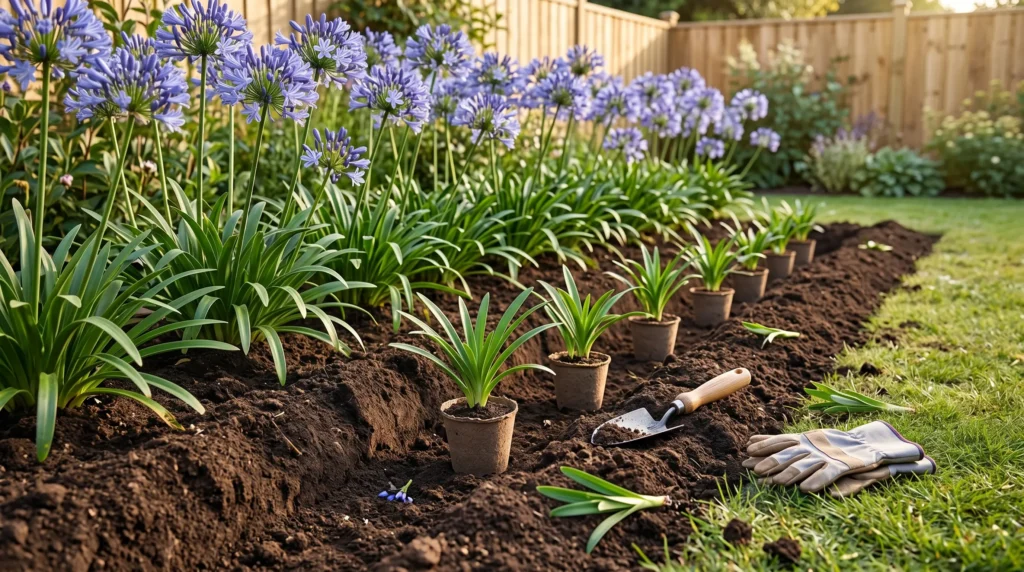
Step 1 — Prepare and rehydrate the roots Place bare roots in a bucket of water and soak for 1–2 hours before planting. The fleshy roots are often partially dehydrated in transit; soaking rehydrates them and helps them establish faster. Do not soak for longer than 3 hours.
Step 2 — Prepare the planting area Dig the planting area to one spade’s depth. If the soil is heavy clay, fork in horticultural grit across the whole area — not just the planting hole — to improve drainage. Level the surface.
Step 3 — Dig the planting hole Dig a hole wide enough to accommodate the roots spread naturally without bending or forcing. The hole depth should allow the growing tip (nose) of the rhizome to sit 5–10 cm below the soil surface. Too deep = delayed flowering. Too shallow = frost damage in winter.
Step 4 — Position the rhizome Place the rhizome with the growing tip pointing upward and the roots spread downward in a natural fan. The nose of the rhizome should be 5–10 cm below the surface.
Step 5 — Space correctly Space plants 30 cm apart. Agapanthus clumps spread slowly over years; this spacing allows room without overcrowding.
Step 6 — Backfill and firm Fill the hole with improved soil (original soil mixed with grit and a little compost), firming gently around the roots as you go to eliminate air pockets. Do not compact the soil aggressively.
Step 7 — Water in thoroughly Water the planted area deeply, ensuring water reaches the root zone. The first watering is important for root-to-soil contact.
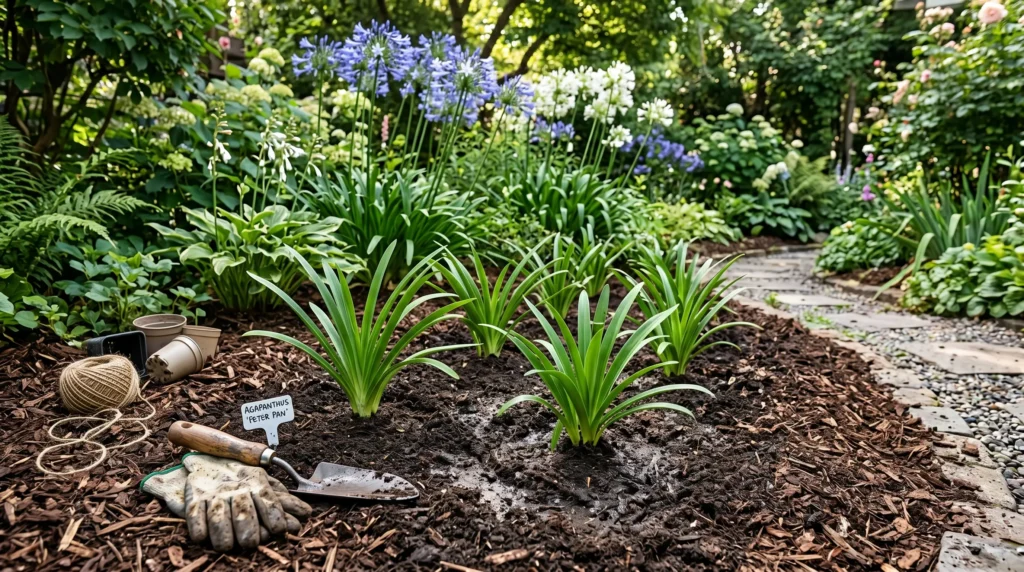
Step 8 — Label immediately Write the variety name and the type (deciduous/evergreen) on a plant label and insert it next to the plant. This information is essential for correct winter care decisions — especially if you have multiple varieties in the same border.
Method B: Planting Potted Agapanthus in the Ground
Use this method for container-grown plants bought from a nursery or garden centre.
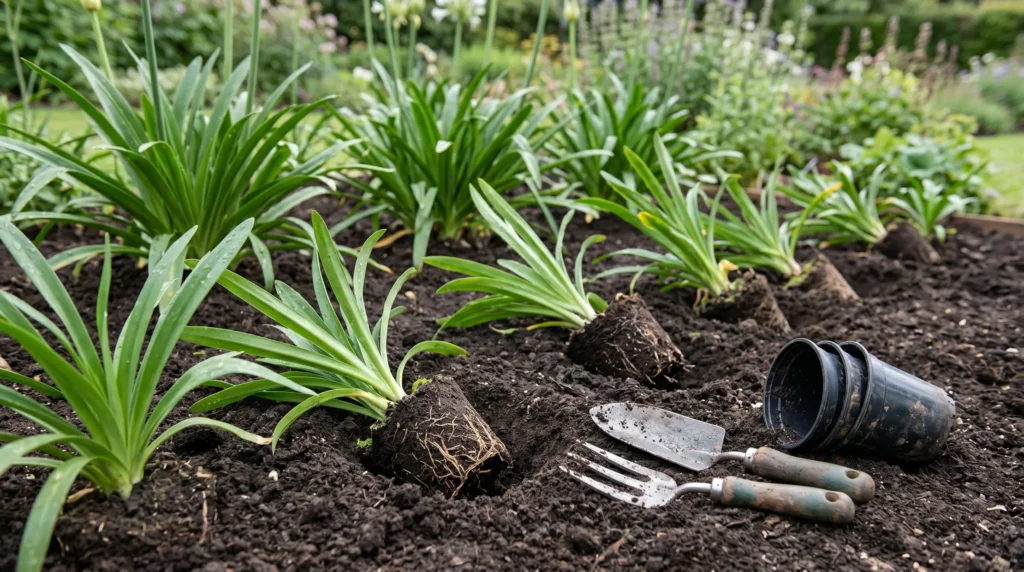
Step 1 — Water the pot Water the potted plant thoroughly at least one hour before planting. A dry root ball shrinks away from the pot walls and is harder to handle.
Step 2 — Dig the hole Dig a hole the same depth as the pot and slightly wider. This prevents the plant from sitting in a sunken pocket that collects water.
Step 3 — Remove from the pot Tip the pot gently and ease the root ball out. Do not pull the plant by its stems. If roots have circled the bottom of the pot, tease them out gently to encourage outward growth.
Step 4 — Check and match the depth Lower the root ball into the hole and ensure the top of the root ball sits level with the surrounding soil surface. Never plant deeper than the original pot depth — burying the crown causes rotting.
Step 5 — Backfill and firm Fill around the root ball with soil, firming gently but not aggressively. Ensure no air pockets remain.
Step 6 — Water in and mulch Water deeply. Apply a 5 cm layer of bark chip mulch around the base, keeping it 5–10 cm clear of the crown itself.
Method C: Planting Agapanthus in Containers
Use this method for patio containers, for tender evergreen types, or for maximising flowering through root restriction.
The single most important rule for container agapanthus: Choose a pot that is only slightly larger than the root ball. Agapanthus flowers best when its roots are slightly restricted — this counterintuitive fact is the key to reliable container flowering.
Step 1 — Choose the right pot
| Pot Factor | Recommendation | Why |
|---|---|---|
| Diameter | 30–35 cm for one plant; up to 45 cm for a multi-plant grouping | Too large = vegetative growth, no flowers |
| Material | Terracotta or heavy stone preferred; plastic acceptable | Terracotta breathes and drains better; weight prevents toppling |
| Drainage holes | Essential — multiple holes preferred | Agapanthus dies in waterlogged compost |
| Depth | At least 30 cm | Root system needs adequate depth |
Step 2 — Prepare drainage layer Place a 3–5 cm layer of crocks (broken pot pieces) or large stones over the drainage holes. Do not use fine gravel — it blocks drainage rather than improving it. Never use saucers that collect water permanently under the pot.
Step 3 — Mix and add compost Mix your compost: 80% John Innes No. 2 or No. 3 (peat-free) + 20% horticultural grit. Add enough to the pot so the rhizome nose will sit 2–5 cm below the finished compost surface.
Step 4 — Position the rhizome Place the rhizome with its nose upward and roots spread naturally. Cover with the remaining compost mix so the nose is 2–3 cm below the surface. The crown should be just barely covered — not buried deeply.
Step 5 — Firm lightly and water Press the compost gently around the roots. Water thoroughly until water drains freely from the drainage holes. Do not water again until the top 3 cm of compost feels dry.
Step 6 — Position in full sun Place the container in the sunniest available spot. South- or west-facing is ideal. Do not move into shade even temporarily during the growing season — every day in shade costs flowering potential.
The root-bound flowering secret: explained
Why do agapanthus flower better when pot-bound?
Agapanthus — like many plants — enters reproductive mode (flower production) when it experiences mild environmental stress. When roots have filled a pot and have nowhere further to go, the plant receives a hormonal signal that resources are limited.
Its strategy switches from building more foliage and roots (vegetative growth) to producing seeds (flowers). This is an evolutionary survival response.
In practical terms: a plant in a pot that is too large spends years filling the pot with roots before it reaches the reproductive trigger. A plant in a snug pot reaches that trigger quickly and flowers reliably from its second or third season.
The practical rule: Repot agapanthus only when it is clearly pot-bound — roots pushing through drainage holes, plant wilting despite regular watering, or very slow growth despite good conditions. At that point, move into a pot 5 cm wider — no more. Repot in spring, using fresh compost mix.
Ongoing Care — Watering, Feeding, and Maintenance
Watering: the seasonal schedule
Q: How often should I water agapanthus in the UK?
Answer: Water frequently during the first growing season to establish the plant. Established border plants need watering only during prolonged dry spells. Container plants need consistent watering throughout May–September — check every 2–3 days in warm weather. Reduce watering to near zero for both deciduous and evergreen types from October through February.
For gardeners building a full wildlife-friendly garden — where agapanthus provides late-summer pollinator support in the border — our complete guide to UK pond plants shows how to extend that habitat value with a wildlife pond, attracting frogs, dragonflies, and a further 100+ invertebrate species.
| Growing Stage | Border Plants | Container Plants |
|---|---|---|
| Year 1 (establishing) | Water every 5–7 days May–Sep | Check every 2–3 days; water when top 3 cm is dry |
| Established (Year 2+) | Water during prolonged dry spells only | Water consistently May–Sep; reduce in Aug to prompt flowering |
| Late summer (Aug–Sep) | Water if dry — critical for next year’s flower buds | Continue regular watering through September |
| Autumn–winter | None needed | Minimal; just prevent complete drying |
Critical watering rules:
- Overwatering is more damaging than underwatering — root rot kills faster than drought
- Late summer watering matters more than you might think: the flower buds for the following year are initiated in late summer while the plant is still actively growing
- Never let containers sit in standing water — empty saucers after rai
Feeding: the high-potash principle
Q: What is the best fertiliser for agapanthus in the UK?
The best fertiliser for agapanthus is a high-potassium (high-potash) liquid feed, applied fortnightly from April to July for container plants, and once or twice in spring for border plants. Tomato feed is ideal and cost-effective. Avoid high-nitrogen fertilisers, which produce lush foliage at the expense of flowers.
Why high-potash?
Potassium (K) is the nutrient most directly linked to flower production in agapanthus. High-nitrogen feeds (most general-purpose fertilisers and lawn feeds) promote vegetative growth — more leaves, larger clumps — but suppress the hormonal trigger for flowering. Switching from a balanced feed to a high-potash feed is the single most effective change most gardeners can make to improve agapanthus flowering.
Feeding schedule:
| Plant Type | Fertiliser | Frequency | Season |
|---|---|---|---|
| Container plants | High-potash liquid (e.g. Tomorite tomato feed) | Every 2 weeks | April–July |
| Border plants | Balanced granular or high-potash liquid | Once in spring | March–April |
| Non-flowering plants | High-potash liquid feed | Weekly | April–September |
| All types | Nothing | Stop feeding | August–March |
What NOT to feed agapanthus:
- High-nitrogen fertilisers (general-purpose, lawn feed, growmore)
- Feeding in autumn or winter
- Over-feeding — more is not better; excess feeding causes salt build-up in container compost
Deadheading, pruning and foliage management
Remove spent flower stems by cutting them at the base of the stem, as close to the foliage as possible. This keeps the plant looking tidy and prevents it from directing energy into seed production. However, you can choose to leave some seedheads — the swelling, globe-shaped heads become architecturally striking through autumn and into winter, providing structure and interest when little else is growing.
Foliage rules — deciduous varieties:
- Never cut back green foliage on deciduous agapanthus
- The leaves are actively photosynthesising and storing energy in the rhizome for next year’s flowers
- Remove foliage only once it has fully yellowed and died back naturally — typically November to December in most of the UK
- Cut back dead foliage to 5–10 cm above soil level
Foliage rules — evergreen varieties:
- Remove damaged, yellowing, or tatty leaves at any time throughout the year
- Do not cut back healthy green foliage
- Evergreen foliage is thinner and more strap-like than deciduous types; handle carefully to avoid bruising
Mulching: the protective layer
Apply a 7–10 cm layer of mulch around the base of agapanthus plants every autumn, ideally in October before the first frosts. Use bark chip, straw, dried bracken, or well-rotted compost.
Mulch does three things for agapanthus:
- Insulates the crown — provides several degrees of additional frost protection
- Retains moisture — reduces summer drought stress
- Suppresses weeds — reduces competition for nutrients
Critical rule: Keep mulch 5–10 cm clear of the crown. Mulch pressed against the crown holds moisture against the rhizome and causes rotting — precisely the opposite of the protection intended.
Overwintering Agapanthus in the UK — Region-by-Region Guide
Q: Can I leave agapanthus in the ground over winter in the UK?
Hardy deciduous varieties can stay in the ground throughout the UK with a 7–10 cm crown mulch. In Northern England and Scotland, also add a layer of horticultural fleece for additional protection. Evergreen varieties must be moved to a frost-free location before the first frosts in most of the UK. The ideal storage temperature for all overwintering agapanthus is 0–5°C.
The key overwintering principle
Temperature is the critical variable — not simply frost vs no frost.
Many UK gardeners focus on protecting agapanthus from frost, but the storage temperature during the dormant period matters equally for the following year’s flowering performance:
- Too cold (below −10°C for deciduous, below −5°C for evergreen): plant damage or death
- Too warm (above 10°C): the plant does not complete proper dormancy; the following summer’s flowering is reduced
- Optimal winter temperature: 0–5°C — cold enough for proper dormancy, but above damaging frost
This is why storing tender agapanthus in a warm, heated room or kitchen conservatory is counterproductive — the plants need cold dormancy, not warmth.
Overwintering: deciduous varieties in open ground
- Allow foliage to yellow and die back naturally — do not cut back green leaves
- Once foliage is fully dead, cut back to 5–10 cm above soil level
- Apply a 7–10 cm mulch of bark chip or straw over the crown area
- In cold or exposed positions: lay horticultural fleece over the mulch and pin down with landscape pins or stones
- Leave undisturbed until new growth appears in April–May
- Remove the mulch layer in March to allow the crown to warm up and encourage earlier growth
Overwintering: deciduous varieties in containers
- Allow foliage to die back naturally
- Move pot to a sheltered location: against a south-facing wall, into an unheated greenhouse, or a cool garage with a window
- Reduce watering to near zero — dormant deciduous roots need minimal moisture
- Wrap the pot in two layers of bubble wrap or hessian to prevent the root ball freezing solid
- The temperature in the storage location should stay around 0–5°C
- In March, gradually bring back into light and begin watering lightly; harden off over 7–10 days before moving back to full outdoor position
Overwintering: evergreen varieties in containers
- Move indoors before the first hard frost — typically early to mid-October across most of the UK
- Best location: unheated greenhouse (ideal), cool conservatory, frost-free garage with a bright window
- Temperature: 0–5°C and bright — warmth and darkness both reduce next year’s flowering
- Water very sparingly — just enough to prevent the compost from drying completely; roughly once every 3–4 weeks
- Do not feed during winter
- Begin bringing back into light and warmth gradually from late March; move outdoors after the last frost date for your region
UK Region-by-Region Overwintering Reference
| UK Region | Avg Last Frost | Deciduous (In-Ground) | Deciduous (Container) | Evergreen (Container) |
|---|---|---|---|---|
| Cornwall / SW Devon / Channel Islands | Late Feb–early Mar | Mulch optional; fleece rarely needed | Shelter against wall; minimal wrapping | Bring in by late October; unheated greenhouse ideal |
| South Wales coast / SW England | March | 7 cm mulch; fleece in cold winters | Move to sheltered wall; wrap pot | Bring in by mid-October |
| South East / London | Mid-April | 7–10 cm mulch; fleece in cold snaps | Move to sheltered spot; wrap pot | Bring in early October |
| Midlands | Late April | 10 cm mulch essential; fleece strongly recommended | Unheated greenhouse or sheltered garage | Bring in September–October |
| North England (Manchester, Leeds, Newcastle) | Late April–early May | Thick mulch + fleece; consider lifting in severe winters | Unheated greenhouse essential | Bring in September; greenhouse required |
| Scotland (lowlands) | Mid-May | Hardiest deciduous only (H5); thick mulch + fleece; be prepared to lift | Unheated greenhouse essential | Not recommended outdoors; greenhouse required |
| Scotland (highlands / exposed) | Late May–June | H5 varieties only; expect to lift most years | Frost-free greenhouse required | Not suitable |
Why Isn’t My Agapanthus Flowering? — Complete Diagnostic Guide
Q: Why is my agapanthus not flowering?
The most common reasons agapanthus fails to flower in UK gardens are: insufficient sunlight (fewer than 6 hours per day), a pot that is too large, overwatering, high-nitrogen fertiliser, poor winter conditions, a plant that is too young, or overcrowded roots that need dividing. The fix depends on identifying the correct cause.
Diagnostic guide: 7 causes and their solutions
Cause 1: Not enough sunlight
- How to identify: The plant produces healthy green leaves but no flower stems. The border or container position is in partial or full shade for significant portions of the day.
- Solution: Move the container to a south-facing position. In a border, cut back or remove overhanging plants. Agapanthus needs a minimum of 6 hours of direct sun per day — this is non-negotiable.
- Timeline for results: If moved to full sun, flowering should improve within the same season (if early enough) or the following year.
Cause 2: Pot too large
- How to identify: The plant is in a container with substantial space around the root ball. Lush, vigorous foliage but no flowers. Often occurs when a plant has been re-potted into too generous a container.
- Solution: Move into a smaller pot — ideally one that the root ball fills snugly with only 2–3 cm of compost around the edges. Alternatively, divide the plant and repot each division tightly.
- Timeline for results: Flowering typically returns within 1–2 growing seasons.
Cause 3: Overwatering or waterlogging
- How to identify: Yellowing foliage; mushy or soft rhizomes at soil level; water sitting on the surface rather than draining; persistent damp compost.
- Solution: Check drainage — lift the pot and ensure holes are not blocked. Add grit to the compost. Reduce watering frequency. If root rot has set in, remove the plant, cut away any black or mushy root material with a clean knife, allow to dry for a day, and repot in fresh, gritty compost.
- Timeline for results: A recovered plant may take a full season to return to full flowering.
Cause 4: Wrong fertiliser — too much nitrogen
- How to identify: Exceptional foliage growth — large, dark green, lush leaves — but no flower stems. Often accompanies use of general-purpose, balanced, or lawn-type fertilisers.
- Solution: Stop all feeding immediately. From the following April, switch exclusively to high-potash liquid feed (tomato feed) applied fortnightly. Do not feed with anything else.
- Timeline for results: Flowering usually improves within the same season if caught early, or the following year if the switch is made late.
Cause 5: Poor winter conditions
- How to identify: Plant was stored in a heated room, warm conservatory, or bright sunny windowsill over winter. Or alternatively — plant suffered frost damage, producing distorted or discoloured new growth in spring.
- Solution: Store overwintering plants at 0–5°C in a bright but unheated location. Frost-damaged rhizomes may take a full season to recover; protect more carefully the following winter.
- Timeline for results: Flowering improves the season following corrected winter storage.
Cause 6: Plant is too young
- How to identify: Plant was grown from seed, or was recently divided from a parent clump, or was purchased as a very small plant.
- Solution: Patience. Ensure all other conditions are correct (sun, gritty compost, high-potash feed, correct pot size). Seed-grown agapanthus typically takes 3–4 years to flower. Division-grown plants usually flower within 2 seasons.
- Timeline for results: Cannot be accelerated beyond the plant’s natural development cycle.
Cause 7: Overcrowded clump needs dividing
- How to identify: An old, established border plant that previously flowered well but has gradually reduced flowering over several years. The clump is very large, the centre may appear dead or hollow, and the foliage at the edges is more vigorous than in the centre.
- Solution: Lift and divide in March–April (see Section 13).
- Timeline for results: Divided plants typically resume flowering within 1–2 seasons.
The emergency fix for stubbornly non-flowering border agapanthus
If an established border agapanthus refuses to flower despite correct sun, feeding, and care, try this proven technique:
- Dig up the entire clump in March–April
- Divide it into sections, each with 2–3 growing crowns
- Pot each division into a snug container (30–35 cm diameter) using gritty John Innes No. 2
- Place in the sunniest available position
- Feed fortnightly with tomato feed from April
- Within 1–2 seasons, the mild root restriction of the pot typically triggers reliable flowering
The logic: the combination of root restriction, full sun, and correct feeding replicates the conditions that prompt agapanthus to produce flowers rather than vegetation.
Pests, Diseases and Common Problems
Q: What are the most common problems affecting agapanthus in UK gardens?
The five most significant problems for UK agapanthus are: agapanthus gall midge (a UK-specific pest first identified in 2014), vine weevil (particularly in containers), root rot (from waterlogging), failure to flower (environmental — see Section 10), and winter frost damage (variety or protection mismatch). Most problems are preventable with correct growing conditions.
Agapanthus Gall Midge — the UK-specific threat
What is agapanthus gall midge?
Agapanthus gall midge (Enigmadiplosis agapanthi) is a small fly whose larvae feed inside developing agapanthus flower buds. It was first confirmed in the UK in 2014 and has since spread through much of southern and central England. It is the most significant disease-like problem specific to UK-grown agapanthus.
How to identify gall midge:
| Sign | What It Means |
|---|---|
| Buds develop but fail to open | Early sign of infestation |
| Buds appear distorted, misshapen, discoloured | Larvae feeding inside |
| Opening a bud reveals creamy-white or orange maggots | Confirmed gall midge |
| Entire flower head collapses without opening | Severe infestation |
| Foliage remains healthy | Distinguishes gall midge from non-flowering (which has no buds) |
Active season: Mid-June through early October; multiple overlapping generations are possible in one season.
Management (there is no effective chemical treatment):
- Remove and immediately destroy all affected flower heads — do not compost
- Repot container plants each spring in fresh compost to remove larvae that pupate in the soil
- Move containers to a different position each year — interrupts the gall midge’s ability to re-infest the same plant
- Consider netting susceptible plants with fine mesh from June (impractical for large border plants; more feasible for pots)
Distinguishing gall midge from non-flowering:
- Gall midge: buds develop, appear deformed, fail to open; maggots visible inside
- Non-flowering: no buds develop at all (environmental causes)
Problem 2: Vine Weevil
Vine weevil (Otiorhynchus sulcatus) is the most destructive pest of container-grown plants in UK gardens, and agapanthus is a frequent victim.
Life cycle relevant to agapanthus: Adult weevils lay eggs in compost in summer. Larvae (white, C-shaped grubs, up to 1 cm long) feed on roots from late summer through winter. The first obvious sign is often a plant that collapses suddenly in spring — the roots have been destroyed during the previous autumn and winter.
Prevention and treatment:
- Apply a biological nematode drench (Steinernema kraussei) to container compost in August–September, when soil temperature exceeds 12°C — the most effective treatment
- Check root balls when repotting: remove and destroy any white C-shaped grubs found in the compost
- Consider vine weevil-specific compost treatments (imidacloprid-containing products where legally permitted)
Problem 3: Root Rot
Root rot is caused by prolonged waterlogging — either in poorly drained border soil or in containers that cannot drain freely.
Prevention:
- Ensure drainage holes are unobstructed at all times
- Add 20% grit to container compost
- Never let pots sit in standing water
- Improve border drainage with grit before planting
Treatment: Lift the plant; cut away all black, mushy, or foul-smelling root material with a clean knife. Allow the rhizome to dry in a cool, airy place for 24 hours. Repot in fresh, gritty compost and do not water for several days.
Problem 4: Fungal diseases
Agapanthus can develop powdery mildew (white dusty coating on leaves in warm, dry conditions), grey mould/Botrytis (grey fuzzy growth on stems in wet conditions), and anthracnose (dark lesions on leaves) in poor conditions.
Prevention: Good air circulation around plants; avoid overhead watering; do not overwater; remove dead foliage promptly.
Treatment: Remove affected plant material. Apply a copper-based fungicide or organic sulphur spray for powdery mildew in severe cases.
Problem 5: Red Spider Mite and Mealybug
Both are more common on agapanthus overwintered indoors or in greenhouses.
- Red spider mite: Fine webbing under leaves; leaves develop a speckled, bronze appearance. Increase humidity; apply predatory mites (Phytoseiulus persimilis) as a biological control.
- Mealybug: White fluffy colonies in leaf axils and on stems. Wipe off with a cotton bud dipped in methylated spirits; apply neem oil spray as a follow-up.
Propagating Agapanthus — Growing More Plants for Free
Q: How do you propagate agapanthus?
Answer: The best method for propagating agapanthus is division — splitting established clumps in March–April before the growing season begins. Each division must have at least 2–3 growing points and a good root system. Agapanthus can also be grown from seed, but seed-grown plants do not come true to the parent variety and take 3–4 years to flower.
Method 1: Division (recommended)
Best time: Late March to April, before the plant comes into active growth. Early autumn (September) is a secondary option for mild gardens.
Step-by-step division guide:
- Water the plant thoroughly the day before dividing — moist roots are more pliable and less prone to damage
- For border plants: lift the entire clump using a garden fork; work around the outside of the clump and lever upward to avoid severing roots
- Shake off excess soil to reveal the root structure clearly
- For small clumps: use two garden forks inserted back-to-back and lever apart
- For large, mature clumps: use a sharp spade to cut through the clump
- Inspect each division: each piece must have at least 2–3 visible growing crowns (the white or pale growing tips) and a healthy root system
- Trim any damaged or obviously dead roots cleanly with a sharp knife
- Replant divisions immediately at the same depth as the parent plant — do not allow roots to dry out
- Water in thoroughly and mulch around the base
Important: Do not divide plants more frequently than every 3–5 years. Agapanthus performs better with some age and established root systems — frequent division reduces flowering for several seasons.
Expectations: Freshly divided plants may not flower in their first season. This is normal — the plant needs one full growing season to re-establish before redirecting energy to flowers.
Method 2: Growing from seed
Collect seed: Seedheads ripen and split open in September–October. Collect seeds before the heads fully open.
Sow: Into pots of moist, free-draining seed compost. Place in a cool, frost-free location (an unheated greenhouse or cool porch). Do not cover with a propagator lid — agapanthus seeds do not need warmth or high humidity to germinate.
Germination: Spring, when temperatures begin to rise naturally.
Critical caveat: Seed-grown agapanthus do not come true to type. Most agapanthus cross-pollinate freely with other varieties growing nearby, producing offspring with unpredictable flower colour, height, and form. If you want to replicate a specific named variety, divide it — do not grow from seed.
Time to first flower: 3–4 years from seed under ideal conditions.
Best use case: Growing from seed is suitable for gardeners who want to experiment with new colour combinations or produce large numbers of plants at low cost, accepting that the results will be varied.
Is Agapanthus Toxic? — Pet and Human Safety Guide
Q: Is agapanthus toxic to dogs, cats, and humans?
Answer: Yes — agapanthus is mildly toxic to humans, dogs, and cats. All parts of the plant contain saponins, compounds that cause gastrointestinal irritation if eaten. The roots and sap are the most concentrated sources. The sap can also cause skin and mouth irritation. Agapanthus is not fatally toxic in normal garden exposure but warrants caution, particularly around cats and small children. Wear gloves when handling the plant.
Toxicity by species
| Species | Risk Level | Primary Concern | Symptoms |
|---|---|---|---|
| Humans (adults) | Low | Sap contact; unlikely to ingest | Skin irritation, rash from sap; GI upset if eaten in quantity |
| Children | Moderate | May handle rhizomes; bitter taste deters ingestion | GI irritation; mouth soreness from sap |
| Dogs | Low–Moderate | Would need to eat significant quantity; bitter taste deters | Nausea, vomiting, diarrhoea |
| Cats | Moderate | Smaller body weight = greater vulnerability; kittens at higher risk | GI symptoms; skin/mouth irritation from sap |
| Rabbits / small pets | Moderate | Rhizomes particularly toxic to small mammals | GI distress; seek vet advice |
What makes agapanthus toxic?
Agapanthus contains saponins — naturally occurring glycoside compounds found throughout the plant but concentrated in the rhizomes, roots, and sap. Saponins irritate mucous membranes and the gastrointestinal lining when ingested. They can also cause skin irritation and rash when the sap contacts exposed skin.
Practical safety guidance
For households with pets:
- Plant agapanthus in areas inaccessible to dogs and cats — raised beds, walled areas, or high containers
- When handling bare roots or freshly lifted rhizomes, keep pets indoors — the exposed roots release more sap
- If your cat has access to container-grown agapanthus, monitor for signs of nibbling
For households with small children:
- Wear gloves when planting, dividing, or handling agapanthus — particularly when working with bare rhizomes
- Wash hands thoroughly after handling any part of the plant
- The plant’s natural bitterness usually deters ingestion, but supervise young children around freshly lifted roots
If you suspect ingestion:
- Humans: rinse mouth with water; contact NHS 111 or a doctor if symptoms develop
- Pets: contact your veterinarian immediately; note the plant name (agapanthus / African lily)
For skin contact with sap:
- Wash the affected area with soap and water immediately
- Apply a soothing cream if irritation persists
- Avoid rubbing eyes after handling — the sap causes significant eye irritation
Garden Design — Using Agapanthus for Maximum Visual Impact
Q: What plants grow well with agapanthus?
Answer: The best companion plants for agapanthus in UK gardens are those sharing the same growing requirements — full sun and well-drained soil. Lavender, Salvia, Stipa tenuissima, Echinacea, Rudbeckia, and ornamental alliums all make excellent companions. Agapanthus also pairs beautifully with ornamental grasses for textural contrast.
If you want to maximise late-summer pollinator activity alongside your agapanthus, see our full guide to growing Musk Mallow in UK gardens — it flowers at the same time, shares identical site requirements, and attracts bumblebees, hoverflies, and three species of UK caterpillar.
Best companion plants
| Companion | Why It Works | Design Effect |
|---|---|---|
| Lavender | Identical growing conditions; flowering period overlaps in July | Blue-on-blue/purple; classic Mediterranean combination |
| Stipa tenuissima (Mexican feather grass) | Same sun/drainage needs; graceful movement | Wispy, airy texture contrasts with bold agapanthus globes |
| Echinacea (coneflower) | Flowers simultaneously; drought-tolerant | Warm pink/orange tones against cool blue agapanthus |
| Rudbeckia (black-eyed Susan) | Midsummer to autumn flowering; sunny position | Yellow/gold warmth against deep blue — dramatic contrast |
| Alliums | Successive flowering; identical site requirements | Spring drumstick heads followed by agapanthus later in summer |
| Salvia nemorosa | Same cultural requirements; vertical flower spikes | Spikes contrast with round agapanthus heads; blue-purple harmony |
| Eryngium (sea holly) | Drought-tolerant; thrives in similar conditions | Metallic blue-silver beside deep blue agapanthus — sculptural pair |
| Pennisetum / Calamagrostis (ornamental grasses) | Similar cultural needs; late season interest | Movement and soft texture alongside architectural agapanthus |
Planting schemes by garden style
Coastal garden (Cornwall, Devon, Welsh coast): Use agapanthus as the anchor plant in a naturalistic coastal border. Combine with sea holly (Eryngium), ornamental grasses, Crocosmia ‘Lucifer’, and Libertia grandiflora. The salt-spray tolerance and drought resilience of all these plants make them ideal companions in exposed positions. Allow plants to drift informally rather than planting in straight lines.
Gravel / Mediterranean garden: Group agapanthus in bold drifts of 5–7 plants, mixing ‘Windsor Grey’ and a deep blue deciduous variety for tonal contrast. Underplant with lavender, Achillea, and Sedum for ground-level coverage. A mulch of pale limestone gravel reflects heat and light, benefiting all Mediterranean-style plants.
Traditional herbaceous border: Position tall varieties (‘Blue Giant’, ‘Windsor Grey’) in the middle to back, behind mound-forming plants like catmint or hardy Geranium. Use shorter varieties (‘Lilliput’, ‘Exmoor’) toward the front. The strong vertical form of agapanthus stems creates contrast with the more relaxed forms of typical border perennials.
Patio container grouping: Create a statement display with three containers of graduated heights. Plant the tallest with ‘Blue Giant’, the mid-height with a blue/white mix, and the lowest with ‘Lilliput’. All three pots can be moved indoors for winter if using evergreen varieties, or simply mulched in place if using deciduous types.
Agapanthus for wildlife
Agapanthus is a valuable pollinator plant for UK gardens, particularly from July onward when many earlier-flowering plants have finished.
Pollinators attracted: Bumblebees are particularly frequent visitors, drawn to the individual trumpet-shaped flowers within each umbel. Honeybees, solitary bees, and some hoverflies also visit regularly. In hot summers, the flowers attract butterflies.
Seedheads: Leaving seedheads standing through autumn and winter provides architectural structure and can provide seeds for some birds. The globe-shaped dried heads are visually striking when covered in frost or dewdrops.
Not invasive in the UK: Unlike in some warmer countries (notably Australia and New Zealand, where some species are classified as invasive), agapanthus does not self-seed prolifically enough in the UK climate to cause ecological concerns. UK winters prevent the kind of rampant self-seeding that occurs in subtropical conditions.
Month-by-Month Agapanthus Care Calendar for UK Gardeners
Save this calendar for reference throughout the year. No competitor guide provides a monthly breakdown.
| Month | Priority Tasks | Notes |
|---|---|---|
| January | Check overwintering plants in greenhouse/shed; water evergreens very sparingly (once every 3–4 weeks); inspect for mealybug, red spider mite, and rot | Do nothing to outdoor deciduous plants; they are dormant |
| February | Continue monitoring stored plants; begin planning border positions for new plants; order bare-root plants from specialist nurseries | Good time to research varieties and place orders before popular types sell out |
| March | Begin hardening off container plants mid-month; divide established clumps in the last week of March; plant bare roots from late March in mild southern gardens | Hardening off: move pots outdoors for increasing periods each day over 7–10 days |
| April | Main planting month — plant bare roots and rhizomes throughout April; pot up container plants; begin feeding with high-potash liquid fertiliser at month’s end; start watering more regularly | Never plant into cold, wet soil — wait for sustained mild weather |
| May | Move containers back outdoors after local last-frost date; begin regular watering as growth accelerates; continue fortnightly high-potash feeding; watch for first signs of gall midge | Emerging flower stems are vulnerable to late frost — keep fleece to hand |
| June | Water and feed consistently; flower buds should be clearly developing by mid-June; monitor containers for vine weevil damage; remove any gall midge-affected buds immediately and destroy | Do not compost gall midge-damaged buds — bin them to prevent spreading |
| July | Peak flowering month; deadhead as individual flower heads fade; continue fortnightly high-potash feeding; water consistently especially in heat waves | The peak display — enjoy the flowers while continuing care |
| August | Continued flowering and deadheading; critically important month for watering and feeding — late summer care directly influences next year’s flower bud initiation; apply vine weevil nematodes if grubs suspected | Do not stop feeding yet — August care matters for 2026 performance |
| September | Flowering winds down; stop high-potash feeding; begin reducing watering; leave seedheads for winter interest or collect seed for propagation; begin planning which container plants need bringing in | Move evergreen container plants indoors by the end of September in northern gardens |
| October | Move all tender evergreen container plants indoors before first frosts; apply 7–10 cm mulch to border deciduous plants; significantly reduce watering; note any vine weevil damage for next year | First frosts typically arrive by mid-October in the Midlands and North |
| November | Complete mulching; wrap container pot balls in bubble wrap; cut back deciduous foliage once it has fully died and yellowed; check greenhouse or shed stores are at correct temperature (0–5°C) | Do not cut back foliage that is still partially green |
| December | Minimal intervention; check overwintering plants monthly for signs of rot, frost damage, or pest activity; enjoy the architectural dried seedheads in the garden | The quietest month — keep storage conditions stable |
Frequently Asked Questions — FAQ Schema
These questions and answers are formatted for FAQ schema markup. Each answer is self-contained and directly quotable.
Q: When is the best time to plant agapanthus in the UK?
A: The best time to plant agapanthus in the UK is March to May. Bare roots and rhizomes should go in the ground from late March through April, once soil temperature has risen above 10°C. Potted agapanthus plants can be planted any time from April through August. Avoid planting into cold, wet, or frozen ground. In northern regions, wait until May to be safe with bare roots.
Q: Are agapanthus hardy in the UK?
A: It depends on the variety. Deciduous agapanthus are reliably hardy throughout most of the UK, surviving temperatures as low as −10°C when given a 7–10 cm crown mulch for winter. They are suitable for open ground in all but the most exposed Scottish and upland locations. Evergreen agapanthus are frost-tender, surviving only to −5°C, and must be moved into a frost-free location for winter in most UK gardens.
Q: Why is my agapanthus not flowering?
A: The seven most common causes are: insufficient sun (less than 6 hours per day), a pot that is too large, overwatering or waterlogging, high-nitrogen fertiliser, poor winter storage conditions, a plant that is too young (under 2–3 years old), or an overcrowded clump that needs dividing. The most common fixes are: move to full sun, switch to high-potash feed (tomato feed), and ensure container plants are slightly root-bound rather than in oversized pots.
Q: Can I leave agapanthus in the ground over winter in the UK?
A: Hardy deciduous varieties can be left in the ground across most of the UK. Apply a 7–10 cm layer of bark chip or straw over the crown before the first frosts, and add a layer of horticultural fleece in northern regions or exposed gardens. Evergreen varieties must be lifted and moved to a frost-free greenhouse or shed before the first frosts — typically by early October in the Midlands, late September in northern England and Scotland.
Q: Do agapanthus grow well in pots?
A: Yes — agapanthus thrives in containers and often flowers more reliably in pots than in borders. This is because a slightly root-bound container triggers the plant’s reproductive response, encouraging flower rather than foliage production. Use John Innes No. 2 or No. 3 compost (peat-free, loam-based) mixed with 20% horticultural grit, choose a pot only slightly larger than the root ball, and feed fortnightly with high-potash liquid fertiliser from April through July.
Q: Is agapanthus toxic to dogs and cats?
A: Yes — agapanthus is mildly toxic to both dogs and cats. All parts of the plant contain saponins, which cause gastrointestinal irritation (nausea, vomiting, diarrhoea) if ingested. Cats are at slightly greater risk due to their smaller body weight. The sap can also cause skin and mouth irritation on contact. Wear gloves when handling the plant and keep pets away from freshly lifted rhizomes, which have the highest concentration of toxins. Contact your vet if you believe your pet has ingested agapanthus.
Q: What is the best fertiliser for agapanthus?
A: High-potassium (high-potash) liquid fertiliser is the best fertiliser for agapanthus. Tomato feed (such as Tomorite) is ideal — cost-effective and widely available in the UK. Apply fortnightly from April to July for container plants; once or twice in spring for border plants. Avoid high-nitrogen fertilisers (general-purpose, balanced, or lawn feeds), which produce lush foliage at the expense of flowers.
Q: How do I divide agapanthus?
A: Divide agapanthus in late March to April, before the growing season begins. Lift the entire clump with a garden fork and shake off excess soil. Split the root mass with two back-to-back garden forks or a sharp spade, ensuring each division has at least 2–3 growing crowns. Replant immediately at the same depth and water in well. Avoid dividing more frequently than every 3–5 years, as agapanthus performs better with some root maturity.
Q: How much sun does agapanthus need?
A: Agapanthus needs a minimum of 6 hours of direct sunlight per day to flower reliably. South- or west-facing positions are ideal. In partial shade — fewer than 4 hours of sun — the plant will produce healthy foliage but rarely flowers. Insufficient sunlight is the single most common cause of agapanthus failing to flower in UK gardens.
Q: What is agapanthus gall midge?
A: Agapanthus gall midge (Enigmadiplosis agapanthi) is a small fly whose larvae feed inside developing agapanthus flower buds, causing them to become deformed and fail to open. It was first identified in the UK in 2014 and is now widespread in southern and central England. There is no effective chemical treatment. Management involves removing and destroying all affected flower heads immediately, repotting containers in fresh compost each spring, and moving pots to different locations each year to interrupt the gall midge’s life cycle.
Conclusion: Starting Your Agapanthus Journey
Agapanthus rewards UK gardeners who take the time to understand one fundamental point: know whether your variety is hardy or tender, and everything else follows naturally.
Choose a deciduous variety for open-ground planting across most of the UK. Choose your position in full sun. Plant at the correct shallow depth. Keep container plants slightly pot-bound. Feed with tomato feed — not a general fertiliser. Overwinter at 0–5°C, not in a warm room.
Do all of that correctly, and agapanthus asks for remarkably little in return while delivering some of the most spectacular displays of any summer perennial. The tall, architectural stems. The globe-shaped flower heads in deep blue, pale lilac, or clean white. The weeks and weeks of colour from July through September, precisely when most borders have exhausted themselves.
Bookmark the month-by-month care calendar (Section 15) for year-round reference. If problems arise, the diagnostic guides in Sections 10 and 11 cover every common scenario. The variety table in Section 3 will help you make the right choice for your specific region and garden style.
All advice in this guide aligns with RHS growing guidance, specialist nursery recommendations from UK agapanthus growers, and the practical experience of gardening in the British climate. Where conditions vary by region, those variations are covered explicitly — because a garden in Cornwall and a garden in County Durham are not the same garden.
Related reading: Best Summer Border Plants UK | How to Create a Coastal Garden | Companion Planting for Late Summer Borders | How to Divide Perennials
Schema markup notes for implementation:
- Wrap full article in
Articleschema (datePublished, dateModified, author, headline) - Wrap Section 16 (FAQ) in
FAQPageschema with each Q&A asQuestion+acceptedAnswer - Wrap Section 7, Methods A, B, and C in
HowToschema (name, step, tool, supply) - Add
Tablestructured data markup to all comparison tables

Leave a Reply