
Aglaonema is the rare plant that looks after itself. Dark north-facing hallway? Green varieties thrive there. Centrally heated flat with radiators blasting from October? It copes. Prone to forgetting to water for three weeks? It survives.
It offers bold, sculptural foliage — from cool silver-green to vivid rose-pink — without demanding the bright windows and high humidity that defeat most tropical rivals.By the end of this guide, you will know every variety, every care requirement, every warning sign, and exactly where to buy one in the UK. This is the most comprehensive aglaonema resource written specifically for British plant owners — covering seasonal care, UK tap water, pest identification, pet safety, feng shui history, interior styling, and a complete propagation guide.
AGLAONEMA AT A GLANCE
- Common name: Chinese Evergreen, Philippine Evergreen
- Scientific name: Aglaonema spp. (genus of approximately 22 species)
- Family: Araceae (arum family)
- Origin: Tropical and subtropical forests of Southeast Asia
- Indoor height: 40–120 cm depending on variety
- Difficulty: Beginner to Advanced depending on variety (most are Beginner)
- Light: Low to bright indirect — dark green varieties tolerate near-shade
- Toxic: Yes — to cats, dogs, and humans (calcium oxalate crystals)
- Lifespan: 10+ years with proper care
What Is Aglaonema? Botanical Background and Cultural Story
Aglaonema is a genus of approximately 22 species of tropical evergreen perennials in the family Araceae — the same family as Monstera, Peace Lily, Philodendron, and Pothos. Native to the rainforest floors of Southeast Asia, aglaonemas have evolved over millions of years to thrive beneath dense forest canopies in deep, filtered shade — which explains their extraordinary low-light tolerance indoors.
Botanical Identity — The Science Behind the Plant
Aglaonema (noun): A genus of 22 tropical species in the family Araceae, native to Southeast Asia. The name derives from the Greek words ‘aglos’ (bright) and ‘nema’ (thread), a reference to the striking variegation patterns on the leaves. Grown worldwide as an indoor foliage plant for its tolerance of low light, low humidity, and intermittent watering.
| BOTANICAL FEATURE | DETAIL |
| Scientific name | Aglaonema spp. — genus of ~22 species; hundreds of cultivated varieties |
| Family | Araceae (arum family) — relatives include Monstera, Peace Lily, Philodendron, Pothos |
| Common names | Chinese Evergreen, Philippine Evergreen |
| Etymology | Greek ‘aglos’ (bright) + ‘nema’ (thread) — refers to the vivid leaf variegation |
| Native range | Tropical and subtropical forests of Thailand, Philippines, Indonesia, Malaysia, New Guinea |
| Natural habitat | Rainforest floor — grows in deep shade under large canopy trees (explains low-light tolerance) |
| Growth habit | Slow-growing, upright, evergreen perennial; clumping with multiple stems from base |
| Indoor height | 40–120 cm depending on variety and growing conditions |
| Lifespan | 10+ years as a houseplant with proper care |
| Difficulty rating | Beginner to Advanced — most common varieties are Beginner |
Q: What is an Aglaonema?
Aglaonema — commonly known as Chinese Evergreen — is a genus of approximately 22 species of tropical evergreen plants in the family Araceae, native to the rainforest floors of Southeast Asia. They are grown worldwide as indoor houseplants for their bold, patterned foliage and exceptional adaptability to low-light conditions. With hundreds of cultivated varieties ranging from dark green to vivid rose-pink, there is an aglaonema suited to almost every UK home. Most varieties are beginner-friendly and can live for 10 or more years indoors.
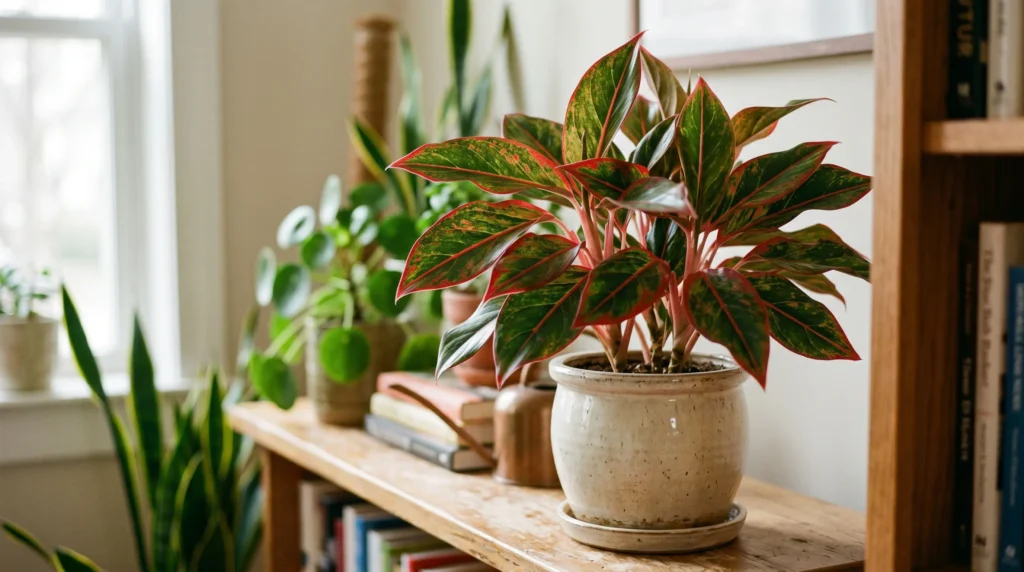
Cultural Significance, Symbolism and Feng Shui
Aglaonema has been cultivated for centuries across Asia not merely as a decorative plant, but as a living symbol of fortune, protection, and positive energy. This cultural dimension is absent from every major UK competitor article — and represents a significant reason why aglaonema resonates so deeply with buyers seeking plants that carry meaning, not just colour.
CULTURAL CONTEXT Aglaonema has been a revered household plant across Southeast Asia for centuries, long before it reached Western plant shops. Understanding its symbolic history helps explain why this genus carries such emotional significance for many buyers — and why mindful interiors increasingly feature it by name.
- Feng shui significance: Cultivated for centuries in China as a ‘happiness plant,’ aglaonema is among the most traditionally auspicious of all houseplants. It is believed to bring luck, prosperity, and positive energy (chi) into the home.
- Colour symbolism: Red and pink in the leaves symbolise warmth and a welcoming home. Silver and white tones represent prosperity and protection against poverty. Variegated patterns are associated with small daily pleasures and life’s abundance.
- Evergreen foliage: The perpetually green nature of the plant represents purity and enduring positive energy — it does not wilt or shed seasonally, reinforcing its association with constancy and strength.
- Thailand — ‘Sri Siam’: In some Thai regions, aglaonema is known as Sri Siam and is traditionally gifted at housewarming ceremonies to bring good fortune to the new occupants.
- Indonesia and Malaysia: Planted near homes as a protective barrier against negative energy and ill fortune. Associated with household harmony and domestic peace.
- Philippines: Used in traditional rituals intended to bring harmony and prosperity to the household.
- Modern feng shui placement: Near the main entrance (to welcome positive energy), in the southeast ‘wealth corner,’ or on work desks to attract focus, success, and financial prosperity.
- Biophilic design: The concept of shinrin-yoku — Japanese forest bathing — applied indoors. Research published by the UK’s Mental Health Foundation links houseplants to reduced anxiety and improved wellbeing. Aglaonema, with its lush tropical foliage, is particularly valued in mindful interior design.
Q: Is Aglaonema a feng shui plant?
Yes. Aglaonema has been cultivated for centuries across Asia as a feng shui plant, believed to attract good fortune, positive energy, and prosperity. The red and pink tones in colourful varieties symbolise warmth and welcome; the silver represents prosperity and protection. In modern feng shui practice, aglaonema is traditionally placed near the main entrance of a home or in the southeast ‘wealth corner.’ It is also gifted at housewarmings in Thailand (where it is known as Sri Siam) and used in traditional rituals in Indonesia, Malaysia, and the Philippines.
Aglaonema Varieties — The Complete UK Guide
With hundreds of cultivated varieties derived from approximately 22 species, choosing an aglaonema can feel overwhelming. This section groups every major UK-available variety by colour family, with a full comparison table and a placement guide matched to the most common UK room types.
The Golden Rule of Aglaonema Varieties
The Golden Rule: The lighter or more colourful the leaf, the more light the plant needs. Dark green varieties tolerate near-shade and are perfect for north-facing UK rooms. Bright pink, red, or orange varieties require bright indirect light. This single rule governs every placement decision for every aglaonema variety.
UK APPLICATION In a typical UK terrace or Victorian flat: north-facing rooms suit dark green and silver varieties (Maria, BJ Freeman, Silver Queen). East-facing rooms suit most varieties. South and west-facing rooms suit the colourful pinks and reds — but always with a sheer curtain to prevent direct summer sun scorching.
Complete Variety Comparison Table
| VARIETY | LEAF COLOUR | LIGHT NEEDS | MAX HEIGHT | DIFFICULTY | BEST FOR | UK AVAILABILITY |
| Aglaonema Maria | Dark green + silver chevrons | Low–medium | 40–50 cm | Beginner ★☆☆☆☆ | North-facing rooms, offices | Widely available |
| Aglaonema Silver Bay | Silver-green, green margins | Medium | 80–90 cm | Beginner ★☆☆☆☆ | Statement floor plant | Widely available |
| Aglaonema Silver Queen | Silver-green lance leaves | Low–medium | ~40 cm | Beginner ★☆☆☆☆ | Shelves, compact spaces | Widely available |
| Aglaonema Cutlass | Narrow silver-green blades | Low–medium | 40–50 cm | Beginner ★☆☆☆☆ | Minimalist interiors | Garden centres, online |
| Aglaonema BJ Freeman | Dark green + silver splatters | Low | 40–60 cm | Beginner ★☆☆☆☆ | Very dark spaces | Online specialists |
| Aglaonema Crete | Green + red/pink leaf edges | Medium–bright | 50–100 cm | Beginner–Int. ★★☆☆☆ | Colourful accent plant | Widely available |
| Aglaonema Red Valentine | Rose-pink + dark green blotches | Medium–bright | 50–80 cm | Intermediate ★★★☆☆ | Statement pieces | Garden centres, online |
| Aglaonema Red Star | Bright red, green margins | Bright indirect | 50–70 cm | Intermediate ★★★☆☆ | Bold colour impact | Online specialists |
| Aglaonema Orange Flame | Green + vivid orange veins | Bright indirect | 50–60 cm | Intermediate ★★★☆☆ | Colour collections | Online specialists |
| Aglaonema Cocomelon | Lime green + pink veins | Bright indirect | 40–60 cm | Intermediate ★★★☆☆ | Trending 2025–2026 | Online specialists |
| Aglaonema Pictum Tricolor | Camouflage: 3-tone green/silver | Medium–bright | 30–50 cm | Advanced ★★★★☆ | Collectors, rare finds | Specialist online only |
Which Variety Is Right for Your UK Home?
Choose your variety based on the light available in your intended room — not just the colour you want. Placing a pink or red variety in a dark north-facing room guarantees faded leaves, weak growth, and eventual reversion to plain green.
| YOUR UK ROOM | RECOMMENDED VARIETIES | AVOID |
| North-facing (very common in UK terraces) | Maria, Silver Bay, Silver Queen, BJ Freeman | Red Valentine, Red Star, Cocomelon, Orange Flame |
| East-facing (ideal for most varieties) | Silver Bay, Crete, Silver Queen, Red Valentine | Pictum Tricolor (needs more consistency) |
| South or west-facing (bright indirect) | Red Valentine, Orange Flame, Cocomelon, Red Star, Crete | BJ Freeman (too much light fades dark leaves) |
| WFH desk / office artificial lighting | Maria, Silver Queen, Cutlass, BJ Freeman | All coloured varieties — too little natural light |
| Bathroom (high humidity, variable light) | Any variety — Maria or Silver Bay best in lower-light bathrooms | Coloured varieties if bathroom has no window |
| Hallway (low light, cool draughts) | Maria, BJ Freeman — most draught-tolerant dark varieties | All coloured/red varieties — too vulnerable to cold draughts |
Q: What is the best Aglaonema for a dark room in the UK?
Aglaonema Maria and Aglaonema BJ Freeman are the best choices for very low-light conditions. Maria — with its dark green leaves and silver chevron patterning — is the most widely available and most forgiving aglaonema in the UK, thriving in north-facing rooms, hallways, and offices with only fluorescent lighting. BJ Freeman tolerates even lower light levels. Avoid colourful pink, red, or orange varieties in dark rooms — they require medium to bright indirect light to maintain their colour and will revert to plain green in shade.
Complete Aglaonema Care Guide (UK-Specific)
Aglaonema care is built around one foundational fact: this plant evolved on the floor of Southeast Asian rainforests, growing under dense shade with irregular rainfall and naturally humid air. In a UK home, replicating those conditions means moderate indirect light, careful watering (especially in winter), protection from draughts, and some attention to the dry air produced by British central heating.
Light — What Aglaonema Actually Needs
Indirect light (definition): Light that does not strike the plant’s leaves as a direct, unfiltered beam from the sun. Indirect light can be achieved by placing the plant away from the window, using a sheer curtain on a south-facing window, or positioning in a north- or east-facing room where no direct sun enters the room.
- General rule: Aglaonema tolerates a wider light range than almost any other tropical houseplant — from low to bright indirect.
- Ideal position: Bright filtered indirect light — equivalent to a north- or east-facing UK windowsill, or back from a south/west-facing window.
- UK winter: Even low-light varieties may slow noticeably in December–February due to very short daylight hours. Rotating the plant 90 degrees weekly ensures even growth. A full-spectrum LED grow light used for 10–12 hours/day resolves winter stalling.
- Critical warning: NEVER place in direct south-facing UK sun — summer sunlight through glass causes rapid leaf scorch and bleaching within days.
- Artificial light: Adapts well to fluorescent and LED office lighting — one of the best indoor plants for windowless offices.
UK WINDOW DIRECTION QUICK GUIDE
- North-facing: Perfect for dark green varieties (Maria, BJ Freeman, Silver Queen). Low light but no direct sun risk.
- East-facing: Ideal for most varieties. Gentle morning sun, bright indirect for the rest of the day.
- South-facing: Use a sheer curtain — direct UK summer sun through south-facing glass will scorch leaves. All varieties tolerate a filtered south-facing position well.
- West-facing: Fine with a sheer curtain. Colourful varieties (Red Valentine, Orange Flame, Crete) perform particularly well here.
Watering — The Most Common Mistake
Overwatering (definition): The primary cause of aglaonema death in UK homes. Overwatering does not mean giving too much water at once — it means watering too frequently before the soil has partially dried. In UK winter, when the plant barely grows and the soil evaporates moisture very slowly, a plant that needed water every 7 days in summer may need it only every 21 days in January.
- The rule: Water when the top 2–5 cm of compost feels dry to the touch. Push your finger into the soil to the depth of the second knuckle.
- Summer schedule (April–September): Approximately every 7–10 days — check soil first, do not water on a fixed schedule.
- Winter schedule (October–March): Reduce to every 14–21 days. The plant grows very slowly and needs far less water.
- Technique: Remove from decorative pot. Water thoroughly over the sink until water flows freely from drainage holes. Allow to fully drain before replacing.
- UK tap water: Generally safe for aglaonema. In hard water areas (London, South East, East Anglia), let water sit overnight to reduce chlorine and soften minerals. Always use room-temperature water — cold water from the tap can shock tropical roots and cause pale, translucent patches on leaves.
- Root rot prevention: Ensure pot has drainage holes. Never let the pot sit in a saucer of standing water. Root rot — where roots turn dark, soft, and mushy from chronic wetness — is the leading cause of aglaonema death in UK homes.
How to Water Aglaonema Correctly — Step by Step
- Check the soil: push your finger or a wooden skewer 3–5 cm into the compost. If it feels cool and damp, wait. If dry, proceed.
- Remove from decorative pot or cache pot if used.
- Water slowly from above until water runs freely from the drainage holes. This ensures all roots receive moisture and flushes mineral salts.
- Leave to drain for at least 30 minutes — never put it back while water is still dripping.
- Return to its position. Do not water again until the soil check in step 1 indicates dryness.
Q: How often should I water my Aglaonema in the UK?
In summer (April–September): water approximately every 7–10 days when the top 2–5 cm of compost is dry. In winter (October–March): reduce to every 14–21 days. Always check the soil before watering — never follow a fixed schedule regardless of conditions. The plant uses far less water in winter because it grows slowly and UK rooms are cooler. Overwatering in winter is the single most common cause of aglaonema death in British homes.
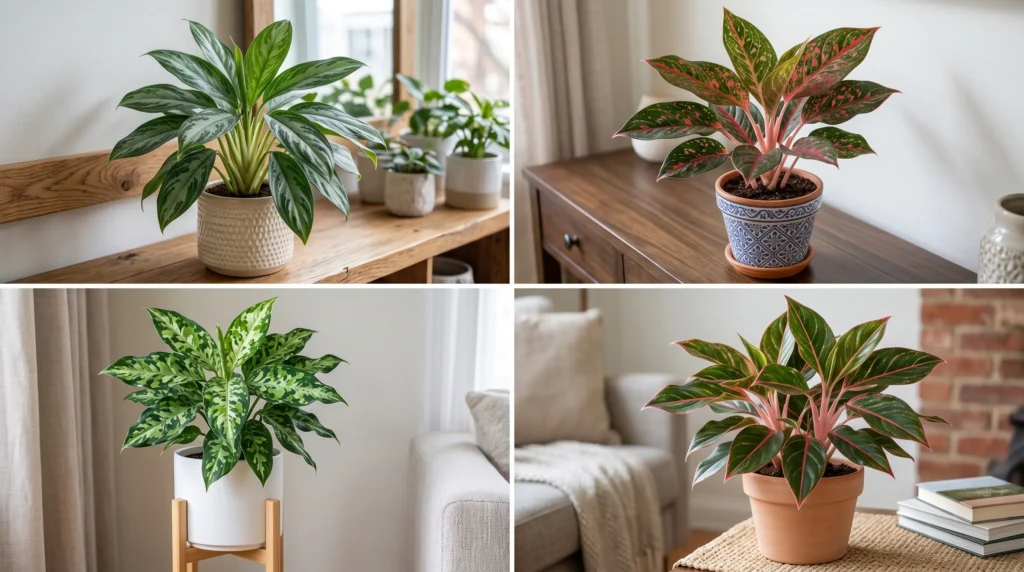
Temperature and Humidity — UK-Specific Guidance
| VARIABLE | IDEAL RANGE | UK CONTEXT & ACTION |
| Temperature (ideal) | 18–26°C | Standard UK room temperature — most centrally-heated homes are suitable |
| Temperature (minimum) | 15°C — never below 12°C | UK conservatories and unheated rooms in winter can drop below this — move plants from Oct to Apr |
| UK draught hazard | Keep away from all draughts | Sash windows, letterboxes, north-facing doorways, and gaps under doors are common draught sources in UK homes — all cause cold damage |
| Humidity (ideal) | 50–70% | UK centrally-heated homes average 30–45% in winter — supplementation is needed for most varieties |
| Humidity (minimum) | 40% — below this causes brown tips | Achievable with pebble tray + plant grouping in most UK rooms |
| Radiator proximity | Minimum 1 metre from any radiator | UK radiators create intense dry heat — the main cause of crispy brown leaf edges Oct–March |
| Leaf waxes / shine | Do NOT use | Leaf shine products clog aglaonema’s large leaf pores and inhibit photosynthesis — wipe with a damp cloth only |
How to Raise Humidity in a UK Home
- Pebble tray (free, effective): Fill a wide tray with pebbles, add water to just below the surface, sit the pot on top. Evaporation raises local humidity around the plant.
- Plant grouping: Grouping several plants together raises the microclimate humidity through shared transpiration.
- Room humidifier (most effective): An ultrasonic humidifier placed 30–60 cm away maintains 55–65% reliably. Use filtered or distilled water to avoid white mineral dust on leaves.
- Misting: A short-term measure only — raises humidity for minutes. More useful for dust removal than lasting humidity. If you mist, do so in the morning so leaves dry before evening to prevent fungal spots.
Soil and Potting Mix
Aerated potting mix (definition): A growing medium that holds some moisture but drains excess water quickly and allows air to reach the roots. Standard peat-free multi-purpose compost alone is too dense and water-retentive for aglaonema — it must be amended with perlite and orchid bark to create the free-draining but moisture-retentive conditions these plants need.
| MIX OPTION | RECIPE | BEST FOR | UK PRODUCTS |
| Standard recommended mix | 50% peat-free compost + 30% orchid bark + 20% perlite | All aglaonema varieties — everyday growers | Westland Peat-Free + Miracle-Gro Perlite + Westland Orchid Compost |
| Budget UK option | Houseplant Focus compost + 20% perlite | Beginners, cost-conscious growers | Houseplant Focus (garden centres) + perlite from B&Q |
| Fast-draining collectors mix | 40% orchid bark + 30% perlite + 20% coco coir + 10% worm castings | Rare varieties, growers prone to overwatering | Source orchid bark from Whartons or The Aroid Shop |
- UK sustainability note: Peat-free compost is now the UK standard — in line with the UK peat ban policy. All mixes above use peat-free ingredients.
- Never use garden soil: Too dense, compacts quickly in pots, and introduces pests. Always use a purpose-made houseplant medium.
- Pot choice: Always use a pot with drainage holes. Aglaonema prefers slightly snug conditions — pot up by only 3–5 cm at a time to avoid excess wet soil around the roots.
Feeding and Fertilising
| PERIOD | REGIME | UK PRODUCT EXAMPLES | NOTES |
| April–September (growing season) | Balanced liquid feed every 4 weeks at half to standard strength | Baby Bio Houseplant, Tomorite, Liquid Gold Leaf (Grow Urban) | Aglaonema is not a heavy feeder — less is more |
| October–March (dormant season) | No feeding — stop entirely | N/A | Feeding a dormant plant causes salt build-up — leads to brown leaf tips |
| After repotting | No feed for 4–6 weeks | N/A | Fresh compost contains sufficient nutrients |
| Organic alternative | Monthly worm castings worked into top compost layer | Fertile Fibre Worm Castings, organic garden centres | Gentle, slow-release — lower risk of burn |
- Signs of overfeeding: Brown leaf tips, white salt crust on the soil surface. Flush soil with clean water to remove salt build-up.
- Signs of underfeeding: Pale leaves, very slow growth despite adequate light — resume feeding in April.
Repotting
- Roots emerging from drainage holes or pushing up through the soil surface
- Roots tightly circling the base when the pot is removed — the plant is root-bound
- Soil dries out very quickly (within 2–3 days) despite regular watering
- Growth has stalled noticeably despite good light and feeding
How to Repot Aglaonema — Step by Step
- Choose timing: repot in April–May at the start of the growing season.
- Select pot: 3–5 cm larger in diameter than the current pot — no more. Aglaonema prefers snug conditions and excess soil holds water, increasing root rot risk.
- Prepare mix: use the recommended aerated potting mix above.
- Remove plant: tip sideways, support the root ball, ease it out gently.
- Inspect roots: healthy roots are white to light tan and firm. Trim any dark brown or black mushy roots with clean scissors. Dust cut ends with cinnamon (natural antifungal).
- Repot: add fresh mix to the base, position root ball, fill around sides. Soil level should sit 2–3 cm below the pot rim.
- Water once, then wait until top 3 cm is dry before watering again. Do not feed for 4–6 weeks.
Pruning and Maintenance
- Pruning: Minimal — remove yellow or damaged leaves at the base with clean, sharp scissors. Wear gloves: the sap contains calcium oxalate crystals that irritate skin.
- Leaf cleaning: Wipe leaves monthly with a damp microfibre cloth to remove dust and improve photosynthesis. Particularly important in UK urban environments where air quality is lower.
- Rotation: Rotate the plant 90 degrees every 2–4 weeks for even, balanced growth.
- Flower spikes: Remove flower spikes (aroid spadix/spathe flowers) as they appear — they divert energy from foliage growth and are not ornamentally significant on aglaonema.
Q: Why are my Aglaonema leaves turning yellow?
Yellow leaves on aglaonema are most commonly caused by overwatering — particularly in UK winter when the plant barely grows and soil dries very slowly. Check the soil: if it feels wet or soggy, stop watering, allow to dry, and check the roots for rot (dark, mushy roots confirm this). If the yellowing is confined to lower leaves only and the plant is otherwise healthy, this is natural — old leaves yellow and drop as the plant matures. If yellowing is widespread across the whole plant, check also for insufficient light and nutrient deficiency (resume feeding in spring).
UK Seasonal Care Calendar — Month-by-Month Guide
A UK-specific seasonal care calendar is absent from every major competitor article on aglaonema. British growing conditions change dramatically across the four seasons — from summer heatwaves that risk scorch to winter central heating that dries indoor air to damaging levels. This calendar gives month-specific actions for every growing season.
UK Seasonal Calendar (definition): A month-by-month care guide adapted specifically for Britain’s growing conditions: shorter daylight hours in winter (8 hours in December), summer temperatures occasionally exceeding 30°C through south-facing glass, and the dry indoor air created by UK central heating systems running from approximately October to April.
| SEASON | KEY TASKS | WATERING | FEEDING | UK WATCH OUT FOR |
| Spring(Mar–May) | Repot if root-bound. Restart feeding in April. Check for pests after winter. Clean leaves. Begin propagation. Rotate for even growth. | Gradually increase from 14 days back to 7–10 days as growth resumes | Restart monthly feeding from April onwards | Vine weevil in compost from outdoor plants. Root rot from winter overwatering — check roots when repotting. |
| Summer(Jun–Aug) | Water regularly. Mist in heatwaves. Move back from south-facing glass. Plan holiday watering arrangements. Wipe leaves in dusty urban flats. | Every 7–10 days; check soil in hot spells — pots dry faster | Monthly balanced liquid feed at standard or half strength | Leaf scorch from south-facing glass in July–August. Spider mites in dry heatwave conditions. Standing water in saucers during hot weather. |
| Autumn(Sep–Nov) | Gradually reduce watering. Stop feeding in September. Move away from cold windows as temperatures drop. Check central heating is not blasting directly onto plant. | Every 10–14 days from October as growth slows | Stop feeding entirely from September | Cold draughts as sash windows and doors are first opened and closed in changing weather. Leaf drop from sudden temperature fluctuations when heating first comes on. |
| Winter(Dec–Feb) | Minimal intervention required. Reduce watering significantly. No feeding. Dust leaves with damp cloth. Plan repotting for spring. Check for root rot if there is any stem softness. | Every 14–21 days. Always check soil first — in cold rooms it may stay wet for 3+ weeks | None — do not feed in winter | Central heating dryness (brown tips, crispy edges). Cold windowsills at night below 12°C. Overwatering in low light — the #1 UK winter killer. |
Q: Can Aglaonema survive a UK winter?
Yes, easily — provided it is kept indoors above 15°C and away from cold draughts and icy windowsills. The key adjustments for UK winter are: reduce watering to every 14–21 days (the plant barely grows and needs very little water), stop feeding entirely from September, move the plant away from windowsills that get cold at night (below 12°C can cause leaf damage), and manage central heating dryness with a pebble tray or humidifier. The plant will slow its growth considerably but recovers fully when light and warmth return in spring.
How to Propagate Aglaonema — Step-by-Step UK Guide
Aglaonema can be propagated by three methods: stem cuttings, division, and water propagation. The plant is slower to root than many aroids — patience is the main requirement. Spring (May–June) is the ideal time in the UK, when warmth and longer daylight hours support root formation. A heated propagator gives significantly better results in cooler UK conditions.
Stem Cuttings (Most Reliable for New Plants)
Node: The point on a plant stem where a leaf, aerial root, or new stem emerges. Cuttings must include at least one node to root successfully — a leaf without a node will not form roots.
Stem Cutting Step by Step
- Choose timing: Spring or early summer (May–June) when the plant is actively growing and UK temperatures are warm enough for rooting without artificial heat.
- Gloves first: Always wear gloves before cutting. Aglaonema sap contains calcium oxalate crystals — a skin and eye irritant. Have clean, sharp scissors or a sterilised knife ready.
- Take the cutting: Cut a healthy stem 10–15 cm long with at least 2–3 leaves and at least one visible node. Cut at a 45-degree angle to increase the rooting surface area.
- Allow to callous: Leave the cutting on a clean surface for 30–60 minutes so the cut end seals. This reduces bacterial rot during rooting.
- Prepare medium: Fill a small pot with damp perlite or a 50/50 mix of perlite and peat-free compost. This medium drains freely but retains enough moisture for rooting.
- Insert cutting: Make a hole with a pencil, insert the stem so the node is buried 2–3 cm deep. Firm gently so the cutting stands upright.
- Humidity dome: Cover with a clear plastic bag, cut plastic bottle, or propagator lid. This maintains humidity around the cutting — essential since the leafy cutting loses water through its leaves but has no roots yet to replace it.
- Warmth and light: Position in 20–25°C with bright indirect light. A heated propagator (£15–£30 from UK garden centres) is strongly recommended in spring before central heating is switched off.
- Wait for roots: Rooting takes 4–8 weeks in UK spring/summer conditions. Test after 6 weeks by giving the cutting a very gentle tug — resistance means roots have formed.
- Transition: Once rooted, remove the humidity cover gradually over 5–7 days. Pot into standard aglaonema mix. Do not feed for 4–6 weeks.
Division (Easiest, Best Success Rate)
Division: Separating a mature aglaonema at the root ball into two or more independent plants. The easiest propagation method because each division already has its own established roots. Best done simultaneously with spring repotting.
- Water the plant 24 hours before to reduce stress.
- Remove from pot and gently shake off excess compost.
- Identify natural divisions — the plant produces offshoots (pups) from the base, each with their own roots.
- Carefully pull or cut sections apart, ensuring each division has at least 2–3 leaves and a healthy root system.
- Pot each section individually into fresh aglaonema mix.
- Water immediately and keep in a warm, bright spot. Hold off feeding for 4–6 weeks. Expect mild wilting for a few days as the plant settles.
Water Propagation (Most Visually Rewarding)
Water propagation is increasingly popular among UK plant communities for its simplicity and visual appeal — a clear vase of cuttings developing white roots is a striking display in its own right, particularly in kitchens and bathrooms.
- Select a healthy stem cutting with at least one node — same technique as soil propagation above.
- Place in a clear glass or vase with room-temperature water. Submerge the node and stem; keep leaves above the waterline.
- Change the water every 7–10 days to prevent bacterial build-up (the primary cause of failure).
- Roots typically appear within 3–6 weeks in a warm position with bright indirect light.
- Transition to soil once roots reach 3–5 cm — pot into standard aglaonema mix, water thoroughly, and keep in moderate light for 1–2 weeks.
- Permanent water growing: Aglaonema can be kept indefinitely in water (a hydroponic method). Add a diluted balanced liquid fertiliser monthly. Change the water every 7–10 days.
| METHOD | BEST FOR | DIFFICULTY | TIME TO ROOTS | UK SUCCESS RATE (SPRING) |
| Stem cuttings (soil) | New plants from existing stems; all varieties | Intermediate | 4–8 weeks | 80–90% |
| Stem cuttings (water) | Beginners, visual display, kitchen/bathroom | Beginner | 3–6 weeks | 75–85% |
| Division | Mature multi-stem plants at repotting time | Beginner | Immediate (roots present) | 95%+ |
Q: How do I propagate Aglaonema?
The easiest method is division — separating offshoots from the base of a mature plant at repotting time (spring). Each division already has its own roots and succeeds at near-100% reliability. For stem cuttings, take a 10–15 cm stem with at least one node in May–June, allow to callous for 30–60 minutes, and root either in a glass of room-temperature water or in a 50/50 perlite-compost mix under a humidity dome at 20–25°C. Roots form in 4–8 weeks in soil, 3–6 weeks in water. Always wear gloves — aglaonema sap is a skin irritant.
Troubleshooting Guide — Diagnosing and Fixing Every Common Problem
Every aglaonema symptom has a diagnosable cause. This table covers all 13 most common problems reported by UK growers, with UK-specific factors (central heating, hard water, sash window draughts, low winter light) called out for each. Start with your symptom and follow the fix — most problems resolve within 2–4 weeks once the cause is corrected.
HOW TO USE THIS TABLE Identify your symptom in the left column. Read the most likely cause, then note the UK-specific factor that often triggers it. Apply the fix and give the plant 2–4 weeks to recover before assuming it has not worked.
| SYMPTOM | MOST LIKELY CAUSE | UK-SPECIFIC FACTOR | FIX |
| Yellow leaves — lower first | Overwatering / root rot | Very common in UK winter — watering too frequently when plant is dormant and soil stays wet for weeks | Stop watering. Let soil dry. Remove from pot, check roots. Trim dark mushy roots. Repot in fresh mix if root rot is advanced. |
| Yellow leaves — all over | Overwatering or severe underwatering; insufficient light | UK winter low light reduces plant’s need for water drastically | Adjust watering schedule. Move to brighter position. If soil is very wet, check for root rot. |
| Brown leaf tips only | Low humidity / fluoride or mineral deposits in water / salt build-up from fertiliser | UK central heating Oct–Mar drops indoor air to 30–40% humidity — well below aglaonema’s 50–70% target | Mist leaves or add pebble tray. Use overnight-rested tap water. Flush soil every 6 months to clear salt deposits. |
| Brown edges (widespread) | Cold draught exposure / cold water shock | UK sash windows, letterboxes, and north-facing doorways are common culprits | Move away from windows and doors. Always use room-temperature water. |
| Drooping / wilting (soil DRY) | Underwatering — roots cannot supply water to leaves | Easily missed in summer if plant is in a warm room | Water thoroughly from above. Allow to drain completely. |
| Drooping / wilting (soil WET) | Root rot — roots cannot transport water despite wet soil | Post-repotting overwatering; winter overwatering | Do not water further. Unpot, inspect roots. Trim rotten roots. Repot with extra perlite. |
| Pale / washed-out colour | Too much direct sunlight (bleaching) | UK south-facing glass in July–August intensifies considerably | Move back from window. Add sheer curtain. Avoid all direct sun. |
| Loss of leaf colour (variegation) | Too little light (coloured varieties reverting) | UK north-facing rooms in winter have very low lux levels | Move to brighter position. Add a grow light. Prune fully green stems. |
| Crispy leaves | Very low humidity / direct heat source / severe underwatering | UK central heating radiators are the #1 cause Nov–Feb | Move away from radiators. Add humidifier or pebble tray. Check watering frequency. |
| Leggy, stretching growth | Insufficient light — etiolation | Common in UK winter; very short daylight hours in Dec–Jan | Move nearer window or add grow light. Prune leggy stems to encourage bushier regrowth. |
| Root rot | Chronic overwatering / poor drainage | Worse in UK winter when low evaporation + slow growth = permanently wet soil | Remove from pot. Trim all black/mushy roots. Repot in fresh mix with added perlite. Ensure pot has drainage holes. |
| White crust on soil surface | Salt build-up from fertiliser or hard water | Hard water regions of South and East England are particularly prone | Flush soil thoroughly by watering heavily and allowing to drain repeatedly. Reduce feed frequency. |
| Mealybugs (white fluffy clusters) | Common indoor pest — often introduced on new plants | Spreads rapidly between houseplants — common in UK plant collections | Isolate plant immediately. Dab clusters with cotton bud in 70% isopropyl alcohol. Repeat weekly for 4–6 weeks. |
| Spider mites (pale stippling + webbing) | Hot, dry conditions | UK heatwaves July–August + dry central heating in winter create ideal spider mite conditions | Increase humidity. Shower plant with lukewarm water. Treat with insecticidal soap or neem oil spray every 5–7 days for 3 cycles. |
Q: Why does my Aglaonema have brown tips?
Brown leaf tips on aglaonema are almost always caused by low humidity — the most common effect of UK central heating from October to March. As radiators heat your home, indoor air humidity can drop from 50–60% to as low as 30%, well below the 50–70% aglaonema prefers. The fix: place the pot on a pebble tray filled with water, group it with other plants, or run a small room humidifier nearby. Move the plant at least 1 metre from any radiator. If the browning persists, also flush the soil with clean water to remove any fertiliser salt build-up, which can cause the same symptom.
Is Aglaonema Toxic? Safety Guide for UK Households
All aglaonema species are toxic to cats, dogs, and humans. This is not a fringe concern — it is one of the most-searched questions about the plant among UK buyers. This section provides comprehensive, UK-specific safety guidance including the Animal Poison Line number that no competitor article includes.
Aglaonema toxicity: All parts of the aglaonema plant — leaves, stems, roots, and sap — contain insoluble calcium oxalate crystals (raphides). When plant tissue is chewed or when sap contacts skin or mucous membranes, these microscopic needle-like crystals cause intense burning, irritation, and swelling. The toxic compound itself (calcium oxalate) is not absorbed systemically in large quantities, so death is extremely rare — but immediate discomfort is severe and veterinary or medical advice should always be sought.
UK EMERGENCY CONTACTS — PLANT POISONING
- Humans: NHS 111 for non-emergency advice. Call 999 if there is difficulty breathing or swallowing.
- Cats and dogs — Animal Poison Line (UK): 01202 509 000 (24/7, fee applies). Have the plant name ready when you call.
- Via your vet: VPIS (Veterinary Poisons Information Service) — accessible through any UK vet practice.
Toxicity by Household Member
| HOUSEHOLD MEMBER | RISK LEVEL | SYMPTOMS | UK ACTION |
| Cats | HIGH — most sensitive | Intense oral pain, drooling, pawing at mouth, vomiting, difficulty swallowing; throat swelling in severe cases | Call Animal Poison Line (01202 509 000) immediately. Do not induce vomiting. Bring plant name or photo. |
| Dogs | MODERATE TO HIGH | Drooling, pawing at mouth, vomiting, diarrhoea, lethargy; rarely throat swelling | Call Animal Poison Line or vet immediately. Most cases self-resolve but throat swelling is a medical emergency. |
| Children (under 12) | MODERATE — pain usually stops further ingestion quickly | Intense mouth burning, swelling of lips/tongue/throat, vomiting | Rinse mouth with water. Call NHS 111. Go to A&E if any breathing or swallowing difficulty. |
| Adults | LOW — burning pain deters ingestion of large amounts | Oral burning, GI discomfort if swallowed | Rinse mouth. NHS 111 if symptomatic beyond minor irritation. |
| Skin contact (all) | LOW — latex sap irritates sensitive skin | Redness, mild burning, rash at contact site | Wash with soap and water. Wear gloves when pruning or repotting. |
Safe Placement in UK Homes
- High shelves: The most effective safety measure for cats and children — out of reach above 1.5 m.
- Closed glass cabinets: Display cabinets with closing doors are reliable for plant collections in pet households.
- Dedicated plant rooms: A single room the cat does not access — increasingly common in UK houseplant collector homes.
- Bitter deterrent sprays: Pet-safe bitter apple sprays applied to leaf edges deter chewing in some pets but are not fully reliable.
- Pet-safe alternatives: If a fully pet-safe tropical plant is needed, Calathea (non-toxic), Spider Plant (non-toxic), or Boston Fern (non-toxic) provide similar lush foliage without calcium oxalate risk.
- Wash hands: Always wash hands after handling aglaonema — before touching your face, eyes, or food.
Q: Is Aglaonema toxic to cats and dogs?
Yes. Aglaonema is toxic to both cats and dogs. All parts of the plant contain insoluble calcium oxalate crystals, which cause intense burning pain in the mouth, excessive drooling, pawing at the face, vomiting, and in severe cases, swelling of the throat and difficulty breathing. If your cat or dog ingests any part of the plant, contact the Animal Poison Line (01202 509 000 — 24/7, fee applies) or your vet immediately. Most cases cause self-limiting discomfort, but throat swelling requires urgent veterinary attention. Keep aglaonema on high shelves or in rooms your pets cannot access.
Benefits of Growing Aglaonema in UK Homes
Aglaonema offers a combination of scientifically documented and practical benefits that makes it one of the most genuinely useful houseplants for UK lifestyles — beyond its considerable visual appeal.
Air Purification
NASA Clean Air Study: A 1989 NASA study by Dr Bill Wolverton that identified a range of common houseplants — including Aglaonema — as effective at removing indoor air pollutants including benzene and formaldehyde. While the study’s real-world applicability has been nuanced by more recent research, aglaonema’s large leaf surface area does absorb airborne organic compounds and contributes to improved air quality in enclosed UK spaces.
- Removes benzene and formaldehyde: Both are common VOCs (volatile organic compounds) found in UK homes — emitted by synthetic carpets, upholstered furniture, cleaning products, and off-gassing new-build materials.
- Particularly relevant for UK urban flats: Limited ventilation, sealed double-glazed windows, and synthetic furnishings create elevated indoor VOC concentrations.
- Large leaf surface area: Aglaonema’s broad, glossy leaves maximise the surface available for gas exchange — making it one of the more effective air-filtering houseplants per plant.
- UK new-builds: UK Building Regulations tighten airtightness year by year — keeping plants like aglaonema in new-build homes is a practical partial mitigation for reduced natural ventilation.
Mental Health and Wellbeing
- Stress reduction: Multiple studies confirm that the presence of indoor plants reduces cortisol (the primary stress hormone) and lowers blood pressure in working and home environments.
- Biophilic design: The deliberate incorporation of natural elements — plants, water, natural light — into interior spaces is clinically linked to reduced anxiety, improved focus, and better sleep quality.
- UK Mental Health Foundation: The Foundation’s wellbeing research highlights indoor gardening as a recognised, accessible mental health activity — particularly valued during the UK’s grey winter months.
- Low-maintenance advantage: Aglaonema’s tolerance of neglect means it provides wellbeing benefits without the anxiety of a difficult plant. The goal is enjoyment, not performance.
- Mindfulness: The routine of tending plants — checking soil, wiping leaves, rotating for even growth — provides grounding, repetitive action that many UK mental health practitioners now recommend as a mindfulness activity.
Practical Benefits for UK Lifestyles
| BENEFIT | DETAIL |
| Thrives on neglect | Perfect for busy British households, students, renters, and frequent travellers — does not demand daily attention |
| No outdoor space required | Entirely indoor plant — ideal for UK urban flats and city apartments with no garden access |
| Adapts to UK winter light | Dark green varieties genuinely tolerate the low lux levels of UK winter — unlike many tropical rivals that collapse without a grow light |
| Slow-growing | Won’t outgrow its pot rapidly — low maintenance, low cost, and does not need frequent repotting |
| Long-lived | With basic care, a single plant can last a decade or more — a genuinely long-term houseplant investment |
| Gifting appeal | One of the most popular UK houseplant gifts — appropriate for housewarmings, birthdays, and professional gifts |
| WFH and office use | Adapts to artificial lighting — excellent for UK home offices and commercial spaces |
| Humidity self-management | Tolerates drier air than most tropical houseplants — less demanding than Calathea, Orchids, or velvet-leaf aroids |
Styling Aglaonema in UK Interiors — Room-by-Room Guide
No major UK competitor article discusses interior styling for aglaonema. Yet for many UK buyers, a houseplant is as much a design decision as a gardening one. This section provides practical placement and styling advice mapped to the most common UK room types.
Room-by-Room Placement Guide
| ROOM | BEST VARIETIES | PLACEMENT NOTES | UK-SPECIFIC TIP |
| Hallway | Maria, Silver Bay, BJ Freeman | Narrow UK hallways often have very little natural light — dark green varieties thrive here | Keep away from letterboxes and front doors where cold draughts enter. A draught is more damaging than low light. |
| Living room | Red Valentine, Crete, Silver Bay | Colourful varieties make bold statements in neutral UK living rooms | Avoid placing near the TV or radiator wall. Group with other plants to boost humidity. |
| Home office / WFH desk | Maria, Silver Queen, Cutlass | Adapts to artificial LED and fluorescent lighting — excellent for home offices | UK remote workers report improved focus and reduced screen fatigue when plants are in view. Desk or shelf positioning within eyeline is most effective. |
| Bathroom | Any variety — Maria or Silver Bay in lower-light bathrooms | Loves bathroom humidity; ideal for UK Victorian bathrooms with high ceilings | Keep away from cold draughts through old sash windows. Position near (not on) a heated towel rail for warmth without direct heat. |
| Bedroom | Maria, Silver Bay, Crete | Air-purifying benefits most valuable in sleeping spaces; dark green varieties suit lower bedroom light | The slow, steady transpiration of aglaonema makes it a particularly good bedroom plant — it contributes a modest humidity boost overnight. |
| Kitchen | Any variety; water propagations especially stylish here | Handles steam and humidity well; a clear glass of water-rooted cuttings on a kitchen windowsill is a striking display | Keep away from cooking heat — steam is beneficial, direct oven heat is not. |
Pot and Display Pairing Tips
- Dark green varieties: Natural terracotta, cream ceramic, or woven rattan baskets complement the silver-green patterning and warm the look of green-dominant varieties.
- Pink and red varieties: Dark matte pots — charcoal, slate, or matte black — make pink and red leaf colouring vivid and dramatic. Popular in UK minimalist interiors.
- Biophilic / Scandi aesthetic: Rattan and wicker outer baskets with a plastic liner have been the dominant UK houseplant pot trend since 2022 and suit aglaonema’s tropical profile well.
- Plant grouping: Multiple aglaonema varieties grouped together create a lush tropical cluster. This also boosts local humidity through shared transpiration — a practical bonus in centrally-heated UK homes.
- Height variation: Use plant stands, shelves at different levels, and a floor-standing Silver Bay alongside smaller desk varieties to create visual depth and mimic natural rainforest layering.
Where to Buy Aglaonema in the UK — Complete Buying Guide
No UK competitor article provides a buying guide — competitor URLs are the retailers themselves. This section serves mid-funnel buyers who have decided they want an aglaonema but have not yet chosen where to buy. It covers online retailers, high street and garden centre options, buying tips, and a 2026 UK price guide.
Online UK Retailers
| RETAILER | WEBSITE | STRENGTHS | BEST FOR |
| Patch Plants | patchplants.com | Reliable delivery, UK-based, beginner-friendly care guidance, subscription options | First-time buyers; gift delivery |
| Grow Urban | growurban.uk | Excellent variety range, detailed care advice, UK specialist | Intermediate growers; soil and accessories bundles |
| Hortology | hortology.co.uk | Wide variety range, commercial focus, regular sales | Office plants; volume buyers |
| Grow Tropicals | growtropicals.com | Rare cultivars, collector community, specialist knowledge | Collectors; Pictum Tricolor, rare finds |
| Happy Houseplants | happyhouseplants.co.uk | UK-based, organic focus, peat-free products | Eco-conscious buyers |
| Plants for All Seasons | plantsforallseasons.co.uk | Good variety range, wholesale and retail available | Bulk buying; competitive pricing |
High Street and Garden Centres
- IKEA: Stocks basic varieties (usually Maria or Silver Bay) — a reliable, affordable entry point for a first aglaonema. Quality is generally good; soil quality varies.
- Dobbies, Wyevale, Notcutts: Regularly stock Aglaonema, particularly in spring (March–May) and autumn (September–October). Dobbies tends to have the widest variety selection among UK garden centre chains.
- B&Q and Homebase: Seasonal availability — look for them spring to early autumn. Basic varieties only (Maria, Silver Bay, sometimes Crete).
- Independent plant shops and florists: Increasingly stock interesting cultivars. UK independent plant shops have grown significantly in number since 2020 — worth checking your local high street or searching for ‘plant shop near me’.
What to Look for When Buying
- Healthy leaves: Firm, glossy leaves with strong colour. Avoid plants with yellowing, pale patches, or drooping — signs of stress, root rot, or overwatering in store.
- Roots: Check if roots are protruding excessively from drainage holes — may indicate the plant is severely root-bound and stressed from sitting in undersized pots.
- Pests: Inspect the undersides of leaves for mealybugs (white fluffy clusters) and spider mites (fine webbing, pale stippling). Check leaf axils closely.
- Store positioning: Avoid plants placed directly next to the store’s entrance (cold draughts) or under air conditioning vents — both cause temperature stress that weakens the plant before you buy it.
- Repot after buying: Shop compost is often nutrient-depleted and poorly draining. Repot into the recommended aglaonema mix within the first 4–6 weeks of ownership.
UK Price Guide 2025–2026
| PLANT SIZE | COMMON VARIETIES | RARE / COLLECTOR VARIETIES | WHERE TO FIND |
| Small (9–12 cm pot) | £5–£12 | £12–£25 | IKEA, B&Q, online retailers |
| Medium (14–17 cm pot) | £12–£22 | £25–£55 | Garden centres, online specialists |
| Large (19–24 cm pot) | £22–£45 | £50–£120+ | Specialist online retailers |
| XL / Statement (25 cm+ pot) | £45–£90 | £100–£300+ | Specialist online only |
Q: Where can I buy Aglaonema in the UK?
Online: Patch Plants, Grow Urban, Hortology, Grow Tropicals, and Happy Houseplants all offer reliable UK delivery, with Maria, Silver Bay, Crete, and Red Valentine typically in stock. In-store: Dobbies, IKEA, B&Q, and Homebase stock basic varieties seasonally (spring and autumn are best). For rarer cultivars — Pictum Tricolor, Cocomelon, Suksom Jaipong — specialist online retailers are the most reliable source. Prices range from £5 for a small IKEA Maria to £300+ for XL rare specimens. Always inspect for pests and healthy roots before purchasing in person.
Aglaonema vs Similar Plants — Which Is Right for You?
Aglaonema is often compared to other low-light tropical houseplants available in UK shops. This table makes the direct comparison across the factors that matter most to UK buyers: light tolerance, watering frequency, pet safety, and ease of care.
| PLANT | LIGHT NEEDS | WATERING | PET SAFE? | LOW LIGHT? | DIFFICULTY | BEST FOR |
| Aglaonema | Low–bright indirect | Every 7–21 days (seasonal) | No (toxic) | Yes (dark green vars) | Beginner–Intermediate | Low-light colour, UK central heating tolerance, long lifespan |
| Pothos | Low–bright indirect | Every 7–14 days | No (toxic) | Yes | Beginner | Trailing / hanging displays; very forgiving |
| Peace Lily | Low–medium indirect | Every 7–10 days | No (toxic) | Yes | Beginner | White flowers, shade tolerance, bathroom plant |
| Calathea | Medium indirect | Every 7 days | Yes (safe) | Partial | Intermediate–Advanced | Pet households; bold patterned foliage; loves humidity |
| Dieffenbachia | Medium–bright | Every 7–14 days | No (highly toxic) | Partial | Beginner | Large dramatic foliage; similar care needs to aglaonema |
| ZZ Plant | Low–bright indirect | Every 14–21 days | No (toxic) | Excellent | Beginner | Extreme neglect tolerance; near-zero watering in winter |
| Snake Plant | Low–bright indirect | Every 14–28 days | No (toxic) | Yes | Beginner | Architectural look; minimal watering; very drought-tolerant |
CHOOSING BETWEEN AGLAONEMA AND CALATHEA If you have pets, Calathea is the safer choice (non-toxic). If you have a dark room or are prone to forgetting to water, aglaonema is significantly more forgiving. Calathea demands consistent moisture and 60–70% humidity at all times — aglaonema tolerates dry British centrally-heated air far better.
Frequently Asked Questions (FAQ)
This FAQ section targets Google’s People Also Ask (PAA) boxes — the most common questions UK users search about aglaonema. Each answer is self-contained, definition-first, and written to be directly quotable.
Q: How often should I water my Aglaonema in the UK?
In summer (April–September): water approximately every 7–10 days when the top 2–5 cm of compost feels dry to the touch. In winter (October–March): reduce to every 14–21 days — the plant grows very slowly and needs far less water. Always check the soil before watering rather than following a fixed schedule. Overwatering in winter is the single most common cause of aglaonema death in UK homes.
Q: Why are my Aglaonema leaves turning yellow?
Yellow leaves are most commonly caused by overwatering — particularly in UK winter when the plant is dormant and soil stays wet for extended periods. Check the soil: if it feels wet or soggy, stop watering immediately and allow to dry. Other causes include insufficient light (move to a brighter position), nutrient deficiency (resume feeding with a balanced fertiliser in April), and natural aging (lower leaves always yellow and drop as the plant matures). If yellowing is accompanied by soft, mushy stems at the base, root rot is likely — unpot and inspect the roots.
Q: Is Aglaonema toxic to cats and dogs?
Yes. Aglaonema is toxic to both cats and dogs. The plant contains calcium oxalate crystals in all its parts — leaves, stems, and sap — which cause intense burning pain, drooling, vomiting, and in severe cases, swelling of the throat. If your pet ingests any part of the plant, contact the Animal Poison Line (01202 509 000 — UK, available 24/7, fee applies) or your vet immediately. Keep aglaonema on high shelves or in rooms your pets cannot access.
Q: Can Aglaonema survive a UK winter?
Yes. Aglaonema is one of the best tropical houseplants for UK winters. Provided it stays indoors above 15°C, away from cold draughts and icy windowsills, it copes easily. Reduce watering to every 14–21 days (the plant barely grows), stop feeding from September, and manage central heating dryness with a pebble tray or humidifier. The plant will slow its growth but returns to active growth in spring.
Q: What is the best Aglaonema for a dark room in the UK?
Aglaonema Maria and Aglaonema BJ Freeman are the best varieties for dark or north-facing rooms. Maria — with its dark green leaves and silver chevron patterning — is the most widely available and the most light-tolerant aglaonema in UK shops, tolerating north-facing rooms, hallways, and offices with only artificial lighting. Avoid pink, red, and orange varieties in dark rooms — they require medium to bright indirect light to maintain their colour.
Q: How do I increase humidity for Aglaonema in a centrally heated UK home?
Central heating significantly dries UK indoor air, typically reducing relative humidity from 50% to 30–40% — below aglaonema’s preferred 50–70%. The most effective methods, in order of effectiveness: (1) place a room humidifier near the plant; (2) set the pot on a pebble tray filled with water; (3) group the plant with other houseplants to share transpiration humidity; (4) mist the leaves 2–3 times per week in the morning. Always position the plant at least 1 metre from any radiator.
Q: Where can I buy Aglaonema in the UK?
Online: Patch Plants (patchplants.com), Grow Urban (growurban.uk), Hortology (hortology.co.uk), Grow Tropicals (growtropicals.com), and Happy Houseplants (happyhouseplants.co.uk) all offer reliable UK delivery. In store: Dobbies, Wyevale, IKEA, and B&Q stock basic varieties (Maria, Silver Bay, Crete) seasonally. For rarer cultivars such as Pictum Tricolor or Cocomelon, specialist online retailers are the most reliable source. Prices range from £5 (small IKEA plant) to £300+ for XL rare varieties.
Q: What are the signs that Aglaonema needs repotting?
The main signs are: roots growing out of the drainage holes at the pot base; roots densely circling the inside of the pot when you lift it; soil drying out very quickly (within 2–3 days) between waterings; or noticeably slowed growth despite good light and feeding. Repot in April–May using a pot only 3–5 cm larger in diameter than the current one. Never go up more than one pot size at a time — excess soil holds moisture and increases root rot risk.
Q: Can I grow Aglaonema in water?
Yes. Take a stem cutting with at least one node, place it in a clear glass of room-temperature water — submerging the node but keeping leaves above the waterline — and roots will develop within 3–6 weeks. Change the water every 7–10 days to prevent bacterial build-up. Aglaonema can be maintained permanently in water using the hydroponic method: add a diluted balanced liquid fertiliser monthly and refresh the water weekly. Water-propagated aglaonema in a clear glass vase makes a popular display in UK kitchens and bathrooms.
Q: Is Aglaonema a feng shui plant?
Yes. Aglaonema has been cultivated for centuries across Asia as a feng shui plant believed to bring good fortune, positive energy, and prosperity. The red and pink tones symbolise warmth and welcome; silver tones represent prosperity and protection from poverty. In modern feng shui practice, aglaonema is placed near the front entrance to welcome positive energy, in the southeast wealth corner, or on a work desk to attract focus and success. It is traditionally gifted at housewarmings in Thailand (where it is known as Sri Siam) and used in domestic rituals in Indonesia, Malaysia, and the Philippines.
Conclusion — The Final Verdict on Aglaonema for UK Homes
Aglaonema is, by almost every practical measure, the single best tropical houseplant for UK homes. It tolerates the conditions that defeat most tropical rivals — low winter light, dry central heating, hard tap water, and inconsistent watering — and it does so while offering more visual variety than almost any other houseplant genus. From cool silver-green varieties that survive north-facing hallways to vivid rose-pink statement pieces that brighten sitting rooms, there is an aglaonema for every UK room and every level of experience.
THE THREE RULES FOR AGLAONEMA SUCCESS IN THE UK 1. Choose your variety based on light — not just colour. Dark green varieties for low-light rooms; coloured varieties for brighter spots. 2. Water less than you think, especially in winter. Check the soil; never water on a fixed schedule. 3. Protect from draughts and radiators — these are the two most common environmental killers in British homes.
For UK plant parents, aglaonema offers a rare combination: genuine visual impact, extraordinary resilience, and a cultural depth that makes it more than just a decorative object. A well-chosen aglaonema, placed thoughtfully and cared for correctly, will still be thriving in your home a decade from now — which is more than can be said for most houseplants.
If you are new to aglaonema, start with Aglaonema Maria — widely available, genuinely forgiving, and beautiful. If you are ready for something bolder, Aglaonema Red Valentine or Crete will reward the slightly brighter position with striking, long-lasting colour. And if you are a collector, Pictum Tricolor awaits: the most complex, beautiful, and demanding aglaonema you can grow in a British home.
Complete Care Quick Reference
| CARE VARIABLE | BEGINNER (Maria, Silver Bay, Silver Queen) | INTERMEDIATE (Crete, Red Valentine, Orange Flame) | ADVANCED (Pictum Tricolor, Cocomelon) |
| Light | Low–medium indirect; north-facing rooms | Medium–bright indirect; east/west-facing rooms | Medium–bright indirect; consistent brightness essential |
| Watering | Summer: every 7–10 days. Winter: every 14–21 days | Summer: every 7–10 days. Winter: every 14–21 days | Same schedule — check soil more frequently; less drought-tolerant |
| Humidity | 40–50% — standard UK home generally adequate | 50–60% — pebble tray recommended | 60–70% — humidifier recommended Oct–Apr |
| Temperature | 15–26°C — standard UK central heating fine | 18–26°C — keep away from cold windowsills | 18–26°C — strict; avoid all temperature fluctuation |
| Soil | 50% compost + 30% orchid bark + 20% perlite | 50% compost + 30% orchid bark + 20% perlite | 40% orchid bark + 30% perlite + 20% coco coir + 10% worm castings |
| Feeding | Balanced liquid feed half-strength, Apr–Sep only | Balanced liquid feed, Apr–Sep only | Balanced feed at quarter strength; high nitrogen causes reversion |
| Repotting | Every 2 years or when root-bound | Every 1–2 years | Every 1–2 years; disturb roots minimally |
| UK winter action | Reduce watering; move away from cold windows; no feeding | Add grow light; humidifier; reduce watering to every 14–21 days | Grow light essential; humidifier; no feeding; monitor closely |

Leave a Reply