
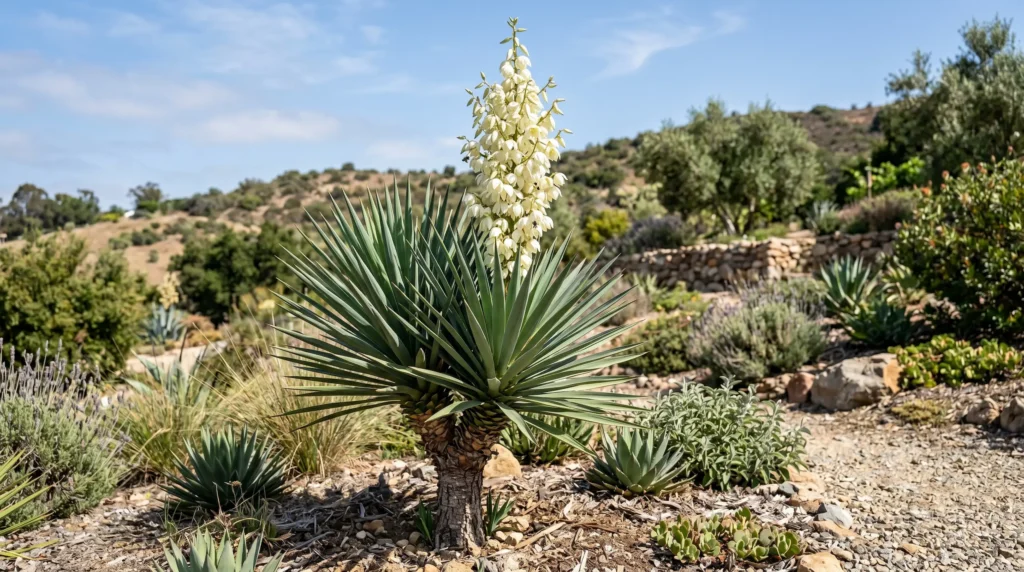
| Attribute | Detail |
| Botanical family | Asparagaceae (asparagus family) |
| Native range | Arid regions of North and Central America, Caribbean |
| Popular UK indoor species | Yucca elephantipes (spineless yucca) — RHS H2 |
| Hardy outdoor species | Y. filamentosa, Y. flaccida, Y. gloriosa — all RHS H5 (–10°C to –15°C) |
| Light requirement | Full sun outdoors; south- or west-facing window indoors |
| Watering | Drought-tolerant; water when top 5 cm of compost is dry |
| Key UK challenge | Winter wet causes root rot — not cold temperatures |
| Toxicity | Harmful if eaten by dogs and cats (HTA guidance); skin allergen — wear gloves |
| Flowering season | Late summer to autumn; bell-shaped, creamy-white panicles |
| Difficulty rating | Easy — ideal for beginners and time-poor gardeners |
Can you grow a yucca plant in the UK? Yes — and it may be one of the most rewarding plants you ever put in the ground. The yucca occupies a unique position in the British garden: it is simultaneously the plant that colonised the Victorian drawing room as an exotic houseplant and the modern garden designer’s favourite for bold, structural outdoor planting. Few genera bridge the gap between indoor statement piece and genuinely hardy, drought-resistant garden plant as convincingly.
The single most important thing UK gardeners need to understand before choosing a yucca is the hardy/tender split. Some yuccas — most notably Yucca filamentosa, Y. flaccida, and Y. gloriosa — carry an RHS hardiness rating of H5, meaning they can survive temperatures down to –15°C and remain outdoors year-round across virtually all of the UK. Others, particularly Y. elephantipes, the popular spineless houseplant, are frost-tender (RHS H2) and must be brought inside before the first frost.
Here is the UK-specific insight that most care guides miss: cold is not your enemy — wet is. The H5 yuccas are well-equipped to handle British winters. What kills them is waterlogged soil during months of persistent rain. Understanding this single principle will make or break your yucca-growing success in the UK.
This guide covers everything you need: which variety to choose, how to plant outdoors and care for indoor yuccas, a seasonal UK care calendar, how to diagnose and fix every common problem, propagation methods, and how to use yuccas in garden design. RHS hardiness ratings are cited throughout.
Yucca Varieties for UK Gardeners — Which One Should You Choose?
What is the most important question when buying a yucca in the UK? The first question every UK buyer must answer is: do I want this plant outdoors year-round, or as a houseplant? This single decision determines which species to choose, because the hardiness difference between groups is significant and non-negotiable.
Quick Buyer’s Decision Guide
| Your situation | Best choice |
| Want it outdoors year-round? | Choose an H5 variety: Y. filamentosa, Y. flaccida, or Y. gloriosa |
| Want a low-maintenance houseplant? | Y. elephantipes (spineless yucca) |
| Small garden or container? | Y. flaccida ‘Ivory’ or ‘Golden Sword’ (AGM, compact) |
| Want the most dramatic architectural form? | Y. gloriosa — tallest, most striking |
| Have young children or pets nearby? | Y. filamentosa — softer leaf tips than Y. gloriosa |
| Coastal or exposed garden? | Y. gloriosa — tolerates salt spray and wind well |
| Cold UK region (Scotland, N England)? | Y. filamentosa or Y. recurvifolia ‘Monca’ (rated to –20°C) |
Hardy Outdoor Varieties (RHS H5 — can stay outside year-round in most of the UK)
What does RHS H5 mean for yuccas? RHS hardiness rating H5 indicates a plant can survive sustained temperatures between –10°C and –15°C, covering the vast majority of UK gardens including exposed sites, northern England, and most of Scotland. The three key H5 yucca species are described below.
Hardy Varieties at a Glance
| Species | RHS Rating | Height/Spread | Key Cultivars | UK Notes |
| Y. filamentosa (Adam’s Needle) | H5 (–15°C) | ~75 cm / 1.5 m spread | ‘Bright Edge’ AGM, ‘Color Guard’ | Curly white filaments on leaf edges; safest near children |
| Y. flaccida (Weak-leaf Yucca) | H5 (–15°C) | ~55 cm / 1 m spread | ‘Ivory’ AGM, ‘Golden Sword’ AGM | Drooping leaf tips; excellent for containers |
| Y. gloriosa (Spanish Dagger) | H5 (–15°C) | Up to 2 m / 2 m spread | ‘Variegata’ AGM | Rigid spine-tipped leaves; most dramatic; plant away from paths |
Yucca filamentosa — Adam’s Needle
Definition: Yucca filamentosa is a clump-forming, stemless hardy yucca with deep green leaves edged with curly white filaments — the filaments are its key identification feature. It holds an RHS H5 rating and is reliably cold-tolerant across the UK.
- RHS hardiness rating: H5 (tolerates –10°C to –15°C, possibly colder)
- Height approximately 75 cm; spread 1.5 m; flower panicles to 2 m in late summer
- Best cultivars: ‘Bright Edge’ (AGM, gold-edged leaves), ‘Color Guard’ (cream-yellow centre)
- UK use: hot dry borders, courtyard gardens, gravel gardens, xeriscaping
- Softer leaf tips make it safer around children and pets than Y. gloriosa
Yucca flaccida — Weak-leaf Yucca
Definition: Yucca flaccida is a compact, clump-forming H5 yucca distinguished from Y. filamentosa by its drooping leaf tips. It is ideal for containers and smaller courtyard spaces.
- RHS hardiness rating: H5
- Best cultivars: ‘Ivory’ AGM (white flowers, compact at 55 cm), ‘Golden Sword’ AGM (gold-striped leaves)
- Note: ‘Golden Sword’ is rated H4 by some sources — confirm with supplier for colder UK regions
Yucca gloriosa — Spanish Dagger
Definition: Yucca gloriosa is the most dramatic hardy UK yucca — a single-stemmed shrub with rigid, spine-tipped leaves and spectacular flower panicles to 2.5 m in late summer. Wear gloves and plant away from paths.
- RHS hardiness rating: H5; tolerates down to –15°C
- Height and spread: up to 2 m; flower panicles to 2.5 m from late summer to autumn
- Cultivar: ‘Variegata’ AGM (cream-yellow striped leaves)
- Most commonly grown outdoor yucca in UK gardens; excellent for coastal and exposed locations
Tender Varieties — Houseplant or Conservatory Use in the UK
What is a tender yucca? A tender yucca is a species that cannot survive frost and must be kept indoors or brought inside before temperatures drop below 7°C. In the UK, Y. elephantipes is by far the most common tender variety.
Yucca Elephantipes — Spineless Yucca
Definition: Yucca elephantipes (also sold as Y. guatemalensis or Y. gigantea) is the dominant UK houseplant yucca, characterised by its soft, spineless leaves and trunk that widens at the base to resemble an elephant’s foot.
- RHS hardiness rating: H2 — cannot survive frost
- Must come inside before temperatures drop below 7°C (typically mid-October at the latest)
- Can be moved outside to a sheltered patio from late May to August
- Minimum winter night temperature: 7°C; suitable for cool conservatories
Other Species Worth Noting
- Y. aloifolia (Spanish bayonet): very sharp leaves, tender; handle with extreme care
- Y. rostrata (beaked yucca): spectacular blue-grey spherical head, slow-growing, up to 4 m; less readily available in UK
- Y. recurvifolia ‘Monca’ (Banana Split): rated to –20°C; excellent for cold UK regions
How to Plant Yuccas Outdoors in the UK
How do you plant a yucca outdoors in the UK? Successful outdoor yucca planting depends on two non-negotiable factors: maximum sunlight and excellent drainage. The most common cause of failure is planting in a poorly drained spot, not cold temperatures.
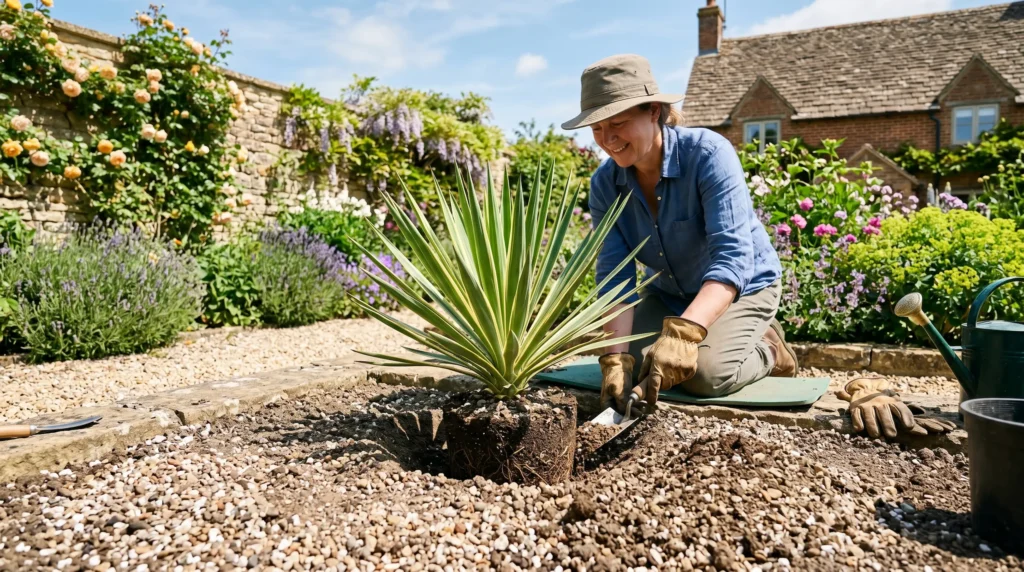
Choosing the Right Spot
Where is the best location to plant a yucca outdoors in the UK? Choose the sunniest, best-drained spot in your garden — ideally a south-facing position against a wall or fence, which provides both maximum warmth and a natural rain shadow in winter.
- Full sun is non-negotiable — a south-facing position against a wall is ideal
- Wall or fence protection serves a dual purpose: extra heat radiation and reduced rainfall exposure in winter
- Look for spots where snow melts first — these are the warmest, fastest-draining microclimates in your garden
- Avoid north-facing or shaded positions; low light causes drooping, lax leaves
- Avoid frost pockets and low-lying areas that collect cold air or standing water
Soil Preparation — The Drainage Imperative
What soil do yuccas need outdoors? Yuccas need well-draining soil above all else. They will tolerate poor, thin, and nutrient-poor soil, but will not survive waterlogging. In the UK’s typically clay-heavy soils, drainage improvement is almost always necessary before planting.
- Well-draining soil is the single most critical requirement; yuccas tolerate poor soil but not waterlogging
- For clay-heavy UK soils: dig in 20–30% by volume of horticultural grit or coarse sand before planting
- Add John Innes No. 2 compost mixed with extra grit for the planting hole
- In persistently wet gardens: plant in a raised bed (minimum 30 cm raised) or in containers
- pH: slightly acidic to neutral is fine; yuccas are not fussy about pH
Step-by-Step Planting Guide
How to plant a yucca outdoors: follow these steps in order for the best results.
- Choose your spot — full sun, south-facing if possible, protected from heavy rain. Check drainage by digging a test hole: fill with water and it should drain within an hour.
- Prepare the soil — dig in 20–30% horticultural grit if soil is clay-heavy. For very wet gardens, build a raised bed at least 30 cm above the surrounding soil level.
- Dig the planting hole — at least 1.5× the depth and width of the root ball.
- Add drainage layer — place a 5–10 cm layer of stones or gravel at the base of the hole.
- Position the plant — place the root ball so its top is level with the surrounding soil; do not plant too deep.
- Backfill — use grit-amended compost; firm in gently, avoiding air pockets.
- Water in — water thoroughly after planting; then leave the plant to settle and do not water again until the soil is dry.
- Space multiple plants — leave at least 1.2–1.8 m between plants to accommodate mature spread.
Container Growing Outdoors
- Use John Innes No. 2 or No. 3 with 20–30% added horticultural grit
- Ensure the pot has large drainage holes — never allow the pot to sit in a saucer of standing water
- Terracotta pots are ideal: breathable material helps wick away excess moisture
- Move pots of tender varieties indoors before first frost; hardy varieties can remain outside if the pot itself will not crack in low temperatures
Indoor Yucca Plant Care (Y. elephantipes)
How do you care for an indoor yucca plant in the UK? Indoor yucca care centres on four principles: maximum available light, disciplined watering (erring toward drought rather than saturation), modest feeding during the growing season only, and avoiding draughts and radiators.
Light
What light does an indoor yucca need? Bright, indirect light is best — a south- or west-facing window is ideal. Unlike most houseplants, yuccas can tolerate direct winter sunshine through glass when light intensity is low.
- A south- or west-facing window is ideal; north-facing positions are unsuitable
- In summer, provide light shade from intense direct midday sun to prevent scorching
- Rotate the pot a quarter-turn every few weeks to prevent the plant growing lopsidedly toward the light source
- Low light causes drooping and lax, pale leaves — a yucca will not tolerate a dark corner
Watering — The Most Important Indoor Care Skill
How often should you water an indoor yucca? Water only when the top 5 cm of compost has dried out completely. Yuccas store water in their trunk and base; overwatering kills far more indoor yuccas than drought.
| Symptom | Most likely cause | Immediate action | Prevention |
| Widespread yellowing, limp soft leaves | Overwatering | Stop watering; let compost dry out almost entirely | Use the 5 cm finger test before every watering |
| Crisp brown leaf tips | Underwatering or low humidity | Water thoroughly; move away from radiators | Keep consistent moisture in growing season |
| Lower leaves yellowing gradually | NORMAL — natural shedding | Remove leaves cleanly; no action needed | No action needed — this is healthy growth |
- In growth (April–September): water when top 5 cm of compost is dry; water thoroughly then let it drain completely
- In dormancy (October–March): reduce to once or twice a month
- Never allow the plant to sit in standing water in a saucer
Feeding
How often should you feed an indoor yucca? Feed sparingly — a balanced liquid fertiliser at half strength, every 6–8 weeks from late spring to late summer only. Do not feed in autumn or winter; the plant is dormant and feeding encourages soft, weak growth.
Temperature & Humidity
- Normal room temperature (15–24°C) is ideal throughout the growing season
- Minimum night temperature in winter: 7°C — a cool conservatory is fine; an unheated greenhouse is not
- Yuccas do not require high humidity — no need to mist
- Wipe leaves occasionally with a damp cloth to remove dust and improve photosynthesis
- Keep away from radiators and draughts — both cause brown leaf tips
Repotting
When and how do you repot an indoor yucca? Yuccas prefer to be slightly pot-bound — repot only every 2–3 years in spring, and only when roots visibly emerge from the base. Use a heavy, stable pot to prevent the top-heavy plant from toppling.
Yucca Winter Care in the UK — The Wet Problem Explained
Why do hardy yuccas die in UK winters? The answer is almost never cold — it is waterlogged roots. Y. filamentosa, Y. flaccida and Y. gloriosa are all rated H5 and can endure temperatures down to –15°C. They do not die from cold. They die from waterlogged roots during wet British winters. This section explains why — and exactly what to do about it.
CORE UK INSIGHT: American yucca care guides miss the wet problem entirely because North American winters are cold and dry. UK winters are cold AND persistently wet — a combination that does not occur in the plants’ native range. Root rot from waterlogging is the primary cause of winter yucca loss in the UK. The H5 rating covers cold tolerance, not wet tolerance.
Why Cold Is Not the Enemy — Wet Is
Can hardy yuccas survive a UK winter? Yes — if drainage is adequate. The H5 rating of Y. filamentosa, Y. flaccida and Y. gloriosa tells you these plants can handle British winter temperatures. What the rating does not protect against is the UK’s other winter characteristic: relentless rain landing on ground that cannot drain quickly enough. Waterlogging kills the roots; once root rot sets in, the plant collapses even if temperatures never fall dangerously low.
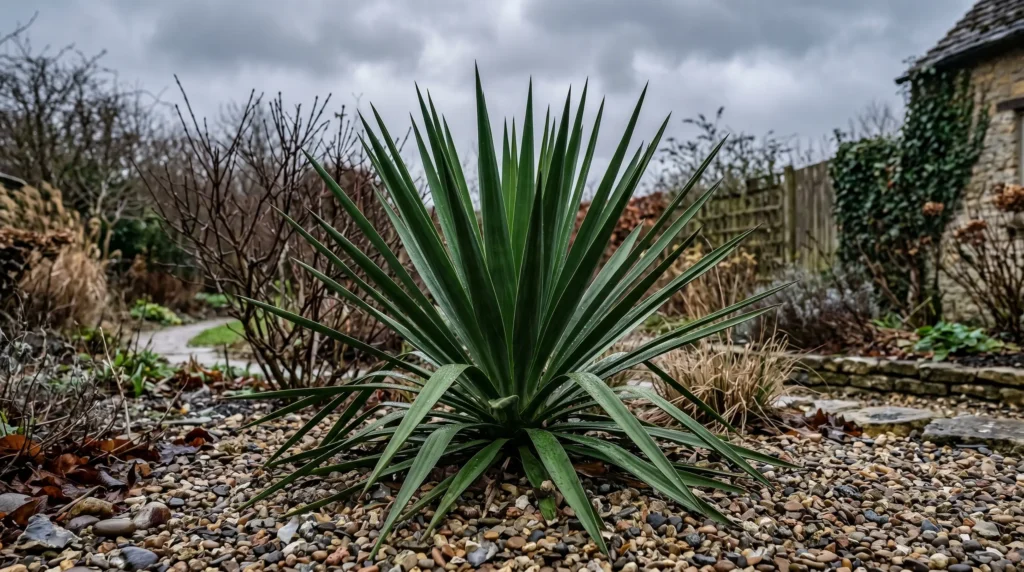
How to Protect Outdoor Hardy Yuccas in Winter
Site Selection — The Most Important Protection (Done at Planting Time)
- Plant in the driest, best-drained area of the garden — this decision cannot easily be reversed later
- A south-facing position near a wall or fence provides a natural rain shadow, significantly reducing the volume of rain reaching the root zone
- Slightly raised ground or mounds drain naturally; flat beds that pool water after rain are unsuitable
- Avoid planting in a dip, frost pocket, or any area that stays damp after rainfall
Winter Drainage Interventions
- In autumn, stop supplemental watering entirely — let natural rainfall provide any moisture needed
- For plants in problem spots: fix a cloche, glass pane, or polycarbonate sheet on a frame over the crown to divert heavy rain while allowing air circulation underneath
- Alternatively, wrap the crown loosely in horticultural fleece to reduce wet penetration without trapping moisture against the plant
- For container plants: move the pot to a covered porch or into an unheated greenhouse for winter
- Apply a 5–8 cm layer of coarse grit or gravel around (not over) the crown to help surface water drain away quickly
Frost Protection for Marginal Areas
- In northern England, Scotland and other colder regions, even H5-rated yuccas benefit from fleece wrapping when temperatures drop below –10°C for extended periods
- Use only horticultural fleece — never impermeable plastic bags; trapped moisture causes far more damage than cold
Overwintering Tender Yuccas (Y. elephantipes)
When should you bring a tender yucca indoors for winter? Bring Y. elephantipes inside before the first frost — usually by mid-October at the latest across most of the UK.
- Move to a bright, cool room or conservatory; a minimum night temperature of 7°C is fine
- Reduce watering dramatically: once or twice per month is sufficient during full dormancy
- Do not feed at all from October through February
- Can return outside to a sheltered spot from late May, once night temperatures are reliably above 10°C
Watering & Seasonal Care Calendar — UK
When is the best time to water a yucca in the UK? This depends on season and whether the plant is indoors or outdoors. The calendar below summarises the complete UK annual care cycle for both growing situations.
| Season | Outdoor Hardy Yuccas | Indoor Y. elephantipes |
| Spring
(Mar–May) |
Begin watering as growth resumes. Remove winter fleece and dead leaves. Light organic feed optional. Divide pups if needed. | Increase watering gradually. Resume half-strength feeding. Repot if rootbound. Move outside from late May. |
| Summer
(Jun–Aug) |
Water only during prolonged dry spells — established plants are drought-tolerant. Watch for flowering panicles emerging. | Water when top 5 cm is dry. Feed every 6–8 weeks. Can go outside to a sheltered spot. Wipe leaves of dust. |
| Autumn
(Sep–Nov) |
Stop supplemental watering. Remove spent flower spikes. Add protective cover before heavy rain. Apply grit mulch around crown. | Bring inside by mid-October. Reduce watering to once per month. Stop feeding completely. |
| Winter
(Dec–Feb) |
Zero supplemental watering. Check drainage. Fleece in very cold spells if in an exposed position. Minimal intervention. | Water once or twice a month. Keep at 7°C minimum. Maintain a bright spot. No feeding. |
Watering: Key Rules at a Glance
- Less is always more — an underwatered yucca will recover; an overwatered one often will not
- Outdoor established yuccas in the ground rarely need supplemental watering except during prolonged drought
- Indoor yuccas: use the finger test (top 5 cm dry) rather than a fixed schedule
- Never let any yucca — indoor or outdoor — sit in standing water
Common Yucca Problems — Diagnosis & Fixes
This section addresses the most common yucca problems UK gardeners encounter. For each symptom, the most likely cause is given first, followed by immediate action and long-term prevention.
Yellowing Leaves
Lower Leaves Yellowing Gradually
Is it normal for yucca lower leaves to turn yellow? Yes — this is entirely normal. Yuccas naturally shed older lower leaves as they age, progressively exposing a palm-like trunk. No action is required beyond removing the leaves cleanly.
- Action: gently pull off or cut away at the base with clean secateurs; do not be alarmed
Widespread Yellowing Across the Plant
What causes widespread yellowing on a yucca? Widespread yellowing — especially when leaves feel soft or limp — is almost always caused by overwatering. Check the compost moisture immediately.
- If compost is soggy: stop watering immediately, allow to dry out thoroughly, check roots for rot
- If compost is bone dry and hard: water thoroughly and resume a more regular but still sparing schedule
Brown Leaf Tips
What causes brown tips on yucca leaves? Brown, crispy leaf tips on an indoor yucca are most commonly caused by low humidity, proximity to a radiator, or inconsistent watering. Fluoride in tap water can also cause tip burn in sensitive plants.
- Fix: move away from heat sources; try rainwater or filtered water for indoor plants
- Low humidity: occasional misting near the plant (not directly on leaves) can raise local humidity
Mushy Base or Stem — Root Rot
How do you treat root rot in a yucca? Root rot — caused by overwatering or winter waterlogging — is the most serious problem for UK yuccas. Act immediately at the first sign of a mushy or darkened base.
- Early-stage: let soil dry out completely; if in a pot, remove from pot, cut away all black/mushy roots, dust with fungicide, repot in fresh dry gritty compost
- Severe rot: if the trunk is completely mushy at the base, the plant cannot be saved; salvage healthy stem sections as cuttings
- Prevention: drainage is everything — see Section 5 for the full winter wet guidance
Drooping or Floppy Leaves
Why are my yucca’s leaves drooping? Drooping leaves on an indoor yucca almost always indicate insufficient light. Move the plant to a brighter position before investigating other causes.
- Most common cause: insufficient light — move to a south- or west-facing window
- Other causes: overwatering, or cold temperatures below 7°C for indoor plants
Brown Spots on Leaves
- Cause: fungal leaf spot — more common during wet UK autumns
- Fix: improve air circulation around the plant; remove affected leaves; avoid wetting foliage when watering
Pests
What pests affect yucca plants in the UK? The main pests to watch for are described below, including vine weevil — a significant UK-specific threat absent from most competitor guides.
| Pest | Signs | Treatment |
| Scale insects | Small brown bumps on stems | Remove with cotton bud dipped in rubbing alcohol; treat with insecticidal soap |
| Spider mites | Fine webbing; stippled pale leaves | Increase humidity; treat with neem oil or insecticidal soap |
| Vine weevil * | Notched leaf margins; sudden wilting; white C-shaped grubs at roots | Treat with nematodes or vine weevil killer in spring/autumn — particularly important in UK container yuccas |
| Mealybugs | White cottony deposits on stems and leaf axils | Treat with insecticidal soap or neem oil |
| Aphids | Clusters on new growth and flower spikes | Spray with organic insecticidal soap; encourage natural predators (ladybirds) |
* Vine weevil is a significant cause of otherwise-unexplained container yucca collapse in the UK — missing from all major competitor guides. Vine weevils thrive in the damp UK climate; check roots if a plant wilts for no obvious reason.
Pruning and Propagation
Pruning
Do yucca plant need pruning? Hardy outdoor yuccas generally do not require pruning — they are naturally architectural and self-maintaining. Pruning is mainly carried out to remove dead or damaged material, or to control the size of an overgrown plant or indoor yucca.
- Remove dead or damaged leaves by cutting cleanly at the base with sharp, clean secateurs
- Remove spent flower spikes after flowering (late summer to autumn) — cut the spike as close to the base rosette as possible
- If the plant has become too large: prune rosettes with a sharp saw after flowering but before the end of August, giving the plant time to recover before winter
- Indoor yuccas that have outgrown their space: cut the trunk to the desired height in spring — it looks bare initially but healthy plants reshoot reliably within a few weeks
Safety: Always wear thick gloves and protective eyewear when working with yuccas, especially Y. gloriosa — the rigid, spine-tipped leaves are genuinely hazardous and can cause serious eye injury.
Propagation Methods
How do you propagate a yucca plant? There are three main propagation methods. Offsets (pups) are the easiest and most reliable for home gardeners; stem cuttings are useful after pruning; seed propagation is possible but slow and rarely used in the UK.
From Offsets (Pups) — Easiest and Most Reliable
What are yucca pups? Yucca pups (offsets) are small rosettes that emerge from the base of the parent plant. They are the most reliable propagation method for home gardeners.
- Best time: spring, ideally when repotting an indoor plant or during the growing season for outdoor plants
- Use a sharp, clean knife to detach the pup as close to the parent’s base as possible, retaining any roots already present on the pup
- Allow the cut surface to callous (dry out) for 24–48 hours before potting — this reduces the risk of rot
- Plant in gritty, free-draining compost; place in a warm spot (18–21°C); water very sparingly until new growth appears
From Stem Cuttings
- Cut a 20–25 cm section from the tip of a healthy stem in spring
- Allow the cut end to callous for 1–2 days
- Plant in coarse sandy rooting compost; keep warm and lightly moist until roots establish (4–8 weeks)
Note: when you cut back an indoor yucca, the severed top section can be rooted as a new plant using this method.
From Seed — Slowest Method
Can you grow yucca from seed in the UK? It is possible but rarely practical. Seeds require hand pollination of flowers (use a small paintbrush to transfer pollen between flowers) because the yucca’s native pollinator — the yucca moth — does not exist in the UK. Germination is slow and unreliable; offsets and cuttings are far more practical for the home gardener.
Yuccas in UK Garden Design — Ideas & Inspiration
How can you use yuccas in UK garden design? Yuccas are one of the few genuinely architectural plants that are reliably hardy in UK gardens — providing year-round structure and drama even in winter when most plants look bare. Their versatility spans Mediterranean courtyard planting through to bold xeriscaping and indoor statement styling.
Architectural Planting: Making a Statement
- Use as a specimen plant in gravel or scree beds where their bold form can be fully appreciated as a focal point
- Pair with other spiky, structural plants: Phormium, Cordyline australis, Kniphofia (red hot poker), ornamental grasses such as Stipa gigantea
- Plant in odd numbers (3, 5, 7) for a naturalistic effect rather than a single isolated specimen
- Excellent year-round structure: unlike most perennials, yuccas look dramatic in winter as well as summer
Mediterranean and Coastal Gardens
- gloriosa is the classic anchor plant for Mediterranean-style UK gardens. Combine it with lavender, cistus, echium, rosemary and a gravel mulch for a water-wise, dramatically beautiful planting.
- Hardy yuccas tolerate coastal winds and salt spray well — excellent for seaside gardens where many plants struggle
- Pair with silver-leaved drought-tolerant plants: Stachys byzantina (lamb’s ears), Artemisia, Santolina
Xeriscaping: The Climate-Change Angle
What is xeriscaping and how do yuccas fit? Xeriscaping is drought-conscious garden design — increasingly relevant as UK summers become drier and hotter. Hardy yuccas are the ideal anchor plant in a UK xeriscape: once established, they require no supplemental watering even in drought.
- Replace water-hungry lawn sections with a gravel mulch planting featuring yucca as the centrepiece
- Companion plants for a UK xeriscape: sedum, echinacea, verbena bonariensis, nepeta, agapanthus
- Established outdoor yuccas reduce garden maintenance significantly — no irrigation required
Indoor Styling: Y. elephantipes as a Design Object
The spineless yucca’s palm-like form and low maintenance make it one of the definitive indoor architectural plants. Works in large, dramatic pots — terracotta, concrete, or ceramic — that counterbalance its height.
- Multiple stems of different heights in one pot create a more interesting, natural effect than a single-stemmed specimen
- Suits minimal, Scandi, industrial, and mid-century modern interiors — pairs well with rattan, linen and natural materials
- One of the lowest-maintenance large indoor plants available — ideal for busy households or offices
Fascinating Yucca Facts — Ecology, History & Uses
The Yucca–Yucca Moth Mutualism
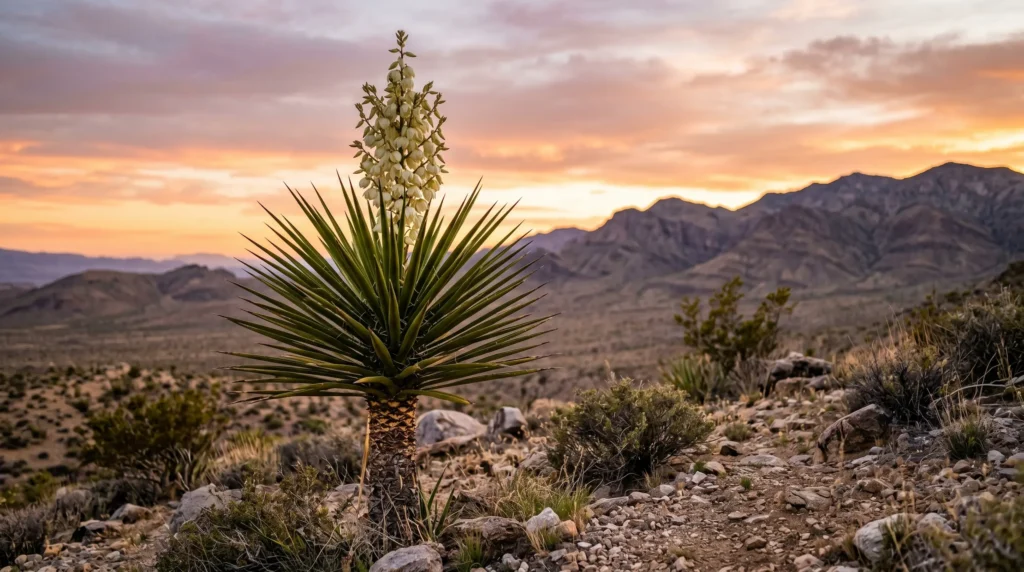
What is the yucca–yucca moth relationship? Yuccas have an extraordinary, exclusive pollination relationship with yucca moths (Tegeticula and Parategeticula species). The moth is the yucca’s sole pollinator in its native range — neither can survive without the other. This is one of the most celebrated examples of obligate mutualism in nature: the moth lays its eggs inside the yucca flower and simultaneously pollinates it, ensuring seeds develop to feed its larvae.
- Because yucca moths do not exist in the UK, hand pollination is needed for yuccas to set seed here: use a small paintbrush to transfer pollen between bell-shaped flowers
Cultural and Historical Significance
- ‘Lamparas de Dios’ (Lamps of God) — early American settlers named the plant for its tall white flowering spikes that seemed to illuminate night journeys
- The Navajo people used leaf fibres for weaving sandals and baskets; the plant featured in ceremonial use
- New Mexico named the yucca blossom its official state flower in 1927
- Introduced to Britain in Victorian times as a status symbol — exotic houseplants signalled wealth and sophistication
Edibility and Medicinal Uses
Are yuccas edible? Some species (not Y. elephantipes) produce edible fruits that resemble a cross between a cucumber and a pepper — eaten raw, baked, or fried in their native regions. Yucca is also available as a health supplement (powders and capsules), traditionally linked with improved digestion and reduced inflammation, though clinical evidence is limited. This article does not constitute medical advice.
Air Quality
Do yucca plant purify air? Yuccas, like most plants, contribute modestly to improved indoor air quality by absorbing airborne particles and producing oxygen. Note: while the NASA Clean Air Study findings are frequently cited, ventilation is far more effective for air quality than houseplants alone, and the effect of individual plants in a domestic setting is modest.
Frequently Asked Questions
The following Q&A blocks are written for AI extraction and featured-snippet capture. Each answer is self-contained and cites the relevant section for further detail.
How often should I water a yucca plant in the UK?
Indoor yuccas: water when the top 5 cm of compost has dried out — roughly every 1–2 weeks in summer, once or twice a month in winter. Outdoor established yuccas in the ground rarely need supplemental watering except during prolonged drought. The rule for both: never allow roots to sit in standing water. See Section 4 (indoor) and Section 6 (seasonal calendar).
Why are my yucca’s leaves turning yellow?
Yellowing lower leaves are entirely normal — yuccas naturally shed older leaves as they develop their trunk. If leaves are yellowing across the whole plant and feel soft or limp, the cause is almost certainly overwatering. Stop watering immediately, let the compost dry out fully before resuming. See Section 7 for full diagnosis.
Can I leave my yucca outside in winter in the UK?
Hardy species (Y. filamentosa, Y. flaccida, Y. gloriosa) can remain outside year-round if planted in a free-draining spot. Tender Y. elephantipes must be brought inside before the first frost, typically by mid-October. See Sections 2 and 5.
Are yucca plants toxic to dogs and cats?
Yes — yuccas are classified as harmful if eaten by dogs and cats under HTA guidance. Place indoor plants out of reach of pets and avoid planting outdoor varieties where animals graze. Seek veterinary advice if ingestion is suspected.
How do I propagate a yucca plant?
The easiest method is to separate offsets (pups) from the base of the plant in spring. Allow the cut to callous for 48 hours, then pot in gritty compost and keep warm. Stem cuttings (20–25 cm) also root well in coarse sandy compost. Seed propagation is possible but slow and requires hand pollination in the UK. See Section 8 for step-by-step instructions.
How quickly do yucca plants grow?
Yuccas are slow to moderate growers. Expect Y. elephantipes indoors to gain 20–30 cm per year in good conditions. Hardy outdoor varieties may take several years to reach mature size but are very long-lived once established — a well-sited outdoor yucca can thrive for decades with minimal intervention.
What is the best yucca for a UK garden?
For most UK gardens, Yucca filamentosa, Y. flaccida and Y. gloriosa are the best choices — all rated H5 (hardy to –15°C). For containers or smaller spaces, Y. flaccida ‘Ivory’ (AGM) is ideal. For indoor growing, Y. elephantipes is the definitive UK houseplant yucca.
Where to Buy Yucca Plant in the UK — Tips for Choosing a Healthy Plant
What to Look for When Buying a Yucca
How do you choose a healthy yucca plant? Inspect these key indicators before purchasing.
- Firm, upright leaves with no mushy patches at the base or crown
- No widespread yellowing — some lower leaf shed is normal, but the overall plant should look vigorous
- Check the undersides of leaves for signs of scale insects or mealybug
- Check the pot base — roots should just begin to emerge; severely rootbound plants are stressed
- Avoid plants with trimmed leaf tips — this is cosmetic damage that never regenerates, and often signals poor handling in the supply chain
Where to Buy
- Garden centres: widest seasonal selection in spring and summer; quality is generally good
- Specialist online nurseries: often stock a broader range of hardy outdoor varieties and rarer cultivars than high-street retailers; reputable suppliers include those accredited by the Horticultural Trades Association
- RHS plant centres and garden shops: carry AGM-awarded varieties with quality assurance
Conclusion
Yuccas are underused in UK gardens for one reason: most care advice is written for other climates. Once you understand the key UK-specific insight — that cold is not the threat, wet is — the calculus changes entirely. Choose a free-draining spot, select an H5-rated variety, and you have one of the most structurally dramatic, lowest-maintenance, genuinely long-lived plants available to UK gardeners.
Indoors, Y. elephantipes delivers architectural impact with almost no effort: water it sparingly, give it a bright window, and it will thrive for years. Outdoors, Y. filamentosa, Y. flaccida and Y. gloriosa bring year-round structure that few other hardy plants can match — flowering spectacularly in late summer, looking dramatic even in the depths of winter, and growing more impressive with every year.
The yucca’s moment in UK gardens is well overdue. Treat it right, and it will reward you for decades.
Have questions or tips from your own UK yucca experience? Share them in the comments below — we read every one. And for further reading, explore our companion guides to variety deep-dives, UK winter care, and drought-resistant garden design.

Leave a Reply