
At dusk, something happens in thousands of British homes that most people dismiss as a trick of the light. Their houseplant folds its leaves upward — as if in prayer. This is the Maranta leuconeura, the prayer plant, and once you understand it, you will never look at houseplants the same way.
The prayer plant (Maranta leuconeura) is a tropical foliage houseplant native to Brazil, prized for its strikingly patterned leaves and its unique daily movement cycle. It is one of the most visually dramatic and biologically fascinating houseplants available in the UK — and, with the right knowledge, one of the most rewarding to grow.
Prayer plants have surged in popularity across UK homes over the past several years, driven by the houseplant boom and a growing appetite for plants with personality. They are available from major UK retailers including Beards & Daisies, Leaf Envy, Patch Plants, and high street garden centres — but most UK-based care guides fail to address the very real challenges of growing them in a British climate.
This guide is different. Every section is written specifically for UK conditions — addressing the hard water problem, the central heating humidity challenge, UK seasonal light levels, and where to source plants and supplies. Whether you are a complete beginner or a seasoned plant enthusiast, this is the only prayer plant guide you need.
What This Guide Covers
- What a prayer plant is and the science behind its famous movement
- All varieties available in the UK, with a visual identification guide
- UK-specific care: water quality, humidity, seasonal light, and temperature
- Step-by-step propagation methods using UK-available materials
- A complete symptom-to-fix troubleshooting table
- A month-by-month UK seasonal care calendar
- Where to buy prayer plants in the UK — online and in-store
- Answers to the most-asked questions on Google
Difficulty level: Beginner to Intermediate. The main challenges for UK growers are water quality and winter humidity — both of which this guide solves completely.
Quick-Reference Care Card
Use this table as an at-a-glance reference. It is designed to answer the most common care questions immediately — with UK-specific notes that US guides omit entirely.
| Care Factor | Requirements | UK-Specific Note |
| Light | Bright, indirect light | North or east-facing windowsills work well in most UK homes |
| Water | Consistently moist, not soggy | Use filtered water, rainwater, or tap water left out 24 hours — UK hard water causes brown tips |
| Humidity | 50–60%+ preferred | UK central heating drops indoor humidity below 30% in winter — use a humidifier or pebble tray |
| Temperature | 15–27°C | Keep away from draughty sash windows and radiators — common hazards in UK homes |
| Soil | Well-draining, moisture-retentive | Mix 50% peat-free compost + 25% perlite + 25% coir (UK brands: Westland, Miracle-Gro) |
| Fertiliser | Balanced liquid feed monthly (March–September) | Half-strength only — prayer plant roots are sensitive to mineral burn |
| Repotting | Every 2 years in spring | Choose wide, shallow pots — prayer plants spread horizontally, not vertically |
| Propagation | Division or stem cuttings in water | Best done in April or May in UK conditions |
| Toxicity | Non-toxic to cats, dogs, and humans | Confirmed safe by the ASPCA — ideal for pet and family households |
| Difficulty | Beginner to Intermediate | Main UK challenges: water quality and winter humidity — both solved in this guide |
What Is a Prayer Plant?
A prayer plant is a tropical foliage plant (Maranta leuconeura) in the family Marantaceae, native to the rainforests of Brazil, and named for the way its leaves fold upward at nightfall — a behaviour scientifically termed nyctinasty.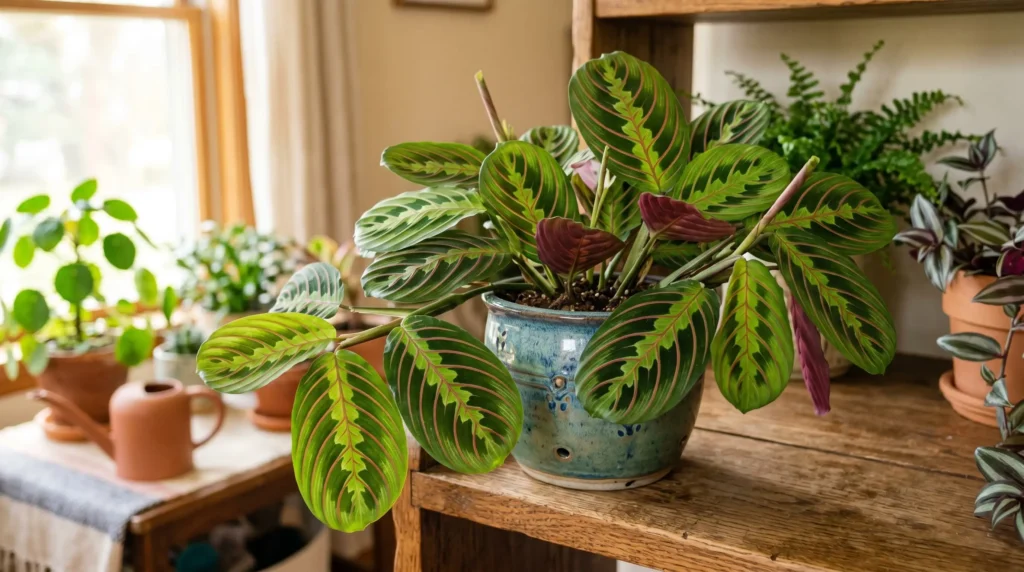
Botanical Identity
Understanding the prayer plant’s origins explains every aspect of its care. It is a floor-dwelling, shade-tolerant plant evolved to thrive in filtered light, high humidity, and warm, consistently moist conditions — the precise opposite of the average British centrally heated living room.
- Scientific name: Maranta leuconeura
- Family: Marantaceae (~550 species including Calathea/Goeppertia, Stromanthe, and Ctenanthe)
- Native habitat: Tropical rainforest floor, Brazil — shaded, humid, warm and consistently moist
- Common names: Prayer plant, herringbone plant (by variety), rabbit’s foot plant (by variety)
- Growth habit: Low-spreading, trailing stems; grows horizontally rather than upright
The Marantaceae family context matters for UK buyers. When you see plants labelled Calathea, Stromanthe, or Ctenanthe at a garden centre, they are cousins of the prayer plant — sharing similar care needs but distinct in their requirements. Understanding the family helps you make better buying and care decisions.
The Great Calathea Confusion — Explained for UK Buyers
What is a Calathea, and is it the same as a prayer plant? No — though they share the same plant family (Marantaceae). The confusion is widespread in UK garden centres and online shops, and understanding it prevents costly mistakes.
Between 2012 and 2020, botanists conducted DNA-based reclassification of the Marantaceae family. Many plants previously sold as Calathea were moved to a new genus: Goeppertia. This means a plant labelled ‘Calathea orbifolia’ in a UK garden centre may now be correctly named ‘Goeppertia orbifolia’ — but retailers have been slow to update their labelling.
The true prayer plant — Maranta leuconeura — was not affected by this reclassification. It remains its own genus. Here is how the three compare:
| Feature | Maranta leuconeura (True Prayer Plant) | Calathea / Goeppertia (Cousins) |
| Care difficulty | Beginner–Intermediate | Intermediate–Advanced |
| Humidity needs | 40–50% tolerated | 60%+ required to thrive |
| Watering tolerance | More forgiving of occasional lapses | Very sensitive to inconsistency |
| UK availability | Widely available; clearly labelled | Wide variety; often mislabelled |
| Growth habit | Spreading, trailing stems | Generally upright and compact |
| Best for | Beginners; pet households; UK central heating | Experienced growers; dedicated humidity environments |
Key takeaway for UK buyers: if you want an easier, more forgiving plant — choose Maranta leuconeura. If you are comfortable with stricter care, the Goeppertia/Calathea varieties offer stunning foliage variety.
The Science of Nyctinasty — Why Prayer Plants ‘Pray’
Nyctinasty is the scientific term for leaf movement in plants in response to light and darkness cycles. The prayer plant is the most famous example of this behaviour among common houseplants, and the mechanism behind it is fascinating.
How Nyctinasty Works — Step by Step
- At the base of each leaf sits a structure called the pulvinus — a swollen, joint-like motor organ.
- The pulvinus contains specialised motor cells that respond to changes in light intensity.
- As light decreases at dusk, potassium ions move between motor cells. Water follows the ions by osmosis, changing the turgor pressure (internal fluid pressure) in different cells.
- Cells on one side of the pulvinus inflate; cells on the other side deflate. This asymmetrical pressure change bends the leaf upward — the ‘praying’ position.
- At dawn, the process reverses: leaves flatten outward to maximise surface area for photosynthesis.
Crucially, this movement is not simply a reaction to light or darkness in the moment — it is governed by the plant’s circadian rhythm, a biological clock running on an approximately 24-hour cycle. This means that even in a room with constant artificial lighting, a prayer plant will still attempt its nightly leaf movement, albeit with reduced amplitude.
Why Do Prayer Plants Move? Three Scientific Theories
- Theory 1 — Light maximisation: Leaves flatten during daylight hours to present maximum surface area for photosynthesis. The upright night position reduces surface area and energy loss.
- Theory 2 — Water collection: The cupped, upright night position channels rainwater and dew down toward the plant’s centre, improving water access in the wild.
- Theory 3 — Pest protection: Closing leaves at night may deter nocturnal leaf-feeding insects by presenting a smaller, less accessible surface.
Engineering note: Researchers have studied nyctinasty as a model for soft robotics and moisture-responsive sun-tracking materials. The pulvinus mechanism — where hydraulic pressure creates movement without muscles or rigid structures — has inspired biomimetic engineering designs published in academic research since 2020.
| Care signal: If your prayer plant stops moving — leaves no longer folding at night or unfolding at dawn — this is one of the earliest and most reliable signs that something is wrong. Likely causes include insufficient light, chronic underwatering, or severe root stress. Do not ignore it. |
Prayer Plant Varieties — Complete UK Guide
Six main varieties of Maranta leuconeura are available in the UK, ranging from the widely sold herringbone plant to rare collector specimens. This guide covers all of them — with visual identification notes and UK availability details that no competitor provides.
All Six Varieties Available in the UK
| Variety | Visual Description | UK Availability |
| M. leuconeura var. erythrophylla (‘Herringbone Plant’) | Dark green leaves with vivid red/pink veins radiating outward from a pale green centre stripe. Undersides are deep purple-red. | Most common in UK — Beards & Daisies, Leaf Envy, most garden centres. Ideal starting choice. |
| M. leuconeura var. kerchoveana (‘Rabbit’s Foot Plant’) | Light green with paired brown blotches along the midrib; trailing habit. Blotches turn green as leaves mature. | Good online availability; excellent for hanging baskets. |
| M. leuconeura var. leuconeura (‘Black Prayer Plant’) | Deep, near-black green with silver and grey markings; more compact growth habit. | Rarer in UK — specialist online nurseries and Etsy sellers. |
| M. leuconeura ‘Lemon Lime’ | Lime-green and yellow-green striped leaves with a bright, zingy coloration. Striking in low-light areas. | Growing UK availability — Etsy plant sellers and specialty online shops. |
| M. leuconeura ‘Fascinator’ | Dark green with crimson or deep pink veins; slightly velvety leaf texture. More dramatic than erythrophylla. | Online specialty retailers; harder to find in physical UK shops. |
| M. leuconeura ‘Kim’ | Cream and white variegated patches on dark green; very distinctive collector’s colouring. | Rare — collector plant; found on Etsy and UK plant swap communities. |
How to Identify Your Prayer Plant Variety
Use these identification keys to determine which variety you own — useful when plants arrive unlabelled or with generic ‘prayer plant’ tags.
- Vein colour first: Red or pink veins = erythrophylla (‘Herringbone’). No coloured veins = kerchoveana or leuconeura.
- Blotch pattern: Paired brown or dark green blotches along the central midrib = kerchoveana (‘Rabbit’s Foot’).
- Leaf base colour: Nearly black-green with silver markings = var. leuconeura (‘Black’ variety).
- Leaf texture: A notably velvety underside often indicates ‘Fascinator’ or var. leuconeura.
- Variegation: Cream or white patches = ‘Kim’. Bright yellow-green stripes = ‘Lemon Lime’.
When buying from UK garden centres, most plants are sold simply as ‘prayer plant’ or ‘Maranta’ — often the erythrophylla variety. For specific varieties, specialist online retailers, Etsy UK sellers, and plant swap communities offer the best selection.
Prayer Plant Care — UK-Specific Deep Dive
This section covers every aspect of prayer plant care, adapted specifically for UK growing conditions. Each subsection addresses the specific challenges that UK owners face — from hard water and central heating to seasonal light levels and British window orientations.
Light Requirements
Prayer plants need bright, indirect light — a direct reflection of their natural habitat on the shaded floor of Brazilian rainforests, where dappled light filters through a dense canopy above.
What Prayer Plants Need from Light
- Ideal: Bright, indirect light for 8–12 hours per day
- Tolerated: Lower light — but leaf markings may fade and growth will slow noticeably
- Harmful: Direct sunlight through glass, which scorches leaves and bleaches the distinctive coloured patterns
UK-Specific Placement Guide
- Best windowsill orientation: North or east-facing — these receive indirect or gentle morning light in UK homes
- South-facing windows: Place the plant 1–2 metres back from the glass, especially in summer
- UK winter (October–February): Move plants closer to windows as daylight hours drop to as few as 8 hours
- Grow lights: A 12-hour timer on a full-spectrum grow light (available from Amazon UK, Gardening Direct) replicates tropical daylength during UK dark winters and prevents leggy growth
| UK placement tip: The phrase ‘bright indirect light’ is often misunderstood. In a UK home, a good test is: can you comfortably read a book without switching on a lamp? If yes, the light level is likely sufficient for a prayer plant. |
Watering — The UK Hard Water Problem
Watering is the most common point of failure for UK prayer plant owners — and the reason is almost always water quality, not quantity. This section addresses both.
The Fundamental Watering Rule
- Keep soil consistently moist (not soggy) from spring to autumn
- Reduce watering in winter — soil should be barely moist, not wet
- Check soil moisture every 3–4 days by pushing a finger 2cm into the compost — water when the top inch feels just dry
- Never water on a fixed schedule — instead, respond to the soil’s actual moisture level
The UK Hard Water Crisis
Hard water is the single biggest UK-specific challenge for prayer plant owners — and the reason most UK guides fail their readers by not addressing it.
|
Water Source Quality — Ranked for UK Owners
- 1. Rainwater (best): Free, naturally soft, no fluoride or chlorine — prayer plants thrive on it
- 2. Filtered water (Brita jug or similar): Removes chlorine and reduces mineral content — widely available in UK
- 3. Distilled water: Excellent water quality; available from chemists and Amazon UK; cost makes it impractical for regular use
- 4. Tap water left out 24 hours: Removes chlorine only — fluoride remains. Better than nothing; not ideal in hard water areas
Watering Technique
- Water thoroughly until water flows freely from the drainage holes — then allow to drain completely before replacing in a saucer
- Always use tepid or room-temperature water — cold water shocks tropical roots and can cause leaf curl
- Never allow the pot to sit in standing water in a saucer — root rot develops rapidly in waterlogged conditions
- Soil flush: every 2–3 months, run filtered water slowly through the pot for several minutes to flush accumulated mineral deposits
Humidity — The UK Winter Challenge
Humidity is the aspect of prayer plant care most neglected by UK guides — and the one most affected by the specific conditions of British homes in winter.
Why Humidity Matters
- Native Brazilian rainforest habitat: 70–90% relative humidity year-round
- UK average indoor humidity in summer: 40–55% (manageable)
- UK average indoor humidity in winter with central heating: 20–35% (critical problem)
- Prayer plants need 50–60%+ — UK central heating creates conditions closer to a desert than a rainforest
UK Humidity Solutions — Ranked by Effectiveness
| Method | Effectiveness & UK Notes |
| Small ultrasonic humidifier | ★★★★★ Best solution. Run near the plant in winter. Available from Amazon UK, Argos, John Lewis, and Dunelm. Target 55%+ relative humidity. A hygrometer (from £8 on Amazon UK) lets you monitor humidity levels precisely. |
| Pebble tray with water | ★★★ Good free solution. Fill a wide saucer with decorative pebbles and add water to just below the pebble surface. The pot sits on the pebbles above the waterline. Evaporation raises local humidity around the plant. |
| Grouping plants together | ★★★ Plants release water vapour through transpiration — clustering several plants raises local humidity. Works well combined with a pebble tray. |
| Bathroom or kitchen placement | ★★★ Naturally more humid rooms in most UK homes. Good option provided adequate light is available. |
| Regular misting | ★★ Controversial. Misting raises humidity only for 20–30 minutes and risks fungal leaf spots if water sits overnight on the leaves in cool UK conditions. Use only as a last resort. |
| Glass terrarium or humidity cabinet | ★★★★ Excellent humidity control; impractical for most UK homes but ideal for smaller specimens or particularly sensitive varieties. |
Temperature
Prayer plants thrive at normal UK room temperatures — making temperature one of the easier care factors to manage in British homes.
- Ideal range: 15–27°C — typical UK living room temperatures throughout the year
- Minimum temperature: 15°C — do not allow the plant to drop below this threshold
- UK conservatories: Excellent in summer, but can fall dangerously cold in autumn and winter — move plants indoors by October
- Draughts: A major UK-specific risk. Old sash windows, back doors, and cold windowsills in Victorian or Edwardian homes create cold spots that stress prayer plants
- Radiators: Proximity to radiators drops local humidity sharply and may cause leaf scorch from hot dry air — keep plants at least 60cm from any heat source
- Air conditioning: Increasingly present in UK offices — creates cool, dry conditions that prayer plants dislike
Soil & Potting Mix
The ideal prayer plant soil is well-draining but moisture-retentive, loose in texture, and slightly acidic — standard UK multipurpose compost straight from the bag is insufficient on its own.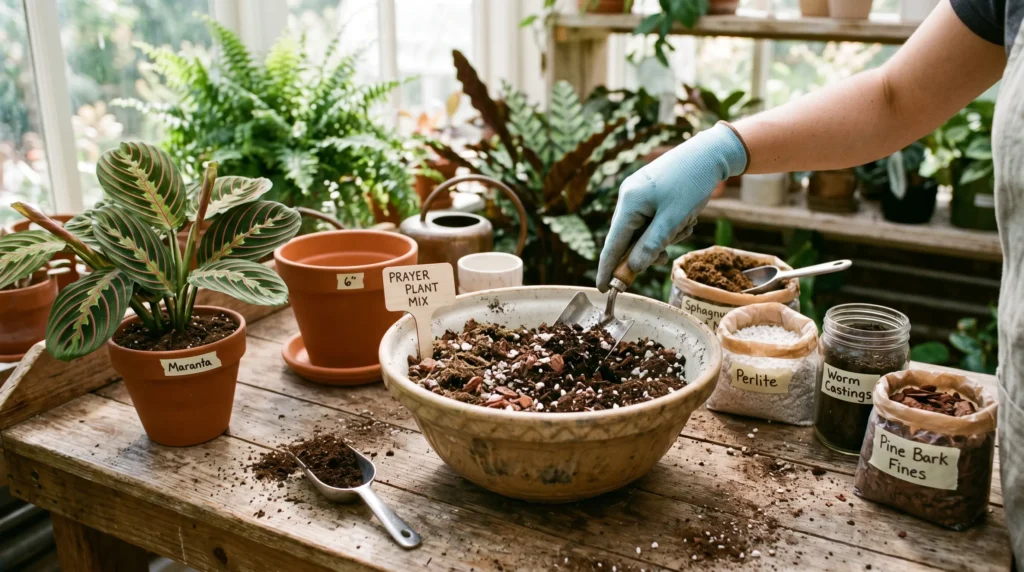
UK DIY Prayer Plant Soil Mix Recipe
|
Fertilising
- Feed monthly during the UK growing season: March through September
- Use a balanced liquid fertiliser — Miracle-Gro All-Purpose Liquid Feed, Westland Houseplant Feed, or Baby Bio are all appropriate and widely available
- Always dilute to half the stated strength — prayer plant roots are sensitive to mineral burn from concentrated feeds
- Do not feed October through February — the plant is in a semi-dormant state and cannot process nutrients effectively
- Signs of overfeeding: brown leaf tips (distinct from hard water browning — overfeeding causes broader browning), white mineral crust on the soil surface
- Signs of underfeeding: very slow growth, pale or fading leaf markings during the growing season
Potting & Repotting
- Repot every 1–2 years, or when roots emerge from drainage holes or circle the base of the pot
- Best time in UK: April or May — at the start of active spring growth
- Choose a wide, shallow pot — prayer plants grow horizontally, not deep; the root system mirrors this habit
- Only increase pot diameter by 2–3cm — going too large too quickly encourages root rot
- Prayer plants tolerate being slightly root-bound — do not rush to repot at the first sign of roots
- Always use a pot with drainage holes — root rot from waterlogged soil is the primary cause of death in UK prayer plants
How to Propagate a Prayer Plant (UK Step-by-Step)
Prayer plant propagation is straightforward, inexpensive, and highly rewarding — but timing matters in the UK, and no competitor guide addresses the seasonal context for British growers. There are three methods: water stem cuttings (easiest), division (fastest for established plants), and soil cuttings (best for cooler months with the right equipment).
Stem Cuttings in Water (Recommended for Beginners)
When to Propagate in the UK
- Best time: April to June — plant is in active growth and UK temperatures are warming
- Good: July and August — still viable but monitor for algae in water during warm spells
- Avoid: October through February — cold UK conditions slow rooting dramatically and increase risk of stem rot
Step-by-Step Instructions
- Step 1: Choose a healthy stem with at least 2 leaves and a visible node — the small bump or joint where leaves emerge from the stem.
- Step 2: Cut just below a node using clean, sharp scissors or a scalpel blade. Sterilise the cutting tool first with rubbing alcohol or a lighter flame to prevent introducing disease.
- Step 3: Remove the lower leaves, leaving only 1–2 leaves above the waterline. Submerged leaves rot quickly and contaminate the water.
- Step 4: Place the cutting in a clear glass or jar of room-temperature filtered water or collected rainwater. Clear glass allows you to monitor root development.
- Step 5: Position in bright, indirect light — a north-facing windowsill in spring works well. Avoid direct sun, which heats the water and encourages algae.
- Step 6: Change the water completely every 5–7 days to prevent bacterial build-up and keep the water fresh.
- Step 7: Roots should appear within 3–5 weeks in UK spring and summer conditions. In autumn, expect 6–8 weeks or more.
- Step 8: Pot into the soil mix (Section 3.5) when roots reach 2–3cm in length. Ease the transition by mixing a small amount of water into the initial potting mix to replicate the water environment.
Division (Fastest for Established Plants)
Division is the quickest propagation method for mature prayer plants with multiple stems. It is best performed at repotting time to minimise disturbance.
- Perform in April or May in UK conditions, at the same time as repotting
- Gently unpot the plant and shake away loose compost from the root ball
- Use your hands to tease apart the root ball gently at natural separation points — avoid cutting unless sections are tightly bound
- Each division requires at least 2–3 leaves and a section of intact root system
- Repot each division into its own appropriately sized pot with fresh soil mix
- Water thoroughly and place in bright indirect light
- Expect a 2–3 week adjustment period before new growth appears — some leaf wilting during this time is normal
Soil Cuttings (Best for Cooler UK Months)
- Take the same node cutting as Method 1 but plant directly into moist propagating compost or the standard care mix
- Cover the pot with a clear plastic propagator dome or bag to maintain high humidity around the cutting
- UK advantage: small heated propagators (available from Wilko, Amazon UK, and garden centres for £15–£30) raise the soil temperature to 18–22°C, significantly speeding rooting in cooler months
- Check after 3–4 weeks by gently tugging the cutting — resistance indicates roots have formed
- Remove the humidity cover gradually over 5–7 days to acclimatise the rooted cutting to normal room conditions
Complete Prayer Plant Troubleshooting Guide
This diagnostic table covers every common prayer plant problem, with UK-specific causes and fixes. Use the symptom column to identify the issue, then follow the diagnosis and fix.
| Symptom | Most Likely Cause(s) | Fix (UK-Specific) |
| Brown leaf tips | UK hard water / fluoride; low humidity; overfertilising | Switch to filtered water or collected rainwater immediately; boost humidity above 55%; reduce fertiliser to quarter-strength |
| Yellow leaves | Overwatering (most common UK cause); root rot; too little light | Check soil — if soggy, withhold water and check roots; if pale, move closer to a light source |
| Curling leaves | Low humidity (most common in UK centrally heated homes); underwatering; cold draughts | Raise humidity with humidifier or pebble tray; check soil moisture; move away from draughty UK windows |
| Brown blotches on leaves | Direct sunlight scorching through UK south-facing glass; cold water shock; fungal leaf spot | Move away from direct sun; switch to tepid water; improve air circulation around the plant |
| Leaves not praying | Insufficient light; chronic stress; constant artificial light preventing a natural dark cycle | Move to a brighter indirect light location; ensure plant receives a natural light/dark cycle of at least 8 hours darkness |
| Drooping / wilting leaves | Underwatering (most common); root rot; cold shock from draught or cold windowsill | Check soil — water thoroughly if dry; inspect roots if soil is persistently wet and plant remains wilted |
| Pale, washed-out markings | Too much direct light; root-bound; nutrient deficiency during growing season | Move to less direct light; check if repotting is overdue; begin monthly half-strength feeding in March |
| Leggy / sparse growth | Insufficient light; no feeding during growing season | Move to brighter indirect light; introduce monthly feeding March–September |
| White crust on soil surface | Mineral build-up from hard UK tap water or over-concentrated fertiliser | Flush soil thoroughly with filtered water; switch water source; reduce fertiliser concentration |
| Spider mites (fine webbing under leaves) | Low humidity; hot dry air — very common in UK centrally-heated homes in winter | Isolate plant immediately; wipe all leaves with a damp cloth; treat with diluted neem oil spray (available UK garden centres); boost humidity |
| Fungus gnats (tiny flies rising from soil) | Overwatering; persistently waterlogged soil | Allow soil to dry more between waterings; apply yellow sticky traps; treat with beneficial nematodes (Nemasys available in UK) |
| Root rot | Overwatering; pot without drainage holes; heavy compact soil | Unpot immediately; trim all brown, mushy roots; repot in fresh mix; withhold water for 7–10 days |
UK-Specific Pest Guide
Red Spider Mite
Red spider mite is the most common pest on UK prayer plants — and low winter humidity is almost always the trigger. When indoor humidity drops below 40% due to central heating, spider mites thrive. Look for fine silvery webbing on the undersides of leaves and a stippled, dull appearance on the upper surface.
- Treatment: isolate the plant immediately to prevent spread to other plants
- Wipe down all leaf surfaces with a damp cloth, paying close attention to undersides
- Spray with diluted neem oil solution (1 teaspoon neem oil + a drop of washing-up liquid per litre of water) — available from UK garden centres and Amazon
- Repeat every 5–7 days for 3 weeks to break the egg cycle
- Prevention: maintaining humidity above 50% makes spider mite infestations extremely rare
Fungus Gnats
Fungus gnats are a symptom of overwatering rather than a plant health crisis in themselves — but their larvae can damage roots. Allow soil to dry more between waterings, apply yellow sticky traps near the pot, and treat severe infestations with Nemasys beneficial nematodes (available online and at larger UK garden centres).
Mealybugs
Mealybugs appear as white cottony clusters, usually in leaf axils and stem joints. Treat by dabbing each cluster with a cotton bud dipped in isopropyl alcohol (70%, available from pharmacies). For larger infestations, spray the entire plant with neem oil solution and repeat weekly for four weeks.
UK Seasonal Care Calendar — Month by Month
No competitor offers a UK-specific seasonal care calendar aligned with British heating seasons and daylight patterns. This calendar tells you exactly what to do with your prayer plant in every month of the year.
| Season & Months | Care Focus | Key Actions for UK Owners |
| SPRINGMarch–May | Wake-up period — resume active care | Resume monthly half-strength feeding in March. Repot if needed in April or May. Move closer to windows as light increases. Begin propagation in April. Gradually increase watering frequency as temperatures rise. |
| EARLY SUMMERJune–July | Active growth — monitor for drying | Water more frequently as UK temperatures rise (check soil every 2–3 days). Keep out of direct sun through south-facing glass. Watch for spider mites during warm spells. Continue monthly feeding. |
| LATE SUMMERAugust–September | Peak growth — final push before dormancy | Continue feeding until end of September, then stop. Check humidity as some UK homes dry out in late summer warmth. Note any new growth for potential propagation cuttings. |
| AUTUMNOctober–November | Transition — prepare for winter | Stop feeding entirely after September. Reduce watering gradually. Move away from cold windowsills as temperatures drop outside. Begin running humidifier as central heating is switched on. Move any conservatory plants indoors. |
| WINTERDecember–February | Minimal care — protect from cold and dry air | Reduce watering to approximately every 10–14 days — always check soil first. Run humidifier continuously near plant. Keep above 15°C at all times. No feeding. Keep away from draughts, cold windows, and direct radiator heat. |
Prayer Plants in the UK Home
Beyond care, prayer plants are one of the most versatile and visually striking houseplants for UK interiors. This section covers placement, styling ideas, and the practical details that matter most to UK households — including pet safety.
Best Rooms in a UK Home
- Bathroom: Naturally more humid than other rooms — ideal for prayer plants if light is available. North-facing frosted glass windows can work with a supplemental grow light.
- Kitchen: Steam from cooking helps maintain humidity. Keep away from cold draughts near back doors.
- Bedroom: Safe for bedrooms (non-toxic to humans); the evening leaf-folding movement is particularly beautiful in a bedside setting.
- Living room: Most popular placement — works on shelving, side tables, or in hanging planters where trailing stems can cascade.
- Home office: Prayer plants are increasingly popular in UK home offices post-2020; their movement and bold markings provide a calming biophilic effect.
Styling Ideas
- Hanging planters: Trailing varieties (particularly kerchoveana) look excellent cascading from ceiling hooks — the undersides of the leaves show off their distinctive purple colouring.
- Shelf grouping: Combine with other Marantaceae cousins (Calathea, Stromanthe) for a cohesive jungle-shelf aesthetic with varied leaf patterns.
- Statement pots: The dramatic red-veined erythrophylla looks best in simple, neutral-coloured ceramic or terracotta pots that allow the leaf markings to take centre stage.
Pet & Child Safety
|
Health & Wellbeing Benefits
- Biophilic design: Prayer plants’ striking markings and daily movement create a living, dynamic element in interior spaces — responding to the natural light cycle in a way that static décor cannot.
- Air quality: Research suggests Maranta leuconeura can contribute to modest improvements in indoor air quality, including CO₂ reduction in enclosed spaces.
- Mindfulness prompt: Many prayer plant owners find the evening leaf-folding a gentle, reliable daily marker — a natural prompt to wind down that correlates with reduced stress.
Where to Buy a Prayer Plant in the UK
This section is completely absent from all major competitor articles. Whether you want a common herringbone variety or a rare collector’s specimen, here is a complete guide to sourcing prayer plants in the UK.
| Retailer | Pros & Cons |
| Beards & Daisies (beardsanddaisies.co.uk) | ✅ UK-based; reliable quality; nationwide delivery; ✅ clear care information included; ❌ limited variety selection |
| Leaf Envy (leafenvy.co.uk) | ✅ UK-based; stylish presentation with matching pot options; ✅ good customer service; ❌ premium pricing |
| Patch Plants (patchplants.com) | ✅ UK-based; excellent customer service and aftercare advice; ✅ plants well-packaged; ❌ limited rare variety selection |
| Amazon UK (third-party sellers) | ⚠️ Variable quality — check seller reviews and ratings carefully; ⚠️ risk of poor packaging in transit; ✅ competitive pricing |
| Etsy UK (independent sellers) | ✅ Best source for rare varieties; ✅ supports small UK growers and hobbyists; ✅ check seller feedback and listed location carefully |
| B&Q / Homebase / Dobbies | ✅ Often the most affordable option; ✅ can inspect the plant before purchasing; ❌ limited variety — usually erythrophylla only; ❌ care labels are often vague |
| Local independent garden centres | ✅ Inspect the plant in person; ✅ staff may have useful local advice; ❌ very limited variety range; ❌ plants may be mislabelled |
| Aldi / Lidl (seasonal) | ✅ Outstanding value when available (typically spring — watch for ‘Plant Week’ promotions); ❌ stock is unpredictable and sells out within days |
What to Check When Buying
- Examine leaves carefully: avoid plants with existing brown tips, yellowing, or pale, washed-out markings — these issues are hard to reverse
- Look for multiple stems: a fuller, bushier plant is better value than a single-stemmed specimen
- Check the undersides of leaves for spider mites (fine webbing, stippled surface) or mealybugs (white cottony clusters) before purchase
- Avoid plants displayed in cold areas: UK garden centres in autumn and winter sometimes display tropical plants near entrances or in unheated areas — cold-stressed plants take weeks to recover
- For rare varieties: Etsy UK sellers and the UK Houseplant Community on Facebook are the best sources for ‘Lemon Lime’, ‘Kim’, and ‘Fascinator’ varieties
Frequently Asked Questions
These questions are taken directly from Google’s ‘People Also Ask’ results for UK prayer plant searches. Each answer is written to be self-contained and directly quotable by search engines.
Q: Why has my prayer plant stopped praying?
A: The most likely cause is insufficient light. Prayer plants need a clear daily light-to-dark cycle to trigger nyctinasty — the leaf movement mechanism. Move the plant to a brighter location with good indirect light. Other causes include chronic drought, cold temperatures, or root stress. If overall plant health is poor, address the underlying care issue and movement should return as the plant recovers.
Q: Can I use tap water on my prayer plant in the UK?
A: In most UK regions, tap water will eventually cause brown leaf tips due to fluoride and mineral content from hard water. The safest options are collected rainwater, filtered water (a Brita-style jug works well), or distilled water. If you must use tap water, leave it uncovered for 24 hours — this dissipates chlorine but does not remove fluoride. For UK growers in hard water areas (South East, East Anglia, East Midlands), switching water source is the single most impactful change you can make.
Q: Why are my prayer plant’s leaves curling?
A: The two most common causes are low humidity and underwatering — both very common in UK centrally heated homes. Check humidity with an inexpensive hygrometer: if below 50%, use a humidifier or pebble tray. Check soil moisture by pressing a finger 2cm into the compost — if the top inch feels dry, water thoroughly with filtered or rain water. Cold draughts from windows or doors are a third common cause in UK homes.
Q: Is a prayer plant the same as a Calathea?
A: No — though they are cousins in the same plant family (Marantaceae). The true prayer plant is Maranta leuconeura, its own distinct genus. Calatheas are a related genus, many of which have been reclassified as Goeppertia following DNA-based botanical revision between 2012 and 2020. Marantas are generally easier to care for than Calatheas or Goeppertia, tolerating lower humidity and less-than-perfect watering.
Q: How often should I water my prayer plant in winter in the UK?
A: In UK winters, reduce watering to approximately every 10–14 days — but always check the soil before watering rather than following a fixed schedule. Push your finger 2cm into the compost: if the top inch feels barely moist, it is time to water. If it still feels damp, wait another 3–4 days. Root rot caused by winter overwatering is one of the most common causes of prayer plant death in UK homes.
Q: Are prayer plants safe for cats and dogs?
A: Yes. Maranta leuconeura is confirmed non-toxic to cats, dogs, and humans by the ASPCA. It is one of the safest houseplants available and an excellent choice for pet households. As with all houseplants, it is best kept where pets cannot chew the leaves — not for toxicity reasons, but to protect the plant from mechanical damage.
Q: Why does my prayer plant have brown tips?
A: In UK homes, the most common cause is hard tap water. Fluoride and calcium compounds in UK municipal water accumulate in leaf tips over weeks, causing crispy brown edges. Switch to collected rainwater or filtered water immediately. The second most common cause is low humidity — below 50% relative humidity, which is typical in UK homes with central heating in winter. Address both issues simultaneously for the best results.
Q: How fast do prayer plants grow?
A: During the UK growing season (March to September), prayer plants grow moderately fast in good conditions — expect several new leaves per month and visible spreading of the plant. Growth slows significantly from October, and the plant is in a semi-dormant state December through February. In ideal conditions — good indirect light, 55%+ humidity, soft water, and monthly feeding — a prayer plant can double in size in a single UK growing season.

Leave a Reply