
The Spanish bluebell (Hyacinthoides hispanica) is a bulbous perennial originally from the Iberian Peninsula. It was introduced to the UK as a garden plant in the 17th century and first recorded growing wild in 1909. It is taller, more vigorous, and less fragrant than the native English bluebell, and can cross-breed with it to produce fertile hybrids.
Every spring, millions of UK gardeners look down at bell-shaped blue flowers in their borders and assume they are looking at a native British bluebell. In most cases, they are not. The plant growing in the majority of UK gardens labelled “bluebell” is almost certainly a Spanish bluebell — or, more precisely, its hybrid — and the two plants have very different implications for your garden and for British wildlife.
The United Kingdom holds approximately half of the world’s entire native bluebell population. That is a globally significant responsibility. The Spanish bluebell poses a documented threat through competition and cross-breeding — but the science is more nuanced than most articles admit, and the picture for UK gardeners is considerably more complex than “this plant is bad.”
This guide covers everything you need to know: how to identify Spanish bluebells confidently, what UK law actually says (nation by nation), how to grow them responsibly if you choose to, how to remove them properly, what they mean for wildlife, and whether they are toxic to your pets or children. No other single source currently covers all of this. By the end, you will be able to make an informed decision for your own garden.
What Is the Spanish Bluebell? Botany and Background
Botanical Identity
The Spanish bluebell (Hyacinthoides hispanica) is a bulbous, deciduous perennial belonging to the Asparagaceae family — the asparagus family, which surprises most people. Its scientific name has changed several times over the centuries; you may also see it listed as Scilla hispanica or Endymion hispanicus in older references.
Key botanical facts at a glance:
| Characteristic | Detail |
|---|---|
| Scientific name | Hyacinthoides hispanica |
| Family | Asparagaceae |
| Native range | Portugal, western Spain, north-west Africa |
| RHS hardiness | H6 — fully hardy to −20°C |
| Plant type | Bulbous perennial; deciduous above ground |
| Dormancy period | July to February |
| Height | 25–45 cm depending on variety |
| Spread | Expanding clumps via bulb offsets |
| Growth habit | Upright |
In its native habitat, the Spanish bluebell grows in rocky landscapes and mixed woodland across Portugal, western Spain, and the fringes of north-west Africa. It is a tough, adaptable plant — qualities that make it an excellent garden subject but also a competitive threat when it escapes into British countryside.
How It Arrived in the UK
The Spanish bluebell was introduced to the UK as an ornamental garden plant in the 17th century. It was highly valued by Victorian and Edwardian gardeners for its ease of cultivation and its reliability. The first recorded “escape” from cultivation into the wild occurred in 1909.
Since then, the Spanish bluebell has naturalised across England, Scotland, Wales, and Northern Ireland. It is now found not only in gardens but in roadsides, woodland edges, railway embankments, and hedgerows throughout the UK. The most likely escape mechanism was a combination of careless bulb disposal — throwing spent bulbs into nearby hedgerows — and cross-pollination by bees carrying pollen between garden plants and nearby wild English bluebells.
The Hybrid Problem Most Articles Get Wrong
This is the most important thing most bluebell articles fail to explain: the majority of “Spanish bluebells” growing in UK gardens are not actually pure Spanish bluebells at all. They are a hybrid between the Spanish bluebell and the native English bluebell, formally named Hyacinthoides × massartiana.
This hybrid is the most commonly grown bluebell in British suburban gardens. It combines characteristics of both parents, tends to look more like a Spanish bluebell than an English one, and — crucially — is itself fertile. That means it can hybridise again with native English bluebells, compounding the genetic dilution concern.
A 2023 genetic analysis by the Royal Botanic Garden Edinburgh examined over 500 bluebell samples from 56 populations across Britain, Spain, and Portugal. Its findings were significant:
- Non-native UK bluebells are overwhelmingly H. × massartiana, not pure Spanish bluebell
- Pure English bluebell populations show greater resilience to hybridisation than previously feared
- The two species are not fully interfertile — native bluebells show a preference for their own pollen
- The hybrid itself tends to lose its non-native genes over time when growing alongside pure native population
This does not mean Spanish bluebells are harmless. But the picture is far more nuanced than “Spanish bluebells will wipe out English ones.” The physical competition for light and space remains a real concern, particularly in woodland edges and suburban settings adjacent to native colonies.
How to Identify a Spanish Bluebell
What Is the Easiest Way to Tell a Spanish Bluebell from an English Bluebell?
The single easiest identification test is smell. Crouch down and smell the flowers. A native English bluebell produces a distinct, sweet fragrance — one of the most recognised scents of the British spring. Spanish bluebells and their hybrids are entirely odourless. This single test eliminates the majority of identification confusion in the fi
The 6-Point Identification Test
| Feature | Spanish Bluebell (H. hispanica) | English Bluebell (H. non-scripta) | Hybrid (H. × massartiana) |
|---|---|---|---|
| Stem posture | Upright and stiff | Arching; drooping at the tip | Slightly arching |
| Flower arrangement | All around the stem (360°) | One side of the stem only | Variable |
| Flower colour | Pale blue (also pink and white) | Deep violet-blue (rarely white) | Pale to mid blue |
| Petal tips | Flared and spreading open | Curled back (reflexed) | Intermediate |
| Scent | None | Sweet and noticeable | Faint or none |
| Leaf width | ~3 cm wide, strap-shaped | ~1.5 cm wide, narrow | Intermediate |
| Anther (pollen) colour | Blue | Cream or white | Often blue |
| Height | Up to 45 cm | Up to 30 cm | Intermediate |
How to use this table in the field: Start with stem posture and scent. An arching stem with a sweet smell is almost certainly a native English bluebell. An upright stem with no scent is Spanish or hybrid. If you want certainty, check the petal tips with a hand lens: reflexed (curling back) tips confirm native English bluebell; spreading, open petal tips confirm Spanish or hybrid.
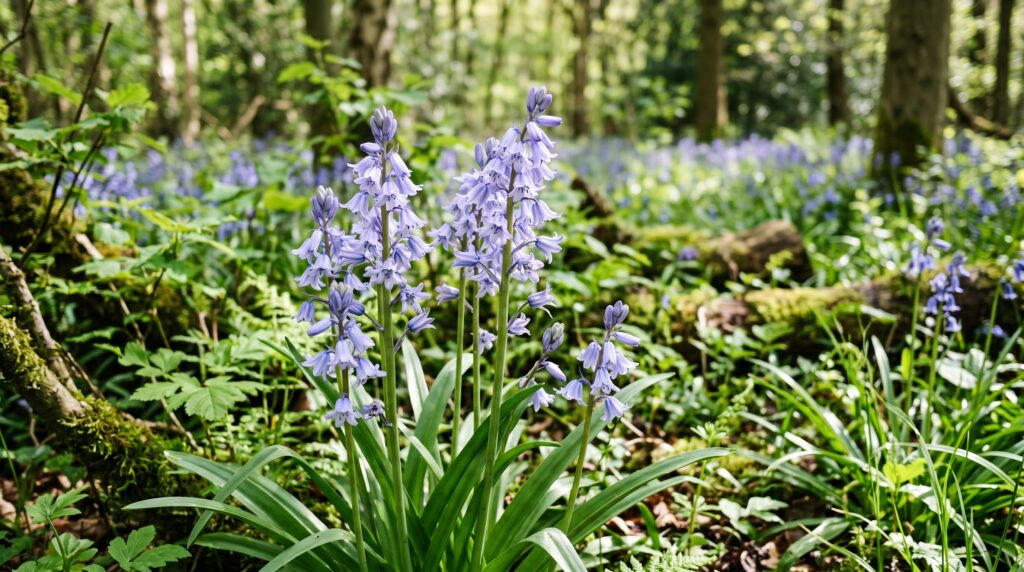
The Smell Test — Your Most Reliable Field Check
English bluebells are fragrant. Spanish bluebells and their hybrids are not. This is the fastest and most reliable identification method available to any gardener, requiring no equipment and no botanical knowledge. Simply crouch close to the flowers, cup your hands lightly around a stem, and inhale. If you can smell anything sweet, you have a native English bluebell or a plant very close to it. If you smell nothing, you are looking at a Spanish bluebell or hybrid.
This test works because the scent is one of the traits most consistently retained in pure native populations and most consistently absent from Spanish and hybrid plants.
How to Spot the Hybrid
Hybrids (Hyacinthoides × massartiana) are the most common bluebell in UK suburban gardens — more common than pure Spanish bluebell and more common in gardens than pure English bluebell.
They tend to resemble Spanish bluebells more than English ones: upright or slightly arching stems, pale flowers, no scent, and intermediate leaf width. The blue anthers are often a reliable giveaway. Plantlife estimates that most “bluebells” in urban areas are actually hybrids, and research by Plantlife found that one in six broadleaved woodlands in the UK now contains either Spanish bluebell or hybrid plants.
If your bluebell does not smell but looks “sort of arching,” you are probably looking at a hybrid.
Pink and White Spanish Bluebells
Spanish bluebells naturally occur in three colour forms: blue, pink, and white. Several named cultivars are widely sold in UK garden centres:
- ‘Dainty Maid’ — violet-pink flowers
- ‘Excelsior’ — deep purple-blue; one of the most popular cultivars
- ‘Miss World’ — violet-pink
- ‘White City’ — clear white flowers
Important: If you see a white bluebell in a garden or suburban setting, it is almost certainly a Spanish bluebell or hybrid. True white English bluebells are exceptionally rare in the wild — the Woodland Trust estimates they occur only once in every 10,000 flowers in native populations.
Flowering Times
Spanish bluebells flower slightly later than English bluebells, which is ecologically significant because their flowering windows overlap — enabling cross-pollination.
- English bluebell: Peaks in April to early May
- Spanish bluebell: Mid to late April through May, sometimes into early June
- Hybrids: Variable, typically tracking the Spanish parent
The overlapping window is the reason hybridisation is possible. Bees and other pollinators visit both species during the overlap and transfer pollen between them.
UK Legal Status — What You Are Actually Allowed to Do
Is It Legal to Grow Spanish Bluebells in the UK?
The answer depends on where in the UK you live and where you are growing them. The legal position differs meaningfully between England and Wales, Scotland, and Northern Ireland. Most gardening articles either ignore this question entirely or state the law inaccurately. Here is the definitive breakdown.
England and Wales
- Growing Spanish bluebells in your own private garden is legal in England and Wales.
- However, Spanish bluebell is listed on Schedule 9 of the Wildlife and Countryside Act 1981, which makes it an offence to plant or cause it to grow in the wild.
- “The wild” includes roadsides, woodland edges, public parks, hedgerows, riverbanks — anywhere outside the boundary of your private property.
- Plantlife and the RHS both recommend against growing Spanish bluebells near native bluebell colonies (particularly within 500 metres of ancient woodland), but this is guidance rather than law.
- Separately: Native English bluebells in the wild are protected by the same Act — it is illegal to pick, uproot, or sell wild English bluebells.
Scotland
- Growing Spanish bluebells in a private Scottish garden is not illegal.
- However, under the Wildlife and Natural Environment (Scotland) Act 2011, it is an offence to plant any non-native species in the wild in Scotland.
- Allowing Spanish bluebells to spread from your garden into wild land — including SSSIs (Sites of Special Scientific Interest), ancient woodland, or even a roadside verge — carries legal risk.
Northern Ireland
- Spanish bluebell is formally listed as an invasive non-native species in Northern Ireland.
- It is an offence to plant or cause it to grow in the wild.
- It is also listed as invasive in the Republic of Ireland
Soil and Waste Disposal Law
Soils containing Spanish bluebell plant material are classified as controlled waste under UK waste regulations. This is one of the most overlooked legal points in all gardening guidance on this topic.
This means:
- You cannot legally dump bulb-laden soil in an unlicensed skip or tip it in a hedgerow or public land.
- Soil with bulb material must be disposed of at a licensed landfill facility.
- Practically, for home gardeners: use your council green waste collection bin. Commercial composting facilities operate at high enough temperatures to kill bluebell bulbs. Your home compost heap does not.
Quick-Reference Legal Summary
Can I legally grow Spanish bluebells?
England and Wales: Yes, in your own garden. Illegal to plant or allow to spread into the wild.
Scotland: Yes, in your own garden. Illegal to introduce to wild land or allow to spread beyond your boundary.
Northern Ireland: Legal to grow in a private garden. Illegal in any wild setting. Formally classified as invasive.
Everywhere: Illegal to dump soil containing bluebell material in an unlicensed site or in the wild.
Spanish Bluebells and Native English Bluebells — The Ecological Debate
Do Spanish Bluebells Threaten Native English Bluebells?
The short answer is: yes, but the picture is more complex — and more hopeful — than most coverage suggests.
Why the Spanish Bluebell Is a Genuine Concern
The Spanish bluebell is significantly more vigorous and adaptable than the native English bluebell. It:
- Tolerates a wider range of soil types and sunnier, drier conditions
- Grows taller and spreads more aggressively via bulb offsets and self-seeding
- Can outcompete native bluebells for light, growing space, and pollinator visits
- Cross-pollinates with English bluebells to produce fertile hybrids that dilute the native gene pool
Plantlife research found that one in six broadleaved woodlands in the UK now contains Spanish bluebell or hybrid plants. Urban and suburban garden populations act as “source populations” — reservoirs of non-native genetic material that seed into adjacent countryside, carried by bees, wind, and careless bulb disposal.
The UK holds around half of the world’s native bluebell population. This gives British gardeners a disproportionate global responsibility.
The 2023 Science That Changes the Conversation
A 2023 genetic study by the Royal Botanic Garden Edinburgh challenges the most alarming predictions about native bluebell extinction through hybridisation. The study analysed over 500 bluebell samples from 56 populations across Britain, Spain, and Portugal and found several reassuring results:
- Non-native UK bluebells are overwhelmingly the hybrid H. × massartiana, not pure Spanish bluebell — meaning even the “invasive” population is genetically more complex than assumed
- English bluebells show a measurable preference for their own pollen (positive assortative mating), giving them a natural genetic defence against hybridisation
- The hybrid H. × massartiana preferentially cross-breeds back with native bluebells in a way that reduces its non-native contribution over time
- The English bluebell population is so large that occasional hybridisation has minimal net effect on the overall gene pool
The Edinburgh study concludes that widespread extinction of native English bluebells through hybridisation is considered unlikely. This does not make Spanish bluebells harmless. Physical competition for space and light in woodland edges and suburban settings near native colonies remains a real and documented concern.
Practical Takeaway for UK Gardeners
| Your situation | What this means in practice |
|---|---|
| Urban garden, 500m+ from any native bluebell woodland | Risk of contributing to hybridisation is low. Responsible management (deadheading) is sufficient. |
| Suburban garden, near woodland edges or parks with native bluebells | Deadhead rigorously. Consider container growing to prevent spread. |
| Garden adjacent to or within 500m of ancient woodland or known native bluebell colonies | Removing or containing Spanish bluebells is a genuinely meaningful conservation action. |
How to Grow Spanish Bluebells in a UK Garden
Should You Grow Spanish Bluebells?
Before the growing guide, an honest caveat: if your garden is near native bluebell woodland, the RHS, Plantlife, and the Wildlife Trusts all recommend choosing native English bluebells or other native alternatives instead (see Section 7). If your garden is an enclosed urban plot, well removed from native colonies, Spanish bluebells can be enjoyed responsibly with proper deadheading.
Ideal Growing Conditions
Spanish bluebells are one of the most tolerant and low-maintenance bulbs available to UK gardeners. Unlike native English bluebells, which prefer deep shade and moist woodland soil, Spanish bluebells thrive across a wider range of conditions.
| Condition | Requirement |
|---|---|
| Light | Partial shade to full shade; more sun-tolerant than native species |
| Soil | Moist, well-drained; tolerates poor and drier soils once established |
| Soil pH | Slightly acidic to neutral (pH 5.5–7.0) |
| Hardiness | H6 (RHS) — fully hardy throughout the UK, to −20°C |
| Best position | Under deciduous trees or shrubs, in borders — avoid waterlogged ground |
How to Plant Spanish Bluebell Bulbs
When to plant: Autumn — September to November, after the soil has begun to cool.
Step-by-step planting:
- Wear gloves. The sap is a mild skin irritant and all parts of the plant are toxic.
- Dig a hole 8–10 cm deep (3–4 inches). The pointed end of the bulb should face upward.
- Space bulbs 10–15 cm apart for naturalising; 5 cm apart in pots for a denser display.
- Plant under or between deciduous trees or shrubs — they tolerate and prefer some shade.
- Avoid planting in lawns. The broad leaves smother grass and take many weeks to die back, leaving unsightly bare patches.
- Water in lightly after planting.
Aftercare Through the Year
Spring (active growth and flowering):
- Water during dry spells while foliage is actively growing
- Apply a light dressing of compost around the base as growth begins
- Deadhead all spent flower heads before they set seed — this is the single most important management action to prevent unwanted spread
Late spring to early summer (dying back):
- Allow leaves to yellow and die back fully — do not cut them while they are still green. The leaves are photosynthesising and returning nutrients to the bulb for next year’s growth.
Late summer (dormancy):
- Divide congested clumps every three to five years while the plants are fully dormant (July–August)
- Lift, separate, and replant bulbs immediately at the correct depth
Autumn:
- No action needed — bulbs are dormant and hardy; no mulching required except in very exposed positions
Container Growing
Growing Spanish bluebells in containers naturally prevents them from spreading — making this the most responsible option for gardeners who want the colour without the invasive risk.
- Use deep pots — minimum 30 cm — with drainage holes
- Plant bulbs approximately 4 cm apart and 4 cm deep in pots
- Water freely during spring growth; reduce watering significantly during summer dormancy
- Refresh compost and repot every two to three years
Pests and Diseases
Spanish bluebells are virtually pest- and disease-free and one of the most problem-free bulbs in UK horticulture. No serious fungal diseases have been widely reported. The main nuisance is that snails are attracted to the sheltered foliage clumps and may then disperse to neighbouring plants. Control snails if this is a problem in your garden.
How to Remove Spanish Bluebells — A Step-by-Step UK Guide
How Do You Get Rid of Spanish Bluebells Permanently?
Permanent removal of Spanish bluebells requires sustained effort over three to five years. There is no single-season solution. The key reasons for this are:
- Bulbs sit 15–25 cm below the soil surface — below the reach of casual digging
- Small offset bulbs scatter through the surrounding soil and are easily missed
- Seeds already in the soil bank can germinate and produce new plants for several seasons
- Bulbs cut by a spade will leave viable fragments that regenerate
This is manageable. It simply requires consistent action over consecutive seasons.
When Is the Best Time to Remove Spanish Bluebells?
There are two ideal windows:
- Early spring: While foliage is actively growing and clearly visible — plants are easy to locate and identify. This is the best time for whole-plant removal.
- Late summer (July–August): When plants are fully dormant. Bulbs are at their most dormant and concentrated at this time of year, making them easier to spot in the soil.
Critical early action: If you are not yet ready for full removal, cut off all flowerheads before they open or immediately after flowering. This prevents seed dispersal and cross-pollination with any nearby native bluebells.
Step-by-Step Removal Method
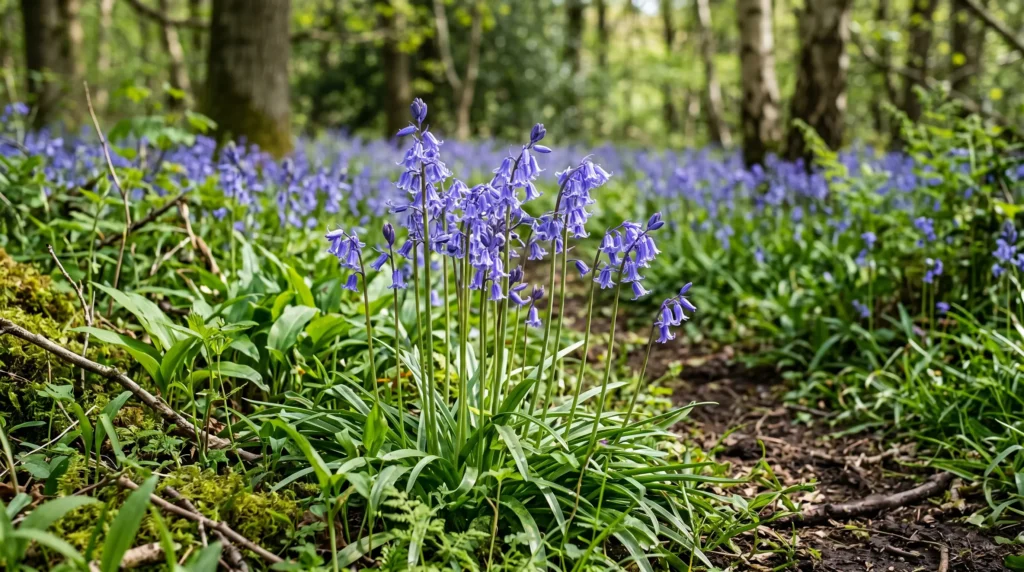
Step 1 — Deadhead immediately Cut all flowerheads before they open, or as soon as flowering finishes. Place cuttings in a sealed bag and put them in the general waste bin. Do not compost flowerheads.
Step 2 — Allow the foliage to die back fully Leave all leaves in place until they have turned yellow and collapsed (usually June to July). During this period the plant is sending nutrients back down to the bulb. Cutting green leaves reduces bulb size and vigour in the remaining plant — but the bulb will still survive and regrow.
Step 3 — Dig out bulbs with a fork, not a spade Use a garden fork, not a spade. Spades slice through bulbs, leaving viable fragments in the soil that will regenerate. Push the fork vertically into the soil as close to the clump as possible, lever the entire clump out carefully, and transfer it to a bag without shaking — shaking knocks small offset bulbs back into the soil. Work in dry conditions where possible, as dry soil makes individual bulbs easier to spot.
Step 4 — Sieve the disturbed soil For established infestations, pass the disturbed soil through a garden riddle (sieve) and remove all bulb fragments you find. Even small white fragments the size of a marble will regenerate if left in the ground.
Step 5 — Dispose of correctly and legally
- Do not put bulbs on your home compost heap — they will survive and regrow
- Do not dump bulbs or soil outside your garden — this is an offence under Schedule 9 of the Wildlife and Countryside Act
- Use your council green waste collection bin — commercial composting operates at temperatures that kill bulbs
- Alternatively, spread bulbs on cardboard in full sun for four to six weeks until completely desiccated (shrivelled and dried), then bag and put in general waste
Step 6 — Monitor and repeat every spring for at least three years New plants will emerge from missed bulbs and from seeds already in the soil. Return each spring as soon as growth is visible and repeat the process. Most gardeners achieve effective control within three seasons of consistent effort.
Does Weedkiller Work on Spanish Bluebells?
Spanish bluebells are resistant to most common garden herbicides. Glyphosate (sold under brand names including Roundup) can be effective if applied in early spring during active leaf growth, but it requires repeat applications and risks damaging surrounding plants and nearby native species. The RHS recommends non-chemical removal as the primary method.
Important: Never apply any herbicide near water or on a large scale without consulting current DEFRA guidance for your area.
Professional Removal
For large garden infestations or development sites, specialist invasive weed contractors can excavate and remove Spanish bluebell at scale. Soil containing plant material must be disposed of at a licensed waste facility under the Environmental Protection Act 1990 — it is classified as controlled waste.
Native Alternatives to Spanish Bluebells
What Should I Plant Instead of Spanish Bluebells?
If you are choosing not to grow Spanish bluebells — or want to complement their removal with better wildlife value — these native and near-native alternatives provide similar visual effects with significantly greater ecological benefit.
| Plant | Flowers | Conditions | Notes |
|---|---|---|---|
| Native English bluebell (H. non-scripta) | Deep violet-blue, April–May | Partial shade, moist woodland soil | The obvious choice. Fragrant; highest wildlife value. Buy from reputable UK nurseries only. |
| Wild garlic (Allium ursinum) | White, April–May | Partial to deep shade | Produces stunning white carpets; beloved by pollinators; strong garlic scent. |
| Wood anemone (Anemone nemorosa) | White, March–May | Partial to deep shade | Delicate, low-growing; naturalises well under deciduous trees. |
| Lesser celandine (Ficaria verna) | Golden-yellow, February–May | Shade tolerant | Earliest-flowering of this group; bright colour in late winter. |
| Three-cornered leek (Allium triquetrum) | White, March–May | Deep shade tolerant | Naturalised (not fully native); strongly shade-tolerant. Note: can itself spread vigorously. |
Sourcing note: Always buy native English bluebell bulbs from reputable UK specialist nurseries. It is illegal to collect bulbs, seeds, or plants from the wild under the Wildlife and Countryside Act 1981. Garden centres frequently sell hybrids labelled as “English bluebells” — look for Hyacinthoides non-scripta on the label and buy from named specialist suppliers if possible.
Do Spanish Bluebells Help or Harm UK Wildlife?
Are Spanish Bluebells Good for Wildlife?
Spanish bluebells are not ecologically worthless, but they are significantly less valuable to UK wildlife than native English bluebells. The honest answer requires looking at pollinators and wider ecological impact separately.
Pollinators
Spanish bluebells do attract bumblebees, butterflies, and hoverflies. The flowers produce nectar and pollen during the spring gap, when many other flowers have not yet opened, and early pollinators do visit them.
However, native English bluebells have co-evolved with UK pollinators over thousands of years. Some specialist insect species — particularly certain early-emerging bumblebee queens — show a clear preference for native bluebells and may not visit Spanish or hybrid flowers with the same frequency.
Net pollinator verdict: Spanish bluebells provide some value to generalist pollinators. They are not a substitute for native species.
Other Wildlife
- Deer and rabbits generally avoid all bluebell species due to their toxicity
- The foliage provides ground-level cover for small invertebrates in spring
- Dense Spanish bluebell colonies smother competing native ground flora — primroses, wood anemones, and violets are all displaced by heavy Spanish bluebell infestations — reducing overall biodiversity in affected areas
Net Ecological Verdict
| Garden context | Assessment |
|---|---|
| Urban enclosed garden, far from native colonies | Minimal ecological harm; some pollinator benefit |
| Suburban garden near woodland edges | Moderate concern; deadhead rigorously |
| Adjacent to or within 500m of native bluebell woodland | Genuine ecological concern; removal and replacement with native species is beneficial |
Are Spanish Bluebells Toxic? Pets, Children, and Humans
Are Spanish Bluebells Poisonous?
Yes. All bluebell species — English, Spanish, and hybrids — are toxic to dogs, cats, horses, and humans. Every part of the plant contains toxic compounds, and this applies to all three types equally. The toxicity of Spanish bluebells is one of the most-searched related questions and one of the most poorly covered in competitor content.
The Toxic Compounds
All bluebells contain scillarens — cardiac glycosides structurally similar to the toxic compounds found in foxglove (Digitalis). Every part of the plant is potentially toxic:
- Bulbs — the highest concentration of toxins; most dangerous
- Flowers and leaves — lower concentration but still hazardous
- Sap — causes skin irritation and dermatitis on contact
- Water in a vase containing cut bluebells — can contain leached toxins
Always wear gloves when handling any bluebell species, particularly when digging bulbs.
Toxicity to Dogs
All bluebell varieties are toxic to dogs. (Source: Purina UK; Veterinary Poisons Information Service)
Symptoms of bluebell ingestion in dogs:
- Vomiting
- Diarrhoea
- Drooling
- Abdominal pain and bloating
- Lethargy
- In severe cases: slow or irregular heartbeat, twitching, collapse
In practice, the Veterinary Poisons Information Service (VPIS) reports that most recorded UK dog cases involve only mild gastrointestinal symptoms. Most adult dogs instinctively avoid the plants. Puppies are at higher risk due to indiscriminate chewing behaviour.
Action: If your dog ingests any part of a bluebell plant, contact your vet immediately. Bring a sample of the plant or a photograph if possible.
Toxicity to Cats
Bluebells are toxic to cats for the same reasons as dogs. Ingestion causes vomiting, diarrhoea, and lethargy. Seek veterinary attention promptly if you suspect your cat has eaten any part of a bluebell plant.
Toxicity to Horses and Livestock
Toxicity in larger animals can be more serious. Digestive disturbances and cardiac symptoms have been reported in horses and cattle following bluebell ingestion. The bulbs can be mistaken for wild garlic or spring onion — do not store cut bluebells in or near stables or fields.
Toxicity to Humans
Bluebells are toxic if eaten by humans, causing abdominal pain, diarrhoea, and reduced heart rate. The bulbs are occasionally mistaken for wild garlic or onions — a potentially dangerous error that has resulted in poisoning incidents. Never consume any part of a bluebell plant.
Spanish bluebells are safe to have in a garden as long as children and pets do not eat the plant material. The risk in a normal garden setting is low, provided basic awareness is maintained.
Summary toxicity table:
| Who | Toxic? | Main risks | Action if ingested |
|---|---|---|---|
| Dogs | Yes | GI upset, in severe cases cardiac effects | Contact vet immediately |
| Cats | Yes | GI upset, lethargy | Seek veterinary attention |
| Horses/livestock | Yes — potentially serious | Digestive and cardiac symptoms | Contact vet immediately |
| Humans | Yes | Abdominal pain, diarrhoea; bulbs most dangerous | Seek medical advice |
| Skin contact | Mild irritant | Dermatitis from sap | Wash skin; wear gloves when handling |
Frequently Asked Questions About Spanish Bluebey.
Are Spanish bluebells invasive in the UK?
Spanish bluebells are listed on Schedule 9 of the Wildlife and Countryside Act 1981, making it an offence to plant or allow them to spread into the wild in England, Scotland, and Wales. They are formally classified as an invasive non-native species in Northern Ireland. In England and Wales they are legal to grow in private gardens, but are not recommended near native bluebell woodland. In Scotland, allowing them to spread from your garden into wild land also carries legal risk.
How do I know if my bluebell is Spanish or English?
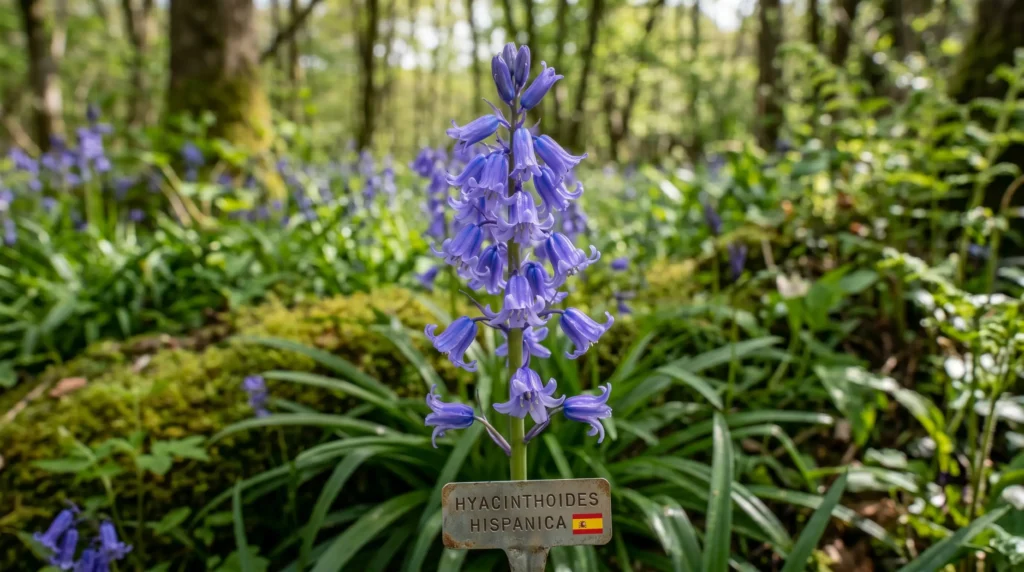
Check four things: stem posture (upright = Spanish, arching and drooping at the tip = English), flower arrangement (flowers all around the stem = Spanish, one side only = English), scent (none = Spanish, sweet fragrance = English), and leaf width (over 2 cm wide = Spanish, narrower than 2 cm = English). The scent test is the easiest and most reliable method.
Will Spanish bluebells take over my garden?
Yes, if left unmanaged. Spanish bluebells spread via underground bulb offsets and by self-seeding, and can form dense colonies within three to five years that smother other spring plants. Deadheading spent flowers before they set seed and digging out bulbs regularly will keep them in check.
Can I put Spanish bluebell bulbs in my compost?
No. Bluebell bulbs survive home composting and will regrow. Place them in your council green waste collection bin instead — commercial composting facilities operate at temperatures high enough to kill the bulbs. Do not dump them outside your garden as this constitutes an offence under Schedule 9 of the Wildlife and Countryside Act.
Is it illegal to pick Spanish bluebells?
Spanish bluebells in your own garden are not legally protected and you may pick them freely. However, native English bluebells in the wild are protected under the Wildlife and Countryside Act 1981 — it is illegal to pick, uproot, or trade wild English bluebells. If you are in any doubt about the species you are looking at in a wild setting, do not pick it.
How deep do Spanish bluebell bulbs go?
Spanish bluebell bulbs typically sit 15–25 cm below the surface, with offset bulbs at varying shallower depths. This is why they are difficult to fully eradicate — a standard garden fork will reach the main bulbs, but many small offsets will inevitably be missed and will regenerate the following season.
Do Spanish bluebells smell?
No. Spanish bluebells and their hybrids are odourless. This is one of the most reliable ways to distinguish them from native English bluebells, which have a distinct, sweet fragrance that is one of the characteristic scents of the British spring. If your bluebell does not smell, it is almost certainly Spanish or hybrid.
When do Spanish bluebells flower in the UK?
Spanish bluebells typically flower from mid to late April through May, sometimes continuing into early June depending on local conditions and the season. This is slightly later than native English bluebells, which peak in April to early May. The overlapping flowering period enables cross-pollination between the two species.
Making an Informed Decision About Spanish Bluebells
The Spanish bluebell is neither villain nor hero. It is an attractive, robust, and easy-to-grow garden plant with a complicated ecological footprint — and the right response to it depends entirely on where you garden and how you manage it.
The decision framework is straightforward:
- Urban enclosed garden, well away from native bluebell woodland: Spanish bluebells can be grown responsibly. Deadhead after flowering, consider container growing, and dispose of plant material correctly.
- Garden near woodland edges, parks with native bluebells, or ancient woodland: Take the invasive concern seriously. Contain, manage rigorously, or remove and replace with native alternatives.
- Near confirmed native English bluebell colonies: Removal and replacement with native species is genuinely beneficial to UK conservation, and your effort will have a real impact.
The UK’s native bluebell woodlands are a globally rare and irreplaceable habitat. Whether you choose to grow Spanish bluebells, manage them, or remove them entirely, the key is informed, responsible action — for your garden and for Britain’s native bluebell woodlands.

Leave a Reply