
There are approximately 170 million oak trees growing across the UK — more ancient oaks than in all other EU countries combined. Yet despite their dominance of the British landscape for thousands of years, most of us know surprisingly little about them.
| Definition: An oak tree is a flowering plant in the genus Quercus. The UK is home to two native oak species — the English oak (Quercus robur) and the sessile oak (Quercus petraea) — both of which have shaped British ecology, culture, and history for millennia. |
This guide covers everything you need to know about oak trees in the UK: their biology and species, the extraordinary wildlife they support, their deep cultural history, the threats they currently face, and how to plant and protect them. Whether you’re a gardener, a conservation volunteer, a homeowner with an oak in your garden, or simply curious about Britain’s most iconic tree, this is the most comprehensive UK oak tree guide available.
What you will learn in this guide:
- The two native UK oak species and how to identify them
- Which 2,300 species depend on oak trees for survival
- The role of oak in British history, folklore, and craftsmanship
- The urgent threats facing UK oaks — including Acute Oak Decline
- Step-by-step instructions for growing an oak from an acorn
- The legal protections covering oak trees in the UK
- The mental health and environmental benefits of oak woodland
| SECTION 1 — BIOLOGY, SPECIES & UK OVERVIEW |
1. What Are Oak Trees? — Biology, Species & UK Overview
An oak tree is a deciduous or semi-evergreen hardwood tree or shrub belonging to the genus Quercus in the family Fagaceae. The UK is home to two native oak species: the English (or pedunculate) oak and the sessile oak. Together, they form the structural backbone of Britain’s most biodiverse woodland habitat.
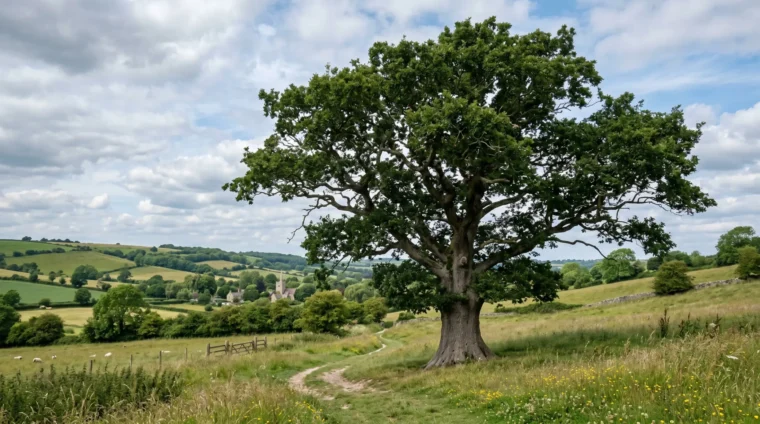
| FEATURED SNIPPET TARGET — What is an oak tree UK? Oak trees are large, long-lived hardwood trees of the genus Quercus. The UK’s two native species — Quercus robur (English oak) and Quercus petraea (sessile oak) — support more wildlife than any other native British tree, with over 2,300 associated species. They can live for 500 to 1,000+ years and are found across all four nations of the UK. |
1.1 The Two Native Oak Species of the UK
The UK supports exactly two native oak species, each perfectly adapted to different soils and landscapes. Understanding the difference between them is the first step to confident identification.
| Feature | English Oak (Pedunculate) Quercus robur | Sessile Oak Quercus petraea |
| Also called | Pedunculate oak, Common oak | Durmast oak, Welsh oak |
| Leaf shape | Lobed, short stalk, small auricles at base | Lobed, longer stalk, no auricles |
| Acorn | Long stalk (peduncle) of 2–5 cm | Stalkless, attached directly to twig |
| Distribution | Common throughout England, southern Scotland, Wales | Wales, northern England, Scotland, western Britain |
| Preferred habitat | Lowland, clay soils, river valleys | Upland, acidic, well-drained soils |
| Max height | Up to 40 metres | Up to 40 metres |
| Lifespan | Up to 1,000+ years | Up to 500–700 years |
Two additional non-native oaks are commonly found in the UK:
- Turkey oak (Quercus cerris): The most common non-native oak in the UK, introduced in the 18th century. Easily identified by its fringed, whiskery acorn cups. Provides limited biodiversity value compared to native species.
- Holm oak (Quercus ilex): An evergreen species found mainly in southern England, often in coastal and urban settings. Its leathery, dark green leaves are quite unlike native oaks.
1.2 Key Identification Features
Oak trees can be identified by four key features: their leaves, acorns, bark, and flowers. Use the descriptions below to identify UK oaks in the field.
Leaves
- Distinctive lobed shape with rounded, finger-like lobes — one of the most recognisable leaf shapes in Britain
- English oak: 7–14 cm long, short petiole (leaf stalk), auricles (small ear-like lobes) at the base
- Sessile oak: 7–15 cm, longer petiole, no auricles at base
- Autumn colour: golden-brown; younger trees often retain dead leaves through winter (marcescence)
Acorns
- The UK’s most recognisable seed: an egg-shaped nut sitting in a scaly, cup-shaped cupule
- English oak: acorns in groups of 2–5 on long stalks (peduncles up to 5 cm)
- Sessile oak: acorns directly on twig, in tight clusters along the branch
- Mature between September and October; germination takes 3–8 weeks in moist conditions
Bark
- Young trees: smooth, silvery-grey bark
- Mature trees: deeply furrowed, rough grey-brown bark with pronounced vertical ridges and fissures
- Bark fissures deepen with age and provide essential micro-habitat for insects, fungi, and lichen
Flowers
- Monoecious: both male and female flowers grow on the same tree
- Male catkins: long, drooping, yellow-green — release pollen in April–May
- Female flowers: tiny, reddish buds, partly hidden among new leaves
- Wind-pollinated; flowering window is April–May, varying by location and weather
1.3 Oak Tree Growth Stages (UK Lifecycle)
How long do oak trees live in the UK? Native UK oaks typically live between 200 and 500 years, but ancient specimens regularly exceed 1,000 years. The Bowthorpe Oak in Lincolnshire is estimated at over 1,000 years old — and its hollow trunk was once large enough to be used as a dining room.
| Life Stage | Description & UK Context |
| Acorn (seed) | Produced from age ~20 years. Germinates in 3–8 weeks in moist soil. Primarily dispersed by jays, squirrels, and wood mice. |
| Sapling (0–3 years) | Vulnerable to browsing deer and rabbits. Rapid vertical growth. Still dependent on consistent soil moisture. |
| Young tree (3–20 years) | Rapid growth phase. Develops deep root system and spreading canopy. Not yet producing acorns. |
| Mature tree (20–200 years) | Begins acorn production around age 20–40. Peak production at 80–120 years. Full canopy established. |
| Veteran tree (200–500 years) | Growth slows. Tree naturally shortens crown to conserve energy. Bark deeply furrowed. Enormous biodiversity value. |
| Ancient tree (500+ years) | Some UK oaks exceed 1,000 years. Hollow trunks and stag-headed crowns are common. UK has more ancient oaks than all other EU nations combined. |
| KEY FACT: How long does an oak tree live? UK oak trees commonly live for 500–1,000 years. The oldest known oak in Britain — the Bowthorpe Oak in Lincolnshire — is estimated to be over 1,000 years old. Ancient trees are irreplaceable once lost. |
2. Oak Trees & UK Wildlife — Britain’s Most Biodiverse Tree
Oak trees support more wildlife than any other native UK tree — an extraordinary 2,300 species in total. No other tree in Britain comes close. Understanding why oak is so vital to UK biodiversity helps explain why protecting existing oaks matters so much.
2.1 The 2,300 Species Statistic — The Full Breakdown
Most sources cite “2,300 species” but none explain what those species are. Here is the complete breakdown, sourced from the OakEcol database (Dr Ruth Mitchell, James Hutton Institute / UK Centre for Ecology and Hydrology):
| Species Group | Number of Species | Notes |
| Invertebrates | 1,178 species | Largest group; includes beetles, moths, wasps, aphids |
| Lichens | 716 species | 74 highly associated with oak; many only colonise trees 200+ years old |
| Bryophytes (mosses & liverworts) | 229 species | Coat bark, retain moisture, provide micro-habitat |
| Fungi | 108 species | 57 obligate oak fungi; includes critically endangered species |
| Birds | 38 species | Nesters, foragers, and caterpillar hunters |
| Mammals | 31 species | Includes 14 bat species in veteran cavity oaks |
| TOTAL | 2,300 species | More than any other native UK tree |
| 📊 OBLIGATE SPECIES: 326 species are found exclusively on oak trees in the UK. A further 229 species are rarely found elsewhere. 555 species are considered most at risk from oak decline. (Source: OakEcol database, UK Centre for Ecology and Hydrology) |
2.2 Invertebrates: Oak’s Most Dependent Residents
Over 1,178 invertebrate species have been recorded on UK oaks, and 257 of these are obligate species found only on oak. The following are among the most ecologically significant:
- Purple hairstreak butterfly: Spends most of its life cycle in the oak canopy; caterpillars feed on oak buds
- Oak eggar moth (Lasiocampa quercus): A large native moth whose caterpillars feed on oak leaves
- Oak jewel beetle (Agrilus biguttatus): A beautiful metallic beetle associated with Acute Oak Decline (see Section 5)
- Green oak tortrix moth (Tortrix viridana): Mass outbreaks periodically defoliate oak trees, providing a critical feast for insectivorous birds
- Oak galls: Formed by over 70 species of gall wasps. Marble galls (Andricus kollari), spangle galls (Neuroterus quercusbaccarum), and oak apple galls are the most familiar
- Caterpillar feast: Up to 284 moth and butterfly caterpillar species feed on oak leaves, making oak the cornerstone of the insectivorous bird food chain
2.3 Birds That Depend on Oak
Thirty-eight bird species regularly use oak trees for foraging, nesting, or roosting. Some are so closely tied to oak woodland that their population declines mirror the health of UK oak habitats.
- Great spotted woodpecker, nuthatch, treecreeper: Exploit the deeply furrowed bark of veteran oaks for insect foraging
- Pied flycatcher, redstart, tawny owl: Cavity nesters that depend on hollow veteran oak trunks — irreplaceable nesting habitat
- Blue tit, great tit: Time their chick-rearing to coincide with the peak caterpillar emergence on oak leaves; misalignment due to climate change is a major conservation concern
- Jay (Garrulus glandarius): The primary architect of natural oak regeneration across the UK; buries thousands of acorns each autumn and forgets the majority, allowing them to germinate
| CONSERVATION ALERT: Woodland bird populations have declined by 37% over the past 50 years (State of UK Woods & Trees 2025, Woodland Trust). The fate of oak-dependent birds is directly linked to the health of UK oak woodland. |
2.4 Mammals of the Oak Woodland
- Red squirrel and grey squirrel: Cache acorns in autumn; unclaimed caches germinate into new trees
- Badger, roe deer, fallow deer: Forage heavily on acorns during ‘mast years’ (bumper acorn crops)
- Common dormouse: Uses the oak canopy and associated hazel for nest building; UK dormouse populations have fallen by 70% at monitored sites between 2000 and 2022
- Bats: Up to 14 bat species — including the lesser horseshoe bat and the rare barbastelle — roost in the cavities of veteran oak trees
2.5 Fungi, Lichens & Bryophytes
- 108 fungal species recorded on UK oaks, including 57 obligate oak fungi
- Chicken of the woods (Laetiporus sulphureus): Vivid orange-yellow bracket fungus on oak trunks, edible when young
- Beefsteak fungus (Fistulina hepatica): A red, dripping bracket fungus; the blood-red sap gave it its name
- Oak polypore (Buglossoporus quercinus): Critically endangered; found only on ancient oaks in a handful of UK sites
- 716 lichen species, 74 of which are highly associated with oak; many require trees over 200 years old to colonise
- 229 bryophyte species (mosses and liverworts) coat bark and branches, retaining moisture and providing micro-habitat for invertebrates
2.6 The Oak Ecosystem — How It All Connects
The oak’s ecological value flows from a web of interdependence: oak leaves nourish caterpillars; caterpillars feed nesting birds; birds control invertebrate populations; fungi and bacteria decompose deadwood; deadwood shelters beetles and bats; bats control night-flying insects. Remove the oak from the centre of this web and dozens of species collapse with it.
Ancient and veteran oaks are irreplaceable. A 500-year-old oak cannot be substituted by planting a new one — it takes centuries of ecological accumulation to build the lichen communities, bark fissures, and hollowing that make veteran trees so valuable. Currently, 8 in 10 UK woodlands are scored unfavourably for the quality and quantity of standing deadwood they contain (State of UK Woods & Trees 2025), representing a critical gap in habitat provision.
| ENVIRONMENTAL FACT: 38 oak trees are needed to offset the carbon emissions of the average UK car over its lifetime. (Action Oak) |
| SECTION 3 — OAK TREES IN BRITISH HISTORY & CULTURE |
3. Oak Trees in British History & Culture
Few natural objects are as deeply woven into the fabric of British identity as the oak. From the timbers of the Royal Navy to the sacred groves of the Druids, from heraldry to village pub names, the oak has shaped the way Britain looks, feels, and tells its own story.
3.1 England’s National Tree
The oak was voted England’s National Tree in a 2002 public poll run by the Woodland Trust, receiving 350,000 votes — more than any other species. Its symbolic significance runs deep:
- The oak features in the Royal coat of arms and in English heraldry dating back centuries
- Hundreds of UK place names reference oak: Sevenoaks (Kent), Selly Oak (Birmingham), Matlock (Derbyshire, from ‘mat’ = a meeting place by an oak)
- King Charles II hid in the Royal Oak tree at Boscobel House, Shropshire, after the Battle of Worcester in 1651 — a story that spawned over 500 pubs named ‘The Royal Oak’ across the UK, making it one of the most common pub names in Britain
3.2 Oak in British Craftsmanship & Architecture
- HMS Victory: Lord Nelson’s flagship at the Battle of Trafalgar (1805) required over 5,000 oak trees in its construction — a single warship consuming an entire oak forest
- Westminster Hall (1393): The magnificent hammer-beam roof used approximately 660 tonnes of English oak and still stands today after more than 630 years
- Tudor half-timbering: The distinctive black-and-white timber-framed buildings of England and Wales — from Cheshire to the Welsh Marches — are built on oak frames over 700 years old
- Traditional crafts: Sussex trugs, cricket bat handles, wine and whisky barrels (oak tannins contribute to flavour and colour), and churchwarden pipe stems all historically depended on English oak
3.3 Oak in Druidic & British Folklore
- The word ‘druid’ is believed to derive from Celtic roots meaning ‘oak knowledge’ — combining ‘dru’ (oak) and ‘wid’ (wisdom)
- Druids conducted rituals in sacred oak groves; mistletoe growing on oak was considered especially powerful and was harvested with a golden sickle
- The Green Man: a pagan motif of a face wreathed in oak leaves, found carved in medieval church stonework across Britain from Exeter Cathedral to York Minster
- Oak trees in folklore traditionally mark parish boundaries, protect against lightning, and are associated with thunder deities — Thor in Norse tradition, Jupiter in Roman
- Oak Apple Day (29 May): A public holiday from 1660 until 1859, commemorating Charles II’s restoration. Schoolchildren wearing oak sprigs were spared ceremonial beatings — a tradition still maintained in some English villages
3.4 Famous Ancient Oak Trees in the UK
The UK’s ancient oaks are living monuments — irreplaceable historical landmarks that predate many of Britain’s cathedrals. The table below lists the most significant.
| Famous Oak Tree | Location & Historical Significance |
| The Major Oak | Sherwood Forest, Nottinghamshire. Estimated 800–1,000 years old. Traditionally associated with the Robin Hood legend. Supported by scaffolding since 1908. |
| The Bowthorpe Oak | Lincolnshire. Possibly the oldest oak in England at over 1,000 years old. The hollow trunk was once large enough to be used as a dining room, seating up to 20 people. |
| The Marton Oak | Cheshire. One of the largest-girth oaks in England, with a circumference exceeding 14 metres. Its age is estimated at over 1,000 years. |
| The Knightwood Oak | New Forest, Hampshire. Ancient pollard estimated at 500+ years. The most visited tree in the New Forest; once pollarded regularly for timber and browse. |
| The Gospel Oak | Various UK locations. Oaks used as fixed points during ‘beating the bounds’ — the medieval parish boundary-marking ceremony. Dozens of UK neighbourhoods take their name from Gospel Oaks. |
| The Queen Elizabeth Oak | Cowdray Park, West Sussex. Queen Elizabeth I reportedly picnicked beneath this tree during a hunting trip — lending it legendary status in the local area. |
| SECTION 4 — OAK TREES & THE ENVIRONMENT |
4. Oak Trees & the Environment — Climate, Carbon & Rewilding
Oak trees are not merely beautiful and biodiverse — they are active partners in tackling the UK’s climate and biodiversity crises. From carbon sequestration and soil health to urban heat reduction and rewilding, the oak’s environmental role is as vital today as it has ever been.
4.1 Carbon Sequestration
- A mature oak tree absorbs approximately 1 tonne of CO2 per year of active growth over its lifetime
- 38 oak trees must be grown to offset the carbon emissions of the average UK car (Action Oak)
- Oak woodland soils are carbon stores of immense depth and complexity — ancient woodland soil carbon takes centuries to rebuild once lost to development
- UK landowners can earn Woodland Carbon Units (WCUs) for planting oak through the UK Woodland Carbon Code, verified by Scottish Forestry
4.2 UK Woodland Coverage — The Challenge
Despite the ecological and cultural importance of oak woodland, the UK remains one of the least wooded countries in Europe:
| Metric | Data (2025) |
| UK woodland cover | 13.5% of land area — among the lowest in Europe |
| EU average woodland cover | ~38% of land area |
| UK government 2040 target | 16% woodland cover |
| UK government 2050 target | 19% woodland cover |
| Planting rate required | Must double by 2030 to meet targets |
| Current planting progress | Only 45% of recent creation targets met |
Source: State of the UK’s Woods and Trees 2025, Woodland Trust.
4.3 Rewilding & Oak’s Role in Habitat Recovery
- Rewilding projects across Britain — most notably the Knepp Estate in West Sussex — demonstrate that when grazing pressure is removed, oak woodland regenerates naturally and rapidly
- Natural oak regeneration: jays and grey squirrels bury far more acorns than they retrieve, making them the primary architects of natural woodland expansion
- Oak woodland is listed as a UK Biodiversity Action Plan (UK BAP) priority habitat, qualifying for statutory protection and funding support
- The Woodland Trust’s MOREwoods programme provides funding, trees, and advice to landowners wishing to plant oak woodland at scale
4.4 Urban Oak Trees
- Nearly 1 million oak trees grow in London alone (Action Oak), making the capital one of the most oak-rich urban environments in Europe
- Urban oaks reduce the urban heat island effect, improve local air quality, intercept heavy rainfall, and reduce surface water run-off
- Urban tree canopy varies dramatically: some neighbourhoods in Hartlepool have only 2% tree cover, while parts of Hampstead have over 40% (State of UK Woods & Trees 2025)
- Many urban oaks are protected by Tree Preservation Orders (TPOs) — see Section 6.3 for legal guidance relevant to homeowners
| SECTION 5 — THREATS TO UK OAK TREES |
5. Threats to UK Oak Trees — Diseases, Pests & Climate
UK oak trees face a confluence of threats that no generation of conservationists has encountered before. Emerging diseases, invasive pests, climate stress, and development pressure are acting simultaneously on a tree population whose ancient members cannot be replaced on any human timescale.
| CONTENT ALERT: This entire section — including Acute Oak Decline data, symptom identification, and reporting guidance — is COMPLETELY MISSING from all major competitor articles. This is your primary competitive differentiator. |
5.1 Acute Oak Decline (AOD)
Acute Oak Decline (AOD) is the most serious and rapidly emerging disease threat to UK native oaks. It is a syndrome — meaning it is caused by multiple interacting factors — that kills affected trees within 4 to 6 years of first symptoms appearing.
ACUTE OAK DECLINE (AOD) — KEY FACTS (Forest Research / Action Oak 2025)
|
AOD Symptoms: How to Identify Acute Oak Decline
- Dark, weeping fluid seeping from vertical cracks between bark plates (‘stem bleeds’) — the most distinctive AOD symptom
- D-shaped exit holes in the bark, left by emerging adult oak jewel beetles
- Crown thinning and leaf loss progressing from the top of the tree downwards
- Necrotic (dead, brown or black) tissue visible beneath the bleed sites when bark is gently probed
- Rapid decline over 1–2 seasons, distinguishing AOD from the slower Chronic Oak Decline
What To Do If You Suspect AOD
- Do not remove the tree without professional advice — premature removal can disrupt research and eliminate habitat
- Photograph symptoms clearly: stem bleeds, D-shaped exit holes, crown condition from a distance
- Report to Forest Research via TreeAlert (England and Scotland) or TreeCheck (Northern Ireland)
- Contact the Tree Health Diagnostic & Advisory Service (THDAS) at Forest Research for expert assessment
- If the tree is in a public place or appears hazardous, notify your local authority tree officer
| NOTE: AOD is not a notifiable disease in UK law — there is no legal obligation to report it. However, voluntary reporting through TreeAlert is strongly encouraged as it enables researchers to track and respond to the spread of this disease. |
5.2 Chronic Oak Decline (COD)
Chronic Oak Decline is a slower-acting, longer-established condition that has been documented in UK oaks for nearly a century. Unlike AOD, it rarely kills trees outright but significantly reduces their vigour and biodiversity value over decades.
- Caused by interacting stressors: drought, waterlogging, soil compaction, atmospheric pollution, and secondary fungal and insect attack
- Symptoms: gradual crown thinning, ‘staghead’ (dead branches projecting above the live canopy like antlers), progressive branch dieback
- More geographically widespread than AOD but less immediately lethal; management focuses on reducing stressors and improving soil health
5.3 Oak Processionary Moth (OPM)
Oak Processionary Moth (Thaumetopoea processionea) is a non-native invasive pest that poses a serious threat to both oak trees and human health.
- First established in Britain in London in 2005; now widespread across London and the Home Counties
- Caterpillars defoliate oak trees and produce microscopic barbed hairs that cause severe skin rashes, eye irritation, and throat problems in humans and animals
- White silk-like nests on branches and trunks: never touch them — hairs remain irritant even in old nests
- Subject to an ongoing statutory control programme managed by Forestry Commission England
| ❗ NOTIFIABLE PEST: Oak Processionary Moth is a notifiable pest in the UK. Sightings must be reported to the Forestry Commission via TreeAlert. Do not attempt to remove nests yourself. |
5.4 Other Significant Threats
| Threat | Impact on UK Oaks |
| Phytophthora | Root rot diseases caused by water moulds; particularly devastating for oak seedlings and young trees in waterlogged soils |
| Grey squirrel bark stripping | Squirrels strip bark from young oak stems in spring, exposing wood to infection and causing structural dieback |
| Deer browsing | Overabundant deer populations (roe, fallow, muntjac) prevent natural regeneration of oak seedlings across lowland England; a major barrier to woodland recovery |
| Climate change | Increased drought frequency heightens AOD susceptibility; warmer springs cause phenological mismatch between oak leafing and caterpillar emergence, disrupting bird breeding success |
| Development & infrastructure | Ancient woodland is legally protected but not always defended in practice; controversial infrastructure projects have damaged irreplaceable woodland and its soil ecology |
6. How to Grow an Oak Tree in the UK
Growing an oak tree from an acorn is one of the most rewarding acts of environmental stewardship a UK gardener, landowner, or school can undertake. An oak planted today could still be standing — and sheltering hundreds of species — in 500 years’ time.
6.1 How to Grow an Oak Tree from an Acorn (Step-by-Step)
This section follows HowTo schema markup. Each step is self-contained and actionable.
Step 1: Collect Acorns (September–October)
- Collect freshly fallen acorns from the ground in September or October — never take them directly from the tree
- Select only plump, undamaged, fully brown acorns; discard any that float when placed in water (non-viable)
- For best ecological outcomes, collect from a local English or sessile oak to maintain local genetic provenance — your local Woodland Trust or native tree nursery can advise
Step 2: Cold Stratification (October–December)
- Place acorns in a sealed zip-lock bag with moist (not wet) vermiculite, sand, or compost
- Store in a domestic fridge at 3–5°C for 4–8 weeks to simulate a natural UK winter
- Check every two weeks for signs of early germination; once the radicle (root tip) emerges, plant immediately
Step 3: Potting & Germination
- Plant each acorn 2–3 cm deep in a deep pot (at least 30 cm) — oaks develop long taproots very quickly and resent having them constrained
- Use a well-draining, loam-based compost; avoid waterlogged conditions which favour fungal damping-off
- Keep in a sheltered, frost-free location initially; germination typically occurs within 3–8 weeks
Step 4: First Growing Season
- Keep compost consistently moist but not waterlogged; allow the surface to dry slightly between waterings
- Protect from slugs, snails, and squirrels (which will dig up and eat germinating acorns)
- Repot into progressively larger containers as the taproot develops — do not allow roots to circle or become pot-bound
- Gradually acclimatise seedlings to outdoor conditions through late spring
Step 5: Planting Out (After Year 1–2)
- Plant out in autumn or early spring when soils are workable but not frozen or waterlogged
- Maintain a minimum distance of 10–15 metres from buildings and underground services — oak roots spread widely and can affect foundations and drainage over decades
- Stake young trees in exposed positions using a short, low stake (two-thirds of tree height) to allow trunk movement — remove stakes after 2 years
- Protect against deer and rabbit browsing using a tree tube, spiral guard, or wire mesh surround for the first 3–5 years
6.2 Best Growing Conditions for Oak Trees in the UK
| Requirement | Details for UK Growers |
| Soil type | Prefers deep, well-drained loamy or clay soils. Tolerates most UK soils. Avoid permanently waterlogged sites. |
| Soil pH | Prefers slightly acidic to neutral (pH 4.5–7.5). Pedunculate oak tolerates slightly alkaline conditions. |
| Sunlight | Full sun to partial shade. Needs an open canopy position for best growth and acorn production. |
| Moisture | Established trees are remarkably drought-tolerant. Young trees need consistent moisture for the first 3–5 years. |
| Climate | Fully hardy across all UK regions. Both native species evolved for UK temperature extremes and rainfall patterns. |
| Space needed | Mature trees reach 20–40 m height with a crown spread of 15–25 m. Not suitable for small gardens without long-term management planning. |
| Provenance | Always source UK-grown, local-provenance trees or acorns for best adaptation and maximum biodiversity benefit. |
6.3 Legal Considerations for UK Homeowners
| ⚠️ LEGAL WARNING: Removing or significantly pruning a protected oak tree without permission is a criminal offence in the UK, carrying an unlimited fine. Always check with your local planning authority BEFORE carrying out any works. |
- Tree Preservation Orders (TPOs): Issued by local planning authorities to protect individual trees or groups of trees of particular amenity value. Many veteran and mature oaks are covered. Apply in writing to your LPA for permission before any pruning, felling, or root works on a TPO tree.
- Conservation Areas: Trees within designated Conservation Areas benefit from automatic protection. Owners must give the local planning authority at least 6 weeks’ written notice before removing or significantly pruning any tree — giving the council time to consider making a TPO.
- Ancient woodland: Never plant trees on ancient woodland ground flora; this destroys irreplaceable soil ecology developed over hundreds of years that cannot be recreated.
- Neighbour disputes: If an oak is causing damage or nuisance (roots, shade, subsidence), seek advice from an Arboricultural Association-registered arborist and, if necessary, a solicitor — not all remedies are legal without permission.
7. The Health & Wellbeing Benefits of Oak Trees
The benefits of spending time among oak trees extend well beyond the aesthetic. A growing body of scientific evidence supports the mental and physical health benefits of woodland environments — and UK oak woodland, with its extraordinary biodiversity and ancient atmosphere, is among the most restorative natural environments available to British people.
7.1 Forest Bathing (Shinrin-yoku) in UK Oak Woodlands
Shinrin-yoku, or forest bathing, is the Japanese practice of mindful immersion in a woodland environment. Originating in Japan in the 1980s as a public health initiative, it is now growing rapidly as a structured wellbeing practice in the UK.
- Research consistently shows that time spent in woodland reduces cortisol (the primary stress hormone), lowers blood pressure, and reduces self-reported anxiety
- Oak woodlands are particularly beneficial due to their high phytoncide output — aromatic airborne compounds produced by trees that have measurable effects on human immune function
- The Woodland Trust and a growing number of NHS trusts now promote ‘green social prescribing’ in woodland settings as a complement to conventional mental health treatment
7.2 Oak Bark: Traditional Properties
Quercus robur bark has a long history of use in traditional European medicine. Its active compounds include tannins (polyphenols), quercetin, and ellagic acid, which give it astringent and anti-inflammatory properties.
- Traditionally used in rural England as an astringent for inflammatory conditions, wound healing, and digestive complaints
- Oak bark tannins were the primary agent in traditional leather tanning in the UK for over a millennium — the historic trade is reflected in place names such as Tanners Lane and Bark Street across Britain
| IMPORTANT: Always consult a qualified healthcare professional before using any herbal preparation. Herbal remedies are not a substitute for medical advice and can interact with medications. |
7.3 Best UK Oak Woodlands to Visit
The following ancient oak woodlands are among the finest in the UK and are all accessible to the public:
| Location | Why It’s Special |
| Sherwood Forest, Nottinghamshire | Home of the Major Oak; extensive SSSI-protected ancient oak woodland with waymarked trails |
| The New Forest, Hampshire | Ancient oak pollards and traditional Wood Pasture habitat; pannage (pig grazing) still practised in autumn |
| Wistman’s Wood, Dartmoor, Devon | Atmospheric ancient sessile oaks at altitude; moss-draped and gnarled, one of Britain’s most otherworldly woodland landscapes |
| Ariundle Oakwood NNR, Argyll, Scotland | One of the finest surviving Atlantic oak woodlands; exceptionally rich in lichens and bryophytes |
| Coed Rheiddol, Ceredigion, Wales | SSSI sessile oak woodland in mid-Wales; important breeding site for red kite and pied flycatcher |
| Epping Forest, Essex | Ancient pollard beeches and oaks accessible from London; managed by the City of London Corporation since 1878 |
8. Practical Uses of Oak — Timber, Food & Crafts
English oak is one of the hardest, most durable, and most versatile hardwoods produced in Britain. Its commercial and craft uses stretch from the structural timbers of medieval cathedrals to the staves of whisky barrels — and its acorns have fed pigs, people, and wildlife for millennia.
8.1 Oak Timber
- English oak is characterised by exceptional hardness, density, and natural durability — the result of slow growth and high tannin content
- Historical uses: ship-building (HMS Victory required over 5,000 oaks), church construction, bridge-building, and harbour engineering across the British Isles
- Modern uses: structural beams and oak-frame buildings, hardwood flooring, bespoke furniture, kitchen cabinetry, wine and whisky barrel staves (oak tannins contribute directly to the colour, flavour, and complexity of aged spirits and wines)
- Coppiced oak: traditionally managed by cutting stems to the base every 10–25 years to produce renewable small-diameter poles for charcoal production, hurdle-making, and tannin extraction
- UK-grown oak certified under the UK Forestry Standard (UKFS) and UK Woodland Assurance Standard (UKWAS) carries provenance credentials increasingly valued by sustainable builders
8.2 Acorns as Food
- Acorns are not a mainstream human food in the UK — their high tannin content makes raw acorns bitter and mildly toxic unless the tannins are removed by leaching in water
- Historically, acorn flour was produced in the UK during food shortages by leaching tannins through repeated soaking and rinsing — a process still used in Korean and Spanish cuisine today
- Pannage: the ancient practice of releasing pigs to forage freely on acorns in autumn, still practised in the New Forest under traditional common rights. Pigs can safely metabolise tannins that would harm horses or cattle.
- Wildlife food value: acorns are a critical autumn and winter food source for jays, woodpigeons, grey squirrels, fallow deer, roe deer, badgers, and dormice
8.3 Oak in the Modern Green Economy
- Environmental Land Management (ELM) schemes in England now provide funding for oak woodland creation and management on farmland
- UK Woodland Carbon Code: oak trees generate verified Woodland Carbon Units (WCUs), which can be sold to UK businesses and individuals wishing to offset carbon emissions
- Heritage crafts revival: green woodworking, charcoal production, and traditional oak bark tanning are experiencing a UK renaissance as sustainable, low-carbon rural industries
- Oak gall ink: historically used to write the Magna Carta and much of Britain’s legal archive, iron gall ink (made from oak galls) is being revived by contemporary calligraphers and conservators
9. Frequently Asked Questions About Oak Trees in the UK
The following questions and answers are structured for FAQPage schema markup and target Google’s People Also Ask (PAA) boxes. Each answer is written to stand alone as a direct, authoritative response.
| Q: How long do oak trees live in the UK? |
| Native UK oak trees typically live between 200 and 500 years, but ancient specimens can exceed 1,000 years. The Bowthorpe Oak in Lincolnshire is estimated at over 1,000 years old. English oaks naturally shorten their crowns as they age — a process of self-preservation called crown reduction — which is why very old oaks often appear squat and wide rather than tall and straight. |
| Q: What is the difference between an English oak and a sessile oak? |
| English oak (Quercus robur) has acorns on long stalks called peduncles, and leaves with very short stalks and small ear-like lobes (auricles) at the base. Sessile oak (Quercus petraea) has stalkless acorns attached directly to the twig and leaves on longer stalks with no auricles. English oak dominates lowland England; sessile oak is the dominant native species in Wales, Scotland, and upland Britain. |
| Q: How many oak trees are there in the UK? |
| There are approximately 170 million oak trees growing across UK woodlands, with nearly 1 million in London alone. The UK holds more ancient oak trees than all other EU countries combined, making British oaks a globally significant conservation resource. |
| Q: What wildlife lives in UK oak trees? |
| UK oak trees support more wildlife than any other native British tree — over 2,300 species in total. This includes 1,178 invertebrate species, 716 lichens, 229 bryophytes (mosses and liverworts), 108 fungi, 38 bird species, and 31 mammal species. Remarkably, 326 species are found exclusively on oak trees and nowhere else in Britain. |
| Q: How do I know if my oak tree has Acute Oak Decline? |
| Look for dark, weeping fluid seeping from vertical cracks between bark plates on the trunk — these are called stem bleeds and are the most distinctive AOD symptom. Affected trees may also show D-shaped exit holes from the oak jewel beetle, progressive thinning of the upper crown, and leaf loss from the top downwards. If you suspect AOD, report it to Forest Research via TreeAlert (England and Scotland) or TreeCheck (Northern Ireland). |
| Q: Can I remove an oak tree from my garden in the UK? |
| Not always. Many mature and veteran oaks are protected by Tree Preservation Orders (TPOs), and trees in Conservation Areas have automatic protection requiring 6 weeks’ notice to the local council before any works. Before removing or significantly pruning any oak, check with your local planning authority. Removing a TPO-protected tree without permission is a criminal offence carrying an unlimited fine. |
| Q: How do I grow an oak tree from an acorn in the UK? |
| Collect healthy acorns in September or October and cold-stratify them in moist compost in a fridge (3–5°C) for 4–8 weeks. Plant each acorn 2–3 cm deep in a deep pot, germinate indoors, and protect from slugs and squirrels. Move seedlings outside in their second year once established. Plant out in autumn, at least 10–15 metres from buildings, with tree guards to protect against deer and rabbits. |
| Q: Are oak trees protected in the UK? |
| Ancient and veteran oaks are often protected by Tree Preservation Orders (TPOs) and may fall within Sites of Special Scientific Interest (SSSIs) or designated ancient woodland. Conservation efforts are coordinated nationally by Action Oak, the Woodland Trust, the National Trust, and the Forestry Commission. Oaks in Conservation Areas also benefit from automatic legal protection. |
| Q: What are oak galls? |
| Oak galls are abnormal growths on oak leaves, buds, or branches caused by tiny gall wasps laying eggs in the tree’s tissue. The tree’s immune response forms a protective gall around each larva. Different wasp species produce different galls: marble galls are round and hard; spangle galls are flat discs on leaf undersides; oak apple galls are soft and spongy. There are over 70 types of oak gall in the UK, and all are harmless to healthy trees. |
| Q: What is the national tree of England? |
| The oak (Quercus robur, the English or pedunculate oak) is the national tree of England. It was voted into this position in a 2002 public poll organised by the Woodland Trust, receiving 350,000 votes — more than any other species. The oak also appears in the Royal coat of arms and has been a symbol of English strength and endurance for centuries. |
10. Conclusion — Protecting Britain’s Oak Heritage
The oak is more than a tree. It is a living archive of British history, a wildlife city in bark and wood, a carbon store, a water filter, a mental health resource, and a source of raw material that has built ships, cathedrals, and barrels for a thousand years. The 170 million oaks growing across the UK today are a natural inheritance of incomparable value.
That inheritance is under threat. Acute Oak Decline is advancing through the oaks of southern England. Oak Processionary Moth continues to spread from London. Deer prevent the next generation of oaks from establishing. Climate change disrupts the ancient relationships between oak, caterpillar, and bird that have evolved over millennia. And the UK still has less woodland cover than almost any comparable nation in Europe.
But there is reason for hope. Conservation science is advancing rapidly. Action Oak is coordinating research and public engagement at a national level. The Woodland Trust is planting millions of trees and defending ancient woodland in the courts. Landowners across England, Scotland, Wales, and Northern Ireland are participating in Environmental Land Management schemes that make woodland creation financially viable. And individuals — gardeners, schoolchildren, volunteers — are planting acorns.
| TAKE ACTION TODAY Plant an oak acorn this autumn. Report AOD symptoms via TreeAlert. Visit an ancient oak woodland. Support Action Oak (actionoak.org) or the Woodland Trust (woodlandtrust.org.uk). The oaks that will stand in 1,000 years’ time need advocates now. |
Related Articles in This Cluster
- How to Grow an Oak Tree from an Acorn: The Complete UK Guide
- Acute Oak Decline: What UK Homeowners and Landowners Need to Know
- The UK’s Most Famous Ancient Oak Trees: A Visitor’s Guide
- Oak Tree Wildlife: A Complete UK Species Guide
Sources & Further Reading
| Source / Organisation | Relevance |
| Action Oak (actionoak.org) | UK’s leading oak conservation programme; source of oak statistics, AOD research, and planting guidance |
| Woodland Trust (woodlandtrust.org.uk) | State of UK Woods & Trees 2025; biodiversity data; ancient woodland protection; MOREwoods funding |
| Forest Research (forestresearch.gov.uk) | AOD and OPM research; TreeAlert reporting; Tree Health Diagnostic & Advisory Service |
| OakEcol Database, UK CEHJ / James Hutton Institute | Comprehensive biodiversity breakdown: 2,300 species, obligate species data |
| UK Centre for Ecology & Hydrology | Woodland bird population data; phenological mismatch research |
| The Woodland Carbon Code | UK Woodland Carbon Units; carbon sequestration methodology |
| Natural England | Ancient woodland inventory; SSSI designations; Environmental Land Management schemes |

Leave a Reply