
Imagine a May morning in a UK garden. Towering violet globes sway above the border — each one a perfect sphere of tiny flowers, buzzing with bumblebees. In the woods nearby, a white carpet of star-shaped blooms releases a soft, unmistakable scent: wild garlic in full flower. That evening, you slice into a shallot and reach for the chives on the windowsill. Without knowing it, you have spent your entire day in the company of alliums.
| QUICK FACTS | |||
| Family | Amaryllidaceae | Native Range | Northern hemisphere, Central Asia |
| Genus | Allium (~750–900 species) | UK Flowering | May–August (variety dependent) |
| RHS AGM? | Yes — many varieties | Toxic to Pets? | YES — dogs, cats, horses |
| Pollinator Value | Excellent — bees & butterflies | UK Wild Species | Wild garlic (A. ursinum), chives, 3-cornered leek |
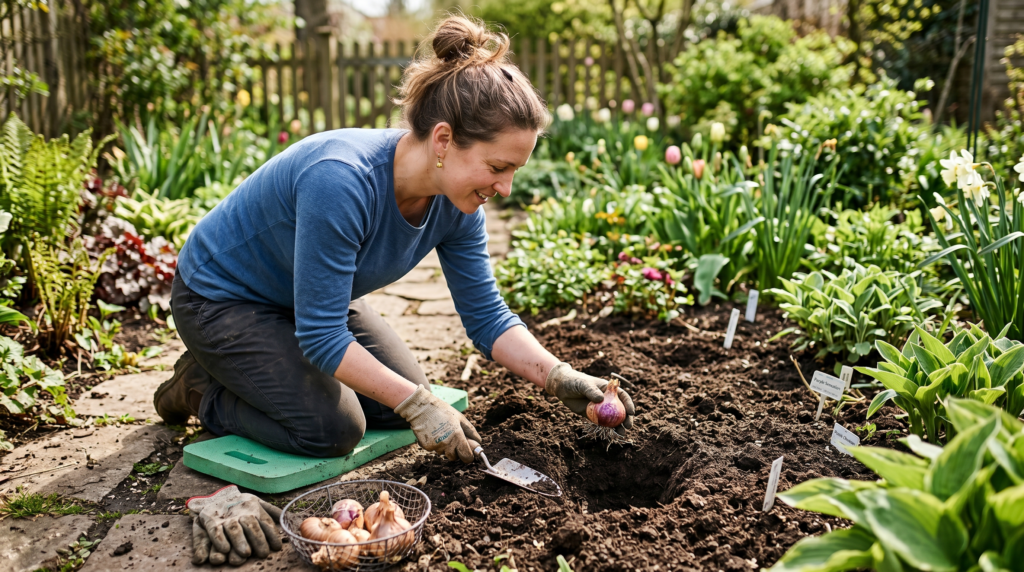
ornamental onion flowers is a genus of approximately 750–900 flowering plant species belonging to the family Amaryllidaceae. It encompasses everything from the purple ornamental globes of Chelsea show gardens to the garlic in every UK kitchen, the leeks at a Welsh rugby ground, and the wild garlic carpeting ancient woodlands each spring. No other plant genus plays such a central role in both British gardening and British cooking.
This guide is the UK’s only comprehensive resource covering ornamental alliums, edible alliums, and wild British species in a single place. Whether you are a home gardener planning your autumn bulb order, a forager seeking to identify ramsons safely, a cook wanting to understand the onion family, or a pet owner checking toxicity, this article has the definitive answer.
What Is an Allium? Botany, Origins & History
Definition: An (Amaryllidaceae) is any plant belonging to the genus Allium, a group of approximately 750–900 species characterised by their umbel flower structure, sulphur-containing compounds (which produce their distinctive smell), and bulbous or rhizomatous growth habit.
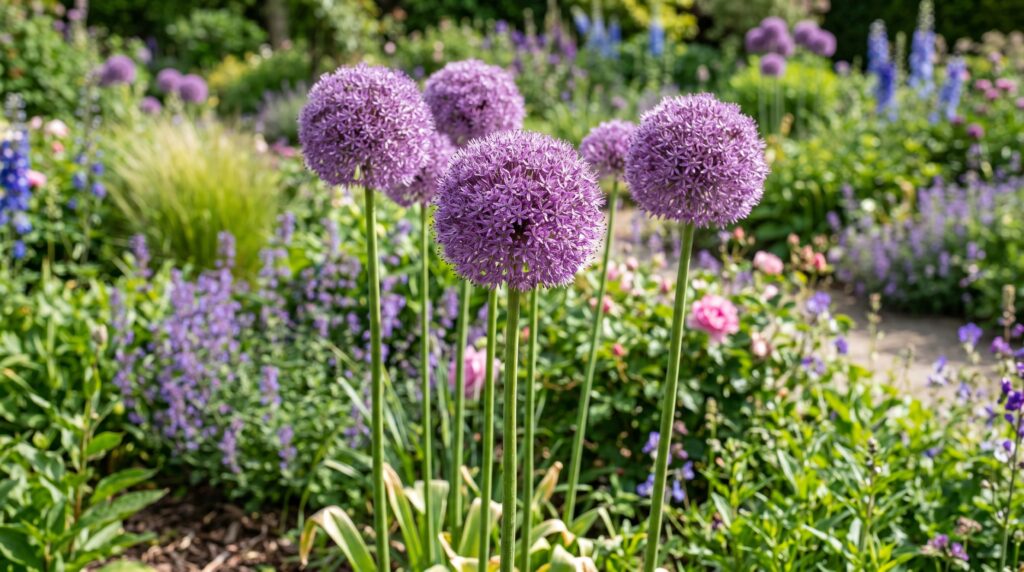
Botanical Classification
| Classification Level | Detail |
| Kingdom | Plantae |
| Family | Amaryllidaceae (formerly Alliaceae — reclassified in 2009) |
| Genus | Allium — from the Latin/Greek for garlic |
| Species count | Approximately 750–900 recognised species worldwide |
| Shared traits | Umbel flower structure, sulphur compounds, bulbous/rhizomatous growth, characteristic onion/garlic scent |
All alliums share three defining traits: their spherical or hemispherical umbel flower clusters, their production of sulphur compounds (responsible for both their smell and their health properties), and their growth from bulbs or rhizomes. Chromosome diversity within the genus means hybridisation is common, which is why new cultivars appear regularly in the nursery trade.
Origins & Native Range
Most ornamental alliums grown in UK gardens originate from the dry mountain regions of Central Asia — Afghanistan, Kazakhstan, and neighbouring countries. This origin explains two of their most useful characteristics: their tolerance of drought once established, and their need for free-draining soil (waterlogged conditions mimic nothing in their native habitat).
The majority of species are distributed across the northern hemisphere: Europe, the Mediterranean, Central and Southwest Asia. A small number of species are native to South America. The wild garlic (Allium ursinum) is a true British native, found across England, Wales, Scotland, and Ireland in damp deciduous woodland.
History & Cultural Significance in the UK
Alliums have been part of human civilisation for longer than almost any other food plant. Onions and garlic appear in Egyptian records from 3,200 BCE; Mesopotamian recipes dating to 1,700 BCE include garlic; Roman legions carried garlic on campaign, believing it conferred strength and courage.
In Britain specifically, the story is equally deep:
- Celtic Britons used Allium ursinum (wild garlic) for over 1,500 years — one of the longest continuous plant use records in these islands
- The leek became the Welsh national emblem — legend credits Welsh soldiers wearing leeks to distinguish themselves from Saxons at the Battle of Heathfield (634 AD); Romans are thought to have introduced cultivated leeks to Britain
- During World War I, British forces used garlic as an emergency antiseptic on wounds when conventional supplies ran short
- At the 2024 RHS Chelsea Flower Show, Allium siculum featured prominently in the Nurture Landscapes Garden, confirming ornamental alliums as central to contemporary UK garden design
Ornamental Alliums — Complete UK Growing Guide
Ornamental alliums are bulbous perennials grown primarily for their dramatic spherical flower heads. They are among the most reliable, low-maintenance plants available to UK gardeners, combining exceptional hardiness (RHS H5–H6) with multi-season interest, pollinator value, and resistance to common garden pests.
Why Alliums Are Ideal for UK Gardens
| Five Reasons UK Gardeners Choose Alliums
1. Fully hardy — RHS H5–H6 rating means bulbs survive UK winters in the ground without lifting 2. Pest-resistant — sulphur compounds deter deer, rabbits, and most browsing mammals 3. Drought-tolerant once established — ideal for increasingly dry UK springs and summers 4. Multi-season value — flowers May–August, ornamental seedheads persist through winter 5. Outstanding pollinator plants — all species attract bees and butterflies; chives are especially noted as bee magnets |
Choosing the Right Site
| Requirement | Detail | Why It Matters |
| Full sun | Minimum 6 hours direct sunlight daily | Alliums originate from sunny mountain slopes — shade reduces flowering |
| Free-draining soil | Improve clay with horticultural grit and peat-free compost | Waterlogged soil causes bulb rot — the #1 killer of alliums |
| Shelter (tall varieties) | Globemaster and Ambassador stems reach 90cm–1.2m | Exposed gardens require staking or wind-filtering shrubs |
| Avoid irrigation zones | Do not plant where soil is regularly irrigated | Summer wetness encourages rot in dormant bulbs |
| Shade-tolerant options | Allium moly ‘Jeannine’ (yellow), Allium schoenoprasum (chives) | Only exceptions — most ornamental alliums need full sun |
UK Flowering onions Planting Calendar — Month by Month
When to plant allium bulbs in the UK depends on whether you are planting dry bulbs (autumn) or pot-grown plants (year-round). The calendar below covers ornamental alliums, edible species, and wild garlic foraging season in one place — no other UK resource combines all three.
| Month | Ornamental Alliums | Edible Alliums | Wild Garlic |
| January | Order bulbs from specialist nurseries — stock sells out fast | Plant garlic (if not done in autumn) | Bulbs dormant underground |
| February | Continue ordering. First shoots may emerge in mild areas | Garlic shoots emerging | First leaves emerging in warm SW England — early foraging begins |
| March | Foliage grows rapidly. No action needed | Chives cut-and-come-again from March | ★ PEAK FORAGING — leaves young, tender, best flavour |
| April | Flower buds forming. Dying foliage begins on early varieties | Spring onions harvestable | ★ PEAK FORAGING — leaves still good; flowers beginning |
| May | ★ PEAK FLOWERING — most ornamental alliums at their best | Harvest spring onions, shallots, overwintered garlic | Flowers open — edible; leaves tougher but still usable |
| June | Late varieties still flowering. Early seedheads forming | Harvest garlic when lower leaves yellow (usually late June) | Plant dies back by end of June — season ends |
| July | Allium sphaerocephalon (drumstick) begins flowering | Cure and store garlic harvest | Dormant — no foraging |
| August | Allium ‘Millenium’ and senescens still in flower. Seedheads ornamental | Leeks planted out. New-season shallots available | Dormant |
| September | ★ BEST PLANTING WINDOW — plant dry bulbs now for strong root establishment | Plant garlic cloves (hardneck varieties) | Dormant |
| October | ★ BEST PLANTING WINDOW — continue planting until ground softens | Continue garlic planting. Harvest leeks begin | Dormant |
| November | Acceptable in milder regions (SW England, Wales) if soil unfrozen | Final garlic planting deadline | Dormant |
| December | Absolute deadline if ground not frozen. Late bulbs bloom later in year one | Leeks harvest continues through winter | Dormant |
How to Plant Allium Bulbs — Step-by-Step
How to plant allium bulbs: follow these seven steps for guaranteed success in any UK garden soil type.
- Prepare the soil: dig over the bed, remove weeds and stones, and work in peat-free compost. For clay soils, mix in one part horticultural grit to two parts soil. Do not add manure — it alters the pH in ways that discourage bulb formation.
- Set the correct depth: plant at 3–4 times the bulb’s own diameter. Large bulbs (Globemaster, Ambassador) need 15–20cm depth. Small bulbs need 7–10cm. Shallow planting is the most common cause of non-flowering.
- Space correctly: small varieties 7–10cm apart; tall varieties minimum 20cm apart. For border impact, plant in groups of 5, 7, or 9.
- Orient with pointy end upward: if the top is unclear, plant the bulb on its side — it will self-correct within weeks.
- Add drainage aid: place a small pinch of horticultural grit or a little Rootgrow at the base of each hole before placing the bulb. This prevents the basal plate sitting in moisture.
- Water in well, then stop: alliums in the ground need no additional watering during autumn or winter. Overwatering is as harmful as insufficient drainage.
- Mark the spot: use bulb labels or plant markers so you avoid accidentally digging into dormant bulbs when planting other things nearby.
Growing Architectural Bulb Plants in Pots and Containers
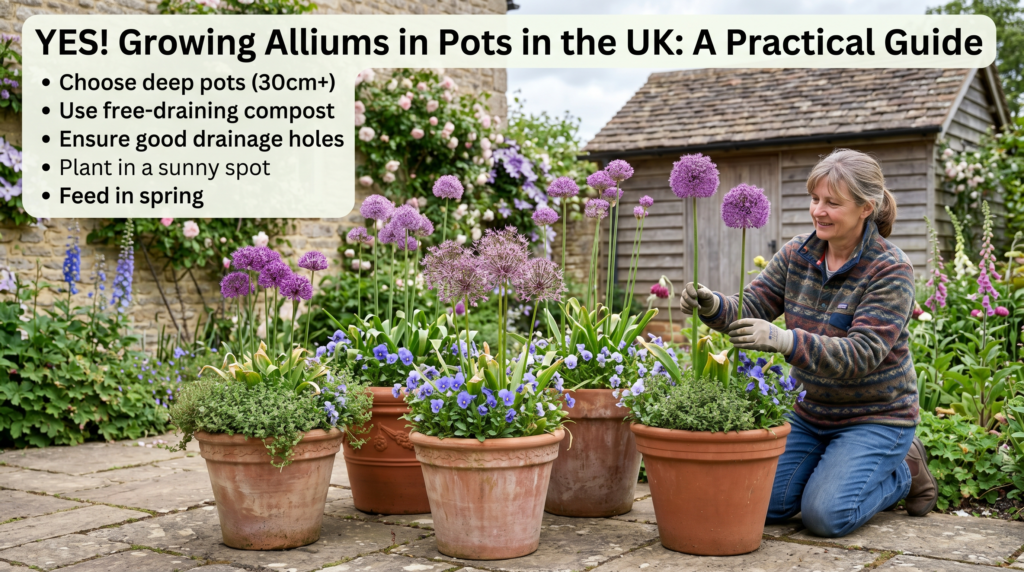
- Choose a pot at least 30cm deep — allium roots need substantial depth to anchor the tall stems
- Use peat-free compost mixed with 20% horticultural grit or perlite for drainage
- Try the ‘bulb lasagne’ technique: layer allium bulbs above late tulips in the same container for extended seasonal interest
- Best container varieties: Allium senescens subsp. glaucum (blue-grey leaves, pink flowers, August–September), Allium caeruleum (bright blue), Allium ‘Millenium’ (long-flowering, rose-purple)
- Move pots to a sheltered, sunny spot in winter to prevent waterlogging; raise on pot feet to improve drainage
Ongoing Care: Feeding, Foliage & Deadheading
| Care Task | When | What to Do |
| Feeding | Early spring | Apply a balanced slow-release granular fertiliser as shoots emerge. Liquid seaweed monthly supports healthy foliage. |
| Foliage management | May–June | Leaves die back as flowers open — this is normal. Plant alliums behind Alchemilla mollis, hostas, or ornamental grasses to mask the dying foliage. |
| Deadheading | Post-flowering | Not required. Seedheads are ornamentally valuable and provide winter structure. Alternatively, cut for striking dried flower arrangements. |
| Staking | As needed | Only tall varieties in exposed gardens. Allow stems to weave through neighbouring plants for natural support. |
| Dividing | Every 4–5 years | Lift after foliage dies back completely. Separate offsets. Replant in September. Dividing rejuvenates flowering in overcrowded clumps. |
Common Problems & How to Fix Them
| Problem | Symptoms | Cause | UK Solution |
| Allium white rot | Yellow wilting leaves; white fluffy fungus on bulb base | Fungal — HIGH risk in wet UK springs | Remove and burn affected plants. Avoid planting alliums in that soil for 5+ years |
| Allium leaf miner | White streaking on leaves; maggots visible inside bulb | Fly larvae — increasingly common in SE England | Fleece cover September–October and February–April. No chemical control available |
| Downy mildew | Grey-purple coating on foliage; leaf shrivelling | Fungal — worse in wet summers | Remove affected leaves. Improve air circulation. Water in mornings only |
| Rust | Orange/brown pustules on leaves | Fungal — most common UK issue | Remove infected foliage promptly. Avoid overcrowding |
| No flowers | Green foliage but no flower spike | Too shallow or overcrowded | Lift bulbs, check depth (needs 3–4x bulb size), divide overcrowded clumps |
| Drooping stems | Stems leaning or falling | Waterlogged soil or insufficient depth | Improve drainage; replant at correct depth in autumn |
Best Bulbous alliums Varieties for UK Gardens — RHS AGM Guide
What Is the RHS Award of Garden Merit (AGM)?
| What does the RHS AGM mean for alliums? |
| The RHS Award of Garden Merit (AGM) is awarded to plants that have been formally trialled at RHS Wisley and found to perform reliably in UK garden conditions. The RHS trialled alliums specifically in 2015–2016. An AGM symbol means: excellent performance in UK conditions, no special care requirements, widely available from UK nurseries, and good value. When buying allium bulbs, always look for the AGM badge — it is the UK’s most trusted horticultural quality mark. |
Complete UK Variety Guide — Sorted by Height & Season
| Variety | Height | Flower Colour | UK Flowering | AGM? | Best For |
| A. ‘Globemaster’ | 80cm | Deep violet-purple | May–June | ✓ AGM | Large borders, focal point |
| A. hollandicum ‘Purple Sensation’ | 80cm | Deep purple | May–June | ✓ AGM | Mass planting, naturalistic borders |
| A. ‘Purple Rain’ | 100cm | Open purple | May–June | ✓ AGM | Prairie/naturalistic style |
| A. stipitatum ‘Violet Beauty’ | 100cm | Violet | May–June | ✓ AGM | Tall borders, structural mixing |
| A. cristophii | 60cm | Greyish-lilac | May–June | ✓ AGM | Front of border, rock garden |
| A. ‘Mount Everest’ | 90cm | Pure white | May–June | ✓ AGM | White garden schemes |
| A. sphaerocephalon | 90cm | Green to deep purple | July–August | ✓ AGM | Late season colour, ornamental grasses |
| A. schubertii | 40cm | Pale lilac-purple | May–June | — | Dried flowers, containers, pots |
| A. caeruleum | 60cm | Bright blue | June–July | — | Containers, blue colour schemes |
| A. siculum | 80cm | Apricot/cream bells | May–June | — | Naturalistic, Chelsea-style planting |
| A. moly ‘Jeannine’ | 25cm | Yellow | May–June | — | Shade, woodland edge, rock garden |
| A. ‘Millenium’ | 30cm | Rose-purple | July–August | — | Long-flowering, late season containers |
| A. nigrum | 50cm | White/green centre | May–June | — | White gardens, mixed borders |
| A. atropurpureum | 70cm | Deep burgundy | May–June | — | Dark colour accent in mixed borders |
Alliums to Avoid: Invasive Species Warning
| INVASIVE SPECIES ALERT — Do Not Plant These in Open UK Gardens
Allium triquetrum (three-cornered leek): listed as an invasive species threatening native UK wildflowers — spreads aggressively. Do not plant near natural habitats. Allium roseum: can naturalise in mild UK areas. Grow in containers rather than open soil. Allium neapolitanum: beautiful but spreads vigorously in mild conditions. Best contained. |
Decorative onions Companion Planting — Best & Worst Neighbours
Best Companion PLANTS for Alliums in UK Borders
| Companion Plant | Why It Works | Design Benefit |
| Alchemilla mollis (Lady’s Mantle) | Frothy lime-green foliage hides dying allium leaves perfectly — the #1 companion from UK horticulturists | Foliage contrast; low maintenance |
| Hostas | Broad leaves mask dying allium foliage; enjoy same moisture levels | Bold textural contrast |
| Euphorbia palustris | Bright green foliage with yellow bracts creates strong contrast with purple alliums | Colour drama; spring overlap |
| Stipa tenuissima / Deschampsia (ornamental grasses) | Allium stems weave through grass naturally, creating the prairie effect dominant in post-Chelsea UK design | Naturalistic; movement and structure |
| Geums (orange/red varieties) | Hot colour contrast against cool purple allium globes | Dramatic colour pop in May |
| Crocosmia ‘Lucifer’ | Pairs with late-season Allium sphaerocephalon for July–August impact | Extends season; fiery colour contrast |
| Late tulips (container use) | Bulb lasagne technique: layer alliums above tulips for seamless seasonal succession | Extended pot interest from April–July |
What NOT to Plant Near Alliums
| Plants to Keep Away from Alliums
Peas and beans: alliums are allelopathic and inhibit legume growth. Maintain at least 50cm separation. Asparagus: alliums compete directly and may stunt asparagus growth. Keep beds entirely separate. Other edible alliums in ornamental beds: not harmful aesthetically, but mixing edible and ornamental alliums in the same bed increases disease transfer risk. |
Edible Alliums — The UK Cook’s Complete Reference
The edible members of the Allium genus form the aromatic foundation of virtually all UK home cooking. Most people use alliums multiple times every day without knowing they are doing so. The onion in a stew, the garlic in a pasta sauce, the chives on a jacket potato, and the leeks in a winter soup are all the same genus.
UK Culinary Alliums — Quick Reference Table
| Common Name | Species | Flavour Profile | UK Availability | Classic UK Uses |
| Brown/yellow onion | A. cepa | Pungent raw; sweet when cooked | Year-round, all supermarkets | Soups, stews, French onion soup, roasting |
| Red onion | A. cepa | Sharper, slightly sweet | Year-round | Pickling, salads, burgers, flatbreads |
| Spring onion / scallion | A. cepa | Mild and fresh | Year-round | Stir-fries, salads, Asian dishes, garnish |
| Shallot | A. ascalonicum | Sweet, gently garlicky | Year-round; markets & supermarkets | Sauces, vinaigrettes, Béarnaise, gourmet cooking |
| Garlic | A. sativum | Strong, pungent, complex | Year-round (cured); UK-grown June–July | Virtually every savoury dish in UK cuisine |
| Leek | A. ampeloprasum | Mild, buttery, sweet | Autumn–spring (UK-grown) | Cock-a-leekie, leek & potato soup, pies |
| Chives | A. schoenoprasum | Delicate onion flavour | Spring–autumn (garden-fresh) | Jacket potato, eggs, dips, garnish |
| Wild garlic | A. ursinum | Fresh, lighter than cultivated garlic | Foraged, March–June only | Pesto, soup, pasta, butter, cheese rind |
| Elephant garlic | A. ampeloprasum | Very mild, almost leek-like | Specialist UK suppliers | Roasting whole, salads, mild cooking |
UK-Specific Culinary Notes
- Leek: Wales’s national emblem and the cornerstone of British winter cooking. Pair with potatoes, cream, and mature cheddar for the quintessential British dish
- Garlic: the UK now produces significant quantities of hardneck garlic (celebrated at the Isle of Wight Garlic Festival). UK-grown garlic has superior fresh flavour but shorter shelf life than imported cured types. Black garlic from Lincolnshire has become a specialist UK artisan product
- Shallots: essential for classic British vinaigrette and Béarnaise sauce — more complex flavour than standard onion
- Chives: iconic atop the British jacket potato with sour cream. The easiest allium to grow — thrives on any UK windowsill year-round
Shallots of the UK — Ramsons, Wild Garlic & Safe Foraging
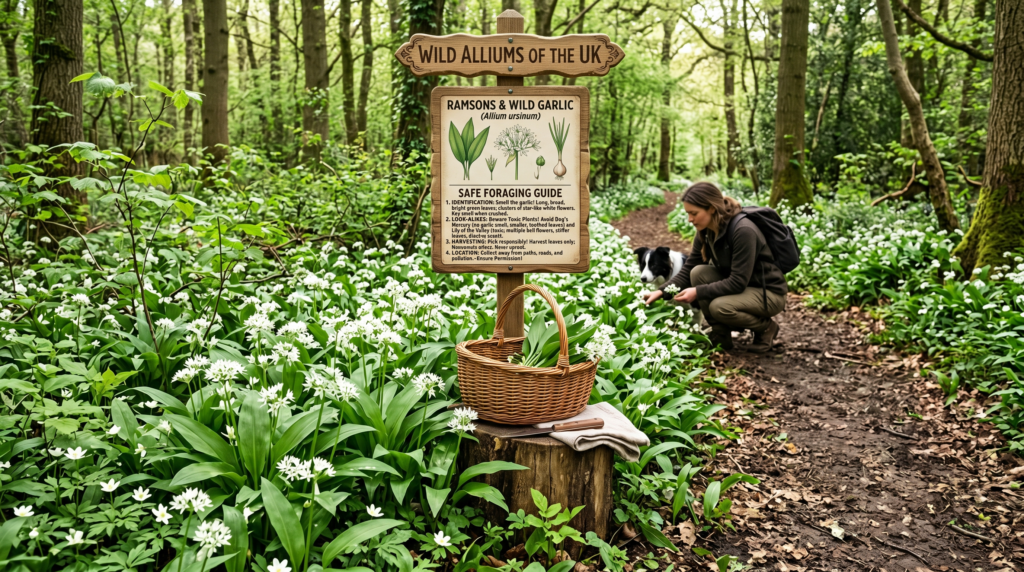
Wild Garlic (Allium ursinum) — The UK’s Native Allium
| Fact | Detail |
| Scientific name | Allium ursinum (‘ursinum’ = bear — legend holds that bears ate the bulbs upon waking from hibernation) |
| Common names | Ramsons, bear’s garlic, buckrams, wood garlic, broad-leaved garlic |
| UK distribution | Widespread across England, Wales, Scotland, and Ireland. Favours damp deciduous woodland on chalky or neutral soils. An ancient woodland indicator species |
| UK season | Leaves emerge late February. Peak season March–May. Flowers May–June. Plant disappears by midsummer |
| Habitat | Damp, semi-shaded woodland floors, often alongside bluebells. Look near rivers, streams, and ancient hedgerows |
| UK history | Evidence of use by Celtic Britons for over 1,500 years — one of the longest-running plant use records in Britain |
Identification Guide: Wild Garlic vs Dangerous Lookalikes
| CRITICAL SAFETY WARNING: Correct Identification Is Essential
Several toxic plants share wild garlic’s woodland habitat and early-season appearance. Misidentification has caused serious illness. GOLDEN RULE: If in doubt, do not pick. The only reliable test is the unmistakable garlic smell when a leaf is crushed. CAUTION: If your hands already smell of wild garlic from handling, subsequent smell-testing other plants is unreliable. UNIQUE IDENTIFIER: Wild garlic has a triangular stem cross-section. All lookalikes have round stems. |
| Plant | Leaf shape | Smell when crushed | Flower | Safety |
| Wild garlic (SAFE) | Broad, elliptic, bright green, single midrib | STRONG GARLIC | White star clusters on triangular stem | Edible — all parts |
| Lily of the valley | Paired leaves, dull green, from single reddish stem | No garlic smell | White drooping bells | TOXIC — can be fatal |
| Lords & Ladies (Arum maculatum) | Triangular, wavy-edged, dark spots when mature | No garlic smell | Green calla-lily hood; later red berries | TOXIC |
| Colchicum (Autumn crocus) | Similar glossy leaves | No garlic smell | Pink/mauve crocus-like flowers | DEADLY — contains colchicine |
| Bluebell | Narrow, strap-like | No garlic smell | Drooping blue bells | TOXIC if eaten |
Responsible Foraging in the UK
- Legal position: anyone may forage wild garlic on public land (National Trust, Forestry England, commons) for personal use. Digging up bulbs on any land requires landowner permission, and is illegal on common land
- Sustainability rule: cut leaves, never uproot the bulb. Take no more than 10–20% of any one patch to allow regeneration
- Hygiene: wash leaves thoroughly. In areas subject to flooding or livestock, there is a risk of liver fluke on unwashed leaves
- Finding locations: use iNaturalist or the Woodland Trust’s nature reserve map to locate wild garlic colonies near you
Flowering Onion Plants in UK Cooking
| Part | When Available | How to Use |
| Leaves | March–May | Raw in salads; wild garlic pesto (substitute for basil + pine nuts); soups, pasta, risotto, scrambled eggs, compound butter |
| Flowers | May–June | Fully edible; use in salads, as garnish, or pickle in white wine vinegar |
| Bulbs | March–June | Small but edible — use like regular garlic. Legal restrictions apply: requires landowner permission to dig |
| Wild garlic butter | Make March–May; freeze | Blend leaves with softened butter and lemon zest. Freeze in portions for year-round use. Excellent on bread, steak, and pasta |
| UK Artisan Food Note
Cornish Yarg cheese uses wild garlic leaves as its rind — one of the UK’s most distinctive artisan food products and a testament to wild garlic’s culinary versatility. |
Health Benefits — What the Science Says
The health benefits of are real, well-researched, and significant. Alliums owe their distinctive smell, taste, and tear-inducing pungency to sulphur-containing compounds — the same chemicals responsible for their most important health properties.
Key Active Compounds in Alliums
| Compound | Found In | Health Role |
| Allicin | Garlic (primary source) | Formed when garlic is cut or crushed; antimicrobial, cardiovascular protective, anti-inflammatory |
| Quercetin | Onions, especially skin | Polyphenol/flavonoid; anti-inflammatory, antibacterial, antioxidant |
| Inulin & fructooligosaccharides | All alliums | Prebiotic fibre; feeds beneficial gut bacteria (Lactobacillus, Bifidobacterium) |
| Sulphides | All alliums | Cholesterol and blood pressure reduction; anti-clotting properties |
Evidence-Based Health Benefits
| Health Benefit | Evidence Summary | Best Source |
| Cardiovascular protection | Sulphur compounds demonstrated to lower blood cholesterol and triglycerides, reduce blood pressure, and reduce blood clot formation | Garlic, onions |
| Anti-cancer activity | Regular allium consumption associated in multiple epidemiological studies with reduced risk of stomach and intestinal cancers | Garlic, onions |
| Anti-inflammatory | Flavonoids including quercetin provide significant anti-inflammatory effects; relevant to joint health and chronic disease management | Onions (especially skin) |
| Antimicrobial | Quercetin in onions has documented antibacterial properties. Garlic was used as a wound antiseptic in WWI when conventional supplies ran low | Garlic, onions |
| Gut health | Prebiotic inulin fibres in all alliums feed beneficial gut microbiome, strengthening immune function and improving digestive health | All alliums |
| Blood sugar regulation | Preliminary evidence suggests allium compounds may improve insulin sensitivity — ongoing research area | Garlic, onions |
Getting Maximum Nutritional Value from Pollinator-friendly bulbs
| How to Maximise Allium Health Benefits
Garlic: use the ‘chop and rest’ rule — allow chopped or crushed garlic to sit for 10 minutes before cooking. This allows allicin to fully activate. Heat destroys the enzyme needed for allicin formation, so resting before cooking maximises benefit. Onion skins: the highest concentration of quercetin is in onion skins. Save skins for stock or bone broth to extract maximum nutritional value. Raw vs cooked: raw alliums deliver more sulphur compounds overall, but cooking does not destroy quercetin — roasting or sautéing onions is nutritionally comparable for this compound. Daily intake: even small, regular amounts of alliums (one clove of garlic, half an onion) provide meaningful health benefits according to population studies. |
Purple Globe Flowers Safety — Pets, Children & Toxicity
| IMPORTANT: ALL Alliums Are Toxic to Dogs, Cats & Horses
This applies to: ornamental alliums AND edible alliums (onions, garlic, leeks, chives). All plant parts are toxic: leaves, flowers, bulbs, stems — including dried and cooked forms. Even small quantities can cause serious harm. Cooked alliums (garlic in food, onion in gravy) are still toxic. Toxicity mechanism: N-propyl disulfide damages red blood cells, causing haemolytic anaemia. |
| Topic | Detail |
| Symptoms in pets | Vomiting, diarrhoea, lethargy, weakness, rapid breathing, pale or yellow gums, collapse |
| Action if ingested | Contact your vet immediately. Do not wait for symptoms to develop — early treatment is significantly more effective |
| Wild garlic | Allium ursinum is equally toxic to companion animals. Dogs on woodland walks should be kept away from wild garlic carpets |
| Humans (ornamental bulbs) | Ornamental allium bulbs are labelled inedible (not for human consumption) though not acutely toxic in small amounts. Store bulbs out of reach of children |
| Children (ornamental bulbs) | If a child eats an ornamental allium bulb, contact NHS 111 for guidance |
| Culinary alliums for humans | All culinary alliums are entirely safe for human consumption in normal food quantities |
Where to Buy Floating purple spheres in the UK
Recommended UK Allium Suppliers
| Supplier | Speciality | Best Ordering Window | Top Tip |
| Crocus.co.uk | Award-winning collections, AGM sets, butterfly-friendly mixes | July–November | Premium varieties sell out by September — order early |
| Suttons Seeds | Ornamental and veg alliums with detailed growing guides | Aug–Nov | Good for beginners; covers edible and ornamental in one order |
| Ashridge Trees | Large-grade bulbs, extensive growing information | Sept–Nov | Established 1949; excellent AGM range including sphaerocephalon |
| J Parkers | Budget-friendly bulk allium packs | Aug–Oct | Best for mass planting schemes where volume matters |
| Thompson & Morgan | Unusual varieties and curated collections | Aug–Nov | Often stock hard-to-find species and late-season varieties |
| Beth Chatto Gardens | Specialist woodland-edge and unusual varieties | Spring & Autumn | Expert curation; peat-free only; ideal for naturalistic gardeners |
| Pottertons Nursery | Rare and specialist small alliums | Year-round | For experienced gardeners seeking unusual species |
What to Look for When Buying
- Choose firm, plump bulbs with no soft spots, mould, or hollow sections — reject any that feel light or papery
- Bigger bulbs produce bigger flowers: do not compromise on size for centrepiece varieties such as Globemaster or Ambassador
- Buy AGM-awarded varieties where possible for proven UK performance
- Plant within one week of purchase — large bulbs lose moisture quickly once out of their packaging
- For containers: buy at least 5 bulbs of the same variety for impact
- For borders: plant in groups of 3, 5, or 7 (odd numbers create more natural-looking drifts)
Tall flowering bulbs in UK Garden Design — Style Inspiration
Popular UK Garden Styles for Alliums
| Garden Style | Best Allium Varieties | Design Notes |
| Prairie/naturalistic | A. sphaerocephalon + Stipa tenuissima | Post-Piet Oudolf influence; allium stems weave through grasses. Dominant contemporary UK look |
| Formal border | A. hollandicum ‘Purple Sensation’ | Tall purple globes as punctuation marks spaced through structured rose or perennial beds at equal intervals |
| Cottage garden | Mixed heights and colours | Combine with geraniums, salvias, and catmint for relaxed profusion |
| Gravel/Mediterranean | A. schubertii, A. cristophii, A. nigrum | Drought-tolerant alliums thrive in free-draining gravel. Strong architectural effect |
| Contemporary/minimalist | A. ‘Globemaster’ | Uniform rows through clipped box or Taxus — bold structural statement |
| RHS Chelsea style | A. siculum, A. hollandicum | As seen in the 2024 Nurture Landscapes Garden — naturalistic drifts with perennials |
Expert Design Tips
- Plant in odd numbers — groups of 3, 5, or 7 look far more naturalistic than even numbers. Repeat 2–3 times through the border for rhythm.
- Mix heights deliberately: combine tall Allium stipitatum (1m) with mid-height Allium hollandicum (80cm) and front-of-border Allium cristophii (60cm) for layered visual depth.
- Position mid-border, not just at the back: allium stems weave naturally through neighbouring plants, which is exactly how they look best in naturalistic schemes.
- Leave the seedheads through autumn and winter: in smaller urban gardens, dried allium heads catch frost beautifully and provide essential winter structure when the border is otherwise bare.
Ornamental bulb flowers FAQs — Answering Britain’s Most-Searched Questions
These questions and answers are structured for Featured Snippet extraction and voice assistant responses. Each answer is a complete, self-contained response.
Are Bulbous monocots perennials in the UK? |
| Yes. Most ornamental alliums are fully hardy perennials in the UK (RHS H5 rating) and return reliably year after year with minimal care. The bulbs can be left in the ground undisturbed through winter. After 4–5 years, clumps may need dividing if flowering diminishes. |
When do Starburst flowers flower in the UK? |
| Alliums flower from May to August in the UK, depending on variety. Most ornamental types bloom in May–June. Allium sphaerocephalon (the drumstick allium) is the exception, flowering in July–August, which makes it particularly valuable for extending the border season into late summer. |
Do Onion-like flowers multiply? |
| Yes. Most alliums produce offsets (small daughter bulbs) around the parent bulb. Over 4–5 years, clumps can become overcrowded and flowering may decline. Lift, divide, and replant in September to rejuvenate them. Some alliums also self-seed freely, particularly Allium hollandicum. |
Are Herbaceous bulb perennials good for bees? |
| Extremely so. All alliums are excellent pollinator plants. Chives (Allium schoenoprasum) are particularly noted as bee magnets — even a small clump attracts significant bumblebee and honeybee activity. Late-flowering varieties like Allium sphaerocephalon extend the nectar season into late summer when other sources become scarce. |
Can I grow Amaryllis in pots in the UK? |
| Yes, many alliums thrive in deep containers with free-draining compost. Use a pot at least 30cm deep. Best varieties for pots include Allium senescens subsp. glaucum, Allium caeruleum, and Allium ‘Millenium’. Try the bulb lasagne technique — layer alliums above tulips in the same container for continuous interest from April to July.
|
Are Dome flower heads safe for dogs and cats? |
| No. All alliums — both ornamental and edible — are toxic to dogs, cats, and horses. This includes raw, cooked, and dried forms. Even small quantities can cause haemolytic anaemia. Contact your vet immediately if a pet has ingested any part of an allium plant, including wild garlic on a woodland walk. |
Do Spring Bulb Flowers need deadheading? |
| No deadheading is required, and it is generally not recommended. Allium seedheads are highly ornamental, persist well into autumn and winter, provide structural interest when the border is otherwise bare, and offer seeds for birds. If you prefer a tidier look, cut stems for striking dried flower arrangements indoors. |
What causes Allium-style blooms not to flower? |
| The three most common causes are: (1) bulbs planted too shallow — alliums need to be planted at 3–4 times their own diameter in depth; (2) overcrowded clumps that need dividing — lift and separate every 4–5 years; (3) bulbs in waterlogged soil that have partially rotted. Check depth and drainage first if plants produce only foliage. |
wild garlic |
| Wild garlic (Allium ursinum) is a true member of the Allium genus and a genuine British native plant. It is one of approximately 750–900 species worldwide. Unlike ornamental alliums, which are grown for their globe-shaped flowers, wild garlic is valued for its edible leaves, which have a lighter, fresher flavour than cultivated garlic. |
When to plant Garden allium bulbs in the UK? |
| The best time to plant allium bulbs in the UK is September to October. This gives bulbs time to establish roots before winter and ensures the strongest flowering the following May–June. November planting is still acceptable in milder regions. December is the absolute deadline, provided the ground is not frozen. Spring planting of pot-grown alliums is possible year-round. |
Article Information
| Last reviewed | April 2025 | Primary keyword | allium (UK) |
| Word count | ~7,200 words | Schema markup | Article, FAQPage, HowTo |
| Target audience | UK home gardeners, foragers, cooks, pet owners | Update schedule | Annually before UK bulb season (August) |

Leave a Reply