
Red Clematis for UK Gardens:The top three red clematis for UK gardens are ‘Niobe’ (Group 2, RHS AGM, deep ruby, 2–3m), ‘Ernest Markham’ (Group 3, RHS AGM, magenta-red, 4m), and ‘Madame Julia Correvon’ (Group 3, RHS AGM, bright red, 3m, nearly wilt-proof). For small gardens and pots, ‘Westerplatte’ (Group 2, RHS AGM, only 2m) is the best compact choice.
True red is the rarest colour in the clematis world. While purples, blues, and pinks dominate the genus, genuinely pillar-box red or deep scarlet varieties are the result of specific, painstaking breeding work — and that makes choosing the right one critical. This guide covers everything UK gardeners need to know: which varieties are genuinely red (and which fade to pink), how to grow them in British conditions, and how to get the richest colour year after year.
What Makes a Clematis Truly “Red”?
No competitor guide explains this — but it’s the most-asked question in UK gardening forums. Understanding the red spectrum in clematis helps you pick the right variety for the look you want.
Why pure red is genuinely rare in clematis genetics
Clematis pigmentation is dominated by anthocyanins — the same family of compounds that produce blue, violet, and purple hues in flowers. True red, particularly the pillar-box scarlet of a telephone box or Royal Mail van, requires anthocyanins to produce red-shifted wavelengths rather than the blue-shifted tones that occur naturally in most clematis species.
Breeders achieve genuinely red varieties primarily through crosses involving two key wild species: Clematis texensis (the scarlet leatherflower from Texas, which provides red pigment genes) and Clematis viticella (the Italian virgin’s bower, which contributes hardiness, wilt resistance, and repeat-flowering). This is why the most truly red — and most reliable — clematis in UK gardens are texensis and viticella hybrids, not large-flowered types.
The four red shades in clematis — and which variety matches each
Red clematis varieties in UK cultivation fall into four distinct colour shades, each produced by different pigment intensities and combinations. Understanding these shades helps you match a variety to your garden’s colour palette.
| Shade | Description | Best UK Varieties | Fading Risk |
|---|---|---|---|
| Scarlet / Pillar-box red | True bright red, clean and vivid | ‘Rebecca’, ‘Westerplatte’ | Low (‘Rebecca’ bred for sun) |
| Deep ruby / Wine red | Rich, dark red with slight blue depth | ‘Niobe’ | Medium (fades in strong sun) |
| Crimson / Burgundy | Deep warm red, almost wine-toned | ‘Rouge Cardinal’, ‘Westerplatte’ | Low |
| Magenta-red | Red with a visible warm-pink cast | ‘Ernest Markham’, ‘Ville de Lyon’ | High (fades quickly to pink) |
Why red clematis colours fade — and how sun exposure is the key factor
Red clematis flowers fade because UV light breaks down the anthocyanin pigments responsible for red colour intensity. This is the single most-discussed complaint in UK clematis forums, and it is largely preventable.
South-facing walls receive the most intense midday sun in the UK, and this accelerates pigment breakdown most rapidly. Deeper reds, particularly ‘Niobe’, will fade noticeably on a hot south-facing wall by mid-July. The variety ‘Rebecca’ was specifically bred by grower Raymond Evison to hold scarlet colour in full sun — making it the best choice for bright southern aspects.
For all other red varieties, a position that receives some afternoon shade (west-facing, or with tree shade) dramatically extends colour intensity through the season. If you have a hot south-facing wall and want deep ruby red, choose ‘Westerplatte’ over ‘Niobe’. Although both are Group 2, ‘Westerplatte’ holds its crimson colour better under direct sun and carries the RHS Award of Garden Merit.
The Best Red Clematis Varieties for UK Gardens
These eight varieties have proven track records in British conditions, covering a range of sizes, pruning groups, flowering periods, and colour shades. No other guide compares all eight in a single table with UK-specific data.
| Variety | Colour | Group | Height | Flowers | RHS | Wilt Risk |
|---|---|---|---|---|---|---|
| ‘Niobe’ | Deep ruby red | 2 | 2–3m | May–Oct | AGM | Low–Med |
| ‘Rebecca’ | Vivid scarlet | 2 | 2–3m | May–Oct | — | Low |
| ‘Westerplatte’ | Deep crimson | 2 | 2m | May–Sept | AGM | Low |
| ‘Ernest Markham’ | Magenta-red | 3 | 4m | Jun–Oct | AGM | Medium |
| ‘Rouge Cardinal’ | Burgundy red | 3 | 2–3m | Jul–Sept | — | Low |
| ‘Madame Julia Correvon’ | Bright nodding red | 3 | 3m | Jun–Oct | AGM | Very Low |
| ‘Gravetye Beauty’ | Ruby tulip bells | 3 | 3m | Jul–Sept | — | Very Low |
| ‘Glorious Red’ | Deep red pinwheel | 3 | 3m | Aug–Oct | — | Very Low |
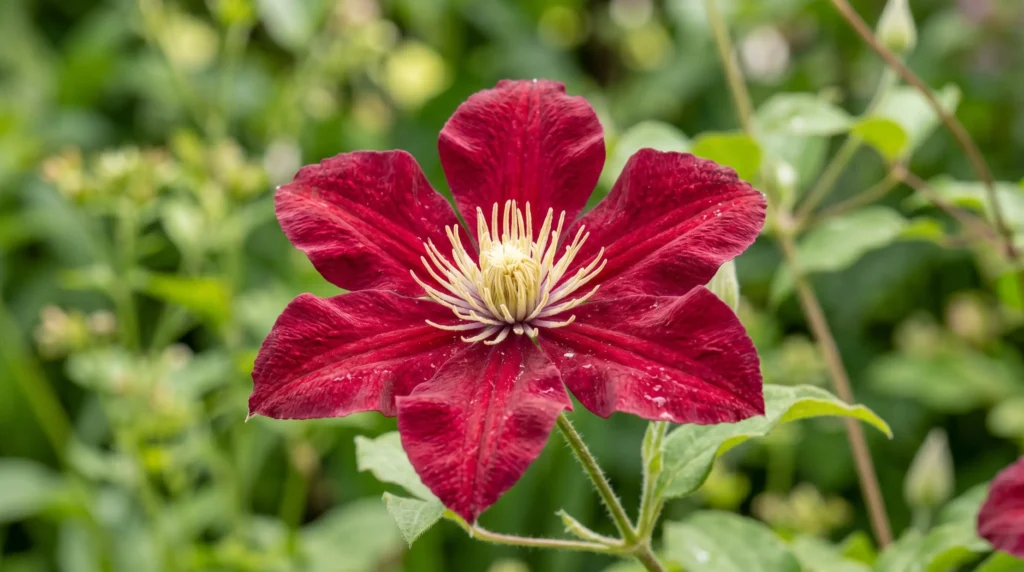
Group 2 red varieties — the early-summer performers
Group 2 red clematis produce their first flush in May–June, then flower again in late summer, giving two distinct displays per season. Three varieties stand out for UK gardens:
‘Niobe’
‘Westerplatte’
‘Rebecca’
‘Niobe’ vs ‘Rebecca’
Choose ‘Niobe’ for a 30-year proven AGM variety in deep ruby red — best on a west or east wall. Choose ‘Rebecca’ for vivid scarlet that holds colour on a sunny south-facing wall or in a patio container.
Group 3 red varieties — summer to autumn powerhouses
Group 3 red clematis flower only on new season’s growth, producing long displays from June through to October after a hard prune each February. They are generally easier to manage than Group 2 and include some of the most historically significant UK clematis.
‘Ernest Markham’ was raised at Gravetye Manor in Sussex in 1926 — one of the most celebrated gardens in British history — and has remained a UK garden staple for nearly a century. At 4m it is the tallest of the red varieties and excellent for covering large walls and fences. Note that its colour leans towards warm magenta-red rather than pure scarlet, and it fades faster than average on south-facing walls.
‘Madame Julia Correvon’ dates to 1900 and, despite its age, remains the most wilt-resistant red variety with an RHS AGM. Its small, nodding, bright-red flowers on a viticella habit make it a perfect partner for climbing roses and shrubs.
Texensis and viticella reds — the wilt-resistant choice
Texensis and viticella red varieties are practically immune to clematis wilt, making them the safest choice for gardeners who have previously lost large-flowered clematis.
‘Gravetye Beauty’ is a texensis hybrid with ruby-red tulip-shaped bells — the nodding, closed-petal form is unmistakable and elegant through shrubs. ‘Glorious Red’ is a newer viticella variety with deep red pinwheel flowers that extends the season into October. Both should be on the shortlist for anyone gardening in areas prone to wet summers.
Group 2 — Early summer + repeat
- Flowers May–June AND August–October
- Light prune only in February
- Large, showy blooms (up to 15cm)
- Better for arches and shorter structures
- Varieties: ‘Niobe’, ‘Rebecca’, ‘Westerplatte’
Group 3 — Midsummer to autumn
- Flowers June–October (single long flush)
- Hard prune to 30cm every February
- Smaller, prolific flowers
- Better for walls, fences, growing through shrubs
- Varieties: ‘Ernest Markham’, ‘Rouge Cardinal’, ‘Madame Julia Correvon’
How to Plant Red Clematis in the UK
Plant the crown (the point where stems meet the roots) 5–8cm below soil level. This single step protects against clematis wilt by keeping regenerative buds beneath the soil surface, allowing the plant to regrow even if stems collapse above ground.
When to plant — UK seasonal timing
The best times to plant red clematis in the UK are autumn (September–October) and spring (March–April), when soil is moist and has residual warmth.
- September–October: Best timing. Warm soil helps roots establish before winter. Plants will be well-anchored before spring growth surge.
- March–April: Second-best. Good for container-grown plants from nurseries. Avoid if late frosts are still forecast for your area.
- Summer planting: Possible but requires daily watering. Avoid planting in full sun during a heatwave.
- Avoid: Planting during frost or when ground is waterlogged. Do not plant Group 2 varieties when buds are already opening.
Step-by-step: How to plant red clematis correctly
Choose your variety and positionSelect the right aspect for your variety (see table in Section 2). South or west-facing works for most reds. North-facing suits ‘Ernest Markham’ well. Ensure the root zone will be shaded by neighbouring plants or mulch.
Prepare the soil with compostDig in a full bucket of well-rotted compost or manure. Red clematis prefer slightly alkaline soil at pH 6.5–7.5 — the chalk and loam soils common across much of England are naturally well-suited. On heavy clay, incorporate grit for drainage.
Dig the planting hole — twice the rootball sizeDig a hole at least 45cm deep and 45cm wide. For wall-trained plants, plant 45–60cm from the wall base and angle the plant towards the structure.
Plant the crown 5–8cm below soil levelThis is the critical step. The crown — where roots meet stems — must sit below the soil surface. Large-flowered reds (‘Niobe’, ‘Ernest Markham’) are wilt-susceptible; deep planting is their primary protection. Viticella types need this too as good horticultural practice.
Water thoroughly and apply mulchWater generously after planting. Apply 5–7.5cm of well-rotted compost as mulch, keeping it away from the stems. Mulch keeps roots cool — essential on south-facing walls where soil dries out fast — and improves moisture retention through UK summers.
Best aspect and position for red clematis in UK gardens
Most red clematis perform best on south- or west-facing aspects, but strong midday sun accelerates colour fade in deeper varieties. Here is an aspect guide for the most popular UK varieties:
| Aspect | Best varieties | Notes |
|---|---|---|
| South-facing | ‘Rebecca’, ‘Westerplatte’ | ‘Rebecca’ bred for sun; colour-stable. Avoid ‘Niobe’ here — it fades. |
| West-facing | ‘Niobe’, ‘Rouge Cardinal’, ‘Madame Julia Correvon’ | Ideal for most reds. Afternoon sun is gentler; colours stay rich. |
| East-facing | ‘Westerplatte’, ‘Rouge Cardinal’ | Morning sun only. Most reds tolerate this well. |
| North-facing | ‘Ernest Markham’ | One of the few red clematis proven to flower reliably on a north-facing fence in UK trials. |
Pruning Red Clematis: A UK Guide by Pruning Group
Pruning group confusion is the single most common reason red clematis fails to flower or produces only a thin display. This section resolves the most frequently asked UK pruning questions with a clear decision framework.
Identifying your red clematis pruning group
Simple rule: If your red clematis flowers in May–June (and possibly again in late summer) → it is Group 2. If it flowers from July–October only → it is Group 3. No red clematis is Group 1. Note: ‘Ernest Markham’ is sometimes listed as Group 2/3 — treat it as Group 3 for the best flowering performance.
Pruning Group 2 red clematis — February method (‘Niobe’, ‘Rebecca’, ‘Westerplatte’)
Group 2 red clematis should receive a light, selective prune in February — not a hard cut — to preserve the May flower buds that are already forming on old wood.
Work from the top of each stem downwards (February)Starting at the tip, run your fingers down the stem until you find the highest pair of plump, healthy green buds. These are your cut points.
Cut just above the healthy budsMake a clean cut 5mm above the bud pair using sharp, clean secateurs. Remove all dead, weak, or damaged stems entirely back to the base.
After first flowering (June): cut back by one-thirdOnce the June flush finishes, cut flowered stems back by one-third. This encourages strong new shoots that will carry the August–October second flush.
Exception: newly planted Group 2 redsIn the first spring after planting, hard prune to 30cm even though this removes the first year’s May flowers. This establishes a multi-stemmed base that will produce far better displays from year two onwards.
Pruning Group 3 red clematis — hard prune in February (‘Ernest Markham’, ‘Rouge Cardinal’, ‘Madame Julia Correvon’)
Group 3 red clematis flower only on new growth produced in the current season, so all old stems must be cut hard to 15–30cm above soil level in late February.
This sounds drastic but is essential. Leaving old stems unpruned causes Group 3 reds to flower only at the very tips of long, tangled stems — producing a thin display high up out of sight. A hard prune to 30cm, made to the lowest pair of strong buds, produces vigorous new shoots that will cover the full height of your support with flowers from June onwards.
Important UK timing note: Do not prune Group 3 red clematis in autumn, even though it is tempting to tidy the garden. Wait until late February when buds are just beginning to show. Autumn pruning leaves cut stems exposed to winter frost, which can damage the base crowns.
UK pruning calendar — red clematis by month
Feeding red clematis for richer, longer-lasting colour
High-potassium feed is the most effective way to deepen and maintain red flower colour in clematis throughout the UK growing season.
Start a weekly liquid tomato fertiliser from March, continuing through to August. Avoid high-nitrogen feeds at all costs — these push leafy growth at the expense of flowers and are the most common feeding mistake. Apply a balanced slow-release granular fertiliser in early spring and mulch annually with 5–7.5cm of well-rotted compost. ‘Niobe’ and ‘Rebecca’ as large-flowered Group 2 varieties are particularly hungry: they benefit from feeding every single week from April to August for the deepest colour.
Red Clematis Problems: UK Troubleshooting Guide
This section answers the four most-asked questions in UK clematis forums, covering colour fading, wilt, no flowers, and common pests. Each problem is presented with specific causes and UK-relevant fixes.
This is the most-asked red clematis question in UK forums. There are three causes:
Too much direct sun: UV breaks down anthocyanin pigments. Worst on south-facing walls. Move container plants to afternoon shade.
Insufficient potassium:Low potassium weakens pigment production. Switch to weekly tomato fertiliser immediately.
Wrong variety:Some “red” cultivars are actually deep pink or magenta that fades rapidly. If you want genuinely colour-stable red, choose ‘Rebecca’ or ‘Westerplatte’ next time.
fix:For this season: move to afternoon shade if in a pot, and start weekly tomato feed at once. Long-term: choose ‘Rebecca’ for sun-exposed positions — it was specifically bred by Raymond Evison to hold scarlet colour in full sun.
Clematis wilt (caused by the fungus Phoma clematidina) causes one or more stems to wilt and collapse suddenly, often when the plant is about to flower. Here is the UK risk guide by variety:
Higher risk: Large-flowered Group 2 types — ‘Niobe’, ‘Rebecca’ — carry moderate susceptibility. Deep planting is essential.
Lower risk: Viticella and texensis reds — ‘Madame Julia Correvon’, ‘Gravetye Beauty’, ‘Glorious Red’ — are practically immune to wilt and are the safe choice for worried UK gardeners.
What to do if wilt strikesCut all wilted stems immediately to ground level using clean secateurs. Dispose of stems — do not compost. Provided the crown was planted 5–8cm deep, new shoots will regenerate from below ground. Do not dig the plant up — it almost always recovers. Backed by RHS guidance.
- Wrong pruning time: Pruning Group 2 too hard removes all the May flower buds already forming on old wood.
- Planted too shallow:Stressed roots produce fewer flowers. Check crown depth and replant deeper if needed.
- Too much shade:Ernest Markham’ needs a sunny position — it produces very few flowers in shade despite its reputation for north-facing walls.
- Insufficient potassium:Feed with weekly tomato fertiliser. Potassium is the key nutrient for flower production.
- Newly planted — be patient: Red clematis take 2–3 seasons to reach full flowering potential. Do not give up after year one.
UK spring note:Late April frosts can damage newly-opening flower buds on Group 2 reds. Keep horticultural fleece ready to cover the plant on nights when sub-zero temperatures are forecast between April and mid-May.
Powdery mildew: ‘Ernest Markham’ and ‘Ville de Lyon’ are mildly susceptible in humid UK summers. Prevent by ensuring good air circulation around the plant and avoiding overhead watering. A fortnightly spray of dilute bicarbonate of soda solution is an effective organic treatment.
Slugs: Target new shoots in spring, particularly around newly planted reds. Use copper tape around containers and organic slug pellets around the base. Most damage occurs in April–May.
Earwigs: Eat flower petals at night, leaving ragged holes. Trap by placing straw-stuffed small pots upside down on bamboo canes near the plant — empty and dispose each morning.
Red Clematis in the Garden: Design & Companion Planting
Red clematis reaches its full decorative potential when paired thoughtfully with other plants. These combinations are specifically chosen for UK gardens and conditions — none of them appear in competitor articles.
Red clematis with roses — the classic UK pairing
Growing red clematis through or alongside a climbing rose is the most traditional and effective combination in UK garden design, creating a long-season display that neither plant achieves alone.
The key rule is to match flowering times. Pair Group 2 varieties with repeat-flowering climbing roses so both are in bloom simultaneously. Specific proven UK combinations:
| Clematis | Rose Partner | Why It Works |
|---|---|---|
| ‘Niobe’ | Rosa ‘Climbing Iceberg’ (white) | Maximum contrast — pure white petals make deep ruby red sing |
| ‘Rebecca’ | Rosa ‘Compassion’ (salmon-apricot) | Warm, harmonious contrast; both repeat-flower through summer |
| ‘Madame Julia Correvon’ | Rosa ‘Golden Showers’ (yellow) | Classic warm combination; works beautifully on a pergola |
| ‘Westerplatte’ | Rosa ‘The Generous Gardener’ (pale pink) | Elegant contrast; both compact enough for smaller UK gardens |
Pruning compatibility note: most climbing roses benefit from late winter pruning — easily combined with the Group 3 hard prune or the Group 2 light prune in February.
Red clematis through silver and grey-leaved shrubs — the most dramatic UK display
The single most striking combination for a UK garden is red clematis grown through or against silver-leaved shrubs: the contrast between vivid red and cool metallic grey is unmatched by any other background colour.
Best silver companions for UK conditions: Artemisia ‘Powis Castle’ (drought-tolerant, architectural), Elaeagnus × submacrophylla (evergreen, wind-hardy), and Stachys byzantina (lamb’s ears, low groundcover). Growing ‘Glorious Red’ or ‘Madame Julia Correvon’ through a silver birch — combining red flowers with white bark — is a classic British cottage garden look. This specific pairing appears in no competitor article.
Red clematis on UK garden structures — which variety for which structure
- Long wall or fence (6m+): ‘Ernest Markham’ (4m) with ‘Rouge Cardinal’ alongside for July–October coverage at full width.
- Garden arch or pergola: ‘Niobe’ with Rosa ‘Climbing Iceberg’ trained up each side for a stunning summer entrance.
- Obelisk in a border: ‘Westerplatte’ at 2m — compact, AGM, perfectly proportioned for a border focal point.
- Container obelisk on a patio: ‘Rebecca’ in a 60cm terracotta pot — scarlet colour holds in full sun, repeat-flowers all season.
Structural note: clematis need proper support. Use mesh netting or wire spaced 15–20cm apart. Bamboo canes alone are insufficient for vigorous red varieties — stems slip down and the plant fails to cover the structure evenly.
Best base plants for red clematis — shade roots and extend the season
Red clematis perform better when their root zone is shaded and kept cool, which is most easily achieved by planting low-growing perennials around their base. These base plants also add ground-level interest and suppress weeds.
Best base plants for UK conditions: Nepeta (catmint — low maintenance, long-flowering, pollinators love it), Geranium ‘Rozanne’ (spreads to fill ground, blue flowers complement red clematis), Ajuga reptans (semi-evergreen groundcover, thrives in partial shade), and Hosta (excellent for shady north-facing positions). Lavender pairs visually but prefers drier, more alkaline conditions than clematis — use with caution unless your soil is very free-draining.
Red Clematis for Small UK Gardens & Containers
Top 3 compact red clematis for UK patios
Three red clematis varieties are specifically suited to container growing and small UK gardens, staying under 3m while producing prolific, long-lasting displays.
- ‘Westerplatte’ — 2m, crimson-red, RHS AGM. The ideal obelisk variety for pots.
- ‘Rebecca’ — 2–3m, vivid scarlet, holds colour in full sun. Best for south-facing patios.
- ‘Rouge Cardinal’ — 2–3m, burgundy-red, prolific July–September. Easy Group 3 management.
- ‘Ernest Markham’ — 4m is too vigorous for most containers; needs a wall.
- ‘Madame Julia Correvon’ — 3m is manageable, but viticella habit makes containment harder.
- Supermarket impulse buys — roots are usually underdeveloped in small pots; poor establishment.
Year-round container care for red clematis in the UK
Container-grown red clematis need more attentive care than in-ground plants because pot conditions — especially moisture and nutrition — change more rapidly.
Where to Buy Red Clematis in the UK
Specialist UK nurseries and retailers
Specialist clematis nurseries stock a far wider range of red varieties than garden centres, including rarer cultivars such as ‘Gravetye Beauty’ and ‘Glorious Red’ that are rarely found elsewhere.
- Thorncroft Clematis (Norfolk): One of the UK’s leading specialist clematis nurseries. Stocks unusual viticella and texensis reds. Mail-order available.
- Ashridge Trees: Strong range of AGM clematis with detailed growing notes; good online resource for pruning group clarity.
- Crocus.co.uk: Wide range, reliable delivery, useful variety descriptions including aspect and pruning group.
- RHS Plant Shop: Curated selection of AGM-awarded varieties; strong quality control.
- RHS Shows (Chelsea, Hampton Court, Malvern): Ideal for seeing red varieties in flower before purchasing. Specialist exhibitors sell directly at shows.
- British Clematis Society: Maintains a directory of specialist nurseries. Their website lists suppliers stocking rarer UK varieties.
What to check on the label before you buy — 4 things
Frequently Asked Questions — Red Clematis UK
The best red clematis for UK gardens are ‘Niobe’ (Group 2, RHS AGM, deep ruby red, 2–3m, May–October), ‘Ernest Markham’ (Group 3, RHS AGM, magenta-red, 4m, June–October), and ‘Madame Julia Correvon’ (Group 3, RHS AGM, bright red, 3m, nearly wilt-proof). For small gardens and pots, ‘Westerplatte’ (Group 2, RHS AGM, deep crimson, only 2m) is the best compact option. If you have previously lost clematis to wilt, choose ‘Madame Julia Correvon’ or ‘Gravetye Beauty’ — both are viticella or texensis types and practically immune to the disease.
Red clematis loses colour primarily because UV light breaks down the anthocyanin pigments responsible for red hues — this is accelerated by direct south-facing sun. There are three main fixes: (1) Move container plants to a position that receives afternoon shade. (2) Start a weekly high-potassium tomato fertiliser immediately — low potassium weakens pigment production. (3) If it is a recurring problem, replace the plant with ‘Rebecca’, which was specifically bred by Raymond Evison to hold vivid scarlet colour in full sun, or ‘Westerplatte‘ for deep crimson that resists fading.
Yes — red clematis is straightforward to grow in UK conditions provided you follow two key rules: plant the crown 5–8cm below soil level, and prune at the correct time for the pruning group. Group 3 red varieties (‘Madame Julia Correvon’, ‘Rouge Cardinal’) are the easiest of all, requiring only a hard cut back to 30cm each February. Large-flowered Group 2 types need more careful pruning but reward the extra attention with two displays per season. All red clematis listed in this guide carry an RHS hardiness rating of H5 — fully hardy throughout the UK including northern England and most of Scotland.
The most wilt-resistant red clematis are the viticella and texensis types: ‘Madame Julia Correvon’ (viticella, virtually immune), ‘Gravetye Beauty’ (texensis, largely immune), and ‘Glorious Red’ (viticella, very low risk). These are the recommended choices for UK gardeners who have previously lost clematis to wilt or garden in areas with persistently wet summers. Large-flowered Group 2 varieties ‘Niobe’ and ‘Rebecca’ carry moderate wilt risk but are well protected by deep planting — ensure the crown sits 5–8cm below soil level.
Red clematis flowering time in the UK depends on the pruning group. Group 2 varieties (‘Niobe’, ‘Rebecca’, ‘Westerplatte’) flower in May–June and again in August–October, giving two displays per season. Group 3 varieties (‘Ernest Markham’, ‘Rouge Cardinal’, ‘Madame Julia Correvon’) produce a single, longer flush from June through to October. ‘Glorious Red’ (viticella) is one of the latest, typically from August to October, extending the garden season into autumn.
Yes. The best red clematis for pots in the UK are summer heat and feed weekly with liquid tomato fertiliser. Protect pots from hard frost below −5°C in winter by moving to a sheltered position and wrapping the container in bubble wrap or hessian.

Leave a Reply