
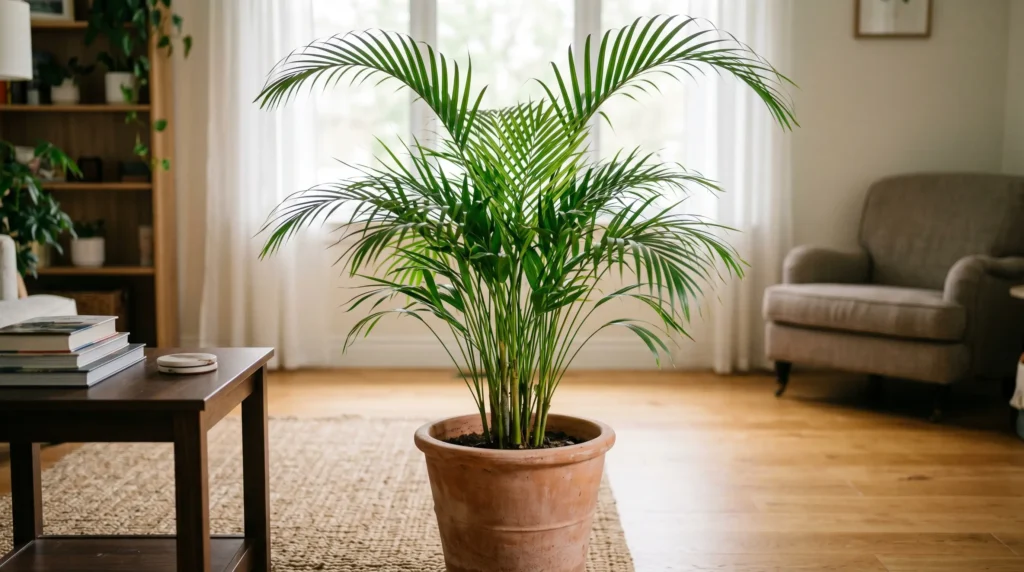
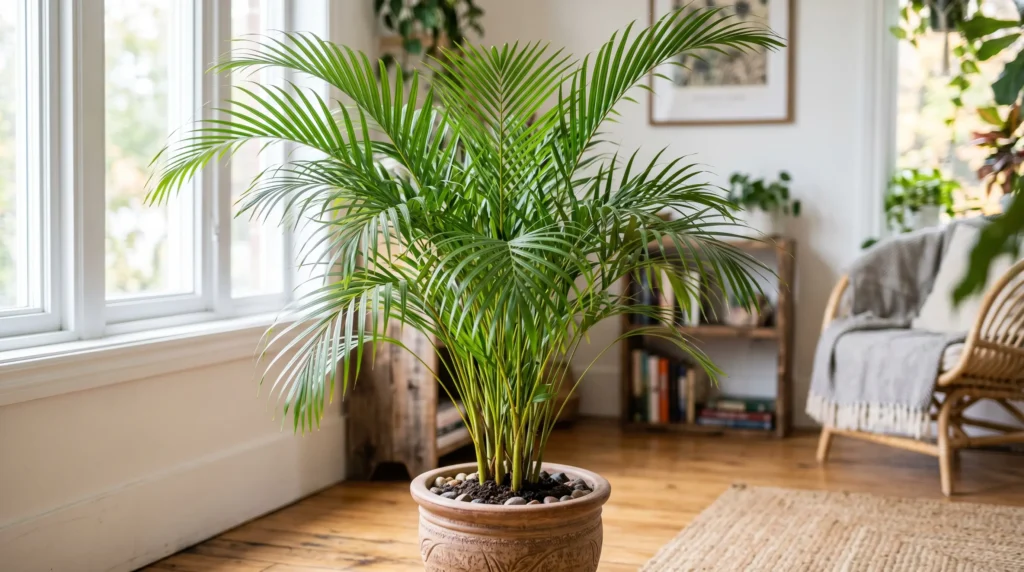
What is an areca palm? The areca palm (Dypsis lutescens) is a tropical houseplant native to Madagascar. Indoors in the UK it grows up to 2 metres tall, producing feathery, arching fronds from multiple bamboo-like canes.
| Care Factor | UK Requirement |
|---|---|
| Light | Bright indirect light; south or west-facing window |
| Water | When top 2–3cm is dry; use rainwater in hard water areas |
| Humidity | 40–60% RH; critical in winter with central heating on |
| Temperature | 18–24°C; never below 10°C |
| Fertiliser | Every 6–8 weeks, March–September only |
| Repotting | Every 2–3 years in spring |
| Toxic to pets? | No — pet safe for cats and dogs |
What Is the Areca Palm plant?
What is an areca palm? The areca palm is a tropical palm species with the botanical name Dypsis lutescens (formerly known as Chrysalidocarpus lutescens). It is native to the rainforests of Madagascar and is widely grown as an indoor houseplant in the UK. It is also commonly sold under the names butterfly palm, golden cane palm, bamboo palm, and yellow palm.
Why Does It Have So Many Names?
Each common name describes a distinct feature of the plant:
- Areca palm — from its former genus name Areca
- Butterfly palm — the arching fronds spread upward like butterfly wings
- Golden cane palm — the canes (stems) have a distinctive yellow-gold colour
- Bamboo palm — the clustered canes resemble bamboo stems
Key Facts for UK Growers
- Origin: Madagascar rainforest — high heat, high humidity, filtered light under a canopy
- UK indoor height: Up to 2 metres in a pot
- Growth rate: 15–25cm per year during the UK growing season (spring–summer)
- Lifespan indoors: Approximately 10 years with good care
- Outdoor suitability in UK: Indoor-only. Cannot survive UK winters outdoors — it struggles below 10°C, and UK winters regularly reach 1–5°C across most of England, Scotland, and Wales
Despite being one of the world’s most popular houseplants — sold in millions across Europe every year — the areca palm is listed as endangered in the wild in its native Madagascar due to deforestation and habitat loss. Understanding its wild origins helps UK growers better replicate its ideal conditions.
Is Areca Palm Right for Your UK Home? (Honest Pros & Cons)
The areca palm is frequently marketed as an easy, beginner-friendly houseplant. In UK conditions, that description is only partly true. The plant is forgiving in some respects — but the combination of UK hard water, low winter light, and central heating creates genuine challenges that most care guides don’t acknowledge.
Pros for UK Growers
- One of the best natural humidifiers — genuinely useful in dry, centrally heated British homes
- Pet safe — non-toxic to cats and dogs (unlike many statement plants)
- Excellent air purifier, particularly effective against formaldehyde and xylene
- Dramatic, architectural appearance — a statement plant for living rooms
- Faster-growing than the Kentia palm — visible progress year on year
- Widely available and relatively affordable compared to other large houseplants
Cons for UK Growers
- Very sensitive to fluoride and limescale in UK hard tap water — brown tips almost inevitable without rainwater
- Needs 40–60% humidity — UK central heating creates the opposite (10–20%)
- UK winter light is often insufficient — careful window placement is essential
- Brown tips are practically unavoidable in a typical British home without active intervention
- Not a low-maintenance, set-and-forget plant in UK conditions — requires seasonal care adjustments
The honest assessment: the areca palm is a rewarding plant for UK growers who understand its needs — but it is not the “easy” plant it is sometimes sold as. If you are a complete beginner looking for something genuinely unfussy, the Kentia palm is more forgiving of UK conditions.
Light Requirements in the UK (Window Orientation Guide)
How Much Light Does an Areca Palm Need?
Areca palms need bright, indirect light for at least 6–8 hours per day. They cannot tolerate prolonged direct midday sun (which scorches leaves) or deep shade (which causes the plant to thin and decline). In practice, this means positioning the plant near — but not directly against — a large, bright window.
UK Window Orientation Guide
| Window Direction | Suitability | UK-Specific Notes |
|---|---|---|
| South-facing | Best year-round | Use a sheer curtain in June–August to diffuse intense afternoon sun; ideal in winter |
| West-facing | Very good | Afternoon light rarely intense enough to scorch; excellent for spring and autumn |
| East-facing | Adequate | Gentle morning light; may need a supplemental grow light in UK winter months |
| North-facing | Not recommended | Insufficient light year-round; plant will thin, stop growing, and decline |
Why UK Light Levels Create a Seasonal Challenge
A key difference between UK growing conditions and the advice published on many global plant care websites: the UK sun tracks significantly lower in the sky than in Mediterranean or tropical climates. South-facing windows in the UK deliver far gentler, more diffused light than in Spain or North Africa — meaning scorching from a south-facing window is rare except during the height of summer.
More importantly, UK daylight hours drop to just 7–8 hours per day in December and January, and light intensity is very low. During this period, growth stalls or stops entirely — this is normal and not a sign of disease or poor care.
Practical Positioning Tips
- Ideal distance from window: 1–2 metres from a large south or west-facing window
- Beyond 2–3 metres: The plant will slowly thin and lean toward the light source
- Rotate quarterly: Every 2–4 weeks, rotate the pot 90° to prevent one-sided growth
- Supplemental grow lights: Worth considering for UK homes from October to February — a full-spectrum LED grow bulb in a standard lamp fitting is sufficient for most households
Zero new growth from November to February is completely normal for a UK-grown areca palm. The plant is in semi-dormancy. Do not respond by moving it somewhere warmer, feeding it more, or increasing watering — this usually makes things worse.
Watering Your Areca Palm: The UK Seasonal Schedule
When to Water — The Core Rule
Water your areca palm when the top 2–3cm of soil feels dry to the touch. Poke your finger into the compost up to the second knuckle: if it feels dry at that depth, water thoroughly. If it still feels damp, wait another day or two and test again.
This “finger test” is more reliable than any fixed schedule, because watering frequency varies significantly with UK seasons, room temperature, pot size, and whether the central heating is running.
How to Water Correctly
- Water slowly and thoroughly until water runs freely from the drainage holes
- Allow the pot to drain fully — never let the pot sit in a saucer of standing water
- Empty the saucer after 30 minutes if water remains
- Use rainwater where possible (see Section 5 for why this matters in the UK)
UK Season-by-Season Watering
Guide
Spring (March–May)
- Resume increased frequency as growth resumes
- Aim for 1–2 times per week
- Begin checking soil every 2–3 days as temperatures rise
Summer (June–August)
- Most frequent watering period
- Check soil every 2–3 days, especially in south-facing rooms or conservatories
- Up to twice weekly in very warm conditions
Autumn (September–November)
- Taper off frequency as growth slows
- Allow soil to dry more fully between waterings
- Reduce to once per week by October
Winter (December–February)
- Minimum watering — every 10–14 days
- Plant is in semi-dormancy; soil dries slowly in low UK light
- Overwatering in this period is the #1 cause of root rot
Common Watering Mistakes UK Growers Make
- Continuing a summer schedule into autumn and winter — the most common cause of root rot in UK homes
- Watering little and often — shallow watering causes roots to grow near the surface and dry out quickly; always water deeply
- Using hard tap water without treatment — accumulates fluoride and salt over time (see next section)
- Letting the pot sit in water — particularly dangerous in winter when the soil is already drying slowly due to low light
A moisture meter (widely available from Amazon UK or B&Q for under £10) removes the guesswork from the finger test. Insert the probe into the middle of the rootball — water when the reading drops to 3–4 (out of 10). Never water if the reading is still above 5.
The UK Hard Water Problem — Why Your Palm Has Brown Tips
This is the single most important UK-specific section in this guide — and the most commonly overlooked issue in areca palm care advice written for a global audience.
Why UK Tap Water Harms Areca Palms
Areca palms are sensitive to fluoride found in tap water. UK tap water also contains high levels of calcium and magnesium (the minerals that cause limescale) and chlorine. These substances accumulate in the soil over time as salt deposits, causing a condition known as salt burn — the progressive browning of leaf tips, yellowing, and stunted growth.
Which UK Regions Have the Hardest Water?
| Region | Water Hardness | Risk Level for Areca Palms |
|---|---|---|
| London & South East | Very hard (200–350mg/l CaCO₃) | High — use rainwater strongly recommended |
| East Anglia & Midlands | Hard (150–250mg/l) | High |
| South West England | Moderate to hard | Moderate |
| Northern England | Moderate | Moderate |
| Scotland & Wales | Soft to moderate | Lower risk (but fluoride still present) |
Check your specific area’s water hardness by visiting your local water company’s website — they are legally required to publish this data.
Signs of Hard Water Damage on Your Areca Palm
- Brown tips starting at the very edge of leaf tips and spreading inward
- White crusty residue on the soil surface or on the outside of terracotta pots (visible limescale)
- General dull, yellowed appearance of older leaves
- Stunted growth despite adequate light and watering
The Rainwater Solution
Rainwater is the best water for areca palms in the UK. It is naturally soft, fluoride-free, and at a slightly acidic pH that suits the plant perfectly. Given the UK’s famously wet climate, collecting rainwater is both practical and free.
How to collect and use rainwater for houseplants:
- Attach a simple water butt (available from garden centres, B&Q, and Amazon UK from around £25) to a downpipe from your roof guttering
- Store in a lidded container to prevent algae growth and mosquitoes
- Allow water to reach room temperature before use — cold water shocks roots
- Collected rainwater can be used immediately on the areca palm without treatment
Other Water Alternatives
- Distilled water — available cheaply from supermarkets; excellent for watering if rainwater is unavailable
- Filtered water — a Brita-type jug filter reduces chlorine significantly but does not remove fluoride or all hardness minerals; better than nothing
- Tap water left overnight — leaving tap water uncovered in a jug for 12–24 hours allows chlorine to off-gas. This does not remove fluoride or calcium — but it eliminates chlorine, which helps
- Water softener output — avoid. Softened water replaces calcium ions with sodium. Sodium accumulation in soil causes its own yellowing and is harmful to palms
Flushing Accumulated Salts from the Soil
Even with good practice, mineral salts build up in the soil over time. Every 1–2 months, flush the pot by running a large volume of distilled or rainwater slowly through the soil until it flows freely from the drainage holes. This washes out accumulated salt deposits and prevents long-term soil toxicity.
Planting your areca palm in slightly acidic compost (pH 6.0–6.5) reduces fluoride availability for root absorption. Adding a small amount of sulphur chips to the potting mix at repotting time can help maintain acidic pH in hard water areas.
Humidity: The #1 Challenge for UK Growers
What Is the Ideal Humidity for an Areca Palm?
Areca palms need 40–60% relative humidity (RH) to thrive. Most UK homes sit around 30% RH. When central heating is running — which in the UK can mean 6 or more months per year — indoor humidity can plummet to 10–20%. This is the single most common reason for brown tips and general poor health in UK-grown areca palms.
Why UK Homes Are Particularly Hostile for Tropical Plants
British homes with gas central heating are among the driest indoor environments for tropical plants anywhere in the temperate world. Unlike in continental European countries where underfloor heating is more common (which dries air less aggressively), UK radiator-based central heating creates intense localised heat that dramatically reduces surrounding air moisture.
The first step to managing this is measurement, not guesswork. A digital hygrometer costs £8–£15 from Amazon UK, B&Q, or Wilko and gives you a real-time RH reading. Without measuring, you are managing blind.
6 Proven Ways to Increase Humidity for Areca Palms (Ranked by Effectiveness)
- Electric humidifier — the most effective solution by far. Place 1–2 metres from the plant and set to maintain 45–55% RH. Quiet ultrasonic models are suitable for bedrooms. Budget models start from around £20–£30; mid-range options from brands like Levoit or Vicks offer better capacity and quiet operation.
- Pebble tray with water — fill a wide, shallow tray with pebbles or gravel, add water to just below the pebble surface, and place the pot on top. As the water evaporates it raises localised humidity. Ensure the bottom of the pot never touches the water (root rot risk). Replace the water weekly.
- Grouping tropical plants together — plants naturally transpire moisture through their leaves. Grouping your areca palm with other tropical houseplants (pothos, peace lily, calathea) creates a micro-humid zone that benefits all of them.
- Bathroom placement — steam from showers and baths naturally raises bathroom humidity to near-ideal levels for tropical plants. Viable if your bathroom receives adequate indirect light (ideally via a frosted east or south-facing window).
- Bowl of water on a nearby radiator — a specifically UK tip. Placing a wide bowl or trough of water on or directly in front of an active radiator causes the warm air to evaporate the water and distribute moisture around the room. Replace the water every 2–3 days.
- Misting — the most popular advice online, but the least effective long-term solution. Misting raises humidity for only 20–30 minutes before the droplets evaporate. In rooms with poor air circulation it can also encourage fungal leaf spots. Misting is better than nothing, but a humidifier is far superior.
In many UK Victorian terraces and period flats, radiators are positioned directly under windows — exactly where you want to place a light-loving plant. Never place your areca palm directly on or immediately in front of a radiator. The rising hot, dry air will cause rapid moisture loss from the fronds, guaranteed brown tips, and potentially crispy, dead leaf sections. Position the plant at least 50–60cm to the side of any active radiator.
Temperature & Draught Sensitivity in British Homes
What Temperature Does an Areca Palm Need?
Areca palms prefer a room temperature between 18°C and 24°C. They tolerate down to 10°C but will stop growing and show visible stress below 15°C. They cannot tolerate frost.
The good news: in most centrally heated UK homes, room temperature rarely falls below 15°C during winter — so temperature itself is rarely the primary problem for indoor palms. Draughts are the real threat.
Draught Sources in UK Homes
- Single-glazed windows in older properties and Victorian terraces
- Letterboxes and under-door gaps on external doors in hallways
- Poorly insulated or unheated conservatories
- Air conditioning units (less common in UK homes, but increasingly present)
- Open windows in autumn and winter during airing
UK conservatories can reach 35°C+ in summer (too hot — scorching risk and accelerated water loss) and drop below 5°C in winter (potentially fatal for an areca palm). Either move the plant indoors between October and April, or ensure the conservatory is heated to a minimum of 10°C throughout winter.
Positions to Avoid in UK Homes
- Hallways with external doors (cold draught spikes every time the door opens)
- Directly against single-glazed windows in winter
- Near or under air conditioning vents or fans
- Directly on or immediately next to radiators
- External walls in older properties with cold bridging
Best Soil Mix for Areca Palm in the UK
What Soil Does an Areca Palm Need?
An areca palm needs a free-draining, slightly acidic potting mix that retains some moisture without becoming waterlogged. Standard houseplant compost alone is often too moisture-retentive for UK conditions — particularly in winter when low light means the soil dries very slowly.
Recommended DIY UK Soil Mix
- 60% high-quality peat-free houseplant compost
- 20% perlite (dramatically improves drainage and aeration)
- 20% horticultural grit or coarse sand
Target pH: 6.0–6.5 (slightly acidic — also reduces fluoride uptake from hard water)
Why Perlite Matters in the UK
In UK winter conditions — low light, cool temperatures, reduced watering — standard compost can remain wet for 2–3 weeks between waterings. This dramatically increases root rot risk. Perlite is a volcanic mineral that creates air pockets in the soil, allowing water to drain and roots to breathe even when the compost itself retains some moisture.
What to Avoid in Potting Mixes
- Standard garden compost — too dense, retains excessive moisture, increases root rot risk
- Water-retaining gel crystals — counterproductive; increases moisture retention when UK conditions already slow drying
- Calcium-rich composts — compounds hard water problems, raises soil pH
Pot Material Matters
| Pot Material | Best Season / Use | Reason |
|---|---|---|
| Terracotta | UK autumn & winter | Porous; allows soil to breathe and dry faster — reduces root rot risk |
| Plastic | UK spring & summer | Retains moisture longer — useful in warm rooms where soil dries quickly |
| Decorative ceramic (no drainage holes) | Never alone | Use only as a cachepot with an inner nursery pot; water collects invisibly at the base |
UK product recommendations: Westland Houseplant Compost, Miracle-Gro Houseplant Potting Mix (both widely available). Perlite is available from B&Q, Wilko, and Amazon UK.
Fertilising: What to Use, When, and What to Avoid
When to Fertilise an Areca Palm in the UK
Feed your areca palm only during the active growing season: March to September in the UK. Apply a balanced liquid houseplant fertiliser every 6–8 weeks, diluted to half the recommended strength. Stop feeding entirely in October and do not resume until March.
What Fertiliser to Use
- Type: Balanced liquid houseplant fertiliser with an NPK ratio of approximately 10-10-10, or a palm-specific liquid feed
- Dilution: Always use at half the strength stated on the packaging — areca palms are sensitive to over-fertilisation
- Always water first: Water the plant an hour before fertilising to prevent root burn on dry roots
What to Avoid When Fertilising
Areca palms are sensitive to chloride and fluoride — avoid mineral fertilisers made of salts, and avoid any product with a high fluoride or chloride content. Granular slow-release fertilisers can cause localised salt hotspots in the soil if the plant is watered with hard tap water.
Signs of Fertiliser Problems
| Problem | Signs | Solution |
|---|---|---|
| Over-fertilisation | White crusty deposits on soil surface; sudden worsening of brown tips; yellowing of leaf margins | Flush soil thoroughly with distilled water; stop feeding for 6–8 weeks |
| Under-fertilisation | Slow or no growth during spring/summer; pale, chlorotic (washed-out) leaves | Introduce a balanced feed at half strength; add a monthly Epsom salts solution (1 tsp per litre) for magnesium |
Iron and magnesium deficiencies are particularly common in areca palms grown in UK hard tap water, which can interfere with nutrient uptake. A monthly application of Epsom salts solution (magnesium sulphate — 1 teaspoon dissolved per litre of water) during the growing season addresses this effectively and cheaply.
UK product recommendations: Baby Bio Houseplant Food, Miracle-Gro Liquid All Purpose, Westland Palm Fertiliser.
Repotting Guide (When, How, and UK-Sourced Products)
When Should You Repot an Areca Palm?
Repot only when the plant is root-bound — the clearest sign is roots emerging from the drainage holes at the bottom of the pot. Areca palms are somewhat tolerant of being root-bound and should only be repotted every 2–3 years at most. Repotting unnecessarily disturbs the root system and triggers a stress response.
Step-by-Step: How to Repot an Areca Palm in the UK
- Time it correctly: Only repot in spring (April–May in the UK), giving the plant maximum recovery time before the following winter
- Choose the right pot: Select a pot only 2–5cm larger in diameter than the current one. Too large = excess soil retains moisture for too long = root rot risk
- Prepare the mix: Use the recommended mix (60% peat-free compost + 20% perlite + 20% grit)
- Remove gently: Tip the plant sideways and ease it free; never pull by the canes
- Check the roots: Trim any black or mushy roots with clean scissors; dust cuts with cinnamon (a natural antifungal)
- Repot and water lightly: Position in the new pot, fill around the rootball, water once lightly
- Post-repotting care: Reduce watering for 2 weeks; keep out of direct light while roots re-establish; some drooping is normal and temporary
In low UK winter light, the plant cannot generate enough energy to recover from root disturbance. Repotting between October and March dramatically increases the risk of root rot and plant death. If you notice the plant is root-bound in autumn, wait until the following April.
Note: expect a temporary spike in brown tips after repotting. Root damage — however minor — temporarily reduces the plant’s ability to absorb water, causing brief moisture stress in the fronds. This resolves within 3–4 weeks as roots re-establish.
Propagation: How to Divide an Areca Palm
Can You Propagate an Areca Palm?
The only practical propagation method for UK home growers is division. Areca palms naturally grow in clumps; when you repot in spring, outer clumps at the edge of the pot may come away naturally. These can be potted separately to create a new plant.
Step-by-Step: Dividing an Areca Palm
- Remove the plant from its pot in April or May during your scheduled repotting
- Gently tease apart an outer clump of canes — look for a natural separation point
- Each division must have at least 3–4 healthy canes and an intact root section
- Never force apart canes that are firmly fused — cutting these kills both sections
- Pot each division separately in fresh mix, water lightly, and place in a warm, humid spot out of direct light
- Keep consistently moist (not wet) for 2–4 weeks while the new roots establish
- Expect some drooping and even frond loss — the division is under stress
What About Growing from Seed?
Areca palm seeds can be germinated (they take 6–8 weeks at 25°C+ to sprout), but the seedlings take years to develop into a presentable plant. For UK home growers this is not a practical approach — buying a young plant is far more efficient.
Troubleshooting: Brown Tips, Yellow Leaves & Drooping
This section covers the six most common problems UK areca palm growers encounter, with UK-specific diagnosis and practical fixes.
Problem 1: Brown Tips on Leaf Ends
The most common complaint from UK areca palm growers — especially October to March.
What causes brown tips? Brown tips are a sign that the plant is losing moisture from its fronds faster than its roots can replace it. The brown area is dead tissue and will not turn green again.
UK causes ranked by likelihood:
- Low humidity from central heating (most common, October–March)
- Hard tap water fluoride and salt accumulation in soil
- Overwatering in winter (root rot reduces water uptake)
- Cold draught from window or door
- Over-fertilisation (salt burn)
- Pest damage (spider mites, scale)
Fix: Address humidity first with a humidifier or pebble tray; switch to rainwater; adjust watering frequency for the season. Do not attempt to cut off brown tips — trimming a palm frond causes the entire frond to die back. Only remove completely dead (fully brown) fronds by cutting cleanly at the base of the cane.
Problem 2: Yellow Leaves
Often caused by a nutrient or watering issue, not disease.
Causes and diagnosis:
- Lower/older fronds turning yellow: Normal ageing — remove cleanly at the base
- General yellowing of new fronds: Likely underwatering, too much direct sun, or iron/magnesium deficiency
- Yellow margins on fronds: Over-fertilisation, or sodium build-up from a water softener
- Whole plant yellowing and wilting: Root rot — urgent action needed
Fix: Check soil moisture first. If dry, water thoroughly. If wet and smelling musty, investigate root rot. If using a water softener, switch to unsoftened water or rainwater immediately. Add a monthly Epsom salts solution to address magnesium deficiency.
Problem 3: Drooping Fronds
Usually underwatering or cold shock — check soil immediately.
If soil is dry: The plant is dehydrated. Water thoroughly and the fronds often recover within 12–24 hours. This is a fixable crisis.
If soil is wet: Root rot is likely. The roots are too damaged to move water to the fronds. Unpot the plant, check roots, and treat as described below.
If soil is normal and drooping is sudden: Cold draught or temperature shock. Check for open windows, cold air sources, or a position that changed in autumn.
Problem 4: No New Growth
In the UK, this is almost always normal winter semi-dormancy.
October to February: Zero or minimal new growth is completely normal. Do not panic and start over-fertilising or moving the plant.
March to September with no new growth: Likely insufficient light (move closer to a window or add a grow light) or the plant is severely root-bound (time to repot).
Problem 5: Root Rot
A serious but often recoverable condition — act quickly.
Signs: Mushy or soft base canes, black or brown slimy roots when unpotted, foul or sour smell from the compost, yellowing fronds that droop despite moist soil.
Treatment:
- Remove from pot immediately and inspect all roots
- Cut away every black, brown, or slimy root with clean scissors (sterilised with alcohol)
- Dust all cuts with cinnamon powder (natural antifungal)
- Leave roots to air-dry for 1–2 hours
- Repot in fresh, dry mix with added perlite
- Do not water for 1 week; then water very sparingly until new growth resumes
Problem 6: Pale or Washed-Out Leaves
Almost always too much direct summer sun.
Cause: Direct midday sun bleaches the chlorophyll from the fronds, causing them to look faded, pale, or almost white in the most exposed areas.
Fix: Move the plant 30–60cm back from the window, or add a sheer curtain. The affected fronds will not recover their colour, but new fronds will grow correctly once the light issue is resolved.
Common Pests in UK Homes (Spider Mites, Mealybugs, Scale)
Red Spider Mite
Red spider mite is the most common areca palm pest in UK homes, particularly during winter when central heating creates the warm, dry conditions they thrive in.
Signs: Fine webbing on leaf undersides and between fronds; upper leaf surface becomes mottled or stippled with tiny pale dots; fronds look dull and dusty.
UK treatment: Increase humidity immediately (this disrupts their breeding cycle). Spray with a fatty acid insecticide, neem oil solution, or SB Plant Invigorator (an organic option available at B&Q and garden centres). Treat every 5–7 days for 3 weeks to break the lifecycle. Keep the plant away from other houseplants during treatment.
Mealybugs
Signs: Small white fluffy or cottony blobs in the joints between canes and fronds, and on leaf undersides. They excrete sticky honeydew that attracts mould.
Treatment: Wipe each bug with a cotton bud dipped in isopropyl (rubbing) alcohol. For heavy infestations, use a neem oil spray or Provanto Ultimate Bug Killer (widely available at B&Q, Wilko). Repeat weekly for a month — mealybugs are persistent and eggs survive initial treatments.
Scale Insects
Signs: Small, hard brown or tan oval bumps approximately 3–6mm long, attached to stems and the undersides of fronds. They are sap-sucking insects disguised as part of the plant.
Treatment: Scrape off with a soft toothbrush or cloth dampened with insecticide containing fatty acids. Neem oil applied to the whole plant weekly for a month prevents reinfestation.
Prevention — The UK Grower’s Monthly Routine
- Maintain humidity above 40% — the single best preventive measure against spider mites
- Inspect the undersides of fronds monthly, particularly October to April
- Wipe leaves with a damp cloth monthly (removes dust and potential eggs)
- Isolate any new houseplants for at least 2 weeks before placing near your areca palm
UK product recommendations: Provanto Ultimate Bug Killer, SB Plant Invigorator (organic), Westland Resolva Bug Killer.
UK Placement Guide: Best Rooms & Positions
Areca Palm in the Living Room
The living room is the most popular placement and generally the best choice. A south or west-facing wall near — but not touching — a large window is ideal. The main conflict to be aware of in UK living rooms is the classic British radiator-under-window setup: position the palm to the side of the radiator, not directly above or in front of it.
Areca Palm in the Bedroom
An excellent choice for UK bedrooms, and one underused by British plant owners. The areca palm actively transpires moisture — up to a litre of water per day — helping to combat the drying effect of overnight central heating. It also produces oxygen overnight. Place near a west or south-facing bedroom window for best results.
Areca Palm in the Bathroom
Viable — provided sufficient light is available. Steam from daily showers naturally handles humidity needs without any extra equipment. However, many UK bathrooms are north-facing with frosted glass windows that let in very little light. Assess your bathroom’s light carefully before committing — a plant in a dark bathroom will decline slowly regardless of humidity.
Areca Palm in a UK Conservatory
Manageable in summer if shaded from direct midday sun, but risky from October to April. Most UK conservatories drop to below 10°C on cold nights unless specifically heated. If you want to keep your areca palm in a conservatory, you must either move it indoors for winter or heat the conservatory to a consistent minimum of 10°C — which is expensive.
Areca Palm in a Home Office
A good choice. The plant is effective at reducing volatile organic compounds (VOCs) from new furniture, printer ink, and synthetic materials — all common in home offices. Position near a window and away from any desk fan or electric heater.
Positions to Avoid in UK Homes
- Hallways — cold draught from front doors, insufficient light
- North-facing rooms — insufficient light year-round
- On or directly next to radiators
- On windowsills in direct summer sun
- Near external walls with cold bridging in older properties
- Near air conditioning units (uncommon in UK homes, but increasingly found)
Air Purifying Benefits: What the NASA Study Really Found
What Did the NASA Clean Air Study Find?
NASA’s Clean Air Study identified the areca palm as one of the most effective houseplants for removing indoor air pollutants — specifically formaldehyde, xylene, and toluene. According to Dr. Wolverton’s research underpinning the study, the areca palm ranked among the top performers for formaldehyde removal and was noted as one of the few plants that functions as a significant natural humidifier, transpiring up to a litre of moisture per 24 hours.
The Important Honest Caveat
Here is what most houseplant websites don’t tell you: the NASA study was conducted in sealed test chambers — not in typical homes with ventilation, air movement, and normal room volumes. A 2019 analysis published in the Journal of Exposure Science and Environmental Epidemiology calculated that you would need dozens of plants per room to match the performance of a basic HEPA air purifier.
What the Areca Palm Actually Delivers for UK Homeowners
The air quality benefits, while real, are modest compared to a mechanical air purifier. However, the humidity transpiration benefit is very real and practically meaningful for British growers. In a centrally heated UK bedroom or living room where a single electric humidifier can feel excessive, a large areca palm contributes meaningfully to maintaining healthier air moisture levels.
A more recent study monitored areca palm efficiency across four months in naturally ventilated indoor spaces and found measurable phytoremediation effects on total volatile organic compounds (TVOCs), CO₂, and carbon monoxide — though multiple plants were required for significant impact.
Honest verdict for UK growers: The areca palm is genuinely beneficial for indoor air quality and meaningfully helpful for humidity. But don’t buy it primarily as an air purifier — buy it because it is a beautiful, fast-growing, pet-safe plant that happens to make your air slightly better and your room a bit less dry in winter. That’s a good enough reason.
Is Areca Palm Safe for Cats & Dogs?
No. The areca palm (Dypsis lutescens) is non-toxic to cats, dogs, and horses, according to the ASPCA. This makes it one of the few large, dramatic architectural houseplants that UK pet owners can keep without concern about accidental ingestion.
The sago palm (Cycas revoluta) is a completely different plant that is extremely toxic — potentially fatal — to cats and dogs. It is sometimes sold with similar “palm” labelling. Always check the botanical name (Dypsis lutescens) before purchasing an areca palm from any retailer.
While non-toxic, ingestion of large quantities of any plant material may cause mild stomach upset in pets. If your cat or dog habitually chews houseplants, consider positioning the areca palm where it cannot be easily reached, or using a cat deterrent spray around the base of the pot.
Seasonal Care Calendar (UK Spring, Summer, Autumn, Winter)
Spring (March–May)
- Resume watering frequency as growth resumes
- Begin fertilising at half strength (balanced liquid feed)
- Best time to repot if rootbound
- Move closer to window as UK daylight hours extend
- Check for spider mites — common after dry winter heating
- Divide for propagation if desired
Summer (June–August)
- Most active growth period — check soil every 2–3 days
- Water frequently; increase humidity monitoring
- Protect from direct afternoon sun in south-facing windows
- Can move outdoors to sheltered shade on days above 18°C
- Bring back indoors before September nights fall below 12°C
- Fertilise every 6–8 weeks at half strength
Autumn (September–November)
- Taper watering frequency as growth slows
- Stop fertilising by October
- Move away from cold window glass
- Central heating starts — deploy humidifier or pebble tray
- Inspect for pests before bringing outdoor plants inside
- Check pot placement — away from radiators
Winter (December–February)
- Minimal watering — every 10–14 days maximum
- Use a humidifier; avoid positions near heat vents
- Supplement light with a grow lamp if needed
- Do NOT fertilise, repot, or propagate
- Expect zero or minimal new growth — this is normal
- Monitor for spider mites monthly
Where to Buy Areca Palm in the UK
Online Retailers
Online plant specialists generally offer healthier, better-cared-for plants than supermarkets and large DIY stores. Recommended UK online retailers include Patch Plants, Bloombox Club, Beards & Daisies, and Crocus — all of whom ship well-packaged plants with care guidance. Plants arrive in better condition than supermarket alternatives, and you can often choose size.
Garden Centres & Physical Retailers
RHS Garden Centres and independent local garden centres are the best physical options — staff can advise and you can inspect the plant before purchase. B&Q, Dobbies, and Homebase all regularly stock areca palms, particularly in spring and summer.
Supermarkets (ASDA, Sainsbury’s, Lidl, Aldi)
Areca palms appear at supermarkets at low prices, particularly at Lidl and Aldi. However, supermarket plants are often overwatered in-store, poorly lit, and may already have early root rot or pest problems. Always check: squeeze the soil (should be moist, not soggy or bone dry), smell the pot (no sour or musty odour), inspect fronds for webbing or white fluff.
What to Look For When Buying an Areca Palm
- Multiple healthy green canes with no wobble at the base
- At least 70% of fronds should be fully green and upright
- No visible webbing, white fluff, or brown oval bumps on stems
- Moist but not waterlogged soil — no sour or musty smell from the pot
- No more than 20–30% of fronds browning or yellowed
2025 UK Price Guide by Plant Size
Areca Palm vs Kentia Palm — Which Is Better for UK Homes?
The two most popular indoor palms sold in the UK are the areca palm (Dypsis lutescens) and the Kentia palm (Howea forsteriana). Both are pet safe and impressive as statement plants, but they suit different UK homes and lifestyles.
| Factor | Areca Palm | Kentia Palm |
|---|---|---|
| Light needs | Bright indirect | Tolerates lower light |
| Hard water sensitivity | High — prone to brown tips | Moderate — more forgiving |
| Humidity needs | High (40–60% RH) | Moderate (30–50% RH) |
| Growth rate | Faster (15–25cm/yr) | Slower (5–15cm/yr) |
| Pet safe? | Yes | Yes |
| Price | Cheaper | More expensive |
| North-facing rooms | Not suitable | More tolerant |
| Best for UK winters | Needs more care | Easier to maintain |
| Aesthetic | Bushy, tropical, multi-stemmed | Single-stemmed, elegant |
| Overall difficulty in UK | Moderate–challenging | Easy–moderate |
UK Verdict: The Kentia palm is the more forgiving choice for typical British homes — particularly those with north or east-facing windows, limited light, or hard water. The areca palm rewards growers who can meet its humidity and water quality needs with faster growth, a lusher tropical appearance, and better air humidification. If you are committed to addressing UK hard water and investing in humidity management, the areca palm is the more rewarding plant. If you want something beautiful that asks less of you, choose the Kentia.

Leave a Reply