
Here is the most common calathea plant story in the UK: you do everything the care label says, and your plant still develops brown, crispy tips. You water it. You keep it away from direct sun. It still deteriorates. The reason is almost never what you think — and almost always specific to UK conditions.
Three invisible forces work against calathea in British homes: hard tap water, low winter light, and central heating that strips humidity. Generic houseplant guides written for a global audience miss all three. This guide does not.
What is a calathea plant? A calathea is a tropical foliage plant native to the forest floors of Central and South America, prized for its dramatic patterned leaves and its distinctive habit of folding its leaves upward at dusk — a movement known as nyctinasty. It is one of the UK’s most searched houseplants, and for good reason: it is pet-safe, visually striking, and well-suited to flat and apartment living.
Is calathea a beginner plant? Honestly, no — not without the right knowledge. But with UK-specific guidance, it is absolutely achievable. This guide gives you every answer you need, in one place, without the vagueness of generic care advice.
What Is a Calathea Plant?
Botanical Background
What family does calathea belong to? Calathea belongs to the family Marantaceae — commonly called the prayer plant family — which contains over 600 species.
- Native habitat: Forest floors of Central and South America, primarily Brazil
- Original genus: Calathea. Many species have since been reclassified as Goeppertia — this causes confusion when shopping, because both names appear in UK garden centres and online shops
- The three genera sold as “calathea” in the UK: Calathea, Goeppertia, and Ctenanthe — care requirements are essentially identical across all three
- Traditional uses: In South America, the broad leaves are used for weaving baskets and wrapping food — a cultural detail that hints at just how robust the foliage is in its native environment
What is the difference between calathea and goeppertia? Many plants sold as “calathea” in UK shops have been scientifically reclassified as “goeppertia.” The name change is botanical only — care requirements are identical. UK retailers have been slow to update labelling, so continue searching under “calathea” when shopping.
The Prayer Plant Movement — Science Behind Nyctinasty
Calathea belongs to the same family as the prayer plant — another UK favourite known for its leaf-folding behaviour — and shares many of the same care requirements.
How does calathea move its leaves? The movement is powered by pulvini — specialised motor cells located at the base of each leaf. These cells fill with or release water (via osmotic pressure) to raise or lower the leaf. The mechanism is entirely chemical and light-driven, not clock-driven.
Why do calathea leaves move? Scientists propose three competing theories:
- Water conservation — reducing leaf surface area exposed to night air
- Predator deterrence — disturbing insects that land on leaves at night
- Light-capture optimisation — repositioning to maximise photosynthesis at dawn
UK-specific note: In UK homes during November through February, natural light levels — especially in Scotland, northern England, and north-facing rooms — may be too low to trigger reliable leaf movement. Reduced or absent prayer movement in winter is normal and is not a sign of a dying plant. If movement stops entirely and it is not winter, insufficient light is the most likely cause — and the fix is simply moving the plant closer to a window.
Why Calathea PLANT Is So Popular in the UK
- Pet-safe and non-toxic to cats, dogs, and children — a major advantage over many popular alternatives
- Visual drama without outdoor space — suits UK flat and apartment living
- Post-pandemic houseplant boom drove UK plant sales sharply upward; calathea became a social media favourite for its patterned foliage and visible “personality”
- Suits lower-light UK interiors better than many tropical plants, which need more direct sun
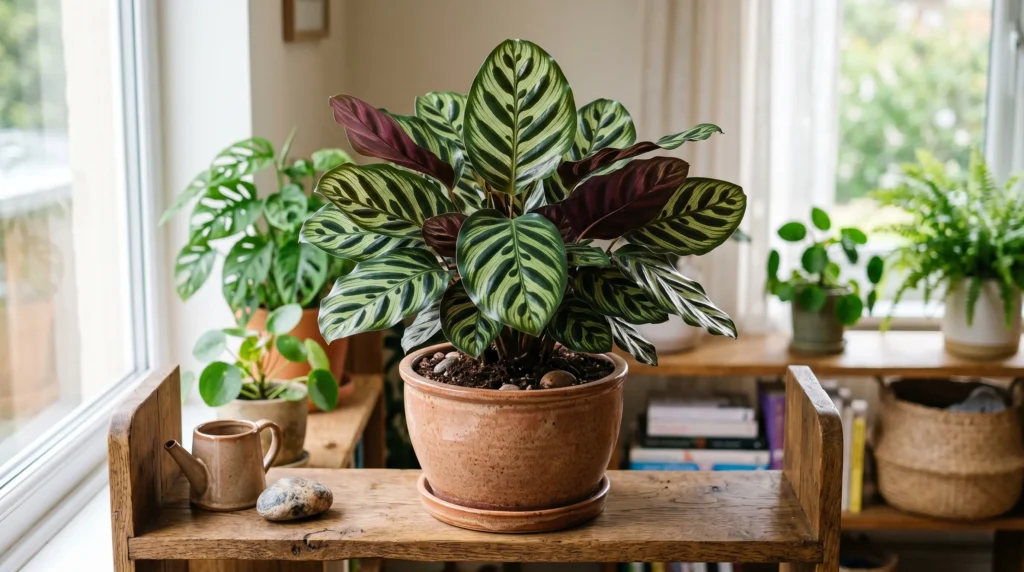 Calathea PLANT Varieties — The UK Buyer’s Guide
With dozens of calathea varieties available in UK garden centres and online, choosing the right one matters. Some are far more forgiving than others. This section is a practical buying guide, not just a list.
Beginner-Friendly Varieties (Most Forgiving)
These varieties tolerate slightly lower humidity and minor inconsistencies in watering better than most. Start here if you are new to calathea.
| Variety | Common Name | Key Feature | Max Height | Difficulty |
|---|---|---|---|---|
| C. lancifolia | Rattlesnake Plant | Wavy leaves, dark oval spots | 60–90cm | Easy |
| C. freddie (C. concinna) | Freddie | Pale green with darker stripes | 40–60cm | Easy |
| C. makoyana | Peacock Plant | Feathered pattern, compact | 30cm | Easy–Medium |
| C. rufibarba | Velvet Calathea | Fuzzy, wavy leaves, purple underside | 40–60cm | Easy |
Best beginner choice for UK owners: C. lancifolia (Rattlesnake Plant). It is the most tolerant of UK tap water and inconsistent humidity, and its wavy, spotted leaves are genuinely striking.
Intermediate Varieties (Rewarding With Care)
These varieties reward attentive care with exceptional foliage, but will visibly object to hard tap water and dry air.
| Variety | Common Name | Key Feature | Max Height | Difficulty |
|---|---|---|---|---|
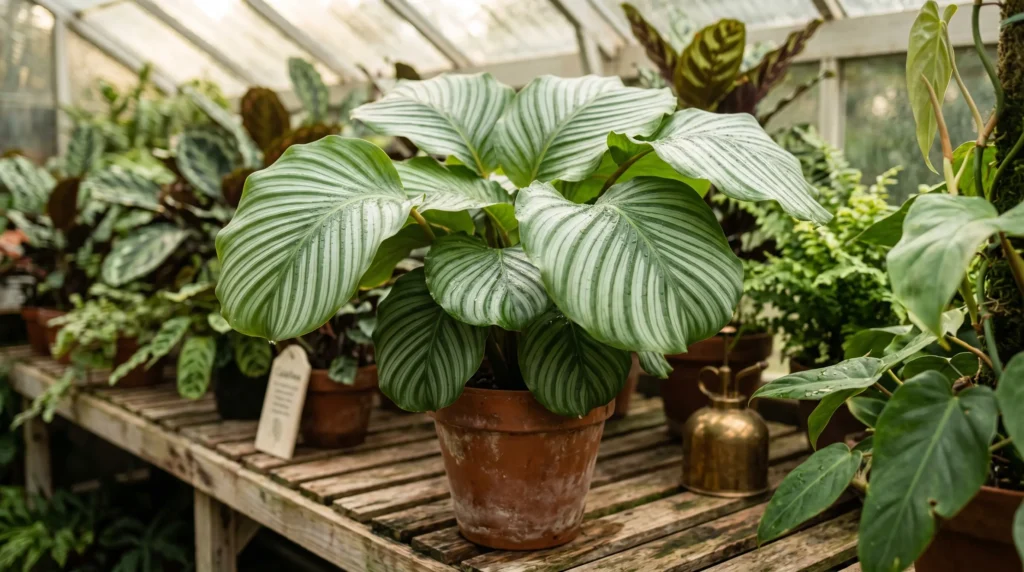
| G. orbifolia | Orbifolia | Large, silver-striped round leaves | Up to 90cm | Medium |
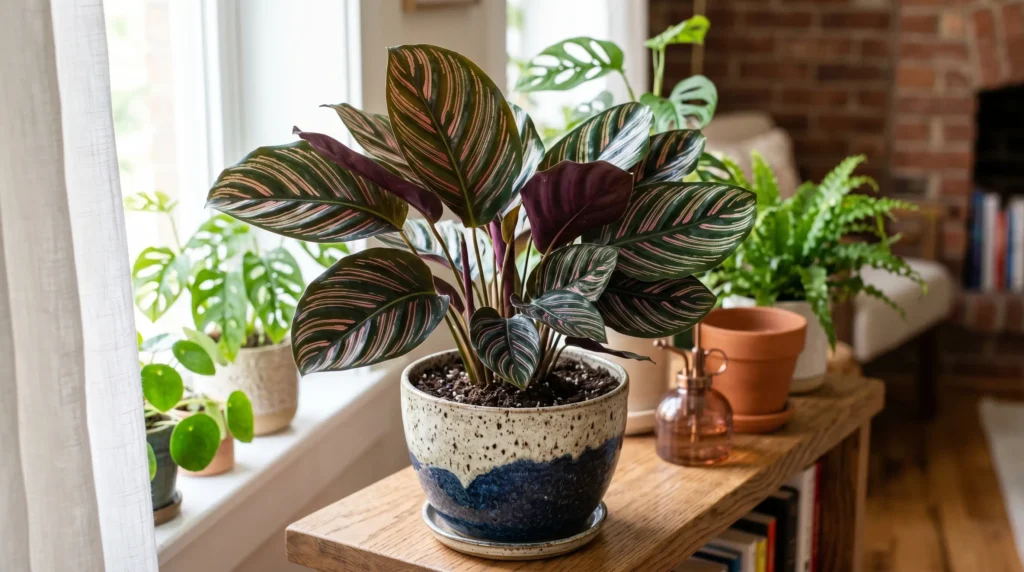
| C. ornata | Pinstripe Calathea | Pink/white pinstripes on dark green | 60–90cm | Medium |
| C. zebrina | Zebra Plant | Bold zebra stripes, velvety texture | 60–100cm | Medium |
| C. medallion | Medallion | Oval leaves, rose-coloured underside | 45–60cm | Medium |
| C. roseopicta | Rose-Painted | Dark leaves with pink brushstroke ring | 50cm | Medium |
Advanced/Statement Varieties (For Experienced Growers)
These are the most visually dramatic — and the most demanding. Do not start here.
| Variety | Common Name | Key Feature | Max Height | Difficulty |
|---|---|---|---|---|
| C. warscewiczii | Jungle Velvet | Velvety, deep green, tall | 100–120cm | Hard |
| G. lietzei ‘Fusion White’ | White Fusion | Marbled white and green, dramatic | 50cm | Hard |
| C. crocata | Saffron Calathea | Only variety likely to flower indoors in UK | 40–60cm | Hard |
Where to Buy Calathea plANT in the UK
Online retailers: Patch Plants, Happy Houseplants, The Little Botanical, Hortology, The Stem, Beards & Daisies — all ship with insulated packaging and offer good variety selection.
Garden centres: Dobbies and Gardener’s Dream stock calathea reliably; independent nurseries often carry more unusual varieties.
What to look for when buying:
- Unblemished leaves — no browning, yellowing, or spots
- Upright, firm stems — no wilting or drooping
- No fine webbing under leaves (a sign of spider mites)
- Avoid plants placed near cold shop entrances or in draughty displays
UK winter delivery tip: January and February deliveries are high-risk. Unpack plants immediately on arrival and do not leave near cold windows or doors. Give the plant 1–2 weeks to acclimatise before assessing its condition.
Calathea plant Care — The Complete UK Guide
This is the most important section in the guide. Every piece of advice below is contextualised for UK homes, UK tap water, UK light levels, and the UK climate.
Light — Getting It Right in a UK Home
What light does calathea need? Calathea needs bright, indirect light — sometimes described as “bright shade.” Think of the dappled light on a forest floor: plenty of ambient brightness, no direct sun.
Best window positions in a UK home:
- East-facing: Gentle morning light — ideal
- North-facing: Consistent, soft light with no direct sun — works very well
- West-facing: Acceptable if the plant is set back 1–2 metres from the glass
- South-facing: Too intense in summer; must be positioned well away from the window, or behind a sheer curtain
What does “indirect light” actually mean? It means the sun’s rays never fall directly on the leaf surface. Direct sun through glass magnifies UV intensity and will scorch calathea leaves within hours. A common UK mistake is placing calathea on a south-facing windowsill in a conservatory during summer.
UK winter light warning: Between November and February, light levels across the UK — and particularly in Scotland, northern England, and north-facing rooms — can fall too low for calathea to thrive.
Signs your calathea is not getting enough winter light:
- Leaf movement reduces or stops entirely
- New growth is pale or stunted
- Existing leaf patterns fade
Fix: Move the plant to the brightest available spot without direct sun. If no suitable natural light position exists, a basic LED grow light used for 12–14 hours per day will compensate effectively.
Watering — The Single Biggest Issue for UK Owners
Why is watering calathea plant harder in the UK than guides suggest? Because much of England has hard tap water — high in calcium carbonate, magnesium, and fluoride — and calathea is acutely sensitive to these minerals. Hard water is the primary cause of the brown tips UK owners so frequently complain about.
The UK Hard Water Problem
Which UK regions have the hardest tap water?
- Hardest: London, South East England, East Anglia, East Midlands
- Moderate: West Midlands, Yorkshire, parts of the South West
- Softest: Scotland, Wales, North West England, Northern Ireland
If you live in London or the South East and are watering with straight tap water, your calathea’s brown edges are almost certainly water-related, not care-related.
Water Options Ranked for UK Owners
| Water Type | Suitability | Notes |
|---|---|---|
| Collected rainwater | Best | Free, soft, naturally pH-balanced — use a water butt |
| Filtered water (Brita-style) | Excellent | Good compromise; removes chlorine and reduces minerals |
| Boiled and cooled tap water | Acceptable | Reduces chlorine; does not remove calcium or fluoride — use only in soft-water areas |
| Bottled still water | Works | Effective but expensive and environmentally wasteful |
| Straight tap water | Risky | Fine only in genuinely soft-water regions; will cause damage in London and the South East |
The single most impactful change a UK calathea owner can make: Switch to collected rainwater. A basic water butt costs under £30, installs in an afternoon, and solves the most common calathea problem permanently.
How Often to Water Calathea plant in the UK
How often should I water calathea UK? There is no fixed schedule. Water when the top 2–3cm of compost feels dry to the touch. In summer, this may be every 4–5 days. In winter, this may be every 10–14 days.
Seasonal watering calendar:
| Season | Frequency | Notes |
|---|---|---|
| Spring (Mar–May) | Increasing | Resume as days lengthen; growth is resuming |
| Summer (Jun–Aug) | Every 3–5 days | Peak growth period; check soil regularly |
| Autumn (Sep–Nov) | Reducing | Growth slows; pull back frequency |
| Winter (Dec–Feb) | Every 10–14 days | Minimum — the most common overwatering period |
How to Water — Bottom vs. Top Watering
Bottom watering: Place the pot in a tray or basin of water and allow the compost to absorb moisture from the drainage holes upward for 20–30 minutes. Then remove and allow excess to drain.
- Pros: Avoids wetting foliage; encourages deep root growth; reduces fungus gnat risk
- Cons: Slower; may allow mineral build-up in soil over time
Top watering: Pour water slowly and evenly onto the soil surface until it runs freely from drainage holes. Discard any water that collects in the saucer after 30 minutes.
- Pros: Also flushes out accumulated minerals when done thoroughly
- Cons: Water sitting on leaves overnight can cause fungal leaf spot
Signs of Overwatering vs. Underwatering
| Symptom | Overwatering | Underwatering |
|---|---|---|
| Leaves | Yellow, soft, drooping | Curling inward, dry-edged |
| Soil | Constantly wet, may smell | Bone dry, pulling away from pot |
| Roots | Black, mushy, rotting | Dry and thin |
| Base | Mushy or collapsing stem | Firm stem |
Humidity — Recreating the Rainforest in a British Home
What humidity does calathea need? Calathea requires 50–70% relative humidity. The average UK home in winter, with central heating running, sits at 30–40%.
Why is this a specific UK problem? British central heating — typically gas-fired radiators running from October to March — dramatically reduces indoor relative humidity. A calathea placed near a radiator in a centrally-heated UK living room is experiencing the equivalent of living next to a desert wind.
How to Increase Humidity — Ranked by Effectiveness
| Method | Effectiveness | Notes |
|---|---|---|
| Electric humidifier | Best | Maintains consistent humidity; most reliable option |
| Grouping plants together | Very good | Shared transpiration creates a local microclimate |
| Pebble tray with water | Moderate | Do NOT let pot base sit in the water — root rot risk |
| Bathroom or kitchen placement | Good | Naturally higher humidity from steam and cooking |
| Regular misting | Least effective | Creates brief local humidity; water sitting on leaves can cause fungal spots |
UK seasonal note: Humidity is typically adequate between May and September in most UK homes without intervention. October through March is the critical period — this is when active humidity measures become necessary.
The UK central heating warning: Never place calathea near a radiator, regardless of how well you are watering and humidifying it in every other respect. Radiators are the single most common cause of calathea deterioration in UK homes.
Temperature — Handling UK Winters
What temperature does calathea need? The ideal range is 18–24°C. The minimum safe temperature is 15–16°C — below this, root function is impaired even if the air feels warm to you.
UK-specific temperature hazards:
- Cold windowsills: Glass conducts cold air; the pot can be several degrees colder than the room air temperature in winter — especially on single-glazed or older windows
- Draughts: Sash windows, letterboxes, and period property gaps create cold air currents that can shock calathea leaves even if ambient temperature seems adequate
- External doors: Positioning near a front door or porch in British winter causes repeated cold exposure
- Conservatories: Ideal in summer; dangerous in winter. Many UK conservatories drop below 10°C at night from November to February — this is lethal to calathea roots
Practical tip: Place a thermometer at pot level, not just reading room temperature. There can be a 4–5°C difference between the thermostat reading and the temperature at a cold windowsill.
Soil — The Peat-Free UK Context
What soil does calathea need? Calathea needs a mix that is simultaneously moisture-retentive (holds water between waterings) and free-draining (does not become waterlogged). A slightly acidic pH of 6.0–7.0 is ideal.
The UK peat-free context: Following the UK’s amateur peat ban, peat-free composts are now the standard in British garden centres. Many are excellent for calathea — but some peat-free mixes compact, retain too much moisture, and limit root aeration.
Recommended DIY mix for UK owners:
- 60% peat-free houseplant compost
- 20% perlite (for drainage and aeration)
- 20% bark chips (for structure and moisture regulation)
What to look for in a ready-made UK compost: Choose bags listing coir (coconut fibre), perlite, or bark as ingredients. Avoid bags listing only “composted wood fibre” or “green compost” as the primary ingredient — these tend to compact and cause root problems.
What to avoid: Heavy general-purpose garden compost. This compacts around roots, retains far too much moisture, and dramatically increases root rot risk.
Feeding and Fertilising
When should I feed calathea? Feed only during the UK growing season: May through August. Do not feed in autumn or winter.
How to feed calathea:
- Use a balanced liquid fertiliser (equal NPK ratios)
- Dilute to half the recommended strength — calathea is sensitive to fertiliser burn
- Feed once per month during the growing season
- Stop entirely by late September; do not resume until May
Over-feeding is as damaging as under-feeding. UK owners often over-compensate when a plant looks pale or unhealthy, applying full-strength fertiliser in the hope of reviving it. This burns roots and worsens the problem.
Signs of over-feeding:
- Brown leaf edges and tips that are not improving despite switching to rainwater
- White or pale crust forming on the soil surface (mineral build-up)
Organic alternative: Diluted seaweed fertiliser is gentler and less likely to cause burn. It works well for calathea during the growing season.
Choosing the Right Pot
What pot is best for calathea?
| Pot Type | Pros | Cons |
|---|---|---|
| Plastic pot | Retains moisture well; lightweight | Less breathable; risk of overwatering |
| Ceramic/glazed pot | Retains moisture; attractive | Heavy; drainage depends on hole |
| Terracotta pot | Breathable; good aeration | Dries out faster; requires more frequent watering |
Best choice for most UK owners: Plastic or glazed ceramic — both retain moisture more effectively, which suits calathea’s preference for consistent moisture without waterlogging.
Key rules:
- Drainage holes are non-negotiable. A pot without drainage will cause root rot, regardless of how carefully you water.
- Pot size: Go up only one size at a time. Calathea prefers to be slightly snug — an oversized pot holds excess wet compost around the roots and increases root rot risk.
- Saucers: Use them, but empty them within 30 minutes of watering. Never allow the pot to sit in standing water.
Repotting and Propagation
When to Repot
How do I know when to repot my calathea? Look for these signs:
- Roots circling the base of the pot or emerging from drainage holes
- Soil drying out unusually quickly between waterings
- Slowed or stopped growth despite good care conditions
- The plant becoming visibly top-heavy
Best time to repot in the UK: Late March to May — as growth resumes with lengthening days but before peak summer heat.
When NOT to repot: October through February. Recovery is slower in cold, low-light conditions, and root rot risk is higher when disturbed roots are sitting in cool, wet compost.
How to Repot — Step by Step
What you need: A new pot (1–2cm larger in diameter), peat-free compost mix, perlite, bark chips, clean scissors, filtered or rainwater.
- Water the plant 24 hours before repotting — this reduces transplant stress
- Choose a new pot no more than 1–2cm wider than the current one
- Prepare your peat-free compost mix (60% compost / 20% perlite / 20% bark chips)
- Gently remove the plant from its pot; loosen the root ball with your fingers
- Inspect the roots — trim any that are black, mushy, or foul-smelling with clean scissors
- Position the plant in the new pot at the same depth as before; backfill with fresh compost
- Do not compact the compost — firm it gently only
- Water lightly with filtered or rainwater
- Keep out of direct light for the first week; do not feed for 4–6 weeks post-repot
- Expect some leaf droop for 1–2 weeks — this is normal transplant shock and will resolve
Propagation by Division — The Only Method That Works
Can you propagate calathea from cuttings? No. This is one of the most common and costly mistakes UK calathea owners make. Calathea cannot be propagated from leaf cuttings or stem cuttings. Division is the only reliable method.
What is calathea division propagation? Division involves separating a mature plant into two or more clumps, each containing its own leaves and roots. It is best done during spring repotting.
How to propagate calathea by division — step by step:
- Identify natural clumping points where separate shoots emerge from the soil
- Gently tease apart root clumps with your fingers — each section needs at least 2–3 healthy leaves and a portion of root system
- If roots are densely tangled, use a clean, sharp knife to make one clean cut — a single clean cut causes less damage and disease risk than tearing
- Pot each division into its own container with fresh compost mix
- Place in a warm, humid location — a clear plastic bag loosely draped over the pot creates a humidity tent to support establishment
- Keep out of direct light; water lightly
- Expect 2–4 weeks for divisions to settle and begin producing new growth
UK timing: Early April is ideal for divisions in most UK regions.
Calathea plant Problems — Diagnosis and Fixes
Quick Diagnostic Table
| Symptom | Most Likely Cause | Secondary Cause | Fix |
|---|---|---|---|
| Brown leaf tips | Hard tap water / low humidity | Fluoride or chlorine sensitivity | Switch to rainwater; increase humidity |
| Brown leaf edges | Low humidity / central heating | Underwatering | Humidifier; check watering regularity |
| Yellow leaves | Overwatering | Low light | Let soil dry slightly; improve drainage |
| Curling leaves | Underwatering | Low humidity or excess heat | Water thoroughly; mist or humidify |
| Drooping/wilting | Overwatering (root rot) | Underwatering | Check roots; adjust watering |
| Faded/pale leaf patterns | Too much direct light | Insufficient feeding | Move to shadier position |
| No leaf movement at night | Insufficient light | Temperature too low | Move to brighter spot; add grow light |
| White crust on soil surface | Tap water mineral build-up | Over-fertilising | Flush soil with filtered water |
| Mushy base or stem | Root rot from overwatering | Cold and wet together | Emergency repot; trim rotten roots |
| Holes in leaves | Pest damage | Natural imperfection | Inspect for pests; isolate if found |
Brown Tips and Edges — The Most Common UK Complaint
Why does my calathea have brown tips? In UK homes, the primary cause is hard tap water. Fluoride, chlorine, and calcium in municipal water accumulate in leaf tissue over time, causing tip and edge browning that begins at the extremities and works inward.
How to confirm it is water-related: Brown tips from hard water progress symmetrically across all leaves, starting at the very tip and moving inward uniformly. Browning caused by pests or disease tends to be patchy and irregular.
Fix: Switch immediately to collected rainwater or filtered water. The existing brown tips will not reverse — brown leaf tissue is dead — but new growth will emerge healthy and unblemished. No further browning should progress within a few weeks of switching.
Can brown calathea tips be fixed? No. Brown tips on calathea leaves are permanent. The correct response is to remove the cause (switch water source), and the plant will produce healthy new growth going forward.
Yellow Leaves
Why are my calathea leaves turning yellow? The most likely cause is overwatering. When roots are consistently waterlogged, they are deprived of oxygen (a condition called root hypoxia), which prevents them from absorbing nutrients — leading to yellowing foliage.
Secondary cause — low light: In poor light conditions, chlorophyll production decreases and leaves lose their colour, often presenting as yellowing rather than browning.
How to distinguish overwatering from underwatering yellow:
- Overwatering yellow: Soft, limp leaves; wet or soggy soil; possible musty smell
- Low-light yellow: Firmer leaves; adequate soil moisture; fading of leaf pattern as well as colour
Curling Leaves
Why are my calathea leaves curling? Curling inward (along the length of the leaf) is primarily a moisture stress response — the plant reduces surface area to conserve water. The two triggers are underwatering and low humidity.
UK winter-specific cause: Central heating dries the air in British homes from October to March, and the rate of moisture loss from calathea leaves accelerates substantially. Owners who water on a fixed summer schedule without adjusting for winter often find leaves curling despite what appears to be regular watering — because the air itself is drying the plant faster than the roots can supply moisture.
Fix: Check soil moisture first. If the soil is adequately moist, low humidity is the cause. Increase humidity using a humidifier or pebble tray, and move the plant away from any radiators.
Root Rot — Recognition, Treatment and Recovery
What does root rot look like in calathea? Root rot presents as a musty or sour smell from the soil, leaves collapsing despite moist soil, and when the plant is removed from its pot, visibly black or brown, soft, mushy roots rather than firm, pale-coloured healthy roots.
How to save a calathea with root rot — step by step:
- Remove the plant from its pot immediately — do not delay
- Rinse roots gently under lukewarm water to expose the full root system
- Trim all black or mushy root sections with sterile scissors; cut back to firm, healthy tissue
- Dust all cut surfaces with ground cinnamon (a natural antifungal) or apply diluted hydrogen peroxide (3% solution)
- Allow the bare roots to air-dry for 30–60 minutes
- Repot into fresh, dry compost in a clean pot with good drainage
- Do not water for 3–5 days after repotting to allow cuts to callous
- Resume watering sparingly and allow the top layer to dry between waterings
Recovery prognosis: Plants with less than 50% root loss typically recover well within 4–6 weeks. Plants with more than 70% root loss may not recover. Act quickly — root rot progresses rapidly.
Pests
Spider Mites
What are spider mites on calathea? Spider mites are tiny sap-sucking arachnids that thrive in hot, dry conditions — making them the most common calathea pest in UK homes, particularly during summer heatwaves and in winter when central heating reduces humidity.
Signs: Fine silky webbing under leaves; tiny yellow-green specks on leaf surfaces; overall faded or stippled appearance.
Treatment:
- Isolate the affected plant immediately
- Wipe all leaf surfaces (top and underside) with a damp cloth
- Spray with diluted neem oil solution (follow product instructions)
- Increase humidity significantly — spider mites cannot establish easily above 60% humidity
- Repeat treatment every 5–7 days for 3–4 weeks
Mealybugs
Signs: White, cottony clusters in leaf axils and along stems.
Treatment: Apply isopropyl alcohol (70%) directly to clusters using a cotton bud. Follow with a neem oil spray. Inspect weekly and repeat until clear.
Scale Insects
Signs: Brown, hard, shell-like bumps attached to stems and leaf undersides.
Treatment: Remove manually with a cotton bud dipped in isopropyl alcohol. Follow with neem oil spray.
Fungus Gnats
Signs: Small, dark gnats flying around the soil surface. Larvae in the soil damage fine roots.
Treatment:
- Allow the top layer of soil to dry more thoroughly between waterings — larvae need consistently moist soil to survive
- Use yellow sticky traps to catch adults
- Apply biological nematodes (Steinernema feltiae) to the soil — available in UK garden centres and highly effective
Oedema — An Underreported UK Problem
What is oedema on calathea? Oedema is a physiological condition — not a pest or disease — that appears as water-soaked, corky, or blister-like patches on calathea leaves. It occurs when a plant absorbs water faster than its leaves can release it through transpiration.
Why is oedema more common in UK homes? Oedema is most likely to occur in UK winter, when low light levels dramatically reduce the rate of transpiration while owners continue watering at their summer rate. The plant absorbs water it cannot process, and the excess pressure causes cells to burst.
Fix: Reduce winter watering frequency. Ensure good air circulation around the plant. Do not water on a fixed schedule — always test soil moisture first.
Seasonal Care Calendar for UK Owners
No UK calathea guide is complete without a seasonal breakdown. UK conditions shift dramatically across the year — and calathea care must shift with them.
Spring (March–May) — The Revival
- Resume regular watering as days lengthen and light improves
- Begin feeding in May with half-strength liquid fertiliser
- Repot if root-bound — the ideal window
- Propagate by division if desired
- Move plants back from radiators as central heating reduces
- Open windows with caution — watch for aphids on new growth
Summer (June–August) — Peak Growth
- Water more frequently; check soil every 3–4 days
- Feed monthly with diluted fertiliser
- Keep away from direct sun through south-facing glass; conservatories become dangerous at this time
- UK heatwave alert: Spider mites spike during hot, dry spells — inspect leaf undersides weekly during any extended warm weather
- Enjoy the most active leaf movement of the year
Autumn (September–November) — Winding Down
- Reduce watering frequency gradually from late September
- Stop feeding by late September
- Begin preparing humidity measures as central heating resumes
- Move away from windowsills as temperatures drop
- Do not repot — plants need stability going into winter
Winter (December–February) — The Survival Season
- Water sparingly — this is the most critical period for overwatering errors
- Keep entirely away from radiators, external doors, and cold glass
- Run a humidifier if available; at minimum, group plants together
- Consider a grow light in rooms with very low natural light — particularly north-facing rooms or homes in Scotland and northern England
- Monitor for fungus gnats (warm indoor soil combined with occasional overwatering creates ideal conditions)
- Do not: feed, repot, or propagate in this period
Calathea in the UK Home — Placement, Styling and Benefits
Best Rooms in a UK Home
Bathroom: Highest natural humidity of any room — ideal if natural light is present. Works well in en-suites with frosted-glass windows.
Kitchen: High humidity from cooking; typically good natural light; keep away from cold draughts from back doors.
Bedroom: Works well with humidity management; the visible prayer movement at dawn is genuinely relaxing to observe.
Living room: The most common placement. Use a humidifier; position away from south-facing windows and all radiators.
Home office: Tolerates lower light levels well; benefits focus and perceived air quality; particularly useful in interior rooms away from windows.
Styling Calathea in a UK Interior
- Elevated on a plant stand or low table: Allows the beautiful undersides of leaves — often as dramatic as the tops — to be appreciated
- Pair with muted ceramics and natural textures: Terracotta, linen, concrete, and raw wood let the foliage lead visually without competition
- Group with humidity-loving companions: Ferns, peace lily, and pothos create a shared microclimate that benefits all plants
- Scale your selection: G. orbifolia works as a large-leaf statement plant; C. ornata or C. lancifolia as shelf accents
Pet and Child Safety
Is calathea toxic to cats and dogs? No. Calathea is non-toxic to cats, dogs, and humans, confirmed by the ASPCA. This makes it one of the most genuinely safe statement houseplants available to UK pet owners.
Comparison to common alternatives:
| Plant | Toxic to Cats/Dogs? |
|---|---|
| Calathea | Non-toxic |
| Peace lily | Toxic |
| Pothos | Toxic |
| Monstera | Toxic |
| Spider plant | Non-toxic |
| Boston fern | Non-toxic |
Wellbeing and Mindfulness
The daily prayer movement encourages observation and routine — simply checking whether a plant has opened its leaves is a small but documented mindfulness trigger. Creating a humid plant grouping can marginally improve comfort in dry winter homes. Tracking a calathea’s leaf cycle across the seasons is one of the most accessible forms of nature connection available in a UK flat.
Calathea FAQ — Your Questions Answered
This section is optimised to answer the most common UK search queries about calathea.
Q: Is calathea a good houseplant for beginners in the UK?
A: It depends on the variety. Calathea lancifolia (rattlesnake plant) and Calathea freddie are the most forgiving options for beginners. The single biggest obstacle for UK beginners is tap water quality — switching to rainwater or filtered water immediately removes the most common source of failure. With the right variety and the right water, calathea is manageable for attentive beginners.
Q: Can I use tap water for my calathea in the UK?
A: In soft-water areas — Scotland, Wales, North West England — tap water is generally tolerable for calathea. In hard-water regions — London, South East England, the Midlands, East Anglia — tap water will cause brown tips over time due to its fluoride and calcium content. Rainwater collected from a water butt is the ideal free solution for the majority of UK owners.
Q: Why are my calathea leaves curling?
A: Curling is almost always a moisture problem — either underwatering or low humidity. In UK homes during winter, central heating reduces humidity dramatically and can cause curling even when watering appears adequate. Check soil moisture first; if the compost is sufficiently moist, increase humidity using a humidifier or by grouping the plant with others.
Q: How often should I water calathea in the UK?
A: There is no fixed schedule — water when the top 2–3cm of compost feels dry to the touch. In summer, this is typically every 4–5 days; in winter, every 10–14 days. Always use rainwater or filtered water, and ensure the pot has drainage holes.
Q: Why does my calathea have brown tips?
A: Brown tips are the most common complaint among UK calathea owners. The primary cause is hard tap water — fluoride and calcium cause gradual leaf edge damage. Switch to collected rainwater, and the problem typically stops progressing within a few weeks. Existing brown tips will not reverse — the tissue is permanently damaged — but new growth will emerge healthy.
Q: Can calathea go outside in the UK?
A: Only briefly, in sheltered and shaded spots during the warmest summer months — typically June to August, and only reliably in the South of England. They must be brought back indoors before temperatures drop below 15°C at night. They should never be left outside overnight in UK conditions except during peak summer.
Q: Is calathea toxic to cats and dogs?
A: No. Calathea is non-toxic to cats, dogs, and humans, making it one of the safest statement houseplants for UK pet owners.
Q: Why isn’t my calathea doing its prayer movement?
A: Insufficient light is the most common cause. Calathea moves its leaves using light-sensitive pulvini cells. In low UK winter light — particularly November to February — movement may reduce or stop entirely. Move the plant to a brighter spot without direct sun, or supplement with a grow light. If movement is absent during summer, the plant needs significantly more light.
Q: How long does a calathea live?
A: With good care, calathea can live for many years — typically 5–10 years indoors, and potentially longer. They grow slowly, particularly during UK winters, but with consistent care they are long-lived perennial houseplants that continue growing and can be divided to produce new plants indefinitely.
Q: What is the difference between calathea and goeppertia?
A: Many plants sold as “calathea” in UK shops have been reclassified as “goeppertia” following a botanical revision. The name change is scientific only — care requirements are identical. UK retailers have been slow to update their labelling, so continue searching under “calathea” when shopping. If you see both names, do not worry: they refer to the same group of plants with the same needs.
Calathea Care Checklist for UK Owners
Print this checklist and keep it near your plant.
Weekly
- Check soil moisture (top 2–3cm) — water only if dry
- Water using rainwater or filtered water only
- Observe leaf movement, colour, and texture for early signs of stress
- Check humidity levels if using a hygrometer
Monthly (Growing Season — May to August Only)
- Feed with half-strength balanced liquid fertiliser
- Wipe leaf surfaces with a damp cloth to remove dust and improve light absorption
- Inspect leaf undersides for pests — look for webbing, specks, or white clusters
Seasonally
- Spring: Resume feeding; repot if root-bound; propagate by division if desired
- Summer: Protect from direct sun; monitor weekly for spider mites during warm spells
- Autumn: Stop feeding; reduce watering; prepare humidifier before heating season starts
- Winter: Run humidifier; reduce watering significantly; move away from cold glass and radiators
Annually
- Inspect roots and repot if needed (spring window only)
- Flush soil with filtered water if white mineral crust appears on soil surface
- Replace top 2cm of compost if not repotting (known as top dressing)
Conclusion
Calathea is not the easiest houseplant in the world. But the reasons it is difficult are almost entirely specific, solvable, and — once understood — easy to avoid. Hard tap water, central heating, and low winter light are the three invisible barriers between UK owners and a thriving calathea. Every single one of them has a straightforward fix.
The single most impactful change any UK calathea owner can make — regardless of where they live, what variety they own, or what problems they are experiencing — is switching from tap water to collected rainwater. That one change removes the most common cause of failure overnight.
Beyond that: keep it away from radiators, give it the brightest indirect light you can find, and reduce your watering in winter. Do those three things and calathea rewards you with one of the most visually extraordinary houseplants available — living, moving, patterned foliage that changes with the light every single day.
Explore related guides: calathea variety deep-dives, seasonal care guides, humidifier recommendations for UK plant owners, and solutions for specific calathea problems in the articles linked throughout this guide.
Article schema type: Article + FAQPage + HowTo Last updated: 2026 Target keyword: Calathea Plant | Secondary: calathea care UK, calathea varieties, prayer plant UK, calathea problems, calathea watering, how to grow calathea UK

Leave a Reply