
Yellow rattle (Rhinanthus minor) is a native British annual wildflower that parasitises grass roots, weakening dominant grasses by up to 73% and creating space for a rich diversity of wildflowers to establish. It is the single most important plant for creating or restoring a wildflower meadow in the UK
The Small Plant That Changes Everything
Walk through a traditional British hay meadow on a warm August afternoon and you will hear it before you see it — a dry, papery rattling carried on the breeze, rising from thousands of seed pods shaking gently in the wind. That sound belongs to yellow rattle (Rhinanthus minor), one of the most ecologically important wildflowers native to the UK, and the plant that farmers once despised and conservationists now prize above almost any other.
Over 97% of Britain’s species-rich wildflower meadows have been lost in the last century — destroyed by intensive agriculture, repeated fertiliser application, and a shift from traditional hay-cutting to silage production. What once covered millions of acres of the British countryside, alive with orchids, oxeye daisies, knapweeds, and dozens of wildflower species, has been reduced to scattered remnants in upland areas and nature reserves.
Nicknamed “the meadow maker,” yellow rattle has a unique biological superpower: it is hemiparasitic on grasses, meaning its roots tap directly into the root systems of surrounding grass species and drain them of water and nutrients. In doing so, it weakens dominant grasses that would otherwise smother every wildflower you try to establish. According to research cited by Natural England, the parasitism of yellow rattle can reduce grassland productivity by between 8% and 73%, most powerfully on the most fertile, grass-dominated sites — precisely the kind of ground most UK gardeners and land managers are starting with.
What Is Yellow Rattle? — Plant Profile & Identification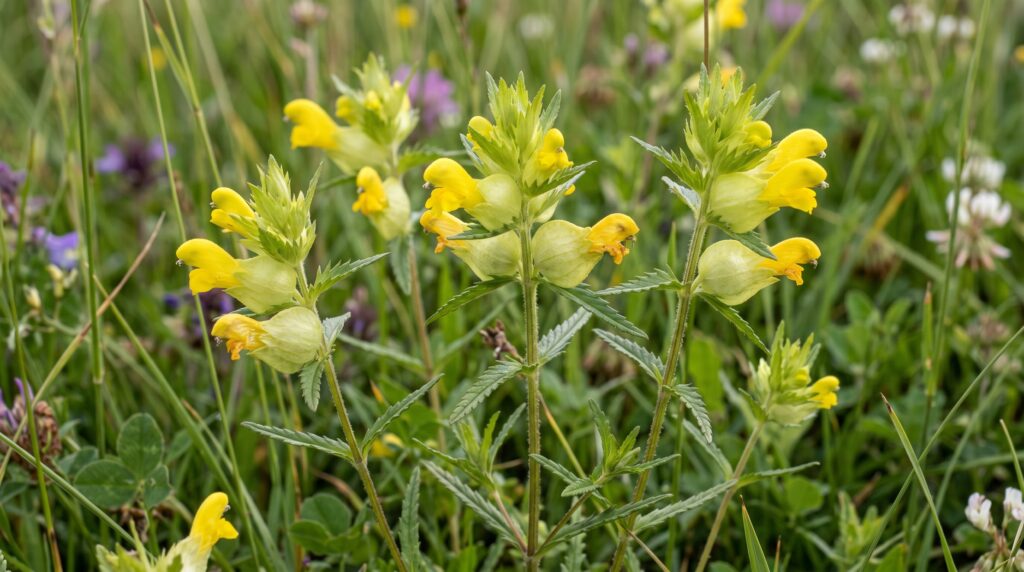
What Is Yellow Rattle? (Definition)
Yellow rattle is a native British annual wildflower (Rhinanthus minor) in the broomrape family (Orobanchaceae). It is hemiparasitic on grasses and legumes, drawing water and nutrients from their roots while still producing its own food through photosynthesis. It is the most important species for wildflower meadow creation and restoration in the UK.
It grows to between 10 and 50 centimetres tall, produces bright yellow tubular flowers from May to September, and gets its name from the sound of loose seeds rattling inside the dried, papery seed capsules in late summer.
Scientific Classification and Common Names
| Classification | Detail |
|---|---|
| Scientific name | Rhinanthus minor |
| Family | Orobanchaceae (broomrape family) |
| Type | Annual wildflower; hemiparasitic |
| Conservation status | Least Concern (UK); once common, now locally scarce |
| Related species | Rhinanthus angustifolius (Greater Yellow Rattle — now very rare in UK) |
Common names across the UK and Ireland:
Yellow rattle carries more regional common names than almost any other British wildflower — a reflection of how deeply it was woven into rural life for centuries. Its names include:
- Yellow Rattle (most widely used)
- Hay Rattle (northern England — Cumbria, Lancashire)
- Rattle Grass / Rattle Basket / Rattlebag / Rattlebox
- Cockscomb (shape of flower resembles a rooster’s comb)
- Penny Rattle / Penny Grass
- Poverty Weed (Somerset — reflects farmers’ view of it as a sign of poor, unproductive land)
- Cribell Felen (Welsh)
- Gliográn (Irish)
How to Identify Yellow Rattle — Physical Description
Yellow rattle is an upright annual plant, 10–50 cm tall, with distinctive black-spotted stems, toothed opposite leaves, tubular yellow flowers enclosed in an inflated green calyx, and papery seed pods that rattle audibly when shaken.
Use the following features to identify it with confidence:
Stems:
- Upright and four-angled
- Often streaked or spotted black — one of the most reliable identification features
- Can be simple or branched
Leaves:
- Narrow, lance-shaped (lanceolate to ovate)
- Toothed/serrated edges (dentate) with a rough texture (scabrid)
- Grow in opposite pairs directly from the stem (sessile — no leaf stalk)
- Dark, prominent veins
- Size: approximately 20–30mm long × 5–8mm wide
Flowers:
- Bright yellow, tubular, two-lipped
- Upper lip arched with two teeth — white or purple (the purple-toothed form is distinctive)
- Lower lip has three lobes
- 13–15mm across
- Enclosed within an inflated green calyx (bladder-like structure)
- Flower from May to September
Seed Pods (most distinctive feature):
- As flowers fade, the calyx turns silver/brown and papery
- Seeds loosen inside and rattle audibly when shaken
- Seeds are flat, kidney-shaped, and winged for short-distance wind dispersal
Identification Tip: In July or August, gently shake a stem. If you hear a papery rattling sound, it is Rhinanthus minor. This test is definitive and works in the field even for beginners.
Yellow Rattle vs. Look-Alike Plants — Identification Comparison
No other widely available UK guide covers this comparison. Use it to avoid misidentification.
| Feature | Yellow Rattle (R. minor) | Greater Yellow Rattle (R. angustifolius) | Common Cow-wheat (Melampyrum pratense) | Yellow Bartsia (Parentucellia viscosa) |
|---|---|---|---|---|
| Height | 10–50cm | 20–70cm | 15–60cm | 10–50cm |
| Flowers | Yellow, two-lipped, inflated calyx | Yellow, larger, broader calyx teeth | Yellow, two-lipped, no inflated calyx | Yellow-orange, sticky |
| Stem | Black-spotted, upright | Black-spotted, more robust | No black spots | Sticky/glandular hairs |
| Habitat | Meadows, grassland | Meadows (now very rare UK) | Woodland edges, heathland | Coastal/disturbed ground |
| Seed pod rattle? | Yes | Yes | No | No |
| UK status | Widespread | Very rare | Common | Locally common (SW/W) |
The Annual Lifecycle of Yellow Rattle — Month by Month
Yellow rattle is an annual plant, completing its entire life cycle — from germination to seed set and death — within a single growing season. It cannot persist in the soil as a seed bank; each year’s population depends entirely on seeds produced the previous summer.
| Month | What Yellow Rattle Is Doing |
|---|---|
| August–November | Best window to sow seed; existing plants have died back |
| December–February | Seeds lie dormant; require sustained cold below 5°C to break dormancy |
| Late February–March | Germination begins as temperatures rise; seedlings emerge |
| March–May | Rapid growth; root haustoria develop and attach to nearby grass roots |
| May–September | Flowering; bumblebees pollinate the flowers |
| June–August | Seeds set; capsules ripen and turn papery; rattling audible |
| Late July–August | Peak seed dispersal; plant begins to die back |
| August–September | Plant dies completely; leaves gaps in the sward for wildflowers to colonise |
Important: Yellow rattle has no persistent seed bank. Seeds that fall in summer must germinate the following spring or they are lost. This is why consistent annual management — allowing seed to set and fall before cutting — is non-negotiable.
The Science of Yellow Rattle — How Hemiparasitism Works
How Does Yellow Rattle Work? (Definition)
Yellow rattle is a hemiparasite — a plant that both photosynthesises (makes its own food from sunlight) and parasitises nearby plants (stealing additional water and nutrients from their roots). It is obligately hemiparasitic, meaning it cannot grow vigorously without a host plant. Its primary targets are grasses and legumes.
What Is a Hemiparasite? (Plain-Language Definition)
A hemiparasite is a plant that occupies a middle ground between fully independent plants and fully parasitic plants.
- Fully independent plants (like oxeye daisy): Make all their own food through photosynthesis
- Full parasites (like broomrapes, Orobanche spp.): Have no green tissue; entirely dependent on a host
- Hemiparasites (like yellow rattle): Have green leaves and photosynthesise, but also tap into host roots for extra water and nutrients
Yellow rattle is classified as an obligate root hemiparasite — obligate because it needs a host to thrive, root because it parasitises the roots (not the stems or leaves) of its host plants.
How Yellow Rattle Attacks Grass Roots — The Mechanism
Yellow rattle uses specialised root structures called haustoria to penetrate the root tissue of nearby grasses, creating a direct vascular connection through which it draws water, carbohydrates, and minerals.
Here is the step-by-step process:
- Germination: Yellow rattle seedlings emerge in late February or March
- Root development: As roots extend outward, they chemically detect nearby host roots
- Haustorial attachment: Specialised haustoria (root-like organs) penetrate the surface of the host root
- Vascular connection: The haustorium connects to the host’s xylem (water transport tissue) and phloem (nutrient transport tissue)
- Resource extraction: Yellow rattle draws water, dissolved minerals, and carbohydrates from the host continuously through the growing season
- Host weakening: The host grass progressively loses vigour — it grows more slowly, produces fewer tillers, and competes less aggressively for light
- Gap creation: As grasses weaken, light penetrates to the soil surface, creating microsites where wildflower seeds can germinate
Primary host targets:
- Perennial ryegrass (Lolium perenne) — most susceptible
- Cocksfoot (Dactylis glomerata)
- Yorkshire fog (Holcus lanatus)
- Timothy grass (Phleum pratense)
- Legumes (clovers, vetches) are also parasitised
Why wildflowers are largely safe: Broadleaved wildflowers (forbs) develop lignified barriers in their roots in response to haustorial attack, effectively blocking the connection. This is the biological reason why yellow rattle suppresses grass while leaving most wildflowers unharmed — it selectively weakens the competition.
What Does the Research Say? — Scientific Evidence
Multiple peer-reviewed studies and Natural England guidance confirm that yellow rattle significantly increases wildflower diversity by suppressing grass dominance in UK grasslands.
| Study / Source | Key Finding |
|---|---|
| Davies et al. (1997) — Biological Conservation | Parasitism reduces grassland productivity by 8–73%, most strongly in the most productive, grass-dominated swards |
| Smith et al. (2003) — North Yorkshire field study | Sowing yellow rattle + legumes together significantly accelerated colonisation by target meadow species |
| Smith (2005) — Same North Yorkshire site | More yellow rattle present = more herbaceous species replacing perennial ryegrass; also faster nitrogen mineralisation in soil |
| Pywell (2004) | Restored grassland plots with yellow rattle contained significantly more plant species than control plots without it |
| Natural England TIN060 | Natural England’s Technical Information Note TIN060 — a free government PDF — is the definitive reference for professional land managers, covering yellow rattle ecology, all three establishment methods, and agri-environment scheme integration. |
| Centre for Ecology and Hydrology (CEH) | Encouraging yellow rattle in hay meadows greatly increases biodiversity by restricting grass growth |
| 2021 literature review | Majority of studies found positive or neutral effects of Rhinanthus spp. introduction on grassland species richness; most found negative effect on grasses specifically |
The Broader Soil Effect — More Than Just Grass Suppression
Yellow rattle’s ecological role goes beyond simply weakening grasses. Research has identified two additional mechanisms that further boost wildflower diversity:
1. Enhanced nitrogen mineralisation: When yellow rattle is present, the rate at which nitrogen is converted to plant-available forms in the soil increases. This sounds counterintuitive — more nitrogen should favour grasses — but the effect benefits wildflowers that are adapted to moderate nutrient availability, while the simultaneously weakened grasses can no longer outcompete them.
2. Bare soil creation: As an annual, yellow rattle dies completely in late summer, leaving small bare-soil gaps in the sward. These microsites are critical germination points for wildflower seeds that cannot establish in dense, closed grassland. This is why meadows managed with yellow rattle gradually attract new wildflower species even without deliberate seeding — the plant physically creates space for them.
Yellow Rattle in British History — From Farmers’ Pest to Conservation Hero
What Is the History of Yellow Rattle in the UK?
Yellow rattle has been part of the British landscape for millennia, but its relationship with humans has changed dramatically — from a despised agricultural pest that reduced hay yields, to one of the most valued plants in conservation and ecological restoration.
First Recorded in Britain
The first written record of yellow rattle in Britain dates to 1597, when the botanist John Gerard described it with evident frustration:
“Christa galli… groweth in drie medows and pastures and is to them a great annoyance.”
Gerard’s irritation was understandable. For centuries, yellow rattle was a problem plant for farmers. Its ability to weaken grass directly reduced the yield of hay from a meadow — and hay was the primary winter feed for livestock. A meadow infested with yellow rattle was literally worth less.
The plant had dozens of local names that reflected this agricultural hostility. In Somerset, it was bluntly called “poverty weed” — a direct statement that its presence indicated poor, unproductive grassland.
Yellow Rattle and the Hay Harvest — Traditional Agricultural Significance
Despite being despised, yellow rattle became woven into the rhythm of traditional hay-making in a remarkable way.
Farmers used the sound of rattling seed pods as a signal that the meadow was ready to cut. When walking through the field and hearing the dry percussion of seeds inside the papery capsules, a farmer knew the grasses had passed their peak and the hay should come in. This is why the plant is still called “hay rattle” across northern England.
Traditional scything and haymaking, it turns out, were accidentally perfect for yellow rattle. The process of cutting and turning the hay spread the winged seeds across the meadow, naturally sowing them for the following year. It was an unintentional but highly effective dispersal mechanism — one that disappeared almost overnight with the mechanisation of farming in the 20th century.
Modern lawnmowers and silage harvesters cut early, cut repeatedly, and effectively “hoover up” yellow rattle seeds before they can disperse or establish. This is the primary reason for its dramatic decline.
Folk Medicine and Traditional Uses
Beyond the hay harvest, yellow rattle had a presence in British folk medicine and rural craft:
- Eyesight: 17th century botanist Nicholas Culpeper — author of the famous Complete Herbal — recorded that yellow rattle could be used to treat coughing and poor eyesight. This claim reappears in folk medicine records across Britain and Ireland
- Yellow dye: The leaves of yellow rattle produce a yellow dye that was used in traditional textile dyeing
- Livestock preference: Cattle have a strong preference for yellow rattle — when let into a field, Plantlife records that “it is the first thing they will eat.” This reflects its palatability and nutritional value to grazing animals
- Machair habitat: In Ireland and Scotland, yellow rattle is strongly associated with Machair — the unique, floristically rich coastal grassland habitat found particularly in the Western Isles and western coasts of Ireland. Here it formed part of a culturally significant landscape
The 20th Century Collapse — and Why It Matters
Yellow rattle’s decline in Britain throughout the 20th century mirrors, and in many ways explains, the collapse of wildflower meadow diversity.
What changed:
- Shift from traditional hay meadow management (single late summer cut, clippings removed) to silage production (multiple early cuts, herbage left on field)
- Application of artificial fertilisers — fertilised soil favours coarse grasses that can outcompete even yellow rattle
- Herbicide use — yellow rattle is sensitive to broad-spectrum herbicides used to “improve” grassland
- Loss of traditional knowledge — fewer farmers retained the practice of late-summer cutting
The result:
- 97% of species-rich hay meadows in the UK lost in 100 years (Plantlife / Natural England data)
- Yellow rattle populations fragmented, now largely confined to upland areas in Yorkshire, the Lake District, the Welsh uplands, and Scottish highlands — where traditional management practices survived longest
The reversal: Today, the same understanding that made farmers hate yellow rattle — its ability to dramatically reduce grass vigour — makes it indispensable to conservationists. A plant that was once systematically eliminated from the British countryside is now deliberately sown on millions of restoration sites each year.
Where Yellow Rattle Grows — Natural Habitat and UK Distribution
Where Does Yellow Rattle Grow in the UK? (Definition)
Yellow rattle is a widespread but increasingly patchy UK native, found across England, Scotland, Wales, and Ireland wherever nutrient-poor grassland remains under traditional or sympathetic management. It is most abundant in upland areas of northern England, the Yorkshire Dales, the Lake District, Welsh uplands, and Scotland, and in coastal Machair habitats in western Ireland and the Hebrides.
Natural Habitats in the UK
Yellow rattle is associated with a specific range of grassland types, classified under the UK’s National Vegetation Classification (NVC):
Primary habitats:
- MG3 — Northern hay meadows (its classic stronghold)
- MG4 — Flood meadows
- MG5 — Lowland hay meadows
- MG8 — Water meadows
Also found in:
- Coastal sand dunes (especially in northern and western UK)
- Roadside verges on low-fertility soils
- Lightly grazed pastures
- Dry areas within fens
- Waste ground on low-nutrient substrates
Soil Types — What Yellow Rattle Tolerates and Prefers
One of yellow rattle’s most useful characteristics for restoration is its broad soil tolerance. However, fertility is more important than soil type.
| Soil Type | Yellow Rattle Performance | Notes |
|---|---|---|
| Clay (heavy, acid) | Good | Will grow in both heavy clay acid soils |
| Limestone / chalk | Excellent | Natural low fertility; rapid establishment |
| Sandy / free-draining | Good | Naturally lower fertility; watch for spring drought |
| Peaty / acidic upland | Good | Natural partner to upland meadow grasses |
| Fertile clay loam | Challenging | Requires nutrient stripping over several years |
| Recently fertilised soil | Very poor | Coarse grasses overwhelm yellow rattle |
The golden rule: Yellow rattle is not choosy about soil chemistry — it will grow on both acid clay and thin limestone. What it cannot tolerate is high fertility. Repeatedly fertilised soils produce the vigorous, coarse grasses that shade out yellow rattle seedlings before they can attach to a host.
Shade tolerance: Yellow rattle is intolerant of shade. It requires open, sunny conditions. North-facing slopes or sites overhanging by trees are unsuitable.
UK Regional Distribution and Strongholds
| UK Region | Yellow Rattle Status | Notable Sites |
|---|---|---|
| Yorkshire Dales | Strong; traditional hay meadow stronghold | Upper Teesdale, Swaledale |
| Lake District | Present; associated with traditional farmland | National Park hay meadows |
| Welsh uplands | Locally common | Snowdonia upland meadows |
| Scottish Highlands | Present; Machair habitat on west coast | Western Isles, Hebrides |
| Northern Ireland / Ireland | Present in Machair; locally common | Burren limestone grasslands |
| Southern England | Scarcer; earlier seed ripening | Chalk downland remnants |
| East Anglia | Rare in farmland; found in conservation sites | Norfolk Wildlife Trust reserves |
| Nidderdale AONB (Yorkshire) | Case study in successful restoration | Distribution has increased over 10–20 years |
| Wakehurst (Kew, Sussex) | Successfully introduced 2009 | Near Millennium Seed Bank wildflower meadows |
Regional note for practitioners: Yellow rattle seed ripens earlier in southern England due to warmer temperatures. Gardeners in the south-east should begin listening for rattling from late June; those in northern England and Scotland may not hear it until late July or early August.
How to Grow Yellow Rattle — The Complete UK Step-by-Step Guide
How Do You Grow Yellow Rattle? (Overview)
Growing yellow rattle successfully requires three things: fresh seed sown at the right time (autumn, not spring), sufficient bare soil prepared before sowing, and existing grass for the plant to parasitise. Get these three fundamentals right, and yellow rattle will establish on most UK soils.
This section covers all three growing methods — seed, plug plants, and green hay transfer — with full step-by-step instructions.
Is Your Site Suitable? — Pre-Growing Checklist
Before purchasing seed or plug plants, assess your site against these criteria. Honest site assessment saves wasted effort.
Conditions that favour success:
- Existing grass present (yellow rattle must have a host — it cannot grow in bare soil alone)
- Open, sunny position (full sun or very light shade)
- Low to medium fertility soil (not recently fertilised)
- Grass not completely dominated by coarse species (ryegrass monoculture is the hardest start)
- Willingness to manage with a single annual cut in late summer, with all clippings removed
Conditions that make establishment harder (but not impossible):
- Very fertile soil — requires more preparation and patience (3–5 years on heavily fertilised ground)
- Dense ryegrass monoculture — scarify hard; consider nutrient stripping over 2–3 seasons first
- History of herbicide use — check grass recovery before sowing
Conditions where yellow rattle will not establish:
- Heavy shade (under trees or north-facing walls)
- Bare ground with no existing grass host
- Regularly mown lawns (weekly mowing prevents seed set)
- Waterlogged, compacted soil with no drainage
Site Suitability: Yellow rattle needs: existing grass (as a host), full sun, low-to-medium soil fertility, and a once-yearly late summer cut with clipping removal. It will not grow in dense shade, bare soil, or very recently fertilised ground.
Growing Yellow Rattle from Seed (Most Common Approach)
How to grow yellow rattle from seed: Sow fresh, current-year seed onto prepared, short-cut grass in late August to November. Create at least 50% bare soil by scarifying. Do not sow in spring — the seed requires 4+ months of cold to germinate.
Step 1: Choose the Right Timing
- Best sowing window: Late August to end of November
- Seeds require cold stratification — sustained temperatures below 5°C for at least 4 months
- Sowing in spring does not work; seeds sown in spring will not germinate that year
- If sowing is delayed past November: mix damp seed with sand and refrigerate at 4°C for 6–12 weeks before an early spring sow
- Deadline: Seed sown after November may not receive adequate cold — southern England gardeners should aim for October
Step 2: Source Fresh, High-Quality Seed
- Yellow rattle seed has very short viability — it must be from the current year’s harvest
- Always check the harvest year clearly printed on packaging before purchasing
- Old seed (even from the previous year) will have dramatically reduced germination rates
- Buy from reputable UK wildflower seed specialists who guarantee fresh harvest stock
- For conservation projects: Source UK-provenance seed for genetic appropriateness
Step 3: Prepare the Site
This is the most critical stage, and where most failures occur. Yellow rattle seedlings are small and easily out-competed by vigorous grass.
3a. Cut the grass short
- Mow to approximately 25–50mm height (setting 2–3 on a typical rotary mower)
- For larger areas: graze hard with livestock in late summer/autumn (livestock hooves also open the sward)
- Remove all clippings — leaving them on the surface smothers germination points
3b. Remove thatch
- Use a scarifier or stiff wire rake to remove the layer of dead grass (thatch) at the base
- Thatch prevents seed-to-soil contact and is a major cause of failure
3c. Create bare soil
- Aim to expose at least 50% bare soil across the sowing area
- Methods: Raking, harrowing, light discing, or heavy scarification
- Bare soil patches are where yellow rattle seeds will actually germinate; seeds sitting on dense grass rarely establish
3d. Check for problem grasses
- If the site is dominated by couch grass (Elymus repens) or creeping bent (Agrostis stolonifera): address these first
- Do not use herbicides — this will affect the entire sward and the seed mix. Physical removal or repeated cutting is preferable
Step 4: Sow the Seed
- Broadcast seed evenly by hand across the prepared surface
- Do not bury the seed — press it lightly into the soil surface with your feet, a roller, or a board
- Seeds need light contact with soil, not coverage
- For even distribution on large areas: mix seed with dry sand as a carrier before broadcasting
Sowing rate reference:
| Area | Seed quantity |
|---|---|
| 1 m² | 0.5–1g |
| 10 m² | 5–10g |
| 100 m² | 50–100g |
| 500 m² | 250–500g |
| 1,000 m² (0.1 ha) | 0.5–1kg |
| 1 hectare | 0.5–2.5kg |
Note: Higher rates establish cover faster but cost more. Lower rates (0.1–0.2g/m²) may be acceptable on sites where you are patient and will re-sow in subsequent autumns.
Step 5: First Winter Management
- Continue mowing through winter if the grass is growing — keep it short (5–8cm)
- Remove clippings every time without exception
- Mow or cut in February and remove clippings — this gives germinating seedlings a critical light advantage over the surrounding grass
- Do not apply any fertiliser, compost, or top-dressing
Step 6: Spring — What to Expect in Year 1
- Seedlings begin emerging late February to March — they are small and can look like grass initially
- Do NOT mow once seedlings are visible
- First-year germination is often sparse — this is normal and expected; populations build over years
- By May–June: Yellow flowers appear; bumblebees begin visiting
- Leave completely undisturbed until seed is fully ripe
Step 7: Year 1 Seed Set and Post-Season Cut
- Wait until you can hear the seeds rattling before making any cut — typically late July to August
- Cut the whole area and remove all clippings
- This cut simultaneously: sets the grass back; spreads and distributes yellow rattle seeds; exposes bare soil for next year’s germination
- Consider re-sowing in the autumn of Year 1 to boost numbers more quickly
Yellow Rattle Plug Plants — A Reliable Alternative
Yellow rattle plug plants are pre-grown young plants supplied with fescue grass in the root cell (their host). They are planted in April and flower in their first year, giving faster, more visible results than seed — especially for small areas.
When to Use Plug Plants Instead of Seed
Plug plants are the better choice when:
- You have a small area (under 20 m²) where a reliable result in Year 1 matters
- You missed the autumn seed sowing window
- Your site is challenging (tougher soils) and you want assured establishment
- You prefer a hands-on, tactile method to broadcast sowing
Seed is the better choice when:
- You have a large area to cover (seed is far more cost-effective at scale)
- You are patient and willing to invest 2–3 years in building a colony
- Budget is a key consideration
Plug plant comparison table:
| Factor | Seeds | Plug Plants |
|---|---|---|
| Best timing | Aug–Nov (autumn sow) | April |
| Flowers in Year 1? | Often not | Yes |
| Cost for 10 m² | Approx £5–£12 | Approx £15–£30 |
| Cost for 1,000 m² | Approx £60–£200 | Approx £1,500–£3,000+ |
| Success rate | Variable (prep-dependent) | High (if watered) |
| Best for | Large areas, patience | Small areas, quick results |
| Labour | Low | Moderate |
How to Plant Yellow Rattle Plugs
- Timing: Plant in April; delay if soil is dry, frozen, or waterlogged
- Preparation: Cut surrounding grass short (5cm) to reduce competition
- Spacing: Plant up to 5 plugs per m² — more than this is unnecessary; fewer is acceptable
- Extraction: Push plugs from the bottom (through the drainage hole) rather than pulling from the top
- Planting: Make small holes in the turf; firm in each plug gently; do not remove the grass from the plug cell — the host grass in the cell is part of the system
- Watering: Water thoroughly at planting; continue watering for 2–3 weeks
- Warning: The most common cause of plug plant failure is drying out immediately after planting — water is the priority
Green Hay Transfer (Conservation Scale)
Green hay transfer is the most ecologically authentic method for large-scale meadow restoration. Freshly cut green hay from an established yellow rattle meadow is spread onto prepared ground, with seeds falling naturally from the hay as it dries.
This method is recommended by Natural England for formal meadow restoration projects and is used on SSSI management sites, agri-environment scheme land, and large rewilding projects.
How it works:
- Identify a donor meadow (with landowner permission) that contains yellow rattle
- Cut the hay in late July when seed pods are ripe and rattling
- Transport the fresh-cut hay immediately to the receptor site
- Spread a shallow layer over prepared, short-cut, scarified ground
- Leave hay to dry in place — seeds fall onto the soil surface
- Remove hay after 2–3 days
Advantages: Transfers the full seed bank of a local meadow, not just yellow rattle; provides local-provenance seed; historically authentic method
Disadvantages: Requires access to a suitable donor meadow; logistically complex; not practical for small gardens
Annual Meadow Management — Your Year-by-Year Guide
How Do You Manage a Yellow Rattle Meadow? (Overview)
Managing a yellow rattle meadow requires one essential action: a single annual cut in late summer (after seed set), with all cuttings removed immediately. This one discipline — consistently applied each year — does more for wildflower diversity than any other intervention.
The One Rule That Changes Everything
The reason most wildflower meadow attempts fail is not poor seed quality or bad soil — it is the failure to remove clippings after cutting. Leaving cuttings on the surface adds organic matter, raises soil fertility, smothers bare soil germination points, and directly reverses the nutrient-stripping effect that makes meadow management work.
The rule: Cut once a year in late summer. Remove every clipping. Do this every year without exception
Year 1 Management Calendar — Month by Month
| Month | Action | Why It Matters |
|---|---|---|
| August–September | Prepare site; sow seed | Seeds need autumn cold to germinate |
| October–November | Keep grass short (mow if growing); remove clippings | Prevents grass shading germination sites |
| December–January | No action needed | Cold period breaks seed dormancy |
| February | February is also the ideal month to plant spring bulbs like daffodils in borders adjacent to your meadow patch — their early flowers provide vital nectar for queen bumblebees emerging from hibernation before yellow rattle begins flowering. Full UK daffodil growing guide → | Gives seedlings light advantage when they emerge |
| March | Seedlings emerge — stop mowing | Seedlings are small and fragile |
| April–May | Do not disturb; allow growth | Root haustoria developing; first flowers appear |
| June–July | Flowering; do not cut | Bees pollinating; seeds developing |
| Late July–August | Listen for rattling; cut when seeds ripe | Seed set complete; distribute seeds with cut |
| August–September | Remove ALL clippings; consider re-sowing | Prepares ground for Year 2 |
Year 2 — Building Momentum
By Year 2 with good management, you should see:
- Noticeably more yellow rattle plants than Year 1 (self-seeding is underway)
- First signs of grass thinning in patches where yellow rattle density is high
- Possibly the first appearance of opportunistic wildflowers (self-heal, bird’s-foot trefoil, oxeye daisy) in the gaps
Year 2 actions are identical to Year 1: Allow to grow, flower, set seed; cut late; remove clippings. Continue re-sowing in autumn if numbers are still low.
Year 3+ — The Transformation
From Year 3 onwards, with consistent management, the meadow begins its visible transformation:
- Yellow rattle forms a more consistent colony across the site
- Grass becomes visibly shorter, thinner, and less dominant
- Significant bare soil patches appear after cutting — colonisation sites for wildflowers
- A progressively richer wildflower community begins to establish:
- Year 3–4 typical arrivals: Oxeye daisy (Leucanthemum vulgare), Common knapweed (Centaurea nigra), Bird’s-foot trefoil (Lotus corniculatus), Self-heal (Prunella vulgaris)
- Year 4–5 arrivals (with good conditions): Field scabious (Knautia arvensis), Betony (Betonica officinalis), Vetches (Vicia spp.)
- Long-term (5–10+ years on suitable sites): Common spotted orchid (Dactylorhiza fuchsii) and other orchid species
Yarrow (Achillea millefolium) is another excellent companion wildflower that thrives in the same low-fertility grassland conditions as yellow rattle. See our complete guide to growing yarrow in the UK →
Realistic expectation: Yellow rattle does not transform a site overnight. The process takes 2–3 years to become clearly visible, and 4–5+ years for a genuinely diverse wildflower community to establish. Patience and consistent annual management are the entire secret.
When to Cut — Regional UK Timing Guide
The single most important question for meadow managers: when is the right time to cut?
The answer: When the yellow rattle seed has ripened and is audibly rattling in its pods. This varies significantly by region.
| UK Region | Typical Cut Window | Notes |
|---|---|---|
| South-East England | Late June to mid-July | Warmest summers; earliest seed ripening |
| South-West England | Mid-July | Watch for wet summers delaying ripening |
| Midlands | Mid-to-late July | Variable; listen for rattling each year |
| Wales | Late July | Upland sites: August |
| Northern England | Late July to early August | Yorkshire Dales traditional cut: late July |
| Scotland | August | Highland sites may be early August or later |
The practical test: Gently shake a stem of yellow rattle. If you hear a dry papery rattling sound, the seeds are ripe and can be cut. If the pods are still green and silent, wait another week.
The Nutrient Stripping Effect — Long-Term Soil Change
One of the most powerful aspects of correct meadow management is gradual soil fertility reduction. Every time you cut and remove clippings, you physically remove nutrients from the site.
What happens over years:
- Phosphorus levels drop year on year (grass loves phosphorus)
- Soil becomes progressively less suitable for coarse, dominant grasses
- Fine-leaved, slow-growing grasses (red fescue, sweet vernal grass) gradually replace ryegrass
- The wildflower seed bank — naturally present in most UK soils at very low levels — finds conditions it can finally germinate in
This process can take 5–10 years on heavily improved grassland, but it is self-reinforcing: the more it progresses, the easier subsequent wildflower establishment becomes.
Do not:
- Add any fertiliser or compost to a meadow area — ever
- Leave clippings on the surface — ever
- Apply herbicides to the area
Troubleshooting — Why Is My Yellow Rattle Not Growing?
Why Is Yellow Rattle Not Growing? (Overview)
The most common reasons yellow rattle fails to establish are: old or non-viable seed, spring sowing instead of autumn, insufficient bare soil preparation, and soil that is too fertile. Most failures are preventable with the correct approach.
This section covers every significant failure mode with specific diagnosis and solution.
No Germination at All
Symptom: Seed was sown but no yellow rattle plants appear the following spring.
| Possible Cause | How to Identify | Solution |
|---|---|---|
| Old / non-viable seed | Harvest year not printed, or previous year’s stock | Always buy current-year harvest; test a sample with float test |
| Spring sowing | Seed sown after January | Cannot fix this season; re-sow the following August–November |
| Insufficient cold | Mild winter, or seed sown too late (after November) | Pre-chill seed: mix damp with sand, refrigerate at 4°C for 8–12 weeks |
| Seed buried too deep | Ground heavily raked over seed | Surface-sow only; press lightly but do not cover |
| No bare soil | Dense grass closed over sowing area | Scarify more aggressively next preparation; aim for 50% bare soil |
| Seed washed into clumps | Sown in heavy rain; pooling on surface | Re-sow; avoid sowing immediately before heavy rain forecast |
Germinated in Year 1 But Not Returning in Year 2
Symptom: Yellow rattle grew and flowered in the first year, but has not returned.
| Possible Cause | Solution |
|---|---|
| Mown before seed set — most common cause | In future years, wait until audible rattling before cutting |
| Clippings left on surface — smothering germination sites | Remove all clippings every cut, every year |
| Grass too tall in early spring — shaded seedlings out | Mow in February and remove clippings |
| Plant self-seeded but seed rolled into one spot | Seeds are winged but disperse a short distance; ensure even distribution by mowing right after seed set |
The fix: Re-sow in the autumn following failure. Re-sowing for two or three consecutive autumns is normal practice on difficult sites.
Very Sparse Numbers Despite Good Preparation
Symptom: Plants are present but at very low density — not enough to suppress grass.
Cause: This is almost always a soil fertility problem. Vigorous, coarse grasses are successfully out-competing yellow rattle seedlings before they can attach to a host.
Solution:
- Continue annual cutting and strict clipping removal — this strips nutrients over time
- Add additional scarification in autumn before re-sowing
- Re-sow each autumn for 2–3 consecutive years to build numbers
- Target: Natural England recommends 100–200 plants per m² for effective grass suppression — densities below this may not produce noticeable results
Yellow Rattle Present But Grass Still Completely Dominant
Symptom: Yellow rattle is growing but the grass has not thinned noticeably.
Cause: Either insufficient density, too short a time, or the site is too fertile.
Solutions:
- Check density: Are there 100+ plants per m² across a significant area? If not, density is the issue — re-sow
- Check timing: On fertile ground, allow 3–5 years before expecting dramatic grass reduction
- Check soil: On very fertile sites, consider a single “soil poverty” intervention — a late summer hollow-tine aeration without topdressing — to help remove thatch and nutrients
Yellow Rattle Growing Well, But Spreading Outside Intended Area
Symptom: Yellow rattle appearing in the lawn area or beds outside the intended meadow patch.
Is this a problem? Mostly, no — yellow rattle cannot persist without host grass and without seed set. A lawn that is mown regularly (before July) will naturally eliminate any yellow rattle plants before they can seed. It cannot become invasive in a managed garden.
If you want to prevent spread: Cut the meadow area in late June — before seeds are fully ripe — in any area adjacent to where you don’t want it. Or edge the meadow with a closely mown strip.
Plants Are Tall and Weak, Not Flowering Well
Symptom: Yellow rattle has established but plants look leggy and produce few flowers.
Cause: Usually insufficient light — either grass is too tall and shading the yellow rattle, or the site is partially shaded.
Solutions:
- Cut the grass short in late winter (February) and remove clippings before seedlings emerge
- Ensure the site receives at least 6 hours of direct sun daily
- If the site is partially shaded, yellow rattle will not perform well — consider relocating the meadow to a sunnier position
Quick Troubleshooting Reference Card
| Symptom | Most Likely Cause | First Action |
|---|---|---|
| No germination | Old seed OR spring sowing | Re-sow with current-year seed in autumn |
| Disappeared after Year 1 | Cut before seed set | Wait for rattling sound next year |
| Very low density | Soil too fertile | Continue annual cutting; re-sow each autumn |
| Not suppressing grass | Too few plants | Build density over 3–4 years; re-sow |
| Spreading to lawn | Normal behaviour | Mow lawn before July |
| Leggy, poor flowering | Too much shade or grass too tall | Cut grass short in February |
Yellow Rattle for Different UK Gardens and Landscapes
Can Yellow Rattle Grow in My Type of Garden? (Overview)
Yellow rattle can be successfully grown in almost any sunny, grassy area across the UK — from a 2 m² patch of urban lawn to a 100-hectare rewilding estate. The method, scale, and timeline differ, but the fundamental biology is the same in every context.
Small Urban and Suburban Gardens
Yellow rattle works in any sunny patch of lawn, regardless of size. A patch as small as 2–3 m² can support a productive yellow rattle colony.
Best approach for small gardens:
- Use plug plants in April for faster, more certain establishment
- Or sow seed in a small, carefully prepared patch — even a few square metres well-prepared outperforms a large area poorly prepared
- Combine yellow rattle with small packs of companion wildflower seed: self-heal, bird’s-foot trefoil, oxeye daisy, and field scabious are excellent UK-native companions
Visual transformation in a small garden:
- Year 1: Yellow rattle flowers; grass begins to look slightly thinner
- Year 2: First wildflowers appear in gaps; clear visual difference from remainder of lawn
- Year 3+: A genuine wildflower patch — a significant biodiversity asset in a suburban setting
Garden design tip: Edge the meadow patch with a closely mown 30cm strip — this creates a clear visual boundary, signals intentional planting (not neglect), and prevents yellow rattle seeds from dispersing to the rest of the lawn.
Medium-Sized Gardens and Paddocks
For areas of 100–2,000 m², seed is the most practical and cost-effective approach.
- Prepare thoroughly — at this scale, good preparation is worth every hour spent
- Use a seed rate of 0.5–1g/m² for a strong first-year establishment
- Consider hiring a scarifier for large areas
- For paddocks: Autumn/winter grazing with sheep or cattle is the most effective preparation — livestock hooves open the sward naturally, creating ideal germination points
Farm and Agricultural Land
For farmers and land managers, yellow rattle is a cost-effective alternative to expensive topsoil stripping on sites where species-rich grassland restoration is the goal.
Yellow rattle-led restoration is:
- Cheaper than topsoil removal
- More practical than changing grazing timing on all livestock farms
- Supported under Countryside Stewardship and Environmental Land Management (ELM) schemes in England
Natural England’s Technical Information Note TIN060 is the reference document for professional land managers and should be consulted for detailed restoration protocols on SSSI and agri-environment sites.
Agri-environment scheme relevance:
- Countryside Stewardship Option HK7: Restoration of species-rich, semi-natural grassland
- Yellow rattle is specified in many HK7 management agreements as a required sward component
- Its presence is used as an indicator of grassland condition on many SSSI sites
Roadside Verges and Community Spaces
Yellow rattle is increasingly used on UK roadside verges, community open spaces, and school grounds as part of low-maintenance wildflower management programmes.
Why verges work well:
- Often have naturally low-fertility soil (topsoil removed during road construction)
- Not regularly fertilised
- Traditional roadside management (cut once in late summer) accidentally mirrors ideal meadow management
How councils and communities use it:
- Several UK local authorities now sow yellow rattle on selected verges as part of pollinator corridor strategies
- Works particularly well on south-facing verges with exposed, low-nutrient soil
- Community groups can sow it during volunteer events with minimal equipment
School and Education Projects
Yellow rattle is an ideal educational plant for UK schools:
- Safe: Non-toxic to children and animals; no irritant hairs or sap
- Fast enough to hold interest: Visible growth, flowering, and rattling seed pods within a single school year
- Rich curriculum connections: Parasitism, annual life cycles, pollination, traditional farming practices, biodiversity, conservation
- Low cost: A small seed packet sufficient for a school wildflower patch costs under £10
Educational activities:
- Sow seed in autumn term; observe germination in spring term
- Identify the rattling sound in summer — a memorable sensory experience
- Compare grass density inside vs outside the yellow rattle patch
- Record visiting bee species during flowering
- Collect seed in late July for next year’s cohort
Soil-Specific Growing Advice by UK Region
| Region | Typical Soil | Preparation Notes | Establishment Difficulty |
|---|---|---|---|
| South-East England (chalk) | Thin chalk/flint | Minimal preparation needed; naturally low fertility | Easy |
| South-West England (clay loam) | Heavy clay loam, sometimes fertile | Intensive scarification; expect 3+ years | Moderate–Hard |
| Midlands (fertile arable border) | Clay or loam; often fertilised | Nutrient strip for 1–2 years before sowing; patience essential | Hard |
| Wales (upland) | Acid loam / peaty | Good natural conditions; check for rush dominance | Easy–Moderate |
| Yorkshire / Northern England | Variable; clay vale to limestone | Limestone sites: very easy; clay vale: moderate | Easy–Moderate |
| Scotland (upland) | Peaty acid soil; Machair (coastal) | Machair: very easy; upland: good if traditional management maintained | Easy |
| East Anglia (arable) | Fertile loam | Hardest UK region — heavily fertilised soils; longest preparation time | Hard |
Wildlife and Ecological Benefits — What Yellow Rattle Supports
What Wildlife Does Yellow Rattle Support? (Overview)
Yellow rattle benefits wildlife in two ways: directly, by providing nectar and acting as a larval foodplant for specialist insects; and indirectly, by creating the open, low-fertility grassland habitat that a broad range of UK declining species need to survive.
Most guides mention bees.
The Wildlife Trusts — the UK’s largest wildlife conservation movement — recognise yellow rattle as a keystone grassland species in their official yellow rattle wildlife profile, noting its transformation from farmers’ pest to conservation cornerstone.
Bumblebees — The Primary Pollinators
Bumblebees are the most important pollinators of yellow rattle, and yellow rattle is one of the most important plants for bumblebees.
The relationship works because yellow rattle flowers require buzz-pollination (sonication). A bee lands on the flower and vibrates its flight muscles at a specific frequency, releasing the pollen — a technique only bumblebees (and some solitary bees) can perform. Honeybees cannot buzz-pollinate and visit only occasionally.
Bumblebee species regularly recorded on yellow rattle in the UK:
- Buff-tailed bumblebee (Bombus terrestris)
- White-tailed bumblebee (Bombus lucorum)
- Common carder bee (Bombus pascuorum)
- Early bumblebee (Bombus pratorum)
- Garden bumblebee (Bombus hortorum) — particularly well-suited to the tubular flowers
Why the timing matters: Yellow rattle flowers from May through September — one of the longest flowering windows of any UK meadow plant. This makes it a critical mid-summer nectar bridge at a time when many early spring plants have finished and late-season species have not yet started.
To maximise your garden’s value to bumblebees beyond the meadow season, pairing yellow rattle with long-flowering plants like English lavender creates a continuous nectar corridor from spring through to early autumn.
Moths — Specialist Relationships
Yellow rattle is a recorded larval foodplant for specialist moth species — a relationship almost entirely ignored by existing guides.
Grass Rivulet (Perizoma albulata):
- A nationally scarce moth found in traditional hay meadow habitats
- Larvae feed inside the seed capsules of yellow rattle — consuming the developing seeds
- This is an obligate relationship: the Grass Rivulet depends on yellow rattle for reproduction
- Restoring yellow rattle meadows directly supports this declining moth
- Found across much of Britain but becoming increasingly local
Broad-bordered Bee Hawk-moth (Hemaris fuciformis):
- One of Britain’s most spectacular moth species — a convincing bumblebee mimic
- Yellow rattle is a confirmed larval foodplant
- Unfortunately very local in distribution; most likely in southern England woodland edges adjacent to open meadow
- A rare but exciting visitor to established yellow rattle meadows
Conservation note: If you are aware of Grass Rivulet in your area, avoid collecting yellow rattle seed pods until late August when larvae will have completed development inside the capsules.
Butterflies — Habitat Beneficiaries
Yellow rattle is not a primary butterfly foodplant, but the open meadow habitat it creates is essential for many of the UK’s most threatened butterfly species.
UK butterflies directly benefiting from yellow rattle-created meadow structure:
| Butterfly | Benefit | Status |
|---|---|---|
| Meadow Brown (Maniola jurtina) | Grass-feeding larvae; open meadow adult habitat | Common but declining |
| Common Blue (Polyommatus icarus) | Bird’s-foot trefoil (a companion species) as foodplant | Declining |
| Small Heath (Coenonympha pamphilus) | Fine-leaved grass larvae foodplant; needs open, warm turf | Declining |
| Marbled White (Melanargia galathea) | Red fescue larvae foodplant; open grassland adult | Locally common |
| Small Skipper (Thymelicus sylvestris) | Yorkshire fog foodplant; open grassland | Stable |
By reducing dominant coarse grasses and allowing fine-leaved species to establish, yellow rattle indirectly creates the exact turf structure these butterflies need.
Solitary Bees and Other Pollinators
The open, warm soil structure created by yellow rattle management is critical for ground-nesting solitary bees, which make up the majority of the UK’s 270 bee species.
- Tawny mining bee (Andrena fulva) and related mining bees nest in bare or sparsely vegetated soil
- Yellow rattle’s annual die-back creates exactly these bare-soil patches at ground level
- Reduced grass density warms the soil more effectively — essential for nest temperature regulation
Other pollinator beneficiaries:
- Hoverflies (Syrphus spp., Episyrphus balteatus) — abundant nectar visitors to yellow rattle flowers
- Soldier beetles (Rhagonycha fulva) — commonly found on meadow flowers including yellow rattle
Birds — Direct and Indirect Benefits
Meadow birds: directly benefiting from yellow rattle management:
- Skylark (Alauda arvensis): Requires open grassland with sparse, tussocky structure for nesting — precisely what yellow rattle-managed meadow provides
- Yellowhammer (Emberiza citrinella): Declining farmland bird; feeds on meadow seeds in late summer
- Linnet (Linaria cannabina): Seed-eater that forages in low-fertility wildflower grassland
- Goldfinch (Carduelis carduelis): Feeds on knapweed and other wildflower seeds that only establish once yellow rattle has opened the sward
- House sparrow, Tree sparrow: Forage on meadow seed heads through autumn
The Bigger Picture — Yellow Rattle and the UK Biodiversity Crisis
The ecological significance of yellow rattle cannot be separated from the scale of what has been lost.
Key UK biodiversity facts (State of Nature 2023):
- The UK is classified as one of the world’s most nature-depleted countries
- One in six (16%) of the 10,000+ species assessed are at risk of being lost from Great Britain
- Pollinators (bees, hoverflies, moths) have declined in distribution by 18% on average
- Since 1970: The abundance of species studied has declined by 19% on average
- 97% of species-rich hay meadows have been lost in the last century
What individual action achieves: A single household converting a 50 m² patch of lawn to yellow rattle-led wildflower meadow:
- Creates a new pollinator foraging resource for bumblebees up to 1.5km away
- Provides larval habitat for specialist moths dependent on meadow structure
- Contributes one more fragment to the network of habitat corridors that allow species to move between nature reserves
- Reduces lawn mowing frequency — saving both fuel/energy and time
When multiplied across millions of UK gardens — which cover a combined area larger than all UK nature reserves combined — the potential impact is genuinely significant.
Collecting, Storing, and Testing Yellow Rattle Seed
How Do You Collect Yellow Rattle Seeds? (Overview)
Yellow rattle seed can be collected by hand between June and August, when the seed pods turn brown and papery and produce an audible rattle. Seeds must be used in the same season — they do not store for more than one year.
When to Collect
The collection window for yellow rattle seed is June to August — but it is short, and timing is critical.
Signs that seed is ready to collect:
- Seed pods have turned from green to brown/papery
- Seeds rattle audibly when the stem is shaken
- Some seed may already be falling naturally when plants are disturbed
Warning: Once ripe, seeds begin falling to the ground quickly. The collection window at any individual site may be as short as two to three weeks. Warmer sites (south-facing, south-east England) will ripen earlier than cool upland sites.
Timing by region:
- South-East England: Late June–mid-July
- Midlands and Wales: Mid-July
- Northern England: Late July
- Scotland: Late July–August
How to Collect — Methods
For small quantities (garden scale):
- Hold a paper bag or container under the ripe seed head
- Gently rub or shake the pods with your fingers
- Seeds fall cleanly into the bag
- Work on a dry day — wet seeds clump and are harder to handle
For medium quantities (meadow restoration):
- Cut flowering stems at their base and place head-first into paper bags
- Shake bags to release seeds
- A single pass through a yellow rattle-rich meadow can yield several hundred grams
For large quantities (conservation/professional scale):
- A garden vacuum cleaner or leaf blower in vacuum mode can be used
- Plantlife demonstrates this method — it is highly effective for large areas
- Commercial seed harvesters (brush harvesters) are used on professional meadow restoration sites
Permission: Always obtain landowner permission before collecting from any site. In Scotland, responsible access rights include seed collection for personal use, but conservation-scale harvesting requires landowner agreement.
Storing Yellow Rattle Seed
Yellow rattle seed cannot be stored for more than one growing season. It must be sown in the autumn immediately following collection.
Storage instructions for same-season use:
- Store in paper bags (not plastic — moisture causes mould and premature germination)
- Keep in a cool, dry, dark location (a garage or shed is ideal)
- Do not refrigerate dry seed — this will not extend viability and may cause condensation problems when removed
- Label with collection date, location, and quantity
If you need to store for spring sowing: Mix the dry seed with damp horticultural sand (3–5 parts sand to 1 part seed) and place in a sealed container in a refrigerator at 4°C for 6–12 weeks before sowing. This replicates the cold stratification the seed requires. This method works for late spring sowing but is less reliable than direct autumn sowing.
Testing Seed Viability
How to test if yellow rattle seeds are viable:
Float test (simple, indicative):
- Place a sample of 20–30 seeds in a glass of water
- Leave for 30 minutes
- Seeds that sink are more likely to be viable (dense, fully formed)
- Seeds that float are more likely to be hollow or damaged
Limitation: This test is a rough guide only — some viable seeds float; some dead seeds sink. It is most useful for comparing batches (if 90% float, the batch is likely poor quality; if 90% sink, it is likely reasonable quality).
Germination test (more reliable):
- Place 20 seeds on damp kitchen paper in a sealed container
- Refrigerate at 4°C for 8 weeks (to mimic stratification)
- Move to room temperature and observe for 2–3 weeks
- Count germinated seeds — above 50% germination suggests acceptable viability for fresh seed
Buying Yellow Rattle in the UK — A Practical Guide
How Do I Buy Yellow Rattle Seeds in the UK? (Overview)
When buying yellow rattle seeds in the UK, the single most important factor is the harvest year. Only purchase seed from the current season’s harvest. After that, choose UK-provenance seed from a specialist wildflower supplier.
What to Look For When Buying Seed
Checklist for buying yellow rattle seed:
- Harvest year clearly stated — the non-negotiable; current year only
- Species clearly identified as Rhinanthus minor — not just “yellow rattle” generically
- UK-grown provenance — especially important for conservation projects (local ecotype seed is genetically appropriate for UK grassland)
- Sowing instructions included — signals a knowledgeable supplier
- Sowing rate guidance — good suppliers specify g/m² or g/hectare
- Marketplace listings without harvest year — high risk; avoid
- Unlabelled bulk seed of unclear origin — do not use for conservation purposes
UK Yellow Rattle Seed Suppliers — Overview
Note: This is a general overview of the supplier landscape; always check current stock and harvest year at time of purchase.
| Supplier Type | Notes | Best For |
|---|---|---|
| Specialist wildflower nurseries (e.g., Emorsgate Seeds, Scotia Seeds, John Chambers) | Highest quality; bulk options; professional-grade | Conservation, large areas, professional projects |
| Wildlife charities (e.g., Plantlife Shop) | Supports conservation; good provenance information | Ethical purchasing; garden to small meadow scale |
| Wildflower specialists with retail (e.g., Naturescape, Meadowmania, Seed Revolution) | Good quality; retail-friendly quantities; plug plants available | Garden scale, plug plants, small–medium areas |
| RHS Plants / garden centres | Convenient; quality variable; check harvest year carefully | Small garden packets |
| Local harvest / community seed swaps | Ideal for local provenance; free or very low cost | Committed gardeners; conservation ethos |
Seeds vs. Plug Plants — Which Should You Buy?
(Full comparison in Section 5.3 — quick summary here for AI extraction)
Buy seeds if: You have more than 20 m² to cover; you are patient; you are on a tight budget; you are doing autumn sowing.
Buy plug plants if: Your area is small (under 20 m²); you missed the autumn sowing window; you want guaranteed flowers in Year 1; you are happy to water consistently after planting.
Price Guide — Yellow Rattle in the UK (2025 Market)
| Product | Quantity | Approximate Price |
|---|---|---|
| Small seed packet | 1–2g | £3–£6 |
| Medium seed packet | 5–10g | £6–£15 |
| Large seed quantity | 25–50g | £15–£35 |
| Bulk conservation seed | 250g–1kg | £40–£120 |
| Plug plants (tray) | 24–36 plugs | £12–£25 |
| Plug plants (large tray) | 60–100 plugs | £25–£50 |
Prices vary by supplier and harvest year. Conservation-grade, UK-provenance bulk seed commands a premium but is significantly more appropriate for SSSI and agri-environment scheme use.
Yellow Rattle and Modern Conservation — Rewilding, BNG & Policy
What Role Does Yellow Rattle Play in UK Conservation Policy? (Overview)
Yellow rattle is central to several major UK conservation frameworks, including Biodiversity Net Gain (BNG) legislation, Countryside Stewardship agri-environment schemes, SSSI management agreements, and the broader rewilding movement. Its low cost and high ecological impact make it the most accessible conservation tool available to UK landowners.
Yellow Rattle and the Rewilding Movement
The word “rewilding” covers a spectrum of approaches, but for grassland — which covers more UK land than any other habitat type — yellow rattle is almost always the starting point.
High-profile rewilding projects using yellow rattle:
- Knepp Wildland Estate (Sussex): Britain’s most celebrated rewilding project; wildflower-rich grassland established using yellow rattle as a foundational species
- Nidderdale AONB (Yorkshire): Active meadow restoration programme where yellow rattle distribution has measurably increased over the past 10–20 years
- Wakehurst (Royal Botanic Gardens Kew, Sussex): Yellow rattle introduced in 2009 to establish wildflower meadows adjacent to the Millennium Seed Bank
Key rewilding principle: Yellow rattle does not simply add a wildflower — it restructures the entire plant community, making the site more receptive to the full range of meadow species. It is not the destination; it is the gateway.
Biodiversity Net Gain (BNG) — What Developers and Land Managers Need to Know
From April 2024, all major developments in England are legally required to deliver a 10% Biodiversity Net Gain under the Environment Act 2021. Yellow rattle-led wildflower meadow creation is one of the highest-scoring BNG habitat types.
Why BNG matters for yellow rattle:
- Creating a species-rich grassland (BNG habitat type: “Modified grassland” to “Species-rich grassland”) is one of the highest-impact, most achievable BNG interventions
- Yellow rattle is essential for long-term BNG maintenance — without it, the grassland reverts to grass dominance and the BNG value declines over the 30-year monitoring period
- Yellow rattle’s presence is increasingly used as an indicator of genuine BNG grassland quality vs. superficial wildflower seeding
Who needs to know this:
- Property developers and their ecological consultants
- Land managers creating BNG mitigation sites
- Local planning authorities monitoring BNG conditions
- Farmers creating BNG habitat banks under the BNG off-site mechanism
BNG: Under England’s Biodiversity Net Gain rules (from April 2024), creating species-rich grassland is a high-scoring habitat intervention. Yellow rattle is a required component of sustainable species-rich grassland BNG schemes, as it prevents grass from re-dominating the sward over the 30-year monitoring period.
Countryside Stewardship and Environmental Land Management
Yellow rattle-led meadow restoration is supported — and often required — under UK agri-environment payment schemes.
England — Countryside Stewardship:
- Option HK7: Restoration of species-rich, semi-natural grassland — yellow rattle typically specified in the management requirements
- Option GS6/GS7: Creation and maintenance of flower-rich margins and plots — yellow rattle compatible
- Yellow rattle presence used as an indicator in farm stewardship assessments and SSSI favourable condition monitoring
England — Environmental Land Management (ELM) Schemes:
- Sustainable Farming Incentive (SFI): Multiple actions relate to grassland management where yellow rattle plays a role
- Local Nature Recovery (LNR) funding: Supports meadow restoration projects where yellow rattle is a primary tool
Wales, Scotland, Northern Ireland: Equivalent schemes (Glastir, AECS, DAERA agri-environment) similarly support wildflower grassland creation in which yellow rattle plays a central role.
No Mow May and Lawn Rewilding
No Mow May — Plantlife’s annual campaign asking UK households to stop mowing their lawns throughout May — has introduced millions of people to the concept of wildflower lawn management. Yellow rattle is the logical next step.
The campaign has grown dramatically: in 2021, over 300,000 households pledged to take part. The resulting data showed that unmown May lawns contained up to five times more nectar than mown lawns.
Yellow rattle builds on this awareness:
- No Mow May creates public receptivity to the idea of a different kind of lawn
- Yellow rattle offers the sustainable long-term mechanism: not just letting it grow, but actively restructuring the grass community so wildflowers can persist year after year
- The combination of No Mow May awareness + yellow rattle action is the most accessible entry point to meaningful garden biodiversity improvement for the average UK householder
Frequently Asked Questions About Yellow Rattle
This section is optimised for Google’s People Also Ask boxes, featured snippets, and AI engine extraction. Each answer is self-contained and definitional.
Q: What is yellow rattle?
Yellow rattle (Rhinanthus minor) is a native British annual wildflower that is hemiparasitic on grasses. It attaches to grass roots via specialised structures called haustoria, drawing water and nutrients from the grass and weakening its dominance. This creates space for wildflowers to establish. It is widely known as the “meadow maker” and is the most important plant for wildflower meadow creation in the UK.
Q: What is yellow rattle used for?
Yellow rattle is used to suppress dominant grasses in wildflower meadows. Its hemiparasitic nature reduces grassland productivity by 8–73%, allowing more delicate wildflowers — including oxeye daisy, knapweed, bird’s-foot trefoil, and eventually orchids — to establish and thrive. It is used by home gardeners, conservationists, farmers in agri-environment schemes, and developers fulfilling Biodiversity Net Gain obligations.
Q: When should I sow yellow rattle seeds in the UK?
Sow yellow rattle seeds between late August and the end of November. The seeds require at least four months of cold temperatures below 5°C to break dormancy and germinate the following spring. Sowing in spring will not produce results — this is the single most common mistake. If you miss the autumn window, mix damp seed with sand and refrigerate at 4°C for 8–12 weeks before sowing in early spring.
Q: Why is yellow rattle called the meadow maker?
Yellow rattle earned the nickname “meadow maker” because its root parasitism weakens dominant grasses, opening the sward to allow diverse wildflowers to establish. Without yellow rattle (or other intervention), coarse grasses smother every wildflower planted in their vicinity. With yellow rattle, grassland productivity falls, light reaches the soil surface, and wildflowers can finally compete. It does not just add to the meadow — it makes the meadow possible.
Q: Why isn’t my yellow rattle growing?
The most common reason is old seed. Yellow rattle seed must be from the current year’s harvest — older seed has very low germination rates. Other common causes include sowing in spring instead of autumn, failing to create sufficient bare soil (aim for 50% bare soil before sowing), soil that is too fertile for establishment, and cutting the meadow before the seed has fully ripened and fallen. Most failures can be corrected by re-sowing with verified current-year seed in the following autumn.
Q: Does yellow rattle kill grass permanently?
No. Yellow rattle weakens grass during the growing season through root parasitism, but the effect ends when the plant dies back in late summer. However, with consistent annual management — a single late summer cut after seed set, with all clippings removed — soil fertility gradually drops over years, and the balance between grasses and wildflowers shifts permanently in favour of wildflowers. The process takes years, not months.
Q: How long does yellow rattle take to work?
In ideal conditions, some grass thinning may be visible by the end of Year 1. More significant results — clear gaps in the grass sward and the appearance of new wildflower species — typically take 2–3 years. Full meadow transformation, with a rich community of wildflowers, generally requires 4–5 years of consistent annual management. On highly fertile soils, allow up to 7–10 years.
Q: Can yellow rattle grow in a small garden?
Yes. Yellow rattle can be grown successfully in any sunny area of lawn, regardless of size — even a patch of 2–3 m² will support a productive colony. For small gardens, plug plants (planted in April) are often the most reliable option, as they give faster and more certain results than seed. Any existing grass can serve as the host, including typical UK garden lawn grass.
Q: Is yellow rattle invasive?
No. Yellow rattle is a UK native annual plant. It cannot persist without a grass host, cannot form a persistent seed bank in the soil, and requires annual seed-setting to return each year. It is easily controlled by mowing before seed set in late June or early July. It is not classified as invasive in any UK jurisdiction. In North America it is considered a non-native pest in some areas, but in the UK it is a native species and not subject to any regulatory restrictions.
Q: Is yellow rattle good for bees?
Yes. Yellow rattle flowers from May to September — one of the longest flowering periods of any UK meadow wildflower — and provides abundant nectar for bumblebees, which are its primary pollinators. Bumblebees use buzz-pollination (sonication) to access the flowers. Yellow rattle also indirectly benefits bees by creating the open, structurally diverse grassland habitat that supports ground-nesting solitary bees, which make up the majority of the UK’s 270 bee species.
Q: Is yellow rattle the same as greater yellow rattle?
No. Yellow rattle (Rhinanthus minor) and greater yellow rattle (Rhinanthus angustifolius) are two different species. Greater yellow rattle is larger, with broader calyx teeth, and is now extremely rare in the UK. The common yellow rattle (R. minor) is the species widely sold, grown, and used in meadow restoration. When purchasing seed, verify the label specifies Rhinanthus minor.
Q: What wildflowers grow well with yellow rattle?
The following UK wildflowers establish well alongside yellow rattle in meadow conditions: oxeye daisy (Leucanthemum vulgare), common knapweed (Centaurea nigra), field scabious (Knautia arvensis), bird’s-foot trefoil (Lotus corniculatus), self-heal (Prunella vulgaris), betony (Betonica officinalis), ragged robin (Lychnis flos-cuculi), cowslip (Primula veris), and where conditions allow, common spotted orchid (Dactylorhiza fuchsii).
Conclusion — Every Patch Counts
Yellow rattle is one of the most remarkable stories in British natural history. A plant despised by farmers for centuries for its ability to diminish hay yields has been transformed, in the space of a generation, into the single most important tool for reversing one of the most significant ecological losses in modern British history.
The loss of 97% of the UK’s wildflower meadows is not an abstraction. It represents the disappearance of the summer soundscape that previous generations took entirely for granted — the hum of bumblebees, the flash of butterflies, the rattle of seed pods in the wind. Recreating even a fragment of that richness in a garden, a roadside verge, a farm field, or a school ground is a meaningful contribution to the UK’s nature recovery.
The science is clear: yellow rattle works. The peer-reviewed evidence shows consistent positive effects on grassland species richness. Natural England, Plantlife, Kew, the Wildlife Trusts, and the RHS all recommend it. The approach is accessible and low-cost. A packet of fresh seed, a rake, a late summer cut, and patience are all that is required.
Your practical next steps:
- Assess your site using the checklist in Section 5.1
- Decide on your method — seed (large areas, autumn) or plug plants (small areas, spring)
- Purchase current-year harvest seed from a reputable UK wildflower specialist
- Prepare the ground in August–September — the preparation is more important than the seed
- Sow in autumn — late August to November
- Manage consistently — one late summer cut, remove all clippings, every year
- Be patient — the meadow you want is 3–5 years away, not 3–5 weeks
The meadow does not have to be large. A 3 m² patch in a suburban garden, managed correctly with yellow rattle, will host more species than an acre of mown lawn. Start small. Start this autumn. And listen, the following July, for the sound of seeds rattling in the pods — the same sound that told farmers for a thousand years that the hay was ready.
Quick Reference: Yellow Rattle at a Glance
| Key Fact | Detail |
|---|---|
| Scientific name | Rhinanthus minor |
| Family | Orobanchaceae (broomrape family) |
| Type | Annual hemiparasite |
| Height | 10–50 cm |
| Flowers | Yellow, tubular, May–September |
| Distinctive feature | Rattling seed pods in summer |
| Best sowing time | Late August–November |
| Sowing method | Surface sow on scarified ground |
| Sowing rate | 0.5–1g per m² |
| Annual management | Single late summer cut; remove all clippings |
| Years to see results | 2–3 years (visible grass thinning); 4–5 years (wildflower community) |
| Grass reduction effect | 8–73% productivity reduction (Davies et al., 1997) |
| Key wildlife | Bumblebees, Grass Rivulet moth, Bee Hawk-moth |
| UK meadow loss | 97% in 100 years |
| Policy relevance | BNG, Countryside Stewardship, No Mow May |
Sources and References
- Davies, D.M., Graves, J.D., Elias, C.O. & Williams, P.J. (1997): The impact of Rhinanthus spp. on sward productivity and composition: Implications for the restoration of species-rich grasslands. Biological Conservation 82:87–93
- Natural England Technical Information Note TIN060: The use of yellow rattle to facilitate grassland diversification
- Smith, R.S. et al. (2003): Soil microbial community, fertility, vegetation and diversity as targets in the restoration management of meadow grassland. Journal of Applied Ecology 40:51–64
- Pywell, R.F. (2004): Conservation Evidence database, Individual Study 2780
- Plantlife: How to Grow Yellow Rattle (plantlife.org.uk)
- Royal Botanic Gardens, Kew: Yellow rattle plant profile (kew.org)
- The Wildlife Trusts: Yellow-rattle species profile (wildlifetrusts.org)
- Wikipedia — Rhinanthus minor: (en.wikipedia.org/wiki/Rhinanthus_minor) — for taxonomy and distribution
- Emorsgate Seeds: Rhinanthus minor species notes (wildseed.co.uk)
- State of Nature 2023: Wildlife Trusts / RSPB / Joint Nature Conservation Committee

Leave a Reply