
A christmas cactus is one of the most popular christmas cactus UK a trailing houseplant in the genus Schlumbergera, native to the cloud forests and mountains of Rio de Janeiro, Brazil. Despite its name, it is not a true desert cactus — it is a tropical epiphyte that grows on trees and rocks in humid, shaded rainforest environments.Growing a Christmas cactus in the UK is surprisingly straightforward, as British homes naturally provide the warm, indirect-light conditions this plant loves.”
Key Facts at a Glance
| Feature | Detail |
|---|---|
| Botanical name | Schlumbergera spp. |
| Main species sold in UK | S. × buckleyi (Christmas cactus), S. truncata (Thanksgiving/winter cactus) |
| Native habitat | Cloud forests, Organ Mountains, Rio de Janeiro, Brazil |
| UK bloom time | Late November – late January |
| Plant height/spread | Up to 45cm × 45cm |
| Lifespan | 20–30+ years |
| Pet toxicity | Non-toxic to cats, dogs, and humans |
| RHS Award of Garden Merit | Yes (S. × buckleyi) |
What Does a Christmas Cactus like?
A Christmas cactus uk forms clumps of flat, segmented, leaf-like stems that start upright and, as the plant matures, cascade gracefully over the sides of the pot. Each stem is made up of individual oval segments joined end-to-end. The plant produces long, tubular flowers at the tip of each stem, in colours ranging from deep crimson and hot pink to white, mauve, and occasionally orange or yellow. A mature, well-cared-for plant can produce dozens of blooms simultaneously.
Is a Christmas Cactus Actually a Cactus?
Yes and no. Christmas cacti belong to the cactus family (Cactaceae), but they behave nothing like desert cacti. Here is how they differ:
- Desert cacti store water in thick stems, tolerate drought, thrive in direct sun, and prefer sandy, bone-dry soil.
- Christmas cacti grow in humid, shaded rainforests, need regular watering, prefer indirect light, and thrive in well-draining but moisture-retentive compost.
The key point for UK growers: treat your Christmas cactus like a tropical houseplant, not a cactus. Neglect of watering will harm it far more than overindulgence.
Why Is It Called a Christmas Cactus in uk ?
In the UK and across Europe, this plant is called the “Christmas cactus” because it naturally blooms around the Christmas period — late November through January. The common name reflects its most valued quality: bright, cheerful flowers during the darkest, greyest weeks of the British winter.
The Fascinating History of the Christmas Cactus in Britain
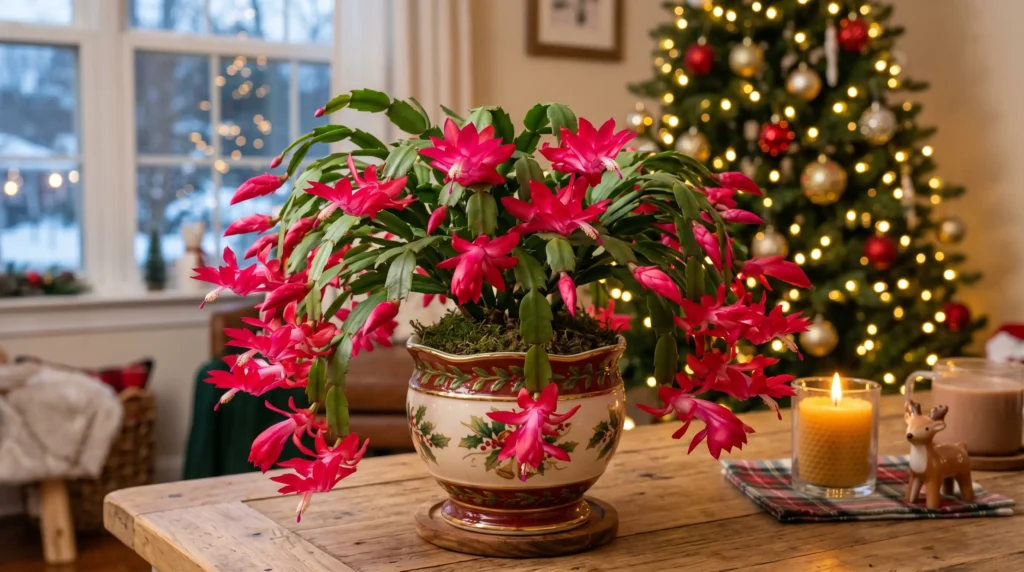
Overview: The Christmas cactus in the uk has a surprisingly rich history in Britain, stretching back over two centuries to the early days of botanical exploration and Victorian plant collecting.
Timeline: Christmas Cactus in the UK
1819 — First botanical description English naturalist Adrian Haworth first formally described the plant from a specimen cultivated at the Royal Botanic Gardens, Kew. At the time it was named Cactus truncatus.
1823 — First published illustration The plant appeared in The Botanical Register under the name Cactus truncatus, becoming one of the earliest recorded references to the species in British horticultural literature.
1837 — George Gardner’s discovery Scottish botanist George Gardner discovered a related species — later named Schlumbergera russelliana — growing on the trees of the Organ Mountains in Brazil. His patron, John Russell, the 6th Duke of Bedford, received living specimens for his renowned cactus collection at Woburn Abbey. Gardner wrote of finding the plant while cutting through dense bamboo forests, describing it as a “lovely new species” that he hoped to see “universally cultivated” in England.
1850s — The modern Christmas cactus is born British horticulturalist William Buckley crossed S. truncata and S. russelliana to create Schlumbergera × buckleyi — the true Christmas cactus sold in UK shops today. This hybrid combined the best qualities of both parents: a graceful trailing habit and abundant, jewel-coloured winter flowers.
1882 — On sale in Chelsea By the 1880s, Christmas cacti were being sold commercially in London. William Bull & Sons of Chelsea listed various Epiphyllum varieties in their retail catalogue at 30–42 shillings per dozen — a luxury purchase for Victorian plant enthusiasts.
1897 — Ellen Willmott’s photograph The Garden magazine published a photograph of Epiphyllum truncatum coccineum taken by Miss Ellen Willmott, the renowned horticulturist, at her estate in Warley, Essex. The accompanying article noted that “under gas light the colours of the flowers are very rich” — a reminder that these plants have been brightening British interiors through dark winter evenings for well over a century.
Today From grand Victorian stove houses to IKEA flat-pack shelving, the Christmas cactus has democratised entirely. It is now available for a few pounds at Aldi, Tesco, and Lidl every November — yet it remains as beautiful and botanically interesting as ever.
Christmas Cactus vs Thanksgiving Cactus vs Easter Cactus — What Is the Difference?
Three different Schlumbergera species are commonly sold in the UK as “Christmas cactus.” They look similar but bloom at different times of year and have subtle physical differences. Knowing which one you have helps you time care correctly.
Comparison Table: The Three Holiday Cacti
| Feature | Christmas Cactus (S. × buckleyi) | Thanksgiving / Winter Cactus (S. truncata) | Easter Cactus (Rhipsalidopsis gaertneri) |
|---|---|---|---|
| Stem segment edge | Rounded, gently scalloped | Pointed, claw-like teeth | Rounded, symmetrical, bristled |
| Flower direction | Droops downward | Points outward or upward | Faces upward |
| UK bloom time | Late November – January | October – November | March – April |
| RHS Award of Garden Merit | Yes | No | No |
| Availability in UK shops | Common (often mislabelled) | Very common (most common) | Less common |
| Care requirements | Identical | Identical | Similar but different bloom trigger |
Which One Is Being Sold in UK Shops?
Important fact for UK buyers: The majority of plants sold as “Christmas cactus” in UK supermarkets, garden centres, and online retailers are actually Schlumbergera truncata — the Thanksgiving or winter cactus — which blooms slightly earlier (October–November). The true Christmas cactus (S. × buckleyi) has rounded stem segments rather than pointed claws, and its flowers droop more elegantly downwards.
Does it matter which you have? For most UK growers, no. Both are equally beautiful, equally easy to care for, and both make outstanding houseplants. The care routine is identical. The main practical difference is bloom timing — S. truncata may be in peak flower before Christmas rather than during it.
How to Tell Them Apart (Quick Visual Guide)
- Look at the edges of the stem segments:
- Rounded, gentle bumps = Christmas cactus (S. × buckleyi)
- Sharp, pointy teeth = Thanksgiving/winter cactus (S. truncata)
- Look at the flowers:
- Hanging downward with symmetric petals = Christmas cactus
- Pointing outward or slightly upward with irregular shape = Thanksgiving cactus
Where to Buy a Christmas Cactus in the UK
Christmas cacti are widely available across the UK from October to December, with year-round options from specialist online nurseries. Prices range from under £5 in supermarkets to £25+ for named cultivars online.
UK Retailers at a Glance
| Retailer Type | Examples | Price Range | Best For |
|---|---|---|---|
| Supermarkets | Aldi, Lidl, Tesco, M&S | £3–£8 | Budget buys, seasonal availability |
| DIY/homeware stores | B&Q, Homebase | £6–£12 | Convenience, reasonable quality |
| Garden centres | Dobbies, Wyevale, RHS Centres | £8–£25 | Quality plants, expert advice |
| Online specialists | Crocus, Hortology, Hayloft, RHS Plants | £10–£30 + P&P | Named varieties, year-round |
| Local / community | Facebook Marketplace, plant swaps | Free–£5 | Free cuttings, mature plants |
What to Look for When Buying
- Choose buds, not blooms. A plant in bud will last far longer in your home than one already in full flower. Full flower = already peaked.
- Check the stems. Segments should be firm, plump, and mid-to-dark green. Avoid plants with shrivelled, yellowing, or pale stems.
- Inspect the roots. Lift the pot. Roots poking out of the drainage holes are acceptable, but avoid plants sitting in soggy, waterlogged compost.
- Check the shop environment. A plant displayed in a cold, draughty shop doorway or near a chiller cabinet will already be experiencing bud drop stress. Avoid these plants.
- Protect on the journey home. Wrap the plant well. Cold air (even a few minutes in a cold car or wind) can trigger immediate bud drop.
When Is the Best Time to Buy?
- October–December: Peak season; widest choice in most high street retailers
- January: Post-Christmas sales — significant discounts, but plants may be past their best bloom
- Year-round: Online specialists like Crocus and Hayloft stock plants outside the festive season
How Much Does a Christmas Cactus Cost in the UK?
| Budget Level | Price | Where to Find |
|---|---|---|
| Budget | £3–£8 | Aldi, Lidl, Tesco, B&Q |
| Mid-range | £8–£15 | Dobbies, Homebase, garden centres |
| Premium (named cultivar) | £15–£30 | Crocus, Hortology, Hayloft, RHS Plants |
| Free | £0 | Cuttings from friends, plant swaps, Facebook Marketplace |
Christmas Cactus Varieties and Colours Available in the UK
Christmas cacti are available in a wide range of flower colours, from classic red to rare yellow. Most UK supermarkets and garden centres stock red and pink; specialist nurseries offer a far broader palette.”The Christmas cactus’s naturally trailing stems make it one of the best candidates for a hanging planter — a display style increasingly popular in UK homes. For more inspiration on trailing and cascading houseplants, see our complete Hanging Plants UK Guide.”
Colour Guide
| Flower Colour | Availability in UK | Notes |
|---|---|---|
| Red / Crimson | Very common | Classic festive choice; widely sold everywhere |
| Hot pink | Very common | Particularly popular; long-lasting flowers |
| Pale pink | Common | Softer, elegant appearance |
| White | Moderate | Striking; slightly harder to find in shops |
| Mauve / Purple | Moderate | Beautiful; more available online than in-store |
| Orange | Less common | Rarer; seek online from specialist nurseries |
| Yellow | Rare | Very hard to find in UK; collector’s choice |
| Bi-colour | Moderate | Pink/white, red/purple combinations |
Named UK Cultivars Worth Knowing
Schlumbergera × buckleyi The true Christmas cactus. Awarded the prestigious RHS Award of Garden Merit — meaning it has been independently trialled and confirmed as a reliably excellent performer in UK conditions. Produces elegant drooping flowers in soft pink-purple shades. Rounded stem segments distinguish it from the Thanksgiving cactus.
Schlumbergera truncata cultivars This species offers the widest colour range. Look for named cultivars from specialist nurseries including:
- ‘Thor Alise’ — vibrant red
- ‘White Christmas’ — pure white, very striking
- ‘Madisto’ — deep magenta
Hayloft Cascading Christmas Cactus Bred for particularly long, trailing stems, ideal for hanging baskets and high shelves. Available in red, pink, and white.
Where to Find Rare Varieties
For unusual colours (orange, yellow, bi-colour), specialist online nurseries are the best source. Search Hayloft, Crocus, and Hortology in late summer to early autumn before stock sells out. Some collectors also trade cuttings through the UK Cactus & Succulent Society.
How to Care for a Christmas Cactus in the UK — The Complete Guide
Christmas cactus care in the UK involves six key elements: light, temperature, watering, humidity, soil, and feeding — plus two annual rest periods that trigger flowering. Get these right, and your plant will bloom reliably for decades.
Light Requirements
Christmas cacti need bright, indirect light. They evolved under the rainforest canopy, so direct sun causes stress and scorching.
Best position in a UK home:
- East-facing windowsill — morning sun only; ideal year-round
- North-facing windowsill with supplementary light — acceptable in summer
- South or west-facing windowsill — only if net curtains or blinds filter the midday sun
What to avoid:
- Direct midday sun through south-facing glass — scorches stems and fades colour
- Dark corners — produces weak, leggy growth with few flowers
- Near artificial lights in autumn evenings — disrupts bud formation (see Section 6b)
Practical tip for UK winters: Britain’s short, overcast winter days can reduce light levels significantly. During November–January, maximise natural light by placing the plant as close to the window as possible — as long as the glass itself is not cold enough to chill the stems.
Temperature — Including the Critical Autumn Cool-Down
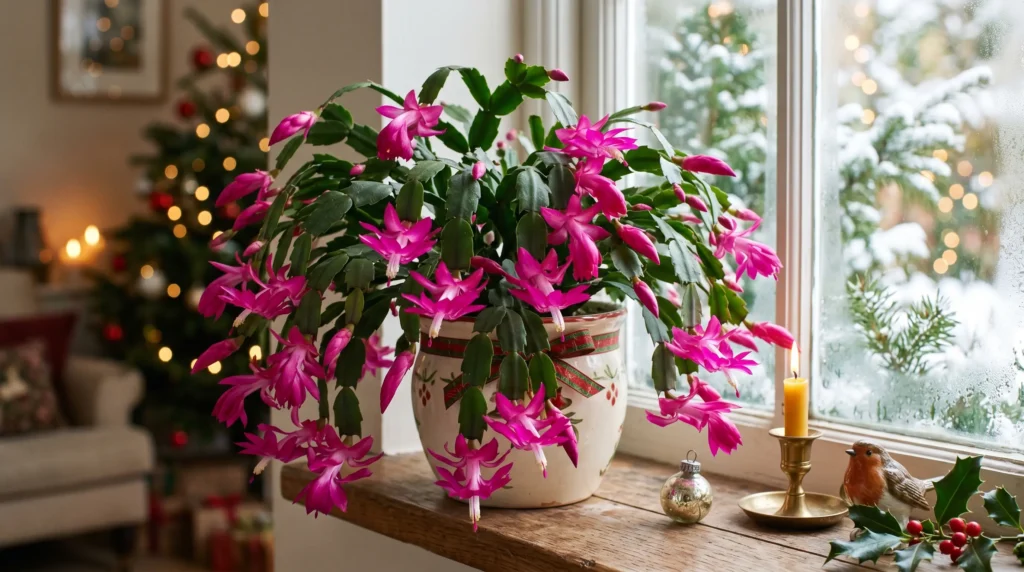
Christmas cacti need warm temperatures (18–20°C) during their growing season but require a distinct drop to 12–15°C in autumn to trigger bud formation.
Temperature guide by season:
| Season | Ideal Temperature | Purpose |
|---|---|---|
| Spring (March–May) | 18–20°C (65–69°F) | Growing season — active growth |
| Summer (June–August) | 18–22°C (65–72°F) | Active growth continues |
| Autumn (mid-Sept–Oct) | 12–15°C (55–59°F) | Critical: triggers bud formation |
| Winter — flowering (Nov–Jan) | 18–20°C (65–69°F) | Return to warmth once buds appear |
| Post-flowering rest (Jan–March) | 12–15°C (55–59°F) | Second rest period |
How to achieve the autumn cool-down in a UK home:
- Move to an unheated spare bedroom or a conservatory (frost-free)
- A windowsill away from radiators often drops naturally to 12–15°C in autumn
- In many UK homes, the temperature fluctuation happens automatically — the plant will flower without intervention
Critical warning: Do not expose to temperatures below 10°C (50°F). Cold draughts from windows, doors, or a cold car journey will cause bud blast — the flowers will drop before opening.
The artificial light problem: In autumn, Christmas cacti also need longer dark periods — at least 12–14 hours of darkness per night — to trigger bud formation. A plant sitting near a lamp switched on after dark, a television, or even a streetlight visible through a thin curtain, may fail to flower. Move to a room that genuinely goes dark in the evenings during September and October.
Watering
Christmas cacti need regular watering during their growing season (spring–summer) but reduced watering during two annual rest periods in autumn and post-flowering.
Step-by-step watering guide:
- Check the compost first. Insert your finger 2–3cm into the compost. If it feels moist, wait. If it feels dry, water.
- Water thoroughly. Pour water until it drains freely from the bottom of the pot.
- Empty the saucer. Never leave the pot sitting in standing water — this causes root rot.
- Use room-temperature water. Cold tap water can shock the roots.
UK-specific tip: Water in many parts of England is hard (high in calcium and magnesium). Over time, mineral deposits can build up in the compost and on the stems. Wherever possible, use collected rainwater or filtered water. If using tap water, allow it to sit overnight to dissipate chlorine before watering.
Watering by season:
| Period | Watering Frequency | Compost Condition |
|---|---|---|
| April – September | Every 7–10 days (check first) | Keep moist, never waterlogged |
| Mid-September – bud appears | Reduce significantly | Let top half dry before watering |
| In flower (Nov–Jan) | Regular (every 7–10 days) | Keep compost evenly moist |
| Post-flowering rest (Jan–March) | Minimal | Let most of compost dry before watering |
Signs you’re watering correctly:
- Stems are firm and slightly glossy
- New segment growth visible in spring
Signs of problems:
- Stems feel soft or mushy → overwatering / root rot
- Stems feel wrinkled → underwatering (or root damage from rot)
Humidity
Christmas cacti prefer humid air (50–60% relative humidity), reflecting their rainforest origins. UK homes in winter, heated by central heating, are often too dry.
How to increase humidity around your Christmas cactus:
- Pebble tray method: Place the pot on a tray filled with gravel or pebbles and water. Keep water below the base of the pot — the evaporation creates local humidity without waterlogging the roots.
- Regular misting: Use a fine-mist sprayer on the stems every few days, particularly in winter when central heating is running.
- Plant grouping: Clustering houseplants together raises the ambient humidity around all of them.
- Bathroom or kitchen placement: These rooms naturally have higher humidity — ideal, provided there is sufficient indirect light.
Soil and Potting
Christmas cacti need a free-draining compost that retains some moisture but never becomes waterlogged.
Recommended compost mixes:
| Mix | Composition | Notes |
|---|---|---|
| Cactus compost (shop-bought) | Ready to use | Convenient; good drainage |
| Peat-free John Innes No. 2 + grit | 2 parts compost : 1 part horticultural grit | Excellent drainage and structure |
| Peat-free multipurpose + perlite | 3 parts compost : 1 part perlite | Good moisture retention with drainage |
Potting tips:
- Christmas cacti prefer to be slightly root-bound — a snug pot encourages flowering
- Only repot when roots are visibly crowded or circling the drainage holes
- Repot in late March, at the start of the growing season
- Move up only one pot size at a time — oversized pots hold too much moisture
Feeding / Fertilising
Christmas cacti benefit from regular balanced feeding during the growing season (spring–summer), with a switch to high-potassium feeding in late summer to encourage flower bud development.
Feeding schedule:
| Period | Feed Type | Frequency |
|---|---|---|
| April – July | Balanced liquid houseplant fertiliser (e.g. Miracle-Gro, Westland) | Every 2–3 weeks |
| August – mid-September | High-potassium feed (e.g. tomato fertiliser) | Every 2 weeks |
| Mid-September – flowering | None | Rest period begins |
| In flower (Nov–Jan) | None | |
| Post-flowering rest | None |
Why switch to high-potassium in August? Potassium supports root development and flowering. Switching from nitrogen-rich balanced feed to a potassium-rich tomato feed in late summer replicates what happens in the plant’s native habitat as the dry season approaches — it signals the plant to start preparing flower buds.
How to Encourage Your Christmas Cactus to Flower
The two flowering triggers are: shorter days and cooler temperatures. Both must be present together for reliable bud formation. This is the most important thing to understand about Christmas cactus care.
Step-by-step flowering guide:
- From mid-September: Move the plant to a cool room (12–15°C). Reduce watering. Stop feeding.
- Ensure darkness for 12–14 hours per night: Switch off all nearby artificial lights by 6pm or move the plant to a room that goes fully dark.
- Wait 6–8 weeks: Buds should begin to appear by October or November.
- Once buds are visible: Move back to a warm room (18–20°C) and resume regular watering.
- Do not move the plant: Once buds form, even rotating the pot can cause bud drop.
- Enjoy the flowers: With the right conditions, the display can last 4–8 weeks.
If your plant still won’t flower: See the troubleshooting section below.
UK Christmas Cactus Care Calendar — Month by Month
This month-by-month guide covers everything you need to do with your Christmas cactus throughout the UK year, accounting for British seasons, heating patterns, and daylight hours.
Full UK Seasonal Care Calendar
| Month | Stage | Key Tasks |
|---|---|---|
| January | Flowering / beginning rest | Enjoy the display; as flowers fade, begin post-bloom rest — reduce watering and move to a cooler spot (12–15°C) |
| February | Rest period | Minimal watering; keep cool; watch for signs of new growth signalling the plant wants to wake up |
| March | Waking up | Resume regular watering; repot if roots are crowded; move back to a warm bright spot |
| April | Active growth begins | Begin feeding with balanced fertiliser every 2–3 weeks; check for any pest damage from winter |
| May | Active growth | Prime time to pinch stem tips to encourage branching; take cuttings for propagation |
| June | Active growth | Continue feeding and watering; consider moving outdoors to a sheltered, shady spot |
| July | Active growth (outdoor option) | If outdoors, protect from slugs and full sun; water more frequently in warm weather |
| August | Transition month | Bring indoors before temperatures drop; switch to high-potassium fertiliser to prime for flowering |
| September | Rest period begins | From mid-September: move to a cool room (12–15°C), reduce watering, stop feeding, ensure 12–14 hours darkness nightly |
| October | Bud formation | Watch for the first tiny buds at stem tips; once buds appear, move back to warmth and resume watering |
| November | Buds swell | Keep in bright, indirect light; water regularly; keep away from cold draughts and artificial light |
| December | Peak flowering | Enjoy the display; maintain steady temperature; do not move or repot while in flower |
The Four Key Months
May — The Most Important Month for Future Flowers May is the hidden powerhouse month for Christmas cactus care. The plant has finished flowering, is out of its rest period, and is actively growing. This is the ideal time to:
- Pinch off 1–2 segments from the tips of any long, straggly stems — this forces the plant to branch, and more branches mean more stem tips, and more stem tips mean more flowers next winter
- Take cuttings from the pinched-off segments to propagate new plants
- Repot if the plant is clearly root-bound (roots pushing through drainage holes)
- Begin outdoor summering in a sheltered, shaded spot
September — The Flowering Switch Mid-September is when you flip the switch from “growth mode” to “flowering mode.” The single biggest reason UK Christmas cacti fail to flower is that this step is skipped. Even if you do nothing else differently, moving the plant to a cool room (an unheated bedroom or conservatory) and ensuring it has long dark nights from mid-September will usually be enough to trigger bud formation.
October — Watch and Wait October is the patience month. You’ve done the work in September — now you wait for the first tiny, pearl-like buds to appear at the tips of the stems. These are easy to miss at first, so check weekly. Once you see them, the hard work is done: move the plant back to warmth, start watering regularly again, and the buds will swell and open over the following weeks.
December — Reward Month Keep the plant stable. Do not move it, do not repot it, do not suddenly change the watering routine. The main threat in December is cold draughts from doors and windows — keep the plant away from these. Central heating can be drying, so mist the stems occasionally and ensure the compost does not dry out completely.
How to Propagate a Christmas Cactus UK — Step-by-Step Guide
Propagating a Christmas cactus means growing new plants from stem cuttings taken from an existing plant. It is easy, free, and one of the best ways to create gifts, replace ageing plants, or build a collection of different colours.
When to Propagate
- Best time: May (after flowering, during active growth)
- Also possible: March–April (as growth resumes)
- Avoid: Autumn (rest period) and winter (while flowering)
Stem Cuttings in Compost (Most Reliable)
What you need:
- A healthy parent plant
- Small pots (7–9cm)
- 50:50 mix of peat-free cuttings compost and sharp sand or perlite
- Clean hands or clean scissors
Step-by-step:
- Select the cutting. Choose a healthy stem and count 2–3 segments from the tip. This will be your cutting.
- Remove the cutting. Snap or cut at the joint between segments — a clean snap is better than a torn cut. No tools are needed; the segments simply twist off at the joint.
- Let it callous. Place the cutting on a dry surface (a piece of kitchen paper works well) and leave for 24–48 hours. This allows the cut end to dry and seal, reducing the risk of rot when planted.
- Prepare your pot. Fill a small pot with the 50:50 compost and sharp sand mix. Moisten the mix slightly.
- Insert the cutting. Push the calloused end 1–1.5cm into the compost — just enough to keep it upright. Do not bury it deeper, as this increases rot risk. You can place 3–4 cuttings around the edge of a single small pot.
- Position and wait. Place in a bright spot out of direct sun at 18–24°C. Water very sparingly — just enough to prevent the compost drying out completely. Mist the cutting lightly every few days.
- Check for rooting. Cuttings typically root within 3–8 weeks. The sign of successful rooting is new segment growth appearing at the tip. Do not tug the cutting to test — this disturbs the developing roots.
- Pot up individually. Once clearly rooted and producing new growth, pot each cutting into its own small pot using standard cactus compost.
Water Propagation
Step-by-step:
- Prepare a cutting as above and allow it to callous for 24 hours.
- Place the cutting in a small glass or jar with just enough water to cover the base of the bottom segment — approximately 1–2cm of water.
- Position in a bright spot out of direct sun.
- Change the water every 3–4 days to prevent stagnation.
- Roots typically appear within 3–6 weeks.
- Once roots are 2–3cm long, pot up into compost.
Pros and cons of water propagation:
| Compost Method | Water Method | |
|---|---|---|
| Success rate | Higher | Slightly lower |
| Time to root | 3–12 weeks | 3–6 weeks |
| Root quality | Strong, adapted to compost | Fragile; may struggle on transplanting |
| Ease | Easy | Very easy |
| Best for | Reliable results | Watching the process / children |
Growing from Seed (Advanced)
Growing Christmas cacti from seed is possible but requires patience — it takes 3–4 years to produce a flowering plant. Seed-grown plants are hybrids and may differ in flower colour from the parent plant.
How to produce seeds: Cross-pollination between two different plants is required. Use a fine artist’s paintbrush to transfer pollen from a fully open flower on one plant to the stigma (the protruding, often pink-tipped part of the flower) on a different plant. Repeat in reverse. After successful pollination, grape-like berries will form over 4–6 months. Harvest seeds when the berry is fully ripe and soft.
Sowing: Sow seeds on the surface of moist, peat-free seed compost in a heated propagator at 18–24°C. Keep in bright indirect light. Germination can take several weeks.
Christmas Cactus UK Cuttings as Gifts
A propagated Christmas cactus is one of the most thoughtful and personal gifts you can give. A few ideas:
- Root cuttings from May onwards; by October they will be small, established plants ready to gift at Christmas
- Present in a terracotta pot with a handwritten care card
- Label with the flower colour so the recipient knows what to expect
- A single mature plant can provide 10–20 cuttings per season at zero cost
Christmas Cactus UK Problems — Causes and Solutions
Christmas cacti are generally robust and tolerant plants. Most problems are caused by incorrect watering, unsuitable temperature, or wrong light conditions — all easily corrected once identified.
Christmas Cactus UK Not Flowering
Cause: The plant has not received the two flowering triggers — reduced temperature and longer dark periods — during autumn.
Most common reasons in UK homes:
- Room stays above 18°C throughout autumn (central heating)
- Plant is near a lamp, TV screen, or visible streetlight after dark
- Watering continued heavily through September
Solution:
- Move to a cool room (12–15°C) from mid-September
- Ensure 12–14 hours of complete darkness per night
- Reduce watering significantly
- Check that no artificial light reaches the plant after 6pm
Flower Buds Dropping (Bud Blast)
Cause: Bud blast is caused by environmental stress after buds have formed. The buds are highly sensitive to sudden changes.
Common triggers:
- Cold draught or rapid temperature drop
- Moving or rotating the pot
- Overwatering once buds appear
- Cold during transport when buying the plant
Solution:
- Find a stable, draught-free spot and do not move the plant
- Water carefully — let the top layer of compost dry slightly between waterings
- When buying: protect the plant well on the journey home
Yellow or Pale Stems
| Symptom | Likely Cause | Solution |
|---|---|---|
| Yellow, washed-out stems | Too much direct sunlight | Move to indirect light |
| Yellow with soft, mushy texture | Overwatering / root rot | Reduce watering; check roots |
| Pale, faded colour | Insufficient light | Move to a brighter spot |
| Yellow with white crusty residue | Hard water mineral build-up | Switch to rainwater or filtered water |
Shrivelled or Wrinkled Stems
Cause: Shrivelling stems indicate the plant is dehydrated — but the cause is not always simple underwatering.
Diagnostic steps:
- Check the compost. If bone dry → water thoroughly.
- If the compost is moist but stems are shrivelling → suspect root rot. Remove from pot and inspect. Healthy roots are white or cream; rotten roots are brown, mushy, and may smell.
- If root rot is present: trim all rotten roots with clean scissors, dust cut ends with cinnamon (natural antifungal), repot in fresh, dry compost, and do not water for 1 week.
Leggy or Straggly Growth
Cause: Stems grow long and sparse with few branches, producing fewer flowers.
Causes:
- Insufficient light (plant stretches toward light source)
- Plant has never been pinched or pruned
Solution:
- Move to a brighter position
- Pinch off 1–2 segments from the tip of each leggy stem in May — this forces the stem to branch into two, doubling the stem tips (and therefore the flowers) over time
Pests
| Pest | Signs | Treatment |
|---|---|---|
| Mealybugs | White, fluffy cotton-like clusters at stem joints | Dab with isopropyl alcohol on a cotton bud; apply neem oil spray for larger infestations |
| Fungus gnats | Tiny flies around compost; larvae in soil | Allow compost to dry more between waterings; use yellow sticky traps; apply nematodes |
| Spider mites | Fine webbing on stems; stippled, pale patches | Increase humidity; wipe stems with damp cloth; apply insecticidal soap |
| Scale insects | Brown, shell-like bumps on stems | Scrape off manually; apply neem oil or horticultural soap |
 Is a Christmas Cactus UK Toxic to Cats, Dogs, or Children?
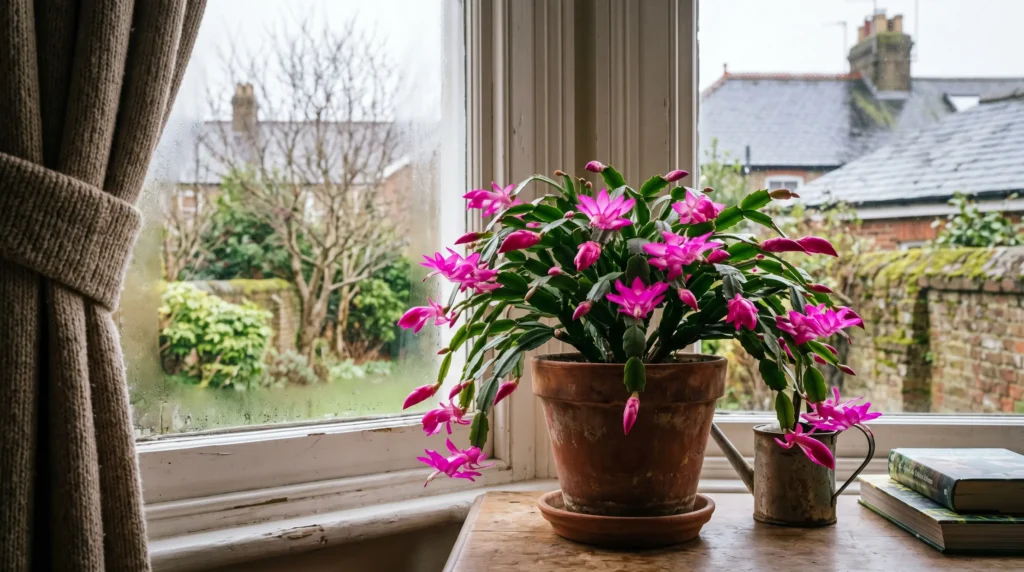
No. Christmas cactus (Schlumbergera) is non-toxic to cats, dogs, and humans. It is one of the safest festive houseplants you can choose, particularly for households with pets or young children.”According to the ASPCA’s official plant toxicity database, Christmas cactus (Schlumbergera) is classified as non-toxic to cats, dogs, and horses — making it one of the safest festive houseplants available for UK pet owners.”
Pet Safety at a Glance
| Animal | Toxic? | Notes |
|---|---|---|
| Cats | Non-toxic | Safe; eating large amounts of fibrous stems may cause mild stomach upset |
| Dogs | Non-toxic | Safe; same mild gastrointestinal caution applies |
| Children | Non-toxic | Safe; not a harmful plant |
| Rabbits / guinea pigs | Generally safe | Consult a vet before allowing access |
Source: The ASPCA (American Society for the Prevention of Cruelty to Animals) does not list Schlumbergera as toxic to cats or dogs. The Royal Horticultural Society also does not classify it as a harmful plant.
Important nuance: While the plant itself is not poisonous, any plant material eaten in large quantities can cause digestive upset in pets. If your cat is a known plant chewer, placing the plant out of reach protects both pet and plant.
Why Christmas Cactus UK Is a Safer Choice Than Common Alternatives
| Festive Plant | Toxic to Cats/Dogs? | Notes |
|---|---|---|
| Christmas cactus | Non-toxic | Safe choice |
| Poinsettia | Mildly toxic | Can cause vomiting and irritation |
| Mistletoe | Toxic | Can cause severe illness; keep well away from pets |
| Holly (berries) | Toxic | Berries toxic to cats and dogs |
| Amaryllis (Hippeastrum) | Toxic | Toxic to cats and dogs |
For pet-owning households, the Christmas cactus is one of the best festive plant choices available in the UK.
Can You Put a Christmas Cactus Outside in the UK?
Yes — but only in summer (late May to late August), in a sheltered, shaded spot. Christmas cacti are tropical plants and cannot tolerate frost or prolonged exposure to temperatures below 10°C.
Outdoor Summering: A Step-by-Step Guide
- When: Move outdoors from late May, once UK night temperatures are consistently above 10°C.
- Where: Choose a sheltered spot with:
- No direct sun (north or east-facing patio; under a tree or garden umbrella)
- Protection from strong wind
- Some shelter from heavy rain (to prevent waterlogging)
- Benefits: Fresh air and the natural temperature fluctuations of a UK summer help ripen new growth and prime the plant for autumn bud formation. Many experienced growers report better flowering after outdoor summering.
- Pest check: Slugs and snails find Christmas cactus stems very appealing. Apply a pet-safe slug barrier around the pot or elevate it on a stand.
- Watering: Compost dries out faster outdoors in warm weather. Check more frequently — every 5–7 days may be needed.
- Bring back in: Return the plant indoors in late August — before UK night temperatures begin dropping below 10°C. In northern England, Scotland, and Wales, bring in a few weeks earlier than the South.
UK Regional Guidance
| UK Region | Outdoor Season | Notes |
|---|---|---|
| London / SE England | Late May – early September | Warmest region; longest outdoor season |
| SW England / Wales | Late May – late August | Good conditions; watch for sudden autumn dips |
| Midlands | Late May – mid-August | Be cautious; bring in on forecast cold nights |
| Northern England | Early June – early August | Shorter season; monitor temperatures closely |
| Scotland | June – late July | Outdoor summering risky; cool summers; proceed with caution |
Christmas Cactus as a Gift in the UK
A Christmas cactus makes one of the most thoughtful, long-lasting, and affordable living gifts available in the UK. Unlike cut flowers or a poinsettia, it can live for 20–30 years and will bloom again every winter with minimal effort.
Why It Makes an Exceptional Christmas Gift
- Long-lasting: A single plant can outlive most other gifts — some heirloom Christmas cacti are passed between generations
- Low maintenance: Even the least experienced plant owner can keep one alive
- Pet-safe: A rare quality among festive plants
- Affordable: Available from £3 at UK supermarkets
- Reblooms annually: Unlike most flowering plants sold at Christmas
- Propagatable: One plant can eventually produce dozens of free offspring
Gift Ideas for the UK Market
Option 1 — Buy ready to give (£3–£15) Buy a plant in bud (not full flower) from a UK supermarket or garden centre. Present it in a decorative pot with a handwritten care card.
Option 2 — Propagate your own (free) Take cuttings in May, root over summer, and by October you will have small, established plants ready to give as Christmas gifts. Label with the expected flower colour.
Option 3 — Build a care gift set Pair a mid-range plant (£10–£15) with:
- A small bottle of liquid houseplant feed
- A simple terracotta pot and saucer
- A handwritten seasonal care calendar
Option 4 — Heirloom cutting If you have a particularly old or sentimental Christmas cactus — one that belonged to a grandparent, or has been in the family for years — a rooted cutting from it carries real sentimental value. Label it with the plant’s history.
Who Is the Christmas Cactus Perfect For?
- Flat dwellers with no garden but a bright windowsill
- Pet owners who need plant-safe options
- Elderly relatives who want a low-maintenance blooming plant
- Beginner plant parents — forgiving and unfussy
- Anyone who loves a festive but lasting home decoration
Frequently Asked Questions — Christmas Cactus UK
These questions and answers are structured for AI extraction and featured snippet eligibility.
Q: What is a Christmas cactus? A: A Christmas cactus (Schlumbergera) is a flowering tropical houseplant native to the rainforests of Brazil. It produces tubular flowers in red, pink, white, or mauve at the tips of its segmented stems, typically between late November and January in the UK. Despite its name, it is not a desert cactus but a tropical epiphyte that prefers indirect light and regular watering.
Q: How long does a Christmas cactus live? A: With proper care, a Christmas cactus can live for 20–30 years or more. Some heirloom plants passed between family generations have been documented at 50+ years. This longevity makes it one of the most rewarding houseplants you can grow.
Q: Why is my Christmas cactus not flowering? A: The most common reason a Christmas cactus fails to flower in the UK is that it did not receive the two autumn triggers: a temperature drop to 12–15°C and 12–14 hours of darkness per night. Move the plant to a cooler room from mid-September, ensure no artificial lights reach it in the evenings, and reduce watering. Buds should appear within 6–8 weeks.
Q: Why are my Christmas cactus buds falling off? A: Bud drop (bud blast) is usually caused by cold draughts, sudden temperature changes, overwatering once buds have formed, or moving the plant after buds appear. Once you find a stable, warm, draught-free spot for the plant when it is in bud, do not move it — even rotating the pot can trigger bud drop.
Q: How often should I water a Christmas cactus? A: During the growing season (April–September), water every 7–10 days when the top 2–3cm of compost feels dry. During the two rest periods — mid-September to bud formation, and late January to late March — water much less frequently, allowing the top half of the compost to dry before watering.
Q: Is Christmas cactus toxic to cats and dogs? A: No. Christmas cactus (Schlumbergera) is non-toxic to cats, dogs, and humans. It is listed as safe by the ASPCA and is one of the safest festive houseplants available in the UK. Eating large amounts of the fibrous stems may cause mild stomach upset in pets, but the plant is not poisonous.
Q: Can I put my Christmas cactus outside in the UK? A: Yes, but only in summer — from late May to late August. Place in a sheltered, fully shaded spot with no direct sun. Bring it back indoors before UK night temperatures drop below 10°C, typically in late August or early September. The plant cannot tolerate frost.
Q: What is the difference between a Christmas cactus and a Thanksgiving cactus? A: The key differences are the stem segment shape and bloom time. Christmas cactus (S. × buckleyi) has rounded, gently scalloped stem edges and drooping flowers, blooming in late November to January. Thanksgiving cactus (S. truncata) has pointed, claw-like stem edges and outward-facing flowers, blooming in October to November. Most plants sold as “Christmas cactus” in UK shops are actually the Thanksgiving cactus.
Q: How do I propagate a Christmas cactus? A: Snap off 2–3 segments from a stem tip in May. Allow the cutting to dry on a surface for 24–48 hours, then insert 1cm deep into a 50:50 mix of peat-free cuttings compost and sharp sand. Keep at 18–24°C in bright, indirect light. Water very sparingly. Roots develop in 3–8 weeks, confirmed by new segment growth at the tip.
Q: Do Christmas cacti need special compost? A: Yes — standard multipurpose compost retains too much moisture and can cause root rot. Use a proprietary cactus compost, or mix peat-free John Innes No. 2 with horticultural grit or perlite (2:1 ratio) to improve drainage while retaining some moisture.
Q: How do I make my Christmas cactus bushier? A: Pinch off the last 1–2 segments from the tip of each stem in May. This encourages each stem to branch into two, doubling the number of stem tips. Since flowers only form at stem tips, more tips means more flowers the following winter.
Q: Where is the best place to put a Christmas cactus in the UK? A: The best position is an east-facing windowsill, which provides bright morning light and avoids the harsh midday sun. Avoid south-facing windows with direct sun (causes scorching), dark corners (causes leggy growth), and spots near radiators (too warm and dry). In autumn, move to a cool room away from artificial lights to trigger bud formation.”Other tropical houseplants that thrive in similar bright, indirect light conditions include the Rubber Plant (Ficus elastica) — a low-maintenance favourite for UK windowsills and a natural companion plant if you enjoy building a tropical indoor display.”
Quick Reference: Christmas Cactus Care Summary
| Care Aspect | Requirement |
|---|---|
| Light | Bright, indirect — east-facing windowsill ideal |
| Temperature (growing season) | 18–20°C (65–69°F) |
| Temperature (autumn rest) | 12–15°C (55–59°F) |
| Watering (growing season) | Every 7–10 days; moist but not waterlogged |
| Watering (rest period) | Minimal; allow compost to partially dry |
| Humidity | Moderate-high; mist regularly |
| Feeding | Balanced fertiliser April–July; high-potassium Aug–Sept |
| Compost | Free-draining cactus mix or JI No.2 + grit |
| Repotting | Every 2–3 years, late March |
| Propagation | Stem cuttings in May |
| Pet safety | Non-toxic to cats, dogs, and humans |
| Lifespan | 20–30+ years |
© Article prepared for topical authority content strategy | Target keyword: Christmas Cactus UK | Word count: ~5,800 words | Last updated: May 2026

Leave a Reply