
ZZ plant (Zamioculcas zamiifolia) is a slow-growing, drought-tolerant tropical houseplant native to eastern Africa. It is characterised by glossy, deep-green oval leaflets on arching stems, thick underground rhizomes that store water, and an exceptional ability to thrive in low-light conditions.
It grows to 60–90 cm indoors, is suitable for UK room temperatures of 18–26°C, and requires watering only every 1–6 weeks depending on the season.
The Plant That Thrives on Being Forgotten
You’ve killed a cactus. You’ve watched a peace lily collapse three days after bringing it home. You’ve given up on the idea that you can keep a houseplant alive — especially in that dark north-facing bedroom or the hallway that barely gets any sun in January.
The ZZ plant (Zamioculcas zamiifolia) has earned its reputation as one of the most genuinely indestructible houseplants available to UK buyers. It does not ask for much: no misting, no humidity trays, no grow lights, no complex fertilising schedule.
It tolerates the low light levels that kill most tropical plants, survives being forgotten for weeks on end, and quietly gets on with looking elegant in whatever corner of your home you put it in.But “easy” does not mean “care-free.” The ZZ plant has a specific biology — one that, once understood, makes caring for it almost automatic.
This guide explains that biology in plain language, then translates it into practical advice calibrated for UK homes, UK seasons, UK retailers, and the specific challenges of keeping a tropical plant alive through a British winter.Whether you are buying your first ZZ plant this weekend or trying to diagnose why your existing one has developed yellow leaves, everything you need is here.
What Is a ZZ Plant? — Plant Profile & Biology
What Is a ZZ Plant?
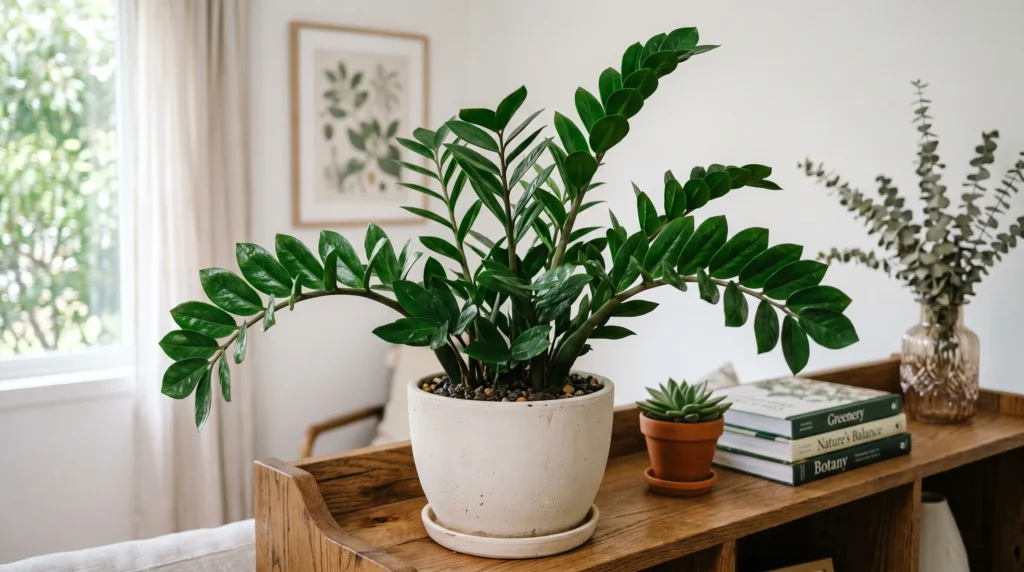
A ZZ plant is a tropical perennial houseplant belonging to the family Araceae, scientifically named Zamioculcas zamiifolia. It is native to the dry forests and grasslands of eastern Africa and is distinguished by its thick underground rhizomes (energy and water storage organs), glossy pinnate leaves, and exceptional tolerance of drought, low humidity, and low light.
ZZ Plant Full Botanical Profile
| Botanical Name | Zamioculcas zamiifolia |
| Family | Araceae (the aroid family, alongside Philodendron, Peace Lily, Monstera) |
| Common Names | ZZ plant, Zanzibar gem, Zuzu plant, Emerald palm, Eternity plant, Aroid palm |
| Native Range | Eastern Africa: Tanzania, Kenya, Malawi, Mozambique, Zimbabwe |
| Plant Type | Tropical herbaceous perennial; rhizomatous succulent |
| Mature Size (UK) | 60–90 cm tall; up to 1.5 m in ideal indoor conditions over many years |
| Leaf Form | Glossy, waxy, deep-green oval leaflets on arching pinnate stems (6–8 pairs per stem) |
| Stems | Thick at the base where they arise from rhizomes; arching and feather-like with age |
| Growth Rate | Slow to moderate: 2–4 new stems per year under good conditions |
| Flowers | Small, pale yellow-green spadix at the base of stems — rarely seen indoors |
| Lifespan | Very long-lived: thrives indoors for 10+ years with correct care |
| Toxicity | Mildly toxic — contains calcium oxalate crystals in all parts |
| Commercial Origin | 1996, Dutch propagators; mainstream in UK by early 2000s |
How Does a ZZ Plant Actually Work?
The ZZ plant stores water and nutrients in its rhizomes — thick, potato-like underground organs that act as a built-in reservoir. When the plant is watered, the rhizomes absorb and hold moisture. During dry periods (which can last weeks), the plant draws on these reserves rather than relying on the soil, which is why it survives far longer without water than most houseplants.
This is not simply drought tolerance in the conventional sense — it is a biological adaptation to eastern Africa’s natural cycle of heavy rainfall followed by extended dry seasons. The ZZ plant evolved to fill its tanks during floods and then live off those reserves for months. In a UK home, this means you can go on a two-week holiday and return to find your ZZ plant completely untroubled.
When repotting, you will often find large, pale rhizomes packed beneath the soil — these are a sign of a healthy, well-established plant. If any break off, pot them separately: they may produce new shoots.
CAM Metabolism: The Science Behind the Drought Tolerance
The ZZ plant uses Crassulacean Acid Metabolism (CAM) — a specialised photosynthesis strategy shared with cacti and succulents. Most plants open their leaf pores (stomata) during the day to absorb CO₂, simultaneously losing water through evaporation. CAM plants do the opposite: they open their stomata at night when temperatures are cooler and humidity higher, absorbing CO₂ then, and keeping their pores firmly shut during the hot day to minimise water loss.
The practical result is that a ZZ plant loses far less water through its leaves than a conventional tropical plant — and what moisture it does have is mostly stored in its rhizomes below the soil line. It is, in essence, a succulent that looks like a lush tropical foliage plant. This dual identity is why overwatering kills it far more reliably than underwatering.
A secondary benefit: because ZZ plants absorb CO₂ at night, they continue producing oxygen in darkness — making them one of the few houseplants genuinely suited to bedrooms.
A Brief History of the ZZ Plant in UK Horticulture
The Zamioculcas zamiifolia genus has only one species. Known in eastern Africa for centuries, it remained outside Western horticulture until 1996, when Dutch commercial propagators recognised its remarkable tolerance and began mass production. Shipments reached Europe and the United States by the late 1990s; the plant was established in UK garden centres by the early 2000s.
In 2017, a near-black cultivar — the ‘Raven’ ZZ plant — was developed and quickly became one of the most sought-after houseplant novelties of the decade. Since then, the ZZ plant has moved from garden centre staple to interior design statement piece, appearing in everything from hotel lobbies to co-working spaces to BBC home improvement shows.
Why ZZ Plants Are Perfect for UK Homes
What Makes a ZZ Plant Ideal for UK Living Conditions?
The ZZ plant is ideal for UK homes because its natural tolerances align almost perfectly with the conditions found in British houses and flats: moderate indoor temperatures between 18–26°C, low-light rooms particularly common in north-facing or terraced properties, dry air produced by central heating systems, and the irregular watering schedules of busy working households.
Temperature: Calibrated for British Living Rooms
The ZZ plant’s preferred temperature range of 18–26°C is precisely the temperature range of the average UK living room. British homes rarely exceed 24°C indoors in summer, and most are kept at 19–22°C during the heating season — both comfortably within the ZZ plant’s comfort zone.
The important threshold to know is the lower limit: 15°C. Below this temperature for sustained periods, the rhizomes begin to go dormant and growth stalls. This becomes relevant in specific UK settings: cold conservatories in winter, north-facing windowsills in January, and hallways in older houses where draughts bring temperatures down at night.
| Location | Typical UK Winter Temp | Safe for ZZ Plant? | Action |
|---|---|---|---|
| Living room (heated) | 19–22°C | Safe | None needed |
| Home office (heated) | 18–21°C | Safe | None needed |
| North windowsill | 14–17°C at night | Marginal | Move away from glass at night |
| Cold conservatory | 5–12°C | Too cold | Bring indoors for winter |
| Unheated hallway | 12–16°C | Marginal | Monitor; add draught excluder |
| Bathroom (heated) | 18–24°C | Safe | Check light levels |
North-Facing Rooms and UK Window Orientations
North-facing rooms are one of the most common challenges for UK plant owners. Because the UK sits at a relatively high latitude, north-facing rooms receive very little direct sunlight — often only reflected or ambient light year-round. Most tropical houseplants struggle or fail in these conditions.
The ZZ plant is one of very few genuinely attractive houseplants that not only survives but grows in a north-facing placement. It can thrive at light levels as low as 50 lux — equivalent to a room lit by a single ceiling light — though growth will be slower than in brighter positions.
ZZ Plant Light Requirements by Lux Level
| Light Level | Lux Range | ZZ Plant Response | UK Room Equivalent |
|---|---|---|---|
| Very low | Below 50 lux | Survives; minimal growth | Dark hallway, inner room with no window |
| Low | 50–100 lux | Survives; slow growth | North-facing room, shaded bedroom |
| Medium (ideal minimum) | 100–250 lux | Grows steadily; good health | Bright north-facing room, away from window in east/west room |
| Bright indirect | 250–800 lux | Optimal growth; 4+ new stems per year | Near east/west-facing window; south-facing behind sheer curtain |
| Direct sun | 800+ lux | Leaf scorch; curling; bleaching | South-facing windowsill — avoid entirely |
UK Window Direction Guide for ZZ Plants
| Window Direction | ZZ Plant Suitability | Best Placement | Notes |
|---|---|---|---|
| North-facing | Excellent | Anywhere in room; closer to window in winter | One of very few plants that genuinely thrives here |
| East-facing | Excellent | On or near windowsill | Morning sun is gentle — ideal light quality |
| West-facing | Good | Step back 1–2 m from window in summer | Afternoon sun can be strong in summer |
| South-facing | With care | 1.5–2 m from window OR behind sheer curtain | Direct afternoon sun will scorch and bleach leaves |
Central Heating and Dry Air — Not a Problem for ZZ Plants
Central heating is a significant stress factor for many tropical houseplants. As boilers fire up from October onwards, indoor humidity in UK homes can drop from a comfortable 50–60% to as low as 30% — causing brown leaf tips on moisture-loving plants like Calatheas, Fiddle-Leaf Figs, and many ferns.
Its waxy leaf cuticle minimises water vapour loss, and its CAM metabolism keeps stomata closed during the dry daytime hours. It neither needs misting nor benefits from a humidity tray. The only central heating precaution: do not place the plant directly above a radiator, where localised hot air blasts can dessicate leaf tips over time.
Irregular Watering — The ZZ Plant’s Greatest Strength
The average UK adult waters their houseplants approximately once per week — but forgets frequently, especially during holidays, busy work periods, and the general chaos of daily life. The ZZ plant is biologically engineered for exactly this scenario.
Its rhizomes store enough water to sustain the plant for 2–6 weeks without any top-up, depending on the season and light level. This means two-week summer holidays pose no threat. It also means the most dangerous thing you can do is water it on a fixed weekly schedule regardless of whether the compost is dry — the leading cause of ZZ plant death in UK homes.
UK Suitability Quick-Check Checklist
Use this checklist before placing your ZZ plant in any room in your home:
| Condition | Suitable for ZZ Plant? | If No — What to Do |
|---|---|---|
| North-facing room | Yes | — |
| East or west-facing room | Yes | — |
| South-facing room with direct sun | Move back from window | Position 1.5 m+ from glass or use sheer curtain |
| Centrally heated room | Yes | — |
| Near a radiator (within 50 cm) | No | Move the plant at least 1 m away |
| Cold conservatory in winter | No | Bring indoors from October to April |
| Steamy bathroom (warm) | Yes | — |
| Dark hallway below 15°C | No | Relocate to heated room |
| Home with cats/dogs | With care | Place on high shelf or in inaccessible room |
| Home with small children | With care | Keep out of reach — wear gloves when handling |
| Office under fluorescent lighting | Yes | — |
| Busy lifestyle / frequent travel | Yes — ideal | — |
ZZ Plant Varieties Available in the UK
How Many Types of ZZ Plant Are There?
There is only one species of Zamioculcas: Zamioculcas zamiifolia. . As of 2025, four cultivars are realistically available to UK buyers: the Classic, the Raven, the Zenzi, and the rare Variegated. All share the same care requirements, with minor differences noted below.
The Four ZZ Plant Varieties: Side-by-Side Comparison
| Variety | Foliage | Mature Height | UK Availability | Approx. UK Price | Best For |
|---|---|---|---|---|---|
| Classic ZZ | Deep glossy green | 60–90 cm+ | Widely available | £8–£25 | Beginners; offices; any room |
| Raven ZZ | Near-black (new growth starts lime-green) | 60–90 cm+ | Moderate | £12–£35 | Statement décor; dark modern interiors |
| Zenzi ZZ | Dark green; compact, cupped leaves | Up to 45 cm | Specialist only | £10–£28 | Small spaces; desks; shelves |
| Variegated ZZ | Green with cream/white splashing | Variable | Rare, expensive | £50–£150+ | Collectors; specimen plants |
Classic ZZ Plant (Zamioculcas zamiifolia)
The Classic ZZ plant is the original cultivar and the most widely grown houseplant in the UK. Its stems arch gracefully, each lined with 6–8 pairs of thick, oval, deep-green leaflets that catch and reflect light — giving the plant its characteristic glossy appearance. It is the largest commonly available cultivar and the most forgiving of the group.
Where to buy in the UK: B&Q, Dobbies, Waitrose, IKEA, Patch Plants, The Stem, Hortology, Beards and Daisies, Happy Houseplants. It is the easiest ZZ plant to find in a high-street garden centre.
| Quick Facts: Classic ZZ |
| Foliage colour: Deep, glossy green |
| Height: 60–90 cm; up to 1.5 m over many years |
| Growth rate: 2–4 new stems per year in good conditions |
| Difficulty: Very easy — ideal for beginners |
Raven ZZ Plant (Zamioculcas zamiifolia ‘Raven’)
The Raven ZZ plant is the most dramatic cultivar currently available in the UK. First bred commercially in 2017, it has become hugely popular for its near-black foliage — which is achieved in a particularly striking way: new growth emerges as vivid lime-green, then gradually deepens over several weeks to an almost-black dark purple-green.
Care requirements are identical to the Classic ZZ. The Raven ZZ is increasingly available from specialist UK online retailers and is now stocked by some Dobbies and IKEA branches. If your local garden centre does not carry it, Patch Plants, The Stem, and Hortology consistently stock it online.
| Quick Facts: Raven ZZ |
| Foliage colour: Near-black (dark purple-green); new growth vivid lime-green, darkening over weeks |
| Height: 60–90 cm; similar to Classic |
| Best display: Against white or pale grey walls where the dark foliage reads most strongly |
| Light note: Needs slightly brighter light than Classic to maintain deep colouration |
Zenzi ZZ Plant (Zamioculcas zamiifolia ‘Zenzi’)
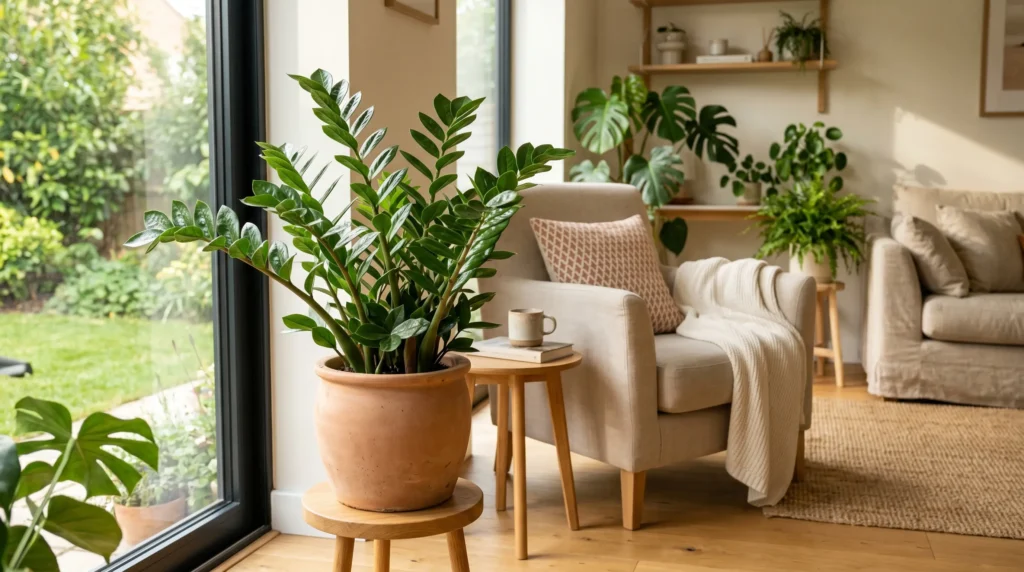
The Zenzi is a compact, more tightly clustered cultivar with smaller, slightly cupped dark-green leaflets on shorter, more upright stems. Where the Classic can eventually dominate a corner with its arching form, the Zenzi stays modest — making it ideal for UK flats, small home offices, bathroom shelves, and desk displays.
It is less commonly found in UK high-street garden centres but is available from specialist online retailers. Care is the same as the Classic, though it appreciates slightly more light to maintain its compact, dense form.
| Quick Facts: Zenzi ZZ |
| Foliage: Dark green; smaller, slightly cupped leaflets |
| Height: To approximately 45 cm — notably more compact than Classic or Raven |
| Best for: Small UK flats, desks, bathroom shelves, bedside tables |
Variegated ZZ Plant
The Variegated ZZ plant is the rarest and most expensive cultivar, featuring leaves with cream, white, or pale-yellow splashing alongside the standard green. It is genuinely difficult to find in the UK — availability is limited to specialist plant importers, independent plant shops, and Etsy sellers.
Variegated ZZ plants require more light than green varieties to maintain their variegation (the pale areas contain less chlorophyll and need brighter conditions to compensate). They are slower-growing than the Classic and command significant price premiums — a healthy specimen of reasonable size will typically cost £50–£150 or more in the UK market.
| Quick Facts: Variegated ZZ |
| Foliage: Green with cream, white, or pale-yellow variegation |
| Light: Needs more light than Classic — bright indirect light for best variegation |
| Growth: Slower than Classic |
| UK price: £50–£150+ depending on size and source |
Complete ZZ Plant Care Guide for UK Homes
How to Care for a ZZ Plant: The Core Principle
The single most important principle of ZZ plant care is: water less than you think you should, and provide light whenever possible. The ZZ plant is biologically adapted to drought — its rhizomes store water, its waxy leaves minimise moisture loss, and its CAM metabolism keeps stomata shut during the day. Overwatering is the primary cause of ZZ plant death.
ZZ Plant Care at a Glance — Quick Reference Table
| Care Element | UK Specification | Common Mistake |
|---|---|---|
| Light | Bright indirect preferred; tolerates low light (50 lux+); never direct sun | Placing in direct south-facing sun leaf scorch and bleaching |
| Watering (summer) | Every 1–2 weeks; always check compost first | Watering on a fixed schedule regardless of soil moisture |
| Watering (winter) | Every 4–6 weeks; central heating speeds drying — check weekly | Watering as frequently as summer root rot |
| Compost | Cactus/succulent mix or houseplant compost + 30–40% perlite | Standard multipurpose compost alone waterlogging |
| Pot | Terracotta or pot with drainage holes; never pot without drainage | Decorative pot with no drainage standing water root rot |
| Temperature | 18–26°C; minimum 15°C; away from draughts and direct radiators | Cold windowsill below 15°C in winter dormancy and root stress |
| Humidity | Normal UK household humidity (40–60%) is adequate; no misting needed | Misting leaves in low-light rooms fungal issues |
| Feeding | Monthly at half-strength, May–August only | Feeding in autumn/winter when plant cannot process nutrients |
| Repotting | Every 2–3 years; one pot size up; early spring | Using too large a pot excess wet compost root rot |
| Leaf cleaning | Wipe with damp cloth monthly; no leaf shine products | Using commercial leaf shine clogged pores |
Light: What ZZ Plants Need and What UK Homes Provide
ZZ plants are flexible in their light requirements but not entirely light-independent. The optimal light level is bright, indirect light — the kind found 1–2 metres from an east or west-facing window. At this level, the plant produces 4 or more new stems per year and maintains its deep, glossy colouration.
How to Measure Light in Your Room (Without Equipment)
Hold your hand about 30 cm above a white sheet of paper at the spot where you plan to place the plant. A soft, blurry shadow indicates medium light. No shadow at all means low light. You can also use a free lux meter app on your smartphone for a more accurate measurement.
Signs Your ZZ Plant Needs More Light
- New stems are thin, long, and leggy — reaching towards the nearest light source
- Leaves are spaced far apart on stems rather than closely packed
- Growth has stalled entirely (outside of winter dormancy)
- The plant leans markedly towards the window
Signs Your ZZ Plant Has Too Much Direct Sun
- Pale, yellowing, or bleached patches on leaves — particularly on the side facing the window
- Leaves curling inward or away from the light source (unusual — most plants turn towards light)
- Brown, papery, scorched patches that do not recover
How to Water a ZZ Plant: The Complete UK Guide
Watering a ZZ plant correctly is the most important thing you can do for it. The rule is simple: water thoroughly, then wait for the compost to dry completely before watering again. ‘Thoroughly’ means water until it drains freely from the bottom of the pot — then stop and wait.
‘Completely dry’ means just that: the top 5–6 cm of compost should feel dry to the touch, not just the surface.The finger test is the most reliable method: push your index finger 4–5 cm into the compost. If you feel any cool moisture at that depth, wait. If it is dry through and through, water now.
UK Seasonal Watering Schedule
| Season (UK) | Months | Approximate Frequency | Notes |
|---|---|---|---|
| Early spring | March–April | Every 2–3 weeks | Begin increasing as light improves and temps rise |
| Summer (growing season) | May–August | Every 1–2 weeks | Check compost first every time — do not water if still moist |
| Autumn (growth slows) | September–October | Every 2–4 weeks | Reduce gradually; central heating can still dry compost quickly |
| Winter (rest period) | November–February | Every 4–6 weeks | Central heating misleads — check compost weekly even if you are not watering |
Watering Method: Step-by-Step
- Remove any decorative outer pot (cachepot) before watering.
- Take the plant to a sink or use a watering can with a narrow spout.
- Water slowly around the base of the stems — avoid getting water in the cubbyholes where stems emerge, as this promotes rot.
- Continue until water flows freely and steadily from the drainage holes.
- Allow the pot to drain for 10–15 minutes.
- Return to its position. Never leave it standing in a saucer of water.
Water Quality: A UK-Specific Note
Most of southern England, the Midlands, and parts of the north have hard tap water — water with a high mineral (calcium and magnesium) content. Hard water is not harmful to ZZ plants, but over time it leaves white chalky deposits on leaves and can cause slight compost pH changes. To minimise this:
- Use collected rainwater where possible — the ZZ plant prefers it
- If using tap water, let it sit in a jug overnight before watering — this dissipates chlorine and allows the water to reach room temperature
- Wipe white mineral deposits from leaves with a damp cloth — do not scrub
Overwatering vs Underwatering: How to Diagnose the Difference
Both overwatering and underwatering produce yellow leaves — making diagnosis confusing. Use this table:
| Symptom | Overwatering | Underwatering |
|---|---|---|
| Compost feel | Wet or soggy | Bone dry; pulling from pot edges |
| Stem base | Soft, squishy, possibly brown | Firm but shrivelling or grey-tinged |
| Leaf condition | Limp, yellow; falling off | Yellow with dry brown edges or crispy tips |
| Rhizomes (if checked) | Brown, mushy, foul-smelling | Firm but deflated and pale |
| Compost smell | Musty; sour | No unusual smell |
| Recovery | Slow — remove from wet compost; let dry | Fast — water thoroughly and plant rebounds within days |
Soil and Potting Mix for ZZ Plants
ZZ plants require a free-draining compost mix. Standard multipurpose compost retains too much moisture and will cause root and rhizome rot over time. The ideal mix provides fast drainage while still offering enough structure to anchor the plant.
Recommended UK Soil Mixes
- Option 1 (easiest): Ready-made cactus/succulent potting mix — available from B&Q, Dobbies, Wilko, and online retailers
- Option 2 (best): 60% peat-free houseplant compost + 30% perlite + 10% coarse horticultural grit
- Option 3 (budget): Standard multipurpose compost + 40% perlite — workable but requires careful watering discipline
What to Look for in a ZZ Plant Compost
- Free-draining: water should flow through rapidly, not pool on the surface
- Not water-retentive: avoid composts marketed as “moisture-retaining”
- pH neutral to slightly acidic: 5.8–6.5 is ideal
- Peat-free options: recommended for environmental reasons; John Innes No. 2 (peat-free version) blended with perlite works well
Choosing the Right Pot
- Always use a pot with drainage holes — this is non-negotiable for ZZ plants
- Terracotta pots allow compost to breathe and dry faster — helpful in UK winters
- Plastic pots retain moisture longer — check the compost more frequently
- Do not use a pot more than 1–2 cm wider than the root ball — excess compost holds water around the rhizomes
- If using a decorative cachepot (pot without holes), always remove the inner pot to water and drain fully before replacing
Temperature and Humidity for UK ZZ Plants
ZZ plants prefer temperatures of 18–26°C — the range found in most UK heated rooms — and will tolerate the normal household humidity of 40–60% without any supplemental misting or humidity trays.
Temperature: Key Thresholds
- Optimal range: 18–26°C — standard UK living room temperature throughout the year
- Minimum: 15°C — below this for sustained periods, growth stalls and rhizome stress increases
- Maximum: 30°C — uncommon in UK homes, but may occur in south-facing conservatories in summer
- Do not expose to frost — a single frosty night will damage rhizomes irreversibly
- Keep away from cold window glass in January/February — the air immediately beside a single-glazed or poorly sealed window can fall significantly below the room temperature
Central Heating: Specific UK Considerations
- Do not place directly above or within 50 cm of an active radiator — dry heat blasts damage leaf tips
- Central heating drops indoor humidity but does not harm ZZ plants — unlike Calatheas or ferns
- Central heating also warms compost through the pot — which can accelerate drying in winter. Check soil weekly even in December
- Draughts from letterboxes, poorly sealed doors, and single-glazed windows can create cold microclimates — reposition plants away from these in winter
Feeding and Fertilising Your ZZ Plant
ZZ plants are slow growers with low nutrient requirements. Feeding supports healthy growth during the active season but must be stopped completely in autumn and winter when the plant cannot process nutrients and excess fertiliser accumulates as harmful salts in the compost.
Feeding Schedule (UK Growing Season)
| Month | Action | Notes |
|---|---|---|
| January–April | No feeding | Plant is resting; cannot process nutrients |
| May | Begin monthly feeds — half-strength liquid fertiliser | Growing season begins as UK light levels improve |
| June | Monthly feed | Active growth period |
| July | Monthly feed | Peak growing month in UK |
| August | Monthly feed (last of the year) | Begin tapering off by late August |
| September–December | No feeding | Growth slows; excess nutrients cause root burn |
How to Feed a ZZ Plant
- Use a balanced liquid houseplant fertiliser (e.g., Baby Bio, Miracle-Gro Liquid Houseplant Food, Westland Liquid Houseplant Food).
- Dilute to half the recommended strength stated on the packaging — ZZ plants are sensitive to over-fertilisation.
- Apply to damp compost — never feed a completely dry plant as this can cause root burn.
- Alternatively, use slow-release granule fertiliser in April — push into the compost surface, and it feeds steadily through the growing season without monthly attention.
Signs of Over-Fertilisation
- White crusty deposit on compost surface or pot edges — salt build-up
- Brown leaf tips spreading inward from the edges
- Sudden wilting despite correct watering
- Fix: flush the pot thoroughly with plain water to leach out excess salts; skip feeding for the rest of the season
How and When to Repot a ZZ Plant
ZZ plants prefer slightly snug conditions and do not need frequent repotting. Repot every 2–3 years, or when the rhizomes begin to visibly bulge the pot sides or push out of the drainage holes.
Signs Your ZZ Plant Needs Repotting
- Pot sides are visibly bowing or distorting — the rhizomes are strong enough to crack plastic pots
- Rhizomes or roots emerging from the drainage holes
- The plant dries out very quickly after watering — the rhizomes have displaced most of the compost
- Growth has stalled in summer despite good light and regular feeding
How to Repot a ZZ Plant: Step-by-Step
- Choose the right time: March or April is ideal — as the growing season begins, the plant will establish quickly in its new pot.
- Select a pot only 1–2 cm wider than the current one — do not jump up to a much larger pot as excess compost holds moisture and increases root rot risk.
- Put on gloves — the sap of all ZZ plant parts contains calcium oxalate crystals which can cause skin irritation.
- Lay the pot on its side and gently slide the plant out. Do not pull by the stems.
- Shake loose as much old compost as possible from around the rhizomes.
- Inspect the rhizomes: firm, pale rhizomes are healthy. Brown, mushy rhizomes indicate root rot — cut these away with clean scissors or a sterile knife. Dust cut surfaces with horticultural charcoal or cinnamon (natural antifungal).
- If any rhizomes detach during repotting, pot them separately in cactus mix — they may produce new plants.
- Place a layer of fresh cactus/perlite mix in the new pot. Position the plant at the same depth it was previously growing.
- Fill around the rhizomes with fresh compost, firming gently. Do not compact it.
- Water lightly — just enough to settle the compost. Resume normal watering only once the compost has dried completely.
Pruning and General Maintenance
ZZ plants require minimal pruning. The primary maintenance tasks are removing dead or damaged growth and keeping the leaves clean.
Pruning — What to Remove and How
- Remove yellowing or brown stems at the base, as close to the rhizome as possible, using clean secateurs or sharp scissors
- Do not cut healthy green stems — the ZZ plant does not respond well to stem cutting for shaping and will not branch from the cut point
- If a stem becomes very leggy (long, sparse, and leaning), cutting it back to the base encourages the rhizome to produce a new, fuller stem
- Always sterilise cutting tools with rubbing alcohol before use to prevent transmitting pathogens
Leaf Cleaning
- Wipe leaves monthly with a damp cloth to remove dust — dust-clogged pores reduce photosynthesis and make the plant more susceptible to spider mites
- Use soft, room-temperature water — cold water can leave temperature marks on the waxy leaves
- Do not use commercial leaf shine products — they coat the pores and reduce the plant’s ability to exchange gases
- After cleaning, the natural gloss of the leaves is sufficient — no polish or wax is needed
ZZ Plant UK Seasonal Care Calendar — Month by Month
How Should ZZ Plant Care Change Through the UK Year?
ZZ plant care changes significantly across the UK calendar year. The plant has a natural growth cycle driven by light levels and temperature: active growth from May through August, a gradual slow-down in autumn, and a rest period from November through February. Caring for your ZZ plant well means aligning your watering, feeding, and maintenance schedule to this cycle.
This calendar is calibrated to UK conditions, including the specific challenges of British winters (low light, central heating drying compost) and British summers (moderate temperatures; growing season from May rather than March).
| Month | Watering | Feeding | Key Actions | Watch For |
|---|---|---|---|---|
| January | Every 4–6 weeks | None | Keep above 15°C; wipe leaves to maximise light absorption | Cold draughts from windows; overwatering in low-light conditions |
| February | Every 4–6 weeks | None | Check compost weekly — central heating can dry faster than expected | Soft stems at base → root rot beginning |
| March | Every 2–3 weeks (begin increasing) | None | Inspect pot — repot now if rhizomes are bulging; begin checking for pests | New shoot tips emerging — exciting; protect from cold |
| April | Every 2–3 weeks | None | Repot if needed with fresh cactus/perlite mix; move closer to windows as light improves | Do not start feeding yet — wait for May |
| May | Every 1–2 weeks | Begin monthly at half-strength | Active growing season starts; rotate pot for even growth; inspect for spider mites | Compost drying faster as temps rise — check twice weekly |
| June | Every 1–2 weeks | Monthly | Consider propagating by stem cutting or division this month; wipe leaves | Direct sun through south-facing windows strengthening — step plant back if needed |
| July | Every 1–2 weeks | Monthly | Peak growth month; watch for pests in warm conditions; wipe leaves | Spider mites in hot, dry spells; underwatering if compost dries in under a week |
| August | Every 1–2 weeks | Last monthly feed of year (mid-August) | Best month for propagation; begin preparing to reduce watering in September | Days shortening — watch for growth slowing toward end of month |
| September | Every 2–3 weeks | None (season ends) | Reduce watering gradually; bring in any plants moved outdoors for summer | Overwatering as light and temps drop simultaneously |
| October | Every 3–4 weeks | None | Move from cold windowsills; check temperature at plant position; turn on heating | Temperature below 15°C at night near windows; draughts from poorly sealed frames |
| November | Every 4–6 weeks | None | Check compost weekly even if not watering; wipe dusty leaves; enjoy the plant | Central heating drying compost faster than expected in winter |
| December | Every 4–6 weeks (minimum) | None | Ensure plant is not near cold glass; give as a gift — excellent timing | Cold window glass; overwatering from holiday good intentions |
| Key UK Seasonal Rule to Remember |
| Growing season: May to August — water more, feed monthly, watch for pests, propagate. |
| Rest season: November to February — water far less (every 4–6 weeks), no feeding, prioritise warmth over everything else. |
| Transition months: March, April, September, October — adjust gradually in both directions. Do not switch care regimes abruptly. |
Troubleshooting — Common ZZ Plant Problems and Fixes
What Are the Most Common ZZ Plant Problems?
The most common ZZ plant problems in UK homes are yellow leaves (caused by overwatering in the majority of cases), brown leaf tips (caused by hard tap water or radiator proximity), and complete failure to grow (caused by insufficient light or pot-bound rhizomes).
ZZ Plant Problem Diagnosis: Complete Reference Table
| Symptom | Most Likely Cause | UK-Specific Trigger | Solution |
|---|---|---|---|
| Yellow leaves — soft stems | Overwatering / root rot | Watering on fixed weekly schedule through UK winter | Let compost dry completely; check rhizomes; repot if rot present |
| Yellow leaves — dry compost | Underwatering or very low light | Forgetting to water; dark north-facing room in January | Water thoroughly; move to brighter indirect position |
| Yellow lower leaves only | Natural ageing (normal) | Older leaves naturally drop as new growth appears | Remove at the base; no concern unless spreading upward |
| Brown, crispy leaf tips | Low humidity / hard water / radiator heat | Hard water in SE England; near central heating | Use rainwater; move from radiators; wipe leaves with damp cloth |
| Brown mushy stem base | Stem rot from overwatering | Wet UK winters + decorative pot without drainage | Remove affected stems; dry out; repot with draining mix |
| Drooping/wilting | Overwatering or extreme drought; excess heat | Both occur in UK households | Diagnose by checking compost — act accordingly |
| Pale, bleached patches on leaves | Direct sunlight — leaf scorch | South-facing rooms; conservatories in summer | Move away from direct sun; step back from south-facing window |
| Leggy, sparse growth | Insufficient light | North-facing rooms in UK winter; deep interior rooms | Move to brighter spot; add LED grow light (300–500 lux) |
| No new growth (summer) | Pot-bound; insufficient light or nutrients | Common in UK offices with artificial light only | Repot in April; begin feeding in May; improve light |
| No new growth (winter) | Normal winter dormancy | Low UK light October–February triggers rest | No action needed — growth resumes in spring |
| White crust on leaves or pot | Hard water mineral deposits | Very common in London, SE England, Midlands | Wipe with damp cloth; switch to collected rainwater |
| Fine webbing on leaves | Spider mites | Hot dry UK summers; dry heated rooms in winter | Wipe leaves; treat with diluted neem oil; increase airflow |
| Sticky residue on leaves | Scale insects or mealybugs | Less common; sometimes imported with new plants | Wipe with rubbing alcohol on cotton wool; isolate plant |
| Pot deforming / cracking | Pot-bound — rhizomes expanding | Normal if plant has not been repotted in 3+ years | Repot in April — a sign of a thriving plant |
Overwatering vs Underwatering: Full Diagnosis Guide
Yellow leaves are the most confusing ZZ plant symptom because both overwatering and underwatering cause them. Use this step-by-step diagnosis process before acting:
Step 1: Check the Compost
- Push your finger 4–5 cm into the compost. Wet or moist at that depth = almost certainly overwatering.
- Bone dry, pulling away from pot edges = possibly underwatering.
Step 2: Check the Stem Bases
- Squeeze the stem gently at the base where it meets the soil. Soft and squishy = overwatering / rot.
- Firm but slightly shrivelled = underwatering.
Step 3: Check the Rhizomes (If Needed)
- Slide the plant out of its pot. Healthy rhizomes are firm, pale, and potato-like.
- Rotting rhizomes are soft, brown-black, and may smell sour or musty. Cut these away with sterile scissors.
Treating Root Rot: Step-by-Step
- Remove the plant from its pot entirely.
- Shake off all old compost — do not leave any wet soil clinging to rhizomes.
- Using clean, sterilised scissors, cut away all brown, soft, or mushy rhizomes and roots.
- Dust the cut surfaces with cinnamon powder or horticultural charcoal — both act as natural antifungals.
- Leave the plant out of its pot in a warm, dry spot for 24 hours to allow cut surfaces to callous.
- Repot into completely fresh, dry cactus/perlite mix in a clean pot with drainage holes.
- Do not water for 7–10 days after repotting. Then water very lightly and allow to dry completely before watering again.
ZZ Plant Pests: Prevention and Treatment
ZZ plants have very few pest problems — one of the reasons they are so popular for UK homes and offices. The most commonly encountered pests are spider mites (in warm, dry conditions) and occasionally scale insects or mealybugs (usually introduced from a newly purchased plant).
Spider Mites
- Identified by: Fine webbing between leaves and stems; tiny moving dots on leaf undersides; stippled, dull leaf surface
- UK trigger: Hot, dry rooms in summer; central heating in winter; dust build-up on leaves
- Treatment: Wipe all leaves with a damp cloth; shower the plant to dislodge mites; apply diluted neem oil spray weekly for 3–4 weeks; increase airflow around the plant
- Prevention: Wipe leaves monthly; do not allow dust to accumulate; avoid placing near radiators
Scale Insects
- Identified by: Small brown or white shell-like bumps on stems; sticky residue (honeydew) on leaves
- Treatment: Dab each scale with a cotton bud soaked in rubbing alcohol (70% isopropyl); remove physically with a soft toothbrush; repeat weekly until clear
- Isolate the affected plant from other houseplants immediately
Mealybugs
- Identified by: White, cottony masses in stem joints and leaf axils; sticky residue
- Treatment: Same as scale — rubbing alcohol on cotton wool, applied precisely to each colony; neem oil spray as follow-up
How to Propagate a ZZ Plant — Step-by-Step UK Guide
Can You Propagate a ZZ Plant at Home?
Yes — ZZ plants can be propagated at home using three methods: rhizome division (easiest and fastest), stem cuttings (moderate difficulty), and leaf cuttings (slowest but requires the fewest resources). All propagation methods are best undertaken during the UK growing season (May to August) when warmth and light support new root and rhizome development.
Propagation Methods Compared
| Method | Difficulty | Time to Established Plant | Resources Needed | Best UK Month |
|---|---|---|---|---|
| Rhizome division | Easy | Immediate plant; new growth in 4–8 weeks | Fresh compost; clean pot; gloves | April–May (at repotting time) |
| Stem cuttings in water | Moderate | 4–8 weeks for roots; 3–6 months for established plant | Clean glass; indirect light; patience | May–July |
| Leaf cuttings in soil | Harder / Slower | 6–12 months for rhizome formation | Cactus/perlite mix; warm spot (22°C+); patience | May–June (max warmth) |
Rhizome Division (Recommended — Fastest Results)
Rhizome division is the most reliable propagation method and produces an established plant immediately. It is best done in April or May when repotting time naturally arrives.
How to Divide a ZZ Plant: Step-by-Step
- Put on gloves. All parts of the ZZ plant contain calcium oxalate crystals — wear gloves throughout.
- Remove the plant from its pot: lay on its side and gently slide out. Do not pull by the stems.
- Shake off as much compost as possible from around the rhizomes to see their arrangement clearly.
- Identify natural separation points — look for clusters of rhizomes that are already partially separate from the main mass.
- Gently pull apart the rhizome clusters by hand. If they are firmly attached, use a clean, sterile knife to cut through the connecting tissue.
- Ensure each division has: at least one healthy stem, at least one firm rhizome, and ideally some attached roots.
- If any rhizomes break off without a stem — pot them separately in damp cactus mix. They may produce new growth within 3–6 months.
- Pot each division into its own clean pot with fresh cactus/perlite mix at the same depth it was previously growing.
- Water lightly — just enough to settle the compost. Allow to dry before watering again.
- Place in bright indirect light and wait. New shoot tips emerging from the soil confirm successful establishment.
Stem Cuttings in Water
Stem cuttings take longer than division but allow you to create a new plant without disturbing the parent plant at repotting time.
How to Propagate ZZ Plant from Stem Cuttings
- Select a healthy, mature stem — one with several leaflets and a firm, thick base.
- Cut at the base of the stem where it meets the soil, as close to the rhizome as possible. Use clean scissors or secateurs.
- Allow the cut end to dry (callous) for 1–2 hours before placing in water.
- Place the stem in a clean glass of room-temperature water. The base of the stem should be submerged; the leaflets should be above the waterline.
- Wrap the glass in black paper or place in an opaque container to prevent algae growth.
- Position in bright indirect light. Change the water every 7–10 days.
- Roots typically appear in 4–8 weeks. Wait until they are 2–3 cm long before potting.
- Transfer to cactus/perlite mix; keep slightly more moist than usual for the first 2 weeks to help the roots transition from water to soil.
Note for UK readers: The critical factor for successful ZZ water propagation is warmth. A warm windowsill (minimum 20°C) is essential — avoid propagating near cold north-facing glass in autumn or winter.
 Leaf Cuttings in Soil (The Patient Method)
Leaf cuttings are the slowest ZZ propagation method but require no tools beyond a pot of compost and a healthy leaf. Each individual leaflet can theoretically produce a new plant — though it requires months of patience.
How to Propagate ZZ Plant from Leaf Cuttings
- Select a firm, healthy, fully grown leaflet from a mature stem. Do not use soft new growth.
- Using clean scissors, remove the leaflet cleanly where it attaches to the stem — include as much of the base (petiole) as possible.
- Allow to dry for 1–2 hours — this reduces the risk of rot when placed in compost.
- Prepare a small pot of cactus/perlite mix — lightly moistened, not wet.
- Insert the leaflet base approximately 2 cm into the compost at a slight angle. Firm gently around it.
- Place in a warm location (22–25°C) — in the UK, the top of a kitchen cabinet near a boiler cupboard, or on a heat mat set to 23°C, works well.
- Water sparingly — only when the compost is completely dry. Overwatering kills leaf cuttings before rhizomes form.
- A tiny rhizome develops at the buried base after 2–6 months. A new stem emerges from the rhizome at around 6–12 months. Do not be discouraged by the slow progress.
| UK Winter Propagation Note |
| ZZ leaf cuttings taken in UK winter rarely succeed without supplemental heat. Ambient UK living rooms at 19–21°C feel warm enough, but the compost temperature at soil level can be 3–5°C colder than air temperature — and rhizome formation requires sustained temperatures of 22–25°C at root level. If propagating in autumn or winter, use a heat mat set to 24°C placed beneath the pot. Without it, the cutting will simply sit dormant for months before eventually rotting. |
ZZ Plant Toxicity — Is It Safe for Pets and Children?
Is a ZZ Plant Toxic?
Yes . All parts of the plant (leaves, stems, roots, and rhizomes) contain calcium oxalate crystals — microscopic, needle-shaped structures that cause irritation to the mouth, tongue, throat, and digestive tract on contact. The sap can also cause mild skin irritation or a rash on sensitive skin.
Unlike truly dangerous plants such as Lily (Lilium), Sago Palm (Cycas revoluta), or Oleander, the ZZ plant does not contain systemic toxins that cause organ failure. Calcium oxalate crystals are irritants, not poisons — and many edible foods (spinach, rhubarb, some teas) contain them in small amounts.
What Are Calcium Oxalate Crystals?
Calcium oxalate is a naturally occurring compound produced by many plants as a defence mechanism against herbivores. In the ZZ plant, it takes the form of raphides — bundles of microscopic, needle-shaped crystals packed into specialised cells throughout the plant tissue. When plant tissue is damaged (chewed or broken), these crystals are released and embed themselves in the soft tissues of the mouth and throat, causing an immediate burning and stinging sensation.
The crystals are a physical irritant rather than a chemical toxin. This means that the severity of symptoms depends on the amount consumed and the individual’s sensitivity — a small amount of contact typically causes mild discomfort, not a medical emergency.
Toxicity by Affected Party: Symptoms and Actions
| Who | If Ingested — Likely Symptoms | If Skin Contact | Recommended Action |
|---|---|---|---|
| Cats | Drooling; pawing at mouth; vomiting; lethargy; reluctance to eat | Mild — unlikely to cause reaction | Contact vet if vomiting persists beyond 1 hour or cat seems distressed |
| Dogs | Same as cats — mouth irritation, drooling, vomiting, gastrointestinal upset | Mild — unlikely to cause reaction | Contact vet if symptoms persist or are severe |
| Children (young) | Burning/stinging in mouth and throat; swelling of mouth and lips; drooling; possible vomiting | Mild rash or redness on sensitive skin | Rinse mouth thoroughly with water; seek medical advice if swelling significant or breathing difficult |
| Adults | Burning mouth/throat sensation; nausea if significant amount ingested | Mild rash, redness, or itching on sensitive skin | Wash affected area with soap and water; seek advice if severe reaction |
Owning a ZZ Plant with Pets or Children
| Factor | Risk Level | Manageable With… |
|---|---|---|
| Toxicity severity | Mild — not fatal | Sensible placement; no need to remove the plant from the household |
| Skin contact during normal care | Low — gloves prevent | Wearing gloves when pruning, repotting, or propagating |
| Curious cats | Moderate — cats may chew leaves | Placing on high shelves; cats can jump high |
| Curious dogs | Low — ZZ plants on shelves are typically out of reach | High placement; floor-level plants near dogs are a risk |
| Young children | Low-moderate — children may pull leaves | Out-of-reach placement on high shelves or rooms children do not access |
| Adult households only | Very low — adults are unlikely to eat houseplants | Wear gloves when handling; wash hands after |
Practical Placement Tips for UK Pet and Family Households
- Place on a high shelf, mantelpiece, or dedicated plant stand at 1.2 m or higher
- Use a hanging planter for cats — though note that particularly athletic cats can reach higher than expected
- Consider a dedicated plant room or study that pets and young children do not freely access
- Place ground coffee or citrus peel (orange, lemon) around the pot base — these scents deter cats and dogs from approaching
- Spray a 50/50 solution of white vinegar and water around (not on) the plant — another natural pet deterrent
- When pruning or repotting: wear gloves, wash hands thoroughly with soap and water afterwards, and do not allow pet or child access to the work area during the process
ZZ Plant Benefits — Beyond Good Looks
What Are the Benefits of a ZZ Plant?
The ZZ plant offers four distinct benefits beyond its visual appeal: air purification, night-time oxygen production (via CAM metabolism), psychological wellbeing effects, and low ecological impact in care (requires no pesticides, minimal water, and no specialist equipment).
Air Purification — What the Science Actually Says
The ZZ plant can remove volatile organic compounds (VOCs) from indoor air. A 2014 study conducted by researchers at the University of Copenhagen found that ZZ plants remove significant quantities of benzene, toluene, ethylbenzene, and xylene from indoor environments.
These chemicals are released by common UK household products including paints, varnishes, cleaning sprays, new furniture, synthetic carpets, and adhesives.The NASA Clean Air Study (Wolverton et al., 1989) established the broader principle that houseplants can improve indoor air quality through phytoremediation — the uptake and processing of airborne pollutants through leaf surfaces, root systems, and associated soil microbes.
Subsequent research has confirmed and expanded on this finding for several Araceae family members, including the ZZ plant.The important caveat: a single ZZ plant in a typical UK room has a modest, rather than transformative, effect on air quality.
The research confirms the mechanism works; it does not suggest that a single plant will clean the air of a 30 m² living room to clinical levels. Multiple plants, combined with adequate ventilation, produce the most meaningful improvements.
VOCs That ZZ Plants Help Remove
| Compound | Found In (UK Household Sources) | Health Concern |
|---|---|---|
| Benzene | Paints, cleaning products, cigarette smoke, petrol fumes | Potential carcinogen with long-term exposure |
| Toluene | Paint thinners, adhesives, varnishes, nail polish | Headaches, dizziness, respiratory irritation |
| Ethylbenzene | Paints, fuels, rubber products | Respiratory irritation; potential carcinogen |
| Xylene | Cleaning products, paints, printing inks | Nervous system effects with prolonged exposure |
| Formaldehyde | New furniture, flooring, pressed wood products | Respiratory irritant; carcinogen at high levels |
Night-Time Oxygen Production
Most houseplants follow conventional C3 photosynthesis: they open their stomata during the day to absorb CO₂ and produce oxygen, then close them at night. This means they are technically competing with sleeping occupants for oxygen during the night hours — though the quantities involved are negligible for most plants.
ZZ plants use CAM (Crassulacean Acid Metabolism) photosynthesis: they absorb CO₂ at night (storing it as malic acid) and process it during the day with their stomata closed. This means the ZZ plant continues to cycle CO₂ and release oxygen during nighttime hours.
Wellbeing and Biophilic Design
Research in environmental psychology consistently shows that exposure to plants and natural elements reduces stress hormones, improves focus, and increases reported wellbeing in workplace and home settings.
The ZZ plant, with its sculptural architectural form, has become a signature element of biophilic interior design — the deliberate introduction of natural elements into built environments.In the UK, the post-pandemic shift to home working has significantly increased interest in creating calming, productive home office environments.
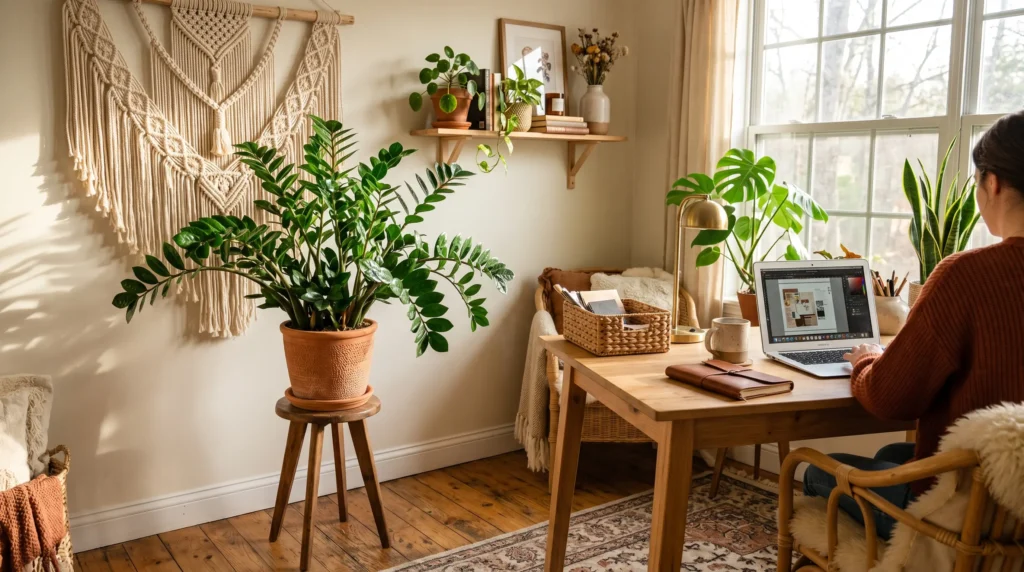
The ZZ plant frequently appears in design recommendations for home offices precisely because it is visually effective and requires negligible maintenance attention — it does its job without requiring yours.
Environmental Footprint of Care
- Extremely low water use compared to most tropical houseplants — watered every 1–6 weeks rather than weekly
- No pesticides needed under normal conditions
- No specialist grow lights required for the majority of UK placements
- Long-lived — a well-cared-for ZZ plant lasts 10+ years, reducing the environmental cost of repeated plant purchases
- Propagates easily from existing plants — one plant can produce many over its lifetime
ZZ Plant Benefits: Feng Shui and Cultural Meaning
In feng shui, the ZZ plant is associated with growth, steady progress, prosperity, and protective energy. It is considered auspicious when placed near the entrance of a home or in the south-eastern (wealth) corner. The plant’s common Chinese nickname — the ‘fortune tree’ or ‘money plant’ — reflects these associations.
Whether or not you subscribe to feng shui principles, the cultural significance of the ZZ plant in many traditions adds an interesting dimension that makes it a popular gift for new homes, offices, and milestone occasions. It is one of the most-gifted houseplants in the UK for exactly this reason
Where Is the Best Place to Put a ZZ Plant in a UK Home?
The best place for a ZZ plant in a UK home is any warm, reasonably lit room away from direct sunlight, draughts, and radiators. The plant’s architectural upright form, glossy dark leaves, and self-sufficient nature make it equally suited to living rooms, home offices, bedrooms, bathrooms, and hallways — provided the temperature stays above 15°C throughout winter.
Room-by-Room Placement Guide
| Room | Suitability | Best Position | What Works Well | What to Avoid |
|---|---|---|---|---|
| Living room | Excellent | Corner near (but not in) window; as a floor statement plant | “Monstera deliciosa: the large, perforated leaves create a dramatic contrast with the ZZ plant’s neat, pinnate stems — popular in open-plan UK living rooms” | Direct south-facing sun through unfiltered glass |
| Home office | Excellent | Desk edge; nearby shelf; on the floor beside desk | Zenzi (compact) for desks; Classic for floor; thrives under LED task lighting | Placing directly in front of a window where screen glare reflects |
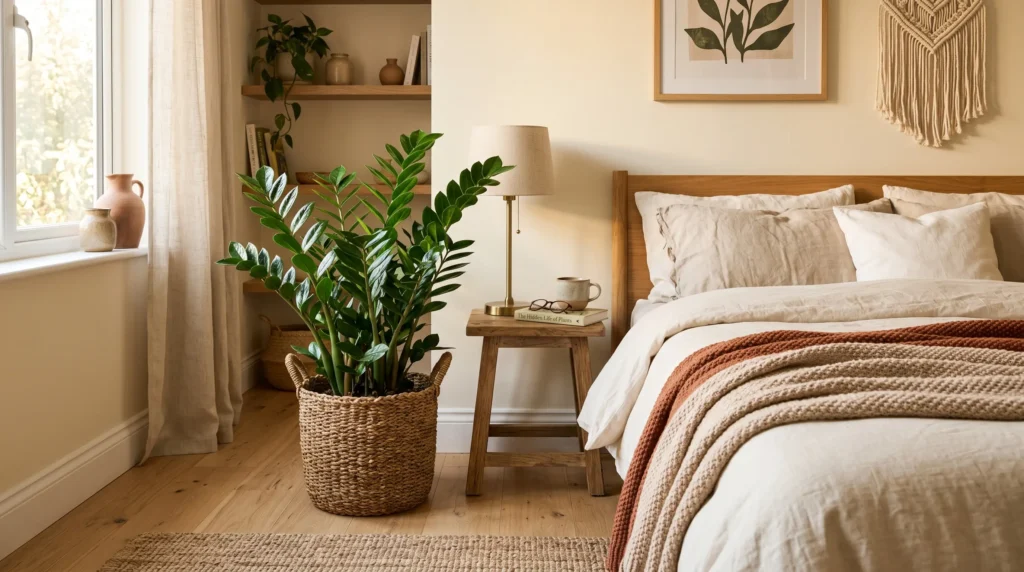
| Bedroom | Good | North or east windowsill; bedside table (Zenzi); chest of drawers | CAM metabolism means CO2 absorption at night; not competing for oxygen | Cold windowsills below 15°C in January/February |
| Hallway/entrance | Good if warm | Console table; tall plant stand as statement welcome piece | Classic ZZ on a tall stand creates an elegant entrance in UK homes | Cold draughty hallways below 15°C — move in winter |
| Bathroom | Good | Well-lit spot; on top of cabinet; near (not in) window | Handles steam and humidity variations; interesting in all-white bathroom spaces | Completely dark bathrooms; very low light means very slow growth |
| Kitchen | Moderate | Away from cooking fumes; on worktop or shelving in brighter area | Adds greenery to functional spaces without high-maintenance care | Near hob — cooking steam and fumes damage leaves over time |
| Conservatory | Caution | 1.5 m from glass; use sheer blinds on south/west-facing glass | Beautiful light levels for growth | Direct glass-magnified sun in summer (can exceed 35°C); cold in winter — bring inside |
Interior Styling: How to Display a ZZ Plant in UK Interiors
Pot and Container Choices
- Matte terracotta or concrete pots: the natural, earthy tones complement the ZZ plant’s glossy leaves and suit the neutral palettes popular in UK interiors (Farrow & Ball whites, warm greys)
- Brushed stone or rattan cachepots: popular in UK biophilic interior design; pair well with both Classic and Raven varieties
- Black or charcoal pots: particularly striking with the Raven ZZ plant — echoes the near-black foliage for a cohesive, moody look
- Do not use pots without drainage holes as the permanent pot — always use a cachepot system if the decorative pot lacks drainage
Pairing with Other Plants
- Monstera deliciosa: the large, perforated leaves create a dramatic contrast with the ZZ plant’s neat, pinnate stems — popular in open-plan UK living rooms
- Pothos (Epipremnum aureum): trailing vines alongside an upright ZZ create a layered indoor garden look popular in UK interior design
- Sansevieria (snake plant): a similar low-maintenance profile and architectural form; the two plants together create a cohesive ‘easy care’ display
- “Rubber plant (Ficus elastica): another glossy-leaved, architectural plant that pairs naturally with the ZZ in height and form”
Styling for Specific UK Interior Trends
| UK Interior Style | Recommended Variety | Best Pot | Key Tip |
|---|---|---|---|
| Scandi minimalism | Classic ZZ | White or pale concrete; clean lines | Single plant as a statement; lots of negative space around it |
| Maximalist jungle | Classic ZZ (large) | Wicker basket; terracotta | Group with 5–8 other plants; floor-level placement |
| Moody/dark interiors | Raven ZZ | Matte black ceramic | Against dark walls (Hague Blue, Railings colour tones) |
| Modern minimalist | Zenzi ZZ (compact) | Brushed stone or grey concrete | On a floating shelf; minimal surrounding objects |
| Traditional/country | Classic ZZ | Glazed cream or antique terracotta | Pair with dried flowers; wood surfaces |
Where to Buy a ZZ Plant in the UK — 2026 Buying Guide
Where Can I Buy a ZZ Plant in the UK?
ZZ plants are widely available across the UK from garden centres, supermarkets, DIY chains, and specialist online plant retailers. Classic ZZ plants can be found at virtually any garden centre and many supermarkets. Rarer varieties (Raven, Zenzi, Variegated) are more reliably sourced from specialist online retailers or through independent plant shops and Etsy sellers.
UK ZZ Plant Retailers: Pros and Cons
| Retailer Type | Examples | Varieties Available | Typical Price | Pros | Cons |
|---|---|---|---|---|---|
| High-street garden centres | Dobbies, Blue Diamond, British Garden Centres | Classic; occasionally Raven | £8–£20 | Inspect before purchase; no delivery risk; instant | Limited variety; seasonal stock |
| Supermarkets | Waitrose, M&S, Sainsbury’s | Classic only | £5–£15 | Very convenient; low price | Small plants; no care advice; variable quality |
| DIY and home stores | B&Q, IKEA, Homebase | Classic; occasionally Raven (IKEA) | £6–£18 | Nationwide access; affordable | Variable quality; limited variety selection |
| Specialist online plant retailers | Patch Plants, The Stem, Hortology, Beards and Daisies, Happy Houseplants | Classic, Raven, Zenzi; sometimes Variegated | £12–£45 | Best plant health; full variety range; care guides included; reliable delivery | Postage cost; winter delivery risk |
| Independent plant shops | Check local independent florists and plant shops | Varies | £12–£30 | Support local business; often higher-quality plants; knowledgeable staff | Limited nationwide availability |
| Online marketplaces | Etsy (independent plant sellers) | All varieties including Variegated | £10–£150+ | Best source for rare varieties; competitive pricing | Variable quality; check seller reviews carefully |
| RHS Plant Finder | rhs.org.uk/plants/search | All registered varieties | Varies by nursery | Highest horticultural authority in the UK; links to registered nurseries near you | May require self-collection from nursery |
 What to Look for When Buying a ZZ Plant
Whether buying in person or online, use this checklist to assess the quality of any ZZ plant before purchasing:
Signs of a Healthy ZZ Plant to Buy
- Firm, glossy leaves with uniform deep-green colour — no yellowing, browning, or pale patches
- Upright, well-branched stems with leaves closely packed (not leggy or sparse)
- Visible or slightly raised rhizomes in the compost — indicates an established, well-developed root system
- Compost that is barely moist or dry — not sitting in saturated compost at the point of sale
- No signs of pests: check leaf undersides for webbing (spider mites), white fluff (mealybugs), or brown bumps (scale)
- Clean, undamaged pot with no root emerging from drainage holes (unless pot-bound and clearly mature)
Signs to Avoid
- Yellow lower leaves — may indicate overwatering in storage
- Soggy, saturated compost — a common issue with mass-retail plants that have been overwatered
- Leggy, thin stems reaching desperately towards the light — indicates poor storage lighting
- Any visible pest damage — isolating and treating is possible, but buying pest-free is better
Buying Online in Winter: UK-Specific Advice
- Check whether the online retailer offers heat-pack shipping from October to March — this is essential for plant health during UK winter postal delivery
- Avoid ordering tropical plants during extreme cold snaps (below 0°C forecast) — even well-packaged plants can suffer cold damage in transit
- Most reputable UK plant retailers have a short-period guarantee — read the returns policy before purchasing
Frequently Asked Questions About ZZ Plants (UK)
Q: How often should I water my ZZ plant in the UK?
Water your ZZ plant every 1–2 weeks in summer (May to August) and every 4–6 weeks in winter (November to February). Do not water on a fixed schedule — always check first by pushing your finger 4–5 cm into the compost. If any moisture is felt, wait. Overwatering is the most common cause of ZZ plant death in UK homes.
Q: Why are my ZZ plant leaves turning yellow?
Yellow leaves on a ZZ plant are most commonly caused by overwatering. Check the compost immediately: if it is wet or damp, stop watering and allow it to dry completely. If the compost is bone dry, underwatering or very low light may be the cause. Yellow leaves on the lowest, oldest part of the plant only — not spreading upward — is normal ageing and not a concern.
Q: Is a ZZ plant toxic to cats and dogs?
Yes, the ZZ plant is mildly toxic to cats and dogs if ingested. All parts of the plant contain calcium oxalate crystals, which cause mouth irritation, drooling, and vomiting. The ZZ plant is not fatally poisonous — it is an irritant rather than a systemic poison — but you should contact a vet if your pet has eaten any part of the plant and symptoms persist beyond one hour. Place the plant out of reach of pets.
Q: Can a ZZ plant survive in a north-facing room in the UK?
Yes — the ZZ plant is one of the very few genuinely attractive houseplants that thrives in north-facing rooms in the UK. It tolerates light levels as low as 50 lux, which is the ambient light typical in a north-facing room. Growth will be slower than in a brighter position, but the plant will remain healthy. In very dark north-facing rooms, reduce watering frequency as the compost dries more slowly.
Q: How big does a ZZ plant grow indoors in the UK?
In typical UK indoor conditions, a ZZ plant grows to 60–90 cm tall. Under ideal conditions — bright indirect light, regular feeding during the growing season, and annual repotting when needed — specimens can reach 1–1.5 m over several years. Growth is slow: expect 2–4 new stems per year in a well-cared-for plant.
Q: Does a ZZ plant purify the air?
Yes — research supports that ZZ plants remove volatile organic compounds (VOCs) from indoor air, including benzene, toluene, ethylbenzene, and xylene. A 2014 University of Copenhagen study confirmed the mechanism. However, the effect of a single ZZ plant in a typical UK room is modest.
Q: How do I know if I am overwatering my ZZ plant?
The clearest signs of overwatering are soft, squishy stems at the base (press gently — they should feel firm), yellow leaves that fall off easily, and wet or soggy compost when you push your finger 4–5 cm in. A foul, musty smell from the compost indicates root rot is likely underway. If you suspect overwatering: remove the plant from its pot, inspect the rhizomes, cut away any soft brown material, repot into fresh dry cactus mix, and do not water for 7–10 days.
Q: How do I propagate a ZZ plant?
The easiest propagation method is rhizome division at repotting time (April–May): separate the rhizome clusters, ensure each has at least one stem, and pot individually into cactus/perlite mix. Stem cuttings placed in water root in 4–8 weeks and can then be potted.. All methods work best during the UK growing season (May to August).
Q: Can I put a ZZ plant in my bathroom?
Yes, provided the bathroom is warm enough (above 15°C year-round) and receives some natural or artificial light. The ZZ plant handles bathroom steam and humidity variation well. Avoid completely dark bathrooms — the plant needs some light to function, even if growth will be very slow. A well-lit bathroom with a north or east-facing window is ideal.
Q: Why is my ZZ plant not growing?
In winter (October to March), ZZ plants naturally slow or stop growing due to reduced UK light levels — this is normal and requires no action. In summer, the most common reasons for no growth are: insufficient light , being pot-bound (rhizomes have run out of space), or not feeding during the growing season. Resume monthly feeding from May and move to a brighter indirect light position if growth remains absent through summer.
Q: What is the best soil for a ZZ plant in the UK?
ZZ plants need free-draining compost. The best option is a ready-made cactus/succulent potting mix or a mix of 60% peat-free houseplant compost and 40% perlite. Standard multipurpose compost alone retains too much moisture and increases root rot risk. The compost must allow water to drain rapidly and dry out fully between waterings.
Q: Do ZZ plants need feeding?
ZZ plants benefit from monthly feeding during the UK growing season (May to August) using a balanced liquid houseplant fertiliser at half the recommended strength. Do not feed from September through April — the plant is resting and cannot process nutrients, and over-fertilisation causes salt burn in the compost. Less feeding is better than more for this plant.
Conclusion: The ZZ Plant — The One That Earns Its Place
The ZZ plant does not ask for much. It does not demand south-facing sunlight, weekly misting, or the constant attention that so many popular tropical houseplants require. What it asks for is simple: reasonably warm temperatures, good drainage, and the discipline not to overwater it.
In return, it offers genuine beauty — the kind that improves over time as each growing season adds new stems and the plant takes on its characteristic sculptural form. It offers resilience through UK winters, through holidays, through the inevitable weeks when plant care falls to the bottom of the priority list.
This guide has covered everything needed to keep a ZZ plant thriving in UK conditions: its biology and why it works; how to care for it across all four UK seasons; how to diagnose and fix every common problem; how to propagate it; how to handle the toxicity question with pets and children; and where to buy one in the UK, from Waitrose and B&Q to specialist online retailers.
The rest is straightforward. Buy the plant. Find it a warm room with reasonable light. Water it when the compost is completely dry. Do that, and the ZZ plant will reward you with years of effortless, glossy, architectural beauty.
for more guide you can also check this source happy house plant

Leave a Reply