
Anthurium plant care UK beginners need is simple once you understand humidity and light . Anthuriums are tropical flowering plants from Central and South America , grown in UK homes for their bold , waxy , heart shaped spathes in red , pink , white , and purple .
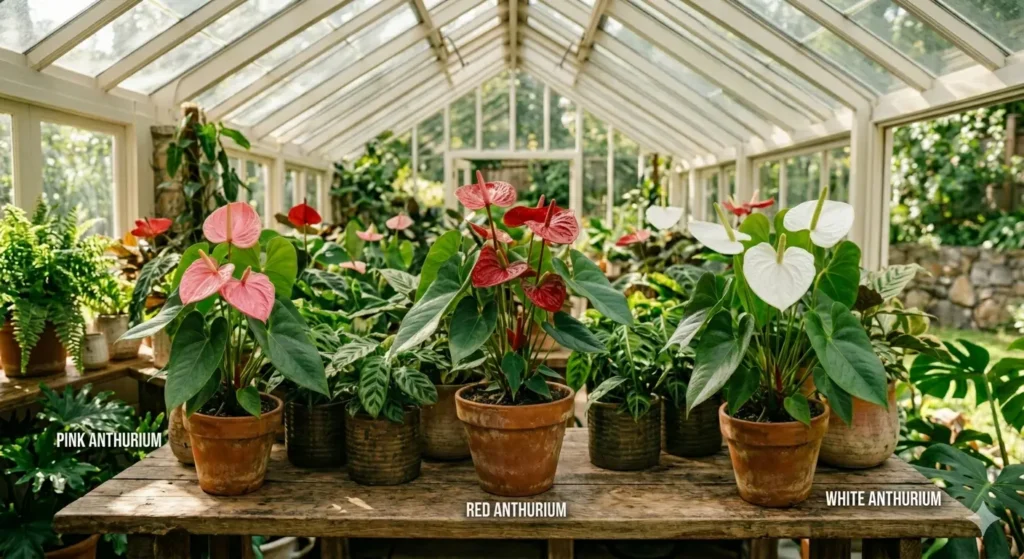
What Is an Anthurium? Origins, Botany & Fascinating Facts
Anthurium is a genus of over 1,000 tropical flowering plants in the Araceae (arum) family, native to Central and South America.
They are grown as houseplants in the UK for their striking waxy spathes — often mistaken for petals and for their lush, often velvety foliage. The most popular type in UK homes is Anthurium andraeanum, the flamingo flower, valued for its glossy heart-shaped spathes in red, pink, or white that bloom for 6–8 weeks at a time.
Botanical Identity
Family: Araceae — the arum family. Close relatives include Monstera, Peace Lily (Spathiphyllum), and Swiss Cheese Plant.
Genus: Anthurium — the largest genus in the entire arum family, with over 1,000 confirmed species.
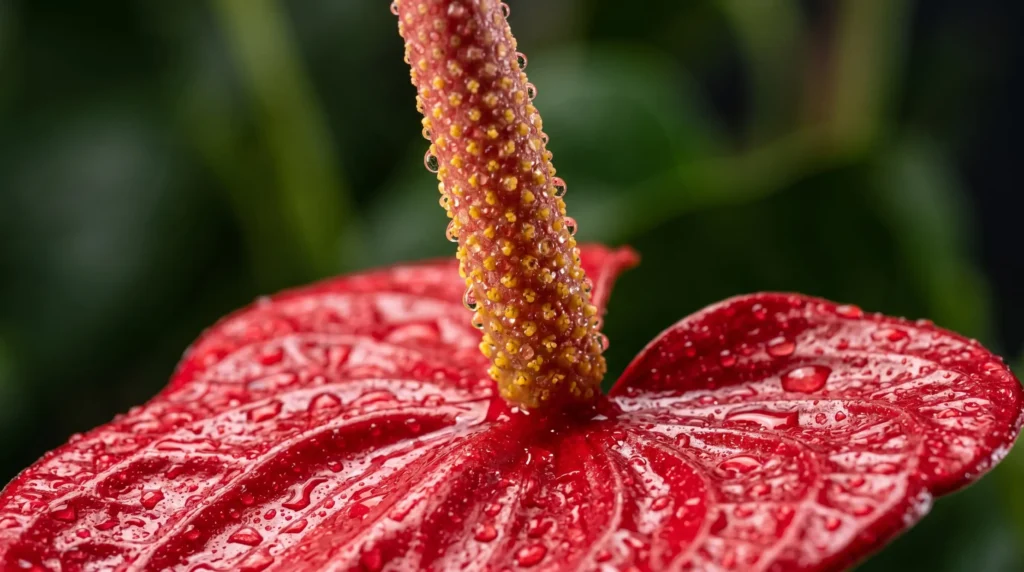
Name origin: From the Greek anthos (flower) + oura (tail), meaning “tail flower.” Refers to the spadix — the central spike — not the showy coloured spathe.
Common UK names: Flamingo Flower, Flamingo Lily, Laceleaf, Painter’s Palette, Tailflower, Boy Flower.
First formally described: 1829, by Austrian botanist Heinrich Wilhelm Schott.
Key moment: Austrian explorer Karl von Scherzer found Anthurium scherzerianum in Colombia in the 1850s. By 1860, 183 anthurium varieties had been recorded by Western botanists.
Where Do Anthuriums Come From?
Native range: Tropical Americas — Colombia, Ecuador, Venezuela, Central America, Mexico south to northern Argentina, and parts of the Caribbean.
Natural habitat: Rainforest floor and tree canopy, as epiphytes — plants growing attached to tree crevices rather than in soil. Their roots are exposed to air, rain, and rapid drainage.
Why this matters for UK growers: Because anthuriums evolved with free-draining, airy roots, they are catastrophically intolerant of dense, waterlogged compost. Standard houseplant compost — used for most UK houseplants — is often too moisture-retentive for anthuriums. This single fact explains the majority of anthurium failures in British homes.
How Anthuriums Reached Europe and the UK
- Late 1800s: Dutch traders brought anthurium cuttings from South America to Europe, beginning the commercial trade.
- Hawaii: Samuel Damon introduced A. andraeanum to Hawaii in the late 1800s, sparking an entirely new commercial cut-flower industry.
- 1940s: Anthuriums became a tourist icon and global cut-flower commodity, primarily exported through Hawaiian plantations.
- Today: The Netherlands is the world’s largest commercial producer. The UK imports millions of anthurium plants annually — and demand for rare collector varieties has surged since 2020.
Anthurium Anatomy — Busting the “Flower” Myth
The most common anthurium misconception: the waxy, coloured, heart-shaped part is NOT the flower.
| Part | What It Is | Description |
| Spathe | Modified leaf (bract) | The large, waxy, coloured “petal-like” structure most people call the flower. Available in red, pink, white, orange, green, purple, burgundy, and near-black. |
| Spadix | True flower structure | The central finger-like spike. Covered in hundreds of tiny true flowers — the plant’s actual reproductive organs. Where pollination occurs. |
Key bloom facts:
- Each spathe lasts 6–8 weeks before fading or turning green
- Between bloom cycles, plants take a rest period of up to 3 months — this is normal, not illness
- The spadix produces pollen when the plant is ready to pollinate — it becomes sticky and may dust nearby surfaces
Types : A UK Buyer’s Variety Guide
Anthuriums divide into two major categories: flowering anthuriums (grown for colourful spathes) and foliage anthuriums (grown for dramatic leaves). Flowering types suit beginners, gifting, and most UK homes. Foliage types appeal to collectors and aroid enthusiasts.
Flowering Anthuriums — Best for Beginners and Gifting
| Variety | Spathe Colour | Difficulty | Best For |
| A. andraeanum ‘Red Champion’ | Classic scarlet red | ★★★★★ Very Easy | Beginners, gifting, offices |
| A. andraeanum ‘White’ | Pure white | ★★★★★ Very Easy | Weddings, minimalist interiors |
| A. andraeanum ‘Pink’ (Spirit, Lilli) | Blush to coral pink | ★★★★★ Very Easy | Mother’s Day, gifting |
| A. andraeanum ‘Purple’ / ‘Miss June’ | Deep violet | ★★★★☆ Easy | Collectors, bold interiors |
| A. scherzerianum | Orange-red, curled spadix | ★★★★☆ Easy | Compact spaces, windowsills |
Where to buy in the UK: Marks & Spencer, Waitrose, Sainsbury’s, IKEA, B&Q, Homebase, and Patch Plants.
UK price range: £8–£25 for standard cultivars.
Foliage Anthuriums — The Collector’s World
Since 2020, the UK has seen a dramatic surge in demand for foliage anthuriums — plants grown not for spathes but for extraordinary leaves: velvety textures, dramatic ribbing, silver veining, and sizes ranging from compact to well over a metre.
Beginner-Friendly Foliage Types
Anthurium clarinervium — The most popular foliage anthurium in UK searches. Heart-shaped, velvety dark-green leaves with striking silver-white veining. Tolerates typical UK indoor conditions. A good first foliage anthurium. UK price: £15–£40.
Anthurium crystallinum — Similar velvety texture, slightly larger leaves, equally forgiving. An excellent choice for anyone ready to move beyond flowering types.
Intermediate Types
Anthurium magnificum — Large, bullate (blistered-texture) leaves with bold veining. Requires consistent humidity of 60%+. Best for growers who already have a humidifier. UK price: £40–£100.
Anthurium forgetii — Distinguished by no sinus — the leaf forms a complete circle at the base rather than the typical notch. Distinctive collector’s plant.
Advanced and Collector-Grade Types
Anthurium warocqueanum (Queen Anthurium) — One of the most coveted houseplants in the UK. Mature specimens produce pendant velvet leaves exceeding 1 metre. Demands 70%+ humidity. UK price: £100–£300+.
Anthurium veitchii (King Anthurium) — Dramatically ribbed pendant leaves. Strong UK demand. Requires consistent warmth and humidity. UK price: £80–£250+.
Anthurium regale — Among the most sought-after aroids worldwide. Enormous velvety leaves with bold venation. Requires dedicated humidity and temperature control. UK price: £200–£500+.
Anthurium luxurians — Deep, bullate, architecturally dramatic leaves.
Strap-Leaf Types (Trending in UK 2025)
Anthurium wendlingeri — Long pendant strap-like leaves with distinctive spiral spadices. A GrowTropicals bestseller for 2025. Ideal for high shelves or hanging positions.
Anthurium vittarifolium — Narrow strap-leaves with architectural elegance. Ideal as a hanging specimen.
Anthurium padiflorum — Described by UK specialists as “genuinely interesting to grow.” A refined strap-leaf collector’s plant.
Notable Hybrids
- A. crystallinum × luxurians — combines velvet texture with bullate patterning
- A. magnificum × luxurians — popular UK collector hybrid
- DocBlock Anthurium Michelle — UK-launched hybrid by GrowTropicals and TerraBotanical.
UK Price Summary
| Tier | Examples | Price Range |
| Beginner foliage | A. clarinervium, A. crystallinum | £15–£40 |
| Intermediate | A. magnificum, A. forgetii | £40–£100 |
| Collector-grade | A. warocqueanum, A. veitchii, A. regale | £100–£500+ |
Anthurium Care — The Complete UK Guide
How do you care for an anthurium in the UK?
Anthuriums need bright indirect light, infrequent but thorough watering, humidity above 50%, temperatures between 18–27°C, and a free-draining chunky substrate — not standard houseplant compost.
All care below is calibrated for British homes, British seasons, and British tap water.
Light Requirements
Ideal: Bright, indirect light. North-facing or east-facing windowsills are typically ideal in UK homes.
UK winter light problem: British November–February brings dramatically reduced daylight hours and intensity. Many UK homes — even south-facing rooms — do not provide enough light for anthuriums to flower or maintain healthy growth in winter.
Solution: Supplemental grow lights (Soltech, Sansi) positioned 30–50cm above the plant, running 12–14 hours per day through winter months.
| Symptom | Cause |
| Reduced flowering, pale leaves, slow growth | Too little light |
| Yellow washed-out patches on leaves | Too much direct light |
| Brown scorched patches on spathes | Direct summer sun through glass |
Watering — The Most Important Care Factor
Golden rule: Water when the top 3–5cm of the substrate feels dry to the touch — never on a fixed schedule.
| Season | Frequency | Notes |
| Spring (March–May) | Every 5–7 days | Growth picks up — increase water gradually |
| Summer (June–August) | Every 5–7 days | Peak growth; monitor soil closely in heat |
| Autumn (September–October) | Every 7–10 days | Reduce as light drops |
| Winter (November–February) | Every 10–14 days | Roots need much less — most common overwatering risk |
UK Tap Water Warning: In hard water areas — London, South East, Midlands, parts of Yorkshire — tap water is alkaline and high in calcium. Over time this raises soil pH and causes white mineral deposits on leaves. Use rainwater, filtered water, or water left standing at room temperature for 24 hours before watering.
Overwatering is the number one killer of anthuriums in UK homes.
- Signs: yellowing lower leaves, mushy stem base, soggy soil after 10+ days, sour or rotten smell from compost
- Method: Water thoroughly until water drains from the bottom. Empty the saucer within 30 minutes — anthuriums cannot sit in standing water.
Humidity — The UK Home Challenge
Target: 60–80% for foliage anthuriums; 50–60% acceptable for flowering types.
UK problem: British homes with central heating typically reach 30–40% humidity in winter — far below anthurium requirements.
UK Humidity Solutions — Step by Step:
- Pebble tray: Place plant pot on a tray filled with pebbles and water. As water evaporates it raises local humidity. Ensure pot sits above the waterline.
- Plant grouping: Cluster several plants together. Collective transpiration raises humidity in the immediate area — free and effective.
- Bathroom placement: A well-lit bathroom is often the single best room in a UK home for anthuriums. Steam from showers provides regular humidity boosts.
- Room humidifier: The most reliable method. Aim for 60%+ in the plant’s immediate area. Monitor with a hygrometer.
- Misting: Use lukewarm, soft, or filtered water. Mist leaves in the morning. On flowering anthuriums, avoid misting the spathe — water droplets cause permanent spotting.
Temperature
Ideal range: 18–27°C — consistent with most UK centrally heated living rooms.
Minimum: 15°C. Cold draughts are lethal to anthuriums, even briefly.
UK-specific temperature risks:
- Cold windowsills in winter: Glass conducts cold. On frosty nights, move plants away from windows when outside temperatures drop below 5°C.
- Temperature fluctuations near doors: Avoid hallways with exterior doors — anthuriums dislike sudden temperature swings.
- Not outdoor-hardy in the UK: Frost will kill anthuriums within hours. Not suitable for year-round outdoor growing anywhere in the British Isles.
- Summer outdoor use: June–August only, in a sheltered shaded spot, when temperatures reliably stay above 18°C overnight.
Soil and Potting Mix
Anthuriums are epiphytes — they need a chunky, free-draining substrate, not standard houseplant compost.
| Mix | Components | Notes |
| Best mix | Orchid bark + perlite + sphagnum moss (equal thirds) | Excellent drainage, humidity retention, root aeration |
| Easy alternative | Shop-bought orchid compost mixed 1:1 with perlite | More accessible; works well for most flowering types |
| Collector mix | Orchid bark + perlite + coco coir + coarse horticultural grit | Maximum drainage for velvet-leaf species |
Target soil pH: Slightly acidic — 5.5 to 6.5.
UK peat-free note: Many UK composts are now peat-free. Peat-free blends vary widely in drainage quality. Always add perlite and bark to any peat-free compost before using with anthuriums.
Feeding
Growing season (March–September): Feed monthly with diluted liquid fertiliser.
- Balanced liquid houseplant food (20-20-20) at half strength — suitable for foliage types
- Tomato feed (high potash) at quarter strength — encourages spathe production in flowering types
- Specialist orchid feed — ideal for most anthurium types; formulated for epiphytes
- For maximum blooming: use a higher-phosphorus fertiliser (higher middle number) in late winter and early spring
Dormant season (October–February): Stop or drastically reduce feeding. UK light levels are too low for effective nutrient processing. Overfeeding in winter causes salt build-up and root damage.
Repotting
How often: Every 2–3 years, or when roots visibly circle the pot base or emerge from drainage holes.
Best time in the UK: Spring — March or April.
How to repot an anthurium — step by step:
- Water the plant 24 hours before repotting to reduce transplant stress.
- Choose a pot 1–2 inches larger than the current one. Avoid going too large — excess soil stays wet and causes rot.
- Ensure the new pot has drainage holes.
- Fill the base with your chunky anthurium mix.
- Remove the plant carefully, shake off old compost, and inspect roots. Trim any brown or mushy roots with sterile scissors.
- Position the plant so the base sits at the same depth as before. Fill around it with fresh mix and firm gently.
- Water lightly and keep in a slightly warmer, more humid spot for 2–3 weeks while new roots establish.
How to Get an Anthurium to Flower Again
Why isn’t my anthurium flowering?
An anthurium that isn’t flowering is almost always experiencing one of five problems: insufficient light, temperatures below 15°C, chronic low humidity, nitrogen-heavy overfeeding, or root-binding.
The natural bloom cycle: each spathe lasts 6–8 weeks, after which the plant enters a rest period of up to 3 months. This rest is completely normal. Problems arise when the plant completes its rest but still fails to produce new spathes.
UK-specific reasons anthuriums stop flowering:
- Insufficient light — most common cause in the UK, especially November–February. A north-facing window in winter may provide only 2–3 hours of usable light per day.
- Too cold — temperatures below 15°C, common on UK windowsills in winter, suppress flowering.
- Low humidity — chronic dry air from central heating stresses the plant and redirects energy away from flower production.
- Nitrogen-heavy feeding — fertilisers high in nitrogen promote lush leaf growth at the expense of flowers.
- Root-bound plant — a severely pot-bound anthurium diverts all energy to root management and produces few or no spathes.
How to trigger re-flowering — step by step:
- Move to a brighter position, or introduce a grow light set to 12–14 hours per day.
- Ensure temperatures remain consistently above 18°C, day and night.
- In early autumn, reduce watering slightly for 4–6 weeks — this seasonal stress signal encourages the plant to prepare for flowering.
- Switch to a high-potash or high-phosphorus fertiliser in late winter and early spring (February–March).
- If the plant is root-bound, repot in spring into a pot 1–2 inches larger.
- Cut spent spathes at the base to redirect energy into new growth.
Propagating Anthuriums — Step-by-Step UK Guide
How do you propagate an anthurium in the UK?
Anthuriums can be propagated by division (easiest, best for beginners), stem cuttings (for mature plants), or tissue culture (available from UK specialist retailers). The key UK consideration is timing: propagation is far more likely to succeed in spring and early summer than in autumn or winter.
Easiest Method for UK Beginners
Best time: Spring, ideally combined with regular repotting.
Step-by-step:
- Water the plant 24 hours before to reduce stress.
- Remove the plant from its pot and gently shake off excess compost.
- Examine the base — look for separate crowns (individual stems emerging from distinct root sections).
- Gently tease apart root sections by hand. Use sterile scissors only where roots are tightly tangled.
- Each division must have at least one leaf and a set of healthy, white roots.
- Pot each division into its own container with fresh chunky mix. Water lightly.
- Place in a warm (18–22°C), humid spot with bright indirect light for 4–6 weeks while roots establish.
Stem Cuttings — For Mature or Climbing Plants
Best time in the UK: Spring or early summer (April–June). Do NOT attempt in autumn or winter.
UK warning: Do not attempt cuttings between October and February — UK light levels and temperatures make rooting success very unlikely.
Step-by-step:
- Identify a healthy mature stem — just above the soil where multiple leaf stalks emerge. This is not the individual leaf stalk (a very common mistake).
- Using sterilised scissors, cut just below a node (leaf joint). Aim for a cutting with 2+ leaves and visible aerial roots.
- Allow the cut end to callous for 30–60 minutes before rooting.
Option A — Water rooting (recommended for beginners): Stand the cut end in a jar of lukewarm filtered water in a bright warm spot (20–25°C). Change water every 3 days. Roots develop in 6–12 weeks. Transplant once roots reach 3–5cm.
Option B — Soil rooting: Dip cut end in rooting hormone powder. Insert into a small pot of moist orchid bark and perlite. Cover with a clear plastic bag. Place in a warm spot (20–25°C). Transplant once the cutting produces a new leaf.
Tissue Culture — For Serious UK Collectors
What it is: Laboratory-propagated clones grown in sterile agar gel — guaranteed disease-free, with known genetics and ethical sourcing.
Where to buy in the UK: GrowTropicals (growtropicals.com) is among the leading UK suppliers.
Acclimatising tissue culture plants:
- Remove from agar gel packaging and rinse roots gently in room-temperature water.
- Pot into a small container with sphagnum moss for the first 4–6 weeks.
- Place inside a clear propagation box to maintain near-100% humidity initially.
- Gradually reduce humidity over 4–6 weeks by adding ventilation holes, allowing the plant to adapt to normal indoor conditions.
Anthurium Problems — Diagnosis & UK Troubleshooting Guide
How do I diagnose problems with my anthurium?
Most anthurium problems in British homes come down to four causes: overwatering in winter, insufficient humidity from central heating, hard tap water mineral build-up, or insufficient light in the darker months. Match your plant’s symptoms below.
Leaf Problem Diagnosis Table
| Symptom | Most Likely Cause | UK Context | Fix |
| Yellow leaves (lower) | Overwatering / root rot | Very common in UK winters | Let dry; check and treat roots |
| Brown leaf tips | Low humidity | Central heating Nov–Mar | Pebble tray + humidifier |
| Brown patches / scorching | Direct sunlight | South-facing windows in summer | Move away from glass |
| Pale, washed-out leaves | Too much light or nutrient deficiency | Over-bright spots | Move to indirect light; feed |
| Black or soft brown patches | Cold damage | Draughty UK windows in winter | Move plant; remove damaged leaves |
| White deposits on leaves | Hard water mineral build-up | London, SE, Midlands | Switch to rainwater; wipe leaves |
| Crispy or curling edges | Low humidity + dry heat | UK homes near radiators | Increase humidity; move away from heat |
Root Rot — Identification and Recovery
Signs of root rot: Yellowing leaves, mushy stem at the base, foul smell from the compost, roots that are brown or black and feel soft.
Root rot recovery — step by step:
- Remove the plant from its pot immediately.
- Examine all roots. Healthy roots are white or light tan and firm. Affected roots are brown/black and mushy.
- Using sterilised scissors, cut off all brown and black roots cleanly.
- Dust cut ends with cinnamon powder (natural antifungal, available in UK supermarkets) or horticultural sulphur.
- Repot into fresh, dry chunky anthurium mix in a clean pot.
- Do not water for 5–7 days after repotting.
- Keep warm (20°C+) with bright indirect light. Monitor closely.
Common Pests — UK Identification and Treatment
Spider mites: Fine webbing on leaf undersides; stippled, faded leaf surfaces. Thrive in dry UK centrally heated homes in winter. Fix: increase humidity; spray with diluted neem oil or insecticidal soap; isolate plant; repeat weekly for 4–6 weeks.
Mealybugs: White cottony clusters in leaf axils and where stalks meet the stem. Fix: dab with isopropyl alcohol on cotton wool; follow with neem oil spray; repeat weekly.
Thrips: Silver streaking on leaves; tiny fast-moving insects. Fix: sticky yellow insect traps; neem oil spray; systemic insecticide as last resort.
Scale insects: Brown crusty shell-like bumps on stems. Fix: scrape off manually; treat with diluted neem oil; repeat weekly.
UK Tip: Always quarantine new anthurium purchases for 2–4 weeks before placing them near your existing collection. Essential when buying from markets, plant fairs, or informal swaps.
Anthurium Toxicity & Safety — Essential Guide for UK Families and Pet Owners
Is anthurium toxic?
Yes — all parts of the anthurium plant are toxic to humans, cats, dogs, and other pets. No part of the plant is safe to ingest.
Toxic compounds: Calcium oxalate crystals (raphides) — microscopic needle-shaped crystals present throughout all anthurium tissue. On contact with soft tissue, they cause immediate and intense pain and irritation. Additional compounds include proteolytic enzymes and asparagine.
Toxicity to Cats and Dogs
Symptoms if ingested:
- Intense burning and irritation of the mouth, lips, and tongue
- Excessive drooling
- Pawing at the mouth or face
- Vomiting
- Difficulty swallowing or breathing in severe cases
Severity: Moderate — rarely fatal in small amounts but causes significant distress and requires prompt veterinary attention.
ASPCA classification: Listed as toxic to cats and dogs.
UK Action: If your pet ingests any part of an anthurium, contact your vet immediately or call the Animal Poison Line (UK): 01202 509000 — the UK’s specialist animal poison helpline.
Toxicity to Children
- If ingested: burning oral and throat irritation; can cause nausea, vomiting, and difficulty swallowing. Seek medical advice promptly.
- Sap contact with skin: can cause skin irritation, redness, and rash. Always wear gloves when repotting, pruning, or propagating.
- Sap in eyes: flush immediately with clean water for 15 minutes and seek medical attention.
Safe Placement and Non-Toxic Alternatives
- Place on high shelves out of reach of both children and climbing cats
- Avoid rooms where pets spend unsupervised time
- Do not place on floor-level plant stands in households with dogs or toddlers.
| Safe Non-Toxic Alternative | Notes |
| Calathea | Beautiful patterned foliage; completely non-toxic to cats, dogs, and children |
| Spider Plant (Chlorophytum) | Easy to grow; safe for all household members |
| Boston Fern | Excellent air purifier; non-toxic |
| Parlour Palm | Elegant; safe for all household members |
Where to Buy Anthuriums in the UK — Complete Buying Guide
Where can I buy anthuriums in the UK?
Anthuriums are available across a wide price and quality spectrum in the UK — from £8 supermarket plants to £500+ collector specimens from specialist retailers.
UK Supermarkets and DIY Stores — Flowering Anthuriums
Where: Marks & Spencer, Waitrose, Sainsbury’s, IKEA, B&Q, Homebase.
| Pros | Cons |
| Cheapest option (£8–£15) | Limited to A. andraeanum in red, white, or pink |
| Widely available across the UK | Plants often kept in poor store conditions |
| No delivery risk; inspect before buying | Frequently root-bound or pot-bound |
| Good for gifting and impulse purchase | Compost often too dense for long-term health |
What to look for in-store:
- Dark green, glossy leaves with no yellowing
- Upright spathes — not drooping or fully faded
- Visible new growth — a small emerging bud or spathe
- Moist but not soggy compost
- No signs of pests on undersides of leaves
Online Plant Retailers — Mid-Range Quality
Patch Plants (patchplants.com): Good quality named varieties with detailed care guides. UK delivery in specialist packaging. Reliable for beginners.
Bloombox Club: Curated houseplant selection with gifting focus and care support.
Crocus / Thompson & Morgan: RHS-linked retailers with a wider variety selection and reliable UK delivery.
UK Specialist Aroid Retailers — Rare and Collector Varieties
GrowTropicals (growtropicals.com): One of the UK’s largest anthurium collections — 400+ species and hybrids. 7-day live arrival guarantee. RHS Chelsea Gold Medal winner. The leading destination for rare UK anthurium purchases.
Odd Leaf Houseplants (oddleafhouseplants.co.uk): Focused on rare aroids with curated buyer’s guidance.
Canopy Plants / The Stem: Quality UK tropicals specialists with a good selection of mid-range to advanced varieties.
UK Plant Fairs, Shows, and Community Groups
- RHS Shows (Chelsea, Malvern Spring, Hampton Court): specialist sellers attend with rare and unusual varieties.
- UK Facebook groups: UK Anthurium Collectors, Aroid UK, and Tropical Plant Society UK — excellent for buying divisions, rare cuttings, and connecting with the collector community.
- Etsy UK: Many small-scale UK growers sell divisions and rooted cuttings at competitive prices.
What to Look for When Buying Anthuriums Online
- Dispatch day: Choose sellers who dispatch Monday–Wednesday. Plants sitting in a depot over the weekend frequently arrive in poor condition.
- Packaging: Reputable sellers use specialist tropical packaging — insulated boxes and heat packs in winter.
- Live arrival guarantee: Look for a minimum 7-day live arrival guarantee. GrowTropicals offers this as standard.
- Ethical sourcing: Always choose nursery-propagated or tissue-cultured plants. Never purchase wild-collected specimens.
UK Seasonal Buying Tip: The safest time to buy online is March–August. If buying rare anthuriums between November and February, ensure the seller offers specialist winter heat-pack packaging and expect a longer acclimatisation period.
Anthurium Meaning, Symbolism & UK Gifting Guide
What does an anthurium symbolise?
Anthuriums carry rich symbolic meanings — hospitality, love, abundance, perseverance, and happiness — that vary by colour and cultural context. Their long-lasting nature (months vs. days for cut flowers) makes them among the most meaningful plant gifts available.
Core Anthurium Symbolism
Hospitality: The heart-shaped spathe and welcoming appearance make the anthurium the classic “hospitality flower.” A traditional gift for housewarmings and new homes.
Love and passion: Red anthuriums are strongly associated with romantic love. In Greek mythology, Cupid’s arrows were said to be forged from anthurium.
Abundance and prosperity: In many Asian cultures and in feng shui practice, anthuriums are placed in homes and offices to attract wealth and positive energy.
Strength and perseverance: The anthurium’s capacity to bloom in varied conditions makes it a symbol of resilience and inner strength.
Happiness: The bright, long-lasting spathes and heart shape are associated across cultures with joy and good fortune.
Anthurium Colour Symbolism Guide
| Colour | Meaning | Best Gifting Occasion |
| Red | Passion, romantic love, desire | Valentine’s Day, anniversaries |
| Pink | Femininity, warmth, compassion | Mother’s Day, new baby, friendship |
| White | Purity, innocence, peace | Weddings, christenings, sympathy |
| Orange | Energy, enthusiasm, optimism | Housewarming, congratulations, new job |
| Purple / Dark | Mystery, luxury, sophistication | Birthdays, collector gifts |
| Green | Growth, harmony, renewal | New job, new home, health wishes |
When to Gift an Anthurium in the UK
Valentine’s Day: A red anthurium plant instead of cut roses. It lasts months, not days.
Mother’s Day: Pink anthurium is one of the UK’s most popular Mother’s Day plant gifts.
Housewarming: The anthurium’s core symbolism — hospitality and new beginnings — makes it the most apt housewarming plant gift.
Christmas: Red anthuriums alongside poinsettias are a UK seasonal tradition. They outlast the Christmas period and bring colour well into the new year.
Get well soon: Long-lasting, cheerful, and low maintenance — ideal for someone recovering.
New job or congratulations: Orange anthurium symbolises energy, optimism, and new beginnings.
Anthuriums in UK Interior Design — Styling Tips
How do anthuriums fit into UK home interiors in 2025?
Anthuriums are among the most versatile houseplants for UK interiors — equally at home in a minimalist Scandi flat, a maximalist jungle room, or a moody dark-toned living space. Their structural forms and long-lasting colour mean they do more visual work than most houseplants.
The 2025 UK Interior Trend: Moody Botanicals
The dominant UK interior trend in 2025 is “moody botanicals” — darker, richer plant palettes replacing the all-green urban jungle aesthetic. Foliage anthuriums are central to this trend:
- Anthurium warocqueanum, A. crystallinum, and velvet-leaf hybrids fit the moodier, deeper aesthetic perfectly
- Dark-spathed flowering anthuriums (deep burgundy, near-black) complement deep green, charcoal, and terracotta palettes dominating UK interiors
- Compact anthurium varieties remain ideal for the smaller living spaces typical of UK urban homes and flats
Where to Place Anthuriums in Your UK Home
Best rooms:
- Bright bathroom: Natural humidity from showers makes this the ideal anthurium environment in most UK homes.
- Kitchen: Often humid from cooking; bright in many UK kitchens if south- or east-facing.
- Bright living room: Away from direct radiator heat and door draughts; an east- or west-facing corner is ideal.
Avoid:
- North-facing rooms without supplemental grow lighting (insufficient light in winter)
- Draughty hallways with exterior doors
- Rooms that drop below 15°C — conservatories in winter, unheated rooms
10.3 UK Styling Ideas
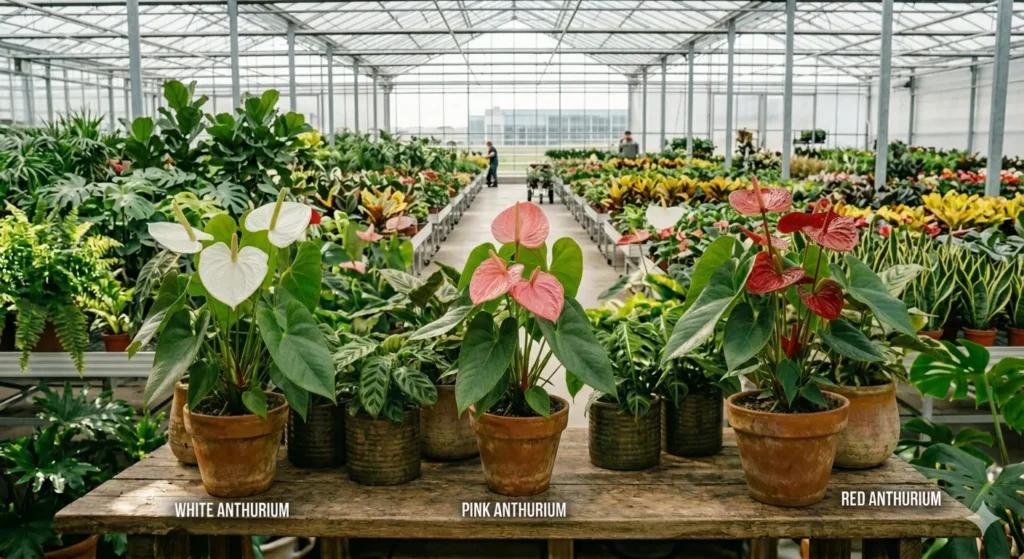
Statement plant: A single large A. andraeanum on a plant stand or sideboard. The spathe does the talking — no other decoration needed.
Layered tropical display: Pair flowering anthuriums with Monstera, Peace Lily, or Calathea for a classic urban jungle corner. Choose a bright east-facing windowsill with a humidifier nearby.
Architectural foliage: A A. clarinervium or A. magnificum in a terracotta pot against a white or pale grey wall — clean, architectural, and deeply satisfying.
Moody botanicals aesthetic: Pair A. crystallinum or A. magnificum with Begonia, ZZ Raven, and dark-leafed Alocasia. Use matte black or dark terracotta pots. Dramatic, contemporary, and perfectly aligned with where UK plant styling is heading in 2025.
Frequently Asked Questions
The following Q&A blocks are self-contained, definition-first answers designed to directly address common UK anthurium questions.
Q: How long do anthuriums live?
A: With proper care, anthuriums live for 5–10 years as houseplants in UK homes. Collector-grade specimens in ideal conditions can exceed that. The keys to longevity are avoiding root rot, maintaining adequate humidity year-round, and refreshing the compost every 2–3 years.
Q: Can I grow anthuriums outside in the UK?
A: Not year-round. UK winters are too cold and frosty. You can move anthuriums outdoors temporarily in summer — June through August — to a sheltered, shaded spot when temperatures reliably stay above 18°C overnight. Always bring them indoors before September.
Q: Why are my anthurium leaves turning yellow?
A: The most common cause in UK homes is overwatering, particularly in winter when the plant’s water requirements drop but many growers continue watering at the same frequency. Check for root rot first — if roots are brown and mushy, follow the root rot recovery guide in Section 6. Other causes include nutrient deficiency, very low light, or cold damage.
Q: How often should I water my anthurium in the UK?
A: In spring and summer, water approximately every 5–7 days when the top 3–5cm of compost feels dry. In autumn and winter, reduce to every 10–14 days. Always let the pot drain fully after watering — never leave it sitting in water. Use rainwater or filtered water in hard water areas.
Q: Why isn’t my anthurium flowering?
A: The most common UK causes are insufficient light (especially in winter), temperatures below 15°C, or imbalanced feeding. Move to a brighter spot or add a grow light set to 12–14 hours per day. Ensure temperatures stay consistently above 18°C. Switch to a high-potash feed in late winter. See Section 4 for the complete re-flowering guide.
Q: Is anthurium safe for cats and dogs?
A: No. Anthurium is toxic to cats, dogs, and humans if any part of the plant is ingested. It contains calcium oxalate crystals that cause intense oral burning and irritation. Keep out of reach of pets and children at all times. If your pet chews any part of an anthurium, contact your vet or the Animal Poison Line (UK): 01202 509000 immediately.
Q: What is the best soil mix for anthuriums in the UK?
A: Equal parts orchid bark, perlite, and sphagnum moss is the ideal mix. Avoid standard houseplant compost alone — it retains too much moisture and almost invariably causes root rot. UK peat-free composts should always be amended with perlite and bark before use with anthuriums.
Q: What is the difference between a spathe and a spadix?
A: The spathe is the large, waxy, heart-shaped “petal” — it is actually a modified leaf (bract), not a true flower. The spadix is the central finger-like spike that bears the plant’s true flowers — tiny reproductive structures covering its surface. When most people say “the anthurium flower,” they mean the spathe.
Q: Where can I buy rare anthuriums in the UK?
A: GrowTropicals (growtropicals.com) offers one of the largest collections of rare anthurium species and hybrids in the UK, with a 7-day live arrival guarantee. Odd Leaf Houseplants, Etsy UK sellers, RHS flower shows, and UK anthurium collector groups on Facebook are also excellent sources. Always verify ethical sourcing — choose nursery-propagated or tissue-cultured plants.
Q: Do anthuriums purify the air?
A: Yes. NASA’s Clean Air Study identified anthuriums as effective at filtering formaldehyde, xylene, toluene, and ammonia from indoor air. While the scale of purification in a typical room requires multiple plants, anthuriums are among the better-performing houseplants for air quality — a practical as well as beautiful addition to UK homes and offices.
Conclusion
Anthuriums are not difficult plants — they simply need you to understand where they come from and what British conditions demand of them. A plant evolved for steamy South American rainforest canopies needs chunky, free-draining compost (not dense houseplant mix), higher humidity than most UK central heating provides (not the 30% your living room hits in January), and consistent warmth (not the cold draught from a gap in your sash window).
Once those fundamentals are in place, anthuriums are among the most rewarding houseplants you can grow in the UK. Flowering types give 6–8 weeks of colour from each spathe — significantly longer than almost any cut flower. Foliage types develop in ways that make them a genuinely living art object. And across both categories, the range available to UK buyers in 2025 — from a £9 red anthurium in M&S to a £400 Anthurium regale from a specialist nursery — means there is an anthurium for every level of experience and every budget.
Bookmark this guide, come back to it when you encounter your first yellow leaf or your plant’s first rest period, and remember: most anthurium problems in the UK boil down to too much water, too little humidity, or too little light. Solve those three things and the plant will do the rest.
For a deeper look into Anthurium care, varieties, and growing tips, check out this expert resource.

Leave a Reply