
The monstera (Monstera Deliciosa), also called the Swiss Cheese Plant, is a tropical houseplant native to Central American rainforests. In UK homes, it needs bright indirect light, watering when the top 2–5 cm of soil is dry, temperatures between 18–27°C, and feeding monthly from May to August. It is toxic to cats, dogs, and humans if ingested as compared to succulent plant.
Table of Contents
- Introduction: Why the monstera Is the UK’s favorite Statement Plant
- Quick-Reference Care Table
- What Is a monstera? Origin & Botany
- Monstera Varieties: The Complete UK Guide
- Monstera Care in the UK: The Complete Seasonal Guide
- Monstera Troubleshooting: Diagnosing & Fixing Every Problem
- How to Propagate Monstera in the UK
- Where to Buy Monstera in the UK
- Monstera Styling in UK Homes
- Frequently Asked Questions
- Conclusion & Next Steps
Why the monstera Is the UK’s Favorite Statement Plant
Picture the average British living room of 1975: a wide-leafed, glossy green plant in the corner, its dramatic split leaves catching the lamplight. The monstera had arrived. Then, quietly, it disappeared — swept out in the minimalist wave of the 1990s and early 2000s. And now? It’s back with a vengeance.
The monstera has become the defining houseplant of the 2020s in the UK. The National Garden Bureau declared 2025 the Year of the monstera, and it is not difficult to see why: scroll through any UK interior design feed on Instagram or Pinterest and you will find its iconic fenestrated leaves in virtually every other flat lay. Independent florists stock it. IKEA sells it for £10.
What makes the monstera so well-suited to British homes specifically? It tolerates the lower natural light levels common in north-facing UK rooms. It copes with the dry air produced by central heating. It is forgiving of the slightly erratic watering habits most of us are guilty of over winter. And it makes an unmistakable design statement in the typically modest proportions of a Victorian terrace or a modern city flat.
This guide covers everything you need to grow a thriving monstera in the UK: all the major varieties and what they cost, a complete UK-contextualized care guide (including what to do when the days get short in November), how to troubleshoot every problem from yellow leaves to root rot, how to propagate new plants for free, where to buy in Britain, and how to style your plant for maximum impact. No US-centric advice, no generic tips copied from a seed packet. Just honest, practical guidance written for British homes and British conditions.
Quick-Reference Care Table — monstera at a Glance
| Requirement | |
|---|---|
| Common Names | Swiss Cheese Plant, Split-Leaf Philodendron |
| Scientific Name | monstera deliciosa |
| Origin | Tropical rainforests of Central America (Mexico to Panama) |
| Light | Bright indirect light; tolerates medium light in north-facing rooms |
| Watering | When top 2–5 cm of soil is dry (roughly every 7–10 days in summer; 14–21 days in winter) |
| Humidity | 50–60%+ ideal; tolerates UK indoor average (30–50%) |
| Temperature | 18–27°C; avoid below 12°C |
| Soil | Free-draining, peat-free mix with perlite |
| Fertilizer | Monthly liquid feed, May–August only |
| Repotting | Every 1–2 years; always in spring |
| Toxicity | Toxic to cats, dogs & humans if ingested |
| Difficulty | Easy — beginner-friendly |
| Max Indoor Size | 2–3 metres tall; leaves up to 60 cm wide |
What Is a monstera? Origin & Botany
Scientific Classification
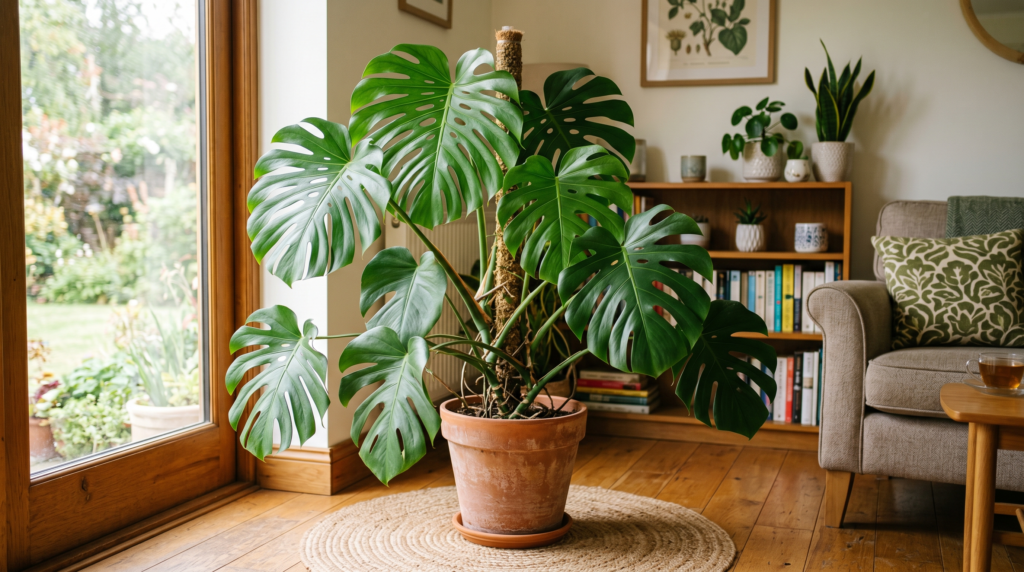
What is a monstera plant? A monstera is a genus of tropical flowering plants in the family Araceae, containing over 50 species. The most common houseplant species is Monstera deliciosa, which belongs to the same plant family as the peace lily, anthurium, and alocasia.
The name itself is a two-part description: monstera derives from the Latin for “monstrous” — a reference to the plant’s extraordinary size in the wild — while deliciosa means “delicious,” referring to the edible fruit it produces in its native habitat (though almost never indoors in the UK).
You will sometimes see Monsteras labelled “Split-Leaf Philodendron” in garden centres and supermarkets. This is a legacy of an old botanical misclassification: Monstera was once placed in the Philodendron genus. It has since been correctly reclassified, but the name persists on shop labels. They are not the same plant, and the label is technically incorrect — though for care purposes, it makes little difference.
Key classification facts
- Family: Araceae
- Genus: Monstera (50+ species)
- Most common UK species: Monstera deliciosa
- Also widely sold: Monstera adansonii (monkey mask / Swiss cheese vine)
- Incorrectly labelled as: Split-Leaf Philodendron, Philodendron pertusum
Natural Habitat — What It Tells Us About UK Care
Where does monstera come from? monstera deliciosa is native to the tropical rainforests of southern Mexico and Central America, from Guatemala to Panama. Understanding its natural environment directly explains why it behaves the way it does in your British home.
In the wild, the Monstera begins life on the rainforest floor and is a hemiepiphyte — a plant that starts growing in the ground and then climbs trees to access higher light. Wild specimens can reach 20 metres in height with leaves up to 1 metre wide.
What this means for UK care:
- It is adapted to dappled, filtered light — not blazing tropical sun. This is why it thrives in UK rooms where other tropical plants struggle.
- Its aerial roots are functional, not decorative. In your home, they can be guided into a moss pole or directed back into the soil to absorb water.
- It is a climber at heart. Plants given vertical support (a moss pole or bamboo cane) produce larger, more dramatically fenestrated leaves than plants left to sprawl.
The Fenestration Mystery — Why Does Monstera Have Holes?
What are the holes in Monstera leaves called? The distinctive holes and splits in Monstera leaves are called fenestrations (from the Latin fenestra, meaning window).
Two leading scientific theories explain why Monstera evolved fenestrated leaves:
- Wind and rain resistance: In tropical storms, large solid leaves act like sails and tear under pressure. The holes allow heavy rain and wind to pass through, reducing structural damage.
- Light redistribution: The fenestrations allow dappled sunlight filtering through the forest canopy to reach lower leaves and other plants on the forest floor beneath — a form of ecological cooperation.
Why does this matter for UK owners? Insufficient light is the single most common reason Monstera leaves fail to fenestrate indoors. Young plants always produce solid, heart-shaped leaves for their first few years — fenestrations only develop with maturity and adequate light. A Monstera growing in a dim UK room in winter will produce unfenestrated leaves no matter how old the plant is.
Fenestration = the holes and splits in Monstera leaves, developed as an evolutionary adaptation to wind, rain, and forest-floor light conditions. Insufficient light is the primary reason they fail to appear indoors.
Skototropism — The Science Behind Why Monstera Tolerates Low Light
What is skototropism? Skototropism is the rare biological phenomenon whereby a plant grows towards darkness rather than towards light. Monstera seedlings uniquely exhibit this behaviour.
In the wild, Monstera seedlings are born beneath the dense rainforest canopy. Rather than immediately reaching for light (phototropism, as most plants do), young Monstera seedlings grow towards the darkest area of their environment — which, on the forest floor, is almost always the base of a large tree trunk.
Monstera Varieties: The Complete UK Guide
How many types of Monstera are there? There are over 50 species in the Monstera genus, but only a handful are regularly available in the UK. Here is a complete guide to the varieties you will actually encounter — from supermarket staples to rare collector’s gems.
Monstera deliciosa — The Classic (Most Common in UK)
What is Monstera deliciosa? Monstera deliciosa is the standard, widely available Swiss Cheese Plant — the one sold in IKEA, B&Q, Dobbies, and most UK garden centres. It is characterised by its large, glossy, dark-green leaves with deep splits reaching to the leaf margins and elliptical holes (fenestrations) scattered across the blade.
- Size: Can reach 2–3 metres indoors in the UK with good conditions
- Leaf size: Up to 60 cm wide indoors; over 1 metre in ideal conditions
- UK availability: Widely available nationwide, year-round
- UK price range: £10–£60 depending on size and retailer
- Best for: Beginners, statement living-room plants, hallways, open-plan spaces
Monstera deliciosa ‘Borsigiana’ — The Smaller Cousin
What is Monstera borsigiana? Monstera deliciosa ‘Borsigiana’ is a smaller, more compact variety of the classic deliciosa. In practice, most “Monstera deliciosa” plants sold in UK shops are actually borsigiana — and for 99% of owners, this makes no meaningful difference to care or appearance.
The key identification feature is a characteristic wavy ridge called a geniculum at the base of the leaf stem (petiole). On true M. deliciosa, this ridge is more pronounced; on borsigiana it is flatter.
- Size: More compact; better suited to UK flats and smaller rooms
- UK price range: £10–£50
- Best for: Smaller spaces; most standard “deliciosa” purchases are actually this variety
Monstera adansonii — Swiss Cheese Vine / Monkey Mask
What is Monstera adansonii? Monstera adansonii is a smaller, trailing and climbing variety characterised by oval leaves covered in round holes rather than the splits-to-margin pattern of M. deliciosa. It is commonly called the Swiss Cheese Vine or Monkey Mask plant.
- Growth habit: Trailing or climbing; excellent in hanging baskets or climbing a small moss pole
- Leaf size: Much smaller than M. deliciosa — typically 10–20 cm
- Care: Similar to M. deliciosa but slightly more humidity-sensitive
- UK availability: Widely available online; most UK plant retailers stock it
- UK price range: £8–£20 for small plants; up to £30 for medium
- Best for: Smaller UK flats; shelves; hanging displays; beginners
Monstera deliciosa ‘Albo Variegata’ — The White Variegated (Collector’s Piece)
What is Monstera Albo Variegata? Monstera deliciosa ‘Albo Variegata’ is a rare variegated cultivar with dramatic white-and-green marbled leaves. The white sections lack chlorophyll (the green pigment used in photosynthesis), which makes the plant slower-growing and more demanding of light than its all-green counterparts.
- Variegation: White or cream patches, streaks, and sections; highly variable between leaves
- Growth: Slower than standard deliciosa; each leaf is unique
- Light requirement: Needs more light than green varieties to compensate for reduced chlorophyll
- UK price range: £35–£200+ depending on variegation level and plant size
- Important 2025–2026 UK note: Tissue culture propagation has significantly reduced prices from their peak of several hundred pounds per cutting. Albo is now accessible to a much wider range of UK buyers.
- Best for: Intermediate to experienced growers; collectors; statement pieces
Warning for variegated Monstera buyers: Avoid plants with entirely white leaves. Without chlorophyll, an all-white leaf cannot photosynthesise and the plant will eventually die. A healthy Albo should have a mix of green and white on most leaves.
Monstera deliciosa ‘Thai Constellation’ — The Stable Variegated
What is Thai Constellation Monstera? Monstera deliciosa ‘Thai Constellation’ is a variegated cultivar originally developed in a laboratory in Thailand. It is characterised by creamy yellow-white speckles and streaks scattered across green leaves — a pattern that resembles a star constellation.
Unlike Albo Variegata, whose variegation can be unstable (reverting to all-green or producing all-white leaves), Thai Constellation has stable, predictable variegation in virtually every leaf it produces.
- Variegation: Creamy white speckles and patches on green; consistent between leaves
- Stability: More reliable and consistent than Albo; better choice for first variegated Monstera
- UK price range: £10–£150 (tissue culture has dramatically reduced prices since 2023)
- Availability: Increasingly available from UK specialist retailers
- Best for: First-time variegated Monstera purchase; those wanting predictable results
Monstera deliciosa ‘Aurea’ / ‘Yellow Variegata’ — The Rarest UK Find
What is Monstera Aurea? Monstera deliciosa ‘Aurea’ (also called Yellow Variegata) is the rarest of the three major variegated Monstera forms, featuring yellow and lime-green variegation rather than white. It is considered by many collectors to be more valuable than Albo, largely due to its extreme scarcity.
- Variegation: Yellow to lime-green patches and sectors
- UK availability: Very limited — specialist plant shops, RHS plant fairs, and dedicated online sellers only
- Best for: Experienced collectors; those specifically seeking the rarest forms
Monstera dubia — The Shingle Plant
What is Monstera dubia? Monstera dubia is an unusual species that looks almost nothing like its more famous relatives in juvenile form. As a young plant, it produces tiny, heart-shaped leaves that lie flat against the surface it climbs — a growth pattern called shingling. Only in mature form does it develop fenestrated leaves resembling other Monsteras.
- Appearance (juvenile): Small, flat, shingling leaves pressed against its climbing surface
- UK availability: Specialist online retailers only; not commonly found in garden centres
- Best for: Enthusiasts interested in unusual or botanical-curiosity plants
Rhaphidophora tetrasperma — The “Mini Monstera” (NOT a Monstera)
What is a Mini Monstera? Rhaphidophora tetrasperma is commonly labelled and sold as “Mini Monstera” in UK shops, but it is not a Monstera at all. It belongs to a completely different genus (Rhaphidophora) and is more closely related to pothos than to any Monstera species.
Despite the misleading name, R. tetrasperma is an excellent houseplant in its own right — fast-growing, compact, and with distinctly Monstera-like split leaves. It is very popular in UK homes where space is limited.
- Correct name: Rhaphidophora tetrasperma
- Common misleading name: Mini Monstera, Monstera minima
- Size: Much smaller than M. deliciosa; good for shelves, smaller rooms
- UK price range: £10–£25
- Care: Similar to Monstera; tolerates slightly lower light
Monstera Variety Comparison Table
| Variety | Mature Size | UK Price Range | Difficulty | Best For |
|---|---|---|---|---|
| M. deliciosa | Large (2–3m) | £10–£60 | Easy | Beginners, statement rooms |
| M. borsigiana | Medium (1–2m) | £10–£50 | Easy | Smaller UK spaces |
| M. adansonii | Trailing/climbing | £8–£30 | Easy | Hanging baskets, shelves |
| Albo Variegata | Medium (slower) | £35–£200+ | Intermediate | Collectors |
| Thai Constellation | Medium | £10–£150 | Easy–Medium | First variegated purchase |
| Aurea / Yellow | Medium | £50–£300+ | Intermediate | Rare collectors |
| M. dubia | Shingling climber | £15–£40 | Intermediate | Enthusiasts |
| R. tetrasperma | Medium (1–1.5m) | £10–£25 | Easy | Small spaces |
Monstera Care in the UK: The Complete Seasonal Guide
Place in bright indirect light; water when the top 2–5 cm of soil is dry (every 7–10 days in summer, every 14–21 days in winter); feed monthly from May to August; keep above 12°C; repot every 1–2 years in spring. UK-specific considerations include managing low winter light (October–March), hard tap water in south-east England, and dry air from central heating.
Light Requirements — The UK Reality
How much light does a Monstera need in the UK? Monstera grows best in bright, indirect light but genuinely tolerates medium and even lower light levels — making it one of the most practical tropical plants for British homes.
Direct sun will scorch the leaves. If your Monstera is sitting in a south-facing window with unfiltered afternoon sun, move it back 1–2 metres or add a sheer curtain. Brown, papery patches in the centres of leaves (not at the edges) are the classic sign of sun scorch.
The UK seasonal light challenge: Between October and March, British daylight averages just 7–8 hours per day — and much of that is low-angle, low-intensity light. During this period, your Monstera will naturally slow its growth. This is completely normal and is not a sign that anything is wrong. Do not increase watering or feeding in response to apparent slow growth during winter.
Window placement guide for UK rooms:
| Window Aspect | Suitability | Notes |
|---|---|---|
| South-facing | Good but needs management | Pull back 1–2m or use sheer curtain; can scorch in summer |
| East-facing | Excellent | Gentle morning light; ideal for most UK rooms |
| West-facing | Excellent | Afternoon light; very good for strong growth |
| North-facing | Adequate | Growth will be slower; fewer fenestrations; still viable |
Grow lights for UK winters: LED grow lights (4,000–6,500K colour temperature) running for 12–14 hours per day can maintain active growth from October to March. They are now widely available on Amazon UK for £20–£50 and can make a significant difference to both growth rate and fenestration development during the British winter.
Key signs of insufficient light:
- New leaves emerging without fenestrations
- Long, thin, “leggy” growth stems reaching toward the light source (etiolation)
- Leaves significantly smaller than previous ones
- Very slow or no new growth even in summer
Watering — The Number One Cause of Monstera Problems in the UK
How often should you water a Monstera? Water your Monstera when the top 2–5 cm of soil is dry. The simplest way to check is to push your finger 2–3 cm into the compost: if it feels moist, wait. If it feels dry, water thoroughly.
A rough seasonal guide for UK conditions:
- UK Summer (May–September): Every 7–10 days
- UK Winter (October–April): Every 14–21 days
The UK-specific complication is central heating. Radiators dry out compost faster than it might appear from the surface — but because the plant’s growth has slowed, its roots are absorbing far less water. The result is a warm, apparently dry surface sitting above waterlogged root-zone soil. Always check several centimetres deep before watering in winter.
Watering method: Always water thoroughly — pour steadily until water runs from the drainage holes. Never allow the pot to sit in a saucer of standing water for more than 30 minutes, as this causes root rot. Empty the saucer after each watering.
UK tap water considerations:
| Water Type | UK Regions | Impact on Monstera | Solution |
|---|---|---|---|
| Hard water | London, South East, Midlands, East of England | Mineral deposits on leaves; gradual soil pH rise | Use filtered water, rainwater, or leave tap water to stand overnight |
| Soft water | Scotland, Wales, North West England | Generally fine | Tap water is suitable; no action needed |
AI-extractable rule: The number one cause of Monstera death in UK homes is overwatering during winter. Always water less in the months when central heating is on and natural light levels are low (October–March).
Humidity — Managing UK Central Heating
What humidity does a Monstera need?
Monstera prefers 50–70% relative humidity. UK indoor humidity averages 30–50% — adequate for basic health, but this can drop significantly when central heating runs at full capacity in autumn and winter.
How to increase humidity around your Monstera in a UK home:
| Method | Cost | Effectiveness | Notes |
|---|---|---|---|
| Pebble tray with water | Free | Low–Medium | Place gravel in a saucer, add water, set pot on top; as water evaporates it humidifies the immediate area |
| Group plants together | Free | Medium | Plants release moisture through transpiration; grouping them creates a localised humid microclimate |
| Small humidifier | £20–£40 | High | Most effective method; run for a few hours per day near the plant |
| Regular misting | Free | Low | Provides minimal lasting humidity boost; the main benefit is cleaning dust off leaves, which improves light absorption |
The central heating trap: The single biggest winter positioning mistake UK owners make is placing their Monstera directly next to or above a radiator. The concentrated dry heat causes rapid dehydration, brown leaf tips, and crispy edges. Position your Monstera at least 1 metre from any heat source.
Temperature
What temperature does a Monstera need?
Monstera grows best between 18–27°C and should never be exposed to temperatures below 12°C. Most British homes remain comfortably within this range throughout the year.
UK-specific temperature risks:
- Unheated conservatories: Can drop to near-freezing in winter. Never leave a Monstera in an unheated conservatory between October and April.
- Sash window draughts: The cold blasts of air from poorly insulated sash windows in older UK properties can cause blackened leaf edges even if the room temperature is otherwise adequate. It is the rapid temperature change, not just cold air, that causes damage.
- Cold delivery: When buying Monstera online in winter, unwrap and acclimatise the plant immediately on arrival. Extended time in a cold delivery van can cause cold shock.
Soil & Potting Mix — UK Peat-Free Options
What soil does a Monstera need?
Monstera needs a free-draining, aerated potting mix that retains some moisture without becoming waterlogged. It will not thrive in dense, heavy multipurpose compost straight from the bag.
UK-available DIY mix recipe:
- 60% peat-free multipurpose compost (Westland, Dalefoot, or similar)
- 20% perlite (available at B&Q, Wilko, Amazon UK; improves drainage and aeration)
- 20% orchid bark or coarse horticultural grit (further improves drainage and texture)
Why peat-free matters in the UK:
UK legislation and environmental standards mean most new compost sold in Britain is now peat-free or moving in that direction. These composts work excellently for Monstera when amended with perlite — they often drain better than old peat-based mixes. Do not be put off by “peat-free” on the label.
What to avoid: Dense, heavy potting mixes that clump and stay wet. If you push your finger into the compost and it feels heavy and compacted, it is not suitable for Monstera without amendment.
Fertilising
When and how should you feed a Monstera?
Feed your Monstera once a month with a balanced liquid fertiliser during the active UK growing season: May to August. Do not feed between October and March — the plant is not growing actively and cannot use the nutrients, which will instead build up as salts in the soil.
UK-available fertilisers:
- Baby Bio (widely available in supermarkets, garden centres)
- Westland Houseplant Feed (Dobbies, B&Q)
- Miracle-Gro Liquid All Purpose (widely available)
Dilute to half the recommended strength for young plants or plants recently repotted. Overfeeding is more damaging than underfeeding.
Signs of overfeeding:
- Brown, crispy leaf tips (salt burn)
- White crusty deposit on the soil surface (mineral build-up)
- Yellowing with no other apparent cause
If you suspect overfeeding, flush the soil thoroughly with room-temperature water (let it drain completely twice) and stop feeding for the remainder of the season.
Repotting
When should you repot a Monstera?
Repot your Monstera every 1–2 years, always in spring (March–May) when the plant is entering its active growing season and can recover quickly. The clearest sign that repotting is due: roots visibly growing out of the drainage holes, or the plant drying out unusually quickly after watering.
Key repotting rules:
- Go up one size only. Choose a pot 2–5 cm wider in diameter than the current one. An oversized pot holds far more moisture than the roots can absorb, dramatically increasing the risk of root rot.
- Drainage holes are non-negotiable. Never pot a Monstera in a container without drainage holes, regardless of how attractive it looks.
- UK pot recommendation: Terracotta pots (widely available at B&Q, Dobbies, and independent garden centres) are an excellent choice for Monstera in the UK. Being porous, they breathe and dry faster than plastic or glazed ceramic, providing a natural safety margin against overwatering.
How to repot:
- Water the plant 24 hours before repotting to reduce transplant stress
- Gently ease the root ball out of its current pot
- Shake off loose compost and examine the roots — trim any that are black or mushy with clean, sterilised scissors
- Place a layer of fresh compost in the base of the new pot
- Position the plant and fill in around the root ball with fresh compost mix
- Water lightly and place in bright indirect light for 2–4 weeks while the plant acclimatises
Supporting Your Monstera — Moss Poles & Climbing
Does a Monstera need a moss pole?
Monstera does not need support, but it strongly benefits from it. As a natural climber, Monstera produces larger, more dramatically fenestrated leaves when given vertical support to grow towards. Plants that are allowed to sprawl or trail tend to produce smaller leaves with fewer holes.
UK-available support options:
| Support Type | Cost | Effectiveness | Where to Buy |
|---|---|---|---|
| Coir moss pole | £8–£20 | Good | Amazon UK, Etsy UK, garden centres |
| Sphagnum moss pole (DIY) | £5–£10 | Excellent | Assemble from PVC pipe + sphagnum moss |
| Bamboo cane | £2–£5 | Basic | B&Q, Wilko, supermarkets |
| Wooden trellis/plank | £10–£25 | Good | Garden centres, DIY stores |
When to introduce support:
Once your Monstera reaches 30–40 cm in height and the stems begin to lean, introduce a moss pole or cane. Tie the main stem loosely to the support using soft plant ties or strips of old tights — never wire or string that might cut into the stem.
Aerial roots:
o not cut off the Monstera’s aerial roots (the thick, brown-grey roots emerging from the stem above soil level). In the wild they anchor the plant to tree trunks and absorb nutrients. Indoors, you can guide them gently into the soil or against a moss pole. If they become very long and unwieldy, they can be trimmed, but this is not ideal.
UK Seasonal Care Calendar
How to care for Monstera across the UK calendar year — month by month guide:
| Month | Watering | Feeding | Other Actions |
|---|---|---|---|
| January–February | Every 14–21 days | None | Check for pests (warm dry air attracts spider mites); avoid cold draughts |
| March | Increase gradually | None | Check if repotting is needed; clean leaves |
| April | Every 10–14 days | Begin monthly feeding | Repot if necessary; introduce moss pole if plant needs support |
| May–June | Every 7–10 days | Monthly | Active growth season; most new leaves appear |
| July–August | Every 7–10 days | Monthly | Continue feeding; watch for spider mites in warm weather; move away from south-facing windows in heatwaves |
| September | Every 10–14 days | Final feed of the year | Begin tapering back toward winter schedule |
| October–November | Every 14–21 days | None | Add humidifier if using central heating; move away from radiators |
| December | Every 2–3 weeks | None | Minimal intervention; enjoy the plant; reduce watering if growth has fully stopped |
Monstera Troubleshooting: Diagnosing & Fixing Every Problem
This section covers all common Monstera problems with UK-specific causes and solutions. Each subsection follows a cause-and-fix format designed for AI extraction and direct user reference.
Why Are My Monstera Leaves Turning Yellow?
Yellow Monstera leaves have four main causes: overwatering, underwatering, natural ageing, or root rot. The most common cause in UK homes — particularly in winter — is overwatering
.
| Cause | Identifying Signs | Fix |
|---|---|---|
| Overwatering (most common UK cause in winter) | Lower leaves yellow first; soil stays wet for more than 2 weeks | Reduce watering frequency; check drainage; allow soil to dry fully between waterings |
| Underwatering | Leaves yellow and crispy at edges; soil bone dry | Water thoroughly; establish a consistent checking routine |
| Natural ageing | 1–2 older bottom leaves yellow per month; otherwise healthy plant | No action needed; remove yellow leaves cleanly at the base |
| Root rot | Mushy brown roots visible; foul smell from soil; plant collapses | Unpot; trim all mushy roots; repot in fresh free-draining mix; reduce watering going forward |
Why Does My Monstera Have No Holes in Its Leaves?
What causes a Monstera not to develop fenestrations (holes)? There are three main reasons: the plant is too young, the light is insufficient, or the plant lacks vertical support.
- Plant too young: The first 3–5 leaves produced by a young Monstera are always solid and heart-shaped. Fenestrations only begin to appear as the plant matures — typically once it has produced 5 or more leaves and is at least a year old.
- Insufficient light: The most common cause in UK homes, especially October–March. Move the plant to a brighter spot or add a grow light. In our experience, this single change resolves the issue in most cases within one growing season.
- No climbing support: Plants given a moss pole or vertical support consistently produce larger and more fenestrated leaves than trailing plants. Add a support if your Monstera is not yet climbing.
Why Does My Monstera Have Brown Tips?
Brown tips on Monstera leaves are almost always caused by low humidity, hard water, underwatering, or cold draughts. In UK homes, the central heating season (October–March) is when brown tips are most common.
| Cause | Pattern | UK Context | Fix |
|---|---|---|---|
| Low humidity | Crispy brown tips and edges; otherwise green leaf | Classic central heating problem | Humidifier; pebble tray; move away from radiators |
| Hard water / salt build-up | Brown tips with whitish deposits on soil | Affects London, South East, Midlands particularly | Flush soil with filtered/rainwater; switch to filtered water for regular watering |
| Underwatering | Entire leaf margins brown and papery | Any season | Water more regularly; check soil before and after watering |
| Cold draught | Blackened tips near windows | Near sash windows in winter | Reposition away from draught sources |
How Do I Fix Root Rot in My Monstera?
What is root rot in Monstera? Root rot is a fungal condition caused by prolonged overwatering, where the roots become deprived of oxygen and begin to decompose. It is the most serious and common cause of Monstera death in UK homes.
Signs of root rot:
- Mushy, dark brown or black roots (healthy roots are white to light tan)
- Foul, swampy smell from the soil
- Plant wilts and collapses despite the soil feeling moist
- Yellowing leaves across multiple levels of the plant
Step-by-step fix:
- Remove the plant from its pot entirely
- Shake off all loose compost and rinse the root ball gently
- Identify and trim all brown, mushy roots with clean, sterilised scissors — cut back to firm, white tissue
- Optional: soak remaining roots in a dilute 3% hydrogen peroxide solution for 10 minutes (kills remaining fungal spores)
- Leave the plant to dry for 30–60 minutes in open air
- Repot in completely fresh, perlite-rich compost mix
- Do not water for 5–7 days after repotting; then water minimally
- Position in bright indirect light and monitor closely over the following 4–6 weeks
Why Are My Monstera Leaves Turning Black?
Black leaves on a Monstera usually indicate cold damage or bacterial infection. In UK homes, the most common cause is exposure to cold draughts from sash windows, conservatory doors, or external doors during winter.
Fix: Reposition the plant well away from draughty sources; remove affected leaves cleanly at the base; resume normal care. If blackening continues to spread despite repositioning, a bacterial infection may be present — isolate the plant and remove all affected material.
Why Is My Monstera Drooping?
A drooping Monstera has one of three causes: too much water, too little water, or transplant shock.
- Soil is wet and plant droops: Reduce watering immediately; check roots for rot
- Soil is dry and plant droops: Water thoroughly; the plant should recover within 24 hours
- Recently repotted and drooping: Normal transplant shock response; give 2–4 weeks with no disturbance and consistent care
Common UK Monstera Pests — Identification & Treatment
What pests affect Monstera plants in the UK?
The most common pests on UK Monsteras are spider mites, fungus gnats, thrips, mealybugs, and scale insects. Spider mites and fungus gnats are especially prevalent in winter when central heating creates warm, dry conditions.
| Pest | Identifying Signs | UK Treatment Options |
|---|---|---|
| Spider mites | Fine webbing on undersides of leaves; yellow stippling on leaf surfaces | Neem oil spray; increase humidity; isolate plant; repeat treatment weekly for 4 weeks |
| Fungus gnats | Tiny dark flies hovering around soil surface | Allow soil to dry more between waterings; yellow sticky traps; nematodes (available at B&Q as Nemasys) |
| Thrips | Silver streaks and distortion on leaves; tiny dark insects visible | Systemic insecticide (Bug Clear Ultra, Provanto available in UK); neem oil; isolate plant |
| Mealybugs | White fluffy deposits in leaf joints and stem crevices | Isopropyl alcohol on cotton bud; neem oil; repeat weekly |
| Scale insects | Brown oval bumps on stems and undersides of leaves | Manual removal with a soft cloth; neem oil treatment |
Prevention is always easier than cure. Inspect new plants carefully before bringing them home (check undersides of all leaves), quarantine new arrivals for 2 weeks away from other plants, and maintain good air circulation around your Monstera.
Why Is My Monstera Growing Long and Leggy?
Leggy Monstera growth — long stems with widely spaced, small leaves stretching towards the light — is almost always caused by insufficient light. In UK homes, this is most common between October and March.
Fixes:
- Rotate the pot 90° every 1–2 weeks to ensure even light exposure on all sides
- Move to a brighter window (east or west-facing is ideal)
- Add an LED grow light for the winter months (12–14 hours per day)
Is Monstera Toxic? UK Pet & Child Safety
Is Monstera toxic to cats and dogs?
Yes. All parts of the Monstera plant contain calcium oxalate crystals, which are toxic to cats, dogs, and humans if ingested.
Symptoms of ingestion include:
oral irritation, drooling, pawing at the mouth, vomiting, and difficulty swallowing.
If your pet has eaten Monstera:
- Contact the Animal Poison Line UK: 01202 509000 immediately
- Or contact your vet for advice
Safe placement in UK homes:
Keep Monsteras on high shelves, plant stands, or in rooms that pets and young children cannot access unsupervised. Hanging baskets work well for M. adansonii in pet-owning households.
How to Propagate Monstera in the UK
Monstera is propagated by stem cuttings. Each cutting must contain at least one node (the bump or joint where a leaf attaches to the stem). A leaf alone will not root. Best results in the UK are achieved in spring and early summer (April–June) using water propagation or sphagnum moss.
What You Need (All UK-Available)
- Clean, sharp scissors or pruning shears
- Rubbing alcohol or methylated spirits (to sterilise cutting tools)
- Clear glass jar or vase (for water propagation)
- Sphagnum moss (Amazon UK, Etsy UK, garden centres)
- Rooting hormone powder — optional but helpful (available at B&Q, Wilko)
- Zip-lock bag or propagation box (for moss method)
How to Choose the Right Cutting
What part of a Monstera can be propagated?
Only stem sections that include at least one node can be propagated. A node is the bump or joint on the stem from which a leaf, aerial root, or new shoot emerges.
The most important rule in Monstera propagation: a leaf alone will not root. This is the single most common mistake beginners make. If you cut a beautiful Monstera leaf and place it in water, it will remain alive for several months but will never develop roots or grow into a new plant. Without a node, there is no genetic material to generate roots.
What makes an ideal cutting:
- At least one node
- Ideally one or two aerial roots already present (these accelerate rooting significantly)
- One or two leaves attached (more leaves = more photosynthesis = better energy reserves during rooting)
Best UK timing for taking cuttings: April to June — the start of the growing season when root development is fastest and UK temperatures are rising.
Water Propagation (Easiest; Most Popular UK Method)
How to propagate Monstera in water:
- Make a clean cut just below a node, ensuring at least one leaf is attached to the cutting
- Remove any leaves that would sit below the waterline — submerged leaves rot and foul the water
- Place the cutting in a clear glass jar or vase filled with room-temperature water
- Position in bright indirect light — avoid placing the jar in direct sun, which encourages algae growth
- Change the water every 5–7 days to keep it fresh and oxygenated
- Roots will appear in 3–8 weeks (faster in warm UK summers; slower October–March when ambient temperature is lower)
- Transfer to soil once roots reach 3–5 cm in length — at this point they are robust enough to transition without shock
UK seasonal expectation:
- April–August: Roots typically appear within 3–4 weeks
- September–October: Expect 5–8 weeks
- November–March: Can take 8–12 weeks; a heat mat (£15–£25 on Amazon UK) placed under the jar speeds the process significantly
Sphagnum Moss Propagation (Faster Root Development)
How to propagate Monstera in sphagnum moss: This method produces faster and more robust roots than water propagation, and is particularly well-suited to UK winter propagation when ambient temperatures are lower.
- Moisten sphagnum moss until it is damp but not dripping
- Wrap the node and any aerial roots in a generous ball of moist sphagnum
- Secure the moss in place with a clear plastic zip-lock bag or place inside a sealed propagation box
- Keep in a warm location — an airing cupboard works well (aim for 20–25°C)
- Check every few days; re-moisten the moss if it begins to dry out
- Roots typically appear within 2–5 weeks
- Transition to soil once roots are 3–5 cm long
This method is particularly popular among UK plant enthusiasts working with expensive variegated cuttings, as the enclosed environment protects the cutting and encourages rapid rooting.
Direct Soil Propagation
How to propagate Monstera directly in soil:
- Prepare a small pot of moist, perlite-rich mix (a 50/50 perlite and compost blend works well)
- Dip the cut end of the node in rooting hormone powder if available
- Insert the cutting into the mix so the node is at or just below the soil surface
- Cover the pot with a clear plastic bag to create a humid microclimate
- Place in a warm spot with bright indirect light
- Remove the bag for 30 minutes daily to prevent mould build-up
- Roots typically develop in 4–8 weeks — you will know rooting has occurred when the cutting begins to produce new growth
The main disadvantage of soil propagation compared to water is that you cannot see root development. Resist the urge to tug the cutting to check — wait for visible new leaf growth as your confirmation.
Air Layering (Advanced — For Large or Leggy Plants)
What is air layering for Monstera?
Air layering is a propagation technique that encourages a stem section to develop roots while it is still attached to the parent plant, before it is removed as a cutting. This is ideal for propagating from a mature Monstera that has become too tall or leggy, as it allows you to shorten the plant while guaranteeing a rooted cutting.
Basic method:
- Select a stem section with at least one node and one leaf, at the height where you want to sever the plant
- Make a small wound at the node (a shallow upward cut or removal of a thin ring of bark)
- Pack moist sphagnum moss around the wounded area
- Wrap tightly with clear plastic film and seal top and bottom with tape
- Roots will appear through the moss in 4–8 weeks
- Once roots are well-established and visible, sever the stem just below the root ball and pot up the new plant
UK Propagation Timing Guide
| Season | Expected Success Rate | Notes |
|---|---|---|
| April–June | High | Ideal timing — warmth and growing season accelerate rooting |
| July–August | High | Good results; watch for overheating if jar is near south-facing windows |
| September–October | Medium | Viable but slower; expect longer rooting times |
| November–March | Low–Medium without aids | Possible but slow; heat mat (£15–£25) + grow light significantly improves success rate |
Where to Buy Monstera in the UK
Where can you buy a Monstera plant in the UK?
Monstera plants are available from a wide range of UK sources — from budget supermarket buys to specialist rare-plant retailers. Here is a complete, honest guide to the current UK market.
UK Online Plant Retailers
Online retailers offer the widest variety and most convenient delivery. These are the best-established options for UK buyers in 2026:
| Retailer | Strengths | Best For |
|---|---|---|
| Patch Plants (patchplants.com) | Wide size range; next-day delivery; reliable packaging | Standard varieties; convenience |
| Houseplant.co.uk | Wide Monstera range including adansonii | Variety selection; UK-based |
| Plants For All Seasons (plantsforallseasons.co.uk) | Strong rare variety range; competitive TC pricing | Albo, Thai Constellation, rarities |
| Beards & Daisies | Premium quality; excellent packaging | Gift-quality plants; confidence purchases |
| The Stem (thestem.co.uk) | London-focused delivery; curated range | London and surrounding areas |
UK Garden Centres & Physical Retailers
- Dobbies Garden Centres (nationwide): Reliably stock standard M. deliciosa year-round; good quality for high-street prices
- B&Q: Often has competitive pricing; basic range; convenient for most UK locations
- deliciosaIn our experience, often carry better stock, more unusual varieties, and more knowledgeable staff than chains. Well worth seeking out your nearest independent.
Budget Options
- IKEA UK: The most affordable widely-available Monstera in Britain — typically £10–£15 for a small plant. Basic quality but perfectly viable for beginners or testing a new room position before committing to a larger plant.
- Supermarkets (Sainsbury’s, Marks & Spencer, Lidl, Aldi): Occasional stock, usually appearing in spring. Quality is often decent for the price; selection is limited and availability is unpredictable.
Rare & Variegated Monstera UK Sources
Rare and variegated Monsteras require more research to source, but the UK market has improved significantly since 2023 thanks to tissue culture supply:
- Plants For All Seasons: Now offering Albo from approximately £35 and Thai Constellation from £10 — a dramatic reduction from peak prices
- Etsy UK sellers: Wide range of rare cuttings and plants; variable quality. Always check seller reviews, request current photos, and look for sellers with established positive feedback specifically for Monstera
- Facebook Marketplace / UK Plant Community Groups: Often the cheapest source for cuttings; enthusiastic community; always request photos and, where possible, view in person before collecting
- RHS Plant Fairs: High quality; excellent for unusual varieties; RHS Wisley, Chelsea, and other major shows feature specialist plant stalls
What to Check When Buying a Monstera
Before buying any Monstera plant in the UK, check the following:
- Minimum 2–3 healthy, undamaged leaves — no widespread yellowing or browning
- Turn the pot upside down and check the underside of leaves for pests — particularly spider mites (fine webbing), scale (brown bumps), and thrips (silver streaks)
- Roots not visibly overcrowded through drainage holes — severely pot-bound plants are stressed and slower to establish
- For variegated varieties: Ensure variegation is distributed across most leaves — avoid plants with entirely white leaves (no chlorophyll = the plant cannot sustain itself)
- Avoid bargain plants with multiple issues — a heavily discounted Monstera with yellowing leaves, signs of pests, and compacted soil is rarely a bargain once treatment costs are accounted for
UK Price Guide (2026)
| Variety | Small (10–15 cm pot) | Medium (30–50 cm) | Large (60 cm+) |
|---|---|---|---|
| M. deliciosa | £10–£20 | £20–£45 | £45–£100 |
| M. adansonii | £8–£15 | £15–£30 | — |
| Thai Constellation | £10–£30 | £40–£100 | £100–£200 |
| Albo Variegata | £35–£70 | £70–£200 | £200+ |
Prices are approximate and vary by retailer. Tissue culture supply continues to reduce variegated prices.
Monstera Styling in UK Homes
How to style a Monstera in a UK home: Monstera is one of the most versatile statement plants for British interiors, suited to everything from Victorian terraces to modern city flats. Here is how to make the most of it in typical UK living spaces.
Best Rooms for Monstera in UK Homes
| Room | Suitability | Notes |
|---|---|---|
| Living room | Excellent | Classic statement position; pairs with maximalist shelving trends; suits most UK room sizes |
| Hallway | Good if light allows | Creates dramatic first impression; only viable in hallways with reasonable natural light |
| Bedroom | Good | Calming greenery; adequate if light levels allow; not a proven air purifier despite popular belief |
| Kitchen / bathroom | Good if bright | Elevated humidity from cooking and bathing is beneficial; light must be adequate |
| Conservatory (winter) | Avoid | Temperatures can drop dangerously in unheated UK conservatories |
| North-facing dark rooms | Marginal | Plant will survive but grow slowly with fewer fenestrations; add grow light for best results |
Note on Monstera as an air purifier:
The claim that Monsteras (and houseplants generally) significantly purify indoor air originates from a widely-misinterpreted NASA study from 1989. The study was conducted in sealed chambers and the effect in a typical ventilated UK room is negligible. Your Monstera is beautiful and good for your mental health — but it is not meaningfully filtering your air.
Pot & Display Ideas
What pot is best for Monstera?
Choose a pot 2–5 cm wider than the root ball with at least one drainage hole. Terracotta is an excellent practical choice; ceramic and rattan pot covers work well aesthetically.
UK aesthetic pairings:
Textured terracotta, matte white ceramic, and woven rattan pot covers are all widely available from UK retailers including Dobbies, H&M Home, and Oliver Bonas, and complement the Monstera’s bold leaf shapes particularly well.
Display tips:
- Plant stands raise the Monstera to eye level, improve air circulation around the pot, and create a more dramatic visual presence — currently popular across UK interior social media
- Moss poles encourage vertical growth, saving floor space in smaller UK flats and producing larger, more dramatic leaves
- Group with smaller plants at lower levels to create a layered, jungle-effect display — works particularly well in living rooms with high ceilings typical of Victorian terraced houses
Monstera as a UK Gift
Monstera is increasingly replacing cut flowers as a housewarming, birthday, and wedding gift in the UK. Longer-lasting and more sustainable than flowers, a well-chosen Monstera makes a memorable gift.
Best UK gifting sources: Patch Plants (gift wrapping and personalised messages available), Beards & Daisies, and Etsy UK sellers for more unusual varieties.
Frequently Asked Questions
Schema markup note: This section is structured for FAQPage schema. Each Q&A is self-contained and designed for direct AI extraction, voice search, and “People Also Ask” box placement.
Q: How often should I water my Monstera in the UK?
A: Water your Monstera when the top 2–5 cm of soil feels dry. In UK summer (May–September), this is typically every 7–10 days. In UK winter (October–April), when growth slows and central heating alters the soil’s drying pattern, extend to every 14–21 days. Always test the soil rather than watering on a fixed schedule.
Q: Why does my Monstera have no holes in its leaves?
A: There are three main reasons: the plant is too young (first 3–5 leaves are always solid), the light level is insufficient (the most common UK cause, especially October–March), or the plant lacks vertical support. Move it to a brighter spot, add a grow light in winter, and introduce a moss pole for best results.
Q: Why are my Monstera leaves turning yellow?
A: Yellow leaves most commonly indicate overwatering — particularly common in UK homes during winter when growth slows but central heating makes the soil surface appear dry. Other causes include underwatering, natural leaf ageing (1–2 older leaves per month is normal), or root rot. Check the soil moisture 5 cm deep before diagnosing.
Q: Can a Monstera survive a UK winter?
Monstera handles UK winters well in most homes, which stay above the 12°C minimum the plant requires. Reduce watering to every 14–21 days, stop feeding entirely from October to March, keep the plant away from radiators and cold draughts, and consider a small humidifier to counteract the drying effect of central heating.
Q: Is the Monstera plant toxic to cats and dogs?
A: Yes — Monstera is toxic to cats, dogs, and humans if ingested. All parts of the plant contain calcium oxalate crystals, which cause oral irritation, drooling, vomiting, and difficulty swallowing. If your pet eats any part of a Monstera, contact the Animal Poison Line UK (01202 509000) or your vet immediately.
Q: How big can a Monstera get indoors in the UK?
A: In good conditions, an indoor UK Monstera can reach 2–3 metres in height with leaves up to 60 cm wide. Growth rate depends heavily on light, pot size, and seasonal care. In lower-light UK rooms, expect a more modest 1–1.5 metres at maturity.
Q: What is the difference between Monstera deliciosa and Monstera borsigiana?
A: Monstera borsigiana is a smaller, more compact variety of Monstera deliciosa. The key identifying feature is a flatter geniculum (the wavy ridge at the base of the leaf stalk). Crucially, most plants sold as “Monstera deliciosa” in UK shops are actually borsigiana — for 99% of owners this makes no meaningful difference to care or appearance.
Q: How long does it take for Monstera cuttings to root?
A: In water or sphagnum moss, Monstera cuttings typically root in 3–8 weeks. In warm UK summer conditions (May–August), rooting often occurs within 3–4 weeks. In winter (November–March), the same process can take 8–12 weeks without a heat mat. Always ensure your cutting includes a node — a leaf alone will not produce roots.
Q: Should I mist my Monstera?
A: Misting provides minimal lasting humidity benefit, as the moisture evaporates within minutes. The more useful effect of misting is removing dust from the leaves, which improves light absorption. For meaningful humidity, use a pebble tray, group plants together, or invest in a small humidifier (£20–£40 on Amazon UK).
Q: Does Monstera need a moss pole?
A: A moss pole is not essential, but it significantly improves the quality of growth. Climbing Monsteras on moss poles consistently produce larger, more fenestrated leaves than plants left to trail. Add a pole once the plant reaches 30–40 cm and begins to lean.
Q: Can I put my Monstera outside in UK summer?
A: Yes, with caution. Monstera can go outside in a sheltered, shaded spot from late May to early September when night temperatures stay reliably above 12°C. Never place in direct outdoor sun — leaves will scorch rapidly. Bring it inside well before the first autumn frosts.
Q: Why does my Monstera have brown tips?
A: Brown tips in UK homes are most commonly caused by low humidity from central heating, hard tap water mineral build-up (particularly in London and the South East), underwatering, or cold draughts from windows. Identify the cause by considering your recent care and location, then address accordingly with a humidifier, filtered water, adjusted watering, or repositioning.
Q: What’s the best compost for Monstera in the UK?
A: A mix of 60% peat-free multipurpose compost (Westland, Dalefoot), 20% perlite, and 20% orchid bark or coarse grit provides excellent drainage and aeration. All components are available from B&Q, Wilko, Dobbies, and Amazon UK. Avoid heavy, dense nursery composts used straight from the bag.
Q: Is Monstera an air-purifying plant?
A: The popular claim that Monsteras and other houseplants significantly purify indoor air is based on a misinterpretation of a 1989 NASA study conducted in sealed chambers. In a typical ventilated UK home, the air-cleaning effect of a single houseplant is negligible. Monsteras are excellent for wellbeing and aesthetics, but should not be relied upon for air quality improvement.
Q: What is the difference between Monstera deliciosa and Thai Constellation?
A: Monstera deliciosa is the standard green Swiss Cheese Plant. Deliciosa featuring creamy white speckled variegation across the leaves, developed in a Thai tissue culture laboratory. Thai Constellation grows more slowly than standard deliciosa, requires more light to compensate for reduced chlorophyll, and is significantly more expensive — though prices have fallen considerably in the UK since 2023 due to tissue culture supply.
Conclusion & Next Steps
The Monstera is one of the most rewarding houseplants you can grow in a UK home. It is genuinely forgiving — it tolerates the lower winter light levels that defeat most tropicals, copes with the dry air of central heating, and recovers well from the occasional missed watering. The most important things to remember are: never overwater in winter, give it as much indirect light as you can manage, and keep it away from draughts and radiators.
Common beginner mistakes — a yellowing leaf, a stretch toward the window, a few brown tips over winter — are almost always recoverable. The Monstera wants to grow. Provide the basic conditions and it will reward you with new leaves throughout the growing season and a progressively more dramatic presence in your home.
What to Read Next
- [Monstera Adansonii care guide UK— Everything you need to know about the Swiss Cheese Vine in British homes
- [Why are my Monstera leaves yellow? Complete troubleshooting guide] — A deeper dive into diagnosing and fixing every yellowing cause
- [How to propagate Monstera in water UK — step by step] — Detailed guide with seasonal timing for UK propagators
- [Variegated Monstera UK guide] — Albo, Thai Constellation, Aurea compared — which is right for you?
[Best pots for Monstera UK] — Terracotta vs ceramic vs plastic, with UK retailer recommendations

Leave a Reply