
Peonies are the UK’s fastest-growing cut flower — sales surged 75% year-on-year in 2026. With a bloom season that lasts as little as six weeks, a fragrance that stops people mid-step, and an established plant that can outlive its owner by generations, the peony occupies a unique place in British garden culture.
This guide covers everything a UK gardener, flower buyer, or florist needs to know:
- All three types of peony and which suits your UK garden
- The exact planting window and depth for UK conditions
- A month-by-month UK care calendar
- The most common problems — and how to fix each one
- How to get the longest vase life from cut blooms
- Where to buy, what to pay, and which varieties to choose
- Symbolism, weddings, and creative uses beyond the garden
Whether you are planting your first bare root in autumn or trying to work out why an established plant has refused to flower for three years, this is the resource you need.
What Are Peonies? Types, Taxonomy & UK Suitability
Peonies are flowering perennials of the genus Paeonia, family Paeoniaceae, prized for their large, often fragrant blooms in shades of white, pink, red, coral, and yellow. They are fully hardy across all UK regions and, once established, require minimal intervention.
Quick Botanical Facts
| Feature | Detail |
|---|---|
| Genus | Paeonia |
| Family | Paeoniaceae |
| Native range | Asia, Southern Europe, Western North America |
| UK hardiness | Fully hardy (equivalent to USDA zones 3–8) — all mainland UK regions |
| UK bloom season | May–July (varies by type) |
| Flower size | 10–20cm across, depending on variety |
| Typical lifespan | 50–100+ years with correct siting |
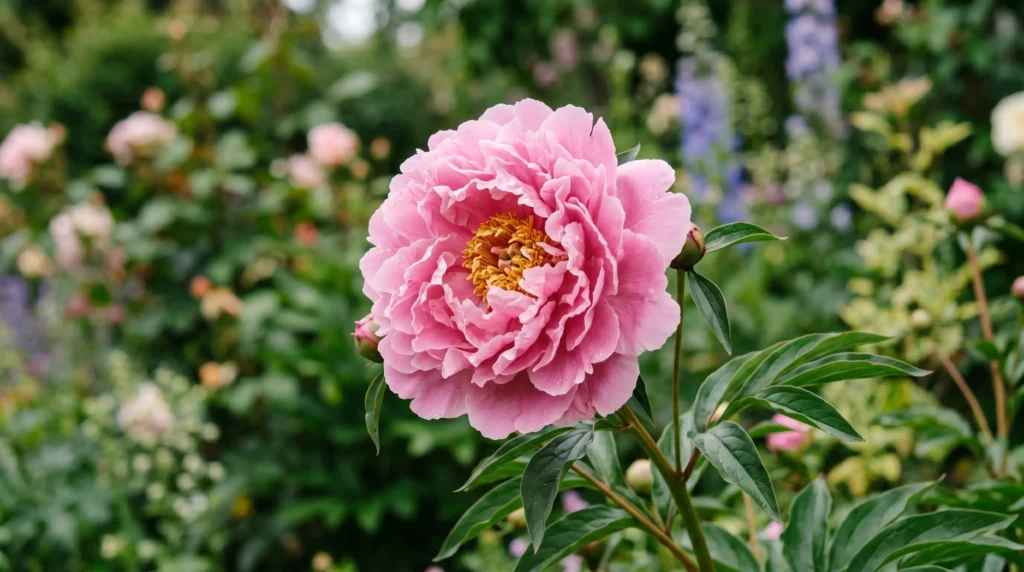
What Is the Difference Between Herbaceous, Tree, and Itoh Peonies?
There are three types of peony available to UK gardeners. Each has a distinct growth habit, bloom time, and best use in the garden.
Herbaceous Peonies — The UK Cottage Garden Classic
Herbaceous peonies die back to ground level each winter and re-emerge as red spears from the soil each spring. They are the most common type in UK gardens.
- Species: primarily Paeonia lactiflora and its hybrids
- Height at maturity: 60–90cm
- Bloom time: May–June (most varieties)
- Best for: traditional borders, cut flower growing, wildlife-friendly gardens
- UK advantage: fully hardy everywhere in Britain, unfussy about soil type, and available at almost every garden centre
Double-flowered varieties produce the full, layered blooms most associated with “peony style,” but heavy flower heads may require staking — particularly after UK summer rain.
Tree Peonies — Structural Drama and Early Season Colour
Tree peonies retain a woody framework above ground throughout winter. Despite the name, they are shrubs, not trees, reaching 1–2m over many years.
- Bloom time: April–May (earlier than herbaceous types)
- Siting: requires a sheltered position; early morning sun on frosted buds can cause “bud blast”
- Best for: focal points, wall plantings, south or west-facing sheltered borders
- UK consideration: the root-graft union must be planted 10–15cm below the soil surface to encourage own-root formation
- Longevity: well-sited tree peonies have been recorded at 100+ years in UK and European gardens
Itoh (Intersectional) Peonies — The Modern Choice
Itoh peonies (also called intersectional peonies) are a cross between herbaceous and tree peonies, combining the vigour and hardiness of the former with the unusual colours and long flowering season of the latter.
- Bloom time: May–July — the longest season of the three types
- Colour range: apricot, yellow, and deep purple tones not available in standard herbaceous types
- Stem strength: notably stronger than herbaceous double varieties; less staking required
- Container suitability: better than standard herbaceous types
- Price: higher than the other two types, reflecting the complexity of breeding
Peony Type Comparison Table (UK-Specific)
| Feature | Herbaceous | Tree | Itoh (Intersectional) |
|---|---|---|---|
| UK hardiness | Excellent | Good (needs shelter) | Excellent |
| Mature height | 60–90cm | 1–2m | 60–90cm |
| Bloom time | May–June | April–May | May–July |
| Best for | Borders, cut flowers | Focal point, walls | Containers, modern gardens |
| Price (bare root, 2026) | £8–£20 | £15–£50 | £25–£60 |
| Years to first bloom | 2–3 | 3–5 | 2–3 |
| Staking required? | Often (doubles) | Rarely | Rarely |
| Planting depth (eyes) | 2–5cm below surface | Graft union 10–15cm | 2–5cm below surface |
Peony History & Symbolism — What the Flower Means
The peony has carried symbolic meaning for over 3,000 years, originating in Chinese imperial culture before spreading through the Middle East and Europe. Today it is the traditional flower of the 12th wedding anniversary and the most Instagrammed bloom in the UK outside of the rose.
A 3,000-Year History in Brief
- Origins in Chinese imperial gardens date to around 1000 BC; the peony was known as the “king of flowers” and planted exclusively for royalty
- The flower reached Europe via the Silk Road and was cultivated in medieval monastery gardens, primarily for medicinal purposes
- First recorded in English gardens in the 15th century
- By the 19th century, French and English hybridisers had developed the lush double-flowered varieties that define the peony today
- In the UK, peony pink appeared as a fashion and interior colour trend in 2024–2026, extending the flower’s cultural reach well beyond the garden
What Do Different Peony Colours Mean?
| Colour | Symbolism | Best Occasion |
|---|---|---|
| Pink | Good luck, prosperity, romance | Weddings, anniversaries |
| White | Purity, new beginnings, forgiveness | Weddings, sympathy |
| Red | Love, honour, passion | Valentine’s Day, 12th anniversary |
| Coral | Desire, energy, warmth | Birthdays, celebrations |
| Yellow (Itoh varieties) | New life, optimism | Housewarming, new baby |
Peony Symbolism in the UK
- In Victorian England, the peony symbolised bashfulness and sincere courtship — giving a peony was a statement of earnest, unhurried intention
- The peony is the traditional flower for the 12th wedding anniversary
- Over 4.4 million Instagram posts are tagged #peony, making it one of the most photographed blooms in the world
- Peony pink is a recurring colour in British fashion, interiors, and wedding design (2024–2026 trend reports)
Medicinal History
Peonies have been used in Traditional Chinese Medicine for centuries, primarily to address inflammation and fever. In medieval Europe, they were prescribed for headaches, asthma, and epilepsy. Today, peony root extract appears in UK skincare products for its brightening properties.
Best Peony Varieties for UK Gardens
Peony variety selection for UK gardens should consider four factors: available space, desired bloom time, fragrance requirements, and whether the primary use is garden display or cut flowers.
“Herbaceous peonies are the most common type in UK gardens and pair beautifully with climbing perennials — read our complete guide to growing red clematis in UK borders for ideas on pairing structure with seasonal colour.”
How to Choose the Right Variety — Five Questions
- Space: Border, container, small courtyard, or large estate?
- Colour palette: Does the variety complement your existing planting scheme?
- Fragrance: Not all peonies are scented — check before buying if this matters to you
- Purpose: Cut flower harvest, garden display, or both?
- Conditions: Exposed and windy, or sheltered and warm?
Top 10 Peony Varieties for UK Gardens
Herbaceous Varieties — Classic Cottage Garden
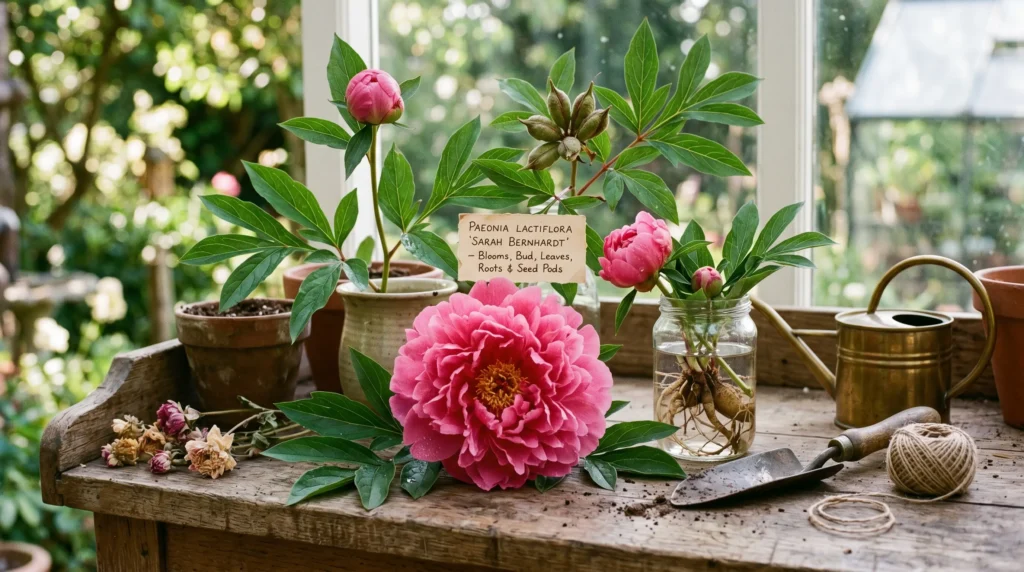
- ‘Sarah Bernhardt’ (Paeonia lactiflora) The most widely grown peony in the UK. Double, apple-blossom pink petals; powerful fragrance. RHS Award of Garden Merit. Performs reliably across all UK regions and is arguably the best all-round cut flower peony available. Widely stocked by Thompson & Morgan, Crocus, and Claire Austin Hardy Plants.
- ‘Duchesse de Nemours’ Fully double white blooms with a cream-tinged centre; powerfully and sweetly scented. RHS AGM. A variety with 150+ years of garden history. Outstanding cut flower with mid-season blooming. One of the best white peonies for UK conditions.
- ‘Bowl of Beauty’ Japanese-form peony — large fuchsia-pink outer petals surround a cream, petal-like centre (petaloids). Flowers reach up to 25cm across. Mid-season, pleasant fragrance, and a reliable performer throughout Britain.
- ‘Felix Crousse’ Rich carmine-red, fully double. A long-established UK favourite that provides bold, saturated colour in a border. Strong stems; reliable annually once established.
- ‘Festiva Maxima’ White with distinctive crimson flecks; fully double. RHS AGM. Early season; among the most fragrant of all peony varieties. A heritage variety (1851) still considered a benchmark performer.
Tree Peonies — Structural and Dramatic
- ‘Renkaku’ (Flight of Cranes) Pure white, semi-double Japanese variety. Spectacular in May. Requires a sheltered position away from early morning sun. A statement plant for a walled garden or sheltered courtyard.
- ‘Souvenir de Maxime Cornu’ Rich golden yellow with red petal edges; fully double. RHS AGM. Fragrant. Best planted against a warm, south-facing wall where it can develop its full potential over many years.
Itoh (Intersectional) Varieties — Modern and Long-Blooming
- ‘Bartzella’ Fully double, lemon-yellow. Widely regarded as the finest Itoh peony in cultivation. Flowers from May into July — the longest season of any peony type. Strong stems make it an exceptional cut flower as well as a garden plant.
- ‘Cora Louise’ White with a distinctive lavender-pink centre; semi-double. Compact, upright habit makes it ideal for smaller UK gardens and containers. An excellent choice for contemporary or minimalist planting schemes.
Patio Varieties — For Containers and Small Spaces
- ‘Starlight’ and patio-designated cultivars Purpose-bred compact peonies for containers and balcony gardens. Strong, upright stems; available from Primrose Hall Peonies (RHS Chelsea Gold Medal winner). Check that any variety bought for a container is labelled “patio” or “compact” by the retailer — standard herbaceous varieties are deep-rooted and unsuitable.
“Tree peonies bloom from late April into May — the same window as ornamental cherry blossoms. For a dramatic early-season display combining both, see our complete UK guide to Prunus trees, covering varieties, care, and companion planting.
Scent Guide
| Fragrance Level | Varieties |
|---|---|
| Highly fragrant | Sarah Bernhardt, Duchesse de Nemours, Festiva Maxima, Bartzella |
| Lightly fragrant | Bowl of Beauty, Felix Crousse |
| Little to no scent | Many single varieties; some tree peonies |
Fragrance is strongest in the cool of the morning and fades significantly by midday.
Extending Your UK Peony Season — Bloom Time Calendar
By choosing a mix of types across early, mid, and late season, it is possible to have peonies in flower from late April through to July.
| Period | Type to Plant | Example Varieties |
|---|---|---|
| Late April – May (early) | Tree peonies | Renkaku, Souvenir de Maxime Cornu |
| May – early June (mid) | Early herbaceous | Festiva Maxima, Felix Crousse |
| June (peak) | Mid herbaceous | Sarah Bernhardt, Duchesse de Nemours, Bowl of Beauty |
| June – July (late) | Itoh / Intersectional | Bartzella, Cora Louise |
How to Plant Peonies in the UK — Step-by-Step Guide
Planting peonies successfully in the UK requires attention to timing, location, soil preparation, and above all planting depth. Getting the depth wrong is the single most common reason peonies fail to flower.
“Heavy clay soil must be improved before planting peonies. Dig in horticultural grit and well-rotted compost — for a full walkthrough on improving UK garden soil, see our guide to growing pond plants, which covers drainage and soil structure in depth.
When to Plant Peonies in the UK
Bare-root peonies: October–November is the ideal planting window, though bare-root plants can be planted through to March if the ground is not frozen.
- Why autumn? The soil retains warmth from summer well into October, giving roots four months to establish before spring growth begins — this is the same principle as planting spring bulbs.
- Bare-root plants are also significantly better value than container-grown and establish just as well when planted at the right time.
“Test your soil pH before planting — the RHS provides a free, plain-English guide on how to test and adjust garden soil pH that works for all UK soil types.”
Container-grown peonies: Can be planted at any time of year, but autumn remains the best window. If you buy a potted peony in spring, plant it immediately, water weekly through the first summer, and do not expect significant flowering in year one — this is entirely normal.
Choosing the Right Spot
A poor location is one of the most common causes of underperforming peonies. The ideal site has:
- Sunlight: At minimum 6 hours of direct sun per day (April–September). More than 3 hours of shade reduces flowering and increases disease risk.
- Shelter: Essential for tree peonies, which can suffer bud blast when early morning sun warms frosted buds rapidly. A west or south-facing position with protection from north and east winds is ideal.
- Air circulation: Allow at least 1m of clear space from neighbouring plants. Good airflow is the most effective prevention against botrytis, the UK’s most common peony disease.
- Drainage: Critical. Standing water around the crown causes crown rot within a single season. If your soil is heavy clay, drainage improvement before planting is non-negotiable.
Soil Preparation
- Ideal soil pH: 6.5–7.0 (neutral). Test with a simple kit from any UK garden centre.
- Heavy clay soil: dig in horticultural grit and well-rotted compost or manure before planting to improve drainage and structure.
- Sandy or free-draining soil: add generous organic matter to improve moisture retention.
- Dig the planting hole at least 30cm deep and 30cm wide; break up the base with a fork to allow roots to penetrate.
The Most Important Rule: Planting Depth
The single most common reason peonies fail to flower in the UK is being planted too deep.
This point cannot be overstated. It is the first diagnostic question for any peony that produces healthy foliage but no flowers.
- Herbaceous and Itoh peonies: The eyes (red buds on the crown) must be no more than 2–5cm below the final soil surface.
- Tree peonies (grafted): Plant the graft union (the knobbly join between stock and scion) 10–15cm below the soil surface to encourage the plant to form its own roots.
- Do not mulch over the crown — even a generous mulch of 5cm effectively pushes the crown deeper and can suppress flowering in otherwise well-established plants.
Step-by-Step Planting Guide
- Prepare the hole: minimum 30cm deep and twice the width of the root ball
- Mix a generous handful of balanced fertiliser (bonemeal or fish, blood and bone) into the soil at the base of the hole
- Position the plant so the eyes sit no more than 2–5cm below final soil level — check by laying a cane across the hole
- Backfill gently, working soil around the roots without compacting
- Firm the soil with your heel (not your hands — palm pressure concentrates force on the crown)
- Water in thoroughly to settle soil and eliminate air pockets
- Do not mulch over the crown in the first winter
- Place a grow-through support ring or peony cage over the planting position in early spring, before stems reach 30cm — this is far easier than attempting to stake tall, brittle stems later
Can I Grow Peonies in Containers?
| Type | Container Suitability | Notes |
|---|---|---|
| Standard herbaceous | Not recommended | Deep-rooted; resents confinement |
| Patio/compact herbaceous | Yes | Minimum 40cm diameter and depth |
| Itoh (intersectional) | Yes | Strong choice for containers |
| Tree peony | Possible but difficult | Large container required; protection from hard frosts essential |
If growing in containers: use free-draining, fertile compost; feed monthly with liquid tomato fertiliser during the growing season; and protect terracotta containers from UK frost (they can crack).
Peony Care — Month-by-Month UK Calendar
Peonies require very little maintenance once established, but a handful of well-timed interventions across the UK growing season make the difference between a plant that flowers reliably for decades and one that struggles.
January–February
- No action required for established plants in the ground; root development continues unseen beneath the surface
- Best time to order:
Order bare-root peonies now from specialist UK growers (Primrose Hall Peonies, Claire Austin, Kelways) for delivery in October. The best named varieties sell out early. - Check container peonies: if forecast temperatures are below -5°C, wrap pots with horticultural fleece. Move terracotta pots to a sheltered position.
March
- Watch for the first red shoots emerging from the soil — these are the eyes breaking dormancy. Do not disturb them.
- Place grow-through support rings or peony cages over plants now, while shoots are still below 30cm. This is the only practical time to stake; once stems are tall, staking causes damage.
- Tree peonies: Inspect emerging buds for frost damage. Blackened material should be removed cleanly with sharp secateurs.
April
- Growth accelerates rapidly; apply a balanced general fertiliser (Growmore at 70g per square metre) around the base, keeping it away from emerging shoots
- Water only if April is genuinely dry — UK spring rainfall is usually sufficient
- Monitor for the first signs of botrytis during cool, wet spells: dark patches on new shoots at soil level are the earliest warning sign (see Section 8)
May–June (The Season)
- Peak bloom time for most UK herbaceous peonies; Itoh varieties extend into July
- Deadheading:
Remove spent flowers promptly. This redirects the plant’s energy away from seed production and back into root and crown development for next year’s flowers. - Cut flower harvesting:
Cut stems at the “marshmallow” stage — see Section 7 for the full guide - Do not remove foliage. After flowering, the leaves continue to photosynthesise and build energy reserves for the following year.
July
- Late-season Itoh varieties still in flower
- Foliage remains green and functional; continue to water first-year plants if the summer is dry (established plants need no supplemental watering under normal UK conditions)
- Do not cut back foliage yet. The leaves are actively feeding next year’s flowers.
August–September
- Foliage begins to yellow and die back naturally — this is correct and expected behaviour
- Continue to leave foliage intact until it has fully died down
- Assess whether any large clumps would benefit from division in October (see Section 6)
October–November
- Cut back herbaceous peonies to ground level once the foliage has fully died down and turned brown
- Remove all plant debris from around the base — do not compost. Botrytis spores overwinter in dead plant material; bin or burn it.
- Plant bare-root peonies — October is the single best month for planting in the UK
- Divide established clumps if needed (Section 6 covers the method)
- Apply a mulch of well-rotted compost to the surrounding soil — but not over the crown
December
- The plant is fully dormant; no action needed
- Use this quiet month to plan new additions, order next year’s plants, and map out a sequence of early, mid, and late varieties to extend the season
Propagating and Dividing Peonies
Peonies can be propagated by division of established clumps, stem cuttings (tree peonies), or seed. Division is the most practical method for home gardeners in the UK and produces flowering plants within 2–3 years.
Should You Divide Your Peony?
Peonies dislike disturbance and should only be divided when there is a good reason to do so:
- The clump has become very large and is crowding neighbouring plants
- You want to create additional plants for other parts of the garden
- The centre of the clump has become woody and unproductive (usually after 15–20 years)
How to Divide Peonies — Step-by-Step (October)
- Lift the entire clump with a garden fork, working outwards from the plant to avoid cutting through roots
- Wash the crown with a hosepipe to expose the structure clearly — you need to see where to cut
- Use a sharp, clean knife to cut the crown into sections, each containing at least 3–5 eyes (red buds)
- Dust all cut surfaces with powdered sulphur or horticultural charcoal to prevent fungal infection
- Replant each division immediately at the correct depth: eyes 2–5cm below the soil surface
- Water in well and mark the positions — divided plants are easy to forget and easy to damage accidentally in early spring
Minimum viable division size:
3 eyes per section. Smaller divisions are possible but take longer to establish and may not flower for 3–4 years.
Growing Peonies from Seed
Growing from seed is possible but slow: expect 5–7 years before a seedling flowers. Seeds require a double dormancy period (a warm phase followed by a cold phase) to germinate. This approach is only worthwhile for specialist collectors or breeders developing new varieties. For anyone wanting to enjoy flowers within a few years, purchasing a well-established 2–3 year-old plant from a UK nursery is the practical route.
Peonies as Cut Flowers — The Complete UK Guide
Cut peonies from UK gardens can last 5–10 days in a vase when harvested correctly and given basic care. The single most important variable is cutting at the right stage of bud development.
When to Cut — The “Marshmallow” Stage
The correct harvest stage for cut peonies is the “marshmallow” stage:
- The test: Gently squeeze the bud between finger and thumb. It should feel soft — like a marshmallow — not hard like a marble.
- At this stage, the first petal is just beginning to show colour at the top of the bud.
- Cutting at this stage gives the bud enough stored energy to open fully in a vase while maximising the number of days before the petals drop.
| Bud Stage | Feel | Vase Life | Action |
|---|---|---|---|
| Very tight (marble-hard) | Rock solid | May not open | Too early — wait |
| Marshmallow | Soft, first petal showing | 7–10 days | Cut now |
| Partially open | Loose, petals visible | 3–5 days | Acceptable if needed |
| Fully open | Petals fully unfurled | 1–2 days | For immediate use only |
Best time of day to cut:
Early morning, when air temperatures are cool and stems are fully hydrated. Avoid cutting in midday heat.
How to Cut
- Use sharp, clean secateurs or floristry scissors — blunt cuts crush the vascular tissue in the stem and reduce water uptake
- Cut at a 45° diagonal angle to maximise the surface area available for water absorption
- Leave at least 2–3 leaves on each stem in the garden; the remaining foliage continues to feed the plant
- Take stems of at least 30–40cm for most vase arrangements
Vase Care — 5 Steps to Maximum Life
- Recut stems at a 45° angle as soon as you get indoors; place immediately into a clean vase of cool water
- Remove all leaves that would sit below the waterline — submerged foliage promotes bacterial growth that clogs the stem
- Place the vase in a cool spot, away from direct sunlight, draughts, radiators, and ripening fruit (ethylene gas from fruit accelerates petal drop)
- Change the water every 2–3 days and retrim the stem base each time
- Use flower food if it was provided with cut flowers from a florist — studies consistently show it extends vase life measurably
Expected vase life: 5–7 days with standard care; up to 10+ days for double varieties kept in a cool room.
Storing Cut Peonies for Events — The UK Florist Method
This technique is how UK florists supply peonies for June and July weddings using blooms cut in May:
- Cut at the marshmallow stage (soft bud, first petal just showing)
- Wrap loosely in newspaper, then in a plastic bag or clingfilm
- Store dry — not in water — in a domestic fridge at 1–4°C
- Peonies stored this way can be held for up to 3 weeks
- When ready to use, remove from the fridge, recut the stems at an angle, and give the blooms a long drink in a deep bucket of cool water for 12–24 hours — stems that look limp on removal will recover fully
Buying Cut Peonies in the UK
| Factor | Detail |
|---|---|
| Peak season | May–June; best quality, widest colour range, lowest prices |
| Average cost per stem (2026) | £2–£3; premium varieties higher |
| Best source | Independent florists > online specialist delivery > supermarkets |
| What to look for | Tight marshmallow buds, no brown petal edges, strong upright stems, no yellowing leaves |
| Supermarket availability | M&S, Waitrose, Aldi, Lidl during May–June; quality varies — buy early in the week |
Common Peony Problems — Diagnosis & Treatment (UK Focus)
The most common peony problems in UK gardens are preventable. Most boil down to incorrect planting depth, poor drainage, insufficient light, or inadequate airflow. This section addresses the eight issues UK gardeners encounter most frequently.
Quick Diagnosis Table
| Symptom | Most Likely Cause | Action |
|---|---|---|
| No flowers; healthy green foliage | Planted too deep, too young, or too shaded | Check eye depth; count years since planting; assess light levels |
| Buds turn brown; grey mould at base | Botrytis (peony wilt) | Remove and bin all affected material; improve airflow |
| White powder on upper leaf surfaces | Powdery mildew | Organic fungicide; move to sunnier spot; improve circulation |
| Stems collapse after rain | Insufficient support | Install grow-through rings early in March next year |
| Ants on buds | Sugary nectar foraging | No action needed |
| Entire plant wilts; roots black and slimy | Crown / root rot | Remove plant; improve drainage; do not replant peonies in the same spot for 3 years |
| Buds fold at stem-bud junction | Classic botrytis bud blast | Remove debris; bin, do not compost |
| Yellow leaves before flowering | Root rot or planting depth issue | Check drainage and planting depth |
My Peony Won’t Flower
This is the most commonly searched peony question in the UK. Root causes, in order of likelihood:
- Planted too deep — the eyes are more than 5cm below the soil surface
- Plant is too young — herbaceous peonies take 2–3 years to flower reliably; tree peonies 3–5 years
- Recently divided — division resets the plant; allow 2–3 years for recovery
- Insufficient sunlight — fewer than 6 hours of direct sun per day reduces or eliminates flowering
- Excess nitrogen — high-nitrogen fertiliser drives leafy growth at the expense of flowers; use a balanced feed only
- Late frost damage — buds blackened by an April frost will not recover that season (protect with fleece)
- Overcrowding — competition from nearby tree roots or dense shrubs depletes available nutrients
Check planting depth first. It is the cause in the majority of cases where healthy growth exists but no flowers appear.
Botrytis / Peony Wilt (Grey Mould)
Botrytis is the most serious disease affecting UK peonies, and the UK’s cool, damp spring climate creates ideal conditions for it.
Cause: Fungal disease (Botrytis paeoniae)
Symptoms:
- Dark brown or black patches on new shoots at or near soil level
- Buds turning brown and failing to open — the bud folds at the stem-bud junction
- Grey, fuzzy mould on stems and leaf bases in wet conditions
Treatment:
- Remove and destroy (bin, do not compost) all affected plant material immediately
- Improve air circulation — ensure plants are at least 1m from their neighbours
- Water at soil level only, never on the foliage
- Important UK note: No fungicides are currently approved for home garden use against peony wilt in the UK. Prevention is the only effective approach.
- In autumn, cut all herbaceous stems to ground level and remove every scrap of debris
Prevention is the whole game. Good airflow, dry foliage, correct spacing, and thorough autumn clean-up are what keep botrytis out of UK peony beds.
Powdery Mildew
Cause: Fungal (Erysiphe); more common in shadier positions and during warm, dry periods
Symptoms: White powdery coating on upper leaf surfaces
Treatment: Apply an organic fungicide spray (sulphur-based products are approved for home garden use in the UK); consider moving the plant to a sunnier position at the next available opportunity. Powdery mildew is rarely fatal — it is mainly cosmetic.
Bud Blast (Buds Turning Brown Before Opening)
Botrytis is the most common cause. Additional causes include:
- Late frost damage to developing buds in April (buds blacken uniformly across the plant after a frost event)
- Waterlogged roots from heavy spring rainfall
Diagnostic tip: If the bud specifically folds and collapses at the point where stem meets bud, that is the classic botrytis bud blast pattern.
Ants on Peony Buds
Ants are completely harmless to peonies and require no treatment.
They are attracted by the sugary nectar secreted by peony buds. The widely repeated idea that ants are necessary for peonies to open is a myth — buds open perfectly well without them. Before bringing cut stems indoors, simply shake or gently brush ants off.
Flopping Stems
Cause: Double-flowered herbaceous varieties produce blooms that can weigh several hundred grams each. After UK summer rain saturates the petals, stem collapse is common without support.
Prevention: Place grow-through support rings or peony cages in position in March, before stems reach 30cm in height. Once stems are tall and brittle, staking is almost impossible without causing damage. Next year’s resolution is to stake earlier.
Yellowing Leaves
- Normal if yellowing occurs in July–September after blooming — this is natural senescence as the plant shuts down for winter
- Investigate if yellowing occurs before or during flowering, which may indicate poor drainage (root rot developing) or planting depth issues
Crown and Root Rot
Cause: Waterlogged soil, most commonly on heavy clay soil without adequate drainage improvement at planting time
Symptoms: The entire plant wilts suddenly and collapses; roots are black, slimy, and foul-smelling when dug up
Treatment: There is no effective remedy. Remove the plant and as much surrounding soil as possible. Do not replant peonies in the same location for at least three years — the soilborne pathogens responsible persist in the soil.
Prevention: Improve drainage before planting. It is the only insurance against root rot.
Where to Buy Peonies in the UK — A Buyer’s Guide
Peony plants in the UK are available from specialist nurseries, mainstream online retailers, garden centres, and supermarkets (cut flowers only). Quality and price vary significantly. For named varieties, specialist nurseries offer the best stock.
Specialist UK Peony Nurseries — Highest Quality
| Nursery | Location | Notes |
|---|---|---|
| Primrose Hall Peonies | Bedfordshire | RHS Chelsea Gold Medal 2019; sell mature 5-year-old plants; premium quality and price |
| Claire Austin Hardy Plants | Shropshire | Extensive range including rare species peonies; mail order and open garden days |
| Kelways Nursery | Somerset | One of the UK’s oldest peony nurseries; strong range of heritage varieties |
Specialist nurseries sell named, correctly labelled varieties, often with RHS AGM status confirmed. The additional cost over mainstream retailers reflects plant age, quality, and accuracy of labelling.
Mainstream UK Retailers
- Crocus.co.uk: Large range of named varieties; reliable quality; good bare-root stock available in autumn; helpful growing information on product pages
- Thompson & Morgan: Wide selection; frequent multi-buy offers; reliable dispatch timings
- YouGarden: Budget-friendly options; solid first choice for beginners or those wanting to trial a variety before investing in specialist stock
Garden Centres
RHS Partner Garden Centres reliably stock AGM-labelled plants and generally maintain good quality control. Independent garden centres allow you to inspect plants before buying, which matters — you can check root quality and stem strength directly. Container-grown peonies are most common in garden centres in spring.
Supermarkets (Cut Flowers Only)
Available at Marks & Spencer, Waitrose, Aldi, and Lidl during peak season (May–June). Quality varies. Buy early in the week for the freshest stock. Cost: £3–£8 per bunch.
UK Price Guide — 2026
| Type | Bare Root | Container Grown |
|---|---|---|
| Standard herbaceous | £8–£15 | £12–£25 |
| Tree peony | £15–£35 | £25–£60 |
| Itoh intersectional | £25–£50 | £35–£70 |
| Rare / specialist varieties | £30–£80 | £50–£100+ |
Bare-root plants are better value and establish just as well as container-grown when planted in October–November. Container plants offer planting flexibility throughout the year but cost more.
Peony Lookalikes & Year-Round Alternatives
Several UK garden and cut flowers share the full, layered aesthetic of the peony. Planting a combination of these with your peonies makes it possible to maintain a “peony-style” display from February through to October.
| Flower | UK Season | Why It Works | Where to Buy |
|---|---|---|---|
| Double tulips (“peony-flowered”) | March–April | Layered petals; blush and cream tones | Thompson & Morgan, Crocus |
| Ranunculus | March–May | Tissue-paper layers; similar lush fullness | Florists, Waitrose |
| English shrub roses | June–September | Blooms all summer; similar romantic form | David Austin Roses |
| Dinner-plate dahlias | August–October | Similar scale and drama | YouGarden, local nurseries |
| Camellia | January–March | Pre-season peony aesthetic; evergreen shrub | Most garden centres |
| Lisianthus | June–September | Ruffled, layered; excellent cut flower | Specialist florists |
Plant a combination of these alongside your peonies for a season that begins in February (camellia) and runs through to first frost (dahlia) — with peonies providing the centrepiece in May and June.
Creative Uses for Peonies Beyond the Garden
Peonies at UK Weddings
Pink peonies are the most popular UK wedding flower after roses, symbolising luck, prosperity, and romance. Key trends for 2025–2026 include peony flower walls, large arch arrangements, and cascading bouquets mixing blush pink with white and coral tones.
Peonies feature prominently at the Chelsea Flower Show and Hampton Court Palace Garden Festival each year, where garden designers use them to set wider UK planting trends.
Practical tip for brides and wedding planners: Book a florist who either grows their own peonies or has a confirmed relationship with a UK seasonal supplier. Imported peonies are available year-round but peak quality — and widest variety choice — comes from UK-grown stems during the natural season (May–June).
Peonies in the Kitchen
- Fresh petals: Edible garnish for cakes, desserts, and salads. The flavour is delicate and floral.
- Peony petal jam: A traditional preparation — petals simmered with sugar and lemon to produce a rose-like preserve
- Petal syrup: Steep fresh petals in hot sugar syrup; use in cocktails, lemonade, or as a cordial in the manner of elderflower
Peonies in Home Fragrance and Wellness
Peony extract and peony fragrance notes appear widely in British-made candles, diffusers, and room sprays. In commercial perfumery, peony is a top-10 floral note in UK bestselling women’s fragrances. Peony root extract is used in skincare products for its purported skin-brightening properties.
Peonies in Interior Design and Craft
- “Peony pink” is a core colour in UK interior design trends running from 2024 to 2026, appearing in soft furnishings, paint ranges, and decorative accessories
- Dried peonies retain their colour well for 12 months or more when air-dried upside down in a cool, dark space
- Fresh and dried peonies are used extensively in UK wedding stationery, textile design (Liberty of London floral prints), and wallpaper collections
Frequently Asked Questions
Q: When do peonies flower in the UK?
Peonies flower between May and July in the UK, depending on the variety. Tree peonies bloom first, typically in April to May. Early and mid-season herbaceous varieties follow in May to June. Late-season Itoh (intersectional) peonies extend the season into July. For most UK gardens, the peak display falls between late May and mid-June.
Q: Why won’t my peony flower?
The most common reason peonies fail to flower in the UK is being planted too deeply. The crown buds (eyes) must be no more than 2–5cm below the soil surface. Other causes include insufficient sunlight (fewer than 6 hours per day), the plant being too young (herbaceous peonies take 2–3 years to settle into flowering), recent division, or late frost damage to emerging buds in April.
Q: How long do peonies last in a vase?
With proper care, cut peonies typically last 5–7 days in a vase, and up to 10 days for double varieties kept in a cool room. Cut at the “marshmallow” stage — when the bud is soft when squeezed and just beginning to show the first petal. Recut stems at an angle on arrival indoors, remove leaves below the waterline, and change the water every 2–3 days.
Q: Should I remove ants from my peonies?
No action is needed. Ants are attracted by the sugary nectar on peony buds and are entirely harmless to the plant. The idea that ants are needed to help peonies open is a myth — buds open without them. Before bringing cut stems indoors, shake or gently brush the ants off.
Q: Can I grow peonies in a pot?
Standard herbaceous peonies are deep-rooted and not well suited to containers. However, compact patio varieties and Itoh (intersectional) peonies can be grown successfully in large containers with a minimum of 40cm diameter and depth. Use free-draining, fertile compost, feed monthly during the growing season with liquid tomato fertiliser, and protect the pot from hard UK frosts in winter.
Q: When is the best time to plant peonies in the UK?
The best time to plant bare-root peonies in the UK is October or November. Planting in autumn gives the roots a full dormant season to establish before spring growth begins, while the soil is still warm enough to encourage early root activity. Container-grown peonies can technically be planted at any time of year, but autumn remains the optimum window.
Q: How long do peonies live?
Peonies are among the longest-lived perennials in any UK garden. With correct siting and minimal disturbance, a peony can flower reliably for 50 years or more. UK and US gardens have documented individual plants exceeding 100 years. This longevity makes peonies among the best long-term investments available to any British gardener.
Q: How much do peony plants cost in the UK?
As of 2026, bare-root herbaceous peonies cost £8–£15 from mainstream UK retailers and up to £30 from specialist nurseries. Tree peonies range from £15 to £60 and above. Itoh intersectional peonies — the newest and most versatile type — cost £25–£70. Cut stems from UK florists average £2–£3 each during peak season (May–June), rising for premium named varieties.
Q: What is the difference between herbaceous and tree peonies?
Herbaceous peonies die back to ground level each winter and re-emerge as shoots from the soil each spring. Tree peonies retain a permanent woody framework above ground and should never be cut back. Herbaceous peonies are the most common type in UK gardens; tree peonies bloom earlier (April–May), grow taller (1–2m), and suit sheltered positions near walls or fences.
Q: What is a “marshmallow stage” peony?
The marshmallow stage is the ideal harvest point for cut peonies. The bud should feel soft when gently squeezed between finger and thumb — like pressing a marshmallow — and the first petal should be just beginning to show colour at the tip. Buds cut at this stage have enough stored energy to open fully in a vase while giving the maximum number of days before petal drop.
Conclusion: Key Takeaways for UK Peony Growers
Peonies reward patience. The first year is about establishment, the second about development, and the third — if planted correctly — about flowers. Get these fundamentals right and a peony will outperform almost any other border perennial in the UK garden:
- Planting depth is everything. Eyes 2–5cm below the soil surface for herbaceous and Itoh types. This is the single most important variable in whether a peony flowers.
- Choose the right type for your purpose. Herbaceous for traditional borders and cut flowers; tree peonies for structural impact and early season interest; Itoh for small spaces, containers, and an extended July season.
- Sequence your varieties. A combination of early (tree), mid (herbaceous), and late (Itoh) peonies gives blooms from late April to July — a twelve-week display from a single genus.
- Harvest cut flowers at the marshmallow stage. Soft bud, first petal just showing, early morning. That is the formula for a 7–10 day vase life.
- Prevention is the only effective strategy for botrytis. Good airflow, dry foliage, and a thorough autumn clean-up will keep UK peonies healthy.
Now you have everything needed to grow, buy, and enjoy peonies in the UK. Bookmark this guide for year-round reference.
Related Guides
- Best companion plants for peonies in a UK border
- How to create a cottage garden: the complete UK guide
- Top 10 RHS Award of Garden Merit perennials for UK gardens
- How to extend your cut flower garden season

Leave a Reply